The Trump administration cut humanitarian aid to Somalia while continuing to pound it with military airstrikes.
By Jamila Osman ,
July 27, 2026

Displaced people collect water from a well inside a camp for internally displaced persons in the outskirts of Kismayo, Somalia, on April 21, 2026.
Simon Maina / AFP via Getty Images
In a recent video released by the State Department, Secretary of State Marco Rubio declared, “The inspiration of America to the rest of the world has been extraordinary.” The video, which commemorates the 250th anniversary of the U.S. Declaration of Independence, hails the legacy of the framers while a voiceover praises the generations who “dedicated themselves to building a more peaceful and prosperous world.”
Just weeks before the video was released, the U.S. carried out its most intensive recent bombing campaign in Somalia, launching a blitz of airstrikes in a five-day operation in the port city of Kismayo — a contradiction that seems lost on this administration. On July 5, an additional airstrike was carried out in the Juba Valley. AFRICOM, the U.S. military command that oversees security operations across Africa, has released no information about casualties or the identities of those killed, leaving the human toll of the campaign unknown. In 2025, AFRICOM spokesperson Lt. Col. Doug Halleaux confirmed it would no longer release specific details about airstrikes to ensure “operations security.”
The first Trump presidency ended with 219 U.S. airstrikes in Somalia, the highest recorded total across previous administrations. His current administration is already on track to surpass that number at more than 207. Kismayo and the surrounding region are frequent AFRICOM targets. Last year, a series of airstrikes in Jamaame, a neighboring town, killed at least 12 people, including eight children and a pregnant woman, according to an investigation by The Guardian. The bombing was the deadliest U.S. airstrike for civilians in East Africa in recent history.
As the intensity of U.S. operations grows, the conflict has become increasingly opaque, making independent monitoring by journalists and human rights groups nearly impossible. Mohamed Gabobe, a Mogadishu-based journalist who investigated the Jamaame massacre, describes a widening gap between events on the ground and the State Department’s official account. “The narrative has been hijacked,” he told Truthout. The authority to exercise military power confers the authority to shape public record, allowing the U.S. narrative to go “unopposed and unchallenged.” The result is a conflict that persists with little scrutiny or oversight — effectively a shadow war, a concept that can be traced back to the Cold War, when superpowers fought through covert operations and proxy conflicts rather than direct confrontation on the battlefield.
In the decades that followed, the so-called global “war on terror” transformed the Cold War doctrine of a war without fronts into an enduring counterterrorism framework: sustained, low-visibility military engagement with no clear endpoint or objective, transforming conflict from a discrete event into a permanent condition. In an interview with Truthout, Samar Al-Bulushi, a professor of anthropology at University of California, Irvine, described this post-9/11 security landscape as one of both “continuity and change.” The U.S. has long sought to “cultivate partners” by training foreign militaries that could “serve as extensions of U.S. power.” In Somalia, this has allowed the U.S. government to conduct military operations for over two decades without a formal declaration of war.
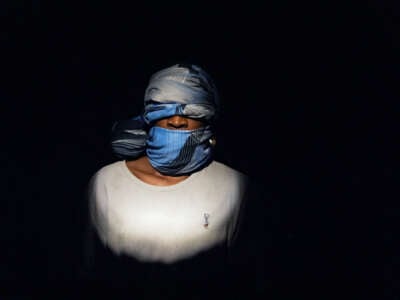
Trump Perpetuates Undeclared War in Somalia With Renewed Airstrikes
The United States has been carrying out operations in Somalia since at least 2002 without a formal war declaration. By Jamila Osman , Truthout March 3, 2025
The Making of a Shadow War
U.S. military involvement in Somalia is not new. Following the collapse of the Somali government in 1991, the United States joined a UN mission to secure the delivery of humanitarian aid amid civil war, drought, and famine. The operation evolved into a nation-building campaign to capture Mohamed Farrah Aidid, a military officer, whose forces played a key role in overthrowing Siad Barre’s government.
AFRICOM, the U.S. military command that oversees security operations across Africa, has released no information about casualties or the identities of those killed, leaving the human toll of the campaign unknown.
The 1993 Battle of Mogadishu, in which hundreds of Somalis and 18 U.S. soldiers were killed, became a turning point in U.S. foreign policy. Images of dead U.S. troops being dragged through the streets prompted demands for immediate withdrawal and played a role in making future large-scale troop deployments and ground invasions more politically costly.
In Somalia, overt military intervention gave way to a more diffuse model of warfare characterized by security partnerships and cooperation agreements with the Somali federal government, and military assistance. The “Mogadishu Effect” did not mark the end of U.S. involvement in Somalia: It transformed it, altering who could see it, contest it, be held accountable for it, and ultimately, who would bear its cost.
Although AFRICOM press releases describe counterterrorism operations as being conducted “in coordination with” the federal government of Somalia, The Guardian’s investigation into U.S. strikes in Jamaame suggests Somalia’s role in this partnership might be little more than a formality. Jethro Norman, a researcher at the Danish Institute for International Studies who has conducted fieldwork in Somalia, said: “Sometimes they’ll call an hour before and say: ‘We’re going to hit this target, please sign this piece of paper.’”
AFRICOM operates within a broader ecosystem of intervention in Somalia that includes the African Union, the United Nations, regional training forces from neighboring countries, European Union training programs, private security contractors, and intelligence agencies. These overlapping institutions form a landscape where one of the state’s most fundamental responsibilities, the provision of security, is outsourced to foreign actors. While this infrastructure is designed, funded, and coordinated by external powers, it relies on Somali and other African troops who are recruited to “die in the name of protecting U.S. interests.”
The Danab Brigade, an elite counterterrorism force established in 2014 through Bancroft Global Development, a private military contractor funded through the U.S. State Department, illustrates the contradiction at the heart of Somalia’s security infrastructure. Its personnel, made up of military officers and soldiers from several countries, were responsible for training and mentoring thousands of Somali army recruits. In 2024, the Somali government and the United States signed a memorandum of understanding to construct up to five military bases for the brigade, a project valued at over $100 million. Danab is considered the first line of defense in the fight against Al-Shabaab and a model for the future of Somalia’s national army, yet remains heavily dependent on foreign funding, training, and equipment. Although AFRICOM frames its mission as building Somali capacity to reduce reliance on external support, foreign military assistance is presented as a pathway to sovereignty even as it increasingly functions as a substitute for it.
The Price of Partnership
At the World Economic Forum meeting in Davos this January, President Donald Trump said Somalia is “not a country … not a nation, got no government, got no police.” A month earlier, as part of a racist rant against Minnesota’s Somali community before he unleashed a devastating flood of immigration police in the state, Trump described Somalia as a place where people just “run around killing each other.” His remarks draw on a familiar but outdated trope disparaging Somalia as a failed state, a term that is overwhelmingly used to describe African and Middle Eastern countries. Like the language of “partnership” and “cooperation,” “failed state” actively conceals an asymmetry of power. It obscures the socio-political and historic origins of state dysfunction, presenting it as an inherent condition, and normalizes continued intervention and diminished sovereignty.
As the intensity of U.S. operations grows, the conflict has become increasingly opaque, making independent monitoring by journalists and human rights groups nearly impossible.
African scholars and political leaders have long warned that previous systems of colonial governance did not end with independence, but were replaced by new forms of economic and political domination often mediated through foreign aid. Somalia is one of the most aid-dependent states in the world. According to the International Monetary Fund, foreign assistance has accounted for roughly 20 to 30 percent of its GDP in the last decade. The United States has historically been one of its largest bilateral donors.
In Neo-Colonialism: The Last Stage of Imperialism, Kwame Nkrumah argued that aid relationships structured by unequal power reproduce dependency and undermine self-sufficiency. Although his analysis centers economic aid, his warning applies equally to the security sphere, particularly in the post-9/11 era where development and counterterrorism agendas have become increasingly intertwined. Over half a century ago, Nkrumah warned that “the only type of aid which the neocolonialist masters consider as safe is ‘military aid.’” Somalia provides a contemporary example to understand that claim.
Recent cuts to U.S. foreign aid programs have disproportionately affected Somalia’s humanitarian sector, worsening food insecurity amid ongoing famine and drought. Numerous health facilities have been forced to close, and between late 2025 and April 2026 in Buur Hakaba, a town north of Mogadishu, the proportion of acutely malnourished children under 5 years old has almost doubled. Funding for military assistance and counterterrorism programs have remained largely intact.
Still, decades of increased counterterrorism operations and deepening security cooperation have failed to deliver on the promise of a self-sufficient security apparatus. The clearest evidence is Washington’s decision to end funding for the African Union Support and Stabilization Mission in Somalia in July, citing Somalia’s inability to sustain its security gains or “take ownership of … its own security functions.”
Al-Bulushi told Truthout the structures that created aid dependency are the same structures that give African states little choice when it comes to becoming partners of the United States in the war on terror: “The sources of funding are narrowing and becoming almost exclusively focused on security.” The issue goes beyond how donor countries shape government priorities, but how they shape civil society and civilian life. As Al-Bulushi observed, even local organizations are being forced to “frame their work through the lens of security” in order to access funding. The central contradiction of aid dependency is that it can reproduce the very conditions it seeks to alleviate. Foreign assistance has undoubtedly prevented suffering and helped avert state collapse in Somalia, but it has also produced a system of governance where dependency is not a temporary feature of the post-conflict state, but its organizing principle.
The Illusion of Sovereignty
According to Gabobe, there is a misconception that the presence of U.S. and foreign forces make life safer for ordinary Somalis. “They support the Somali government, not the Somali people. There’s a difference between the two. Their main job is to keep the Somali government from falling.” For many Somalis living in rural areas, the U.S. presence is not experienced as a provision of safety or the absence of violence, but rather through the constant threat of aerial surveillance and bombardment. “They can see the planes in the skies [and] hear them buzzing. People are afraid to go to sleep because they might not wake up. A missile can hit their home.”
Recent cuts to U.S. foreign aid programs have disproportionately affected Somalia’s humanitarian sector, worsening food insecurity amid ongoing famine and drought.
Al-Bulushi describes the irony at the heart of the matter: “The counterterrorism industry has effectively created the very problem that it claims to address.” To Gabobe, the issue is even more fundamental: “When you outsource security, you outsource sovereignty. I don’t think some American official should get to decide which [Somali] village to bomb today.”
Achille Mbembe, the Cameroonian political theorist, defines sovereignty as the state’s monopoly on life and death — its “power and capacity to dictate who may live and who must die.” In Somalia, that power does not rest in the hands of the Somali state, but with foreign militaries and their security proxies who authorize drone strikes, greenlight ground raids, and sanctify extrajudicial killings with near impunity. In the political lexicon of empire, the distinction between sovereignty and subordination collapses, and “cooperation” becomes a technology of violence — one that does not distinguish between civilians or combatants, between mothers or armed militants.
On July 1, Somalia marked the 66th anniversary of its independence from colonial rule. President Hassan Sheikh Mohamud joined the celebrations in Mogadishu wearing a sash emblazoned with the national coat of arms: two leopards standing on spears. A more fitting emblem might have been the ouroboros, the ancient symbol of a snake consuming its own tail. For decades, Somalia has been mired in a cycle where instability becomes the pretext for foreign intervention, the raison d’être that not only necessitates it, but sustains it. This year’s independence day commemoration took place shortly after the renewed U.S. offensive in June and on the eve of Turkish airstrikes in Somalia’s Lower Shabelle region — a bleak reminder that the country’s security is being shaped by an ever-expanding constellation of foreign actors.
This article is licensed under Creative Commons (CC BY-NC-ND 4.0), and you are free to share and republish under the terms of the license.
In a recent video released by the State Department, Secretary of State Marco Rubio declared, “The inspiration of America to the rest of the world has been extraordinary.” The video, which commemorates the 250th anniversary of the U.S. Declaration of Independence, hails the legacy of the framers while a voiceover praises the generations who “dedicated themselves to building a more peaceful and prosperous world.”
Just weeks before the video was released, the U.S. carried out its most intensive recent bombing campaign in Somalia, launching a blitz of airstrikes in a five-day operation in the port city of Kismayo — a contradiction that seems lost on this administration. On July 5, an additional airstrike was carried out in the Juba Valley. AFRICOM, the U.S. military command that oversees security operations across Africa, has released no information about casualties or the identities of those killed, leaving the human toll of the campaign unknown. In 2025, AFRICOM spokesperson Lt. Col. Doug Halleaux confirmed it would no longer release specific details about airstrikes to ensure “operations security.”
The first Trump presidency ended with 219 U.S. airstrikes in Somalia, the highest recorded total across previous administrations. His current administration is already on track to surpass that number at more than 207. Kismayo and the surrounding region are frequent AFRICOM targets. Last year, a series of airstrikes in Jamaame, a neighboring town, killed at least 12 people, including eight children and a pregnant woman, according to an investigation by The Guardian. The bombing was the deadliest U.S. airstrike for civilians in East Africa in recent history.
As the intensity of U.S. operations grows, the conflict has become increasingly opaque, making independent monitoring by journalists and human rights groups nearly impossible. Mohamed Gabobe, a Mogadishu-based journalist who investigated the Jamaame massacre, describes a widening gap between events on the ground and the State Department’s official account. “The narrative has been hijacked,” he told Truthout. The authority to exercise military power confers the authority to shape public record, allowing the U.S. narrative to go “unopposed and unchallenged.” The result is a conflict that persists with little scrutiny or oversight — effectively a shadow war, a concept that can be traced back to the Cold War, when superpowers fought through covert operations and proxy conflicts rather than direct confrontation on the battlefield.
In the decades that followed, the so-called global “war on terror” transformed the Cold War doctrine of a war without fronts into an enduring counterterrorism framework: sustained, low-visibility military engagement with no clear endpoint or objective, transforming conflict from a discrete event into a permanent condition. In an interview with Truthout, Samar Al-Bulushi, a professor of anthropology at University of California, Irvine, described this post-9/11 security landscape as one of both “continuity and change.” The U.S. has long sought to “cultivate partners” by training foreign militaries that could “serve as extensions of U.S. power.” In Somalia, this has allowed the U.S. government to conduct military operations for over two decades without a formal declaration of war.
Trump Perpetuates Undeclared War in Somalia With Renewed Airstrikes
The United States has been carrying out operations in Somalia since at least 2002 without a formal war declaration. By Jamila Osman , Truthout March 3, 2025
The Making of a Shadow War
U.S. military involvement in Somalia is not new. Following the collapse of the Somali government in 1991, the United States joined a UN mission to secure the delivery of humanitarian aid amid civil war, drought, and famine. The operation evolved into a nation-building campaign to capture Mohamed Farrah Aidid, a military officer, whose forces played a key role in overthrowing Siad Barre’s government.
AFRICOM, the U.S. military command that oversees security operations across Africa, has released no information about casualties or the identities of those killed, leaving the human toll of the campaign unknown.
The 1993 Battle of Mogadishu, in which hundreds of Somalis and 18 U.S. soldiers were killed, became a turning point in U.S. foreign policy. Images of dead U.S. troops being dragged through the streets prompted demands for immediate withdrawal and played a role in making future large-scale troop deployments and ground invasions more politically costly.
In Somalia, overt military intervention gave way to a more diffuse model of warfare characterized by security partnerships and cooperation agreements with the Somali federal government, and military assistance. The “Mogadishu Effect” did not mark the end of U.S. involvement in Somalia: It transformed it, altering who could see it, contest it, be held accountable for it, and ultimately, who would bear its cost.
Although AFRICOM press releases describe counterterrorism operations as being conducted “in coordination with” the federal government of Somalia, The Guardian’s investigation into U.S. strikes in Jamaame suggests Somalia’s role in this partnership might be little more than a formality. Jethro Norman, a researcher at the Danish Institute for International Studies who has conducted fieldwork in Somalia, said: “Sometimes they’ll call an hour before and say: ‘We’re going to hit this target, please sign this piece of paper.’”
AFRICOM operates within a broader ecosystem of intervention in Somalia that includes the African Union, the United Nations, regional training forces from neighboring countries, European Union training programs, private security contractors, and intelligence agencies. These overlapping institutions form a landscape where one of the state’s most fundamental responsibilities, the provision of security, is outsourced to foreign actors. While this infrastructure is designed, funded, and coordinated by external powers, it relies on Somali and other African troops who are recruited to “die in the name of protecting U.S. interests.”
The Danab Brigade, an elite counterterrorism force established in 2014 through Bancroft Global Development, a private military contractor funded through the U.S. State Department, illustrates the contradiction at the heart of Somalia’s security infrastructure. Its personnel, made up of military officers and soldiers from several countries, were responsible for training and mentoring thousands of Somali army recruits. In 2024, the Somali government and the United States signed a memorandum of understanding to construct up to five military bases for the brigade, a project valued at over $100 million. Danab is considered the first line of defense in the fight against Al-Shabaab and a model for the future of Somalia’s national army, yet remains heavily dependent on foreign funding, training, and equipment. Although AFRICOM frames its mission as building Somali capacity to reduce reliance on external support, foreign military assistance is presented as a pathway to sovereignty even as it increasingly functions as a substitute for it.
The Price of Partnership
At the World Economic Forum meeting in Davos this January, President Donald Trump said Somalia is “not a country … not a nation, got no government, got no police.” A month earlier, as part of a racist rant against Minnesota’s Somali community before he unleashed a devastating flood of immigration police in the state, Trump described Somalia as a place where people just “run around killing each other.” His remarks draw on a familiar but outdated trope disparaging Somalia as a failed state, a term that is overwhelmingly used to describe African and Middle Eastern countries. Like the language of “partnership” and “cooperation,” “failed state” actively conceals an asymmetry of power. It obscures the socio-political and historic origins of state dysfunction, presenting it as an inherent condition, and normalizes continued intervention and diminished sovereignty.
As the intensity of U.S. operations grows, the conflict has become increasingly opaque, making independent monitoring by journalists and human rights groups nearly impossible.
African scholars and political leaders have long warned that previous systems of colonial governance did not end with independence, but were replaced by new forms of economic and political domination often mediated through foreign aid. Somalia is one of the most aid-dependent states in the world. According to the International Monetary Fund, foreign assistance has accounted for roughly 20 to 30 percent of its GDP in the last decade. The United States has historically been one of its largest bilateral donors.
In Neo-Colonialism: The Last Stage of Imperialism, Kwame Nkrumah argued that aid relationships structured by unequal power reproduce dependency and undermine self-sufficiency. Although his analysis centers economic aid, his warning applies equally to the security sphere, particularly in the post-9/11 era where development and counterterrorism agendas have become increasingly intertwined. Over half a century ago, Nkrumah warned that “the only type of aid which the neocolonialist masters consider as safe is ‘military aid.’” Somalia provides a contemporary example to understand that claim.
Recent cuts to U.S. foreign aid programs have disproportionately affected Somalia’s humanitarian sector, worsening food insecurity amid ongoing famine and drought. Numerous health facilities have been forced to close, and between late 2025 and April 2026 in Buur Hakaba, a town north of Mogadishu, the proportion of acutely malnourished children under 5 years old has almost doubled. Funding for military assistance and counterterrorism programs have remained largely intact.
Still, decades of increased counterterrorism operations and deepening security cooperation have failed to deliver on the promise of a self-sufficient security apparatus. The clearest evidence is Washington’s decision to end funding for the African Union Support and Stabilization Mission in Somalia in July, citing Somalia’s inability to sustain its security gains or “take ownership of … its own security functions.”
Al-Bulushi told Truthout the structures that created aid dependency are the same structures that give African states little choice when it comes to becoming partners of the United States in the war on terror: “The sources of funding are narrowing and becoming almost exclusively focused on security.” The issue goes beyond how donor countries shape government priorities, but how they shape civil society and civilian life. As Al-Bulushi observed, even local organizations are being forced to “frame their work through the lens of security” in order to access funding. The central contradiction of aid dependency is that it can reproduce the very conditions it seeks to alleviate. Foreign assistance has undoubtedly prevented suffering and helped avert state collapse in Somalia, but it has also produced a system of governance where dependency is not a temporary feature of the post-conflict state, but its organizing principle.
The Illusion of Sovereignty
According to Gabobe, there is a misconception that the presence of U.S. and foreign forces make life safer for ordinary Somalis. “They support the Somali government, not the Somali people. There’s a difference between the two. Their main job is to keep the Somali government from falling.” For many Somalis living in rural areas, the U.S. presence is not experienced as a provision of safety or the absence of violence, but rather through the constant threat of aerial surveillance and bombardment. “They can see the planes in the skies [and] hear them buzzing. People are afraid to go to sleep because they might not wake up. A missile can hit their home.”
Recent cuts to U.S. foreign aid programs have disproportionately affected Somalia’s humanitarian sector, worsening food insecurity amid ongoing famine and drought.
Al-Bulushi describes the irony at the heart of the matter: “The counterterrorism industry has effectively created the very problem that it claims to address.” To Gabobe, the issue is even more fundamental: “When you outsource security, you outsource sovereignty. I don’t think some American official should get to decide which [Somali] village to bomb today.”
Achille Mbembe, the Cameroonian political theorist, defines sovereignty as the state’s monopoly on life and death — its “power and capacity to dictate who may live and who must die.” In Somalia, that power does not rest in the hands of the Somali state, but with foreign militaries and their security proxies who authorize drone strikes, greenlight ground raids, and sanctify extrajudicial killings with near impunity. In the political lexicon of empire, the distinction between sovereignty and subordination collapses, and “cooperation” becomes a technology of violence — one that does not distinguish between civilians or combatants, between mothers or armed militants.
On July 1, Somalia marked the 66th anniversary of its independence from colonial rule. President Hassan Sheikh Mohamud joined the celebrations in Mogadishu wearing a sash emblazoned with the national coat of arms: two leopards standing on spears. A more fitting emblem might have been the ouroboros, the ancient symbol of a snake consuming its own tail. For decades, Somalia has been mired in a cycle where instability becomes the pretext for foreign intervention, the raison d’être that not only necessitates it, but sustains it. This year’s independence day commemoration took place shortly after the renewed U.S. offensive in June and on the eve of Turkish airstrikes in Somalia’s Lower Shabelle region — a bleak reminder that the country’s security is being shaped by an ever-expanding constellation of foreign actors.
This article is licensed under Creative Commons (CC BY-NC-ND 4.0), and you are free to share and republish under the terms of the license.
Jamila Osman
Jamila Osman is a Somali writer from Portland, Oregon.

No comments:
Post a Comment