
The Bogus U.S. Case Against Nicolas Maduro
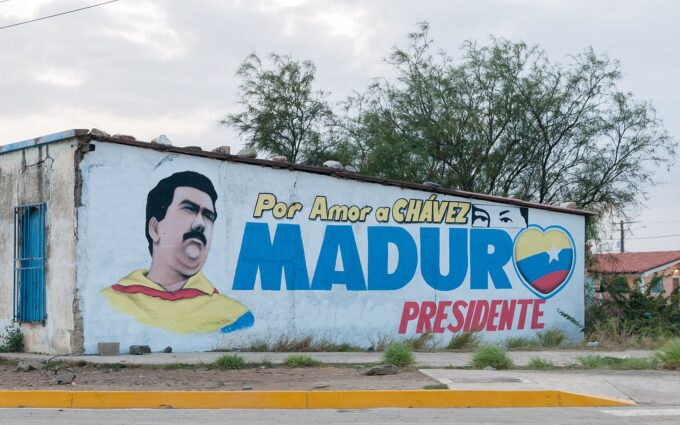
Photograph Source: Wilfredor – CC0
So the U.S. military and CIA kidnapped the duly elected, legitimate president of Venezuela in January, shackled him, brought him to a U.S. prison, and now the white house is desperate to pin crimes on him that fit the unjustifiable punishment it has inflicted. That would be money laundering. And, apparently, the gang in the white house worries, per CBS May 19, about the absence of this charge from the New York indictment of Venezuelan president Nicolas Maduro, because their case is weak, and they know it. In fact, it’s a good guess – mind you, a guess – that it’s been fabricated, spun out of whole cloth to frame Maduro for whatever might stick, because Donald “We’ll Take the Oil” Trump despises Maduro’s political pedigree – socialist – and coveted, before grabbing, his nation’s energy.
I suppose if the money laundering charges don’t work, there are always gun charges, and if those don’t pan out, the Department of Justice (sic) can try a drug indictment. Meanwhile, Washington, having evidently co-opted the acting president in Caracas, Delcy Rodriguez, has finally got its hands back on luckless Venezuelan diplomat Alex Saab, deported over the weekend of May 16 from Venezuela back to the U.S., whence he had previously been released from prison by Joe Biden on December 20, 2023.
Saab’s an ally of Maduro, and according to the AP on May 19, “was charged Monday with bribing top officials to steal hundreds of millions of dollars from lucrative contracts to import food at a time of widespread hardship” in Venezuela. Who caused this hardship, Saab allegedly exploited? The government for which that so-called justice department works, the government whose sanctions starve Venezuelans, the government that had the brazen nerve to blame an admittedly shady character like Saab for the atrocious damage it inflicted on Venezuela. That would be the government of the USA.
So there is “a single count of money laundering tied to a decade-old conspiracy” against Saab. He was previously kidnapped in the first iteration of Trump’s rule, back in 2020, during an airplane refueling stopover in Cape Verde on “a high-level humanitarian mission to Iran.” Those who saw Israel’s hand in this kidnapping of the Venezuelan with supposed Hezbollah ties and in the renewed nabbing of Saab could perhaps be termed paranoid, but be that as it may. Trump, as was seen with Maduro, is perfectly capable of doing horrible things without Israel’s instigation.
Trump’s original Saab caper involved flouting the law of diplomatic immunity by seizing Saab, then on a diplomatic mission, a move that stupidly endangered diplomats everywhere, including American ones. As I wrote in this space on November 3, 2023, “Washington especially loathes Saab, 51, because he was such a SUCCESSFUL Venezuelan diplomat, one who arranged deals for his country with Iran, deals that evaded the stranglehold of U.S. sanctions on both nations.” This was at a time of indisputable hardship for ordinary Venezuelans, due to illegal U.S. sanctions. So Saab, sketchy as he may be, was nonetheless doing this very good, altruistic work, trying to obviate starvation sanctions to aid his financially blockaded country. Saab was likely tortured in Cape Verde, and he wasn’t exactly treated with kid gloves thereafter in the Miami Federal Detention Center, where he rotted away, among other things, vomiting blood, not receiving the life-and-death medical care he desperately required.
One wonders with what threats of lawless violence Washington twisted Delcy Rodriguez’s arm to get its hands on Saab. Anything is possible. After all, look what they did to Maduro – a kidnapping that ranks up there as one of the greatest international crimes of the century. But a white house that has deployed the departments of justice and war like its own private mercenary army has few cards left to play. Gangsterism is its ace, though it may well have maxed out with that: if it crucifies Maduro on phony charges, not only does it lose any credibility a fool might attribute to it, but it also creates a martyr. Maduro was far from a perfect president, but thanks to this revolting kidnapping (and to many of Maduro’s own policies) that is not how he will be remembered. He will be remembered as a president who represented his people and was, in one of the most repellent military operations in recent history, abducted so that Washington could plunder oil.
Maduro and his wife, Cicilia Flores, are in federal custody in the Metropolitan Detention Center in Brooklyn and scheduled to return to court on June 30. The feds have been after him – one could reasonably conclude for his politics – for a long time. The original indictment against him and other Venezuelan officials was filed in the Southern District of New York in 2011 and unsealed in March 2020. Per Wikipedia, that indictment alleged that they “conspired with Colombian guerrilla groups to traffic cocaine into the U.S. in a narcoterrorism conspiracy.” “On January 3, 2026, a superseding indictment was unsealed” after Maduro’s and Flores’ forcible removal to the U.S.
Meanwhile, again per Wikipedia, Argentina had leapt into the act. There, a case against Maduro’s alleged crimes was filed in 2023. An international arrest warrant for Maduro was issued in 2024. In February 2026, an [Argentine] extradition of Maduro was requested after his capture. Argentine judge Sebastian Ramos signed a warrant on Maduro for crimes against humanity. Charges include torture, arbitrary detention and enforced disappearance by the Bolivarian National Intelligence.” In this connection, of course, one must note the politics: Argentina is under the economically incompetent, far-right president Javier Milei, who, it appears, will do almost anything to curry favor with Trump. How and if this political atmosphere influenced the recent extradition request for Maduro in Argentina is an open question, but one worth considering.
On May 20, news via Reuters came that the U.S. is pursuing a second criminal investigation into Maduro. “The second investigation, run out of the U.S. Attorney’s office in Miami, has been ongoing for months,” according to two anonymous sources. Per google, it acts as a “legal fallback to the superseding indictment unsealed last January. An unnamed DOJ official told Reuters that “the Florida probe was active at the time that President Donald Trump ordered the US military raid that captured Maduro.” Reuters credits CBS with being the “first to report on the second investigation fun out of Florida. It is not clear if that probe will lead to additional charges…The Florida investigation could give the Justice Department a fallback option if it faces legal complications in Maduro’s New York case.” On May 18, that same U.S. attorney’s office unsealed money laundering charges against…Alex Saab. The office is also expected on [May 20] to charge Cuban President Raul Castro over the downing of planes piloted by a Cuban exile group in 1996.” Indeed, it promptly did just that, causing RT to wonder, May 21, if Washington had the same scheme in store for Raul Castro as it did for Maduro. So that week in May is officially the “feds get a commie week.” Apparently, it doesn’t matter much which one.
“Interim president Delcy Rodriguez’s action against Saab [turning him over to the U.S.] was one of treachery and should be referred to as such,” wrote Margaret Kimberly in Black Agenda Report, May 20. “The pain of seeing the Bolivarian revolution being picked apart by Donald Trump with the help of some willing participants in Venezuela is devastating to anyone who supported the rights of sovereignty and self-determination for that country and its people.” Kimberly cites the Trump regime’s use of lawfare not only against Saab, Maduro and Flores, but also against Rodriguez, who “is the nominal head of state, but she is following Washington’s orders.”
Years of cruel U.S. sanctions have killed multitudes of Venezuelans by making hungry poor people skip meals, diabetics ration their insulin and cancer patients forgo chemo. Now, under Trump, Washington wants to finish the job. If Rodriguez makes an infernal pact and assists in this endeavor, well, call it what it is: a deadly assault on some of the most vulnerable people in Latin America. You don’t know how Chavista Rodriguez, whose father was tortured to death by the CIA, has been threatened, but you’ve got to assume it was horrifying, not just for her personally but for her country. She has probably avoided a guerrilla war, but in the process, it sure looks like she is making a desert and calling it peace.
The Politics of Purity and the War on Venezuela
May 26, 2026
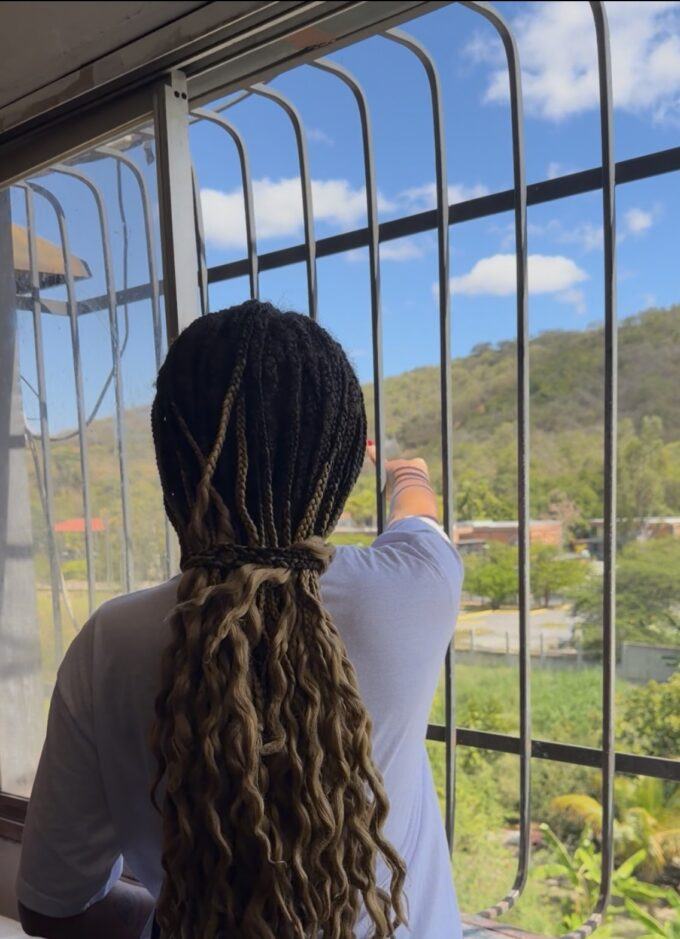
Oriana points through her living room window at the bombing site where President Nicolás Maduro and First Lady Cilia Flores were abducted, January 2026.
Photograph by Celina della Croce.
In mid-January, a young Venezuelan mother named Oriana invited me into her home in Ciudad Tiuna, a government-built housing project with thousands of apartments and roughly 20,000 residents. With her five- and twelve- year-old sons in the other room, she pointed through the window at the charred earth where the United States military had abducted President Nicolás Maduro and First Lady Cilia Flores two weeks earlier. A few buildings down, Oriana’s neighbor showed me the path where a bullet had entered through the bedroom window, ricocheted off the wall, and pierced a dresser, a pair of shoes, and a towel next to her bed. The exterior and interior walls of the building, too, were pierced with bullets. So was the nearby primary school that Oriana’s son attends.
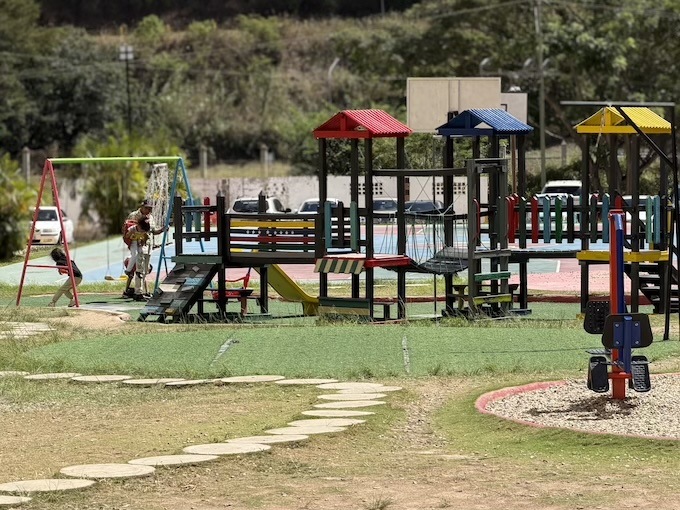
Children in a playground in Ciudad Tiuna, January 2026. Photograph by Celina della Croce.
Since the January 3 assault, rumors and accusations have spread like wildfire across the globe. On the evening of January 3, one of my neighbors in Queens, New York – who knew I was in Venezuela at the time – sent me a screenshot of a Tweet that had been seen by 4.3 million people alleging that “the so called ‘capture’ of Maduro was a negotiated deal between Maduro and US for an agreed exit strategy. … Maduro likely already has purchased property in Dubai to retire to.” Last month, an attendee of an event in Brooklyn, New York – not far from where Maduro and Flores sit in prison – quipped, like many, that the country’s leadership has sold out since January 3 and asked somewhat rhetorically, why Venezuelans weren’t “fighting back”.
When I was invited to Venezuela for an assembly for peace in December, a friend of mine – a photographer – asked if I might have room in my suitcase to bring him a pair of combat pants. He, like many Venezuelans, had begun civic-military training exercises in the build-up to the bombing, in which Trump’s administration killed 150 fisherpeople, seized Venezuelan oil tankers, and repeatedly threatened and carried out acts aggression of against Venezuela. When I arrived in Caracas and caught up with a member of a commune in the neighborhood 23 de Enero (an economist by trade), he had a pistol tucked into his waistband: he was headed straight to his volunteer patrol shift after our conversation, preparing for the possibility of an invasion at any moment.
The idea that Venezuelans have given up or are not “real” revolutionaries is easy to profess from an armchair in the imperial core (as Vijay Prashad, Roxanne Dunbar Ortíz, and others reminded us in “A letter to intellectuals who deride revolutions in the name of purity,” published in the aftermath of the 2019 coup in Bolivia). There is a deep irony that this assertion is made – and made often – in a country that has not only intentionally and strategically “increase[ed] pain and suffering that the Venezuelan people are suffering from,” to use the boastful words of former Secretary of State Mike Pompeo, but that continues to brutally repress the right to democratic expression within its own borders (as is evident from the mass arrests of anti-police and anti-ICE protestors through the years, murders of Alex Pretti and Renée Good in Minneapolis earlier this year, and decades’-long political prisoners such as Mumia Abu-Jamal and Josh Williams). Yet for this group of people, the focal point, seemingly exclusively, is whether or not Venezuela (or Cuba, for that matter) is “doing it right.” Have they sold out? Has enough blood been shed to win the approval of these studied observers? (What happens within the US seems to be of no interest here).
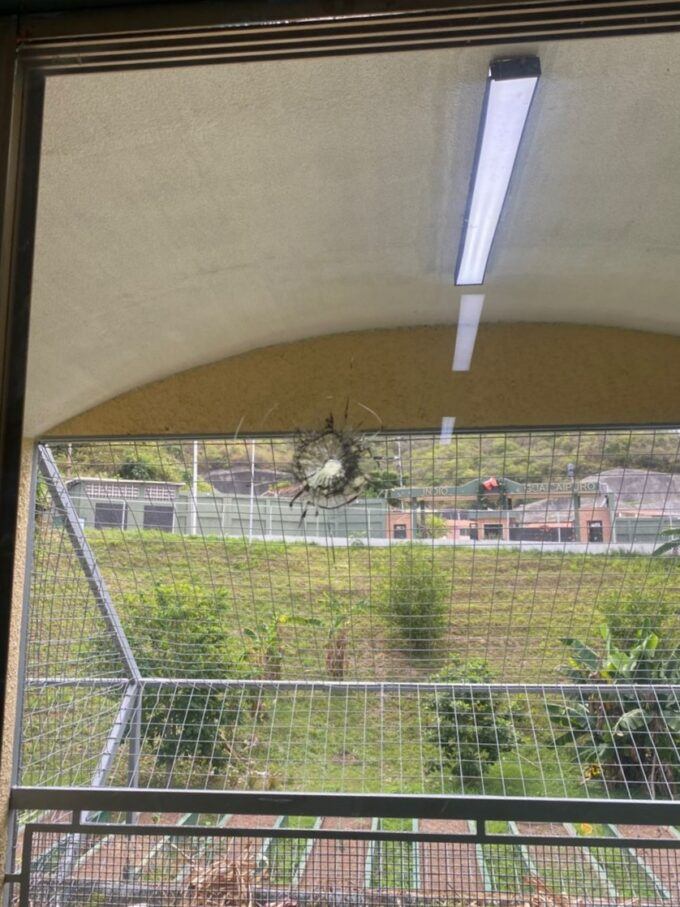
A window of the classroom where Oriana’s five-year-old son studies in Ciudad Tiuna, January 2026. Photograph courtesy of Celina della Croce.
In Venezuela, a country that has lived through terrorism in many forms – from the degradation imposed by the poverty in which 70% of the population lived before the revolution to the economic warfare wrought by the US which caused 40,000 people to die in the first year of Trump’s “maximum pressure campaign” and attempts to assassinate Maduro – many would prefer to die on their feet rather than to live on their knees. Over the years, the United States has spent millions of tax-payer dollars on “pro-democracy” initiatives in Venezuela that seek to enact regime change and has imposed over 1,000 unilateral coercive measures, including one of the harshest sanctions regimes in the world (in fact, the very idea of economic warfare is for the population to overthrow its own leader by, as US President Richard Nixon put it 1970, ‘mak[ing] the economy scream”).
The Trump administration has taken no pains to hide its agenda, declaring, repeatedly, some variation of phrases like “America will not … allow a hostile regime to take our Oil, Land, or any other Assets” (President Donald Trump) and the US is “deadly serious about getting back the oil that was stolen from us” (Secretary of War Pete Hegseth, “our” meaning Venezuela’s oil). Furthermore, Trump has been clear that a decision from the Venezuelan government to refuse to make concessions would undoubtedly lead to mass destruction, stating at his January 3 press conference, for instance, that “we are ready to stage a second and much larger attack if we need to do so… a much bigger wave, actually” and that “All political and military figures in Venezuela should understand what happened to Maduro can happen to them”. (Interestingly, in the press conference there is not a single mention of international law, which the US has violated repeatedly – only of “American justice,” “American property,” “American foreign policy,” “American dominance,” and “American sovereignty.” As Trump said in a telling slip of tongue, “I watched last night one of the most precise, uh, attacks on sovereignty. I mean, it was, uh, an attack f- — for justice.”)
Trump and his predecessor showed how far they are willing to go, and what they are capable of, to further the American agenda and consolidate US hegemony. The livestreamed genocide in Gaza has been one warning to the world; January 3 was another, when the US military shut off power in Caracas, disabled detection and air defense systems, flew over 150 aircraft into the city, bombed at least seven locations, and made off with the president and first lady (herself an important leader in the country since the early years of the revolution) after rehearsing the attack on a full-scale replica of Maduro’s compound built in Kentucky.
As US President Donald Trump boasted later the same day, “[t]his extremely successful operation should serve as warning” and “if you would’ve seen the speed, the violence… it’s just, it was an amazing thing, an amazing job that these people did.” Caracas became an example for the US government to show off its military might; as many survivors of the bombing told me, “we experienced, briefly, what it is like to be Palestinian.”
The discussion of where Venezuela “should” – or can – draw the line is an extremely complex one, and not something that should be taken lightly. January 3, and the genocide of Palestine before it, ushered in a heightened era of hyper-imperialism, an increasingly unrestrained, and illegal, use of US military power as the country’s economic and technological edge lose their edge. Faced with the threat of continued bombings and bloodshed, the Venezuelan people are left with a difficult, if not impossible, set of choices and their own internal contradictions to struggle through.
To fixate on these calculations while ignoring the context that informs them – implying that we, in the West, in fact know what is best and what decisions should be made – is an adaptation of imperialist thinking disguised as left intellect. Or, as Fidel Castro said, “You strangle us for… years and then criticize us for the way we breathe.”
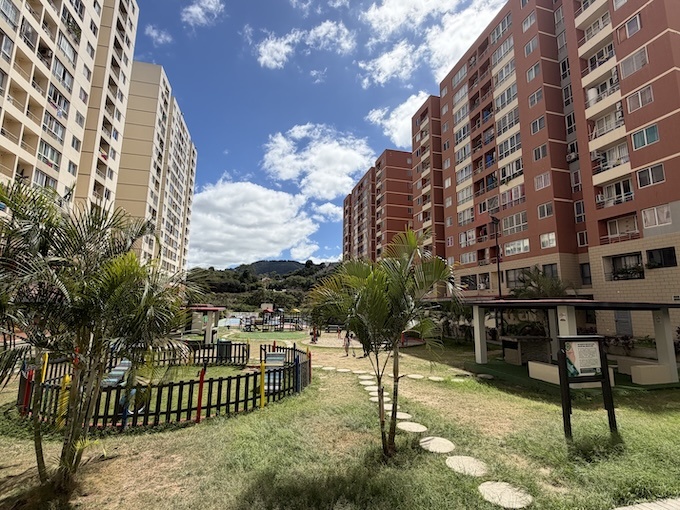
Apartment buildings near a January 3 bombing site in Ciudad Tiuna, a government-funded housing project through Mision Vivienda which has in total constructed over 5 million homes across the country. Photograph by Celina della Croce.
The decision of where to draw the line, what setbacks to accept and at what cost, and how much blood is to be shed, is one that belongs to the Venezuelan people – the ones who would pay the price for a hard stance with their lives. To imply that the Venezuelan people do not have agency in this choice is not only ahistorical but pedantic, colonial, and quite frankly racist. To point to one segment of the population – especially the diaspora in the US – as if they represented the voice of an entire people, is lazy, inaccurate, and unscientific. Those in the West who insist that Venezuela must take a hard stance to be a “real revolutionary” in so doing imply that Venezuelans are not acutely aware of the complex reality in which they find themselves and that they cannot think for themselves or sort through the contradictions and challenges they face, whether external or internal. This assumption is particularly ironic when imposed on a country where the revolution has from the onset used its wealth to fund programs that have not only vastly improved the quality of life of its people but have also bolstered their training, consciousness, and confidence to lead their own revolution, from Mission Robinson (which eradicated illiteracy by 2005 and taught 1.5 million people to read and write) to a variety of programs that have built dozens of universities and developed cadre training and political education.
The task for revolutionaries in the West is not to determine the “right” thing for Venezuela to do, nor is to make ahistorical comparisons that equate the reality in Venezuela with countries like Iran. The task, rather, is to recognize – and learn from – the extraordinary skill, leadership, and fierce dedication of a people who have endured decades, if not centuries, of foreign interference (including the kidnapping of former President Hugo Chávez in 2002) while building a struggle for social advancement and liberation at home. With no such accolades to boast in the US – a country rife with poverty and inequality whose president recently professed that the only obligation of the government is to fund the military – we would do well to learn from the Bolivarian Revolution rather than challenge the competency and ability of the Venezuelan people to determine their own future.

No comments:
Post a Comment