Colombia's 41mn-plus registered voters will go to the polls on May 31 to choose a successor to President Gustavo Petro, who is constitutionally barred from seeking re-election, with surveys pointing to a three-way race unlikely to be resolved before a runoff on June 21.
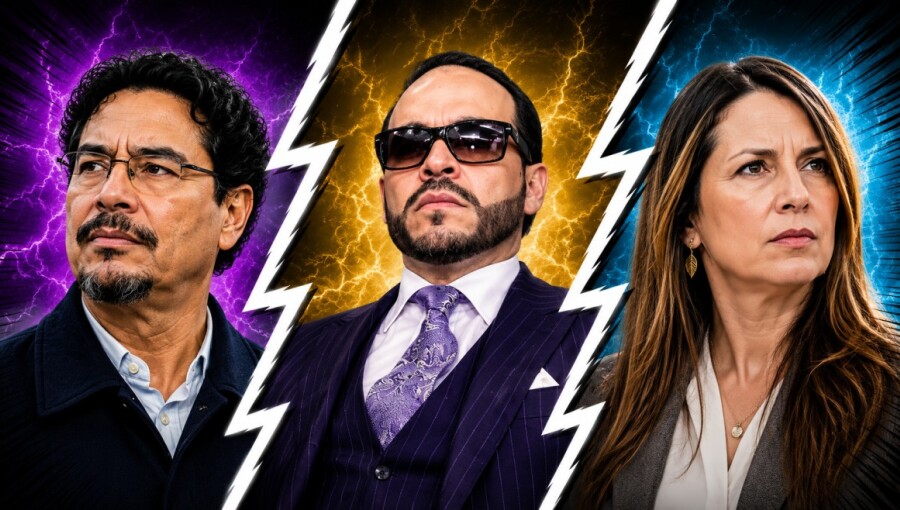
The race has crystallised around three sharply distinct figures, according to an AtlasIntel poll cited by Reuters: Iván Cepeda, a 63-year-old leftist senator backed by Petro's ruling Pacto Histórico coalition, who is polling at roughly 39%; Abelardo de la Espriella, a 47-year-old right-wing millionaire lawyer and political newcomer running on a platform of maximum-force security, at around 37%; and Paloma Valencia, 50, a conservative senator from one of the country's most storied political families, trailing at approximately 14.3%.
Under Colombia's electoral rules, a candidate must clear 50% to win in the first round — a threshold that has been reached only once since the two-round system was introduced in 1991. A runoff is widely expected.
Iván Cepeda: the left's institutional candidate
Cepeda's biography is a compressed version of the Colombian left's own trajectory. He first appeared before television cameras in 1994, standing beside his father's bullet-ridden truck. His father, a communist senator, had been assassinated by paramilitary forces during a period in which more than 5,700 leftist leaders were killed.
The senator, who has lived in exile in several countries including France, Cuba and Eastern European countries under the Soviet bloc, went on to become a central architect of the 2016 peace accord that led to the disarmament of the FARC rebel army and played a pivotal role in the legal proceedings against former president Álvaro Uribe, which briefly resulted in a conviction later overturned on appeal.
His adversaries accuse him of past ties to the FARC and hold him responsible for devising Petro's "total peace" security strategy. This controversial programme, launched in 2022, sought negotiated settlements with multiple armed groups but has since been widely criticised as the number of drone attacks by illegal armed organisations surged from 61 incidents in 2024 to 333 in 2025.
Jenaro Abraham, a political scientist at Gonzaga University, told TRT World that Cepeda's polling position reflects structural consolidation rather than mere momentum. "Following Petro's 2022 victory, the Colombian left is no longer an outsider force — it has institutionalised itself and now commands a relatively stable electoral base," he said, describing the senator as "more methodical and consistent" than his patron, particularly in peace negotiations.
Jairo Libreros, a political analyst who spoke to Bloomberg Línea, noted that Cepeda's moderate tone and institutional image contrast with Petro's more confrontational style, but questioned whether the candidate could connect with undecided voters, a bloc that surveys suggest represents between 23 and 27% of the electorate.
Cepeda typically campaigns in a traditional Caribbean shirt, eschewing a tie, which he has described as a symbol of oligarchy. "I have survived genocide, stigmatisation and relentless persecution. And here I am, still standing," he said during the campaign.
Abelardo de la Espriella: the Tiger in the race
De la Espriella entered the presidential race declaring he had returned to Colombia to prevent the country from being "destroyed" by the left. He had previously been based in Florence, where he lived flamboyantly, running rum and wine businesses and travelling on private jets.
His legal career was built defending prominent Colombians including drug traffickers and football stars. He has since reinvented himself as a populist outsider, branding himself "El Tigre" and drawing explicit comparisons with Donald Trump, Javier Milei of Argentina and El Salvador's Nayib Bukele, leaders he has publicly praised.
On security, he proposes a military alliance with the United States and Israel and the construction of large-scale detention facilities to confront the cartels that have made Colombia the world's leading cocaine producer. He also supports citizens' right to bear arms. "Any criminal who does not surrender will be taken down as the law allows," he told AFP in February.
His campaign has not been without controversy. De la Espriella has made remarks deemed homophobic and sexist and initially called for the Colombian left to be "gutted,” a language he later moderated. He is known for his combative demeanour and frequent profanity.
Libreros told Bloomberg Línea that his strategy mirrors broader international patterns in which outsider right-leaning figures capitalise on voter frustration with established parties. The selection of former finance minister José Manuel Restrepo as running mate was seen as an attempt to reassure investors and soften concerns over policy unpredictability.
Paloma Valencia: Uribe's heir
Paloma Valencia comes from one of the most powerful dynasties in Colombian political history. Her grandfather, Guillermo León Valencia, was a conservative president from 1962 to 1966. She regards former president Uribe, whom she has called her political "father,” as her ideological lodestar and belongs to his Centro Democrático party.
Like Uribe, she opposed the 2016 peace accord with the FARC and favours a militarised approach to internal security. She holds a conservative position on LGBTQ rights and supports fracking. "We are going to put an end to 'total peace' in order to impose total security," she declared at a rally in March.
Abraham cautioned, however, that Valencia faces an "electoral ceiling" given the fragmentation of the right, with De la Espriella also competing for conservative and anti-establishment votes. The contest, he said, represents "not just an electoral dispute but a broader restructuring of Colombia's political spectrum, where Uribismo is no longer hegemonic but one of several factions competing for influence."
Cepeda is currently leading the polls for the first round. However, an AtlasIntel survey conducted between May 18 and 21 complicated the picture for the leftist candidate: should he face De la Espriella in a second round, the poll gave the far-right candidate 50% against Cepeda's 41.3%. Valencia, despite trailing in first-round surveys, was also projected to defeat Cepeda in a hypothetical runoff, by 44.6% to 41.5%.
The wider field — and the security backdrop
Beyond the three frontrunners, the ballot includes Claudia López, the 56-year-old former mayor of Bogotá who secured the centrist Consulta de las Soluciones primary and could draw moderate votes from Cepeda in any runoff, as well as former senator Roy Barreras and Sergio Fajardo, the 68-year-old former mayor of Medellín.
The election takes place against a backdrop of deteriorating security. Colombia's defence ministry recorded a more than fivefold increase in drone attacks by illegal armed groups between 2024 and 2025, and the Electoral Observation Mission estimates that approximately one-third of the country's municipalities face elevated risks from armed organisations on polling day.
According to AP, Elizabeth Dickinson, a senior analyst at the International Crisis Group, warned that a more aggressive military response to the violence could trigger retaliatory attacks from groups that lack conventional fighting capacity, a consideration that will fall squarely in the lap of whoever takes office after June 21.

No comments:
Post a Comment