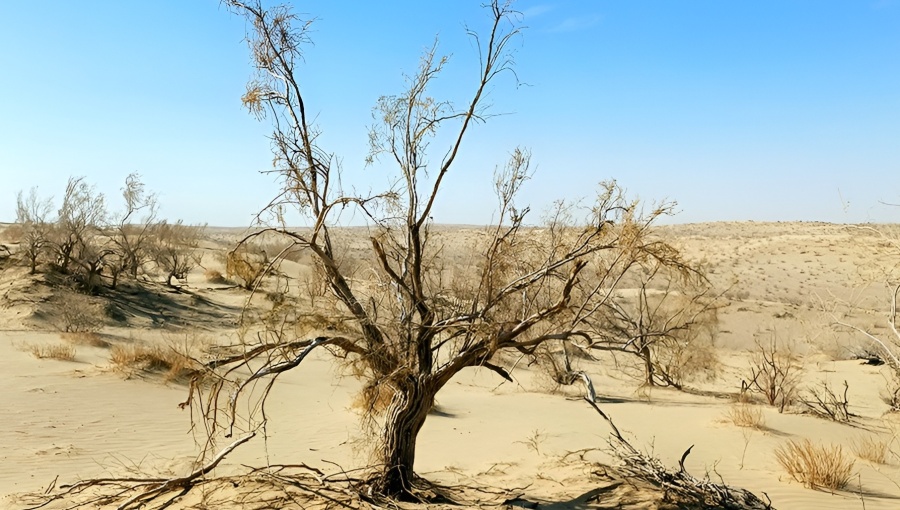
The problem of water scarcity is becoming one of the main challenges for the sustainable development of Central Asia. American experts shared their opinions on the lack of regulation of water resources in Central Asia and how the United States can help states in the region address existing challenges.
Dania Arayssi, who coordinates the Central Asia Center at the New Lines Institute for Strategy and Policy in Washington, DC, noted that water-related issues are one of the most important development challenges facing Central Asian leaders today, and that they influence social stability and sustainable economic development. The New Lines Institute is promoting a concept called the Silk Seven-Plus that advocates for the creation of a Central Asian economic community: cooperation on water-management issues is envisioned as a catalyst for the initiative.
The United States is showing increased interest in developing economic relations with the Central Asian states, as evidenced by the C5+1 summit held in Washington last November. This could pave the way for increased US investment in the industrial, IT and agricultural sectors of Central Asia.
“Large amounts of water will be needed to develop the IT and AI sectors, and to operate data centres and nuclear reactors,” Arayssi said. “It is natural for the United States to want to help find durable solutions on water issues. Establishing a sound and effective water-management framework will unlock Central Asia’s trade potential.”
The framework for an effective regional water-management system already exists, in the form of two institutions – the International Fund for Saving the Aral Sea (IFAS) and the Interstate Coordination Water Management Commission of Central Asia (ICWC). But these bodies currently lack mechanisms to enforce their decisions.
“Until both institutions have effective ways of ensuring the implementation of decisions, they will continue to be ineffective in managing the region’s water resources,” Arayssi said.
Wilder Alejandro Sanchez, president of the consulting firm Second Floor Strategies in Washington, DC, echoed the need for the creation of effective enforcement mechanisms.
“I like the idea of a Central Asian Commission on Water Resources, but I don’t think it will be the key to resolving water issues in Central Asia unless the Commission can ensure that governments carry out its recommendations,” he said.
China has a role in helping Central Asian states establish a stable and effective water management framework, Arayssi pointed out. Currently, China drains a substantial amount of water from transboundary rivers for its own agricultural purposes, aggravating a water-resource challenge in neighbouring Kazakhstan. Astana has sought to engage Chinese officials on the issue, but Beijing, so far, has stonewalled.
“If Beijing is truly a strategic partner for Kazakhstan, Chinese officials should demonstrate more openness in seeking a compromise solution on the water-use issue,” Arayssi said.
It’s not just the lack of effective water resource management mechanisms that exacerbates the challenges in Central Asia. Outdated infrastructure is causing lots of waste. According to some experts, up to 40% of the water used for irrigation in Central Asia is wasted due to antiquated technology and unlined canals.
“The United States and the European Union possess water-saving technologies that can help Central Asian states not only save water but also help prevent the desertification of agricultural lands,” Arayssi noted.
Sanchez added that the elimination of the US Agency for International Development hinders efforts to provide assistance that can address environmentally related issues.
“Many projects in the field of water security are relatively inexpensive, but they can bring significant returns, both for the population of the region and for strengthening relations with Washington,” he said. “Unfortunately, the current US administration does not regard environmental protection, water security in Central Asia, and climate change as priorities.”
When it comes to water resources management in Central Asia, it is necessary to keep in mind the relationship between water and electricity. In this regard, there are several examples of effective water management systems in the United States and Europe that can serve as role models for Central Asia, Arayssi suggested.
One example is the Tennessee Valley Authority (TVA), which was established in the 1930s and covers six US states. For almost a century, TVA has successfully managed electricity generation and water resources in a way that ensures "sustainable business and job growth." There is a similar structure in Europe – the International Commission for the Protection of the Danube River (ICPDR). Both organisations also have strong environmental components.
Sanchez pointed to several other examples of interstate cooperation that Central Asia could emulate. For example, the governments of Moldova and Ukraine are working together to protect the Dniester River Basin, while Peru and Bolivia share Lake Titicaca and are working together to protect it.
International experience shows that effective water resources management is possible only through a combination of long-term planning, sustainable financing and commitment to decisions. External support from the United States, the EU and international financial institutions can be an important catalyst for change, but a sustainable solution to the water problem ultimately depends on the ability of the Central Asian countries themselves to negotiate the joint management of shared resources.
“Solutions cannot be imposed from the outside. It’s up to Central Asian states themselves to do the hard work,” Arayssi said.
Rustem Kozhybayev is a Washington, DC,-based journalist who writes about Central Asian affairs. A Russian-language version of this article was published by the Kazakh news agency Kazinfom. Eurasianet has an operating agreement with the New Lines Institute.
This article was originally published by Eurasianet here.

No comments:
Post a Comment