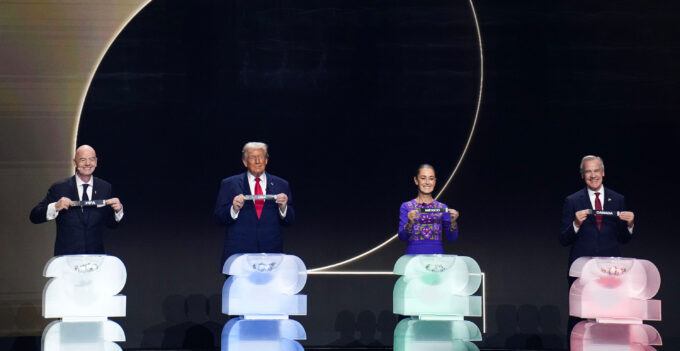
FIFA President Gianni Infantino, U.S. President Donald Trump, Mexico President Claudia Sheinbaum and Canada Prime Minister Mark Carney during the FIFA World Cup 2026 official draw at the John F. Kennedy Center for the Performing Arts in Washington, D.C., December 5, 2025. Photo by Freddie Everett, State Department.
The 2026 FIFA World Cup has begun on American soil, the first time the United States has hosted the tournament in 32 years.
In exchange for the privilege of hosting the Cup, and the enormous revenue it generates, a host nation is generally expected to welcome visitors for the games. Previous World Cup host nations made this the norm by easing their visa policies.
South Africa in 2010 created a dedicated events visa and waived fees for ticketholders. Brazil in 2014 created a visa category tied directly to match tickets and also waived fees. Russia in 2018 abolished visa requirements entirely for Fan ID holders. Most recently, Qatar in 2022 created a universal entry document for all fans and loosened its terms further mid-tournament.
Instead, the United States has adopted the widest nationality-based exclusion policy since the Chinese Exclusion Act.
Nationals from 39 countries currently face U.S. entry restrictions, ranging from partial limitations to outright bans. Among those 39 are four countries whose national teams qualified for the tournament. Haiti and Iran face complete entry bans, while Ivory Coast and Senegal face partial restrictions.
Although players are exempt, fans and families have no way to visit, and local media can’t get visas to cover the games. President Trump has also barred the Iranian national team from sleeping on American soil, requiring the players to spend the night in Tijuana and cross the border only to compete.
One might wonder how these bans are allowed in the first place. The legal vehicle is INA section 212(f), a provision historically invoked with restraint and for targeted purposes.
Before Trump, presidents used it for specific suspensions tied to specific conduct: Haitians intercepted at sea under Reagan, maritime interdiction extended under Bush, senior Haitian government officials (affiliated with the 1994 coup) under Clinton, and persons responsible for grave human rights abuses by the Iranian and Syrian governments under Obama.
Despite leading a country built by immigrants, Trump has used the same authority to ban ordinary people from large portions of the world. This year’s World Cup will reflect that reality in diminished diversity, and the consequences extend beyond mere attendance.
No story captures this more sharply than that of Omar Artan. Named Africa’s best male referee in 2025 and selected by FIFA for the tournament, Artan was set to become the first Somali referee ever to officiate at a World Cup. He cleared the visa process, boarded his flight, and landed in Miami.
But U.S. Customs and Border Protection denied him entry over unspecified “vetting concerns” and FIFA removed him from the tournament. He returned home to a hero’s welcome in Mogadishu, received by thousands at the stadium and by Somalia’s prime minister, who wrote that Artan had “already won the hearts of millions.”
As in the first Trump administration, serious questions remain about whether these bans serve any genuine security purpose. Instead, they appear to function as diplomatic punishment aimed at governments, or people, this administration dislikes.
Preventing fans and players from freely entering the United States, and forcing them to bear the personal cost of policies directed at their governments, produces no discernible security benefit. What it does produce is a steady stream of international criticism.
In its big moment hosting the World Cup, Omar Artan’s story is the image America has projected to the world.
World Cup in the Age of Inequality
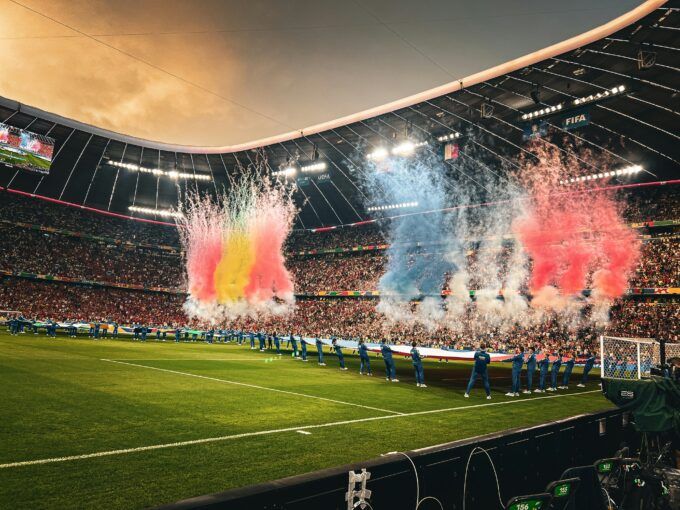
Image by Johannes Hübner.
The FIFA World Cup is one of the few global events whose legitimacy does not derive from the power, wealth, or political influence of its participants, but from the principle of “competitive equality.” Millions around the world follow this tournament because they believe that, at least for ninety minutes on the pitch, differences between nations are not determined by economic size, military capability, or geopolitical weight, but by performance on the football field. It is precisely this perception of equality that has turned the World Cup into the world’s most significant sporting event. Yet, on the eve of the 2026 World Cup, a critical question is emerging for global football: if all teams do not enter the pitch under equal conditions, can the competition still be considered fair?
What is being discussed these days regarding potential restrictions on certain teams in the World Cup may, at first glance, appear to be merely a political or administrative dispute. However, at a deeper level, the issue touches one of the most fundamental principles of global sports governance. The core issue is not that one country has political disagreements with another or that certain players face more restrictive entry or residency conditions. Rather, it is that for the first time, signs are emerging of a new emerging precedent—one in which the host country can, without altering the formal rules of competition, asymmetrically shape the competitive environment for different teams.
In political science and public law, the legitimacy of any competition is grounded in “procedural justice.” People generally accept outcomes only when they are confident that the process has been equal for all participants. This principle applies to elections, courts, tenders, and even sporting competitions. If participants believe that some competitors enjoy advantages to which others do not have access, trust in the outcome gradually erodes—even if the formal rules appear identical for everyone.
Modern professional football is also built on this logic. Contrary to common perception, competitive fairness is not limited to the rules on the pitch. At the professional level, the match begins long before the referee’s whistle. Players’ recovery quality, ease of travel, access to training facilities, psychological stability, scheduling consistency, accommodation conditions, and freedom of movement are all part of a team’s competitive capital. This is why clubs and national teams spend millions optimizing the smallest details of preparation. At such a level of competition, an extra flight, a few hours of delay, an administrative restriction, or a persistent mental burden can influence the outcome as much as a tactical mistake.
From this perspective, the developments related to the 2026 World Cup must be examined. The concern is not merely that some teams may face visa challenges or administrative restrictions; rather, the real concern is that such restrictions could become part of the competitive environment itself. If one team can fully focus on technical preparation, training, and recovery, while another must allocate part of its energy to resolving residency issues, permit renewals, travel restrictions, or re-entry complications into the host country, then the conditions of competition are no longer truly equal. Inequality here is not produced within FIFA’s formal regulations but within the operational environment of the tournament.
This is precisely the point at which the issue transcends political disagreement and becomes a structural challenge for global football. For decades, the host nation has typically been viewed as a facilitator of competition. Its role was to provide infrastructure, ensure security, facilitate team entry, and create conditions in which all participants could compete without external burdens. However, what now appears to be emerging is a paradigmatic shift: the host is no longer merely an organizer of the tournament but is becoming an actor capable of shaping competitive conditions through its sovereign administrative powers.
The real risk lies precisely here. If such a precedent becomes accepted practice, its consequences will extend far beyond the 2026 World Cup. In that case, every future host country could, under the justification of political, security, immigration, or administrative considerations, create differentiated conditions for participating teams. One country might make entry more difficult for certain players. Another might impose movement restrictions on specific teams. A third might use bureaucratic mechanisms to increase the indirect costs of participation for selected competitors. In all these cases, the formal rules of the competition would remain unchanged, yet the principle of competitive equality would gradually erode.
Iran’s case is merely one illustration within a broader trend. Imagine players or members of a national team being required, during the tournament, to deal with time-sensitive residency or administrative constraints. Imagine part of their recovery and rest time being diverted from preparation to managing issues related to their legal status in the host country. Even if such restrictions are not explicitly embedded in tournament regulations, their impact on competitive conditions is undeniable. In such a scenario, teams are no longer competing solely against their opponents; they are simultaneously absorbing costs that others do not face.
What is particularly noteworthy is that this trajectory contradicts the philosophy that global football has promoted for decades. FIFA has consistently described football as a universal language among nations and has emphasized principles such as inclusivity, equality, and non-discrimination. Yet these principles only carry meaning if they are guaranteed in practice. Competitive equality is not merely a promotional slogan; it is the foundation of public trust in tournaments. If this trust is weakened, even the most exciting competitions will lose part of their legitimacy.
Ultimately, the question today is not whether a particular team will face visa issues in the World Cup. The deeper question is whether global football is willing to accept that a host country may impose burdens on some teams that others do not face. If the answer is yes, then what is at stake is not the fate of a single team or country, but the gradual erosion of one of the fundamental principles of international sport.
The World Cup has always symbolized the idea that all teams start from the same point. Some may have better players, more experienced coaches, or greater resources, but the rules of the game remain identical for all. What is at stake today is not the outcome of a single match or the fate of a particular team, but the gradual erosion of this foundational principle. If some teams are required to face obstacles before stepping onto the pitch that others do not, then the match effectively begins before the whistle is blown. In such a scenario, the host is no longer merely an organizer of competition; it becomes an actor influencing the balance of the game itself. And that may be the most dangerous precedent global football has faced in decades.
What Do the World Cup and Iran Deal Have in Common?
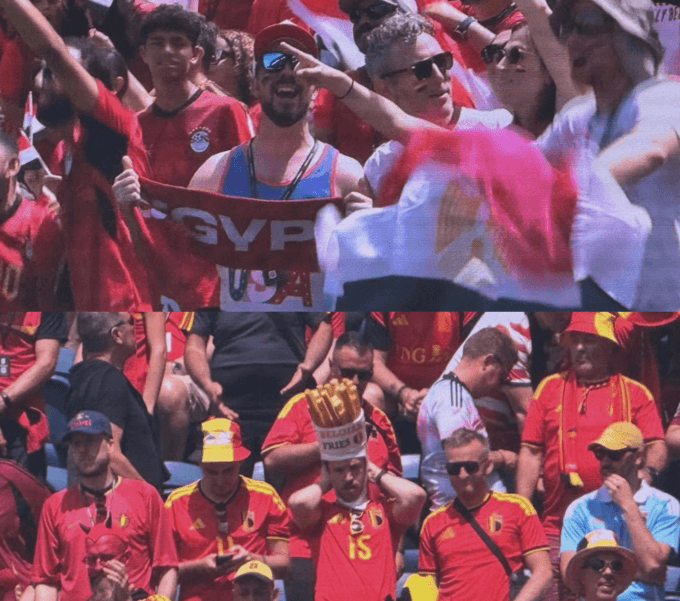
Fans of Egypt and Belgium at the World Cup. (Screengrab.)
What do the World Cup group stage and the Iran War ceasefire deal have in common? Not much at first glance: one is an international sports tournament based on peaceful competition among nations, and the other emerged from a violent cataclysm that has left thousands dead and infrastructure destroyed in a dozen or so nations.
But at second glance, both outcomes have lessons for major powers that are used to domination. The first 2026 World Cup match I watched on TV was Brazil-Morocco, which the powerhouse Brazil should have won, so the 1-1 draw was perceived by both sides as a victory for the top African team.
Draws have now become an early pattern in this tournament group stage, with a lesson attached: A draw for the underdog is a victory over the powerful. I took these photos in Seattle of chagrined Belgium fans—wearing frites (fries) headgear—mourning their 1-1 draw with less-favored Egypt, as the joyous Egypt fans celebrated.
Then tiny Cape Verde drew with mighty Spain, and (shock of shocks) the Democratic Republic of the Congo drew with Ronaldo’s top team Portugal.
This pattern of draws is especially poignant when the heavily favored are the historic colonizers (or other wealthy countries), and the underdogs are the former colonies. Egypt had enormous support in the Seattle crowd, perhaps because the fans understood this asymmetrical power relationship, which makes for good sports drama.
At third glance, the outcome of the Iran War follows a similar pattern. The U.S. and Israel attacked what they perceived as a weakened Iran, with a deeply unpopular regime, a strangled, sanctioned economy, based on vulnerable oil infrastructure, next to wealthier Gulf neighbors, and besieged by enormous U.S. military bases.
In the course of a few weeks, Iran turned most of these deficits into assets, and leveraged the strengths of its enemies into their weaknesses. It leveraged its own geographical position, by closing the Strait of Hormuz shipping chokepoint, and counterattacking against the military bases, and the oil industries of the states that hosted them.
Iran’s propaganda machine leveraged rising gas prices, the growing unpopularity of Trump’s regime, and his party’s vulnerability in the looming midterms. At the same time, by demanding that the Israeli occupation of southern Lebanon be made part of the deal, Tehran managed to drive an unexpected wedge between Trump and Netanyahu. It remains to be seen if this wedge develops into a historic break between the U.S. and its Israeli aircraft carrier, or if Israel (with its Republican and Democratic allies in Congress) sabotages the peace deal to resume the war.
Given the massive destruction and loss of lives in Iran, the Islamabad Memorandum of Understanding is not a victory for either side, even though its terms are more favorable to Iran than Obama’s 2015 nuclear deal. After Trump tore up that deal, Iran pursued uranium enrichment not to build a nuclear bomb, but to build up chips as pressure to lift the sanctions. If the regime can cash in those chips in the months ahead, it can offer economic relief to the Iranian people, and perhaps survive their growing disdain.
So whether it’s underdog teams drawing at the World Cup, or a besieged Middle Eastern power drawing with the most powerful militaries in the region, the system of global apartheid is being challenged at all levels. Just as the British discovered in the 1956 Suez Crisis, all empires eventually fall under their own weight and overextension. When their opponents target this top-heaviness with jujitsu tactics that turn their very strengths into heavy costs, the impunity of empire falls that much sooner.
If the U.S. domination of the Persian Gulf began with the CIA coup that overthrew Iran’s democracy in 1953, perhaps it is ending in Iran in 2026, lessening the pressure on the region and enabling new forms of governance to eventually emerge from the chaos. Tehran could no longer point to foreign enemies to justify its repression, and the Gulf states and Israel could no longer point to Washington to back up their repression. The United States could become a relatively more normal country, tending to its own problems and unresolved histories at home.
Whether drawing at the World Cup, or in a regional war, the trend is toward challenging global inequalities, which means that new teams could rise to the top to savor their place in the sun, and help make the world slightly more peaceful and just.

No comments:
Post a Comment