Showing posts sorted by date for query KURDS. Sort by relevance Show all posts

Sunday, July 19, 2026

Switzerland

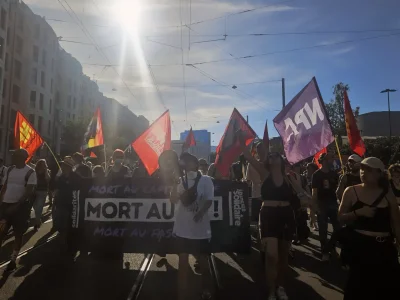
60,000 in Geneva against the G7, imperialism and fascism


Wednesday 15 July 2026, by Juan Tortosa


The mobilization that took place in Geneva, Switzerland at the call of the NOG7 Coalition, against the G7 meeting in Évian-les-Bains, France on 15-17 June 2026 was a huge success, despite the policy of intimidation and restriction of freedoms carried out by the authorities, the police and the media. Is the common thread of the global justice movement finally connected? [1]

The route of the demonstration had been negotiated with the authorities since November. We have come up against an intransigence on the part of the Minister of Police, a member of the Socialist Party, and the authorities of the city of Geneva.

The path requested by our coalition was not accepted. They didn’t want us to get close to the streets where multinationals and luxury boutiques are located. The city centre looked like a barricaded city, most of the windows and some windows were protected by planks. We have witnessed a political and media bludgeon on the part of the authorities and the right against possible violence.

The number of participants in the protest exceeded all the most optimistic forecasts of the NOG7 Coalition. We were counting on a range of 10,000 people; we were about 60,000!

The feminist strike remains the most powerful, socially anchored and most capable of mobilizing. Its cortege was undoubtedly the most numerous. Its demands are radical and anti-capitalist.

Solidarity with the Palestinian people was shown by a large group. The Kurds, in all their diversity, also played a very important role in the demonstration.

The “Living Defends” bloc brought together all the environmental movements. However, we can regret the weak presence of Swiss trade unions, as well as the limited and rather symbolic presence of French trade unions.

Repression and bludgeoning

A few days before the big demonstration, the city of Geneva was under siege: thousands of police and military personnel from other regions of Switzerland had been deployed in the city of Calvin, supported by the French police who could intervene in the canton. According to the newspapers, people were stopped up to five times a day, police vans in large numbers, German-speaking Swiss who did not speak French.

All along the route, grids were provided in “sensitive points” that the demonstrators had to channel. Once the protest ended, in the same park where it had started, the police intervened brutally and surrounded some of the protesters. More than 300 people were trapped until dawn, then about twenty of them were taken to the police station, before being released.

The Geneva and French NOG7 Coalition issued several statements hailing the success of the huge demonstration, but also the “serious security abuses” observed on Sunday. The coalition condemned “the very numerous tear gas shots, especially on the part of the procession reserved for families and children. Similarly, the coalition castigates the scandalous kettling of 549 people implemented for nearly 10 hours.”

The joy of having succeeded!

Despite the repression, we are very satisfied with the massive size, conviviality, diversity and radicalism of the demonstration. This feeling of victory is an excellent springboard for the mobilizations and challenges that await us.

23 June 2026

Footnotes

[1] Photo: joint contingent of SolidaritéS Switzerland and NPA-A France.

Wednesday, July 15, 2026

Iran launches drone, missile attacks on dissident bases in Iraqi Kurdistan


Iran's military forces recently carried out heavy air strikes on bases belonging to Iranian Kurdish militia groups in Iraqi Kurdistan. These unprecedented attacks underscore Tehran’s fear that these militias could become more offensive amid the instability fuelled by the war with Israel and the US.


Issued on: 13/07/2026 - 
By: The FRANCE 24 Observers

An IRGC drone attack on a camp belonging to an Iranian Kurdish dissident group in Iraqi Kurdistan on July 1, 2026. © PDKI_Media

On July 1 and 2, the Islamic Revolutionary Guard Corps (IRGC) hit a Kurdistan Freedom Party (PAK) camp near Erbil in Iraq's Kurdistan region with two ballistic missiles and two drones. Fighters from this Iranian Kurdish militia are established in this region of eastern Iraq, near the border with the Islamic Republic.

Videos posted by locals from a distance during the night showed massive fires.

The Iranian IRGC hit camps belonging to at least two other Iranian dissident Kurdish parties in Iraqi Kurdistan with missiles, rockets and drones within a 48-hour period.
A video posted by local residents in the Erbil region shows the flames rising from the PAK camp on July 1, 2026.

The operations followed at least four reported clashes between Iranian forces and Kurdish dissident armed groups in Mahabad, Saravan and Paveh in Iran’s Kurdish region. Five IRGC members were killed during the fighting on June 29 and 30, according to Tehran, while six fighters from the Democratic Party of Iranian Kurdistan were killed on July 1, and four men from another Kurdish group, PJAK, reportedly died on June 30.


The tensions come against the backdrop of the US-Israel war on Iran, which broke out on February 28. A New York Times article in May 2026 also claimed that some Kurdish groups were expected to begin attacks and advance inside Iran as part of the initial Israeli-US war plan, but that US President Donald Trump changed his mind at the last moment and did not approve the attack. The Kurdish groups, for their part, denied receiving any weapons.

In the initial days of the conflict, Israeli jets bombed border posts between Iran and the Iraqi Kurdistan region and Iranian military bases near the border – areas where Kurdish militia groups are active. Meanwhile, Iran launched dozens of drone, rocket and missile attacks on Iranian Kurdish militia camps in Iraqi Kurdistan.

According to Kurdish parties, these drone and missile attacks left five dead among the militia and one 17-year-old boy, while the Iranian side claims dozens of deaths. The FRANCE 24 Observers team could not independently verify the real number of casualties of these attacks.

Four Iranian Kurdish groups

There are four primary Kurdish dissident groups in Iran, operating as both political and military organisations. Historically, the two main independent Iranian Kurdish dissident parties with military branches have been Komala, founded in the 1960s, and the Democratic Party of Iranian Kurdistan, founded in the 1940s. The other two groups are more recent: the PAK (2006) and the PJAK (2004), affiliated with the Kurdistan Workers’ Party (PKK). The PKK was the primary armed Kurdish movement active in Iraq and Turkey until it announced its dissolution in May 2025. The EU, the US and Israel have designated the PKK as a “terrorist” group for years.

During the war, the attacks remained unilateral, with Iran targeting Komala and the Democratic Party of Iranian Kurdistan.

After the announced US-Iran ceasefire on June 17, some Iranian Kurdish militia groups began attacks on Iranian forces, including assassinations of IRGC members and ambushes. In recent weeks, several clashes have broken out within Iranian Kurdistan between the IRGC and both the PJAK and forces of the Democratic Party of Iranian Kurdistan.

‘The Islamic Republic appears to feel more confident’


Saman Rasoulpour, a London-based journalist and expert on Iran’s Kurdish region, told our team:

“Following the recent war involving the United States, Israel and Iran, the Islamic Republic appears to feel more confident and has increased pressure on both the Iraqi government and the Kurdistan Regional Government to disarm Iranian Kurdish opposition groups. Tehran has also pursued requests against the leaders of these groups through Interpol, while continuing drone and missile attacks on their bases in Iraq.

The attacks have targeted the Democratic Party of Iranian Kurdistan, Komala and PAK (the Kurdistan Freedom Party). PJAK, however, has barely been directly targeted, likely because many of its forces are based in difficult mountainous and border areas, and because a significant part of them are present inside Iranian Kurdistan itself.

The Islamic Republic has also intensified pressure on the Kurdish population through some sections of pro-regime Kurdish tribes, alongside a wider security crackdown on civil activists. On July 1, a 19-year-old man was stabbed to death in Mahabad by a member of one of these groups. These developments have contributed to anti-regime protests.”
Protests were held in Mahabad after the death of Siavosh Alak, a 19-year-old man, reportedly killed by members of local pro-regime groups.
‘Iranian Kurdish military commanders who fought ISIS (Islamic State group) in Syria joined PJAK'

Groups such as PJAK, and to some extent the Democratic Party of Iranian Kurdistan, are using their increased field activity and these clashes to send a political and military message: that they cannot be easily eliminated or forced into submission.

Some analysts believe this may be an attempt to push the Islamic Republic to recognise that a purely military solution is impossible, potentially creating the basis for dialogue or some form of settlement in the future.

Previously, there was a degree of restraint among Kurdish groups to avoid a full-scale war.

These groups now believe they have greater operational independence to respond militarily, because they feel they can justify their actions without being seen merely as instruments of broader US or Israeli interests.

In the case of PJAK, there is also a specific tactical factor. With the ceasefire between the PKK and Turkey, and the shifting dynamics of the Syrian conflict, some experienced Kurdish fighters have refocused their attention on Iran.

A number of Iranian Kurdish military commanders who fought ISIS in Syria have returned to Iranian Kurdistan and joined PJAK, bringing advanced military experience and a record of field cooperation with international forces in the anti-ISIS campaign, including the US.

The wreckage of an Iranian suicide drone after it struck an Iranian Kurdish dissident camp in Iraqi Kurdistan on July 1, 2026.

‘During the war between Israel, the US and Iran, these groups avoided reckless action’

During the US-Israeli war on Iran in April 2026, Trump claimed that the US had transferred weapons to Kurdish groups, and that they were supposed to move these weapons inside Iran, but “the Kurds kept them”.

The Kurdish groups deny these claims. There is also no record, during this period, of military action by Komala or the Democratic Party of Iranian Kurdistan inside Iran.

Rasoulpour said Kurdish groups remain wary because of past experiences – notably in Syria, where “they felt abandoned after helping advance American interests”.

“Iranian Kurdish opposition parties, which currently cooperate with one another through a coalition of Iranian Kurdistan parties, welcome engagement with major powers. But at the same time, they want to be seen as independent actors with their own clear goals and demands, not as tools of foreign powers.

During the recent war involving Israel, the United States and Iran, these groups deliberately avoided reckless action so they would not be blamed for bloodshed or labelled as part of a US-Israel war package.

Their approach to Israel is more cautious than their view of the United States, because they are still uncertain about Israel’s real long-term plans.

There have been reports suggesting the possibility of US-led military operations against Iran with the participation of Kurdish groups. But as far as I can see, Kurdish leaders have shown no unconditional willingness to take part.

Their cooperation is usually conditional and requires clear answers about the future political structure and the specific share Kurds would have in any future Iranian system.

Without such guarantees, they fear entering a campaign that would only increase the political and military costs for their society.”

On July 3, the PJAK said its guerrilla forces were “in a position of legitimate defence, not in a position of attack”, adding that it was “not in favour of expanding a comprehensive war in the region” because it believed the Islamic Republic intended to use the war “as a pretext to legitimise its internal repressions”.


Why Is War the Father and King of All?


 July 15, 2026

War, painting by Evi Sarantea.

For a variety of reasons, humans often resort to killing each other. Instead of resolving their differences peacefully, they arm themselves and kill each other until one of them wins the conflict, that is, he has killed most of his opponents. This deadly tradition survives and thrives to this day – in 2026.

Despite international organizations designed to prevent wars like the United Nations, there are alliances like NATO and the European Union, which still prepare and crown war. NATO is basically an American war alliance against Russia. It is an extension of US hegemony in Europe. Meanwhile, deadly conflicts are wrecking Africa, the Middle East and Europe. The war in Ukraine is to some degree WWIII. It has been funded and armed by NATO. This abhorrent race to war justifies the sixth century BCE philosopher Herakleitos who said, “War is the father and king of all” (Hippolytos, Refutation 9.9.4).

True, it is, but why? Wars have been the greatest forces shaping civilization and history. The question is, why are humans incapable of learning to live with each other without mayhem? Such behavior negates civilization. Therefore, what we call civilization to praise ourselves has become civilized barbarism.

Wars in Hellas / Greece

The Greeks discovered democracy, science and beautiful culture. They tried to avoid war through the Olympics and other Panhellenic games and festivals as well as the Oracle at Delphi, which constantly reminded them of their eusebeia / piety for the gods, the speaking of the same Greek language and their Hellenic identity. But these worthwhile institutions and efforts of reconciliation often failed. The result was a series of dehumanizing and de-Hellenizing civil wars like the Peloponnesian War, 431- 404 BCE. This very destructive mayhem started not because of any aggression on the part of the strongest Hellenic city states: Athens, Sparta, Thebes or Corinth. No. The spark for the war came from Sparta because of its fear of rising Athenian influence and power. And once the deadly conflict started, Persia funded Sparta.

After the Greek victories over the Persian invasions of Hellas in 490 and 480-479 BCE, Athens allied with other city states in Ionia / Asia Minor and the Aegean concerned about more Persian invasions. This leadership of Athens gave it international prestige, influence and money with which Athens rebuilt the Parthenon, which the Persians had burned. Sparta did not appreciate a strong rival in Hellas, hence it started the Peloponnesian War that had catastrophic consequences for all Greeks.

The internal strife in Hellas weakened the Greeks and invited conquerors like the Greek Macedonians from Northern Greece and the Romans from the West. The Roman emperor Constantine embraced Christianity in the fourth century. That caused a political and cultural earthquake that demolished nearly all of Hellenic civilization. Christians and other barbarians undid Hellas, overthrowing its temples, architecture, science, schools, libraries and way of life. The Christianization of Hellas was a global catastrophe that sunk Western Europe into darkness: the burning of libraries, crusades and the triumph of barbarism for several centuries.

A very small number of Greek manuscripts survived the march of Christianity into Hellas. These treasures sparked the Renaissance among the Arabs in the 8th century and among the Western Europeans in the 15th century. But the Greeks themselves, made Christians by force, failed to repel the attacks of the Mongol Turks and, in 1453, they lost their freedom. The Western Christian Europeans did not go to the assistance of the Greeks because of theological divisions. Some 400 years later, in the 1820s, the Greeks fought a heroic struggle and won their freedom.

Wars in Europe

Wars continued in Europe. The Greeks spent most of the 19th and early 20th centuries to recapture their land. World War I and especially WWII almost annihilate Greece. In addition, the British and the Germans sowed the seeds of civil war in Greece, 1943-1949. Communist class struggle and American and British capitalist ideologies fought a ferocious conflict in impoverished Greece.

The United States founded the European militarist alliance of NATO, that also included the perennial enemy of Greece, Turkey. This meant that the hot wars of the first half of the 20th century would continue as Cold War conflicts between NATO and the Soviet Union, both armed with the genocidal and extermination nuclear bombs. Islamic Turkey was the only beneficiary of this meaningless regime of tensions and conflicts in Europe. Turkey continued to play one Western Christian country against another and against the communist Soviet Union.

As for Greece, the game was desperate. German occupation, 1941-1944, almost wiped out the country. The civil war, 1943-1949, became another Peloponnesian War: destructive and fratricidal. And just like the Mongol conquest of 1453, when most Greek scholars escaped to Florence, Padua, Venice and Rome, many Greeks left their country in the 1950s and 1960s for other countries in Europe, Australia and America, especially America.

The misfortunes of modern Greece started in 1831. Local enemies of the first president of modern Greece, Ioannes Kapodistrias, did not like him. He came to Greece in 1828 after a brilliant career in Russia, where he was the Secretary of State, 1816-1822. Kapodistrias was also the preeminent diplomat of Europe. In Greece, he tried to create an independent nation state. However, he set the foundations of the modern Greek national state, using his own wealth and Philhellenic contributions for funding the army, schools, courts, hospitals, post office and the expansion of the national borders. He was just to the landless peasants by giving them land. Nevertheless, on September 27, 1831, his local and foreign enemies assassinated him. Britain might have funded the assassins.

After Kapodistrias, the “great” European powers (Britain, France, Russia) sent kings and monarchical institutions to Greece, which undermined the country’s democracy, facilitated the looting of Greek archaeological treasures and weakened ancient traditions. The outcome, as I said, was NATO that included Turkey.

The US, Turkey and NATO

The US was so incense by the influence of the gigantic communist Soviet Union that overlooked the genocidal legacy and policy of Turkey. Like Britain, the US treated Turkey as a fence for the Soviet Union. This blind bias encouraged Turkey’s 1955 pogrom against 85,000 Greek residents of Constantinople / Istanbul. Turkish state-led mobs, armed with torches, knives and iron rods, smashed everything Greek: churches, cemeteries, schools, hospitals, orphanages and thousands of business and commercial stores.

The same disregard for Greece and admiration for Turkey was the reason the US ordered Greece to remove its army from Cyprus. To facilitate such a cowardly act, the Greek army took over the government from 1967 to 1974. The Greek military gave the green light to Turkey, which, in 1974, invaded Cyprus and occupied about 40 percent of the Greek island.

Meanwhile, NATO and the European Union remain silent about Turkish aggression. Even the Greek Prime Minister Kyriakos Mitsotakis downplays the Turkish war threat. If his country dares to expand sovereignty to sea waters that belong to Greece in the Aegean., Turkey threatens war. Mitsotakis mumbled this apocryphal message in early July 2026 NATO conference in Ankara: “My country is in a very delicate neighborhood, facing geopolitical challenges.” NATO and the EU are well aware of this “delicate” situation developing into a volcano in the Aegean but keep silent. The United Nations also treat Turkey like a “normal” state, more than 50 years after Turkey occupied Greek and EU territory.

The Trump administration also has no trouble with genocidal Turkey. In fact, Trump seems to like Erdogan, who continues threatening Greece. Erdogan reads the lips of Trump. In the Ankara NATO meeting, July 7-8, 2026, Erdogan welcomed his distinguished guests with music from an Ottoman-era orchestra.

Evolution of war

Demetrios Karkamanis, a Greek war expert who spent his professional life in the Swedish armed forces, published a couple of articles about the immorality of NATO. None of its nation state members had the courage to raise the human rights violations the government of Erdogan inflicted on Turkish citizens primarily because of the NATO summit in Ankara, much less the systematic violence Turkey has been inflicting on the Greek population and institutions in occupied northern Cyprus for more than 50 years. NATO in early July 2026 was repeating the Trump obsession of spending about $ 50 billion for additional armaments. One wonders all these new guns are going to fight whom? Certainly the Europeans are not deluded or insane to think of fighting Russia directly, though they have been doing that indirectly through the arming and destruction of Ukraine.

The Greek Swedish military expert talked extensively on what Greece needs to do to face the inevitable military confrontation with NATO-embolden Turkey.

I read Karkamanis carefully. He is a strategic thinker. He knows the weapons manufactured and used today. He agreed it was a good idea that Greece purchased 4 very advanced technology warships from France, the so-called Belharra. But he raised critical questions about warfare and strategy. He said that Greece must become self-reliant in weapons and the manufacture of weapons. Her dangerous neighbor, Turkey, has been investing in its military industry and especially in the development of drones, sea and air drones carrying explosives for the annihilation of the enemies they attack. Would the French warships in the Greek navy be able to withstand the ferocity of the drone attacks, the explosive powers of wave after wave of explosives-armed kamikaze drones? And what if the warship destroyed the cheap drones with expensive bullets or missiles? And then he speculated about the algorithmic warfare of tomorrow. Where would such mechanical killing nightmare push humans? Back to the dark ages and mountain caves?

Extinction is the other side of the high tech warfare coin, the potential outcome of still maintaining thousands of “modernized” nuclear weapons by several nation states: US, Russia, China, Pakistan, India, Britain, France, North Korea and Israel: flying them in military aircraft and filling submarines with missiles loaded with the dreadful weapons of extinction; keeping them in air force bases and elsewhere. But instead of discussing disarmament, showing off nukes is becoming fashionable once again.

Nuke fever is unsettling Britain. The Bulletin of the Atomic Scientists, which for decades is acting like the canary in the mine, is warning that Britain is up to something dangerous: “In the last five years,” the Bulletin says, “Britain has quietly moved to increase the maximum size of its nuclear stockpile and revise its nuclear doctrine, and it is now acquiring an additional nuclear capability. In concert with the United States, the UK government is expanding the deployment of non-strategic (tactical) nuclear weapons in a way that could destabilize the strategic balance in Europe.”

Yes, but why is Britain moving around “tactical” nukes? To scare Iran? Ireland? Russia? the EU? We don’t know the depths of insanity behind this extremely dangerous and provocative “doctrine” and policy of Britain. Of course, Britain works closely with its younger brother, the United States, which she educated so well that the US replaced her as world hegemon.

Epilogue

The dogma of Britain to rearm its nuclear forces confirms that war is not about to take a vacation. In such a new jungle of enemies armed to the teeth with a variety of high tech AI weapons, Hellas / Greece must merge her ancient virtues of daring, courage and passion for freedom with the latest high tech technologies of war. No doubt, fighting Turkey in the Aegean will be complex, demanding weapons, daring and strategy. The geography of the Aegean is a tremendous asset to Hellas. Arm each island to defend and fight any invader. The Greeks defeated much larger armies and navies because they had centuries of experience fighting for their freedom. They had studied their potential enemies and knew their strength and weakness. The Turks have a large army but very little experience in fighting naval battles. The Greeks practically lived in the sea for millennia. Belharra, drones, submarines, missiles, air force, electronic warfare and radars become heroic if they are monitored and guided by heroes.

I am not praising warfare. But we live surrounded by danger and enemies. The Greeks are not aggressive. They prefer peace to war. However, their neighbors, the Turks, want what the Greeks have. That’s why the Greeks must develop a strategy to defeat the Turks decisively.

Turkey does not belong to the West and NATO. It’s a jihadist state that has been oppressing non Turks and non-Muslims for centuries. Why is the US and its Western allies refuse to learn this simple truth? Don’t they learn from history? It would be a good idea to talk to the Armenians and Kurds.
Evaggelos Vallianatos, Ph.D., is a historian and ecological-political theorist. He studied zoology and history, Greek and European, at the University of Illinois and Wisconsin. He did postdoctoral studies in the history of science at Harvard. He worked on Capitol Hill and the US Environmental Protection Agency; taught at several universities, and authored hundreds of articles and several books, including Poison Spring (2014), The Antikythera Mechanism (2021), Freedom (2025) and Earth on Fire: Brewing Plagues and Climate Chaos in Our Backyards (World Scientific, 2026).