Sunday, May 03, 2026

A Country of Strangers: Death, Despair and Indifference in the US

 May 1, 2026

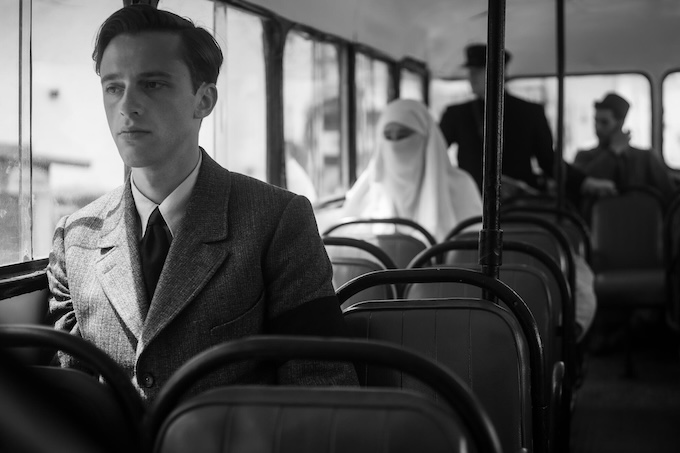
Still from Francois Ozon’s film of Camus’ “The Stranger.” (Music Box Films)

One of the few guarantees in life is loss. The unmerciful realities of temporal existence and entropy make the pain of separation a sole constancy. Over the course of an average life, a person will lose not only one person of emotional importance, but many. A few will take their last breath after an extended and humiliating period of decline, giving the bereaved an opportunity to prepare, which despite what logic would have us assume, doesn’t always make the blow any easier to absorb, while others will exit like captives making a jailbreak or party guests who neglect to say, “goodbye.” The surprise does seem to make the aftermath worse.

Grief is universal. The disorientation, burden, and sadness that it brings transgresses all racial, ethnic, and national differences. To wrap it up in simplest terms, grief is hard. It is especially hard in the United States of America. As if representatives of each sector met in a shadowy hideaway, the most powerful institutions of governance and finance, the most dominant social norms, and the most influential pop culture appear to conspire to coordinate a society that makes grief more confusing and alienating. Everyone from Sarah Winnemucca, a Native American leader in the nineteenth century who authored the first autobiography of an indigenous woman, to patrician man of letters, Gore Vidal, questioned if the US even has a culture, but there is little doubt that the most triumphant strain of the society is its consumer culture. “The chief business of the American people is business,” President Calvin Coolidge famously said. Its people, as he went on to say, are “profoundly concerned with producing, buying, selling, investing and prospering.”

Grief doesn’t sell. More important, the dead don’t make good consumers. A corpse cannot produce, buy, sell, or invest. Their erasure, along with the eradication of anything that might provoke sustained reflection and appreciation in regard to the lives they led – to the past – becomes an important business practice. Life, especially as it becomes inseparable from the market, is for the living.

Of course, the people whose business is business are nothing if not clever, always able to brandish their latest “innovations” and “disruptions.” So, grief doesn’t sell, except when it does. There are countless grief manuals that line the shelves of the remaining bookstores. One forthcoming release promises the bereaved, “40 grief-centered meditational practices.” Grief podcasts can fill the earbuds of listeners with endless chatter, and then, of course, the self-help racket offers high priced seminars to those who miss their deceased loved ones. Meanwhile, psychotherapy has become big business with an entire generation of Z’s operating according to the belief that sorrow, disappointment, worry, sadness, and even the slightest pang of unpleasantness, are not inevitable and unavoidable aspects of the human experience, but problems to troubleshoot with professional intervention. The amateur therapist and the professional podcaster are in agreement that grief should lead to an epiphany, conversion, or transformation. It is a lesson, perhaps even for which the bereaved will eventually feel grateful. But those who live with their grief with honesty realize that grief doesn’t teach as much as it hurts. Sure, it might affirm the power of love or the value of counting blessings, but that is similar to someone saying, “Getting hit on the head with a hammer reminded me of the importance of cognitive health.”

I recently lost two of my closest friends. They were both dedicated to movements that sought to make America a more humanistic, humanitarian, and ultimately, human society. Working for civil rights and social justice consumed them. To mourn my friends demands that I survey the disparity between the country in which they hoped, labored, and fought to live, and the one that they left behind. It is an unsettling and bizarre experience.

Grief is a sustained examination of the value of life. Because the lives of my friends ended, I am dealing with their eternal and irreplaceable value. There is only one of each person. So, when that person dies, we feel what they meant. We feel how much they mattered. The intensity of that feeling is painful. It is also strange in a society that consistently diminishes and devalues, often to the extent of denial, the value of human life.
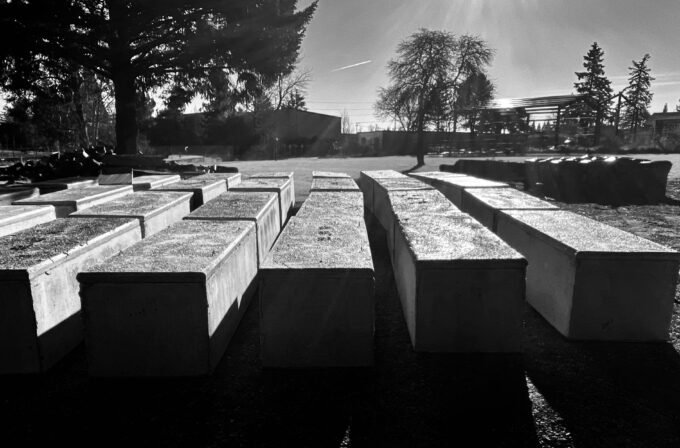
Burial vaults at Mt. View Cemetery in Oregon City, during height of Covid pandemic. Photo: Jeffrey St. Clair.

To grieve people who committed themselves to civil rights and social justice is also to grieve a society currently swinging a wrecking ball at those pillars of a just world. It is to measure the distance between the friends that I admired and a large percentage of the American people who treat civil rights and social justice with indifference or even contempt. Finally, it is to live in a strange inversion of the Albert Camus novella, The Stranger.

In Camus’s first published work of fiction, the protagonist, Meursault, learns of the death of his mother. In French Algeria, he goes through the motions of requesting time off work, attending the funeral arranged by the director of the nursing home where she resided, and seeing to her burial, but he seems to feel nothing. His emotional detachment is not only odd. It is borderline psychopathic. One of the most unforgettable passages involves the memorial service. Meursault obsesses over his body temperature, the physical appearance of his mother’s mourners, and his own fatigue. It disturbs him that a nurse from the nursing home is wearing a bandage over his nose, and he finds the sobbing of one of his mother’s friends annoying. When she stops crying, while thinking of his back pain, he then thinks that the silence irksome: “Now it was all these people not making a sound that was getting on my nerves. Except that every now and then I’d hear a strange noise and I couldn’t figure out what it was. Finally I realized that some of the old people were sucking at the insides of their cheeks and making these weird smacking noises. They were so lost in their thoughts that they weren’t even aware of it.”

Later in the novel, Meursault murders an Arab without a clear motive, provoking the reader to consider the effects of colonialism and Meursault’s own refusal to engage with the stakes of life and death. Apathy is his defining characteristic until his bitter end. When in a jail cell, awaiting his execution, he comes to embrace the “benign indifference of the universe.” Camus said that The Stranger was about “man faced with the nakedness of the absurd.” Meursault fails to see any meaning in the world beyond his immediate physical sensations, whims, and fluctuations of temperament.

The focus of Camus’s intellectual life and work was not domestic. It went beyond France and Algeria to touch upon the most fundamental questions of philosophy, politics, and psychology. Those questions are not unique to the United States, as Camus’s own background demonstrates, but they are, perhaps, sharper in the United States. The blade of absurdity cuts everywhere. In the US, it lacerates.

Imagine wrestling with the grief of losing a loved one in a mass shooting, only to watch your country move on as if it didn’t happen. Even worse, the ruling political party and its tens of millions of voters celebrate and fetishize the lethal weapon that your child, spouse, parent, sibling, or friend’s killer used to commit the crime. Meanwhile, the opposition party never even speaks of the issue.

Imagine wrestling with the grief of losing a loved one to a treatable disease, knowing that your child, spouse, parent, sibling, or friend did not acquire adequate care, because their insurance policy forbid it or they could not otherwise afford it. Then, you watch an insurance industry profit in the billions from denying other people’s loved ones medical care, while the political system has arguments about stripping millions of people of health care coverage.

Imagine wrestling with the grief of losing a loved one in the Covid-19 pandemic, learning that the US did relatively little as compared to the rest of the developed world to prevent Covid deaths, and then listening to the most powerful forces in media and politics discuss how the main lessons of the pandemic are that governing authorities kept schools and business shut too long, and that the vaccine didn’t do all that epidemiologists initially promised.

Imagine caring for a disabled child or close family member, only to have to go through the annual irritation and indignity of having to prove that said relative is sufficiently disabled to qualify for the miserly aid that the state government is able to provide. Meanwhile, perhaps as you help your loved one to bathroom, wipe his chin, or remind him to take his medication, you hear the news that the federal government intends to further cut assistance programs for families caring for disabled children.

Imagine wrestling with the grief of losing a loved one to an act of police brutality, only to see both political parties and innumerable programs on television treat agents of law enforcement as knights on horses galloping into the village to slay dragons and save princesses. If you live in a major city, the police union is the most powerful political force in your community.

It is difficult to contemplate anything more nakedly absurd than the above scenarios, and yet they transpire nearly every day in the land of the free. They don’t happen anywhere else in the developed world. The political systems of other wealthy, democratic societies, and the voters that they represent, long ago determined that mass shootings, medical bankruptcies, and police killings are not tolerable within a civilization. Far from utopian and full of their own respective histories of injustice against indigenous people, countries like Canada and Australia have, at least, met a bare minimum standard of community, safety, and solidarity.

It is hard to grieve in a country where the opposite is true; where the reality is best captured by Asha Bandele, who wrote in her novel, Daughter, “The United States likes to act as if it honors its dead. But if it did, there’d be a whole lot more people alive.”

The United States is a country of strangers.

David Masciotra is the author of six books, including Exurbia Now: The Battleground of American Democracy and I Am Somebody: Why Jesse Jackson Matters. He has written for the Progressive, New Republic, Liberties, and many other publications about politics, literature, and music. His Substack is Absurdia Now.

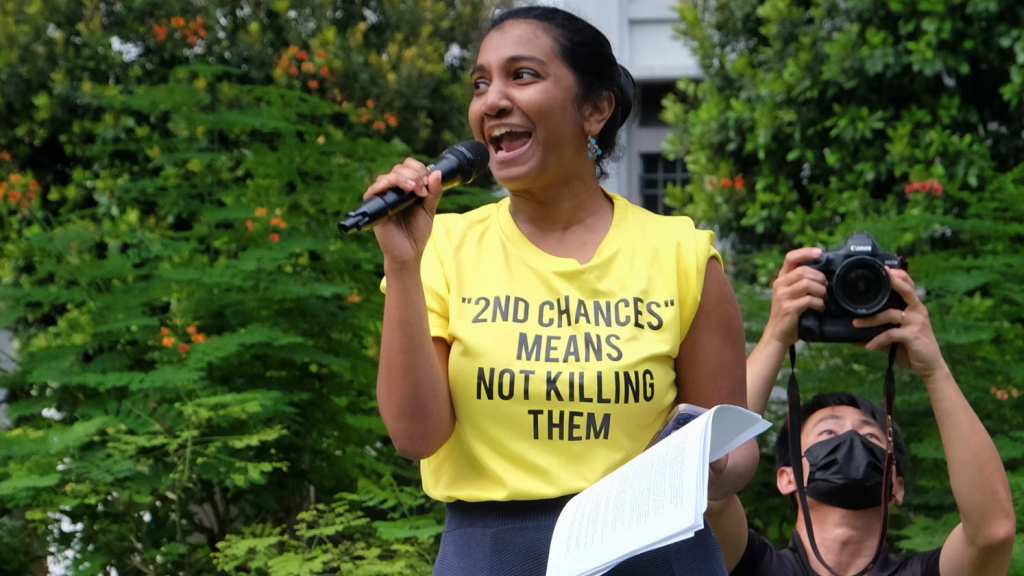
Joint statement: Drop charges against Kokila Annamalai in Singapore


Kokila Annamalai

We, the undersigned organisations, stand in solidarity with Singaporean abolitionist activist Kokila Annamalai Parvathi, criminally charged on 23 April 2026 for defying a correction direction under Singapore’s Protection from Online Falsehoods and Manipulation Act (POFMA).

In October 2024, she spoke up about the cruelties of the death penalty regime and how it impacted Azwan Bihari and his family. The state’s response was not to answer her concerns but to order her — under threat of law — to publicly declare her own views false. She bravely refused.

For this act of conscience, she now faces up to 12 months in prison and a S$20,000 fine. This is the second criminal prosecution under POFMA since the law was enacted in 2019.

POFMA was never about falsehoods. It is a tool used by the government of Singapore to intimidate activists and silence dissent. This latest charge against Kokila simply proves it.

We call upon the government of Singapore to:

  • Drop all charges against Kokila Annamalai Parvathi;
  • End the use of POFMA against activists and dissenters;
  • Repeal POFMA;
  • Impose an immediate moratorium on executions and abolish the death penalty.

This joint statement is endorsed by:

  1. Parti Sosialis Malaysia (PSM)
  2. Socialist Alliance, Australia
  3. Europe solidaire sans frontières (ESSF), France
  4. Workers’s Initiative, Kolkata, India
  5. People’s Liberation Party, Indonesia
  6. Perserikatan Sosialis, Indonesia
  7. Sedane Labour Resource Centre (LIPS), Indonesia
  8. Aliran, Malaysia
  9. Gabungan Marhaen, Malaysia
  10. MANDIRI, Malaysia
  11. North South Initiative (NSI), Malaysia
  12. Pemuda Sosialis PSM, Malaysia
  13. Haqooq Khalq Party, Pakistan
  14. Partido Lakas ng Masa (PLM), Philippines
  15. Socialist Workers Thailand

If your organisation would like to endorse this statement, can fill out the form here: https://forms.gle/LoCPtFXZgfPCcUVr6

Another Attempt to Assassinate Trump Could Put the Left in Danger

IT ALREADY HAS; ANTIFA IS DESIGNATED A TERRORIST ORG


Wednesday 29 April 2026, by Dan La Botz


Cole Tomas Allen, a 31-year-old man from Torrance, California, raced through a Secret Service checkpoint in an attempt to attack President Donald Trump, members of his cabinet, and leaders of Congress, all gathered at the White House Correspondents Dinner on April 26 at the Hilton Hotel in Washington, D.C. Agent succeeded in stopping him before he entered the ballroom where dinner was being served. Allen was armed with a pistol, a shotgun, and knives.

Allen is a college graduate with a B.A. in engineering from the California Institute of Technology and an M.A. in computer science from California State University in Dominguez Hills who worked as a tutor. Max Harris, a high school student who was tutored by Allen, described him as a “completely average guy.” The tutoring organization that he worked for named him “teacher of the month” and commented on what a “gentle” person he was.

In notes that he sent to friends and relatives shortly before his attempt on Trump and others, Allen wrote, “I am a citizen of the United States of America. What my representatives do reflects on me. And I am no longer willing to permit a pedophile, rapist, and traitor to coat my hands with his crimes.” Allen, describing himself as a, “half-black, half-white person,” expressed his opposition to Trump’s immigration policy and foreign policy. Apparently motivated by his own Christian faith, Allen expressed his contempt for the hypocrisy that carried out such policies in the name of Christianity.

Cole seems to have been an enraged liberal rather than a leftist. In the 2024 presidential election, he made a $25 donation to a Democratic Party political action committee supporting Kamala Harris, according to federal campaign finance records. He also belonged to a local activist network called The Wide Awakes, taking its name from an abolitionist group of 1860. Allen is also reported to have attended a No Kings protest against the Trump administration. Still, his assassination attempt could cause problems for socialist and anarchist groups, given that Trump routinely describes his opponents as “lunatic leftists.”

Those of us in the Marxist, democratic socialist left oppose individual acts of violence and terrorism. We work to organize progressive social movements against racism and sexism and to build working class organizations to fight for a better life for all. We know from history and from our own experience, that when we build powerful social movements that threaten the powers-that-be, that we may face violent repression and have to defend ourselves. Or if in an election we win a majority and threaten to take power, we may someday have to fight to defend our victory.

When someone like Allen decides to use violence to kill the country’s ruling group, a handful of people that oppresses and exploits so many, that engages in foreign wars taking the lives of tens of thousands, and through its economic policies threatens our environment and our climate, we understand how he feels. But such individual acts of violence—that almost always hurt innocents—cannot change the system and they threaten to provoke repression against all of us working to construct a better world.

The most famous example in U.S. history is the Red Scare of the 1920s that resulted from anarchists sending 36 bombs to businessmen and politicians in April and May of 1919. In response, Attorney General A. Mitchell Palmer launched a series of raids in1919 and early 1920, arresting thousands of suspected Communists, Socialists, and anarchists. The raids particularly targeted immigrants from Eastern Europe and Italy. Many thousands arrested and hundreds deported, often held without warrants or legal counsel. The anarchist movement was crushed.

We don’t need individual violent attacks; we need to build mass movements from below.

27 April 2026

Solidarity with Ukraine

Against defeatism disguised as radicalism


With the Ukrainian resistance – without ambiguity

Friday 1 May 2026


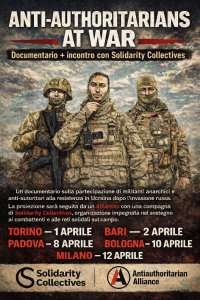
The documentary Anti-authoritarians at war [see below for an interview with the makers of this documentary] was programmed in several cities across Italy in April, as part of a solidarity tour with Solidarity Collectives.

The organisers of these screenings came under pressure and received threats in to make them cancel these events.

This statement was released by the Antiauthoritarian Alliance in response to these attempts at intimidation. (photo: Zenon Sych/Wikimedia Commons)

In recent days we have been subjected to a series of attacks, accusations, attempts at delegitimization, and threats of violence against us and our events that we cannot ignore. In some cases, these have led to previously granted availability to host the initiatives we announced being called into question.

These are not simple political disagreements, but a campaign aimed at undermining the work we are carrying out, isolating those who build concrete solidarity, and discrediting anarchist comrades who are today participating in the Ukrainian resistance.

These attacks do not affect only us. They also target the self-determination of a collective process that brings together different subjectivities, anarchist and non-anarchist alike, united by the will to support those resisting a real act of aggression. Claiming the authority to decide from the outside what is “legitimate” to do, which practices are acceptable and which are not, means arrogating a power we reject.

This is also why we are speaking out: so that those who read us clearly understand the context, and because we do not intend to leave space for distorted narratives or self-serving reconstructions.

There is something profoundly indecent in the writings of those who, while a people is being bombed, occupied, and deported, find the time and tone to pontificate against those who resist. It is not only a political mistake: it is a moral inversion.

To turn concrete solidarity into “complicity with militarism” means having completely lost contact with the material reality of war.

Those who write about the “normalization of militarism” do so from a position of safety, far from the front line, far from the rubble, far from the brutal choice that millions of people have faced: to submit or to resist. Speaking of “refusal of conflict” as a general line, while an invading army advances, is not radical: it is an elegant way of telling others to surrender.

The Ukrainian resistance exists, and it is made up of real people, not abstract categories. Among them are also anarchists who have chosen not to flee, not to submit, not to hand over their cities to an authoritarian and imperial power. Dismissing them as “enlisted” means denying their autonomy and reducing them to extras within an ideologically constructed narrative.

The equivalence between aggressor and aggressed is the most convenient of positions: it allows one not to choose, not to take a stand, not to risk anything. But it is also the most hypocritical. Not all violence is the same, not all wars are symmetrical, and pretending otherwise means obscuring the responsibility of those who invade.

To say that materially supporting the resistance strengthens the “war machine” is a sophism that ignores a basic fact: without means, those who resist are crushed. There is no form of “pure” resistance capable of opposing an army without tools. Demanding it is pure abstract moralism, useful only to those who do not bear the consequences of their words.

The obsessive call for desertion, detached from any concrete analysis, sounds like an escape from reality. Desertion can be a political act in certain contexts; in others, it means leaving the field open to oppression. Turning it into a universal solution is a theoretical shortcut that completely ignores real power relations.

Those who speak of “two barracks of the same prison” construct an imaginary world in which differences disappear and everything is equivalent. But in the real world there are those who invade and those who are invaded, those who bomb and those who defend themselves, those who impose and those who resist. Refusing to see these differences is not clarity: it is political blindness.

The anarchists participating in the Ukrainian resistance have not ceased to be anarchists. They are operating within a real contradiction, trying to defend spaces of existence against an immediate threat. This is not a surrender to the state, but a difficult choice within extreme conditions. Criticizing it from the outside, without taking any risk, is easy—much easier than living it.

So-called antimilitarist “purity,” when it becomes a refusal of any concrete solidarity, turns into its opposite: a sterile position that changes nothing and helps no one. Worse still, it ends up objectively aligning with those who hold more power, because it leaves the weakest without means.

Solidarity is not a slogan. It is a material stance. It means choosing a side when no perfect options exist. And today, choosing means standing with those who resist, with those who do not surrender, with those who try to defend their lives and their freedom even within a terrible context.

Everything else is rhetoric. And rhetoric, when it covers the abandonment of the oppressed, ceases to be harmless. It becomes complicity.

26 March 2026

Source: Anti-authoritarian space.

Documentary: Anti-authoritarian fighters in Ukraine

Documentary film, 1 hr 10 mins, produced by l’Anticapitaliste
In contrast to abstract geopolitical narratives, this documentary gives a voice to Ukrainian anti-authoritarian left-wing activists facing the harsh reality of war. Through their journeys and choices, it explores commitment, international solidarity and the ability of peoples to resist the imperialist invasion on their own.
Interview with Manon Boltansky and Nico Dix.

What is this film about?

This documentary focuses on the Ukrainian resistance. More specifically, it gives a voice to anti-authoritarian left-wing activists (anarchists, libertarians) who, at various stages of the war, chose either to enlist directly in the Ukrainian army or to actively support left-wing activists on the front line. It is a film that explores commitment: the way in which a concrete, extreme situation tests, transforms or strengthens a militant commitment to an emancipated society.

Where did this project come from?

We have been involved in practical solidarity with Ukraine since the start of the large-scale invasion. We travelled there to meet people we had previously known only through online exchanges.

The idea to film arose from the realisation that here, very little is said about Ukraine and that, when it is discussed, it is essentially leaders and geopolitics that dominate the media landscape — Macron, Putin, Trump, Biden, NATO — at the expense of the people and their concrete forms of resistance.

It is essential to hear what the Ukrainian left has to say

We also wanted to address those on the left who deny Ukrainians any agency, sometimes going so far as to refuse dialogue with the Ukrainian left. It is essential to hear what this left has to say; we even have a great deal to learn from our comrades.

How was the film made, and by whom?

This is a deliberately ‘guerrilla’ documentary. We set off with our phones, without a predefined shooting plan or a precise itinerary. The film took shape through the encounters and contacts we made on the ground.

We always began with long discussions before filming, in order to build a relationship of trust, to better frame the interviews and to adopt an activist rather than a journalistic perspective.

We filmed what we could, as best we could, without preconceived ideas, which made the editing process complex. As the amount of footage gathered was substantial, the project will ultimately take the form of a trilogy. This film constitutes the first part; the next two will focus respectively on civil self-organisation to aid displaced populations or those living near the front line, and on political and trade union activists committed to fighting both social breakdown and the Russian invasion.

Who are the people featured in the film?

We meet Sergey, an anarchist activist, co-founder and coordinator of Solidarity Collectives, responsible in particular for logistics and communications. Mobilised a few months ago, he is now serving in the army.

There is also Ilya, a revolutionary socialist activist, who volunteered from the very first days of the invasion as a combat medic in the infantry, and is supported by Solidarity Collectives.

Finally, there is Yuri, an anti-fascist activist from the hardcore punk scene in Kharkiv, who has been active since 2019. After sustaining two serious injuries during assaults, he now serves in the artillery.

Are there any particularly memorable anecdotes from the shoot?

One image left a deep impression on us: as we set off towards Izium, in the east of the country, we saw almost nothing but military vehicles travelling in one direction and hearses in the other.

During a visit to a shelter for displaced people, we met elderly women who had lost everything but were determined to feed us, to share the little they had.

Finally, witnessing the bombing of Kyiv first-hand was a brutal reminder of the daily reality endured by the local population.

Sometimes, in life, you have to make real and precise choices

Were there any scenes that particularly struck you?

The walk through Izium with Ilya, who doesn’t mince his words and explains to us that we don’t really know Ukraine, and so we cannot fully understand what is happening there.
One quote sums up the film’s message particularly well: Ilya explains his commitment by saying that “sometimes, in life, you have to make real and precise choices”. It is, he says, a choice of survival. This statement is essential, for there is a fundamental difference between engaging in theoretical reasoning from France and actually living through an invasion, with its accompanying violence, looting and massacres.

Here, war is thought of in abstract terms; there, it is lived through. We have no lessons to give.

What role can this film play in the current climate?
In a context marked by ‘campism’, we believe it is essential to make the direct voices of Ukrainian left-wing activists accessible. The bourgeoisie, governments and ‘campist’ currents often share the same denial of the existence of peoples and their capacity for action.

We hope this film will help shift the stance of part of the left on the issue of supporting the Ukrainian resistance, and that it will encourage some to engage in concrete forms of solidarity, notably through fundraising for comrades on the ground.

The reactions reveal the glaring absence of Ukrainian voices in activist and media circles

What feedback have you received from people who have seen the film?

Viewers often come out deeply shaken. This highlights the glaring absence of the Ukrainian voice in activist and media circles. Several people have spoken of a realisation of the human dimension of war and the way it crushes lives.

The film has inspired some to take action in solidarity with the Ukrainian people.

How is the film being distributed? How can a screening be organised?

At present, distribution is mainly taking place outside France. The film is being made available to Solidarity Collectives networks and European anarchist circles. Screenings combined with fundraising events have already taken place in Finland, the Netherlands, Poland, Germany and Ukraine.

The film is available to all activist collectives wishing to organise a screening. It has been shown in Denmark, Portugal, Sweden, Spain, Canada as well as Italy.

The film is available to all activist collectives wishing to organise a screening, on the sole condition that a fundraiser in support of Solidarity Collectives is organised.

Contact us if you would like to help distribute it!

15 January 2026

Translated by International Viewpoint from l’Anticapitaliste.