AI Wants Your Land, Water, Power

Photo by İsmail Enes Ayhan
“This is just like a free-for-all. There’s really no oversight. There’s really no regulation.” (Erin Brockovich, Brockovich AI Data Center Reporting)
Erin Brockovich is a well-known American consumer advocate who made her name by exposing evidence that Pacific Gas & Electric poisoned groundwater in Hinkley, California (1996) with toxic hexavalent. Now, she’s investigating AI datacenters.
AI date centers are everywhere, in every state throughout the land. They are starting to quasi-own American citizens via appropriation of resources, both human and natural. This is an invasion of the land, the water, the power, the intellectual resources of America.
Erin Brockovich was recently interviewed about her commitment to investigating AI development by Katie Couric, appearing on YouTube.
Erin: “I’ve never seen in 30 years anything like this… This is every town in every state, and all our resources at once happening.”
The common thread in submissions from individuals in communities across the land: “it feels to them like a takeover.” First, there is a lack of transparency. Local city councils, where “the people” should be represented are hijacked via non-disclosure agreements signed by local officials. This is step number one in gaining approval to build where city regulations and city code control the land. The locals are left out of decisions.
Datacenters Consume Natural Resources
Smaller data centers use about 500,000 gallons of water per day. The average family of four uses ~350 gallons of water per day. Therefore, a newly constructed small data center is equivalent to moving 1,428 new families into a neighborhood.
The bigger data centers, which are in vogue, being built right up next to hospitals, schools, and residences willy nilly use anywhere from 1-to-7 million gallons of water per day. On average, equivalent to moving 15,000-20,000 new families into a neighborhood.
“So, if we build 1,200 data centers… that’s the projection for the total and you just take an average of those between 500,000 to seven million, and the average is 5 million gallons per day, and multiple that by 365 days. You’re looking at numbers of 2.2 to 2.7 trillion gallons of water per year… that are on already drought restricted lands.” (Erin)
(There are already 4, 542 active data centers, 1,500 more are in the planning stage.)
A recent study by The Guardian found that 2/3rds of the planned data centers in the U.S. are in drought-stricken areas.
Datacenters disrupt the regular flow of water. For example, residents sent reports to Erin “of water bills going from $40/month to $250/month… and we’re seeing the exact same thing with electrical.”
According to Katie Couric, Sam Altman, CEO of Open AI, dismisses concerns about AI water use, “fake, completely untrue, totally insane, and having no connection to reality.”
In response, Erin wondered if Altman lives in the areas and experiences what residents report to her. He is implying that the reports by residents are false (16,000 total submissions to Erin by individuals involving various AI issues). “It is insulting.”
Erin asked AI itself in a query to the faceless genius a question of placement of data centers assuming the entire network were to start all over again from scratch, redesigned. AI responded that it would place new data centers based upon one simple rule: “Zero conflict with human resources.” Hmm.
“The people” who submit to Erin from all 50 states are saying the opposite of Sam Altman. And she’s going with the people as a more credible source. After all, they live in the immediate area of data centers. He does not.
Data Center Noise – Wow!
The “hum,” the “buzz” can extend a couple of miles away from a data center. The endless humming is a 24/7 annoyance that’s driving some people nuts. Residents are informing Erin of dizziness, nausea, headachy experiences. This is a common issue tbat’s reported from every one of the facility areas in the country.
Locals Fighting Back
Three hundred (300) municipalities have established moratoriums on data center development, some for one year, some for two years, some six months, some are flat-out bans.
But according to Erin, as usual, “many of them won’t be able to withstand the pressure by huge corporations that have got all the money in the world.”
Yet, public protests can exercise powerful influence. For example, in Utah it was clearly via public opposition that the governor had to scale back the size of the facility coming in.
And New York is the first state to ban development of new data centers as a moratorium for one year and direct state regulators to create standards focused on environmental impacts, energy demand, water usage and other factors: “As datacenter development threatens to hike up utility bills, deplete our natural resources, and create uncertainty for New Yorkers, it’s my responsibility to take action and lead,’ Hochul, a Democrat, said in a statement.” (New York Becomes First State to Impose One-Year Pause on New AI Datacenters, The Guardian, July 14, 2026)
According to Katie, a recent Gallup poll shows 7 out of 10 Americans oppose data centers being built near them, making it one of the few contemporary issues that has broad bipartisan agreement, republicans and democrats alike do not favor AI datacenters in their locales.
Meanwhile, the power source for data centers is passed off to consumers. Infrastructure is required. Erin has received submissions from people stating their utility bills normally $75 went up to $425. A recent submission by a resident out of Texas, which has the most data centers at 417, said their city notified residents to expect a 75% electrical bill increase.
Stated by Katie: According to The New York Times, PJM, the nation’s largest electrical grid operator’s results of an electricity auction will add $6.3 billion costs to consumers within the next 3 years, an increase driven by the power demands of data centers.
AI Ownership
Katie Couric’s interview of Erin Brockovich brought to light the impact AI has on the country’s natural resources but did not discuss nontangible resources like music or speech or art. These human resources, similar to natural resources, are public resources. Who owns these resources?
Bernie Sanders has an interesting take on ownership of resources: “The foundation of AI is based on our collective human intelligence. Our books, songs, artwork, journalism, computer code, scientific research, videos, conversations, images, and ideas span generations. The reality is that Big Tech oligarchs have fed this knowledge into their AI models without permission, without acknowledgement, and without compensation. The creative work of many millions of people – writers, artists, musicians, journalists, teachers, scientists and ordinary people- has been stolen by the wealthiest people in the world. In the coming weeks I will be introducing the American AI Sovereign Wealth Fund Act. This legislation would give the public a direct ownership stake in the largest AI companies in our country. Through a one-time 50% tax, not on the profit of the largest AI companies in the US but something that is far more valuable than that: The Stock. Under this bill the federal government would have the power through its voting shares and an equal representation on each company’s board to block decisions that hurt the public and to push for policies that help them. When a public resource generates wealth, the public should share in that wealth.”
The truth is, we don’t need hyperscale data centers to “beat China.” We aren’t racing China. We’re killing ourselves so Silicon Valley can race itself.
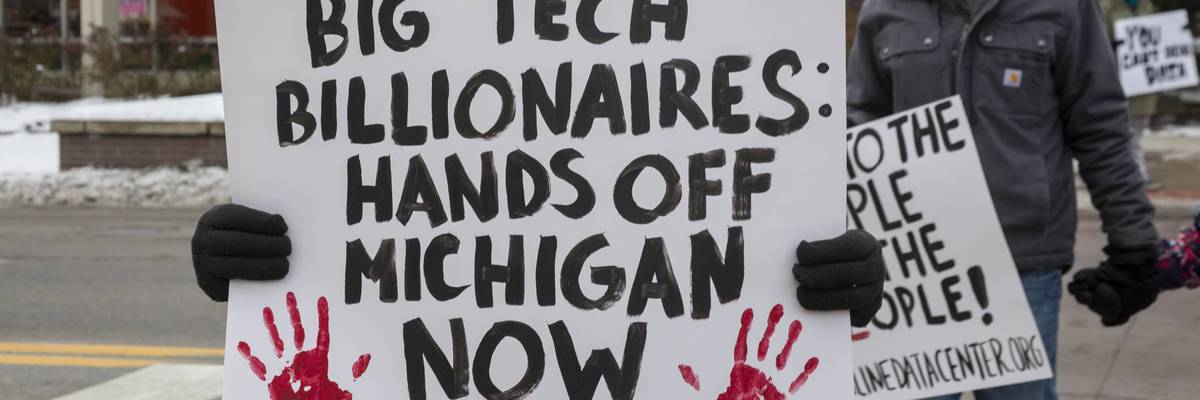
Rural Michigan residents rally against the $7 billion Stargate data center planned on southeast Michigan farm land in Saline, Michigan on December 1, 2025.
(Photo by Jim West/UCG/Universal Images Group via Getty Images)
Jul 27, 2026
As Big Tech races to build water-guzzling, energy-hungry data centers for its artificial intelligence, talk of an “AI race” between the United States and China has permeated public discourse. Pundits, politicians, and the media have all joined tech corporations in selling this narrative. And it’s giving license to Big Tech and their political handmaidens to ruin our communities, exploit our every action (both online and via AI-powered surveillance), and steal the wealth of human knowledge for private gain.
But the idea of an AI race between China and the US isn’t grounded in reality. The researchers, companies, and governments behind Chinese and US AI development are pursuing completely different goals.
The discourse in the US assumes that achieving artificial general intelligence (AGI)—computers that mimic human consciousness—would be so momentous and earth-shattering that clearly this must be the goal of anyone pursuing AI development. But that’s not the main goal of Chinese AI development. And a competition in which the competitors are running toward different finish lines isn’t a race.
If we allow the myth of an AI race with China to give Big Tech free rein, we face a more polluted, less equal world.
A Race Doesn’t Have Two Different Finish Lines
While the US is focused on artificial general intelligence (AGI) powered by Large Language Models (LLMs), Chinese developers are focused on AI embedded in products. It’s ChatGPT versus robots.
Yes, China is developing LLMs, although largely in an open-source way as opposed to the for-profit competition in the US. Recent news stories report that China is “catching” the US in LLM development. Indeed, the latest Chinese model outperforms leading US models. But this isn’t evidence of an LLM-AGI race. Instead, it shows that without making AGI its main focus, China is capable of developing its own models almost as quickly as US companies.
If every environmental review, every question raised by a community, every issue around water usage and electricity prices can be dismissed or lessened as “helping China,” then meaningful political debate can be silenced.
More to the point, LLM development in China is incidental to the country’s real goal for AI. Its focus remains on products embedded with AI and robots. Or, as AI policy researcher Liang Zheng says, in China, “The first priority is to use it to benefit ordinary people” (debatable, but indicates the kind of AI they are pursuing).
In the US, the first priority is to exploit people so that the tech oligarchs can profit. It’s chatbots all the way down.
This isn’t to argue that China is doing it “right” and the US is doing it “wrong.” Either approach will lead to a future in which citizens become increasingly disempowered. In which work becomes more scarce and less lucrative for most people. And in which a handful of billionaires grow wealthier and more powerful.
But the arguments being hauled out to support the destructive growth of hyperscale data centers are based on a fallacy. There is no need to “beat China.” China and the US are racing on separate tracks, in different races, with different finish lines.
These two separate approaches also explain the mind-boggling scale of the data center invasion we currently face. The massive hyperscale data centers—recent proposals would demand up to 5 gigawatts, enough electricity to power roughly 3.75 million US households—are only “required” because the US is racing toward AGI. Meanwhile, the embodied AI dominating in China does not require the same amount of computational power.
The truth is, we don’t need hyperscale data centers to “beat China.” We aren’t racing China. We’re killing ourselves so Silicon Valley can race itself.
How Big Tech Is Weaponizing the “AI Race” to Build Data Centers
Yet, the “AI race” story is a convenient lie for Big Tech and its political protectors. It is a neat political argument designed to insulate the industry from criticism and regulation.
If every environmental review, every question raised by a community, every issue around water usage and electricity prices can be dismissed or lessened as “helping China,” then meaningful political debate can be silenced. Real regulation—if even possible—can be avoided. Fear becomes a substitute for policy.
We understand why O’Leary and the other Tech Broligarchs don’t understand the grassroots opposition to data centers building across the country. It’s hard to spot the grassroots from the window of a private jet.
At the same time, data center developers and their minions in Washington have tried to weaponize false claims about foreign ties to the anti-data center movement. Kevin O’Leary of Shark Tank fame has explicitly said that our movement is being funded by China. He has no evidence because evidence of a falsehood can’t exist. In fact, Fox News has been forced to retract its coverage of his claims.
We understand why O’Leary and the other Tech Broligarchs don’t understand the grassroots opposition to data centers building across the country. It’s hard to spot the grassroots from the window of a private jet. But the opposition is real and organic, and no amount of disinformation and pushing the “AI race against China” scare tactic will derail the movement.
Big Tech Is Selling Us a Dystopian Future
The myth of an AI race with China threatens to propel us into Big Tech’s vision of the future—one that’s more unequal than ever. Yes, tech leaders suggest their algorithms will cure cancer, but their real goal is and has been to increase their power and wealth at the expense of the rest of us.
Even as American Tech Broligarchs have distanced themselves from earlier prophecies of widespread job loss, their vision of the future will see the vast majority of us out of meaningful work. We’ll be subject to living off whatever meager handouts are created in an attempt to mollify us.
Even if there were an AI race, is it worth running, let alone winning, if the prize is a dystopian future of mass misery with a thin layer of super wealthy tech oligarchs at the top?
At the same time, our movement will be traced whether or not we use the electronic gadgets they sell us. Already, surveillance devices linked to AI can recognize our faces, record our license plates, and report our movements. Companies and governments can buy this data in order to track us.
Meanwhile, “surveillance pricing” allows companies to change prices in an instant so that they can exploit our needs for their profit. Deepfake videos have already added to the rapidly decaying trust in a commonly shared world and a basic set of facts necessary for a functioning democracy. And this is but a scratch of the surface.
Even if there were an AI race, is it worth running, let alone winning, if the prize is a dystopian future of mass misery with a thin layer of super wealthy tech oligarchs at the top?
Big Tech’s Dystopian Vision Isn’t Inevitable
But we should be clear. This dystopian vision is not the inevitable outcome of unstoppable technological “progress” as the Tech Broligarchs would have us believe. Each and every decision being made to advance AI is a political decision. And, for now, we still have the ability to determine our political future.
Across the country, there is a growing resistance to the nightmare being shoved down our throats. Communities are coming together to fight the spread of destructive hyperscale data centers. Already in 2026, more than $130 billion-worth of proposed data center projects have been defeated and canceled.
That’s the real “AI Race.” Not China versus the US, but us versus Big Tech.
Communities are taking control of their futures by placing moratoriums on new data centers. New York enacted a one-year pause on new centers, and there is growing support for a nationwide pause in Congress.
We aren’t destined to live in Elon Musk’s fever dream. We have the power to stop him and his fellow Broligarchs. When we organize, we win. That’s the real “AI Race.” Not China versus the US, but us versus Big Tech. That’s not only a race worth running—it’s one we have to win.
© 2021 Food & Water Watch
Mitch Jones
Mitch Jones is the managing director of policy and litigation at Food & Water Watch.
Full Bio >

No comments:
Post a Comment