Under the new rule, an immigrant rights activist said, many asylum seekers “will never get a chance to argue their case.”
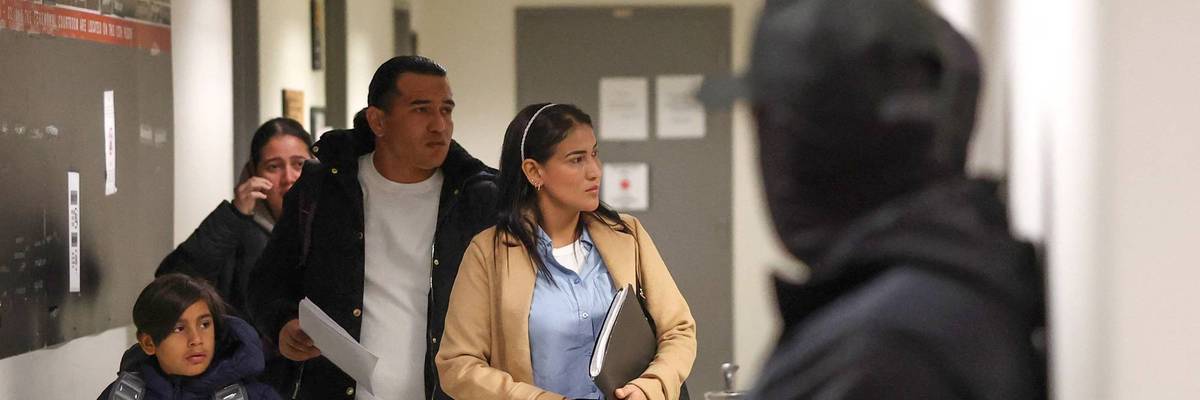
People arrive for a hearing as a federal agent wearing a face covering waits outside a courtroom at New York Federal Plaza Immigration Court in the Jacob K. Javits Federal Building in New York City on October 29, 2025.
(Photo by Timothy A. Clary/AFP)
Stephen Prager
Jul 27, 2026
COMMON DREAMS
The Trump administration published a new regulation on Monday that will immediately allow it to potentially send almost a third of asylum applicants straight into deportation proceedings without an interview to evaluate their claims.
US asylum law requires the government to give asylum seekers a “reasonable opportunity” to present evidence that they face persecution in their country of origin as a result of race, religion, nationality, social group membership, or political opinion.
For more than three decades, US Citizenship & Immigration Services explicitly stated that this process includes the “right” to an interview, where those seeking asylum have the opportunity to describe the persecution they fear and provide facts that may not have been included in their written asylum application.
But an interim final rule is scheduled to take effect on Tuesday that will scrap this right, allowing USCIS to skip the interview and refer applicants directly to immigration judges based solely on other documents they have submitted, which are often prepared without the help of an attorney in a language the applicant may not speak fluently.
In the filing for the new rule, USCIS acknowledged that applicants may be more likely to provide greater detail in face-to-face interviews, but that the overwhelming backlog of cases makes this unsustainable.
The filing states that the new rule will “more quickly place certain aliens into removal proceedings” at the Executive Office of Immigration Review (EOIR), the agency within the Department of Justice (DOJ_ that runs the federal immigration court system.
While these officials are referred to as “judges,” they are really part of the executive branch, appointed at the discretion of the attorney general and not subject to any Senate confirmation process.
Critics say that under President Donald Trump, these appointees have been selected to carry out his restrictive immigration agenda.
For these positions, which the administration has advertised as “deportation judges,” The Washington Post found that two-thirds of those appointed as of April 2026 had no immigration law experience. Immigration judges granted asylum in fewer than 5% of cases in February 2026, compared with 48% in 2024.
In September, the Trump DOJ gave immigration judges broader discretion to toss out claims by allowing them to “pretermit” those that they decide are “legally deficient,” meaning that applicants can be deported without a full hearing.
As it has carried out its “mass deportation” campaign, the administration has often violated the due process of immigrants in the US by removing them without notice or hearings, detaining longtime residents without the opportunity to secure bond, restricting access to legal counsel, and using mass court procedures to prevent claims from being meaningfully heard in court.
Aaron Reichlin-Melnick, a senior fellow at the American Immigration Council, said that the new rule will allow USCIS to “deny hundreds of thousands of applications without an interview, sending applicants directly to deportation proceedings.”
According to the filing, the Department of Homeland Security estimated that the new rule could affect as many as 444,724 pending cases and roughly 132,000 future applicants each year.
“This means many people will never get a chance to argue their case,” Reichlin-Melnick said.
‘Bigotry’ as Government Policy: Trump Orders ICE to Ramp Up Arrests of Haitians
“ICE has been ordered to round up nurses, home health aides, factory workers, teachers, students, and thousands of others who have been living and working here legally for years; who’ve done nothing wrong.”
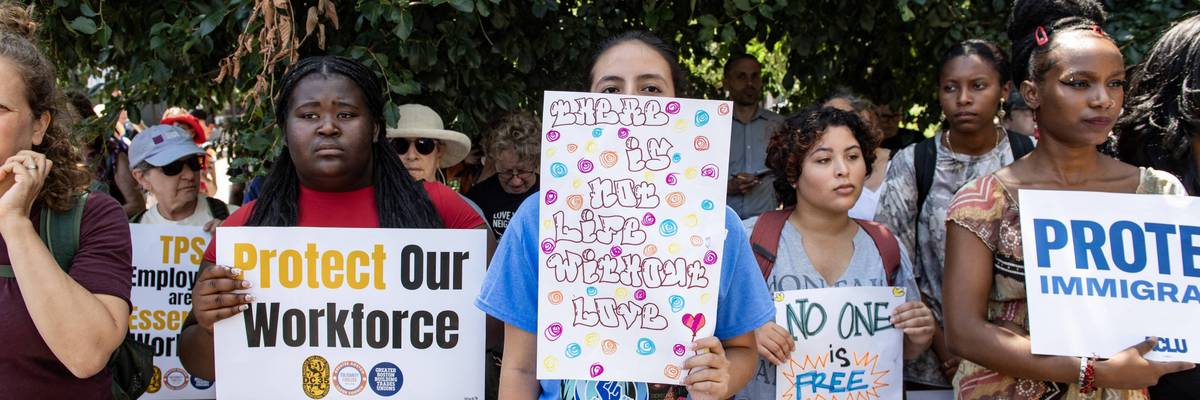
People hold signs at a rally calling on Congress to restore Temporary Protected Status (TPS) for Haitians in Boston on July 23, 2026.
(Photo by Joseph Prezioso/AFP via Getty Images)
Julia Conley
Jul 27, 2026

“ICE has been ordered to round up nurses, home health aides, factory workers, teachers, students, and thousands of others who have been living and working here legally for years; who’ve done nothing wrong.”
People hold signs at a rally calling on Congress to restore Temporary Protected Status (TPS) for Haitians in Boston on July 23, 2026.
(Photo by Joseph Prezioso/AFP via Getty Images)
Julia Conley
Jul 27, 2026
COMMON DREAMS
Mass arrests of Haitian immigrants by federal agents could begin as early as this week, according to federal documents regarding President Donald Trump’s new directive to US Immigration and Customs Enforcement following the right-wing majority on the Supreme Court’s ruling that Trump could end deportation protections for the community.
A binding mandate was expected to be sent to lower courts on Monday regarding the high court’s decision last month that held the Department of Homeland Security (DHS) could strip 350,000 Haitians and 6,000 Syrians of their Temporary Protected Status (TPS), which is granted to migrants from certain countries facing disasters, armed conflicts, or other conditions that would put immigrants in danger if they were forced to return there.
After the mandate is transmitted, Haitians across the country will lose their ability to legally live and work in the US, and the administration is reportedly already planning to send ICE agents into states including Ohio—where Haitian communities were targeted by Trump and Vice President JD Vance during the 2024 election—to quickly arrest and deport migrants to their crisis-stricken home country.
Jean Négot Bonheur Delva, director-general of Haiti’s National Office of Migration, told the Haitian Times this month that according to the US embassy in the Caribbean country, about 250 former TPS beneficiaries could be forced back to Haiti on flights each week.
Aaron Reichlin-Melnick, senior fellow at the American Immigration Council, emphasized that the reported operation targeting Haitian communities is just the latest evidence that Trump is rounding up people who have been living and working in the US for years, despite the White House’s claims that it is going after “the worst of the worst.”
“The majority of Haitians with TPS today entered the US lawfully on humanitarian parole during the Biden administration, and then transitioned to TPS before their parole status expired,” said Reichlin-Melnick. “Those people have not spent a single day in violation of immigration law.”
The crisis in Haiti that necessitated TPS for people who arrived in the US from the country, he added, “hasn’t ended.”
Haiti is the poorest country in the Western Hemisphere, with widespread food insecurity, and large swathes of the country as well as transport routes are controlled by armed gangs. Violence intensified toward the end of 2025 “and remains the dominant force shaping the daily life of Haitians,” according to the United Nations, with more than 8,100 killings reported last year, and gangs have increasingly used children in violent attacks.
Many healthcare facilities are “barely functioning,” and extreme weather including hurricanes and droughts have worsened the humanitarian crisis. The country has also struggled to fully recover from the devastating 2010 earthquake that killed hundreds of thousands of Haitians.
Last week, US Rep. Joaquin Castro (D-Texas) spoke out about a Pentagon plan to strengthen coordination between the UN’s Gang Suppression Task Force in Haiti and a private military contractor run by Erik Prince, a close ally of Trump’s. The contractor, Vectus Global, has conducted drone strikes that have killed dozens of Haitian civilians.
Those conditions are what DHS suggested Haitians should voluntarily return to, after having built lives in the US, when the agency told CBS News on Monday that TPS has been used as a “defacto amnesty program” and called on people who are about to lose protections that have been in place for 16 years to “self-deport.”
“What we would say now is it’s closing time which means you don’t have to go home, but you can’t stay here,” DHS told CBS News. “The good news is it’s not too late to get a $2,600 check and a free flight home.”
The Supreme Court’s majority asserted last month that Trump administration officials did not make “overtly racial” comments about Haitians that would suggest the push to end TPS for the population was driven by “racial animus”—but US District Judge Ana Reyes in the District of Columbia came to the opposite conclusion earlier this year, saying then-Homeland Security Secretary Kristi Noem had likely pushed to end TPS “because of hostility to nonwhite immigrants.”
Reyes pointed out that Noem had not acknowledged the $1.3 billion Haitian TPS holders pay each year in taxes, and said Trump’s racist comments about Haitians in the US—including that they “probably have AIDS” and that residents of the community in Springfield, Ohio were eating their white neighbors’ pets—were rooted in “racial animus.”
The ICE directive to ramp up enforcement operations against “an ethnic group the president has repeatedly attacked is bigotry as official government policy,” said Reichlin-Melnick.
Rep. Sylvia Garcia (D-Texas) called on members of Congress to sign on to a discharge petition she put forward for a vote on “the American Dream and Promise Act, to extend protections for TPS holders from Haiti and 16 other countries.”
“In less than four days, House Democrats secured 210 signatures, including two Republicans, we just need eight more members of Congress to force a vote,” said Garcia. “TPS holders, you are not alone, we are with you!”
Mass arrests of Haitian immigrants by federal agents could begin as early as this week, according to federal documents regarding President Donald Trump’s new directive to US Immigration and Customs Enforcement following the right-wing majority on the Supreme Court’s ruling that Trump could end deportation protections for the community.
A binding mandate was expected to be sent to lower courts on Monday regarding the high court’s decision last month that held the Department of Homeland Security (DHS) could strip 350,000 Haitians and 6,000 Syrians of their Temporary Protected Status (TPS), which is granted to migrants from certain countries facing disasters, armed conflicts, or other conditions that would put immigrants in danger if they were forced to return there.
After the mandate is transmitted, Haitians across the country will lose their ability to legally live and work in the US, and the administration is reportedly already planning to send ICE agents into states including Ohio—where Haitian communities were targeted by Trump and Vice President JD Vance during the 2024 election—to quickly arrest and deport migrants to their crisis-stricken home country.
Jean Négot Bonheur Delva, director-general of Haiti’s National Office of Migration, told the Haitian Times this month that according to the US embassy in the Caribbean country, about 250 former TPS beneficiaries could be forced back to Haiti on flights each week.
Aaron Reichlin-Melnick, senior fellow at the American Immigration Council, emphasized that the reported operation targeting Haitian communities is just the latest evidence that Trump is rounding up people who have been living and working in the US for years, despite the White House’s claims that it is going after “the worst of the worst.”
“The majority of Haitians with TPS today entered the US lawfully on humanitarian parole during the Biden administration, and then transitioned to TPS before their parole status expired,” said Reichlin-Melnick. “Those people have not spent a single day in violation of immigration law.”
The crisis in Haiti that necessitated TPS for people who arrived in the US from the country, he added, “hasn’t ended.”
Haiti is the poorest country in the Western Hemisphere, with widespread food insecurity, and large swathes of the country as well as transport routes are controlled by armed gangs. Violence intensified toward the end of 2025 “and remains the dominant force shaping the daily life of Haitians,” according to the United Nations, with more than 8,100 killings reported last year, and gangs have increasingly used children in violent attacks.
Many healthcare facilities are “barely functioning,” and extreme weather including hurricanes and droughts have worsened the humanitarian crisis. The country has also struggled to fully recover from the devastating 2010 earthquake that killed hundreds of thousands of Haitians.
Last week, US Rep. Joaquin Castro (D-Texas) spoke out about a Pentagon plan to strengthen coordination between the UN’s Gang Suppression Task Force in Haiti and a private military contractor run by Erik Prince, a close ally of Trump’s. The contractor, Vectus Global, has conducted drone strikes that have killed dozens of Haitian civilians.
Those conditions are what DHS suggested Haitians should voluntarily return to, after having built lives in the US, when the agency told CBS News on Monday that TPS has been used as a “defacto amnesty program” and called on people who are about to lose protections that have been in place for 16 years to “self-deport.”
“What we would say now is it’s closing time which means you don’t have to go home, but you can’t stay here,” DHS told CBS News. “The good news is it’s not too late to get a $2,600 check and a free flight home.”
The Supreme Court’s majority asserted last month that Trump administration officials did not make “overtly racial” comments about Haitians that would suggest the push to end TPS for the population was driven by “racial animus”—but US District Judge Ana Reyes in the District of Columbia came to the opposite conclusion earlier this year, saying then-Homeland Security Secretary Kristi Noem had likely pushed to end TPS “because of hostility to nonwhite immigrants.”
Reyes pointed out that Noem had not acknowledged the $1.3 billion Haitian TPS holders pay each year in taxes, and said Trump’s racist comments about Haitians in the US—including that they “probably have AIDS” and that residents of the community in Springfield, Ohio were eating their white neighbors’ pets—were rooted in “racial animus.”
The ICE directive to ramp up enforcement operations against “an ethnic group the president has repeatedly attacked is bigotry as official government policy,” said Reichlin-Melnick.
Rep. Sylvia Garcia (D-Texas) called on members of Congress to sign on to a discharge petition she put forward for a vote on “the American Dream and Promise Act, to extend protections for TPS holders from Haiti and 16 other countries.”
“In less than four days, House Democrats secured 210 signatures, including two Republicans, we just need eight more members of Congress to force a vote,” said Garcia. “TPS holders, you are not alone, we are with you!”
'Feels like an earthquake': Trump threatens elderly care after Supreme Court ruling
David Edwards
July 27, 2026
David Edwards
July 27, 2026
RAW STORY
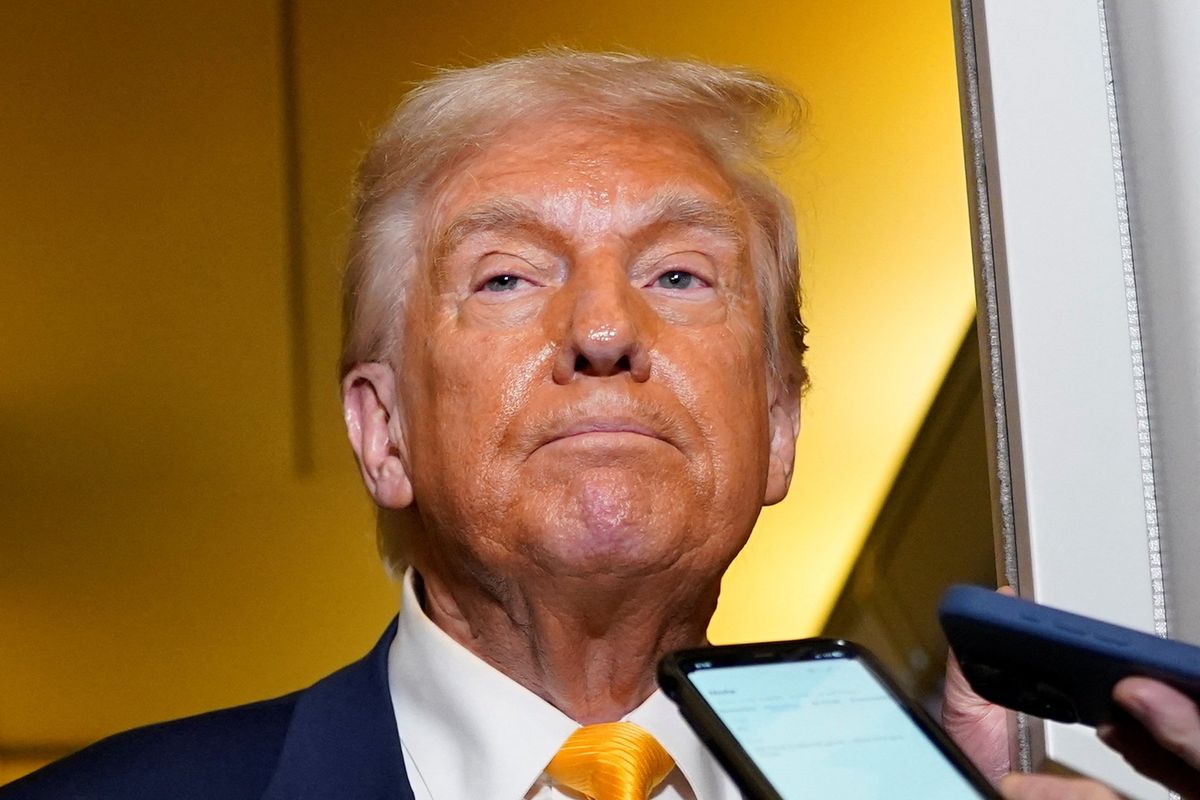
U.S. President Donald Trump looks on as he addresses the media on board Air Force One on the way to West Palm Beach, Florida, U.S., April 13, 2025. REUTERS/Nathan Howard
President Donald Trump is using powers enabled by a recent Supreme Court decision to force thousands out of jobs, and it's the elderly who could face "dire consequences" of his actions.
Last month, the court ruled in Mullin v. Doe that federal law bars judges from reviewing presidential decisions on Temporary Protected Status — meaning no court can stop Trump from terminating it, according to CBS News.
The ruling's mandate took effect Monday, ending TPS for an estimated 348,000 Haitians — including 13,000 nursing assistants and 8,000 caregivers, Princeton University research fellow Phillip Connor found.
A peer-reviewed study in The Gerontologist found that staffing shortages have "dire consequences for residents" of nursing homes and long-term care facilities, where certified nursing assistants provide up to 90% of direct resident care. When staffing levels fall short, the study warned, "residents are at elevated risk for neglect and harm" — including infection and rehospitalization.
LeadingAge, which represents nursing home providers, said facilities face closing units or turning away new residents entirely until vacancies are filled.
For Haitian communities across the country, the human cost is already being felt.
"Once again our community members find themselves in a state of extreme trauma, fear and terror. One of them told me it feels like a tsunami or an earthquake with nonstop aftershocks," Guerline Jozef, executive director of the Haitian Bridge Alliance, told CBS News.
The ruling that handed Trump this authority reversed a lower court that had found the TPS termination was "in part" rooted in "racial animus." The Supreme Court's majority overrode that finding, ruling that presidential TPS decisions are not subject to judicial review. Department of Homeland Security General Counsel James Percival celebrated on X, writing, "The T in TPS stands for TEMPORARY."
White House spokeswoman Abigail Jackson called it "a tremendous win," telling Fox News the ruling affirmed that TPS "was never intended to be a pathway to permanent status."
DHS told CBS News it was "closing time," and offered departing Haitians a $2,600 check and a free flight home.
A Senate bill that would have extended TPS protections for three years failed this week. The U.S. Chamber of Commerce had urged senators to act, warning of "significant disruption to America's work force."
Jozef said the fear has reached into the smallest corners of family life.
"Her little girl doesn't even want to go to school for fear of coming home and not finding her mother," she said.
U.S. President Donald Trump looks on as he addresses the media on board Air Force One on the way to West Palm Beach, Florida, U.S., April 13, 2025. REUTERS/Nathan Howard
President Donald Trump is using powers enabled by a recent Supreme Court decision to force thousands out of jobs, and it's the elderly who could face "dire consequences" of his actions.
Last month, the court ruled in Mullin v. Doe that federal law bars judges from reviewing presidential decisions on Temporary Protected Status — meaning no court can stop Trump from terminating it, according to CBS News.
The ruling's mandate took effect Monday, ending TPS for an estimated 348,000 Haitians — including 13,000 nursing assistants and 8,000 caregivers, Princeton University research fellow Phillip Connor found.
A peer-reviewed study in The Gerontologist found that staffing shortages have "dire consequences for residents" of nursing homes and long-term care facilities, where certified nursing assistants provide up to 90% of direct resident care. When staffing levels fall short, the study warned, "residents are at elevated risk for neglect and harm" — including infection and rehospitalization.
LeadingAge, which represents nursing home providers, said facilities face closing units or turning away new residents entirely until vacancies are filled.
For Haitian communities across the country, the human cost is already being felt.
"Once again our community members find themselves in a state of extreme trauma, fear and terror. One of them told me it feels like a tsunami or an earthquake with nonstop aftershocks," Guerline Jozef, executive director of the Haitian Bridge Alliance, told CBS News.
The ruling that handed Trump this authority reversed a lower court that had found the TPS termination was "in part" rooted in "racial animus." The Supreme Court's majority overrode that finding, ruling that presidential TPS decisions are not subject to judicial review. Department of Homeland Security General Counsel James Percival celebrated on X, writing, "The T in TPS stands for TEMPORARY."
White House spokeswoman Abigail Jackson called it "a tremendous win," telling Fox News the ruling affirmed that TPS "was never intended to be a pathway to permanent status."
DHS told CBS News it was "closing time," and offered departing Haitians a $2,600 check and a free flight home.
A Senate bill that would have extended TPS protections for three years failed this week. The U.S. Chamber of Commerce had urged senators to act, warning of "significant disruption to America's work force."
Jozef said the fear has reached into the smallest corners of family life.
"Her little girl doesn't even want to go to school for fear of coming home and not finding her mother," she said.


No comments:
Post a Comment