Ecosocialism That Doesn’t Address Animal Agriculture Isn’t Serious

Pigs in a confined feeding factory in the Midwest. Photo: EPA.
I was disappointed to learn the Building for Power campaign, put forward by the Green New Deal Campaign Commission of the Democratic Socialists of America, doesn’t seem to address the enormous environmental damage caused by animal agriculture. Building for Power focuses on four areas: energy, transit, housing, and public spaces. Unfortunately, our food system is a massive contributor to climate change, and it’s hard to take seriously an ecosocialism which doesn’t recognize this and plan accordingly.
I should begin by acknowledging the reasons why I suspect greenhouse-gas emissions associated with animal agriculture aren’t addressed by Building for Power. The first is any critical discussion of meat and other animal products is sure to spark a right-wing backlash. The second is that suggestions for addressing environmental harms caused by animal agriculture are often individualistic in nature. Of course, just because a discussion represents a political third rail doesn’t make it any less necessary, and potential solutions needn’t be so focused on consumer choices, oblivious to the economic forces which help shape them.
“Conservative estimates by the United Nations Food and Agriculture Organization say animal agriculture is responsible for 14.5 percent of all greenhouse gas emissions globally (the industry has lobbied to reduce that estimate further, and were successful recently to now say about 12 percent),” Will Potter writes in his excellent 2025 book, Little Red Barns. “Some estimates put animal agriculture’s contributions higher, at 28 percent to 37 percent. A report by the WorldWatch Institute placed it at a minimum of 51 percent.” The author noted these numbers don’t factor in the carbon opportunity costs of rewilding land associated with animal agriculture.
There are many ways ecosocialists could plausibly use the levers of government to encourage a transition to a more environmentally-friendly food system. One method would be a massive increase in state and federal funding into alternative-protein research, in the hopes vegan and cultivated options can achieve price and taste parity with animal-based protein. Consumers frequently cite these two factors to explain why they don’t adopt alternative options. For those who aren’t aware, cultivated meat is grown from livestock cells, without killing. Scientists believe the product, which remains in early stages of development, will eventually require a fraction of the greenhouse-gas emissions necessary to produce slaughtered meat.
In professional taste-test panels run by the nonprofit Food Systems Innovations, no existing plant-based options fully satisfied omnivores’ expectations, though the Impossible Burger came close, according to Good Food Institute founder Bruce Friedrich in his fantastic 2026 book, Meat. This makes sense, given Impossible spent years and millions of dollars developing the product. I see no reason, however, why it can’t be improved upon, with the help of artificial intelligence and further human research.
A significant problem for the plant-based sector is there is a wide variation in quality and those products which come closest to meeting omnivores’ desires are often significantly more expensive than traditional meat. Ecosocialists could help address this with publicly-funded, open-access research into vegan meat. The goal, of course, would be to make the taste of Impossible Burgers the plant-based sector’s floor, as opposed to its ceiling, and improve upon taste from there. Such research would aim to lower the costs as well.
In contrast to plant-based meat, cultivated meat is identical to incumbent options at a cellular level. Unfortunately, I’ve yet to try the product, which has only been sold in a handful of restaurants, but I’ve heard — aside from an occasional comment saying the texture needs further work — the taste is indistinguishable from slaughtered meat. The main barriers to cultivated products appearing in your local grocery store are various technological hurdles which, for now, render the protein too expensive to mass produce.
Ecosocialists should back the creation of facilities like the Tufts University Center for Cellular Agriculture at schools across the country. “Our goal is to do really good research, and propel educational opportunities for students as the field grows, and the field will grow,” TUCCA’s director, David Kaplan, said to Tufts Daily. “At the same time we try and build partnerships with industry to understand where their needs are going forward.” I have no doubt that, working together, government-backed scientists can overcome the technological hurdles impeding the mass production of cultivated meat.
TUCCA has been funded with an initial $10-million grant from President Joe Biden’s Department of Agriculture, supplemented by $2 million from Massachusetts Governor Maura Healey’s administration. More recently, Senator Adam Schiff and Representative Julia Brownley introduced a bill that would allocate more than $500 million toward the research and development of alternative proteins, including cultivated meat. Surely self-avowed ecosocialists can offer more robust funding to this effort to usher in an environmentally-friendly food system than centrist Democrats like Biden, Healey, Schiff and Brownley.
Animal agriculture is a leading cause of greenhouse-gas emissions. Ecosocialists refusing to acknowledge this, and making their policy platform reflect that reality, due to political inconvenience, isn’t so different from climate denialism. It’s especially egregious given moderate liberals appear willing to engage with the issue. The Democratic Socialists of America‘s Building for Power campaign should include animal agriculture as an area of focus and agitate for a host of government interventions intended to transition the country toward an agricultural system centered on greater consumption of plant-based and cultivated proteins.
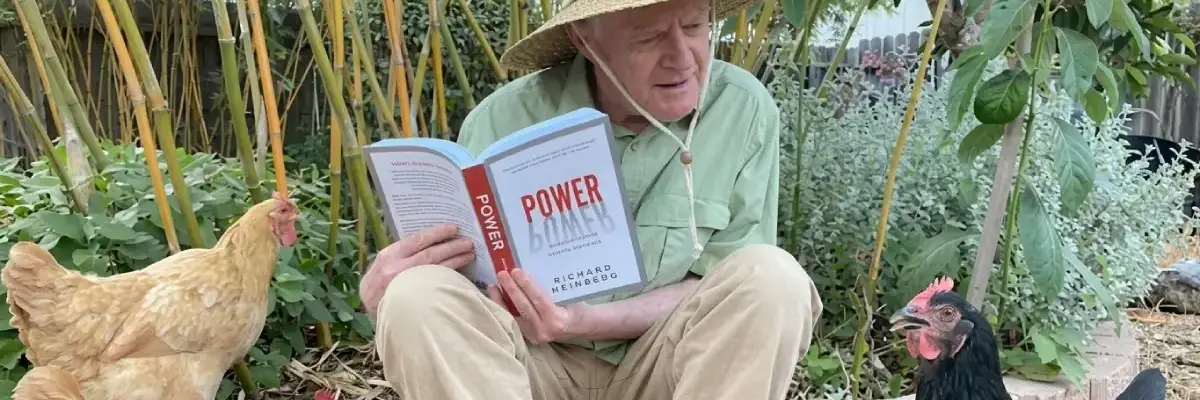
Richard Heinberg, formerly a senior fellow of the Post Carbon Institute, reads aloud to a chicken from his book Power: Limits and Prospects for Human Survival.
Asher Miller
Jul 27, 2026
This is the hardest article I’ve ever had to write.
On Sunday July 19th we lost our kind, brilliant friend and colleague, Richard Heinberg.
The world has lost a voice of clear, truth-telling wisdom—a man whose work reached millions of people and fundamentally changed the lives of thousands. Perhaps that includes you. It certainly does me.
Richard died after a short, brutal illness. He was diagnosed with pancreatic cancer just two weeks before his passing. As you can imagine, we’re reeling and gutted.
In ways big and small, Richard displayed humility, gentleness, and joy—especially for someone grappling with such complex and difficult subject matter.
If Richard’s contributions impacted you in any way, we’d love to hear your reflections. Please visit his memorial site to share your own stories or learn more about Richard.
Countless people came to know Richard only through his books, articles, lectures, and interviews. Yet many felt as though they knew him personally. That was one of his remarkable gifts. He challenged people to face difficult truths without giving up on beauty, community, or the possibility of living well within Earth’s limits.
There’s so much I can and simply cannot say about Richard as a person and as a writer and teacher. Working alongside Richard for the last 18 years has been one of the biggest gifts in my life. In ways big and small, Richard displayed humility, gentleness, and joy—especially for someone grappling with such complex and difficult subject matter. An inveterate introvert, Richard was often quiet in groups but when he spoke it was additive, given with generosity, kindness, and humor, and always with a focus on the greater good.
When he wrote, on the other hand, it was with such powerful clarity, unflinching truth telling, and a talent for presenting complex issues in a brilliantly accessible way. He could weave together ecology, thermodynamics, history, anthropology, behavioral psychology, politics, and more into expansive explorations, as he did with his 14th and final book, Power: Limits and Prospects for Human Survival, or into succinct storytelling, as he did when narrating the award-winning animation, “300 Years of Fossil Fuels in 300 Seconds.” He could jump from writing about the collapse of industrial civilization to writing about what he learned from chickens. Perhaps the best example of Richard’s breadth is this recording of him playing the violin and giving a talk on “Post-Carbon Music” at the New England Conservatory of Music.
I’ll miss Richard’s smile, his laugh. I’ll miss the few times when I got to see him get mad at the stupidity or cowardice of those in power. I’ll miss hearing him talk about trying to conquer an early jazz tune or the simple joy he got from his afternoon chocolate or shot of espresso. I’ll desperately miss the way he could take my meandering ideas for topics to explore and turn them into brilliantly cogent essays in a matter of hours or days. I simply loved our collaborations.
While grieving and in shock, and frankly a little lost about how Post Carbon Institute will find its voice without him, I think what Richard would want is for each of us to redouble our efforts toward his vision of people and nature thriving within ecological limits. One full of bird song, music, and laughter.
We would love to hear from you. Please share your remembrances of Richard here.
With a heavy heart,
Asher Miller
© 2023 Resilience
Asher Miller
Asher Miller is the executive director of the Post Carbon Institute.
Full Bio >


No comments:
Post a Comment