Sunday, July 19, 2026

A Global Fossil Fuel Phaseout Is a Challenge ‘Big Enough to Solve’

The immediate challenge is to develop a global phaseout road map that’s ambitious enough to stabilize the climate system and equitable enough to drive a resilient, renewables-based development in even the poorest parts of the world
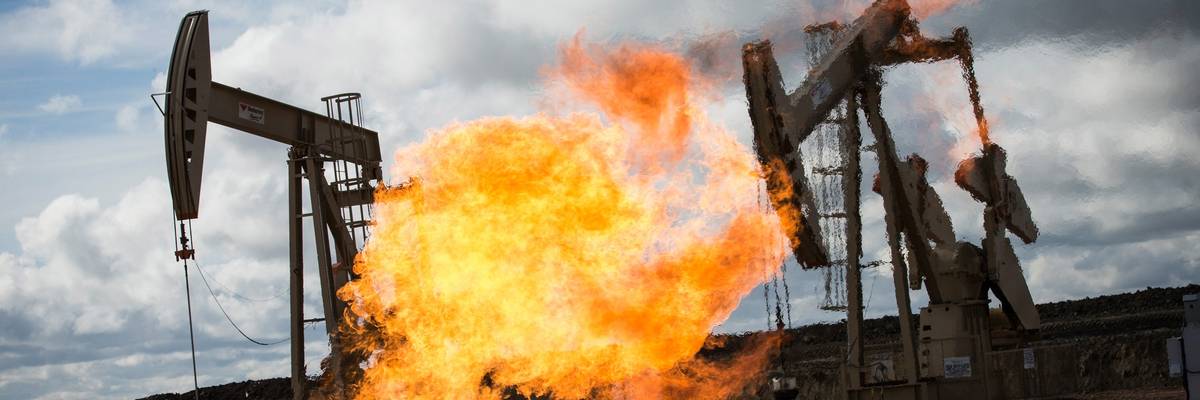


A gas flare is seen at an oil well site  outside Williston, North Dakota. Gas flares are created when excess flammable gases are released by pressure release valves during the drilling for oil and natural gas. North Dakota has been experiencing an oil boom recently, bringing tens of thousands of jobs to the region, lowering state unemployment and bringing a surplus to the state budget.
(Photo by Andrew Burton/Getty Images)

Tom Athanasiou
Jul 18, 2026
Foreign Policy In Focus

It’s no secret that the climate negotiations are failing. The simple fact is that the carbon concentration of the atmosphere continues to rise, rapidly and along a pathway that threatens—but does not yet guarantee—true catastrophe.

That said, there’s little agreement on why the climate negotiations are failing, or what their role would be in the emergency global transition that’s so desperately needed. Such a transition will have to be very widely accepted as fair if it is to have a chance of success, and the negotiations as we have them are hardly rising to the challenges of global climate justice. Is this likely to change soon? Perhaps not, but such a change is both necessary and possible, and the goal has to be to increase the odds.

One promising way of doing so is to concentrate effort on launching a global push to phase out fossil fuels—that is, a phase out of both fossil fuel extraction and consumption, and the simultaneous development and global deployment of a fossil-fuel free energy economy. Such a phaseout would not solve the whole of the climate problem, let alone the still larger ecological crisis, but it would make solutions possible. The phaseout challenge is one that, as Dwight D. Eisenhower used to say, is “big enough to solve.”


The Road to Santa Marta

The story of the climate negotiations can be told many ways. I like to tell it as a story of failure, and renewed effort, and late, inadequate, steps forward. Such a process gave us the foundational United Nations Framework Convention on Climate Change (UNFCCC), and the Paris Agreement, and the hard-won breakthrough at 2023’s COP28 in Dubai, where the world’s nations agreed to “transitioning away from fossil fuels in energy systems, in a just, orderly, and equitable manner.” The question is if the current impasse, which settled in after Dubai, will play out in similar fashion.

How rapidly can the world’s civilizational dependence on fossil fuels be broken?

But first, know that a great burst of joy accompanied the Dubai agreement’s inclusion of the words “transitioning away from fossil fuels.” It broke a firewall that had held for decades, one in which a blocking coalition led by the Saudis and the American oil companies, playing a long and Machiavellian game, was able to keep fossil fuels from even being mentioned in a formal COP decision.

This silence has long been excoriated by climate activists around the world, but its origins are too seldom brought to light. To see them, drop back to 1992, when the Framework Convention was being finalized. Back then, the world’s climate diplomats were able to make substantive decisions. Some of these, like the agreement that countries would act in proportion to their “common but differentiated responsibilities and respective capabilities,” were inspiring and visionary. But the founders fell short in at least one enduringly negative and perhaps fatal way—they were unable to agree to a majority, or even a super-majority “last resort” decision-making system. They got close, but the fossil coalition blocked all paths, and the result, by both default and design, was consensus decision-making.

Consensus decision-making, alas, is a special kind of problem. It appears to be a commitment to deep democracy, yet in practice it means everyone has a veto, which is not exactly what you want if you’re trying to negotiate a life-or-death global transition that requires the interests of wealthy and powerful minorities to yield to those of the global community as a whole. On the contrary, it empowers blockers, allowing them to endlessly force the deletion of ambitious text, and thus it keeps both fossil phaseout (which is blocked by the fossil cartel) and meaningful finance reform (which is blocked by the wealthy countries) forever off the table. Over time, it has driven the negotiations into a realm of shadow play far divorced from the realities of the actual world.

It is difficult to pinpoint the original sin here. The Saudis, after all, have a point. Their economy is indeed threatened by any phaseout of fossil fuels. So why should they not fight like hell to preserve their power and their privilege? Everybody else does. But there’s a deeper problem as well: the climate finance problem, which continues to loom forbiddingly over any possible international climate accord. Ultimately, the deadlock in the climate negotiations is defined by the intransigence of the Global Rich, most of whom reside in the Global North, on key justice questions—finance in particular. Bluntly, the rich refuse to pay their fair shares. This intransigence makes any real breakthrough impossible, in part by empowering blockers on all sides.

At COP30 in Brazil, push came to shove. After a large group of activist nations failed to land an agreement to negotiate a “roadmap” away from fossil fuels, those nations, many of them frustrated beyond words, made a new move. Led by Colombia and The Netherlands and with a great deal of support from civil society (the Fossil Fuel Treaty Initiative in particular), they forked off a more informal process, which launched the First Conference on Transitioning Away from Fossil Fuels, held in April 2026 in Santa Marta, Colombia.

Santa Marta seemed immediately to be a game changer. Here, for example, is Tzeporah Berman, founder and chair of the Treaty Initiative: “After years stuck in endless debates about whether to phase out fossil fuels, finally we are focusing on the how. We are no longer fighting for recognition of the problem, but creating solutions. It’s like watching a dam break—all that pent-up experience, knowledge, and passion suddenly flowing into concrete ways to phase out dirty fuels. The hope is contagious.”

The hope is also strategic. With President Donald Trump’s people in control of the US government, and doing everything in their power to undermine both the Paris Agreement and the Framework Convention itself, everyone could sense the opening. Which is why Santa Marta, as climate diplomacy’s favorite play-by-play announcer Ed King noted, was “weirdly” optimistic. One observer even described it as an “euphoric” experience.

Beyond any review of the formal takeaways, Santa Marta was a conference of the hopeful: 57 countries (plus California) representing about a third of the global economy, were present, and they all represented countries, or factions within countries, that wanted to face the fossil energy challenge. The US government, obviously, was not among them. Neither were the Gulf oil states, or Russia, or (more controversially) China and India. There was no formal negotiating. Civil society had its venues and made its declaration (a heroic synthesis), the academics had theirs, and a high-level science panel set the stage. The official discussions were universally reported to be congenial, even when it came to the equity question, which is always a reliable source of inconclusive discord.

The second Conference on Transitioning Away from Fossil Fuels will be chaired by Tuvalu and Ireland. It will be in 2027, after COP31 in Turkey, which one way or another will have to react to Santa Marta and its outcomes. Moving forward with the transition is now on the official diplomatic agenda. Formally, this means defining national phaseout road maps and a global phaseout road map to plug them into. In reality it means much more, because even good road maps will mean little unless they’re accompanied by the financial and institutional breakthroughs that could bring them to life.
The Santa Marta Breakthrough

How rapidly can the world’s civilizational dependence on fossil fuels be broken?

The good news is that the renewable energy revolution is finally arriving in force, and this has made countries of all kinds willing to countenance a sharp break with fossil energy. Thanks in large part to China’s immense commitments to electrification and mass manufacturing, the cost of wind and solar, and the batteries that convert them into “firm” baseload power sources, has plummeted.

The US-Israeli war against Iran has accelerated the renewables buildout, by convincing countries to prioritize domestic energy production. Fadhel Kaboub, a prominent southern observer of today’s geopolitical ferment, put it well: “A world less dependent on oil would be less vulnerable to the weaponization of tanker routes, refinery disruptions, and sudden fuel-price shocks,” adding that “a renewables-based system does not make peace automatic, but it does make energy blackmail much harder.”

To avoid a future in which vast areas of the Earth become almost uninhabitable, the world’s governments will have to pick up the pace.

Further, the global renewables boom, which began before the war, may well be reaching its own inflection point. Solar evangelist Danny Kennedy cites 2025 as the big year, because that’s when China and India—the two largest energy consumers in Asia—together reached a historic tipping point. “For the first time, fossil fuel generation fell in both countries simultaneously: China down 0.9%, India down 3.3%. These are not small numbers.” Then, in 2026, as the war dragged on, China’s solar exports hit all-time records. “This is not charity. It is commerce. It is nations choosing energy security, economic agency, and lower costs over the inherited architecture of fossil fuel dependency.”

There are provisos. China and India still struggle to avoid new coal even as they scale up renewables. Also, China’s clean energy technology dominance, coupled with the Global North’s political inability to adopt robust industrial policies, seems destined to deepen deindustrialization and despair, particularly in the United States and Europe. But, though critical, these remain only provisos, because China’s mass manufacturing prowess shows a way forward. In fact, as the cost of electrification has dropped, it’s become difficult for the fossil cartel to convince the world’s people that their dreams of prosperity—or even stability—depend on the continued burning of coal, gas, and oil.

Alas, technology alone will not stabilize the climate in time. Renewables are displacing coal in particular, but the oil and gas story is more mixed. Thinktank Ember’s view is authoritative: “if demand and clean electricity growth continue at their recent pace, then fossil fuel generation will plateau before starting to decline consistently from the early 2030s.” Which is great, but not even close to fast enough to hold the 1.5°C line. To do better, it’s also necessary to stop fossil fuel extraction—drilling, fracking, and mining—as the second front in the phaseout battle, the second blade of the scissors.

This imperative has been obvious for decades. In 1998 at COP4 , Oilwatch, Amazon Watch, the Rainforest Action Network, and Project Underground launched a campaign to stop new exploration to avoid breaching the 1.0°C limit. The difference, 28 years later, is that the world has retreated to a far more dangerous 1.5°C goal, and could well retreat again. Moreover, the demand to “keep it in the ground” is now coming from the main stage. At Santa Marta, the science panel’s “action recommendations” included “halting all new fossil-fuel expansion” and “prohibit[ing] fossil fuel advertising.”

It’s easy to see why local communities that directly suffer the pollution, corruption, and abuse that typically accompany fossil fuel extraction have long been demanding its abolition. But why did it take so long for global actors to come to the table, and does their arrival indicate that the tide has definitively turned?

Probably not.

Pause to consider how the goal of “halting all new fossil fuel” investment would sound among the good citizens of Houston, or Oslo, or Riyadh, or Basra, or Moscow. What’s the way forward for nations whose economies are deeply entangled with fossil fuel revenues, or people whose lives are dependent on fossil fuel jobs? Such questions could be glossed over at Santa Marta, but they cannot go forever unanswered.

At Santa Marta, the signs were, as Orwell used to say, in front of your nose. Colombia represented the Global South and its co-host The Netherlands represented the Global North, but both countries will have very difficult times escaping their entanglement with fossil fuels. Colombia exemplifies the predicament of poorer fossil exporters: Over 75% of its energy demand and 35-50% of its export revenues are met by fossil fuels. The Netherlands, for its part, is far richer, and is not a fossil fuel exporter, so it will be far easier for it to extricate itself from its fossil entanglements. Easier but not easy: The Netherlands relies heavily on fossil fuel distribution and refining—the port of Rotterdam is Europe’s primary oil and gas gateway.

To avoid a future in which vast areas of the Earth become almost uninhabitable, the world’s governments will have to pick up the pace. At an absolute bare minimum this means eliminating the subsidies that promote fossil fuels. In practice, however, even this entirely rational reform slams directly into the stranglehold that fossil capital has on all countries. One excellent example is the so called investor state dispute settlement (ISDS) mechanism, which allows fossil fuel companies to sue governments for lost future profits if they move, however timidly, to regulate away even odious advantages that these companies have built over the years to maximize their profits. It’s an absurd and entirely corrupt legal and economic barrier to phasing out fossil fuels and, incidentally, it’s one that The Netherlands helped create in the 1960s. The ISDS was explicitly on the Santa Marta agenda, but was reduced to one meaningless sentence in the formal takeaways: ISDS “by some were perceived as creating barriers, while the extent to which these barriers are perceived varies.” Asked to explain this rather evasive blather, Dutch Minister and co-host Stientje van Veldhoven said. “This was not a negotiating conference, and therefore different parties, different countries have different positions.”

Sooner or later, a serious negotiating conference will have to take meaningful positions on ISDS, economic diversification, external debt, and many other difficult issues. To that end, it will have to distinguish the core problem of extractor dependence—especially in poorer extraction nations—from the broader problem of economic entanglement. Because all nations, rich and poor alike, are entangled with fossil fuels. The crucial step is to put the interests of the poor ahead of the entanglement of the rich, even as the world’s people struggle to face the realities, and the necessities, of climate stabilization.

One immediate question, as Tuvalu and Ireland prepare to host the follow-up conference in 2027, is which countries to invite. Santa Marta was widely praised as a leadership conference, but its attendees included countries, including co-host The Netherlands, that do not seem likely to halt fossil fuel expansion anytime soon, at least not voluntarily. And this while China, the undisputed leader of the clean energy transition, was not on the invitation list. Which is why one well-known, long-time activist (anonymously) suggested to me that the recent UN General Assembly vote on the International Court of Justice climate ruling might offer a convenient and logical first screen for admission to future conferences. Only signers would qualify. Eight countries, including Russia, Saudi Arabia, and the US, voted against the ruling, but another 28, including India, Turkey, Qatar, and Nigeria, abstained.

Sorting out this problem would be a step forward. But the real game changer would be for a wealthy major extractor to repudiate fossil fuel expansion. One would do, though such a repudiation would ideally be followed by a working consensus that fossil fuel extraction (and not just its expansion) must end first in the rich world. Alas, Canada, Ireland, Australia, Norway, The Netherlands, and Brazil, all countries that attended Santa Marta, continue to expand domestic extraction, while the UK, France, and Italy are home to major corporations with growing international operations. All this must stop, and soon, and there will be no real breakthrough until it does.


The Structure of the Challenge

Santa Marta launched three work programs:Develop national fossil-fuel phaseout road maps;
Transform the global financial system to support the transition away from fossil fuels; and
Advance toward a fossil fuel-free trade system.

The details are many, but the real challenge is that any program must be executed within a profoundly divided world that is pressing hard against physical planetary limits.

Given this, any workable phaseout strategy will stretch the politics of the possible to the breaking point. How could it not when the climate system is already destabilizing? Much of the relevant science leverages the notion of the remaining emissions budget—the total amount of carbon dioxide that the world can still emit before crossing a given temperature threshold—and, for any Paris-compliant temperature, this remaining budget is perilously small and rapidly shrinking. Indeed, fossil-fuel emissions must very quickly be drawn down to “real zero” and this will be impossible unless the extraction of fossil fuels ceases.

The second challenge is extreme inequality, which comes to us in two dimensions: between rich countries (the Global North) and poor countries (the Global South) and also between rich and poor classes, in all countries. Yet everything will nevertheless depend on an ability to cooperate in a robust solidarity that can resist the attacks of the fossil cartel and survive even as climate-driven damage and destruction decisively increases. Such cooperation to navigate the turbulence of the climate transition is unlikely without meaningful steps toward a global safety net and paths forward for the world’s poor.

Fossil fuel extraction must be phased out at a breakneck pace with almost complete cessation by 2050. Similarly, the build-out of fossil fuel infrastructure must stop immediately. There’s no room—even in poor countries—for new oil and gas fields or coal mines. All effort must go to the construction of zero-carbon infrastructure.

Yet none of this is even conceivable unless the overall effort is very widely accepted as fair. This judgement will be made in many ways and many places, and not in abstract terms. For example, the tension between “phasing down” and “phasing out” fossil fuels is anything but abstract, and it won’t be easily reconciled. At Santa Marta, the “oil-rich African nations” insisted they would keep drilling as they transitioned to renewables. Onuoha Magnus Chidi, an adviser to Nigeria’s regional development minister: “Not phasing out—phase down. That is the message… We are phasing down, and we are saying that there should be early planning. It must be fair to all.”

I find his point impossible to dispute. The alternative has to be: If a phase-down strategy is pursued with adequate ambition, and if it takes proper account of both the North-South and rich-poor divides, then it becomes a phase-out strategy that can honestly be defended as being “fair to all.”

Chidi put his answer in concrete terms. “People are going to lose their jobs… How are you trying to re-engage them in other sectors?” he said, before stressing the need for debt reform and other financial assistance to make such change possible. Countries that are highly dependent on extraction will need more time to disentangle their societies from fossil fuels and build new economies. This will be extremely difficult even in rich countries like the United States and Saudi Arabia, but far harder in poor countries such as Nigeria, Iraq, and South Sudan, where fossil fuels account for large fractions of national revenue.

Given these challenges, what’s the way forward? This is the central question of phaseout justice. Fortunately, this question, too often treated as subsidiary, was taken seriously at Santa Marta:
The countries present in Santa Marta still have structural dependencies to overcome, including fiscal dependencies, debt constraints, the dependence of the financial architecture on fossil fuels and the need to enable fossil fuels-free trade systems...Transitioning away from fossil fuels is more than replacing one energy source with another. It requires broad economic transformation to overcome structural dependencies, overcome debt constraints, expand reliable energy access, and support diversified, resilient economies. This must be planned with workers and communities, ensuring a transition that is fair, rights-based, and delivers tangible benefits for marginalized groups.

To give poor extracting countries a chance to rapidly phase down, rich extracting countries must very quickly phase out. In fact, to hold to the 1.5°C limit—really, to minimize the time spent in 1.5°C overshoot—the richest fossil fuel extractors like Canada, the United States, Norway, Australia, and the UK must abandon extraction by the very early 2030s. This logic is inexorable; it holds unless you’re prepared to accept a catastrophic level of warming or assume a magical level of carbon dioxide removal. To hold the 1.5°C, or anything close to it, even poor fossil fuel extractors will have to phase out quickly, which they will not be able to do without support from the rich world.
System Change

In his speech to the Santa Marta plenary, Colombia’s former President Gustavo Petro went beyond the usual practice of reading out a bill of complaints against fossil interests. “There is inertia in the power and the economy of this archaic form of energy—fossil fuels—that lead to death. Undoubtedly, that form of capital can commit suicide, taking with it humanity and [other] life,” he said, going after fossil capitalism itself. “The question that needs to be asked is whether capitalism can truly adapt to a non-fossil energy model.”

This is exactly right.

The world is threatened by a suicidal form of capitalism, yet it is simultaneously clear that the reforms necessary to stabilize the climate, while momentous, do not demand wholesale revolution. Mandatory extraction limits, in particular, do not require an end to private property, though states strong enough to direct investment do seem to be necessary. Those devices must prove sufficient because there simply is not time to shift to a post-capitalist world. The goal has to be to shift to another, non-suicidal form of capitalism, assuming that such a thing exists.

Fossil capitalism will have to be forced from the stage, and to that end everything must be done.

The immediate challenge is to develop a global phaseout road map that’s ambitious enough to stabilize the climate system and equitable enough to drive a resilient, renewables-based development in even the poorest parts of the world. To that end, there is much to reconsider, beginning with the global finance architecture and, just as fundamentally, the fact that so many countries, so many elite cabals, and so many techno-economic systems have long co-evolved with the fossil cartel, and have become inextricably entwined with it.

Ultimately, because it is essentially political, the climate challenge is solvable. Formal negotiations could indeed push further the ball Santa Marta set into motion, and by so doing restore faith in multilateral governance, without which there’s no chance of success. But the truth is that the Tuvalu-Ireland meeting could just as easily degenerate into another pointless talking shop that fails to take any meaningful, galvanizing steps. This outcome must be avoided at almost any cost.

Fossil capitalism won’t yield to half measures. Neither market signals nor pipeline protests will reduce emissions at the necessary pace. Fossil capitalism will have to be forced from the stage, and to that end everything must be done. Technology, science, industrial policy, and global climate justice are going to have to line up on the same side, and even then something else—international solidarity—will also be required. But given that under capitalism money makes the world go round, there will be no meaningful international solidarity without international finance.


© 2026 Foreign Policy In Focus

Tom Athanasiou
Tom Athanasiou directs EcoEquity, an Earth Island Institute-sponsored project, and is a member of the Greenhouse Development Rights authors' group. His books include, Divided Planet: The Ecology of Rich and Poor and Dead Heat: Global Justice and Global Warming.
Full Bio >
The Cancellation of a Blue Hydrogen Boondoggle Proves No Project Is Inevitable

This retreat shows that these projects and their false climate solutions are not just unpopular, they’re also a major financial risk to companies, investors, and communities.


The global headquarters of Air Products is shown in Trexlertown, Pennsylvania
(CyberXRef via Wikipedia/ CC BY-SA 3.0)
Taylor Hodge
Jul 18, 2026
CIEL Blog

Plans for one of the world’s largest blue hydrogen and ammonia projects have collapsed, wasting billions of dollars in a risky bet that frontline communities resisted for years. Despite “clean” marketing, the project would have relied on dirty fracked gas.

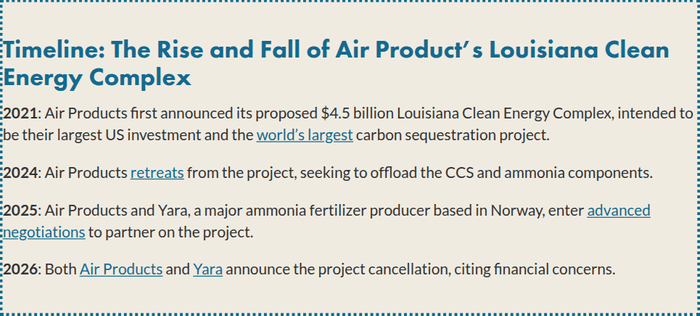
The gas and chemicals company Air Products canceled its proposed $4.5 billion Louisiana Clean Energy Complex, wasting $2.9 billion—more than half of the overall cost—after concluding the project no longer met its financial expectations. Once promoted as the company’s largest US investment—and the world’s largest carbon sequestration project—the cancellation is more than a corporate setback. It is a signal of the end of the so-called “low carbon” hydrogen hype despite years of industry promotion, generous public subsidies, and claims that these technologies can be used to tackle climate change.

This retreat shows that these projects and their false climate solutions are not just unpopular, they’re also a major financial risk to companies, investors, and communities. For Louisiana communities that opposed the project from the beginning, however, the announcement means something else: proof that projects portrayed as inevitable can be stopped.

A Flagship Project That Never Materialized

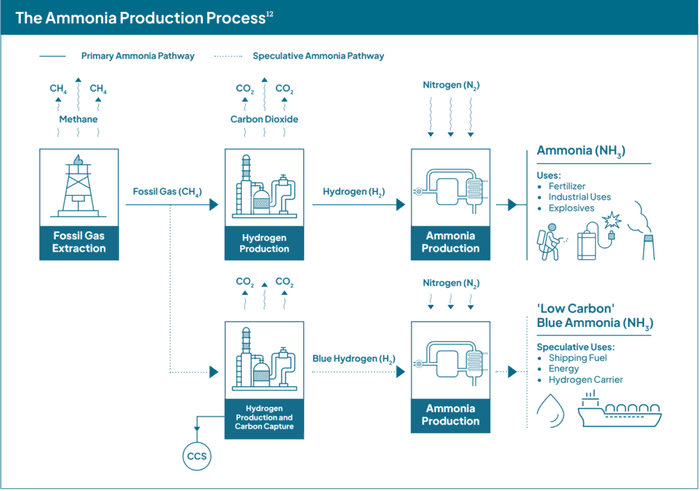
When Air Products first announced the project in 2021, the company described it as a transformational investment. Their plans included the production of 1,700 metric tons of hydrogen per day from fracked gas with up to 95% of emissions mitigated through carbon capture and storage (CCS). They planned to pump the hydrogen—called “blue” hydrogen due to the addition of CCS—through a pipeline along the Gulf Coast for refineries and petrochemical plants, or turn it into ammonia, which is a toxic, fossil fuel-derived chemical—used primarily as a fertilizer.


(Graphic via CIEL Ammonia Factsheet)


That vision quickly began to unravel. By 2024, Air Products was already seeking partners to offload parts of the project, including the ammonia and carbon capture components. In 2025, it entered advanced negotiations with Norwegian fertilizer giant Yara. By mid-2026, both companies announced the project had been abandoned, citing financial concerns and an inability to find customers for a speculative market.

The cancellation reflects a broader reality: Despite billions in public funds and years of political backing, many blue hydrogen projects continue to struggle with rising costs, uncertain markets, and technical challenges.


Why This Matters Beyond One Company

Air Products is not alone. At least 45 hydrogen and ammonia production facilities have been proposed in recent years across the US—mostly clustered in Texas and Louisiana—with only one making it to the construction phase, and many more on hold. Although more than 80% of ammonia produced in the US is used to manufacture fertilizer, much of the proposed buildout depends on speculative markets—including using ammonia as a shipping fuel, hydrogen carrier, and energy source—none of which are possible at scale today.

To make these projects appear climate friendly, companies increasingly market them as “clean,” “blue,” or “low-carbon” by pairing fossil fuel-based hydrogen and ammonia production with CCS. Yet, CCS has repeatedly failed to deliver emissions reductions while putting communities at elevated risk for pollution and related disasters. Despite that record, federal carbon capture subsidies were expanded in 2022 and again in 2025, potentially leading to the transfer of $1 trillion in public funds to private corporations over the coming decades.

The collapse of one of the industry’s flagship projects should prompt investors and policymakers alike to ask whether this business model is built on wishful thinking rather than sound evidence and economics.

Louisiana Was Forced to Bear the Risk


Air Products’ proposed Louisiana Complex would have consisted of a hydrogen and ammonia plant in Ascension, Louisiana, with 38 miles of pipeline sprawling across five parishes, connecting to one of at least 10 separate injection wells underneath Lake Maurepas. The project would have formed part of a larger effort to transform Louisiana into a national hub for CCS.

More than just a proposed storage site, Lake Maurepas is an important estuarine ecosystem beloved by locals for recreational activities like boating, fishing, and wildlife observation. One of the nation’s largest forested wetlands borders the lake, supporting wildlife, commercial fishing, and local businesses. For generations, communities have depended on these waters—not simply for income, but as part of their identity. From the moment residents learned about the Air Products project, they organized against it.

Today, more than 30 CCS projects are under review across the state by the Louisiana Department of Conservation and Energy. Many would be built alongside communities already burdened by decades of petrochemical pollution in the 85-mile stretch along the Mississippi River between New Orleans and Baton Rouge, known locally as Cancer Alley.

These communities have long borne the health costs of fossil fuel development. Siting this experimental and knowingly dangerous CCS technology alongside frontline communities already overburdened by industrial pollution would force them to shoulder another layer of industrial risk, while companies stand to gain hundreds of billions of dollars in public money over the next 20 years through a federal tax credit.

This Isn’t the First Time

The failure of Air Products’ vision is not a surprise to anyone watching the proposed CCS buildout; the ballooning costs and failure to deliver on ambitious promises follow a familiar pattern.

The Kemper “clean coal” project in Mississippi was once celebrated as the future of carbon capture, claiming it would capture 65% of emissions from the power plant. Originally budgeted at $3 billion, the costs of the project more than doubled to $7.5 billion over the seven years of its construction (2010-2017), before the carbon capture system was abandoned altogether. Despite the massive investment, the Kemper facility never operated as promised and was partially demolished in 2021. Local residents are still paying for the corporate loss from this experiment through their electricity bills.

The failure of the Kemper project should have been a warning for future investments and should have prompted the more fundamental question: Who bears the cost of these projects?

While Louisiana leads the nation in oil refining, natural gas production, and chemical production, the state consistently ranks among the poorest and least educated states in the US. CCS projects will no doubt add to the unequal environmental burden that the state population is forced to bear for the benefit of corporations. While many of the hardships can be quantified, the joy and love for the land by its residents is immeasurable. There’s no metric that captures the experience of paddling a canoe across Lake Maurepas, seeing alligators bask in the sun, listening to birdsongs echo across the wetlands, or watching the flotant—marsh grasses that float on top of the water—bob with the waves.


An alligator basks in Lake Maurepas, Louisiana, US. (Photo by Jessi Parfait, CIEL.)


For the communities that have called this place home for generations, protecting the lake has never been about stopping a single project—it has been about safeguarding a way of life. The cancellation of the project is a victory not only for the hundreds of community members who organized against it—showing what is possible when people stand together to fight against false solutions—but also for the future generations who will continue to enjoy this remarkable ecosystem.

The cancellation is also a major win for communities that spent years warning about the project’s risks. Concerned residents across the complex’s planned footprint partnered with environmental groups to speak out at public hearings, organize neighbors, and challenge permits, refusing to accept that the project was inevitable.

Their persistence mattered. For years, the fossil fuel industry insisted that carbon capture represented the future—that projects like this were necessary and unavoidable. But as James Hiatt, founder of For a Better Bayou based in Lake Charles, Louisiana, put it:
Air Products pulling out proves that nothing here is inevitable. Industry wants us to believe these projects are a done deal, that our voices don’t matter. They do. Elected and regulators didn’t hand us this win; community pressure did. Consistent, persistent organizing works.

A Warning for The Future


Air Products’ withdrawal is not simply a failed investment by one company. It is a warning to policymakers considering whether public money should continue subsidizing projects that repeatedly fail to deliver.

Communities increasingly reject being asked to bear new risks in exchange for promises that never materialize. And this failure is likely not the last ammonia and CCS project to be canceled. Even now, many projects are on hold or delayed, further signaling to companies, investors, and communities that they are a bad bet.

The cancellation also sends a broader message: Expensive, speculative technologies designed to prolong fossil fuel production aren’t fooling anyone and companies pushing these risky projects will be footing the bill.


© 2024 Center for International Environmental Law

Jessi Parfait
Jessi Parfait is the senior US carbon capture campaigner at the Center for International Environmental Law.
Full Bio >

Taylor Hodge
Taylor Hodge is the US agrochemicals and fossil fuels campaigner at the Center for International Environmental Law.
Full Bio >
Trump admin accused of 'war crime' after strike leaves thousands without water: report

Julia Conley,
 Common Dreams
July 18, 2026 


A U.S. warship launches a munition at an unknown location during what the U.S. military says is its latest wave of strikes on Iran, hitting "Iranian military targets such as coastal surveillance and air defense sites, military logistics infrastructure, and maritime capabilities," in this still image taken from handout video released July 16, 2026. U.S. Central Command/Handout via REUTERS

About 10,000 people in nearly two dozen villages in southern Iran were without drinking water while the region was under an excessive heat warning on Saturday, after the US struck a water desalination plant in the village of Bonji in one of its latest attacks on Iranian civilian infrastructure.

Islamic Republic of Iran Broadcasting said the drinking water supply was expected to be restored within a week, and emergency supply operations had begun.

Drop Site News reported comments from the deputy governor for political and security affairs in Hormozgan province, who said several missiles had hit power infrastructure and water desalination plants in the region near the Strait of Hormuz, which President Donald Trump has demanded control over as he’s ramped up attacks on Iran in recent days, despite a ceasefire and a memorandum of understanding (MOU) to end hostilities that was agreed to in June.

On 


On Saturday, Iranian officials said the country was suspending its commitments to the MOU after the US violated the agreement repeatedly over the past week.

“The US has violated and suspended all its commitments within the framework of the Islamabad MOU,” said Deputy Foreign Minister Kazem Gharibabadi. “We also likewise have suspended all of our commitments as a result; we are no longer implementing those commitments.”

He added that Tehran is now “busy defending the country.”

A representative for Hormozgan province, Ahmad Moradi, told Iran’s Tasnim news agency that over the past two nights, “about seven to eight people” have been killed in US attacks, all of whom were civilians. One attack targeted a bridge and hit two family cars. The neighborhood of Tappeh Allaho Akbar in Bandar Abbas was also hit, killing a woman and injuring a one-year-old, whose wounds required doctors to amputate.

At least 116 telecommunication towers were out of service in southern Iran Saturday, Al Jazeera reported.

The Iranian Embassy in India posted a video of the destruction of a bridge and also condemned the US attack on a maritime surveillance tower at the Chabahar Port, which US Secretary of Defense Pete Hegseth boasted about on social media on Thursday.

“For


“For a state that once cast itself as the global champion of order, liberalism, and the war on terrorism, proudly displaying images of destroyed bridges and civilian infrastructure has become its only remaining ‘victory,’” said Esmaeil Baqaei, a spokesperson for Iran’s Ministry of Foreign Affairs, on Saturday. “Yet with the collapse of every bridge, every tower, and every civilian facility, it is not merely steel and concrete that is being reduced to rubble. It is America’s moral standing—along with the entire architecture of international law and the civilizational claims of the West—that is crumbling before the world’s eyes.”

According to Drop Site, US attacks have targeted nine bridges, two airports, a railroad junction, and a road tunnel since Wednesday. At least 41 Iranians have been killed and 408 have been wounded in US attacks so far this month, with Iranian authorities reporting that at least three women and one child are among those killed.

In a letter to United Nations Secretary General António Guterres, Amir-Saeid Iravani, Iran’s permanent UN representative, wrote on Saturday that US attacks had “targeted and caused extensive damage to ports, transportation networks, communications facilities, logistics hubs, radar installations, coastal defense systems and other infrastructure indispensable to the civilian population, and to the functioning of the national economy.”

“The continued commission of these unlawful armed attacks poses a grave threat to international peace and security, freedom of navigation, regional stability, and the security of the Persian Gulf and the Strait of Hormuz,” wrote Iravani.

Iran has retaliated against the US this week by striking American allies, including Kuwait, Bahrain, and Jordan. Kuwait’s government Saturday said a power plant and water treatment plant had been attacked for the second time in two days, as well as an oil facility.

Two US soldiers were killed and a third was missing after an Iranian attack on a US military base in Jordan—the first American service members to be killed from hostile fire since an initial ceasefire was brokered in April.

Roxane Farmanfarmian, a professor of Middle East politics at the University of Cambridge, told Al Jazeera that Iranian forces are “using Kuwait, in particular, as an example of what they can do in retaliation.”

“The US is clearly hitting the south in Iran and hitting airports, desalination plants, and bridges, and so the same kinds of things are being hit now in Kuwait to show what kind of effect Iran really can have on those countries that are hosting American bases,” she said.

Kenneth Roth, former executive director of Human Rights Watch, echoed Iranian officials’ condemnation of the US attack on the southern water desalination plant on Saturday, saying it was “not a legitimate military target.”

“It is a war crime to target it,” he said.
Amid Fears of Killer Robots, Humanoid MMA Fight in China Ends With Decapitation

“One brutal kick sent the robot’s head hanging loose.”


Two humanoid robots fight at the Ultimate Robot Knock-out Legend competition in Shenzhen, China on July 17, 2026.
(Photo by Shenzhen Story/YouTube/screenshot)

Jessica Corbett
Jul 17, 2026
COMMON DREAMS

Amid warnings from experts and political leaders about “killer robots,” a Chinese robotics company on Thursday hosted an unprecedented combat tournament in which one humanoid robot decapitated another.

The fight featuring the decapitation—footage of which quickly circulated online—was part of the opening night of the Ultimate Robot Knock-out Legend (URKL) competition in Shenzhen, organized by the company EngineAI, which developed the humanoid.

The Chinese Embassy in Ireland was among the accounts on the social media platform X that highlighted the moment when one robot’s “head” was dislodged.


The “white humanoid robot, named ‘White Eagle’ landed a high kick to the head of its black opponent, ‘Matador,’ which made the robot’s head rock precariously in its socket before rolling completely out of place,” according to Newsweek. “The two continued to spar as Matador’s head was swinging from its socket until eventually the robot fell, crushing its head underneath its body.”

Unveiled last year, the humanoid is called T800, a nod to the Terminator franchise. EngineAI’s website features videos of T800 executing various mixed martial arts (MMA) moves, from a combination punch and a roundhouse kick to punch-kick combos.

EngineAI announced UKRL, the “world’s first” humanoid robot combat league, early this year, seeking 32 teams from universities, enterprises, and research institutions worldwide to compete using its robots. The first round of competition is scheduled for July-August, followed by another round in September-October, and the grand finals in November-December.

As the Chinese tabloid Global Times reported when the tournament was announced in February:
Pan Helin, a Beijing-based veteran analyst, told the Global Times on Monday that such competitions help enhance public awareness of humanoid robots and expand potential application scenarios.

Pan noted that humanoid robots still face technological and practical limitations, and real-world application is key to their further development. Such events could yield positive effects in the entertainment and performance market, which is a necessary step forward in paving the way for further applications in factories or households, Pan said.

Tian Feng, former dean of SenseTime’s Intelligence Industry Research Institute, said that the free provision of T800 robots will lower research and development barriers for smaller companies and promote the integration of applications involving industry, academia, and research bodies.


The tournament’s opening night came on the heels of a series of artificial intelligence events hosted by the United Nations earlier this month, during which Secretary-General António Guterres said that “if AI is to be powerful, it must be governed,” and “my main concern is with ‘lethal autonomous weapon systems.’”

“Let us call them what they are: killer robots,” Guterres continued. “Machines selecting and engaging their target and taking a life—without human control and judgment. That is morally repugnant. It is politically unacceptable. And it must be banned by international law.”

“States are already at the discussion table. But let us not wait for atrocity to act. Some decisions must remain forever human—none more than taking a human life,” he added. “Some might claim that governance is the enemy of innovation. But innovation needs guardrails. The technologies we trust most—in aviation, in medicine, in nuclear energy and beyond—earned that trust because we acted to hold their makers to account.”

As Wired detailed in Friday reporting, “the US military has a long-standing interest in humanoids,” and Sankaet Pathak’s startup Foundation Future Industries aims to “produce an all-American robot supersoldier.”

The startup’s “unique in its targeting of the military market, and so far it’s been lucrative,” the outlet added. “The company has government contracts worth millions of dollars and high-profile backers to spread its message: Eric Trump, the president’s son, is both an investor and the company’s chief strategy adviser.”

This article has been updated to include the Wired reporting.


TATE BROS; RAPISTS ON THE RUN
Pro-Trump influencer jailed in Florida under ‘sealed’ warrant: report

Alexander Willis
July 18, 2026 
RAW STORY


Bucharest, Romania. 21st June, 2023: Andrew Tate and his brother Tristan Tate, surrounded by bodyguards, leave the Bucharest Court/ (LCV - Shutterstock)

Far-right influencer Andrew Tate, a prominent supporter of President Donald Trump, was arrested Saturday in Miami, Florida, the U.S. Marshals Service told the Associated Press.

In 2022, Tate was arrested on rape and human trafficking charges in Romania, though after pressure from the Trump administration, the case ultimately didn’t move forward.

On Saturday, British prosecutors revealed they were “seeking the extradition of the brothers on rape and sex trafficking charges,” the Associated Press reported, offenses that allegedly occurred between 2010 and 2017. A spokesperson for the U.S. Marshals Service confirmed that both Tate and his brother, Tristan Tate, were arrested in Florida Saturday, but could not comment further as the “warrant was sealed,” per the Associated Press.

“The pending charges in the United Kingdom accused the brothers of abusing women between 2012 and 2015 in an area north of London, where they grew up,” the Associated Press’ report reads. “Their lawyers had said they denied the allegations.”

The Trump administration was accused of pressing the Romanian government to ease travel restrictions for the Tate brothers, who hold both U.S. and British citizenship. Further reporting revealed that the brothers were closer to Trump’s inner circle than previously known, with Andrew Tate joining Trump’s youngest son, Barron Trump, on a video call in 2024.

A probe was launched last year over the Trump administration’s alleged intervention in investigations into the Tate brothers.


Saturday, July 18, 2026

ANIMIST CATHOLICS


Faith vs therapy: Inside the Philippine school for exorcists

Manila (AFP) – Asia's only dedicated exorcism centre -- designed to train not only Philippine priests but clergy from across the region -- sits just off a busy thoroughfare in Metro Manila.


Issued on: 19/07/2026 - RFI

An exorcism centre in the Philippines says demands is steady for both the ritual and training of exorcists © Jam STA ROSA / AFP

Inside, neatly made-up rooms for visiting priests line warmly lit halls that lead to a chapel where the 400-year-old ritual takes place.

Holy relics employed in the proceedings line one wall, another features a one-way mirror that allows family members and novice exorcists to observe.

The Michael Center for Spiritual Liberation and Exorcism -- five months old this week -- was built because "cases were piling up", Father Jose Francisco Syquia told AFP.

Trauma driven by bullying, sexual abuse and the pain of separation as family members leave for work abroad has increasingly opened the door to spiritual attacks, he said.


"We had to find a more permanent and secure and private place to pray over people," Syquia said.

The centre's function as an effective school for exorcists, however, is what makes it unique.

Father Jose Francisco Syquia said the exorcism centre in Manila was built because "cases were piling up". © Jam STA ROSA / AFP

"I don't know of any other center in the world that trains exorcists," Syquia said of the two-storey facility built largely with donations from local families of the previously afflicted.

Priests from countries including Singapore, Malaysia, Cambodia and India were already lining up for training, Syquia added.

A key element of that training is discerning the difference between psychological and spiritual problems, he said.
'Beyond science'

While the centre operates without strict Vatican oversight, it follows long-standing Church rules governing exorcism, including mandatory vetting by mental health professionals.

"We have clinical psychologists. We have a psychiatrist... There are also neurologists, so they work hand in hand with us," Syquia told AFP on a visit to the centre.

Still, he insists he knows a demonic possession when he sees one.

Priests from countries including Singapore, Malaysia, Cambodia and India were already lining up for training, the centre said. © Jam STA ROSA / AFP

"You will see a change in behaviour... a different consciousness. Something else takes over a person," Syquia said, noting he had personally exorcised a demon only a week earlier.

"When it comes to the spiritual world, we need something beyond science."

But attempts to draw that distinction have long worried the mental health community.

"If a condition isn't recognised as medical, it delays appropriate treatment," Christopher French, a psychologist and emeritus professor at the University of London, told AFP.

"It's more dangerous to accept the supernatural explanations," he warned, noting that conditions ranging from schizophrenia to Tourette's syndrome were once interpreted as spirit possession.
'A lot of stigma'

The Philippines has roughly one psychiatrist for every 200,000 people in the archipelago, according to the World Health Organization. Some provinces have none at all.

Given the choice between an exorcist and a mental health professional, many in the heavily Catholic country will choose the former, Dr. Kathryn Tan, a Manila-based psychiatrist, told AFP.

"It's a lot of stigma when somebody is brought to a psychiatrist," she said.

"If it's an exorcism... you're a victim, but if you're brought to a psychiatrist, there's a lot of shame," she said.

Many of her own patients came only after first visiting indigenous healers, Tan said, viewing psychiatry as a "last resort".

Tan, who said alleged possessions are often accompanied by symptoms of psychosis, insisted Philippine psychiatrists were not seeking to "compete with the Catholic Church", but rather to bridge the gap between culture and science.

"It's about... compassion and empathy and trying our best to understand without judgement what our patients are experiencing," she said.

Both Tan and French agreed that cultural sensitivities need to be respected in treatment.

"You can shape a treatment to fit the belief system without explicitly endorsing it," French said, conceding an exorcism might even have a beneficial placebo effect in some cases.

Tan, who said she keeps an "open mind" about the supernatural, said it was not surprising when people seek spiritual explanations for something they cannot readily define.

"Perhaps this is our way of trying to control the unknown," she said.

Inside his office, Father Syquia told AFP he was confident science and faith could coexist.

"We're... focusing on the spiritual dimension. But of course, the body is always part of that," he said.

A greater national investment in mental health care might even lighten his own load, he conceded.

"If psychology and psychiatry, if proper mental and emotional health (are) fostered in our country, there will be (fewer exorcism) cases," he said.

"Science is a gift from God."
Greenpeace Africa demands halt to $17bn Kenya coastal oil refinery

Climate rights group Greenpeace Africa has called for a halt to a proposed oil refinery project by Africa's richest man, Aliko Dangote, in Kenya's coastal region, warning of the environmental risks.


Issued on: 16/07/2026 - RFI

A mangrove forest near the resort town of Lamu, on Kenya's north coast. 
AFP - TONY KARUMBA

The east African oil refinery, with a planned capacity of 700,000 barrels per day, was confirmed earlier this month to be located at Kenya's Lamu port, ending months of speculation that Tanzania could host the project.

"This project threatens to damage one of East Africa's most fragile coastal ecosystems while locking Kenya into a risky fossil fuel future," Sherelee Odayar, Greenpeace Africa Oil and Gas campaigner, said in a statement.

The group said the oil refinery, which is expected to take about 30 months to build, will lead to "habitat destruction, marine degradation, oil spill risk and dangerous air pollution".

"Lamu's mangroves, coral reefs and seagrass beds are not expendable. They support fisheries, livelihoods and coastal protection," the NGO said.

Nigerian businessman and Africa's richest man Aliko Dangote attends the Africa Forward summit in Nairobi on 11 May. AFP - LUDOVIC MARIN

Greenpeace Africa called for the $17 billion project to be suspended pending an independent environmental assessment before any approvals are granted.

"No approvals should move forward without a full, independent environmental and social impact assessment, genuine public participation and transparent scrutiny of the long-term economic, health and ecological risks," Odayar said.
Job creation

Kenyan President William Ruto has praised the project, arguing it will create jobs.

Around 800,000 Kenyans join the labour market each year, according to the World Bank.

But Greenpeace said the project will only "create temporary jobs while undermining existing livelihoods in fishing, tourism and small-scale local economies".

"This refinery also risks becoming a stranded asset as the world moves toward cleaner energy. It would also lock Kenya into decades of carbon-intensive development, worsening climate change and its impacts," it said.

Lamu was designated a World Heritage Site in 2001, as it includes the oldest and best preserved example of a Swahili settlement – lamb Old Town – as well as a number of marine protected areas surrounding the archipelago.


Lamu Old Town. © Unesco

The site was at the centre of previous disputes over fossil-fuel projects.

Last year, Kenya’s High Court halted plans for a proposed $2 billion coal-fired power plant, stating that the project "failed to meet public participation requirements," ending a six-year legal battle over the facility.
Zimbabwe’s gold rush adds fuel to a deadly surge in malaria

Mutare, Zimbabwe – In Zimbabwe, open pits left by informal gold miners and filled with stagnant water create breeding grounds for mosquitoes. Health experts say mining is worsening a surge in malaria infections, already spiralling due to funding cuts and climate change.


Issued on: 18/07/2026 - RFI

A miner panning for gold along Mutare River in Mutasa, in Zimbabwe's Manicaland Province. © Farai Shawn Matiashe


By: Farai Shawn Matiashe


In Penhalonga, a gold-rich area in eastern Zimbabwe, George Mutsoka woke up one morning suffering from fatigue, a severe headache and joint aches.

The 43-year-old artisanal miner was too weak to work, so he went to rest at his home in Chishakwe village, just outside Zimbabwe’s second-largest city, Mutare.

By late afternoon, his situation had deteriorated and he sought help from a village health worker. He tested positive for malaria and the health worker gave him treatment.

“I took the medicine for three days. After a week, I had recovered,” he told RFI.

Mutsoka soon returned to Penhalonga, where he works as an informal miner searching for gold.


Ideal conditions for mosquitoes

There are thousands of artisanal miners in Penhalonga, who carry out open-pit and riverbed mining.

Malaria cases have been spreading fast in this mining community and others across Zimbabwe, as stagnant water pools left by miners prove ideal conditions for the mosquitoes that transmit the disease.

Virginia Chakandinakira, the village health worker in Chishakwe who diagnosed and treated Mutsoka, says that all the malaria cases she documented in her community this year originated elsewhere.

“I have treated four people. Interestingly, they are not based in this village. Some of them are artisanal miners from Penhalonga and others are family members who followed to stay with their husbands in that area,” she says.

A Ministry of Health official, who was not authorised to speak to the media, confirmed to RFI that movements of mining communities are making it harder to get malaria under control.

“Our interventions usually target immobile people. Artisanal miners are mobile and bring complications to the interventions,” said the official.

Stagnant water in open pits left by artisanal miners in Mutasa, in Manicaland Province in eastern Zimbabwe. Such pools are breeding grounds for mosquitoes that can transmit disease. © Farai Shawn Matiashe

Sungano Mharakurwa, director of Africa University’s Malaria Institute in Mutare, says artisanal mining – and mining in general – has intrinsic environmental impact, including habitat expansion for mosquitoes.

“There is a high risk of outdoor malaria transmission, which is not amenable to control by mainstay indoor-based house spraying and bed nets in the mining areas,” he says, adding that research is underway to innovate more ways to prevent malaria in such settings.

Another complication is “the cosmopolitan background of the miner population”, Mharakurwa explains. Many miners migrate from non-malarious regions where they did not grow up exposed to strains circulating locally, leaving them especially susceptible to the disease.


Deadly surge

Artisanal miners often sleep in makeshift tents without mosquito nets or repellents.

Nyasha Mungwasho, another informal miner from Penhalonga, says his wife and child contracted malaria after they visited him in May. They successfully recovered after Chakandinakira treated them in Chishakwe, their home village.

Mungwasho reports seeing several of his colleagues infected while they worked in Penhalonga.

A village health worker testing a patient in Mutare for malaria. Zimbabwe has since cases surge in the past year. © Farai Shawn Matiashe

Malaria cases have spiked in Zimbabwe in recent months. Between January and mid-April 2026, 65,399 cases were recorded, compared to roughly 36,000 in the same period in 2025 and 17,000 in 2024, according to the Zimbabwe Ministry of Health’s National Malaria Control Programme weekly surveillance report.

Deaths from the disease also surged to 174 between January and April 2026, double the 85 recorded in 2025 in the same period and five times the 34 in 2024, according to the same report.

Experts say this rise in malaria cases is because of a combination of factors, including mining as well as funding cuts and climate change.
Loss of US funding

United States funding cuts imposed shortly after President Donald Trump assumed office in January 2025 led to the discontinuation of critical malaria control programmes in Zimbabwe.

Some of the programmes crippled included the Zimbabwe Entomological Support Programme in Malaria (Zento) at Africa University, which provides the country’s national malaria programme with scientific research to combat the disease, and the Zimbabwe Assistance Programme in Malaria II (Zapim II) that supported high-burden districts by strengthening malaria diagnosis, treatment and prevention.

“The funding cuts affected Zento, which was contributing key malaria mosquito surveillance technical data for guiding game-changing malaria vector control by the National Malaria Control Programme,” says Africa University’s Mharakurwa.

The university has since used emergency funding from private donors to restart its malaria work.


Thomas Chuchu, a health programme lead at Save the Children Zimbabwe, which helped implement Zapim II, said the funding cuts disrupted key activities such as the distribution of long-lasting insecticidal nets.

The programme worked through the existing Ministry of Health system, targeting 11 districts across Mashonaland Central, Mashonaland East and Matabeleland North. There are shortages of diagnostic kits, frontline health workers report, while some communities are without mosquito nets.

A malaria test showing a negative result in Mutare. Zimbabwe relies heavily on foreign donors for essential equipment such as diagnostic kits. © Farai Shawn Matiashe

The cuts also disrupted the leading US malaria control programme, the President’s Malaria Initiative (PMI), which operated across dozens of countries in Africa. Mharakurwa says the withdrawal of funding left communities in Zimbabwe stranded, given that PMI provided substantial budgetary support for procuring malaria medicines.

Given that US funding was supporting an impactful portfolio of health programmes, including malaria, he believes its abrupt termination is bound to have aggravated the disease’s spread.


Effects of climate change


Heavy rains have also played a role. Chuchu says Zimbabwe’s current malaria surge appears to be linked, at least partly, to the high rainfall experienced in the previous season.

“The rains created favourable breeding conditions for mosquitoes, particularly in already endemic provinces such as Mashonaland Central, Manicaland, Mashonaland East and Mashonaland West,” he says.

Mharakurwa says climate change is worsening malaria outbreaks amid a lack of resources to control the vector-borne disease.

Without protection, Mutsoka and other artisanal miners remain at risk.

“I recently bought a sleeping bag. But we still do not have a mosquito net or repellent,” he says.
France's wheat production to fall after heatwaves push early harvest

The wheat harvest in France, Europe’s largest grain producer, is expected to fall by 4 percent compared to 2025 after an unusually early harvest carried out during successive heatwaves.


Issued on: 17/07/2026 - RFI

A French farmer harvests wheat in his field, in Ligne, near Nantes, western France, 30 June 2026. © Stephane Mahe/Reuters

France is forecast to produce 32 million tonnes of wheat in 2026, according to the French agriculture ministry's first estimates published on Thursday.

The ministry's statistics office, Agreste, estimates the average yield at 6.93 tonnes per hectare, down from 7.42 tonnes per hectare in 2025.

This drop comes despite an increase of three percent in the amount of land planted with wheat.


Deteriorating growing conditions

The decline is largely due to deteriorating growing conditions towards the end of the season, as crops were hit by successive heatwaves, according to Agreste.

France is the European Union's biggest wheat producer and one of the world's largest wheat exporters, making its harvest an important benchmark for global grain markets.

For many French farmers, the smaller harvest is another setback after months of protests over low incomes, rising costs and regulation.

Industry groups have increasingly warned that more frequent heatwaves and droughts are adding to the financial strain on farms.


Heat hitting harvests

Conditions for the crop were generally good until May, before early heatwaves accelerated the cereal harvest, first for barley and then for wheat.

The extreme heat also made harvesting more difficult, with restrictions introduced in some regions where even a small spark from a combine harvester could start a fire.

The biggest losses were in central and western France, which have been hit hardest hit by drought and repeated heatwaves, while northern and eastern regions generally reported better yields.

France’s barley production is also expected to fall, down six percent, to 11 million tonnes, driven by a drop in spring yields of the crop that is particularly affected by the hot weather.
Global prospects

The heat has also taken a toll on maize. FranceAgriMer said crop conditions had fallen to their lowest level in at least 15 years following repeated heatwaves and a lack of rainfall.

French farmers race to adapt as repeated heatwaves hit crops and livestock

In its latest monthly update, the International Grains Council (IGC) left its 2026/27 global wheat crop forecast unchanged, but it cut its outlook for global maize production by 4 million tonnes, to 1.306 billion tonnes.

"Prospects for the 2026/27 maize harvest have been adversely affected by successive heatwaves in parts of Europe," the IGC said.

It lowered its forecast for France’s maize forecast to 9 million tonnes, down from its previous estimate of 12 million tones.

European grain trade association Coceral has also lowered its outlook for the EU maize harvest, citing weather damage in France and Hungary.