You Can’t Drink Data: Native Communities Are Resisting the AI Death Cycle
“These are tools to extract from who we are to erase us,” says organizer Krystal Two Bulls.
By Kelly Hayes ,
August 6, 2026
LONG READ
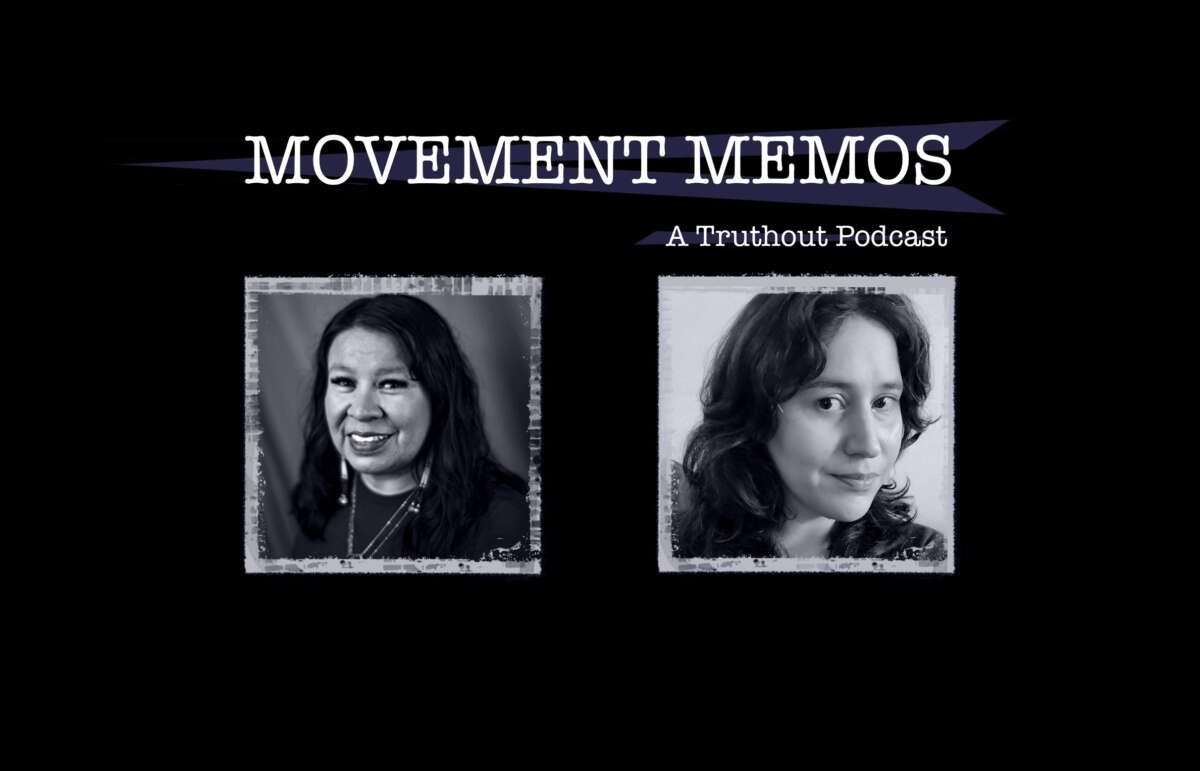
“It comes down to the stealing of everything that is and the taking of everything that is,” says Joseph White Eyes. In this episode of “Movement Memos,” host Kelly Hayes talks with Native organizers Joseph White Eyes and Krystal Two Bulls about the struggle against data centers in Native communities. The conversation explores how the AI boom is advancing a new era of colonial extraction, and how Native communities are resisting land grabs and exploitative technologies.
Music: Son Monarcas and Sarah the Illstrumentalist
TRANSCRIPT
Note: This a rush transcript and has been lightly edited for clarity. Copy may not be in its final form.
Kelly Hayes: Welcome to “Movement Memos,” a Truthout podcast about organizing, solidarity, and the work of making change. I’m your host, writer, and organizer Kelly Hayes.
The AI boom is being built through the seizure and exploitation of land, water, minerals, human creativity, and data. In the book Empire of AI, Karen Hao writes, “Over the years, I’ve found only one metaphor that encapsulates the nature of what these AI power players are: empires.”
Today, I’ll be talking with Krystal Two Bulls and Joseph White Eyes of Honor the Earth about the AI boom as a colonial project and the growing fight against data centers in Native communities. As ravenous tech companies race to build the infrastructure AI requires, and the Trump administration strips away environmental protections to help them do it, Indigenous lands and communities are being targeted — and organizers are fighting back.
If you appreciate this podcast, and you would like to support “Movement Memos,” you can subscribe to Truthout’s newsletter or make a donation at truthout.org. You can also support the show by subscribing to “Movement Memos” on Apple or Spotify, or wherever you get your podcasts, or by leaving a positive review on those platforms. Sharing episodes on social media is also a huge help.
Truthout is an independent news organization, publishing stories that the craven corporate press won’t touch. We are a union shop with the best family and sick leave policies in the industry, and we could not do this work without the support of readers and listeners like you. So thank you for believing in us and for all that you do. And with that, I hope you enjoy the show.
[musical interlude]
Kelly Hayes: Joseph White Eyes and Krystal Two Bulls, welcome to “Movement Memos.”
Krystal Two Bulls: Yeah, thank you for having us. I’m really excited to have this conversation.
Joseph White Eyes: Yeah, definitely appreciate being here as well.
Kelly Hayes: How are you all doing?
Krystal Two Bulls: I am doing great. I am in the middle of strategic planning, visioning some of the work that we have for our future, specifically around this conversation, but also enjoying the beautiful views here in Montana.
Joseph White Eyes: Yeah, I’m doing great too. Spending a lot of time getting ready for ceremony here back in the Homelands. So excited for that, but also looking forward to that as well.
Kelly Hayes: Can you introduce yourselves and share a bit about the work you do?
Krystal Two Bulls: Yeah, so my name’s Krystal Two Bulls. I’m Oglala Lakota, Northern Cheyenne. I reside in Northern Cheyenne territory in Southeastern Montana. Just basically a grassroots organizer who ended up in an executive director position. I’ve organized around just different Indigenous rights, environmental justice, and just really excited to be here right now.
Joseph White Eyes: Yeah, my name is Joseph White Eyes. I’m a member of the Cheyenne River Sioux Tribe located in Central South Dakota. I also come from the Siha Sapa and O’Hanupa, bands of the Lakota people. And yeah, I’ve been organizing against the fossil fuel industry for a number of years. And then with my work for Honor the Earth, it’s been more towards critical minerals and now the current data center fight. So it’s been a big learning curve in understanding the different, I guess, contexts behind everything. And yeah, it’s been great so far.
Kelly Hayes: Well, I’m really glad to be talking with you about this work. You’ve both spent years organizing against fossil fuel extraction and in defense of Indigenous lands and waters. How did that work lead you into the current fight over data centers, and what connections began to emerge as you learned more about the industry?
Krystal Two Bulls: Yeah, I mean, I can share a little bit generally of what brought us to this point and then Joseph can jump in. But I’ve been organizing around the fossil-driven industry as well for a long time, Indigenous rights, just broadly across many different areas that intersect with Indigenous rights as well and climate justice, environmental justice. But for this in particular, it was probably about just over a year ago, there was a small modular nuclear reactor that was proposed for the community that I live in. So I reside 15 minutes north of the Northern Cheyenne Reservation. It’s a coal mining community. They have two coal-fired power plants, a coal mine, and now have been kind of targeted as a place for a nuclear power plant. And so, I basically went to the meetings, listened to the meetings, and basically they said that this is a site where there’s absolutely no deterrents whatsoever for having nuclear.
Also, what happened during that same timeframe was the Montana State Legislature passed legislation that allowed for uranium enrichment and for nuclear waste storage in the state of Montana. And so those two things triggered some research on our end. And so our team started to dive in, and we quickly found out that the reason why that they were pushing for a small modular reactor in Colstrip was because they needed the nuclear power to power the hyperscale data centers that were planned for the state of Montana. So right now, the state of Montana has a 4,000-acre data center proposed for Broadview, Montana, which is maybe about an hour and a half, two hours from that community that I live in. And so, once we found out that that was proposed and that 4,000 acres would, if it goes through, it’ll be the largest hyperscale data center in the state or in the United States actually, not just the state of Montana.
And so once we realized that, all of a sudden, we started getting just slammed with data centers all over in our communities targeting tribal lands, rural communities were getting targeted. And so we just started doing research and trying to figure out what the impacts of these things were. And so, we just started to quickly organize research and anything that we researched or that we found out, turned around and put it out to communities. But I think what we’ve seen, or at least what I’ve been able to see, is that this community was targeted because it’s a fossil fuel-impacted community. And so, the coal mining that was happening there, as we know, coal is a dying industry.
And so there’s a lot of fear in these communities that they will no longer have jobs, there’s no livelihood for them there, things like that. And so, this other corporation comes in and basically targets them and plays into that fear and says, “Well, we can offer you this. There’ll be jobs for you. It’s going to benefit the community,” all of these things. But what our research has actually shown us is that the jobs that exist with these hyperscale data centers and these nuclear power plants don’t actually go to the local communities that are already impacted. And so, what we started to see is that actually fossil fuel-impacted communities, rural communities, and Native lands are all targets because of our access to large land bases, because we have access to water, also because there’s jurisdictional issues. And also, it’s easy to deem us as sacrifice zones for critical infrastructure.
And so, I think a lot of that intersects with a lot of the work that Joseph and I have done in the past around pipelines, coal mining, and then even with the just transition around critical minerals mining, because there’s going to be a large demand for critical minerals mining to get these minerals to create the GPUs [graphics processing units], the servers, the air conditioners, all of these things for the actual hyperscale data centers themselves. And so, I think there’s a lot of intersection right now. And so, a lot of the networks that we’ve built with some of the previous fights have proven to be helpful in this fight as well. And they are also being targeted. And so, it’s just a natural fit that we transition from, not away from fossil fuel, but build from those campaigns into this data center fight that we’re carrying right now. So yeah.
Joseph White Eyes: One of the biggest things that I always talk about when having conversations with our elders, our leaders, and our spiritual people is that if we can quantify our data, then they can sell our data. And so, a lot of times in relationships to these data centers, that’s really what it comes down to. It’s not just the environmental factors of our waters, our lands, nuclear energy phasing out of fossil fuels, but it also comes down to our specific data of who we are as tribal people, as tribal nations. And the moment we engage with things such as large language models or generative AI, that information no longer belongs to us. And when we try to use those same tools that they developed out to try to build what we want to call data sovereignty, if we use their tools to try to build that out for our tribal nations, what we’re seeing is that these multi-billion dollar companies now have access to that information because we use their tools and there’s lack of oversight.
There’s no meaningful policy on guiding principles on what that would look like as far as tribal nations maintaining and really securing what they want to, I guess, reach as data sovereignty. So we’re seeing problems like intellectual property rights. We’re seeing things like our language and culture being taken and bastardized. And so, that’s been one of the big parts of our work here too, has really been education for our tribal communities and helping them to understand that it’s more than just a data center that’s coming to take our land. It’s more than just our water disappearing, but it’s also about us as individuals and our data and what we strive to, I guess, preserve for the well over 500 different tribal nations here on Turtle Island. And that’s one of, like I said, the big conversation that I try to have with our traditional folks, our spiritual leaders and everything related to that.
Kelly Hayes: Can you say more about how Honor the Earth is approaching this fight? How are you helping people understand the larger infrastructure behind data centers, and how are you supporting Native communities that want to organize against them?
Krystal Two Bulls: Yeah, I mean, there’s so much right now, but I think generally right now what it looks like for us is there’s a couple of different ways we’re approaching this. One is on the narrative front and really connecting all of the dots. And so, when we are talking about hyperscale data centers, we’re not just talking about the physical or the material manifestation. What we try to do on the narrative front is really connect it all the way back to the demand for generative AI right now. And the demand for generative AI is directly linked to militarism so that way we can have autonomous AI in warfare. And so that’s what we try to really focus on. And then from there to have generative AI though and to advance it in the way that the United States is, basically they have to build out the physical infrastructure, which is the hyperscale data center.
The cloud is not this invisible place. They are physical buildings that create heat islands, that can cause cancer, that are connected to rare cancers, that are connected to killing off bees. There’s so many negative impacts. And so there’s the hyperscale data center, which houses the data itself. From there, you actually have to have critical minerals. Like I mentioned earlier, you’re going to have to have the critical minerals to create the GPUs, the servers, all of those. And so we know that there’s the exploitation of our relatives in the Congo, in Kenya, in the Philippines, in these different areas currently for their critical minerals. But in this current administration, they’re pushing for everything to be done domestically now. And so what we’re going to start seeing is that the demand for these critical minerals are going to shift towards Indian Country because we have access to that.
Many of our nations live on top of these critical minerals, critical mineral deposits. And so there’s already a long legacy of that. We already know that there has been a rollback of protections, a rollback of any kind of restrictions, and then a fast tracking of this mining. And so we’re going to start seeing those impacts to get these minerals specifically for data centers. And then from there, you have to power these data centers. You have to have energy. Many of these hyperscale data centers require more energy than the cities that they’re next to. So you’re going to start seeing places like Lake Tahoe who actually were notified that they are going to have to find a whole different way to power their community because their utilities company is actually going to be going and pulling all of their energy to these individual homes and providing electricity and energy for a hyperscale data center moving forward beyond 2026.
And so we’re going to start seeing that. And I think recently we just heard that seven states are starting to experience blackouts where the grid is going down, there’s no electricity specifically because they’re powering hyperscale data centers over homes and the grid cannot handle the amount of electricity that needs to be pumped through. So we’re already seeing that. And so you’re seeing the demand for energy, but that means that you’re going to see revitalizing the coal industry. You’re going to see an uptick in the frack gas world. You’re also going to see the advancement in the fast-tracking of nuclear. We’re also seeing Native communities being targeted for that as well. And that doesn’t even take into consideration the conversation around uranium mining, around uranium milling, uranium enrichment to create the fuel that’s needed.
But then also the broader conversation of the nuclear waste that comes from these nuclear power plants, because there is no long-term nuclear waste facility in existence in the world. And so you’re going to see this nuclear waste staying in the communities where these power plants exist. And also, you’re going to see them going to Native lands or other Indigenous lands globally to actually house this nuclear waste. And so that’s coming. And then all of this connected to empowering surveillance, the very surveillance that we’re seeing with the Flock cameras that we’re seeing connected to ICE, that we’re seeing surveil our communities and our tribal nations that are on the borders, the false borders. And so we’re already seeing the impacts of all of that play out across the country, and then all of that towards militarism. And so we’re seeing a lot of direct connections obviously of using generative AI within the military.
I think it was released in an article a couple of weeks ago where the first account of generative AI making the autonomous decision to kill. But before that, we also have generative AI making the decisions about targets, about what is an acceptable human life loss to getting the target. And so this is already happening. It’s already playing out. And so for us, it’s really important that every time we speak about hyperscale data centers, that we speak about the entire infrastructure, which we call the AI death cycle. It’s important to know that this is not just about the physical manifestation of the hyperscale data center, but it’s about the entirety of it in the way that this current administration is fast-tracking and rolling back protections right now for everything. And so that’s one way that we’re fighting is the narrative front. The other way is by organizing. And so we have a national coalition that’s comprised of 36 different Native nations, 14 different states, and they’re all Native Indigenous folks who are organizing actively in their communities.
Honor the Earth has committed to providing toolkits for them. We provide templates, we provide fact sheets, we provide presentations that they can change and modify to fit their own community. We’ve launched a data center tracker across Indian Country specifically, so that way we know which one of our lands and tribal nations are being targeted and we can support them, and that’s growing every day. And then, we also are able and are just now starting to work on tribal resolutions for tribes to protect themselves around things like intellectual property, property rights, generative AI practices and policies, and also just creating moratoriums or flat out bans for hyperscale data centers themselves on Native lands. And so we’ve been doing a lot of that. And so not only are we supporting these coalitions and providing that for them in addition to the research, but we also have people and organizers directly on the ground in communities, specifically in South Dakota, Montana, and Oklahoma. We’ve had a lot of progress in Oklahoma and a lot of victories. Some of the largest Native nations in the country have passed moratoriums.
And I think just recently we got a full-blown ban coming out of Oklahoma as well. And so we’ve been doing that work in Montana. We’ve kind of gone the strategic litigation route of pushing back on them. And in South Dakota, we’re still actively organizing. There hasn’t been any direct attacks on our lands, but we’re definitely doing the legwork in terms of building out and educating the communities and making sure that they’re prepared to push back for when we know that they’ll target our communities there. And so we’ve been organizing both just directly in our own communities, actively on the ground, and then also zooming out and supporting communities on a national level as well. But yeah, so that’s the two things that we’ve been mostly doing is on the narrative front and then the direct grassroots organizing and site fights, really.
Joseph White Eyes: Yeah. And to just add to that too, and other parts of organizing and education, we really made a lot of our information public. So if you take a look at our website, you’ll see all the different flyers, you’ll see the template presentations, our data center tracker, and just questions for tribal nations to ask data center developers. And as was mentioned, we do have that large coalition. And as an organization, we’ve been really focused on working with tribal nations, especially in those three areas that were mentioned – Montana, South Dakota, and Oklahoma.
And we’ve been, also with the coalition itself, we’ve been able to host informal talks. We’re calling them fireside chats where we just go in and talk about the different issues related to hyperscale data centers. And in there, we talk about nuclear, we talk about just every part of the death cycle. And it’s just for people to get well educated to learn more and to learn how to fight back in their communities. And that’s been one of the, I guess, good experiences here at Honor the Earth is that we don’t hog our information. We’re really open to sharing it with community members so that tribal communities are well-equipped to push back, to make policy in their communities, and to organize their people and really stop data colonialism as it continues to come towards us.
Kelly Hayes: And our listeners can find all of that information and those templates and resources at honorearth.org, which we will also drop in the show notes.
The AI industry uses the term “AI lifecycle” to describe the stages involved in developing, deploying, and operating AI systems. But you all use the phrase “AI death cycle” to describe the larger infrastructure and impacts that make those systems possible. Can you explain that reframing?
Krystal Two Bulls: Yeah. Yeah, because essentially what we’re saying is those elements are the infrastructure that allows for generative AI to be directly linked to militarism. But I think we try to reclaim as much as we can. And so definitely ultimately what this is is both a play on that and also the reality that all of those things, they’re going to have just immense impact on our communities and negatively impact them. I mean, we’re talking about potential ecological collapse in some areas because just from the heat islands alone that are created from the heat that these hyperscale data centers emit, I mean, it’s all the way up to 16 degrees that they can increase the temperature. When you hit numbers like that, and then you add the high temperatures and the climate disasters that exist because of climate change, you’re looking at total ecological collapse in some areas. And so, that is death, and that is a death cycle. And so, it’s also the literal meaning and the literal things that are happening as well.
Kelly Hayes: I appreciate the way you’ve retooled the terminology, because the phrase “AI lifecycle” really encourages us to associate life with mechanisms that are not alive and are, in fact, compromising life — and that kind of framing deserves to be turned inside out. So what do people generally understand, or misunderstand, about generative AI and data centers? What myths most need to be addressed?
Krystal Two Bulls: I can name a couple, but I think some things that we ran into just right off the bat was around water positivity in the closed-loop water cooling systems. And so those were the first things that we started to address and to put information out to the communities. And so what we found though is that these corporations have been monitoring and obviously they know what we’re putting out, and other groups as well that we’re in coalition with. And so what they started to do is switch up their language. So now, they’re saying that not only are they not going to have a negative impact on the water, but actually they will help create water positivity in these communities that they have a hyperscale data center built in. And so they are actually claiming that they are going to have a positive impact on the water to the point that the water is going to be even cleaner than it was before, and there’ll be more of it for the community to use.
Kelly Hayes: Water positivity? That is such a strange and confusing bit of word play.
Krystal Two Bulls: Exactly.
Kelly Hayes: It’s not like sex positivity. It’s not like people are going to have more and better water because we’re so laid back and open-minded about it.
Krystal Two Bulls: Exactly. And that’s their goal though, is they’re confusing people. And so I have sat with actual tribal leaders who run tribal nations and make decisions for their people, and they believe this stuff. They are genuinely believing it. And so they’re also believing that there are and is such a thing as a closed-loop water system. So you can think about a transmission in a vehicle, but that is not what is happening with these hyperscale data centers. They have to cool them constantly, consistently. So even if they’re running water, they’re reusing the water that they’re running through there over and over, natural evaporation’s going to happen. And you always have to actually flush your transmission. You have to do that with a closed-loop system because there’s PFAS [Per- and polyfluoroalkyl substances] in there and it’s injected with other chemicals that create a lubricant so it doesn’t erode the pipes.
And so you have to flush that at some point. You can’t just keep recycling it. And so even that is not a fully correct statement. And then on top of that, now we’re starting to hear about the corporation that wants to sue over accessing the hundreds of thousands of gallons of water from the Colorado River when they initially told the community, actually, we won’t even take any water, but now that they’re not getting access, they’re suing over it. And so they’re just blatantly lying. And so those were two things that we ran into right off the bat. I think the other thing that we run into is around data centers and data sovereignty. And I think those are two different things, and Joseph alluded to that earlier, but I think it’s important that we hold those things as two separate things. So there is data sovereignty.
Our communities need to have control of and ownership of our own data and be mindful of who has access to that. But when you are approached by a hyperscale data center, you do not have control of the data that’s going into that hyperscale data center. Also, just because they give you a shelf in that hyperscale data center, that means tribal data can literally sit right next to child pornography. It can sit next to information that’s shared that leads to the genocide in Gaza. And so it’s just like you don’t have control over those things, and that does not equal data sovereignty. And so I think that’s the thing, too, that I run into with our tribes and with our tribal leadership specifically is that they think that those two are equal. If we build a hyperscale data center here, then we have data sovereignty, which is not accurate.
And in fact, tribes don’t even need, most tribes in fact, don’t even need the amount of space that is created with the hyperscale data center to house their own tribal data. And so I encourage them to do their own data assessments of what they actually need and what their real needs are to house all of their tribal data. And most likely the little data center that is a server room that already exists either in the casino or the tribal building is sufficient. That’s sufficient for your tribal data. You don’t need a hyperscale data center.
Joseph White Eyes: When we talk about the different sizes of what is a hyperscale data center versus a smaller scale data center, as Krystal mentioned, tribal nations, folks, different job placements and whatever else have those servers in their computer rooms to store information for who they are. And some of them could be as small as a refrigerator, and then some of them could be as large as a mile wide by a mile long. And I think knowing the difference between who the data center belongs to, does it belong to the tribe? Does it belong to these multi-billion dollar corporations, as mentioned earlier, that we know that we won’t and will not ever have any access or control over to any of that information that’s being stored there?
Kelly Hayes: What arguments or new pieces of information have you seen help people understand the threat data centers pose? When people change their minds or come around to believing action is needed, what tends to break through?
Krystal Two Bulls: I mean, broadly, I feel like what we have found is that people do not like their right to consent taken away. And so yeah, that’s been one thing where these data centers and these corporations are removing people’s ability to consent to this. The other thing is that what we’re finding is that sometimes people, they really don’t care about the environmental impacts, the impacts on water or things like that. They feel like it doesn’t impact them. But what they do care about is the fact that they are watching their utilities bills skyrocket. And in fact, these corporations are being allowed to charge their rate payers upfront for the hyperscale data center. And so they do not like seeing that their bills are being impacted directly in this moment, and that’s already been happening. And so I think those are two broad points that have moved people.
And then you get into the impacts of water is another one where people, they’re definitely acknowledging that we’re in the middle of a drought and also this is going to impact that. And then I think also the health impacts themselves is that we’re getting research now and information directly from the communities who already have hyperscale data centers built next to them. And so just knowing that they are now pushing out that data, pushing out that information, we are able to take it and to really solidify that. And so I think the fact that hyperscale data centers are tied to rare cancers, they’re tied to a lot of diseases in the respiratory system like asthma or COPD [chronic obstructive pulmonary disease] and things like that. They’re also tied to the killing of bees.
So farmers are starting to see the impact, the direct impact of the fact that they do not have pollinators anymore. You have the heat islands, things like that. And so I think that once we can push out that information and you push out data or you push out studies or research or facts, then I see a bit of a shift in people. And those are all secondary though, but I think broadly, people, they really do not like the idea of their consent being taken, and they definitely do not like the idea of paying for these things out of pocket. But I know that it’s a little bit different too, so Joseph probably has some more thoughts of directly how it’s playing out in our communities.
Joseph White Eyes: Yeah, it’s been almost the same here in the state of South Dakota too with our farmers and our ranchers. One of the biggest things as mentioned was the utility rates and the water usage and the noise as well. A lot of these build-outs are out in the smaller communities, but those smaller communities are still going to have to deal with the noise pollution, the different health effects. And then, of course, another big thing that always gets brought up with the non-Native communities is the non-disclosure agreements. And seeing that the data center developers are coming into these communities and talking with elected officials beforehand and having them sign these agreements saying they can’t talk about this, they can’t talk about the water usage, they can’t talk about the amount of electricity. They can’t even talk about something as simple as what’s being stored in this data center.
And that’s been one of the big key things that’s been brought up all across the board is what we’re seeing with NDAs [non-disclosure agreements]. And then specifically when talking about Indigenous sovereignty, and one of the conversations around the education portion is that AI will never be able to accurately learn our languages. And again, there’s over 500 tribal nations in the United States, and that’s not even including the state recognized ones. That’s not including the tribal nations that have to go through 501(c)(3) because they never got recognition. But it comes down to when giving these big tech corporations access to our knowledge, we will always risk misrepresentation. We will always risk appropriation.
And it creates what I like to call Pan-Indianism where it just blends everything together and saying, “This is what a Sun Dance is,” or, “This is what Lakota ceremony is.” “This is how you speak the Lakota language,” and it gives you these prompts for these languages. And it has nothing to do with our language. It’s not even our language at all. And it just combines everything and just puts it into one big mush of information, giving AI the ability to try to describe who we are with the amount of inaccuracies that are related to it. And so the other things that we’re facing are the capacity for legal infrastructure.
How are the over 500 different tribal nations supposed to regulate these multi-billion dollar companies? A lot of what we’re facing in our communities in a lot of the tribal nations is that a lot of us are 20 years behind the rest of the world, and we don’t even have regulations to put even something as simple as an environmental impact statement for some of the tribes. And how are we supposed to now regulate or support and uplift tribal nations to regulate multi-billion dollar companies that have the money to back them, have the lawyers, have the capacity to be able to do what they want to do in our communities? So I just wanted to name that part.
Kelly Hayes: You’ve both named different things that can break through: the loss of consent, rising utility bills, secrecy, and threats to language, sovereignty, and treaty rights. Can you give me some examples of moments when one of those connections moved people from concern or confusion into action or deeper understanding? What made those shifts possible?
Krystal Two Bulls: I mean, I think in our communities, an example of that I think is what we started to see is people play on the narrative of water protectors. And so I think in Native communities, we have the legacy obviously of Standing Rock. And before that, the many other pipelines like Line 3, the Magellan pipeline that’s currently being fought, the Bridger pipeline, KXL, the previous iteration of the Bridger. And so we have that long legacy of water protection. And I think what I’ve seen happen and start to play out in some of these communities is that people started to connect the dots about protecting water with hyperscale data centers as well or against them. And so I’ve seen a shift in our people and in our communities when that narrative started to come out more. And so I have seen that. But I think an example of some of this is really, so we did an action camp down in Pyramid Lake Paiute territory.
We were able to support the community there with just some hard skills, with some basic introduction to Organizing 101, things like that. And from that really came a campaign around “you can’t drink data.” And so from there, they were able to mobilize their community after learning the hard skills, learning the facts about hyperscale data centers, continuing to do their own research, own their own work, build out their own coalitions, their own networks, and they were able to actually get the city of Reno to pass a moratorium on hyperscale data centers right now. And so that was a huge victory. And so I think that was one example of where we’ve seen with a little bit of support and with some resources and the facts that a community was able to take that and push back and are continuing to push actively in this moment as well.
And so I think that’s one example, but we’re watching these fights play out and it’s a little different in every community about what is the fact that gets them? You know what I mean? Which one? Because some of them, it’s been the water. That’s absolutely been the catalyzer. Other communities, it’s all about the fact that they didn’t give consent and they did not like the fact that everything was done through NDAs and in secrecy. Or other communities, they’re worried about the fact that the sound pollution is impacting them and they can’t sleep at night, and that’s what mobilizes them. And so it just depends. And so we’ve seen a lot of different facts be the catalyzers for different communities across the country as of right now.
Joseph White Eyes: Yeah. Here, one of the conversations was with our treaty folks, and we had conversations around generative AI and how it affects our treaties, our law, and just the basic understandings of federal Indian law and what that means. And giving those examples of generative AI, I guess citing sources wrong when it came to certain law cases or law studies and seeing the criminalization of people of color because of the foundations of how these AI models are built. They’re mainly built by middle-aged white upper-class men that create these different projects for surveillance, create these projects for the criminalization or being able to preempt what a criminal is going to do and certain things like that. So when we had that conversation around honoring our treaties is how can we uphold our treaties if we’re giving our information away to these multi-billion dollar companies? And so that was one of the big game changers for some of our treaty delegates here on the Cheyenne River Reservation.
Another example was the art that comes from AI and how it really takes away a lot from artists themselves when creating images for different events, different flyers, and certain things like that. And it shows a lot of misrepresentation in that art as well when developing it out because it’s pulling all this information from whatever data server it has on what you’re asking it to create.
And it’s just creating things that aren’t made by humans. And sometimes you see things in there like extra fingers. You see people in the background that are distorted. You see different animals that could be distorted and certain things like that. And so it really takes away from art itself and the artists that are out there really trying to build themselves up and creating meaningful art, if they’re creating it for their events, if they’re creating it for their culture, their people or certain things related to that. And it loses that much more of a meaning and understanding of how beautiful art can really be outside of generative AI.
Kelly Hayes: What you’re both describing — the distortion of treaty knowledge, the appropriation of culture, and the extraction of human creativity — connects to something you’ve named in your educational materials: AI and data center expansion as a new era of colonialism. What does that mean to you? And what continuities do you see between this expansion and earlier forms of extraction and dispossession?
Krystal Two Bulls: Yeah, I mean, I think that’s exactly what we’re seeing is that capitalism is this driving force. So that way they can capitalize and make money off of the extraction of, at the end of the day, Native lands. And so we already know what that legacy is with settler colonialism removing us from our lands, trying to move us all into Indian territory in so-called Oklahoma as a sacrifice zone. And so we know what the impacts are. We know what the tools were that were used to enforce that and to remove us from the lands. And now, we’re seeing another iteration of that or a new era of colonialism in that they’re starting to utilize critical mineral or critical infrastructure as naming all of this as critical infrastructure, which is similar to the era of “Manifest Destiny” and then utilizing eminent domain to remove people off of their lands, off of their homelands, out of their homes even for this critical infrastructure that they’re deeming.
And so I think it’s just a new era of that. It’s a new iteration. It might have a different name and it may not look the way it did before, but it’s most definitely the same playbook just in today’s time. And so for us, we’re really seeing that all of this, because of the push for everything to be domestic here in the so-called U.S., that it’s going to come back to Native lands and it’s going to fall back on tribal sovereignty being the last line of defense against a lot of this, which during settler colonialism, we were the last line of defense in protecting Mother Earth as well. And so really comparing the whole process, it’s very similar even though it might have different names and different timelines.
Joseph White Eyes: One of the biggest things when it came to the boarding school era and the colonization of our land, one of the key things was always “kill the Indian and save the man.” But this time, it seems to be kill the man and take their land. But this time, they’re not looking to save anything. They’re looking to extract all of our resources and everything that we have, including our sovereignty when it comes back to the emphasis of federal Indian law and related to that. What protections now do we have for tribal nations? And that’s something that we’re working to develop out when we talk about those resolutions on supporting the tribes to develop out policy and procedure when regulating our intellectual property, when trying to preserve our language, our stories and our songs, and even our images.
But yeah, we see the same exact playbook that they’ve brought onto us since well over 500 years ago when Columbus was lost at sea. And it’s not something new that we are fighting. It’s, again, going back to that same playbook of repeating history, and then we have to just come up with a new way of pushing back and organizing based off of how they’re developing up their projects within our communities. And we’ve seen this similar thing happen back in the ’80s when they came into our communities trying to promise certain things related to economics when they said, “Well, we can come in and create jobs for you.” And an example of that would be the uranium industry. When they came into Navajo Nation or even here in the state of South Dakota, they came in saying, “Hey, we want to get this uranium out. We’re going to promise you jobs. We’re going to promise you this. We’re going to promise you payouts and money.”
And then now, we see a lot of that same infrastructure sitting there empty and our tribal nations are still poor. A lot of those affected communities that become those sacrifice zones are still suffering and dealing with the aftermath of that sort of colonialism that comes. And it comes in all forms. And it’s not just been one way. It’s been through economics, it’s been through spiritual attacks, it’s been through, again, “kill the Indian, save the man.” And now, it’s just data colonialism, and that’s what we have to name it. And that’s what we have to call it in order to really, I guess, push back and understand the severity of the dangers that it holds for tribal peoples, but not just tribal peoples, but all people in general.
Kelly Hayes: These insights also make me think about the long history of colonized people being treated as experimental populations, with their communities turned into testing grounds for harmful technologies and ways of governing.
I recently read some disturbing reporting by Michael Sainato in The Guardian about a planned AI pilot program at Salamanca High School, on the Allegany territory of the Seneca Nation. The district planned to introduce an AI teaching assistant and a humanoid robot designed to mimic human expressions and conversation. The company behind the robot was previously a cryptocurrency company and later acquired a manufacturer of realistic sex dolls.
Teachers and families raised concerns about privacy, the dehumanization of educators, and Native children once again being used as test subjects. Some people invoked the legacy of residential schools and questioned what it would mean to impose an artificial performance of human connection on children who are already losing access to elders and endangered languages.
After significant public backlash, the district put the program on hold. So this is also a story about Native people successfully defending their children and their experience of what it means to be human, including what it means to teach and to learn.
But the attempt to present an invasive experiment on Native children as progress feels deeply connected to what you’ve described as a new era of colonialism. When you hear a story like this, what feels familiar?
Krystal Two Bulls: Yeah, I mean, I think all of it feels extremely familiar. And I’m so, so proud of that community for pushing back and just standing their ground on that because what it’s called is sandboxes. So the industry is basically deploying AI curriculum. They are going to schools that are low income or that do not have access to the same resources or privileges that wealthy communities have access to. And basically they’re going to these communities and they are offering new computers or a brand new basketball court or a new facility or whatever it might be, the social bribing that happens with this industry. And then asking them to implement AI curriculum. And then they’re testing that on our children to see what the impacts are going to be, or even to train these models. Because the way that AI works, generative AI specifically is humans have to train them. They have to be taught the things. And so they’re basically using our children as testing grounds and training grounds for generative AI, and then they’re bribing us with that.
And when you go to communities that have lived in extreme oppression and poverty in survival mode under intentional and systematic attempted genocide, of course, are they going to say no to these things? Because we want our children to have access to good things as well. But the thing is when you actually listen to interviews of these different tech oligarchs and them talking about their children is they will actually say their children are not allowed to have iPhones. They’re not allowed to use AI. They’re not allowed to use these platforms because they already know what the impacts are. And the impact is definitely cognitive decline. So we’re already seeing this come out of the world of academia and the education field where they are telling us that the children who have been exposed to it, who have been utilizing AI in the classroom, they are actually going into the next grade. So they’re going from elementary to middle school or middle school to high school or high school onto college, and they are not prepared.
They are literally not equipped to think critically to go into these next grades because they have become so dependent on AI for their answers. And that is intentional. That is an intentional thing that is happening to our communities because why is that not happening in wealthy communities across this country? Why are these tech oligarchs not introducing this to their children? It’s because an uneducated population and now an unintelligent population is easy to control. And so for me, that is very intentional. And it does go back to the “kill the Indians, save the man” in terms of boarding schools, because now they haven’t been able to kill us in any regard. And so what are they doing? They’re literally creating people who are cognitively not capable of pushing back on them. And so to me, that is what that move is doing. And that is extremely dangerous that that is happening to our communities. And so when you look at that, it’s very specifically Black communities, brown communities, poor communities. And it’s definitely not communities that have access to resources.
Kelly Hayes: I really appreciated what you said about how the industry exploits an entirely reasonable desire. Parents and community leaders who have watched their children be denied resources and opportunities want them to have every possible advantage, and that desire is being used to sell them something that may actually set young people back.
And that exploitation extends far beyond the classroom. What does the AI buildout require and extract from communities? How are those costs falling on Indigenous lands and peoples?
Joseph White Eyes: Yeah, I can go ahead and start there. As mentioned earlier, when creating these unlikely alliances with a lot of the MAGA folks or the folks that really don’t agree with environmentalism and certain things around that, we’re seeing a unity come together around the build-out of these data centers when it comes to our electrical costs, when it comes to our water usage, and really understanding who owns the water, who controls the water, how is all of this information quantified? And it comes down to the stealing of everything that is and the taking of everything that is. And now, as mentioned earlier, when I said “kill the man and take the land,” they’re not trying to conserve any sort of human thought process whatsoever. They’re just trying to phase us out in the workplace. They’re trying to phase us out with, again, our education and our health systems, making everything AI so that we don’t have control over our lives.
When it comes to mining metals and critical minerals, as was mentioned earlier too, that tribal communities are sitting on a lot of these bedrocks that really hold a lot of these things that their GPU units, their computer chips need in order to continue operating, to continue moving like copper versus things like nuclear, nickel, and whatever else, all the different rare minerals. And we’re seeing this administration now currently adopting all these different federal exec… Or pushing out these federal executive orders. I think so far, we’ve seen about 18 of them come out related to just AI specific[ally] and hyperscale data center buildup. And in those, it always talks about the need for AI, the need for the build out of these data centers, the need to upgrade our electrical grids because we don’t have the capacity.
And what we’re seeing is that a lot of this relationship is really related to the build-out of these multi-billion dollar companies in order to expand what they want to work on, what they feel like progress is taken away from the local communities, the local individuals that rely on the resources such as water, rely on the resources such as land, and it being stolen has really been, I guess, the uprise and pushback against the build-out of these hyperscale data centers. So it’s really relational, not just to tribal nations, but all across the board. And we’re seeing all these unlikely alliances popping up, pushing back because they realize that there’s more than just the environment at stake. They realize it’s more than just our electrical rates going up. They realize that it has a relationship to militarism.
And the biggest thing right now is the surveillance of our people, the surveillance of what we’re scrolling, the surveillance of what we’re looking up, just us driving down the street in relationship to the Flock cameras, who has access to that information, not us as a general public, but those multi-billion dollar companies and other folks that we have no policy or procedure to even, I guess, understand how to govern what that would look like for the protections of those who use those different systems that are there to really keep us down, to really survey us, and to really continue extracting from our communities.
Krystal Two Bulls: Yeah, just following up on that, I think that’s why we push so hard on the death cycle of AI is to really uplift and to highlight that this all comes home to Indian Country. This comes back to our communities. And so really just looking at in terms of numbers, the Colorado River is expected… They’re expected to sue for 260 million gallons of water because that’s how much water that they’re anticipating utilizing a year. They’re also looking at 50,000 residents in Lake Tahoe that I mentioned earlier. That’s how many people are going to go without electricity after the end of 2026 because a utilities company made the decision to prioritize a hyperscale data center over that community. Or you’re looking at seven states that will experience rolling power outages because of the sheer amount of electricity that will be pushed through an extremely outdated grid that exists.
And then you’re looking at the jobs in terms of [the] way that this impacts communities and people. Everyone argues, and that’s one of the ways these corporations approach us is they say, “Well, it’ll provide jobs.” The reality is that it will not provide jobs. It may provide construction jobs for up to two years max in the construction phase of these hyperscale data centers. However, after speaking with different employees or construction folks that have already built out numerous hyperscale data centers across the country, they tend to stick with construction companies that have experience in creating these. And so they tend to lean towards them and give them the bids versus the local communities. And they’re not going to train our local folks to go and have these jobs. They’re not invested in us. And then even in Rapid City, there’s a data center that’s proposed for Rapid City.
And on their very own postings about this, they said at the end of construction, there will be two full-time jobs for this hyperscale data center, two full-time jobs. That’s it. And so it’s important to understand that they’re not following through on any of those things. And then that doesn’t even include the air contamination. And so we’ve worked with our relatives over in Memphis and they’ve been organizing. They have Colossus 1 and now Colossus 2 over there in Memphis. And so their communities are dealing with the impacts. They’re starting to get higher rates of cancer. They’re starting to get asthma, things like this. And their contamination in their air, when they ran their own, they put their own sensors out to track their own health, they found that the contamination level was 75 percent higher than that of the EPA standard. And so they’re lying to them. The community asked about the air quality initially, and they told them that there would be no impact. And now, their people are getting sick. And so these have direct impacts on communities and people.
And I think also the other thing is the construction jobs that we talk about, oftentimes it’s the unions that we’re running into that are really fighting for these jobs. And I get it. I understand our communities do need these things. However, these unions are going and they are fighting to support these hyperscale data centers in these communities. But what they’re not thinking about is the fact that these corporations are the same corporations that pump millions of dollars into union busting, into pushing back against the unions on the legislative level. And so they are actually doing the dirty work of these corporations, and then these corporations are going to turn around and screw over these unions. And so it’s important to understand who we’re actually dealing with here and that we’re not dealing with people who have a conscience. We’re not dealing with people who want to invest in these communities. And so I think that’s important to also understand when we talk about the impacts on our communities and the people.
But also just like I mentioned earlier with the death cycles, looking at what Joseph said, our communities sit on top of large metal and mineral deposits. And so right now, you can track federal legislation, presidential orders, the different guidelines or the mandates that are being put back. You can track the rollback of the protections that exist within the EPA and all of these things. You can track those things and you can see that they’re opening the door for mining that doesn’t have to go through public comment periods or they don’t have to go through an environmental impact statement. They don’t even have to consult tribes anymore. And so there’s all of these things that are going to come back and it’s going to be Native lands that pay that price. But I will say the last thing in terms of the impacts on communities and people is the spiritual impacts. And Joseph was talking about this earlier. It’s just like our ceremonies are already online right now.
The AI, generative AI is creating videos about Sun Dance. It’s creating videos or a little how-to tutorial for how to create a sweat lodge, or they are creating all of these things that are not accurate about our communities and our people, nor are they appropriate to be online in that way. And so I think it’s important for us to understand that these are not tools for us to reclaim our culture and for us to reclaim our language. These are tools to extract from who we are to erase us. And that’s extremely scary. That is something that people are not thinking about. And even when you’re learning language, yes, there are probably large language models that exist out there that can teach some languages. This is true. However, what are we sacrificing for that? Not only the environmental impacts, but also the social impacts of the very fabric of who we are as Native peoples. And so we have T-shirts that say, “Ask your auntie, not AI,” but there’s more to it than just the quote.
We’re saying instead of turning towards a large language model online to learn your language, go ask a human that exists right now who is still alive. Because our language isn’t just literal learning and memorizing the things. It’s the emotions. It’s the feelings around it. It’s the interaction with the land that you’re actually on where this language came from. It’s the mannerisms when you speak. When elders speak to us, they carry themselves in certain ways. They have different sounds. There’s gutturals and all of that that come with the language. And AI can’t teach us that. They cannot teach us how to be Lakota. They cannot teach us how to be Cheyenne or whatever our respective nations are. And so I think it’s important to understand the spiritual impacts on our people as well, and that’s extremely dangerous because it erases who we are.
Kelly Hayes: I’m also thinking about a recent story about the Trump administration’s decision to exempt power plants built solely for data centers from the Clean Air Act program that regulates pollutants associated with acid rain. The EPA describes that exemption as cutting red tape. But what’s really happening here is that the government is reorganizing environmental policy to make this buildout cheaper and easier, while human beings and the natural world are expected to absorb the pollution, the depletion of water supplies, and the destruction caused by mineral extraction.
At the same time, this administration is politicizing disaster aid and has tried to condition assistance on the embrace of voter ID laws and cooperation with ICE. It is making communities more vulnerable to climate disaster while using people’s vulnerability to expand state control.
You all have drawn connections between AI companies, militarism, ICE, surveillance, and violence against the earth and Indigenous peoples. Can you talk about how those pieces fit together?
Krystal Two Bulls: Yeah, I mean, that’s what this all is for. Generative AI is not to make the workforce more efficient. It’s not to teach languages. It’s not any of that. The reason why they’re pushing so hard and gutting any protections, fast-tracking everything, making everything so conducive and easy for these corporations to come in and extract and exploit is because it’s for militarism. In the name of surveillance and militarism, there’s more money to be made there. And I think that’s the big thing that we really work to convey to our communities. And I think that’s probably the most difficult thing to convey to our communities as well. But I do think that we are not new to that either. And so I think you look at our O’odham relatives on the border. And so the fact that they have been living under surveillance for how long? They have Israeli surveillance technology on their lands and have had it on their lands for decades.
And so it’s like they were being tested on far before. And the surveillance and the militarism that they’ve had to endure and still endure and still live through every day. Now, we’re starting to see that on the northern border with our other relatives up there. And so I think we’re not new to these things in terms of the way that surveillance, we can reference Standing Rock, the fact that they use social media and facial recognition and things like that to identify people to throw into lawsuits. And so I think, yeah, we know that this is something that they target us with. And so this is actually the strategic planning retreat that I’m at right now. This is what we’re building out is the next iteration of our campaign. And so we know that we cannot continue to do site fights because it’s like playing whack-a-mole.
We actually have to go straight to the infrastructure that allows this stuff to happen. And so we’re building out the next iteration of our campaigns to really address that. But I think a lot of it is on the narrative front because I do think a lot of times our communities…. We are so in survival mode that our relatives are just trying to make it through the week or the day and put food on the table, pay the bills. Most of our communities are just barely one paycheck away from houselessness. We’ve been living in these conditions. And so I think that sometimes when we’re talking about these things, it feels like it’s not connected to the struggles that we’re going through. However, I think some of our work is to really connect the dots about how this is and already has been affecting our daily lives.
And so I think continuing to build out that narrative is something that we’re still working on. But I do think that we’re no strangers to the way that surveillance is operating in our communities, nor are we strangers to the militarism and the violence that comes with it. And so for us at Honor [the Earth], it’s not a surprise about the violence that will come with generative AI making their own decisions within the military. And I think really bringing that narrative to our communities and letting them know this is how we are going to be used and we do have to fight back. We do have to protect our communities from this. And so yeah, there’s more to build out around it on the narrative front, but generally I think that’s kind of the way that I’ve been approaching it.
Joseph White Eyes: Yeah. In its relationship to ICE, surveillance, and violence of Indigenous peoples, we’re seeing a lot of technologies come out from the use of generative AI and different things related to that by some of these larger multi-billion dollar companies. And how we’re seeing some of that take place, as mentioned earlier, is that the build-out of these technologies are built by white middle-aged men to… I guess it’s starting to look like it’s meaning just to suppress us and take everything that we are. And there’s a history there related to that of that racism that’s being built out in these different technologies. And we’re seeing that.
And so a lot of the foundations and the build-out of these are built out of colonialism, are built out of racism, and the misidentification of who the bad actor could be or who the bad actor could potentially become based off of the inaccuracies of crime rates that are out there, the inaccuracies of certain things of our history, of how we operate and organize in our communities. And it’s really being used to develop out a police state to continue forcing the average citizen to submit to the federal government, to submit to the powers that be that are in office now. And it’s wrong.
It’s something we have to break away from. And those are conversations that we have to continue having in our community so that our people are able to understand just something as simple as the systems that are being built are racist and how do we have those conversations?
Kelly Hayes: You’ve both talked about the need to move beyond fighting one site at a time, and also about refusing the idea that this build-out is inevitable. For people listening who may feel overwhelmed by the scale of what you’re describing, where can they begin? What should Native people and others who want to fight data centers be doing right now?
Krystal Two Bulls: Oh man, there’s so much. But I think the biggest thing is: get educated. Don’t just take what is shared for fact. Dive in deeper. Do your true education. The other thing is we can all be shifting away from the use of generative AI. It is not inevitable. Our whole organization, we de-Googled. We moved to Proton Mail, and that was a really difficult process. And also, I’m extremely proud of us for doing that. There’s some glitches, there’s things that we’re still figuring out, smoothing out, but also we feel more safe, we feel more secure, and we have the right to choose whether or not we want to engage with generative AI. And we’re starting to do that in other areas that we’re engaging in as well. We’re looking at other types of phones that don’t allow for them to tap into the microphones and things like that.
And so it’s like we’re genuinely trying to find alternatives. We have a webinar that’s coming up around how to create flyers without generative AI. So all of the ugly generative AI flyers that are circulating across Indian Country right now, I have found that most of the time when we reach out to folks and we let them know, “Hey, these are the impacts. Here’s some artists or graphic artists that we can be utilizing.” Most people, they’ll hear you out. And so I think getting educated, removing generative AI from your life as much as you possibly can, and going to the alternatives that exist out there, and then getting organized, sharing that information, share that with other folks. We work really hard to get out facts to people and make them as digestible as possible and user-friendly as possible. And so share those, share all the information that you can out in our communities because we have to fight back against this.
And I think, also, connect with other folks. And so, one thing that has allowed us to be successful in the different areas where we’ve had successes is building out coalitions and unlikely alliances. And I think that’s something that’s also, I think sometimes it can feel overwhelming or we feel alone or we feel like when we’re fighting back against some of the most concentrated wealth in the world that we’re going to get defeated or it feels overwhelming or we get paralysis. But I think whenever we’re able to unite with other communities that have already lived through the impacts, who are currently fighting or any of those things, it makes us that much more powerful and it makes it that much more doable. And so I think get engaged with other communities, get engaged with other organizers or other folks doing that work. But yeah, those would be the things that I would recommend.
Joseph White Eyes: Yeah. It always comes back down to educate yourself, especially more with what you’re familiar with in your field. And that could be an artist pushing back against AI and understanding, digging deeper into that and what that would look like on how to push back. That would be a healthcare professional understanding that gen AI or LLMs could misdiagnose and going based off of the education and the knowledge that has been there through experience, personal experience. And when talking about that, encouraging Native folks to understand that the knowledge of our grandparents means a heck of a lot more than the knowledge we’re getting from these LLMs or generative AI itself. And it has that much more meaning and more understanding because there’s stories there that AI could never understand in our relationships that we have with our language, our cultures and everything in that. And other things, it’s okay to have those hard conversations. If you feel that it’s wrong, have that conversation and more than likely you’ll end up changing the minds of those that may have been tricked into that.
Kelly Hayes: Thank you both so much. I really think this conversation will help people understand the connections between colonialism, AI, and data center expansion, and how this buildout is threatening the earth and our communities in ways many people may not have fully considered. Joseph and Krystal, I know how much important work you’re both carrying, and I’m really grateful that you made time for this conversation.
Joseph White Eyes: Yeah, thank you for having us. I really felt like this was helpful and giving myself insight as well, so thank you.
Krystal Two Bulls: Definitely. Thank you so much. I think the more that we can get people to start thinking about this and at least thinking critically and asking questions, the more powerful this resistance will be. And so yeah, really thank you for sharing your platform and sharing your voice.
Kelly Hayes: I also want to thank our listeners for joining us today. And remember, our best defense against cynicism is to do good and to remember that the good we do matters. Until next time, I’ll see you in the streets.
Show NotesYou can learn more about Honor the Earth’s work and find resources for the fight against data centers here.
You can find more resources about fighting data centers here.
You can find Michael Sainato’s reporting about the robot pilot program here.
An important fundraising appeal: 9 Days to raise $50,000
Truthout is one of only a few platforms for justice-oriented, grassroots journalism. Today, as political censorship from the right intensifies, we have no choice but to ask for your help.
We are fundraising right now to cover our basic operating expenses. If you can support Truthout with a one-time or monthly donation, you will make a significant impact on our work. Anything you can do makes a difference — we appreciate your support.
This article is licensed under Creative Commons (CC BY-NC-ND 4.0), and you are free to share and republish under the terms of the license.
Kelly Hayes
Kelly Hayes is a Menominee author, organizer, movement educator and photographer. She is the host of Truthout‘s podcast Movement Memos, and the creator of Organizing My Thoughts, a weekly newsletter about politics and justice work. She is co-author of the book Let This Radicalize You, with Mariame Kaba, and editor of the upcoming book, Read This When Things Fall Apart: Letters to Activists in Crisis. Kelly’s written work can also be found in Teen Vogue, The Huffington Post, Yes! Magazine, Pacific Standard, The Appeal and numerous anthologies. Her movement photography is featured in the “Freedom and Resistance” exhibit of the DuSable Museum of African American History.