Showing posts sorted by date for query MAN RAY. Sort by relevance Show all posts

Monday, August 10, 2026


Smugglers Attempt to Ship Meth From Germany to Australia Inside Car Parts

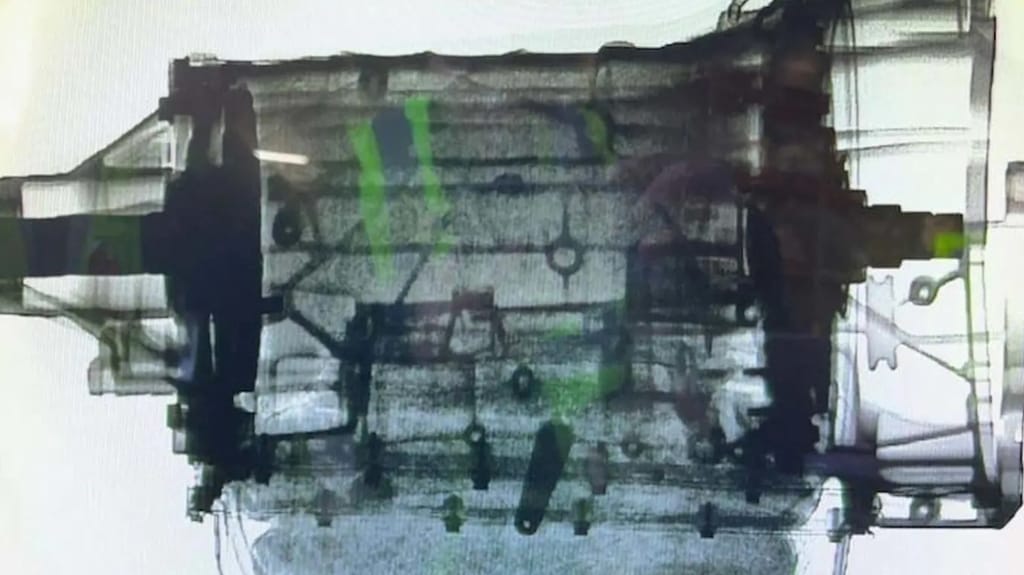
A transmission filled with 13 kilos of meth rather than gears (AFP)

Published Aug 9, 2026 9:25 PM by The Maritime Executive


Australian authorities have charged two men with trying to smuggle methamphetamine into the country in a shipping container of car parts last month. The unusual routing of the shipment - from Europe into Australia - is a sign of the exceptional demand for stimulants on the Australian market, and the profitability available for smugglers. 

On July 27, Australian Border Force officers were examining a shipping container of car parts and decided to give a closer look to a vehicle transmission in the consignment. X-ray examination revealed abnormalities, and when officers opened it up to look, they found five plastic bags filled with a white powder. The substance tested positive for methamphetamine - 13 kilos of it, worth about AUD$1 million per kilo.  

The ABF handed it over to the Australian Federal Police (AFP) for further investigation. AFP officers replaced the drugs with similar bags of an inert substance and sent the shipment on its way, under monitoring. The final destination was an industrial facility in a Sydney suburb. 

The AFP alleges that an 18-year-old man gave false information to collect the consignment, then pulled the "dirty" transmission out of the container and moved it to a location in the adjacent community of Greystanes. At that location, the 18-year-old provided the transmission to a 41-year-old man, the AFP claims. 

The 41-year-old individual was arrested at the scene. The teenager attempted to flee, AFP alleges, but was caught shortly in a foot chase. A third man escaped from the scene. 

The 41-year-old man faces charges of importing a commercial quantity of methamphetamine, and both face a charge of attempting to possess. These charges all carry a maximum sentence of life in prison. 

"Organized crime groups are constantly evolving their concealment techniques, but so too are our intelligence, targeting and detection capabilities to stay ahead of these methodologies," Superintendent Patwardhan said. "ABF officers use targeted, intelligence-based profiling to identify high risk imported consignments, and sophisticated technology to inspect them for any irregularities."

Australia has a higher demand for cocaine and methamphetamine (per capita) than anywhere else, and the drugs command a high price. The shipment intercepted on July 27 originated in Germany - itself a high-value drug market, ordinarily a destination rather than a point of origin - before making its way across the seas to Australia, where it would be worth even more. 

Tuesday, August 04, 2026

KULTURKAMPF

Right Wingers Claim Rap Music Is Dead Thanks to … Elon’s USAID Cuts

Nikki McCann Ramirez
Fri, July 31, 2026
ROLLING STONE


Ella Langley's mournful country ballad "Choosin' Texas" has broken record after record, sitting atop national and international charts for weeks in a row. The Rolling Stone pick for song of the summer is an easy earworm about love, loss, and the Lone Star State, but some on the right are hearing their own favorite tune: a global conspiracy.

No, the fever swamps of the right are not taking the stance that Langley is a nepo baby, or industry plant, or inflating her streams, — that would be too straightforward. Instead, over the past few weeks, some of the most prominent figures on the cultural right have spread conspiracies claiming that Langley's breakout hit was able to reach such heights because Elon Musk and DOGE defunded the U.S. Agency for International Development (USAID).

The conspiracy asserts that somehow, with its roughly $40 billion annual pre-Musk budget, USAID had been propping up the American rap industry, to the detriment of other, more "American" genres. They claim that by eliminating USAID — the now defunct international humanitarian aid agency — DOGE opened the doors for "American" country artists to once again top the charts — as if rap music is not one of the most quintessentially American cultural creations in the nation's history.

Their evidence? Well, the timing of the DOGE cuts coincides with a resurgence of country music's popularity on streaming charts. Maybe this seems plausible if you squint real hard, ignore actual streaming data, and also common sense. There's also a very blatant element of racism undergirding the whole thing.

In May, far-right social media poster and would-be musician Steve Frassen put out a call to his followers on social media. "ATTENTION PROUD WHITES:Everyone who hated rap in the 1990's and 2000's is VINDICATED," he wrote. "Rap isn't music.It's government PISS that was funded by USAID to dumb down Middle America. Take a victory lap, proud Whites who didn't fall for it!"

Within weeks, the claim made it onto the podcast of the perpetually credulous Joe Rogan, who spread it to his millions of listeners. "There's some people that believe that gangsta rap when it came about in the 1980s [… was popularized by] some faction, the government, some faction, some intelligence agencies wanting to create more crime," Rogan said — referencing older, also debunked conspiracies.

"People are pointing out that right now is like one of the rare times where no rap music is on the charts, and they're saying, 'Well, how does this coincide with USAID [being defunded]?' Was USAID like actively promoting rap music?" he went on. "Was that one of the reasons why rap music was so possible? Popular? Is that real? That can't be real."

Rogan's engagement with the conspiracy, which up until that point had been contained to the more extreme cesspools of social media, brought it to the front door of the right-wing creator economy.


Podcaster Tim Pool told his listeners in late July that "Maybe it was the USAID."

"Rap music just vanished from the Billboard Top 40 for the first time in 35 years. Strange, a couple of months — so this would have been about four months after the shuttering of USAID — rap disappears from the Billboard Hot 100. Interesting," he added.

While Langley has held the top spot for an impressive 40 weeks, the genre has not "disappeared" from the charts for that same amount of time, as some right wingers are claiming. On July 31, Drake, Lil Baby and Young Miami all held spots in the Top 20 of the Billboard Hot 100. Mac Miller, Ty Dolla $ign, Don Toliver, BabyChiefDoit, and a slew of other artists made the list.

Pool, who seems to be stuck in the perpetually embittered aesthetic of a 2000s Hot Topic teen, went on to suggest that the Black Eyed Peas somehow benefited from this government intervention. "I want you to think about that Oprah performance — the Black Eyed Peas are there — and there's a big crowd, and on camera, it looks like everybody loves this band, and the song is played on the radio, and it's put in the playlists, and you will listen to what they tell you to listen," Pool complained, possibly in reference to a 2009 Oprah show kickoff party.

Click slop creator Benny Johnson claimed on Thursday that "libtards" had no response to Langley and were "in shambles" over Langley's success. To be clear, there is no discernable backlash to Langley or her music, and she has not spoken publicly about her politics.

Johnson described the hit as a song about "loving Texas," an example of the manner in which many of these creators are incapable of actual cultural comprehension and are instead simply regurgitating slightly remixed versions of formulaic culture war skirmishes for clicks.

"We were suppressed and our culture was manipulated and psy-opped by our own tax dollars and intel agencies, and Elon Musk shut it all down with USAID," Johnson said. "Libs have no answer to it. So produce another piece of mumble rap garbage, please, CIA, and tell us that we're going to like it."

He repeatedly emphasized that Langley's song had broken records set by Whitney Houston and Mariah Carey, two Black female artists, and added that the "queens of pop music" had been "traded for true American culture."


Country music is absolutely seeing a resurgence in popularity, with artists like Kacey Musgraves, Morgan Wallen, Luke Combs, and Stella Lefty all scoring major hits. As previously reported by Rolling Stone, R&B and hip-hop still remain the most popular streaming force in the first half of 2026 when taken as a whole, even as other genres gained steam. Latin, K-pop, and other foreign-language artists have also seen exponential growth.

The decline in rap and hip-hop's presence on the charts can at least partially be attributed to a controversial rule change that Billboard made in October of last year. The outlet decided to weigh paid subscription streams more heavily than ad-supported ones, setting the stage for the Hot 100 singles chart to not feature a single rap or hip-hop artist in the top 40 spots for the first time since 1990. In response to the change, YouTube pulled out of its data-sharing agreement with Billboard in December, writing that the new policy "doesn't reflect how fans engage with music today and ignores the massive engagement from fans who don't have a subscription." (Billboard and Rolling Stone are owned by the same company, Penske Media.)

It's far more likely that the genre's chart troubles have more to do with these factors, and broader ups and downs in listening patterns, than the defunding of a government agency focused primarily on health and development aid abroad. But right-wingers are not interested in the nuances of streaming data and genre growth. They see an opportunity to continue fomenting racist, nativist grievances on the back of a young artist who has done nothing to court a position as the right's latest culture war obsession — except perhaps produce a chart-topping single in the genre she loves.


Country Songs Take All Five Slots in the Billboard Hot 100’s Top 5 for the First Time in Chart History

Chris Willman
Mon, August 3, 2026
VARIETY


Country music is ruling the roost like never before, at least when it comes specifically to the Billboard Hot 100. For the first time in history, country songs are claiming all five of the top five slots on the Hot 100. That's thanks to Ella Langley and Morgan Wallen, who currently stand at No. 1 on the singles and albums charts, respectively… and to Taylor Swift's return to country for a hit soundtrack… and to newcomer Stella Lefty officially joining the ranks of hitmakers.

To no one's surprise, Langley's "Choosin' Texas," the biggest single of 2026 so far, maintains its No. 1 perch in chart results reported by Billboard on Monday. Wallen's new single, "Been by Now," premieres at No. 2. Taylor Swift's "I Knew It, I Knew You" gets pushed down one spot on this week's chart, now landing at No. 3. In the fourth position is a duet between Langley and Wallen, "I Can't Love You Anymore." And coming in at No. 5 is Lefty's career-making "Boston," down two slots from last week, but still with plenty of room to grow.

So many statistical anomalies are included in this top 5, it's hard to know where to begin, although the aforementioned stat about this congregation of songs establishing a collective chart record is a good place to start.

The headline any other week might be about Langley's ongoing winning streak at the top of the chart. This is the 16th week at No. 1 with "Choosin' Texas," which puts Langley in ever-more-rarefied territory. "Texas" is now tied for a historic fourth place for the number of weeks spent at No. 1. The three singles it is tied with for that sweet 16 number are Wallen's "Last Night," Mariah Carey's and Boyz II Men's "One Sweet Day" and the Luis Fonsi/Daddy Yankee/Justin Bieber monster "Despacito."

So, what are the next thresholds for "Choosin' Texas" to cross? If Langley holds on to No. 1 for just one more week — which is a highly likely prospect — then she will still be in fourth place on the all-time streak chart, just no longer tied for it. The next tier for her would be meeting or surpassing the two songs that are tied for second, at 19 weeks each — Shaboozey's "A Bar Song (Tipsy)" and Lil Nas X and Billy Ray Cyrus' "Old Town Road." If she gets to 20 weeks at No. 1, she will hold the record for the most weeks for a non-holiday song. Then, the final frontier would be whether she could beat Mariah Carey's annual perennial "All I Want for Christmas," which, at 22 nonconsecutive weeks, is a tough one for anyone to beat. Tagging on seven more weeks to the current 16 to claim the all-time record sounds impossible, but the song has surpassed so many expectations already that it might be foolish to bet against it.

Looking at the top 10 for this week, country has six out of those 10, since Langley's second-most-popular track, "Be Her" is in at No. 9.

The non-country songs rounding the top 10 this week are Tame Impala and Jennie's "Dracula" at No. 6, Olivia Dean's "So Easy (To Fall in Love)" at No. 7, Ariana Grande's "Hate That I Made You Love Me" at No. 8 and Dean's "Man I Need" at No. 10.

Dean having two songs in the top 10 and Langley having three (one of them a Wallen collaboration) may provide a glimpse of what the Grammy competition holds in store a few months from now. Voters in the four general categories have turned up their noses at country contenders for years, but Langley will provide the true test of whether the Recording Academy can really keep snubbing country or whether her dominance will mean it's time to cry uncle.
India's 'cockroach' protesters have wounds consistent with pellet-gun fire, say experts


Geeta Pandey - BBC Correspondent, Delhi
Mon, August 3, 2026 


The face and body of Sahil Lochab, who appeared with opposition leader Rahul Gandhi at a press conference, are peppered with tiny holes [Congress Party]

Independent ballistic experts have told the BBC that injuries sustained by some Cockroach Janta Party (CJP) supporters during last week's protest in the Indian capital were caused by pellet guns.

Warning: This story contains images some might find distressing

Central Delhi witnessed overwhelming violence on 20 July when tens of thousands of protesters tried to march to the parliament to seek education reforms and the resignation of the education minister.

Police and paramilitary personnel were seen brutally attacking the crowds with wooden sticks, batons and tear gas. Delhi Police said 60 protesters and 118 of their personnel were injured. CJP said the number of injured protesters was a lot higher than the official count.

In the days following the crackdown, the government has not confirmed media reports that pellet guns were used on protesters.

But the BBC has been able to confirm at least four cases where protesters have been treated at hospitals for wounds that experts say are caused by pellet guns.

Shotguns designed for bird hunting are sometimes referred to as pellet guns. They fire cartridges, known as "birdshot", containing 200 to 400 small metal pellets. When used against crowds, the pellets spread out in a wide arc, striking people indiscriminately. These guns are banned in several countries.

We have spoken to two of the injured men who believe they were hit by pellet guns fired by security forces. We have also shown photographs and videos of them and a third man to two independent armament and forensic experts. A senior official at a hospital has confirmed a fourth man who also received treatment for pellet wounds.

The experts say the dozens of tiny round punctures are tell-tale signs of injuries caused by birdshot.

"The injuries depicted are definitely from a pellet gun," UK-based ballistics forensic scientist Philip Boyce told the BBC, adding that the weapon used is "a 12-gauge pump-action shotgun".

"These pellet injuries can actually be quite devastating, especially at close range. The injuries I see [in Delhi] are not at close range, they're at least 50 feet. But they can actually still be devastating and potentially life-threatening even from 100 feet," he said.

NR Jenzen-Jones, director of Armament Research Services (ARES) in UK, told the BBC that "images and video from the protests show the police using shotguns for crowd control" and photos of "injuries are strongly consistent with the use of birdshot".

"While shotguns are a common tool in the less-lethal arsenals of many states, Indian law enforcement agencies have a long history of employing shotgun cartridges loaded with small lead pellets - known as 'birdshot' - in crowd-control scenarios. When loaded with birdshot cartridges, shotguns are sometimes referred to as 'pellet guns'," he added.

"But these pellets are not safe. They can result in life-changing or, occasionally, life-threatening injuries. They also pepper the body with toxic lead, which can sometimes be difficult to remove safely," he said.

That's why many countries have either banned them or restricted their usage. In the UK, Boyce says the guns are widely used for shooting birds and they're fairly freely available. But, he's "not aware" of any instance when they've been used for crowd control.


Shaikh Irshad Mansoori said scans showed he had more than 40 pellets in his body [Shaikh Irshad Mansoori]

In Indian-administered Kashmir - where pellet guns have been used since 2010 - official data, compiled by Human Rights Watch, shows they have injured several thousand people, killed at least 17 and blinded dozens.

If it's confirmed that the forces used pellet guns in Delhi, this would be the first time that India would have used them on its citizens in its capital city.

Two of the young men we spoke to told us they were injured in Connaught Place - a major hub near parliament - after 4pm local time on 20 July.

Mohit (name changed) said when he saw a security personnel aim his gun at him, he turned around and began running in the opposite direction.

"Two-three seconds later, I felt a burning sensation on my right arm and back," the 28-year-old journalist told the BBC.

Mohit said he kept running as a searing pain coursed through his body until he reached a café, bought a bottle of water and washed his wounds. "That's when I saw the tiny circular holes on my arm and upper back. I was completely freaked out."

An X-ray taken at Safdarjung hospital, where he was treated for his wounds, shows tiny objects embedded in his arm and upper torso. Medical records that he has shared with the BBC show he has 26 pellet wounds on his right elbow and four on his upper right back. The notes include a diagram showing where the objects are lodged in his body.

Mohit said the doctors told him that surgery could worsen his situation, but he worries about the damage "they can do in future since they remain lodged in my body or whether the ugly scars would ever go away".

"But after seeing photos of other victims who've been hit in the face, I'm feeling fortunate," he says.

Shaikh Irshad Mansoori, who works at a Gurugram-based firm, was not so fortunate.

He was walking from Connaught Place to Jantar Mantar, the main CJP protest venue, when "the police and RAF [Rapid Action Force, a paramilitary force] personnel began beating the crowd with sticks and firing tear gas, causing a stampede-like situation and panic".

"I was with a group of protesters and we were raising slogans when an RAF personnel pointed his gun at us. We didn't think he would fire, but then I suddenly heard a cracking sound nearby and pellets hit me on my left eyebrow and my chin."

Some protesters tried to stem his bleeding with items of clothing, hailed a passing vehicle and took him to Lady Hardinge hospital.

He said scans showed he had more than 40 pellets in his body, including three embedded deep in his neck, left eye muscle and under his nose that doctors told him needed to be taken out.

"Surgeons next morning removed seven pellets, but they had to leave the one in the neck as it was too risky to be taken out. They told me it's now part of your body. They've assured me that it would not cause any danger in future."

More than 10 days later, Irshad says he's "still in some pain".

A senior hospital official told the BBC that Irshad's injuries were caused by "pellet-type small particles", but would not say whether they were fired from a gun. "That's for the forensics to say once they've examined these pellets," they said.

When the first claims of pellet gun use emerged last week, Delhi police called it "completely false and misleading". They said they did not even possess pellet guns.

Since then, Indian media has reported that the shots were fired by the RAF, which reports to the paramilitary Central Reserve Police Force (CRPF). The BBC has reached out to CRPF chief Gyanendra Pratap Singh and also sent him questions on email. He's yet to respond.


A 28-year-old journalist, who did not want to be named, has shared his photos and X-ray with the BBC [User generated]

On Wednesday, government minister Jitendra Singh said in parliament that no "bullets" were fired and only tear gas was used. But he did not comment on the use of pellet guns.

He was responding to allegations by Rahul Gandhi, Congress party MP and leader of the opposition in the lower house, who demanded that Home Minister Amit Shah be sacked since both the Delhi police and CRPF report to Shah.

Last Saturday, Gandhi addressed a press conference accompanied by Sahil Lochab, a 19-year-old Delhi University student, who may lose an eye to pellet injuries.

One side of Sahil's face and the back of his right arm are peppered with tiny holes. Gandhi lifted his T-shirt to reveal dozens more wounds on his underarm and body.

In a video chat with Gandhi and in media interviews, Sahil said he supported the CJP protest, which centred around the issue of repeated paper leaks of key exams, because he wrote an exam to join the police force last year which was cancelled because of the same issue.

He had gone to the protest with three friends but got separated in the chaos when police charged the crowd with batons. He was shot while marching towards the security forces with other protesters.

"I couldn't see who fired the pellet gun but it came from the side where the forces were," he said. "My right eye was swollen so much that it felt it had popped out of my face, I couldn't raise my right arm. I was bleeding profusely and some of the protesters took me to the hospital."

His family, he told Gandhi, had tried to dissuade him from going to the protest, but "I couldn't stop myself".

"I want justice. Whoever did this to me doesn't deserve to be in power," he said.

Follow BBC News India on Instagram, YouTube, Twitter and Facebook.

Clarification - 1 August: This story was updated to remove a reference to shotguns - or pellet guns - being widely used in the UK to shoot birds of prey, which is illegal.


'What was my fault?': How India's exam paper leak ended young lives

Soutik Biswas - BBC India correspondent
Mon, August 3, 2026 


Three days before his rescheduled exam, 17-year-old Kahaan Patel took his life [Reuters]


Three days before he was due to sit India's rescheduled medical entrance examination, 17-year-old Kahaan Patel jumped from the sixth floor of his family's apartment building in the western city of Ahmedabad.

When his family entered his bedroom after his death in the early hours of 18 June, it looked as though he might return at any moment.

His laptop was still open. Text books, notebooks, pens and markers lay scattered across his bed and study table. He was wearing his headphones when he jumped. In one corner stood his electric guitar, plugged into an amplifier. On the shelves were Harry Potter novels, a book on Elon Musk, a collection of Goosebumps horror novels and board games. There was a trophy for "consistent academic performance".


"The only thing missing," his father, Prashant Patel, says quietly, "was Kahaan."


Kahaan was one of at least 21 students who died by suicide, allegedly upset after this year's National Eligibility cum Entrance Test (NEET) was cancelled because of a question paper leak, forcing nearly two million candidates to take the examination again.

Their deaths became the emotional core of an extraordinary youth uprising that spilled onto the streets of Delhi in July, where thousands demanded accountability for repeated exam failures. After days of protests led by the satirical Cockroach Janta Party (CJP), education minister Dharmendra Pradhan resigned.

But behind the politics were families like Kahaan's – left trying to understand how an examination scandal had become a matter of life and death.

For Prashant Patel, the story begins not with his son's death but with a dream.

After scoring well in school leaving exams, Kahaan announced that he wanted to become a doctor. There were no doctors in the family. His parents reorganised their lives around that ambition.

Prashant Patel moved his family to Ahmedabad so that his son could go to a better school and prepare for his exam [Reuters]

They moved from Surat, a diamond and textile hub, to Ahmedabad, Gujarat's largest city, so Kahaan could attend a better school and prepare seriously. His father, a lawyer, bought a flat close to both the high court and Kahaan's school, commuting between the two cities while Kahaan lived with his mother Veena and younger brother Rihaan.

"He took that decision himself," his father says. "We only supported him."

Kahaan wasn't the sort of teenager consumed only by textbooks.

He played football for his school team, devoured Harry Potter and Percy Jackson novels, loved science-fiction films and spent hours teaching himself hard-rock guitar riffs. He had recently secured a US visitor visa and was excited about returning to Disneyland after the exam, revisiting a place he had first seen on a family holiday 12 years earlier.

He had already tasted success.

After the 2024 paper leak, he took NEET as a practice attempt. His performance convinced both him and his teachers that he was on track.

On 3 May, he emerged from the exam convinced he had done enough and called his father.

"Daddy, I am so happy. I am feeling free, relaxed. I'm going for dinner with my friends. I'm enjoying."


After scoring well in school leaving exams, Kahaan announced that he wanted to become a doctor [BBC]

Prashant Patel remembers telling him: "This is your time. Enjoy."

Then came news that the paper had been leaked.

His parents tried to shield him from the reports, but it was impossible. Friends from his coaching classes were already discussing them. He rushed back from a farmhouse holiday with friends, scrambling to retrieve the notes and textbooks he had already given to younger students in case he had to sit the exam again.

Within days the government announced a retest.

"That was when he became angry," his father recalls.

"He kept asking me: 'Is this a system? Is this how it works? What is my fault? What is the fault of students who gave the exam honestly? Why is the government taking it so casually?'"

His father tried to reassure him. "I told him, 'This is the system. What can we do?'"

Now he wonders whether his words sounded like comfort or resignation.

"Maybe he was disappointed. Maybe he was suffering inside."

Nothing suggested a crisis.

On the evening of 17 June, the day before he died, Kahaan chatted cheerfully with his grandfather, who had just landed in Melbourne to be with his daughter, on a video call. Kahaan asked him to bring back Puma football boots, Levi's jeans and jackets.

Later that evening, he spoke to his father. As the call ended, his father offered one final reassurance: "I told him, 'You proved yourself once. You don't have to prove yourself again.'"


Babita Kumar holds a photograph of her brother, Pradeep Kumar, who took his own life before the NEET retest [Reuters]

Hours later, he was dead.

Only afterwards did friends tell his father how deeply the examination scandal had unsettled him.

"He kept asking why the people responsible couldn't take the right decisions," his father says. "He used to say, 'Is this a joke for our ministers to conduct examinations like this?'"

Kahaan's family was not alone in asking those questions.

Some 770km away, in Rajasthan's Jhunjhunu district, another family was trying to understand an equally unimaginable loss.

Pradeep Kumar was 23.

His father, Rajesh Kumar, is a small farmer in a village where Pradeep was the only student preparing for NEET.

Rajesh, 45, had left school as a child. His wife had never been to school. Becoming a doctor would have made Pradeep one of the first in the family to climb into the professional middle class.

"He would tell me, 'I want to serve people so much that they will remember me,'" Rajesh says.

To finance that dream, he sold land and borrowed more than a million rupees ($10,480; £7,804) from a bank. Coaching in Sikar, one of India's biggest hubs for entrance exam coaching, cost a fortune.


Rajesh Kumar sold land and took a bank loan to finance his son, Pradeep's, education. [Reuters]

In 2022, Pradeep moved to Sikar for coaching, sharing a rented room with his older sister, Babita Kumari who was preparing for police recruitment exams. Two NEET attempts steadily improved his rank, bringing a government medical college within reach.

Then came his third attempt in May this year. The paper was leaked, the examination was scrapped and a retest ordered – meaning Pradeep would have had to sit NEET for a fourth time.

By then, his life was a relentless 16-hour cycle: up at 4.30am, coaching, self-study until 9pm, sleep, and repeat. Everything else was stripped away.

Pradeep refused to own even a mobile phone.

"I'll buy one after I'm selected," he would tell his father. "Phones distract me."

His only indulgence was a collection of about 10 inexpensive wristwatches, bought from roadside shops on trips between Sikar and home.

After sitting the exam on 3 May, he emerged smiling.

"This time my selection is guaranteed," he told his father.

The family planned to leave Sikar, return to their village and celebrate. Instead, the paper leak surfaced.

"We'll have to prepare again," Pradeep told his father stoically.

On the morning of 15 May, Rajesh did what he had done almost every day for four years. He sent milk and homemade curd to Sikar on the morning bus.

Pradeep phoned to say it had arrived.


Pradeep Kumar's only indulgence was a collection of inexpensive wristwatches, bought from roadside shops [Reuters]

He bought fresh okra from a roadside vendor and told his sister, "Go and have your bath. When you come back, we'll cook."

When she returned half an hour later, the room was locked. In the time she had been away, her brother had taken his own life.

"He never told me anything," Rajesh says. "He seemed happy."

His voice hardens when he speaks about the leak.

"I sold my land to educate him. Those who have money buy question papers. Those who study honestly are left behind."

Then he says something that has consumed him ever since.

"The government snatched away my son. If the paper had not leaked, Pradeep would be alive today. He would have been celebrating."

Kahaand and Pradeep came from different Indias.

One was the son of a lawyer who split his week between two cities. The other was the son of a farmer who mortgaged his future for his child's education. One dreamed of Disneyland after NEET. The other postponed buying a mobile phone until he became a doctor.

Yet both fathers are left asking the same question: how did children who believed they had earned their future lose faith in the very system meant to reward them?


Prashant Patel (left) joined the students' protest in Delhi after his son's death [BBC]

For weeks after Kahaan's funeral, Prashant Patel struggled to emerge from grief.

What finally drew him out was the students. He travelled to Delhi twice to join their protests in July.

"I wasn't there for compensation," he says. "I wanted accountability."

Weeks of protests forced education minister Dharmendra Pradhan's resignation on 25 July. The government expressed sympathy for the families of students who died by suicide and promised "maximum compensation in accordance with the rules and regulations".

But for Prashant Patel, the real legacy of the movement lay elsewhere.

He had watched students return to the streets after police action on 20 July.

"I wanted to thank them because they had become Kahaan's voice. If these children can come back after being beaten and still fight for justice," he says, "that gives me strength."

His son never found that voice.

"Kahaan didn't speak out," he says. "Instead, he took his own life."

He pauses.

"The other children spoke."

Then he says the words he wishes every parent – and every government – would hear.

"Our duty is to hear the voices of the young before they fall silent."

Monday, August 03, 2026

The Dartmouth Workshop: The $7,500 investment that gave birth to AI (2/2)

ANALYSIS


Some 70 years before the current frenzy of record-breaking fundraising by modern AI giants such as OpenAI and Anthropic, the Rockefeller Foundation made what may have been the first investment in the history of AI. With a $7,500 grant from the foundation in 1956, four eminent mathematicians organised the Dartmouth Workshop, where the term “artificial intelligence” was first coined.

Issued on: 01/08/2026 
FRANCE24
By: SĂ©bastian SEIBT


The Dartmouth Workshop was where the term "artificial intelligence" was used for the first time. © FMM graphics studio, Chat GPT

In the second part of our summer series “AI before AI”, FRANCE 24 looks back at the early days of artificial intelligence. Click here to read Part I on the forgotten Soviet programme that developed early AI concepts.


Billions of dollars are now pouring into artificial intelligence, and AI start-ups have little trouble convincing investors to back them financially.

But back in 1955, the Rockefeller Foundation rejected a $13,500 request to fund a conference submitted by John McCarthy, a young American mathematician who, although promising, was still at the start of his career.

Rockefeller Foundation administrators balked at approving so much money – the equivalent of more than $160,000 today – to organise a workshop for a field of research that did not yet exist. What was “artificial intelligence”, and why devote two summer months to it at New Hampshire's Dartmouth College?

Nevertheless, McCarthy was backed by some high-profile figures and had teamed up with Marvin Minsky, another young mathematics prodigy. The two rising stars managed to convince other heavyweights to join the project. Nathaniel Rochester, who invented the first commercial computer for IBM, was one of the co-signatories of the funding application. At the time, the few computers in existence resembled large cupboards overflowing with electrical wires and bore little resemblance to today's modern computers.

McCarthy and Minsky also managed to secure the involvement of Claude Shannon, whose reputation as a mathematician was already well established following his seminal 1948 paper on the mathematical theory of communication. Shannon ranks among the names most frequently cited when discussing early AI pioneers alongside Alan Turing and John von Neumann, according to Philippe Mathieu, director of the Multi-Agent Systems and Behaviour team at the University of Lille.

They promised to explore topics at the conference including automatic computers, neural networks, the creation of a computer “programmed to use a language” and even the “self-improvement” of intelligent machines – which might today be described as “deep learning”.
The birth of AI

One man at the Rockefeller Foundation offered a ray of hope: Warren Weaver, director of the Division of Natural Sciences, had already approved funding for several landmark projects of the time, including in genetics, molecular engineering and agriculture. Weaver had also written an analysis of Shannon’s work.

“Weaver was a friend of Shannon's, which is why the application was addressed directly to him,” said Rudolf Seising, who specialises in the history of science and technology at the Deutsches Museum in Munich.

But although Weaver found the proposal interesting, he felt it was focused on how the brain works, and that brain research sounded more like medicine than mathematics, according to Seising. “He therefore forwarded it to Robert S. Morison, the director of medical research at the foundation,” he added.

Morison decided to award $7,500 to this biomathematics project, making the first AI investment in history.

Are we in an AI bubble?
Cover image: PEOPLE & PROFIT © FRANCE 24
11:59


The term “artificial intelligence” was still not yet a fait accompli. In a joint article written with Shannon, McCarthy suggested referring to “Intelligent Machines”, but “Shannon felt the term was much too big,” Seising said. They eventually settled on “Automata Studies”, which McCarthy found less promising.

“‘Artificial intelligence’ was a good term for raising money and to interest the public and policymakers. But it was not purely a marketing decision, as it also served to define a common vision; it was the starting point for a community of researchers on artificial intelligence,” said Hartmut Hirsch-Kreinsen, a sociologist who specialises in technology.

That was the aim of the Dartmouth Summer Research Project on Artificial Intelligence. The group of four – McCarthy, Minsky, Shannon and von Neumann – wanted to bring together mathematicians, philosophers and economists alike to work on the future of AI.

Disappointing results?


In June 1956, the team took up residence at Dartmouth College apartments for five weeks. The true significance of the research programme is debated to this day: was this really the founding moment of AI, or were the results disappointing overall?

The conference itself yielded little of substance. Its organisers had hoped for an exchange of ideas that would in the near future enable them to demonstrate in concrete terms that “every aspect of learning or any other feature of intelligence can in principle be so precisely described that a machine can be made to simulate it”, as McCarthy wrote.

In reality, the various accounts of this historic conference show that most of the participants – the exact number of whom is not known – interacted with one another only very sporadically and were present for just a few days, sometimes simply to make use of the computers.

But the Dartmouth workshop went down in history, and the 50th anniversary of AI was celebrated in 2006.

And at least one breakthrough was unveiled at the conference: the “Logic Theorist”, considered to be the very first AI programme, was presented by its creators, Allen Newell and Herbert Simon, to the Dartmouth assembly.

Many of the workshop's participants went on to have brilliant careers, and several went on to win Turing Awards, the equivalent of the Nobel Prize for AI.

The conference even influenced the silver screen in the 1968 film, “2001: A Space Odyssey”. Director Stanley Kubrick consulted Minsky as he was developing his concept for the HAL 9000 – the hyper-rational, potentially deadly AI computer and centerpiece of the film's spaceship.

This article has been translated from the original in French.


Friday, July 31, 2026

All Rise…For What? Baseball, Conformity, and Violence in the USA

July 31, 2026

Photo by Taylor Rooney

One of the glaring inconsistencies of American life is that the culture prides itself on “individual freedom,” but insists on blind participation in collective ritual. The inculcation of the conformist impulse begins early with the daily recitation of the “pledge of allegiance” in classrooms, and in a display of national arrested development, it continues with an almost identical exercise before every sports event, where the national anthem plays with expectation that everyone in the audience will dutifully rise from their seats, remove their hats, and show great reverence for…what exactly? The flag, as prevalent bumper stickers and t-shirts declare, “In America, we stand for the flag”? The song itself, a largely tuneless paean to war? Military veterans? When former NFL quarterback Colin Kaepernick took a knee during the National Anthem to protest racial profiling and police brutality, he was widely accused of “disrespecting the troops.” Or all of the above in a country that has no real sense of shared culture or history?

It is doubtful that the most pious of patriots can coherently explain, but they will get quite angry with those who refuse to participate. Much of America functions as an inverse execution of psychoanalyst Erik Erikson’s concept of “negative identity.” While Erikson coined the term to describe malcontents who define themselves in perpetual opposition to social mores, in America it is typical to identify in opposition to those who counter the mainstream; who conflict with social mores. So, you don’t who you are, but you know you aren’t the guy who doesn’t stand for the anthem. You don’t know what it means to be “white,” but you know you aren’t Black. You don’t know what “American values” really constitute, but you know they are not the same values as the people we are bombing. To paraphrase the “Star Spangled Banner,” the bombs are always bursting in air…somewhere.

I recently considered the oddity of American ritual when attending a Chicago White Sox game with my father and uncle. My dad, who was drafted into the Vietnam War, was in his seat when a voice over the sound system instructed all attendees to “please rise for the National Anthem.” He later told me that he remained seated, preferring to eat his hot dog in relative comfort. My uncle and I were in the concession stand concourses. He was looking for Italian sausage, while I was trying to find a beer vendor that sold Leinenkugel’s Summer Shandy. Distracting me from my search for my beverage, preferably on draft, was something that resembled a scene from a science fiction movie in which the activation of some devious device places everyone into a catatonic state. In the concession area, almost everyone stopped moving, paused their business transactions, and fell silent to turn toward the field. Most held their ballcaps over their chests. My eloquent reaction was to mutter, under my breath, “what the fuck?” I continued walking, my own hat still squarely on my head, as did my uncle, also wearing headgear. A few of the pious gave us dirty looks. I wondered if anyone would confront us, perhaps even with an insult or threat. The blood and hatred in the American air can always explode into violence. In a country with 500 million civilian-owned guns, and concealed carry liberties, including in the reliably “blue” Illinois, the explosion often becomes literal, inside a victim’s stomach, chest, or cranial cavity.

Perhaps, too hypnotized by the patriotic spectacle, no one chastised my uncle or me. He found his encased meat of choice, and I did locate the summer shandy on draft for a plunderous $15.

Less than two weeks later, controversy, violence, and characteristic Americans idiocy did ensue at a Chicago baseball game, only it was on the north side in the storied, pastoral Wrigley Field. A cell phone video went viral, at least in the Chicagoland area, of a twentysomething man remaining seated during the National Anthem, while an elderly man behind him, wearing a Cubs jersey customized to feature his own surname across the shoulders, barked at him, “Stand up! Stand up!” When the young guy failed to respond, the angry old man smacked him across the back of the head. With a look of shock on his face, the young man slowly rose to his feet. Still not satisfied, the patriot, who just committed an assault in front of hundreds of witnesses, none of whom did a thing to respond, continued to shout toward the back of his victim’s head.

The assailant was later identified as Robert Chavez. In an interview with “Inside Edition,” Chavez explained that security did intend to remove him from the stadium, but his victim actually talked them out of it. Not only did he cooperate with the slap and convince security to let the slapper enjoy the game, he also bought Chavez a beer. The Chicago Cubs organization declined to punish Chavez, and the local media treated the story with a tone of amusement.

In his interview, Chavez confessed to the crime with a degree of remorse, saying, “Even though I fought in Vietnam and I had buddies killed, you know, I mean, we fight for the rights of the people, and that’s one of his rights.”

It leaves one punch-drunk to contemplate how over 51 years after the Fall of Saigon, there are still Americans, combat veterans no less, who believe that the Bill of Rights was somehow at stake in the jungles and villages of Vietnam. Perhaps, it is a coping mechanism for Chavez, along with the many Vietnam Vets who I see walking around grocery stores in sweatshirts and baseball caps advertising their service, to believe that their “buddies were killed” and that they themselves killed people to preserve the American “way of life” against an existential threat; to protect the right of a young man, five decades later, to sit or stand during the National Anthem. My father doesn’t believe that absurdity nor do most of the veterans, like Tim O’Brien, Robert Kovic, Larry Heinemann, and Lynda Van Devanter, who wrote the great literature of the war. But it is sufficiently widespread that every Memorial Day, Veteran’s Day, and Fourth of July includes celebrations of those fought not only in Vietnam, but also Afghanistan and Iraq, whether it was the Gulf War or the post-9/11 “weapons of mass destruction” monstrosity, as defenders of “American freedom.”

Rare is acknowledgement of the three million Vietnamese who the US annihilated or the millions who remained to suffer the defects and diseases that result from agent orange poisoning. It is uncommon to hear discussion of the American soldiers, like my father, who have had a lifetime of health issues related to exposure to the same chemical weaponry. There is hardly a passing thought for the Afghans and Iraqis, numbering in the hundreds of thousands, who died in American wars. Like their medical cousins in Vietnam, thousands of civilians in those countries also deal with an assortment of maladies, some of them life-threatening, from the environmental toxicity that lingers after days and days and days of bullets, bombs, military pollution, and burn pits.

The end of the war is hardly the end of the torture and torment – not for the civilians of the countries that our military leaves choking in the dust or for the women and children who have to tiptoe around the traumatized, maladjusted, on-edge man in their home. Stacy Bannerman, a heroic leader of the campaign for military spouses and children, has dedicated much of her life to spotlighting the dark corners of violence that few Americans, especially those in positions of legal, political, or military leadership, are willing to explore. She has testified in front of Congress that households with a combat veteran are three to five times likelier to experience domestic violence. Her research has also uncovered that the United States Army even has an “acceptable rate of domestic violence,” meaning a rate that they find manageable from a public relations and personnel management standpoint; a rate that does not require or motivate an official response.

The war machine that is central to American power must silence consideration of the lives that it crushes into the dirt. As Bruce Springsteen sings in “Last to Die,”

We don’t measure the blood we’ve drawn anymore
We just stack the bodies outside the door…

Essential to the stacking is a religious reverence for America itself, turning on the dogma that American wars – no matter how many revelations emerge regarding real reasons and specious justifications – are about “freedom.” It is not so much a historical argument or political analysis, but theological doctrine. The young man who Robert Chavez slapped, whether he remained seated as a protest or as an expression of laziness, was a heretic. Heretics deserve punishment.

Sociologist Robert Bellah wrote in 1967 that the “theme” of American life is a “continuous one in civil religion.” “From the earliest years of the republic is a collection of beliefs, symbols, and rituals with respect to sacred things and institutionalized in a collectivity,” Bellah asserted as part of his explanation that there is “no other word” but “religion” to describe how most Americans (I would add, white Americans), from the powerful to the one-out-of-one-hundred-million voter, views their society.

Bellah was not entirely opposed to civil religion, as he believed that it could promote social cohesion, civic virtue, and public service, but he did write that the Vietnam War, the Watergate scandal, and the daily injustices that the Civil Rights Movement had brought to the forefront, drained and discarded much of the substance of the American religion, leaving only a “broken and empty shell.”

The broken and empty shell provokes a massive investment of time and energy – manpower, political resources, and cultural pressure – to make it appear solid, robust, and expansive. White Americans, along with certain immigrant groups attempting to assimilate according to the most obnoxious model of mainstream behavior, love their flags, anthems, patriotic clothing, and declarations of American superiority. Anyone who has lived abroad or travelled to an educated, developed country can attest that the constant displays of national pride in the US, which obviously mask deep feelings of insecurity, are odd and novel. One is unlikely to hear an Italian declare that Italy is the “greatest country in the history of the world.” It is difficult to imagine a Japanese politician announcing, as Kamala Harris did about her own national identity, that “the greatest privilege on Earth is being Japanese.”

I recall one of my first conversations with a Croatian immigrant in college. She told me that when she arrived in the United States, she was “frightened” by all the flags flying from every government building, many businesses, and countless private homes. It reminded her of when the Croatian War of Independence broke out during the 1990s, the only time she saw such widespread and garish exhibitions of patriotism in a European country.

Of course, when she arrived in the US, the country was at war with two countries, Afghanistan and Iraq, under the umbrella policy of the “war on terror,” which would eventually lead to the bombing of eight additional countries, and the deployment of special forces on missions in several African nations. Even the least seasoned political observer can make a safe bet that, irrespective of the president, political party in power, or domestic circumstances, the US is bombing some foreign city. Unless the bombing campaign qualifies as a “war,” as is the current policy toward Iran, the “death from above” method of international relations is not even subject to debate. In the first year of his second term in office, Donald Trump has authorized the bombings of seven countries: Iraq, Iraq, Nigeria, Somalia, Syria, Venezuela, and Yemen. What percentage of Americans could name these countries? What percentage of journalists, for that matter?

Most Americans don’t know who their government is bombing, or why, but they will stand for the National Anthem at the nearest sporting event. Surveys show that Generation Z is less patriotic than their forebears, with 56 percent of them telling national pollsters that they are “proud to be American” (Generation X and Baby Boomers score higher). Well over half is still a strong showing for Gen Z, and the number could easily rise when the ghastly Donald Trump is no longer in office. I was recently surprised at a Fourth of July party to see the large number of recent college graduates wearing patriotic-themed clothing. A few of them asked my wife and me why we weren’t wearing “red, white and blue.”

On the same day, I saw footage of Barack Obama explain that, even though George Washington owned slaves, it “does not negate his greatness.” Such a baffling statement is similar to declaring that Charles Manson was a good musician. The whole murderous cult thing doesn’t “negate his greatness.”

Arguing that keeping human beings as property isn’t a profound enough failure to condemn a leader makes as much sense as young people displaying national pride or smacking young people who refuse to display national pride in a country that is currently rounding up minorities, encaging them in abusive and filthy conditions, and killing those who protest in the streets. For those not under the hypnosis of devotional zeal, it is challenging to have pride in a country that allows thousands of people to die each year for lack of health care coverage, while many more suffer financial ruin due to “medical debt.” One of our national hymns is “America the Beautiful,” and yet with each passing day, more of our natural beauty faces destruction at the hands of corporate machinery and relaxed pollution standards, destroying wildlife habitats, threatening livable ecology, and allowing the degradation of natural treasures from the Alaskan wild to the Indiana Dunes.

But just as it would be improper to walk into a prayer meeting with questions about epistemology, one doesn’t poke at a civil religion. In reviewing the career of Robert Bellah, historian Ray Haberski concludes that the deep moral transformation that genuine leaders, like Martin Luther King, hoped to achieve is unlikely. Instead, periods of reform will merely smooth the rough edges to renew the faith. “The United States [is] is too big to fail,” Haberski writes.

His Great Recession lingo is appropriate. The US is one giant bubble, waiting to pop. The instinct to smack a young guy who sits during the anthem is a milder version of the imperative that a masked agent of the state feels when shooting a protestor: Anything to keep the thin surface intact.

Conformity and violence? As American as baseball and apple pie.
David Masciotra is the author of six books, including Exurbia Now: The Battleground of American Democracy and I Am Somebody: Why Jesse Jackson Matters. He has written for the Progressive, New Republic, Liberties, and many other publications about politics, literature, and music. His Substack is Absurdia Now.