“It begs the question about why you would need to do this. What would be the purpose of the secrecy?” said a former US government official.
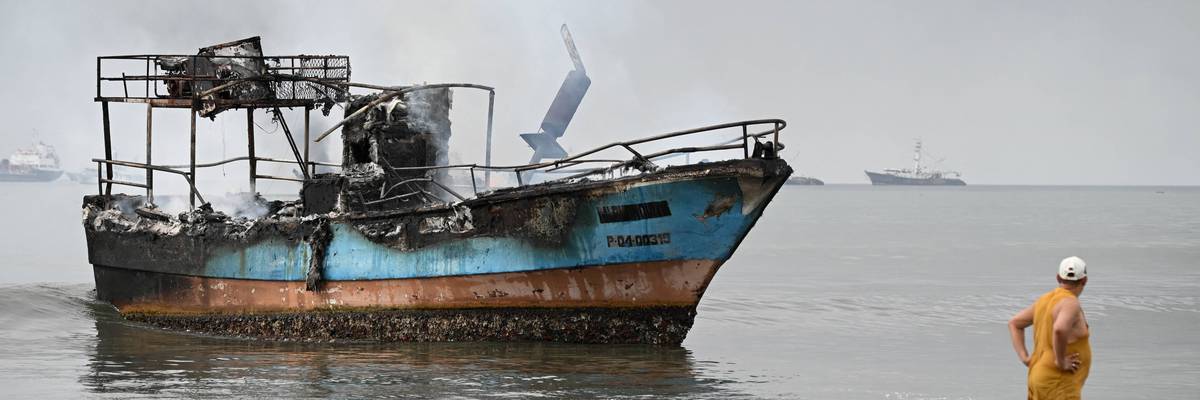
A man stands next to a burned-out fishing boat near the port of Manta, Ecuador on June 6, 2026.
(Photo by Ariel Ochoa/AFP via Getty Images)
Aug 13, 2026
COMMON DREAMS
The Washington Post reported on Thursday that recent mysterious attacks on Ecuadoran fishing boats were carried out as part of a covert CIA operation.
According to the Post, the strikes on the fishing boats, which took place in multiple instances near the Galápagos Islands earlier this year, are separate from the US Department of Defense’s bombing campaign against purported drug-trafficking boats that was launched in September 2025 and has so far killed at least 220 people.
Survivors of a boat attack that occurred in March told the Post they remember coming under fire from small quadcopter drones that either dropped munitions on their vessels or directly crashed into them.
After being shipwrecked, the survivors said they were picked up by a nearby vessel, where they were taken aboard, and “hooded and cuffed by armed men, and transported to El Salvador—only to be returned later without explanation to Ecuador.”
The Post noted that “no evidence has publicly emerged that the crew members were involved in drug trafficking,” adding that “the Galápagos Islands have increasingly become a hub for drug traffickers, where local fishermen are known to pick up jobs delivering gas to smugglers heading to the United States.”
Some former US officials with experience working in Latin America told the Post that they were bewildered about the need for a covert CIA boat strike campaign given that the Trump administration has openly boasted about its other attacks on vessels, which many human rights groups and international law experts have called acts of murder.
“It begs the question about why you would need to do this,” one former official said. “What would be the purpose of the secrecy?”
The covert boat strikes were also reported on Wednesday by The New York Times, which presented evidence that they originated in the US without naming their specific source.
Amnesty International last month raised suspicions of US involvement in the January disappearance of Ecuadoran fishing boat called Fiorella.
Amnesty’s investigation of the Fiorella’s disappearance found that the vessel, in the days before its disappearance, was “allegedly subjected to sustained monitoring by aircraft, patrol boats, and drones bearing United States markings,” as the boat’s captain sent “daily satellite messages to his family expressing his growing concern about the surveillance.”
The ship vanished on January 20.
Two crew members who had departed the ship earlier in the day on a skiff to lay out fishing lines reported seeing “a large column of smoke in the distance in the direction of the Fiorella, but were unable to determine with certainty whether it was from a fire on board,” wrote Amnesty.
The two crew members aboard the skiff are the only confirmed survivors of the incident, as the eight other men aboard the Fiorella are still missing.
The Washington Post reported on Thursday that recent mysterious attacks on Ecuadoran fishing boats were carried out as part of a covert CIA operation.
According to the Post, the strikes on the fishing boats, which took place in multiple instances near the Galápagos Islands earlier this year, are separate from the US Department of Defense’s bombing campaign against purported drug-trafficking boats that was launched in September 2025 and has so far killed at least 220 people.
Survivors of a boat attack that occurred in March told the Post they remember coming under fire from small quadcopter drones that either dropped munitions on their vessels or directly crashed into them.
After being shipwrecked, the survivors said they were picked up by a nearby vessel, where they were taken aboard, and “hooded and cuffed by armed men, and transported to El Salvador—only to be returned later without explanation to Ecuador.”
The Post noted that “no evidence has publicly emerged that the crew members were involved in drug trafficking,” adding that “the Galápagos Islands have increasingly become a hub for drug traffickers, where local fishermen are known to pick up jobs delivering gas to smugglers heading to the United States.”
Some former US officials with experience working in Latin America told the Post that they were bewildered about the need for a covert CIA boat strike campaign given that the Trump administration has openly boasted about its other attacks on vessels, which many human rights groups and international law experts have called acts of murder.
“It begs the question about why you would need to do this,” one former official said. “What would be the purpose of the secrecy?”
The covert boat strikes were also reported on Wednesday by The New York Times, which presented evidence that they originated in the US without naming their specific source.
Amnesty International last month raised suspicions of US involvement in the January disappearance of Ecuadoran fishing boat called Fiorella.
Amnesty’s investigation of the Fiorella’s disappearance found that the vessel, in the days before its disappearance, was “allegedly subjected to sustained monitoring by aircraft, patrol boats, and drones bearing United States markings,” as the boat’s captain sent “daily satellite messages to his family expressing his growing concern about the surveillance.”
The ship vanished on January 20.
Two crew members who had departed the ship earlier in the day on a skiff to lay out fishing lines reported seeing “a large column of smoke in the distance in the direction of the Fiorella, but were unable to determine with certainty whether it was from a fire on board,” wrote Amnesty.
The two crew members aboard the skiff are the only confirmed survivors of the incident, as the eight other men aboard the Fiorella are still missing.
Mysterious Attacks on Ecuadorian Fishers Raise Fears of Expanded US Boat Bombings
“It would be one thing if the US didn’t have an overt maritime strike campaign, but they do, and they’re posting snuff films of boats going up in flames regularly,” said one expert.
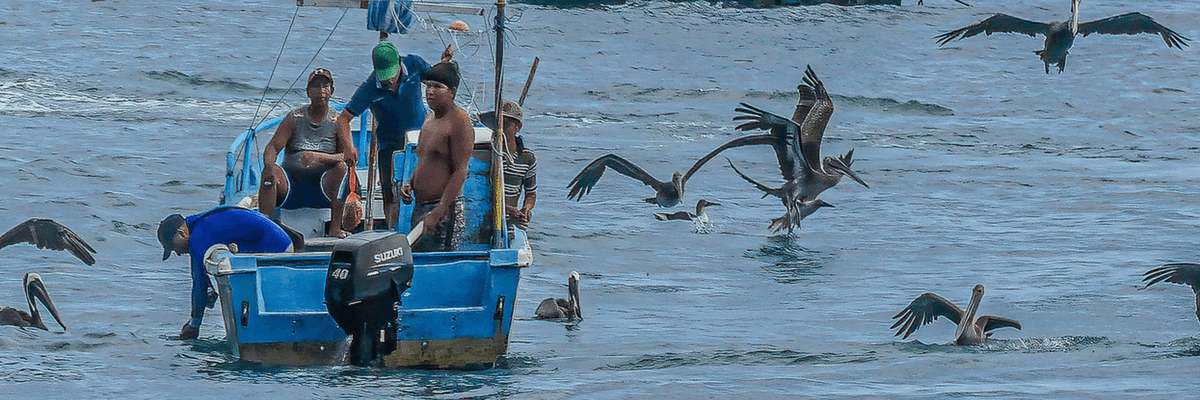
Ecuadorian fishers are seen
Brett Wilkins
Aug 12, 2026
COMMON DREAMS
An investigation published Wednesday by The New York Times has raised fresh questions about who attacked three Ecuadorian fishing vessels in the Pacific Ocean earlier this year—but for fishers and their families in the South American nation, the mystery is hardly new.
According to the Times, Ecuadorian fishers aboard the Fiorella, Negra Francisca Duarte II, and Don Maca were separately attacked by what witnesses called unidentified “gringos” using drones. Survivors said they “came under attack by English-speaking assailants wearing matching uniforms with American flag patches, but without any clear insignia to link them to an official government force.”
International rights groups have called for an investigation after the Fiorella and its crew of eight disappeared in January amid Operation Southern Spear, President Donald Trump’s largely ineffective campaign of extrajudicial strikes on boats that the US administration claims, without evidence, were smuggling drugs.
By the Pentagon’s own admission, more than 220 people have been killed in at least 66 such strikes since last September. The US military says no civilians were killed in the strikes, a claim that anonymous government officials called “a fucking joke” and “a total whitewash.”
Government officials in countries including Colombia and Venezuela, as well as victims’ relatives, have contradicted the US claim. The families of two Trinidadian men killed in one strike earlier this year filed wrongful death lawsuits against the United States. Relatives of a Colombian slain in another US strike also filed a complaint at the Inter-American Commission on Human Rights.
Some of the Ecuadorian fishers featured in the new Times piece say they were seized and interrogated by the attackers before being handed over to the Salvadoran navy, which conducts long-range maritime patrols and counternarcotics operations in the Eastern Pacific and occasionally intercepts vessels.
The new Times report says that a maritime patrol aircraft based at a military facility in El Salvador repeatedly flew toward and tracked the Ecuadorian fishing boats in the days before they were attacked or disappeared. An analysis of flight data found that the aircraft’s course appeared to follow the vessels over several days.
Yet the aircraft was not listed among Pentagon operational aircraft. According to the Times, it was registered to a private company whose address was a UPS store mailbox in Virginia, deepening the mystery over who was operating it—and for whom.
“It would be one thing if the US didn’t have an overt maritime strike campaign, but they do, and they’re posting snuff films of boats going up in flames regularly,” Brian Finucane, a former State Department lawyer who specializes in the laws of war, told the Times.
“And that’s what makes this even more squirrelly,” added Finucane, now a senior adviser in the US Program at the International Crisis Group. “Who are these people that are operating, and under what authority? And they are using a UPS store as their company address? Come on.”
The Pentagon has denied involvement, claiming that US Southern Command (SOUTHCOM) did not know about the attacks or have a role in them. But the new findings raise the possibility that the attacks could have involved a private military contractor or another force operating in coordination with Washington’s expanding anti-drug campaign.
“Who are these people that are operating, and under what authority? And they are using a UPS store as their company address?”
In addition to the boat bombing campaign—which the Pentagon has replaced with the newly created Joint Task Force Western Hemisphere—SOUTHCOM has launched Operation Total Extermination, a joint counternarcotics operation with Ecuadorian forces involving the deployment of US ground troops into the Andean nation.
In one operation in the campaign, Ecuadorian soldiers raided and destroyed a dairy farm in San Martín, Sucumbíos, on March 3. Ecuador claimed the site was a traffickers’ camp, but investigations by The New York Times and, later, Human Rights Watch found substantial evidence that it was a working cattle and dairy farm with no credible evidence of a criminal connection. HRW said four workers at the farm were detained and tortured by Ecuadorian forces, and that the broader operation was carried out with US assistance.
The Times investigation published Wednesday followed months of reporting by Ecuadorian and international media and human rights groups, including HRW, on the three fishing vessels and their crews.
In April, Primicias reported growing fear among fishermen in Manabí, Ecuador’s major fishing province, where crews said they had been intercepted and attacked at sea. Fishers from the Don Maca and Negra Francisca Duarte II separately described being surrounded by drones and subsequently detained by what they believed were US personnel.
Don Maca‘s crew told El Universo that drones bombed their boat without warning on March 26. Fishers aboard said they escaped in small boats, approached a foreign vessel for help, and were instead handcuffed and hooded before eventually being transferred to Salvadoran authorities.
El Universo also separately reported a strikingly similar account from the crew of the Negra Francisca Duarte II. Captain Hernán Flores said a drone struck the boat on March 17, setting it ablaze and forcing all 16 fishermen into the water. When they approached a nearby blue vessel seeking assistance, Flores said, armed foreign personnel pointed weapons at them, bound them, and covered their heads.
In the case of the Fiorella, Primicias and El Universo reported that two fishers who had separated from the boat in a smaller vessel saw a drone circling above shortly before they spotted smoke on the horizon. Fiorella and those aboard it have never been found.

“It would be one thing if the US didn’t have an overt maritime strike campaign, but they do, and they’re posting snuff films of boats going up in flames regularly,” said one expert.
Ecuadorian fishers are seen
Brett Wilkins
Aug 12, 2026
COMMON DREAMS
An investigation published Wednesday by The New York Times has raised fresh questions about who attacked three Ecuadorian fishing vessels in the Pacific Ocean earlier this year—but for fishers and their families in the South American nation, the mystery is hardly new.
According to the Times, Ecuadorian fishers aboard the Fiorella, Negra Francisca Duarte II, and Don Maca were separately attacked by what witnesses called unidentified “gringos” using drones. Survivors said they “came under attack by English-speaking assailants wearing matching uniforms with American flag patches, but without any clear insignia to link them to an official government force.”
International rights groups have called for an investigation after the Fiorella and its crew of eight disappeared in January amid Operation Southern Spear, President Donald Trump’s largely ineffective campaign of extrajudicial strikes on boats that the US administration claims, without evidence, were smuggling drugs.
By the Pentagon’s own admission, more than 220 people have been killed in at least 66 such strikes since last September. The US military says no civilians were killed in the strikes, a claim that anonymous government officials called “a fucking joke” and “a total whitewash.”
Government officials in countries including Colombia and Venezuela, as well as victims’ relatives, have contradicted the US claim. The families of two Trinidadian men killed in one strike earlier this year filed wrongful death lawsuits against the United States. Relatives of a Colombian slain in another US strike also filed a complaint at the Inter-American Commission on Human Rights.
Some of the Ecuadorian fishers featured in the new Times piece say they were seized and interrogated by the attackers before being handed over to the Salvadoran navy, which conducts long-range maritime patrols and counternarcotics operations in the Eastern Pacific and occasionally intercepts vessels.
The new Times report says that a maritime patrol aircraft based at a military facility in El Salvador repeatedly flew toward and tracked the Ecuadorian fishing boats in the days before they were attacked or disappeared. An analysis of flight data found that the aircraft’s course appeared to follow the vessels over several days.
Yet the aircraft was not listed among Pentagon operational aircraft. According to the Times, it was registered to a private company whose address was a UPS store mailbox in Virginia, deepening the mystery over who was operating it—and for whom.
“It would be one thing if the US didn’t have an overt maritime strike campaign, but they do, and they’re posting snuff films of boats going up in flames regularly,” Brian Finucane, a former State Department lawyer who specializes in the laws of war, told the Times.
“And that’s what makes this even more squirrelly,” added Finucane, now a senior adviser in the US Program at the International Crisis Group. “Who are these people that are operating, and under what authority? And they are using a UPS store as their company address? Come on.”
The Pentagon has denied involvement, claiming that US Southern Command (SOUTHCOM) did not know about the attacks or have a role in them. But the new findings raise the possibility that the attacks could have involved a private military contractor or another force operating in coordination with Washington’s expanding anti-drug campaign.
“Who are these people that are operating, and under what authority? And they are using a UPS store as their company address?”
In addition to the boat bombing campaign—which the Pentagon has replaced with the newly created Joint Task Force Western Hemisphere—SOUTHCOM has launched Operation Total Extermination, a joint counternarcotics operation with Ecuadorian forces involving the deployment of US ground troops into the Andean nation.
In one operation in the campaign, Ecuadorian soldiers raided and destroyed a dairy farm in San Martín, Sucumbíos, on March 3. Ecuador claimed the site was a traffickers’ camp, but investigations by The New York Times and, later, Human Rights Watch found substantial evidence that it was a working cattle and dairy farm with no credible evidence of a criminal connection. HRW said four workers at the farm were detained and tortured by Ecuadorian forces, and that the broader operation was carried out with US assistance.
The Times investigation published Wednesday followed months of reporting by Ecuadorian and international media and human rights groups, including HRW, on the three fishing vessels and their crews.
In April, Primicias reported growing fear among fishermen in Manabí, Ecuador’s major fishing province, where crews said they had been intercepted and attacked at sea. Fishers from the Don Maca and Negra Francisca Duarte II separately described being surrounded by drones and subsequently detained by what they believed were US personnel.
Don Maca‘s crew told El Universo that drones bombed their boat without warning on March 26. Fishers aboard said they escaped in small boats, approached a foreign vessel for help, and were instead handcuffed and hooded before eventually being transferred to Salvadoran authorities.
El Universo also separately reported a strikingly similar account from the crew of the Negra Francisca Duarte II. Captain Hernán Flores said a drone struck the boat on March 17, setting it ablaze and forcing all 16 fishermen into the water. When they approached a nearby blue vessel seeking assistance, Flores said, armed foreign personnel pointed weapons at them, bound them, and covered their heads.
In the case of the Fiorella, Primicias and El Universo reported that two fishers who had separated from the boat in a smaller vessel saw a drone circling above shortly before they spotted smoke on the horizon. Fiorella and those aboard it have never been found.


No comments:
Post a Comment