Whatabout Whatabout Whatabout “White Genocide” in South Africa?
Photograph Source: The White House – Public Domain
Saner voices in the U.S. media have been appropriately appalled by President Trump referencing the word “genocide” while claiming that violent persecution of white farmers in South Africa was driving them to flee. This fact-indifferent accusation echoes, presumably deliberately, longstanding white supremacist narratives of “white genocide” in the U.S. and other Western countries. The rise of the MAGA movement had already mainstreamed some mildly subtler versions of these narratives (like “Great Replacement theory”), but this is the closest Trump himself has come to saying “white genocide” without using the exact two word phrase.
If Trump were anyone other than Trump, we might consider this rhetoric a curiously extreme enactment of reputational self-sabotage. It arguably exceeds the shameless racism even of his 2017 “very fine people on both sides” comment about the “Unite the Right” rally in Charlottesville that turned deadly. Since he is Trump, though, being even more nakedly white supremacist will probably somehow work out to help him accumulate more power, wealth and lethal capacity. He has notably linked (a) his expressed white supremacy to (b) his concern for protecting Israel from South Africa’s accusations of genocide. Instead of the former tainting the latter, perhaps he expects the latter will put lipstick on the pig of the former. But the lipstick itself drips blood.
A review of Trump’s beef with South Africa, and the pro-Israel dimension of this beef
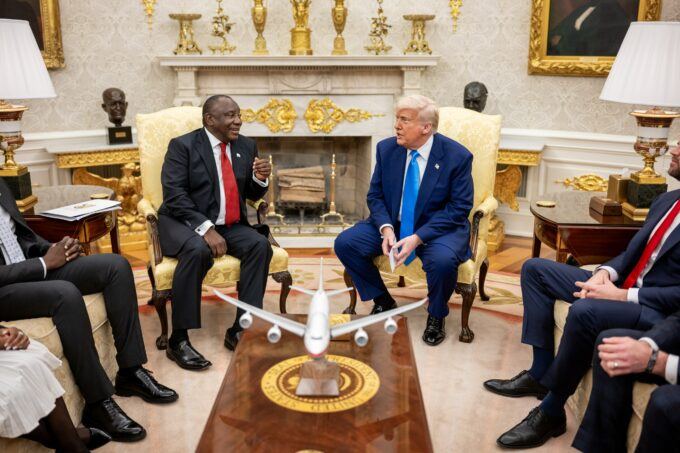
During Trump’s surreal White House meeting with South Africa’s president Cyril Ramaphosa, he went so far as dimming the lights to make his unhinged accusations more dramatically. This meeting intensified media attention on the administration’s determination to strain relations with post-Apartheid South Africa. Months earlier, Trump had made his intentions clear with his February 7th executive order to “(a) … not provide aid or assistance to South Africa; and (b) … promote the resettlement of Afrikaner refugees escaping government-sponsored race-based discrimination…”
The most interesting feature of the executive order, though, was the combination of reasons for issuing it. Section 1 of the order first references South Africa’s supposed “shocking disregard of its citizens’ rights” by having “enacted Expropriation Act 13 of 2024 (Act), to enable the government of South Africa to seize ethnic minority Afrikaners’ agricultural property without compensation.” This claim, as one might expect, grossly exaggerates the functional significance of a provision within South Africa’s bill allowing for expropriation without compensation as an exceptional circumstance. The fact that expropriation without compensation is exceptional means that the typical expropriation is compensated. That said, there are some legitimate, rights-concerned, reasons to quibble with South Africa’s bill.
Whatever rights-based outrage Trump might have been appealing to (half-heartedly), he still must have known on some level that he was morally discrediting himself. It is a non-starter to anchor a cessation of U.S. aid in the claim that post-Apartheid, democratic, one-person-one-vote South Africa is violently oppressing its white Afrikaners. Everyone who has been paying attention knows that the Afrikaners were once privileged by a much more saliently oppressive, and anti-democratic, system called “Apartheid”, and are still much wealthier than the average South African, even with de jure Apartheid gone.
But the most puzzling feature of Trump’s self-discrediting executive order is that it seems designed to discredit Israel also. Right after the hysterical fulminations against the supposed violation of Afrikaners’ rights, and still in Section 1 of the executive order, there is an ancillary grievance that “South Africa has taken aggressive positions towards the United States and its allies, including accusing Israel, not Hamas, of genocide in the International Court of Justice.”
An obviously racist, reality-untethered and white supremacist executive order is an odd forum for emphasizing one’s strong loyalty to Israel, at least if one actually likes Israel. But we should keep in mind the way Israel has grown accustomed to being Israel—especially lately. What would have registered as a stealthily-concealed smear a decade ago might now be welcomed as stalwart support.
In this context, consider the executive order’s implication that Hamas’s October 7 attack was a genocide. As brutal as this attack was (even in the no-lies-or-exaggerations Amnesty International account), calling it “genocide” is absurd. It would be like calling the Chinese government-led 1989 massacre of pro-democracy students and workers in Beijing “genocide.” Such an obvious exaggeration sullies the otherwise legitimate impulse to condemn such massacres for being, well, massacres. Not every mass killing has to be genocide to be bad. In any case, to try to divert opprobrium from a genocide by referencing a massacre is a very odd persuasive technique. In fact, the curious phrasing in Trump’s executive order—”accusing Israel, not Hamas, of genocide”—comes off as self-owning whataboutism.
And yet this particular whataboutist deflection, from Israel’s overwhelming and ongoing war crimes to the one day horror show of October 7, 2023, is pretty normative. Trump certainly did not innovate it. The mainstream media voices inclined to this deflection presumably have to just pretend they never saw reports by Human Rights Watch, Amnesty International, international genocide scholars, legal scholars, and United Nations experts referring to Israel’s carnage in Gaza as “genocide.” Lately, they also need to ignore Israel’s former Prime Minister Ehud Olmert. Olmert has recently acknowledged, “Yes, Israel is committing war crimes” and, “What we are doing in Gaza now is a war of devastation: indiscriminate, limitless, cruel and criminal killing of civilians.”
Even to the extent whataboutists discount the expertise of actual experts (and even a former Israeli Prime Minister) in determining what “genocide” and “war crimes” are, they should still have to contend with the naked facts. Israel has killed at least 53,655 Palestinians (and by the upper end plausible estimate of excess deaths, something more like 400,000). There are plausibly tens of thousands of children among the dead. The official child death tally, inevitably an underestimate, is 16,500. And that is not counting the legless, armless and otherwise maimed. Unicef, lumping killed and injured children together, puts the tally of child casualties at 50,000.
At the end of 2024, Oxfam assessed that Israeli military forces had killed more children in one year than other perpetrating nations had killed in any other “conflict” in the 21st century so far. By comparison, Hamas and other participants in the October 7th mass killings are reported to have killed 37 children under 18. So to use Hamas as a contrastive foil to minimize Israel’s catastrophically destructive, and still ongoing, siege of Gaza is odd. It’s like saying, “You’re so angry about those tens of thousands of Palestinian cockroach vermin ‘children’ killed in our righteously endless battle to guarantee Israel’s security, but what about those 37 Actually Human Children that Hamas and company killed so brutally during their one day Holocaust? And what about the hostages?”
The fact that this whataboutism makes no moral sense to those who embrace human equality on principle has not kept it out of mainstream public discourse, though. This suggests that the principle of human equality may not be as popular among ruling elites as we have often been led to imagine. So Trump might be expecting that his naked disregard for human equality in other, more taboo, ways will just endear him more to the same powers who helped him twice into the presidency.
An interlude on a more persuasive form of whataboutism
Though widely and relentlessly disseminated, the “what about October 7th?” kind of whataboutism typically gets run out of town on a rail in more morally grounded and politically informed discursive communities. So those who wish to break the natural link between outrage and action as regards the Gaza genocide often employ a more sophisticated whataboutist strategy. They first express heartbreak and sympathy about the “humanitarian crisis” in Gaza. Then they pivot to pleading that other relatively neglected horrors in relatively neglected countries like the Congo, Sudan, Ethiopia, Haiti and Myanmar not fly under the radar of activist concern (see, e.g. Sam Harris’s blog post to this general effect).
This strategy is sophisticated because relatively decent people could feel obliged to parrot these whataboutist talking points. These beta (as opposed to alpha) whataboutists need not harbor any strategic intention to get people to twiddle their thumbs in the face of an ongoing genocide funded by the most powerful government in the world. Logically, though, this more sophisticated whataboutism is still whataboutism. As such, it quickly fails the smell test if applied as a general principle for responding to people’s passionate determination to do something about any specific ongoing horror.
For instance, imagine someone expresses outrage about the Rapid Support Forces’ (RSF’s) plausibly genocidal atrocities in Sudan. Imagine they call on the U.S. government to sanction (Israel’s new ally) United Arab Emirates until they cease bankrolling the RSF. Anyone who makes a general principle out of their Israel-defending whataboutism would be obliged to retort, “my heart breaks for the people of Sudan, but don’t forget other neglected humanitarian crises in Myanmar, Ethiopia, Haiti and the Congo.” Applying the whataboutist principle consistently enough lets everyone my-heart-breaks-but-don’t-forget their way to just streaming prestige TV on Max every night. Whataboutism, whatever its intent, functions to weaken people’s resolve to work against any of the horrors they say their hearts break for.
And even some Israel-boosters don’t like the more sophisticated strategy, as it implicitly concedes that there is something comparable about what Israel is doing in Gaza and the atavistic brutality that less “democratic and free” political entities are unleashing on targeted populations. Left unmentioned is the fact that, as per Oxfam’s research noted above, the other reason these comparisons are not favorable to Israel is because Israel’s atrocities still manage to be more atrocious than those of less “democratic” states. Also left unmentioned are the roles that U.S. allies—including Israel—have played in all these other horrors. Like, is attention to the horrors of Myanmar—whose genocidal junta Israel has supported for Islamophobic reasons—really a distraction from the horrors of Israel’s government?
Logic and reason don’t really matter, though. For the whataboutism to function well, it just needs to cause confusion, division and collective paralysis where there might have been principled genocide-stopping collective action. And since the case for the speciousness of the “whatabout Sudan-Congo-Haiti-Ethiopia-Myanmar?” trope is a bit subtle, the trope is still a safe go-to strategy for suppressing anti-genocide mobilization.
Trump’s new “what about white genocide?” riff on the whataboutist rhythm is thus particularly curious. If his intention was to shame South Africa in the eyes of the world for accusing Israel of genocide, he could have just expanded Trumpishly on the more sophisticated “whatabout Sudan, etcetera?” trope already circulating so widely.
Trump could, for instance, have accused South Africa’s political leaders of being “self-hating Black people” who “don’t care about Black people in Sudan, Congo, Haiti and Ethiopia! Sad!” This would have been a safe move within the Trumpian idiom. It would also have been absurd, of course. But it would have been only as absurd as his claimed devotion to rooting out antisemitism from American universities while clearly being an antisemite himself (and surrounding himself with antisemites, from Steve Bannon to Elon Musk).
For whatever reason, Trump has forgone this potentially potent and seductive whataboutist refrain for a more transparently preposterous and racist one. The combined effect of his executive order and his White House debacle with President Ramaphosa adds “what about the white genocide in South Africa?” to compound the stupidity of “what about Hamas’s genocide on October 7?” In addition to being the least persuasive forms of Israel-serving whataboutism on the merits, the choice to use the former kind of whataboutism especially is an odd thing for such an Israel-beloved American president to do.
Trump’s chosen form of whataboutism carries a whiff of “look at the decline of life quality that befell white South Africans when they abandoned Apartheid—do you really want apartheid-protected Jewish Israelis to suffer the same fate?” It is as if Trump wants to give credence to Israel-with-South Africa apartheid comparisons. And he has also effectively planted in Americans’ mind that Israel’s fate post-apartheid might be similar to South Africa’s fate post-Apartheid. This is an odd idea to plant as a quick internet search reveals that South Africa is at worst subpar by developed nation standards, and it is not a nightmare of civil war and genocide.
But it is the latter type of catastrophe that pro-Israel pundits more typically claim would result from enfranchising and giving equal rights—including voting rights—to all Palestinians now under IDF domination. This “universal citizenship and suffrage => genocide” claim, long debunkable, is losing a lot of steam lately, for obvious reasons. The land under IDF control is already a nightmare of war and genocide, genocide exacerbated by the dehumanization of Palestinians at the heart of political Zionism, so there isn’t much ground to lose on this score at this point.
In any case, propagandists for Israel almost never say “if we give universal citizenship and suffrage to all Palestinians, we’ll end up like South Africa!” South Africa’s situation is just not anywhere near catastrophic enough to support a hysterical narrative for the need to maintain Israeli apartheid. For this reason, it is usually those who condemn Israel who make Israel-South Africa comparisons, or give mental space to the possibility of a universal citizenship and suffrage one-state solution, like South Africa’s, to escaping Israel’s apartheid trap.
An interlude on “apartheid” and the “one state solution”
Now I am not saying that there is anything wrong with the condemnatory comparison or the fully egalitarian proposed solution. There is not. Israel’s system of institutionalized state oppression and violence towards Palestinians might be administratively different from pre-1990 South African Apartheid, but it is distinct primarily in being more lethally brutal. In addition, Israel’s institutionalization of anti-Palestinian oppression and violence has long been more complex, and Israel has framed its laws, regulations and policies to allow for plausible denial of Apartheid-like intentions.
However Israeli institutions might gloss it, though, the human rights community consensus—increasingly mainstream within Israel itself—is that Israel practices apartheid for all practical purposes. And whatever you might want to call it, there has been a longstanding institutionalized four-level hierarchy among lands and peoples “watched over” by Israeli Defense Forces. Jewish Israelis rank first, whether they live in Israel proper or forcefully annex large (government-subsidized) illegal settlements in the occupied West Bank. Palestinian and other citizens of Israel rank second, with enfranchised Palestinians regarded as a fifth column within Israeli society. Palestinians in the occupied West Bank rank a much more distant third, lacking both citizenship and suffrage, and subject to extreme restrictions on their movements, regular land seizures, house demolitions and unprosecuted violent attacks by settlers and soldiers. Then the blockaded, bombed and starved Gazan Palestinians have ranked an even more distant last since 2005—with the phrase “dead last” seeming particularly apt lately.
U.S. bipartisanship has historically embraced the idea that ending Apartheid in South Africa was good, while at the same time asserting the goodness of aiding the “self defense” of Israel (such as it is). So did U.S. bipartisan opinion on these scores get reflected in historical tension between Israel and Apartheid South Africa? In fact, historically, there was a cooperative, albeit quiet, relationship between Israel and Apartheid South Africa, up to and including transfer of nuclear weapons technology from the former to the latter.
And the fact that leaders of the South African Apartheid regime were often antisemitic in addition to being racist in more fundamental ways was apparently not a dealbreaker for Israel’s political leadership at the time. As the Guardian notes, “many of the Afrikaner leaders of the time had a history of deep antisemitism. John Vorster, the then prime minister [of Apartheid South Africa], was feted on a visit to Jerusalem in 1976 despite having been interned during the second world war for Nazi sympathies and membership of a fascist militia that burned Jewish-owned properties.”
An interlude on Israel’s support for antisemitic regimes
As can be inferred from the stratospheric popularity of the classically antisemitic Trump among Israelis, Israel’s support for Apartheid South Africa was not a unique case. Israel is often quite content to stand with the more classically antisemitic side of a political “conflict.” For instance, one country that played an outsized role in Israel’s obtainment of nuclear weapons, Argentina, later went through a political phase—the Dirty War of 1976 to 1983—that should not have endeared it to those with philosemitic inclinations. During that period, the ruling junta felt compelled to kill 10,000 to 30,000 of its own citizens for being too far left, among them at least 1296, and possibly more than 3000, Jewish Argentines.
Given that Argentina’s Jewish population was about 300,000 at the time, the mass killings took as much as one percent of this population. If you are like me, you have spent most of your life knowing nothing about this relatively extreme post-War loss of diaspora Jewish life. I challenge anyone to ask their available Artificial Intelligence chatbots if any other mass killings of diaspora Jews ever reached this volume post-Holocaust.
So, given that every act of violence against Jewish Israelis makes the front pages worldwide, why have we not heard about the antisemitic bloodbath against Jewish Argentines, particularly given its scale and scope? Perhaps part of the reason relates to Israel having been one of the countries providing military funding to the junta responsible. In fact, one of the junta leaders whom Argentina’s prosecutors sought, three decades later, to try for war crimes during his tenure—Teodoro Aníbal Gauto—was found, after an extensive search, to be living in Israel. Israel refused to extradite him to stand trial.
To some extent, Israel’s support for Argentina’s junta was consistent with Israel’s broad support for anti-leftist—and thus typically antisemitic—dictatorships in Latin America during the Cold War. Though the Soviet Union was the first country to recognize the state of Israel, Isreali leadership lost faith early in the Soviets’ geopolitical friendliness. Israel joined the U.S. side of the Cold War in the 1950s and found it was quite adept at helping the U.S. with some of its messiest Cold War dirty work. Israel’s relations with Russia didn’t warm up again until after the Soviet Union fell, and grew particularly close after Vladimir Putin took power. All that is to say that Cold War considerations presumably influenced Israel’s support for things like Apartheid in South Africa and the murderously antisemitic junta in Argentina. Yet in the case of Argentina—already the most puzzling one—Israel’s political leadership curiously went beyond realpolitik Cold War obligations. Israel still continued to stand with Argentina’s overtly fascist government even when it broke the Cold War fascists-with-capitalists alliance and attacked the U.K.-ruled Falkland Islands in 1982.
Sometimes the antisemitism even spews rather directly from the mouths of Israelis close to the centers of power. For instance, Yair Netanyahu, Bibi Netanyahu’s son, has expressed his scapegoating displeasure with the “globalists” and exhorted the preservation of “Christian Europe.” Yair didn’t even bother to use the more polite “Judeo-Christian” euphemism for white Europeans, and just dived right into white Christian nationalist buzzwords.
An interlude on the implicit accusations of antisemitism in deployments of whataboutism for Israel
Israel’s effective nonchalance about classic antisemitism, as reflected in its history of aiding and abetting it around the world when expedient, suggests that Israel is not an uncomplicatedly philosemitic political entity. That might partially explain extreme popular affection for Trump in Israel. Trump himself is not an uncomplicatedly philosemitic political entity.
For the rest of us, though, the mystery is why any reasonable people take such antisemitism-stained political entities and individuals seriously as contributors to the conversation on what antisemitism is. Isn’t it clear that the enforcement of their preferred understanding is precipitating a potentially Republic-ending constitutional crisis? And have we not noticed that the intersecting movements subject to being crushed by this understanding of antisemitism have disproportionately Jewish leadership and participation? And shouldn’t any state that sold weapons to a regime that killed the most diaspora Jews since the Holocaust be disqualified from the collective discernment process on these matters anyway?
The definition of “antisemitism” that the State of Israel and its supporters most vigorously promote is that of the International Holocaust Remembrance Association (IHRA). The U.S. government and many other U.S. institutions (including colleges and universities) are pushing to enshrine the IHRA definition as the guiding one, rather than dismissing it as stained by its antisemitism-sullied promoters. The more morally coherent Jerusalem Declaration on Antisemitism, by contrast, has gained much less traction with those running U.S. institutions. And the difference between the definitions? The IHRA definition highlights rhetorically provocative condemnation of the State of Israel as antisemitic; the JDA definition does not.
To understand the absurdity of defining rhetorically provocative condemnations of Israel as antisemitic, imagine that a Jewish Argentine, who lost her family members to the junta, learned of Israel’s military support for that same junta. Then imagine that, in her rage, she intemperately posted on social media something like, “This is my scream of horror against the Nazi state of Israel for helping the junta that killed my Jewish family.” Now imagine the talking heads of America and their institutional enforcers reframing this Jewish victim of actual antisemitism as being guilty of comparing-Israel-to-the-Nazis type “antisemitism” by the IHRA definition.
This hypothetical accusation would follow much the same logic as accusing Anita Hill of facilitating a “high tech lynching” (i.e. anti-Black racism) for adding a wrinkle to the otherwise smooth and bipartisan 1991 confirmation of Clarence Thomas to the Supreme Court. Anita Hill’s actual “crime”: speaking up about the sexual harassment she experienced from this judge appointed to the court by a U.S. president who had won his election in part with racist Wille Horton ads. For that matter, going after Anita Hill for being an anti-Black racist because she didn’t want a toady for white racists in the Supreme Court is very much like going after Jewish pro-Palestine activists for being antisemites because they don’t want a toady for antisemitic white supremacy receiving U.S. tax dollars and diplomatic cover for their ongoing genocide.
The absurd logic at the heart of the IHRA definition grounds the absurd obligation that many Americans feel to say “whatabout whatabout whatabout” whenever there is a push to hold Israel accountable for its acts of oppression or unjust violence. There is a specific encouragement to whataboutism nestled within the IHRA definition, in fact: defining as antisemitic the application of “double standards by requiring of [Israel] a behavior not expected or demanded of any other democratic nation.”
Granted, such “expectations of democratic nations” are probably too subject to contention to ever use them to actually pin down an Israel critic as antisemitic by this standard. But the standard itself encourages a comprehensive “what about” review of all other nations’ atrocious behavior before deciding whether or not to “require” something of Israel. And this review is not obligatory prior to requiring an end to injustices and horrors committed by any other nation state.
Whatever the intention behind this feature of the IHRA definition, the whataboutism that it effectively encourages functions as an attention-distracting diversion from the task of seeking accountability for anything the State of Israel has done. In addition, such whataboutism also functions as a distractingly maddening, albeit not always explicit, accusation of antisemitism. As in, “Why are you so determined to hold a Jewish state accountable for killing tens of thousands of children while bombing hospitals, universities, schools of all kinds, mosques, churches, journalists, and aid workers; as well as implementing a program of deliberate starvation and destruction of a whole society’s critical infrastructure for sustaining life? Why are you so upset about a Jewish state doing these things on the U.S. dime, hmmmm? Why aren’t you putting all your time instead into ensuring accountability for atrocities in Sudan, Congo, Ethiopia, Haiti and Myanmar? Could it beeee…ANTISEMITISM?”
A return to puzzling over what Trump thinks he is doing
Trump, whether or not he perceives the maddening absurdity of this commonplace, and bipartisan, line of argument, might well be fully enjoying his extension of it into even more preposterous ideological territory. As noted earlier, Trump’s bullying of post-Apartheid South Africa strongly suggests that he thinks Apartheid in South Africa was a good thing: a necessary bulwark against the “white genocide” supposedly taking place there now as a result of having abandoned that system (for one-person-one-vote liberal democracy).
Trump almost seems to be reveling in propagating this effectively defamatory-to-Israel message: “Hey, look at me! I’m a stalwart supporter of apartheid Israel and its right to unleash whatever genocidal violence it pleases AND I am also a racist panderer to white supremacists and a nostalgist for South African Apartheid!” Trump has essentially (a) grabbed headlines by promoting the theory of “white genocide” in South Africa while (b) citing his concern for Israel as part of his animus to post-Apartheid South Africa. By the usual expectations of those with experience and expertise in public relations, this association between Israel and Apartheid South Africa should be bad for Israel. Not good, bad.
However, since any public relations disaster for Israel in this regard should be proportionate to how much of a disaster it is for Trump, Israel might well weather this association quite well. Trump, after all, has made a political career out of jumping off a public relations cliff almost daily and levitating regardless. Trump’s racism, specifically, has manifested so many times that most Americans—including Trump opponents—are largely inured to it as just part of the existing political landscape. Indeed, Trump’s general lack of concern for how he might be perceived by people with functioning intellect and conscience is arguably an active ingredient in his charismatic mystique. It might even be the most active ingredient. There is thus a distinct possibility that Trump is not scoring on his own team with this madness, but for it.
If so, this is not the first time, and it will not be the last, that Trump makes himself and his movement temporarily more powerful by broadcasting loudly and shamelessly some unspeakable bipartisan lie, or indulgence in expedient horror. Exposing bipartisan U.S. lies and horrors for what they are while still transparently embracing those lies and horrors is a key part of Trump’s modus operandi. Why this approach to accumulating power works at all for Trump is a question for another time.
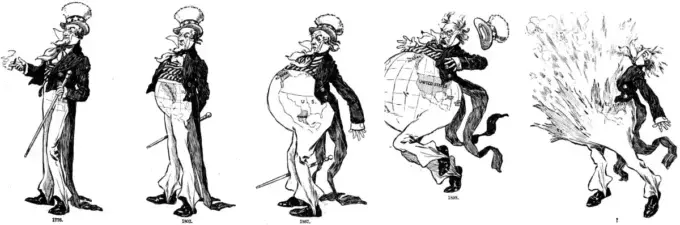
And, sure, all innovations on cruel tyrannical domination might not work in the long run, as Percy Shelly laid out in his famous poem Ozymandias. But arguments that in the long run Trump (and the genocidal apartheid system in Israel?) will suffer the same fate as Ozymandias are of little reassurance to those of us who have to live out that long run. Still, as we watch these bubbles of power grow ever larger against all expected laws of human social psychology (except, perhaps cognitive dissonance), we should allow ourselves to benefit from whatever conceptual clarity the bubbles dispense before they burst.