Monday, June 30, 2025

Budapest Pride’s record turnout exposes Viktor Orban’s waning grip on power

Budapest Pride’s record turnout exposes Viktor Orban’s waning grip on power
Marchers stream across Elisabeth Bridge during Pride celebrations in Budapest on June 28. / bne IntelliNews
By bne IntelliNews June 30, 2025

Despite attempts by Hungarian authorities to ban this year's Budapest Pride, the event went ahead on June 28 with what organisers and observers described as the largest turnout in the march's 30-year history. In fact, it may have the largest ever gathering in Hungary's history, with at least 250,000 people taking part, according to commentators.

In his February State of the Nation address, the prime minister said organisers should not bother with this year's event, implying that the parade marking its 30th anniversary would be cancelled.

The government passed legislation to curb the right of assembly and to that order it changed the Basic Law (constitution) to create the "basis" of banning Pride by placing children's rights above all other rights.

According to observers, the government's attempts to suppress the march ended in a spectacular failure, as it mobilised people to make a show of defiance. As many commentators pointed out, Viktor Orban helped to organise the largest Pride ever and this could be politically damaging for him especially among more radical voters, as he may look weak for not enforcing the ban.

In the lead-up to the event, state authorities deployed a series of escalating intimidation tactics designed to dissuade organisers and participants. Organisers were threatened with criminal liability and potential jail time, while the police issued formal bans on the event citing vague security concerns and administrative technicalities, which, however, were reversed by Hungary's highest court.

Surveillance cameras were hurriedly installed along key sections of the proposed route, fuelling concerns that participants might later face identification and legal repercussions through facial recognition technology.

Before the rally there were fears that radical right-wing party Our Homeland would use the event to show force, as the party received the permits for the same route as Budapest Pride organisers. A few dozen of their supporters blocked Liberty bridge, the planned route of the march from central Budapest to the banks of the Buda side of the capital near the Technical University, but police then rerouted the march.

Budapest Mayor Gergely Karacsony bypassed the government decree and police permit requirement by designating it a "city council-organised event." In the days before the march, the liberal leader of the capital revealed that the Interior Ministry had warned him of possible legal consequences, and that high-level police officials had raised concerns about permitting the march to follow its planned route.

Speaking at the University of Technology and Economics, the endpoint of the parade, Karacsony framed the event as both a "celebration of freedom" and a symbolic counterpoint to Hungary's political climate. "The hateful powers that be have no power over us," he told the crowd, in a veiled rebuke of Viktor Orban's right-wing government, which has frequently clashed with LGBTQ+ groups and curtailed civil liberties.

Marking the anniversary of the withdrawal of Soviet troops from Hungary, Karacsony drew a parallel between past and present authoritarianism. "Since they already left once, we don't need Putin's followers to take their place," he said, referring to Hungary's increasingly close ties to Moscow.

Commentators and opposition politicians suggested that the government may have misjudged the political impact of the move. Attempts to prevent or delegitimise the march appeared to have galvanised support instead, in a rare sign of solidarity.

"Orban may have helped create the largest demonstration against himself," one political scientist told local media, adding that when people are threatened with legal consequences for exercising basic freedoms, they tend to push back harder.

Critics of the government described the event as a turning point, comparing it to earlier moments of mass protest in Hungary's post-1989 democratic era. However, most analysts cautioned that Saturday's events alone are unlikely to cause an immediate political shift, especially without broader mobilisation beyond Budapest.

On social media, Fidesz promoted a parallel "Day of Pride" campaign focused on traditional family values, with party members posting pictures of their children.

According to one political analyst, Fidesz's strategy appeared to be pushing Peter Magyar into taking a public stand in the debate over Pride, so they could associate him with "Brussels gender lobbyists", but the head of the Tisza Party avoided that trap and refrained from the political debate surrounding Budapest Pride.

Fidesz politicians used AI-generated photos of Magyar wearing rainbow-coloured T-shirts as he was promoting the event. Many of his Budapest supporters still showed up, and analysts agree that even his refrainment from supporting Pride will leave his reputation untarnished as leader of the opposition. Magyar knows all too well that in order to defeat Fidesz, he has to convince conservative, less educated rural voters.

Commenting on the events on Saturday, Magyar wrote on Facebook that Viktor Orban, once seen as a strongman, appears weakened, with growing resistance within his own ranks and a state apparatus unwilling to enforce his harsher directives. Orban can no longer govern and this marks the beginning of the final act, the period of total disintegration, he added.

Fidesz appeared to downplay the significance of the wave of solidarity, saying that the entirety of the Hungarian opposition "lined up behind the rainbow flag and openly identified with an ideology that the majority of Hungarian society rejects."

The prime minister's political director, Balazs Orban (namesake of Viktor Orban), said the Hungarian government represented the majority position, which was that "LGBTQ propaganda should not be a part of our everyday life", and that "instead we should protect our children, preserve the family and organise society along clear values".

The government's conservative and child protection policy had collapsed for good, commented deputy leader of Our Homeland, accusing Fidesz of yielding to what he called "the homosexual lobby".

Many commentators noted that the sheer scale of the event, and the state's eventual decision to allow it to proceed, signalled a loss of control and resolve within Fidesz. It exposed a fracture between the government's radical rhetoric and its ability, or willingness, to follow through. This perceived weakness could alienate Fidesz's most hardline supporters, who may increasingly turn to far-right parties like Our Homeland.

Big crowds gather in Hungarian capital to defy ban on Budapest Pride


Police detain more than 50 ahead of banned Istanbul Pride parade


Police arrested more than 50 people ahead of a LGBT pride march in Istanbul on Sunday. The annual parade has been banned by Turkey's ruling conservative government since 2015.

Issued on: 30/06/2025 - 
 FRANCE 24

A person is detained by Turkish police officers during the annual LGBTQ+ Pride March, in Istanbul, Turkey, on June 29, 2025. © Dilara Acikgoz, A

Police arrested more than 50 people in Istanbul Sunday ahead of a banned LGBTQ+ pride march, the city's bar association said.

"Before today's Istanbul Pride march, four of our colleagues, including members of our Human Rights Centre, along with more than 50 people, were deprived of their liberty through arbitrary, unjust, and illegal detention," the Istanbul Bar's Human Rights Centre posted on X.

Earlier Sunday, police arrested protesters near the central Ortakoy district, AFP journalists observed on the scene.

Once a lively affair with thousands of marchers, Istanbul Pride has been banned each year since 2015 by Turkey's ruling conservative government.


"These calls, which undermine social peace, family structure, and moral values, are prohibited," Istanbul Governor Davut Gul warned on X on Saturday.

"No gathering or march that threatens public order will be tolerated," he added.

Taksim Square, one of the city's main venues for protests, celebrations and rallies, was blocked off by police from early Sunday.

According to a video posted on X by Queer Feminist Scholars, one protester chanted "We didn't give up, we came, we believed, we are here," as she and a dozen others ran to avoid arrest.

Homosexuality is not criminalised in Turkey, but homophobia is widespread. It reaches even the highest levels of government, with President Recep Tayyip Erdogan regularly describing LGBTQ+ people as "perverts" and a threat to the traditional family.

The banning of Istanbul pride follows the failure of Hungary's conservative leader Viktor Orban to prevent his country's main pride parade from going ahead.

A estimated 200,000 people, a record, marched in the Budapest Pride parade Saturday, defying a ban by Orban's government.

(FRANCE 24 with AFP)


SPAIN

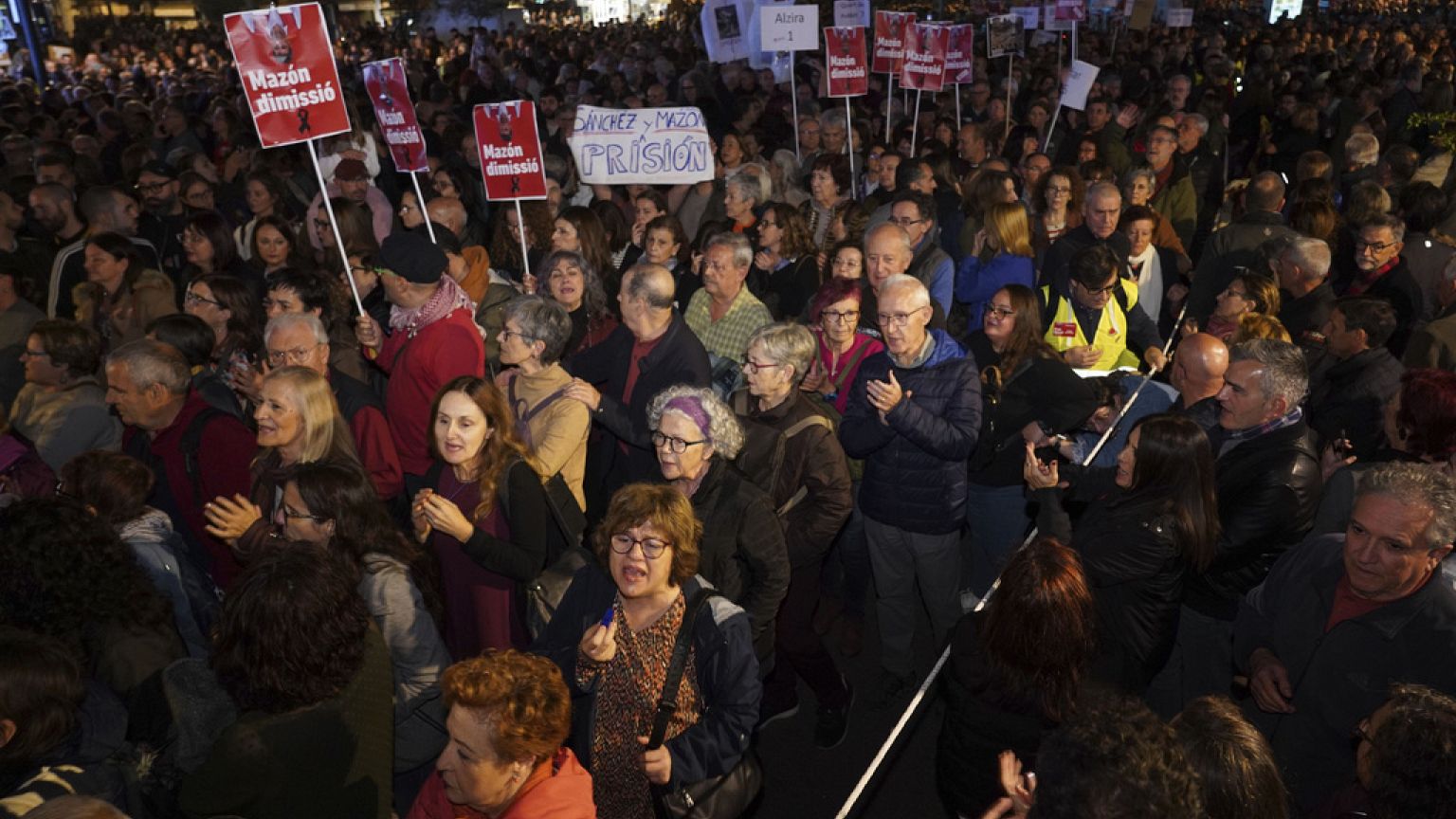
Protesters demand regional government resigns months after deadly Valencia floods


Copyright Alberto Saiz/Copyright 2024 The AP. All rights reserved.


By Euronews with EBU
Published on 30/06/2025 - 


During the deadly Valencia flooding last year, some areas saw a year's worth of rain in just eight hours - leaving people trapped in their homes by floodwaters.

Hundreds took to the streets of Valencia on Sunday to demand the resignation of the regional president Carlos Mazón and his government for their response to devastating flooding which killed hundreds.

The flooding left at least 228 people dead, thousands homeless and caused millions of euros’ worth of damage.

Sunday's demonstration was organised by more than 200 Valencian social organisations. In the rally, the organisers also wanted to highlight what they describe as negligence on the regional government’s behalf in the days following the flooding.

Protesters denounced the fact that their local authorities, in their view, have no serious plans for the reconstruction of educational infrastructures.

They are demanding more urgent action to help the area return to normal.

Mazón is under immense pressure after his administration failed to issue flood alerts to citizens’ cell phones until hours after the flooding started last October.

Mazón, of the conservative Popular Party, is also being criticized for what people perceive as the slow and chaotic response to the natural disaster. Thousands of volunteers were the first boots on the ground in many of the hardest hit areas on Valencia’s southern outskirts.

It took days for officials to mobilize the thousands of police reinforcements and soldiers that the regional government asked central authorities to send in.

Mazón has defended his handling of the crisis saying that its magnitude was unforeseeable and that his administration didn’t receive sufficient warnings from central authorities.
Argentina: workers at main pediatric hospital say care 'under threat'


Issued on: 30/06/2025 - FRANCE24


The Garrahan Hospital, Argentina's largest paediatric health centre — particularly renowned for its treatment of children with cancer — is a prime example of Javier Milei's chainsaw-style budget cuts and is now on the verge of collapse. Its budget has not been increased since Milei took office in December 2023, while inflation continues to soar (currently at 130%). The critical situation of this prestigious public hospital — which provides 600,000 consultations a year and performs more than 10,000 surgeries, mainly on children from across the country — is seen as a symbol of Milei's relentless assault on the State and public services. 

A piece by Mathilde GUILLAUME, Matias MUSA and Peter SCHOUTEN.

FRANCE 24 news coverage disrupted as staff strike against public media merger

FRANCE 24’s broadcasts and digital platforms were disrupted on Monday by a strike called by unions at France Médias Monde, the parent company of FRANCE 24, Radio France Internationale and Arabic-language radio station Monte Carlo Doualiya.


Issued on: 30/06/2025 -
By: FRANCE 24

FRANCE 24 news coverage has been disrupted as staff strike against public media merger. © Martin Lelievre, AFP


A fierce debate is raging in France over reforming public media, and staff at FRANCE 24 parent company France Médias Monde as well as France Télévisions and Radio France are striking on Monday against a proposed merger of France’s public broadcasting sector championed by Culture Minister Rachida Dati.

FRANCE 24 internet and TV journalists have joined the strike, which will cause a temporary disruption in news coverage on Monday and Tuesday.

Watch more

A new proposed holding company would unite France Médias Monde (FMM) with France Télévisions, Radio France and the National Audiovisual Institute (INA) under the direction of a single chief executive officer.

The government decided, however, that France Médias Monde, the international arm of the French public broadcasting system that includes FRANCE 24 and RFI, would be excluded from the scope of the holding company when the proposed reform was considered by lawmakers in June.

But unions say the government has “clearly” left the door open to the eventual integration of FMM into the holding company by 2028.

The merger is strongly opposed by public broadcasting unions.

Radio France launched an indefinite strike action on Thursday, calling the proposed holding "extremely dangerous" both for employees and for the independence of news coverage.

"Public broadcasting is a common asset whose strengths must be unified. Today, these forces are scattered," Dati told France’s private Sud Radio on Thursday, calling for "a coherent and coordinated strategy".

Prime Minister François Bayrou also threw his support behind the reform in comments to Radio Télévision Luxembourg on Sunday.

If the motion is defeated, Dati will face a full-fledged parliamentary battle led by Socialist MP Emmanuel Grégoire, who has tabled over 250 of the 935 amendments to the reform bill.

Due to the large number of amendments, it seems unlikely that the debate will proceed to a vote on either Monday or Tuesday.

(FRANCE 24 with AFP)


CAUCASUS BLOG: Politicians take on Emerging Europe’s powerful churches at their peril


CAUCASUS BLOG: Politicians take on Emerging Europe’s powerful churches at their peril

/ See of Holy Etchmiadzin


By bne IntelliNews June 27, 2025

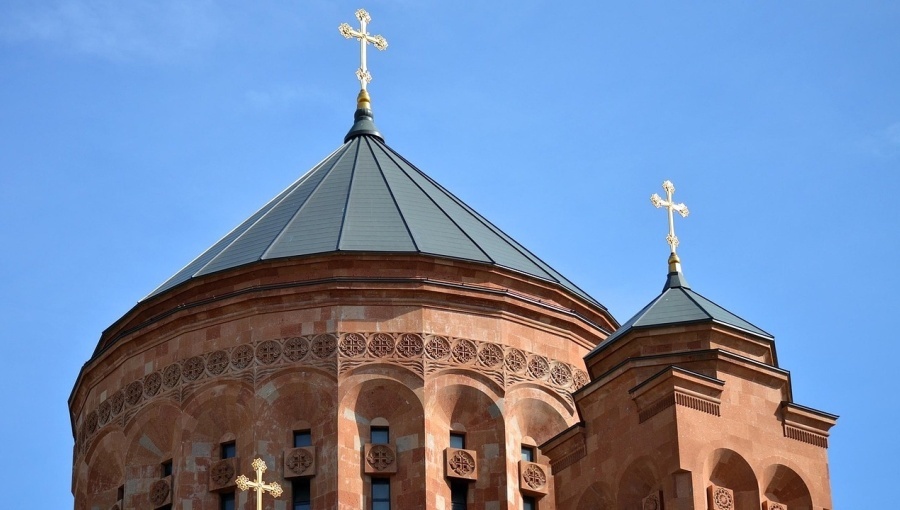
When Armenian Prime Minister Nikol Pashinyan offered to drop his trousers for the head of the Armenian Apostolic Church, it was only the latest – and most graphic – escalation in a bitter feud between Armenia’s embattled leader and the country’s dominant religious institution. The clash confirms a lesson other politicians in the Emerging Europe region have learned the hard way: tangling with powerful churches is rarely a winning strategy.

Pashinyan’s crude riposte came after a priest accused him of being circumcised – a serious charge in a nation where Christianity is not only the official faith but a core pillar of national identity. The prime minister responded on Facebook, offering to “prove the opposite” to the Catholicos, Karekin II. 

ONLY JEWS AND MUSLIMS ARE CIRCUMSICED IN OLD EUROPE

He also doubled down on the question of whether the church leader had broken his vow of celibacy and fathered a child. Armenia’s Apostolic Church, one of the world’s oldest Christian institutions, called the outburst “unbecoming of a statesman” and accused the government of a politically motivated campaign to undermine the church’s standing.

The spat, party conducted on Facebook, is more than a social media sideshow. It has become part of a much broader row pitting Pashinyan’s government against top businesspeople as well as clerics. It is playing out against the backdrop of regional instability and public disillusionment following Armenia’s defeat in the 2020 war with Azerbaijan.

On June 25, the authorities said they had prevented a coup plot. Archbishop Bagrat Galstanyan and several of his supporters were arrested on June 25 on charges of plotting to violently overthrow the state. Galstanyan, who had emerged as a leading opposition figure during protests against territorial concessions to Azerbaijan, denies the charges and has called them politically motivated.

Galstanyan’s detention came just days after the arrest of Armenian-Russian billionaire Samvel Karapetyan. Armenia’s National Security Service (NSS) conducted a search of Karapetyan’s Yerevan residence on June 17, a few hours after the influential tycoon publicly denounced what he called the government’s “attack” on the church and vowed to intervene if political leaders failed to act. Pashinyan has since doubled down, threatening to nationalise Karapetyan’s Electric Networks of Armenia. 

The arrests follow weeks of mutual recriminations between Pashinyan and church leaders. In early June, the prime minister claimed publicly that the Catholicos had violated his vow of celibacy. “If it turns out that Karekin II has a child, then he cannot be the Catholicos of all Armenians,” Pashinyan posted, warning of threats to both “spiritual security” and “state security”. The church, while not directly addressing the allegation, accused Pashinyan of fomenting division and weakening national unity.

Such provocations are striking in a country where the church retains deep social legitimacy. Although Armenia formally separates religion and state, the Armenian Apostolic Church enjoys a privileged position codified in law. A 2024 survey by the International Republican Institute found that 84% of Armenians identify with the church – more than express support for any political institution.

Dangerous precedent

Pashinyan’s campaign to curb the church’s influence may be partly aimed at redirecting public frustration over his government’s diplomatic and military setbacks. Armenia's loss of control over Nagorno-Karabakh in 2020, and subsequent steps toward normalisation with Azerbaijan, have been deeply unpopular. Church’s leaders, particularly Galstanyan, have been at the forefront of protest movements opposing these concessions.

But by making the church a political enemy, Pashinyan is wading into treacherous waters. Politicians in the broader Emerging Europe region have struggled when taking on dominant religious institutions. 

Nowhere is this more evident than in Montenegro, where attempts to diminish the power of the Serbian Orthodox Church backfired dramatically. In 2019, the ruling Democratic Party of Socialists (DPS) passed a controversial law aimed at transferring church property to the state. That law triggered mass protests and contributed to the DPS’s defeat in the 2020 general election after three decades in power.

Subsequent governments struggled to navigate the fallout. Former prime minister Dritan Abazović’s 2022 decision to sign a “fundamental agreement” with the church, intended to resolve the dispute, triggered a no-confidence vote and led to further political instability.

International influence 

The enduring power of religious institutions in the region is not merely a domestic affair. Orthodox churches – particularly the Russian Orthodox Church and to a lesser extent the Serbian Orthodox Church – have become powerful political actors in their own right, often aligning with nationalist and anti-liberal agendas.

In the Western Balkans, Russia leverages Orthodox networks to project soft power and destabilise pro-EU governments. Moscow’s support for the Serbian Orthodox Church contributed to the tensions in Montenegro that erupted into violent protests in summer 2021, and Russian politicians frequently invoke traditional religious values in their campaign against Western liberalism.

The influence of religious conservatism has also played out in disputes over issues such as gender rights across Central and Eastern Europe. The ratification of the Istanbul Convention – a Council of Europe treaty aimed at combating violence against women – met fierce resistance in parts of Central and Southeast Europe. Gay Pride parades have taken place in a tense atmosphere in countries across the region. 

However, the power of the church is eroding in more westernised countries. In Poland, the backlash against the former ruling Law and Justice (PiS) party’s harsh anti-abortion policies happened despite the Catholic Church. Though church influence remains strong, its political clout has diminished.

Following Russia’s invasion of Ukraine, several churches in the region broke away from the Russian Orthodox Church, not only in Ukraine but also in the Baltic States. 

A political gamble

Against this backdrop, Pashinyan’s choice to escalate his confrontation with the Armenian Church appears risky, if not reckless. While the prime minister may hope to capitalise on frustrations with ecclesiastical privilege and broaden his appeal among secular or liberal voters, the gamble could further fracture a deeply polarised society.

But to many Armenians, the church remains a symbol of national survival, especially in the face of historical traumas and regional threats. Even as church leaders face questions over wealth, celibacy or politics, they are still seen by many as more trustworthy than the state.

The lesson from Montenegro is that when political leaders pick fights with powerful religious institutions, they often lose more than they gain.


COMMENT: Iran new rail link to China played a role in provoking the 12-day war

ANY EXCUSE WILL DO
COMMENT: Iran new rail link to China played a role in provoking the 12-day war
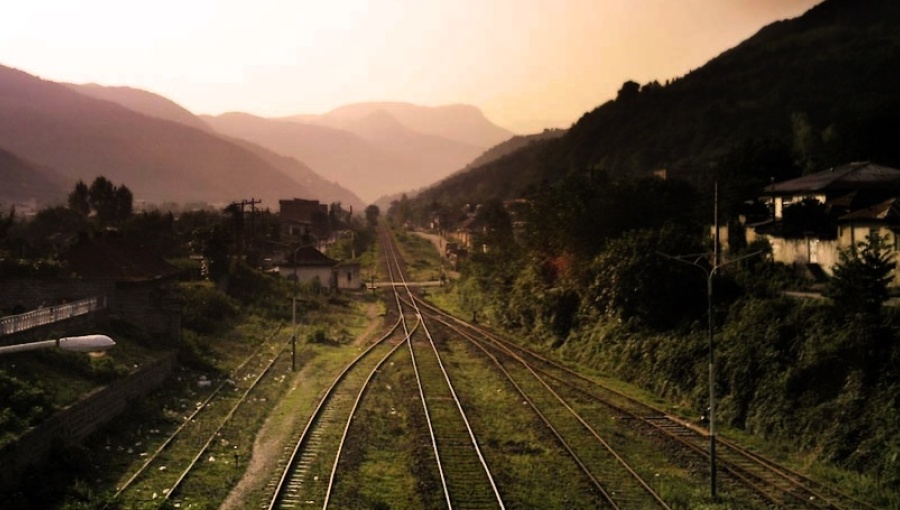
Iran launched its first-ever direct railway connection to China in May, a strategic link that reduces the US's ability to sanction Tehran and probably contributed to the motivation to go to war. Facebook


By Ben Aris in Berlin June 29, 2025

Iran launched its first-ever direct railway connection to China in May, the country’s first rail link to Asia that does not rely on transshipment through seaports or Russia, significantly improving its national security by reducing exports vulnerability to the US navy’s threat to seaborne cargo.

Following the quiet inauguration of Iran’s first direct railway link to China, analysts have suggested it may have sparked off the military escalation that erupted following Israel’s attack on Iran on June 12.

The rail link is a significant milestone in Tehran’s efforts to expand trade and infrastructure links across Eurasia. The inaugural train departed from Tehran in May, travelling more than 5,300 km to the Chinese city of Xi’an in just over 14 days, Iranian state media reported.

The route, which crosses Turkmenistan and Kazakhstan before entering western China, forms part of the broader China-Central Asia-West Asia corridor under Beijing’s Belt and Road Initiative (BRI).

Iranian officials described the opening as a “breakthrough”, as it will reduce transport costs and delivery times for goods traded between the two countries. The overland journey is significantly shorter than traditional maritime routes via the Strait of Malacca and the Suez Canal. The route also effectively bypasses the US sanctions on Iran and also provides China better overland access to the Middle East.

“The launch of this corridor is a major step forward in diversifying Iran’s trade routes and strengthening its position in regional transit,” said Iranian Minister of Roads and Urban Development Mehrdad Bazrpash.

The rail link is expected to allow the direct delivery of Iranian bulk goods like petrochemicals, agricultural products and construction materials, while facilitating the import of Chinese electronics, machinery and consumer goods.

Iran has invested heavily in recent years to expand its rail infrastructure, which comes in the context of other developing overland links, including the Middle Corridor. There was also a new railway link between China and Kazakhstan that opened in November 2023, the Ayagoz-Tacheng railway connection that is also part of the BRI. The new railway line connects Tacheng in China's western Xinjiang region with Ayagoz in eastern Kazakhstan. It is the third rail border crossing between the two countries, alongside the Alashankou-Dostyk and Khorgos-Altynkol corridors.

In addition, a China-Kyrgyzstan-Uzbekistan link is under development that will connect Kashgar (China) through Torugart (Kyrgyzstan) to Andijan (Uzbekistan). Still at the memorandum stage, China and Tajikistan are discussing creating a railway link through the Kulma Pass that would be Tajikistan’s first direct rail connection with China.

War incentive

The Iranian freight route, which connects the central Chinese city of Xi’an to the Aprin dry port nearby, is Iran’s first direct rail corridor to China, but the project has also been described as a strategic rupture that the West is keen to stymie.

Within days of the line becoming operational, the United States and Israel launched a series of high-intensity airstrikes on Iranian infrastructure, officially aimed at halting the country’s nuclear programme, but the railway was also targeted.

Within a week Iran’s parliament voted to close the Straits of Hormuz that analysts said would be a self-inflicted wound, as Iran’s budget depends heavily on oil exports, most of which go to China. The railway provides an alternative export link to China to keep the money flowing even if shipping via the Straits is closed down.

Reducing overland shipping time to roughly 15 days, the line also circumvents the Western-controlled insurance, logistics and payments architecture that underpins global trade and which have been used to sanction Iran.

The development came at a moment of quiet recalibration in US Iran policy. While maintaining a hawkish stance, Washington under the Trump-led Republican administration was reportedly preparing to lift selected secondary sanctions on Chinese entities buying Iranian crude. In return, those transactions would be routed through US-controlled escrow accounts – offering Tehran limited dollar access, but under American financial supervision.

Iran’s establishment of a direct railway to China may have pre-empted or undermined this prospective arrangement, say analysts. The corridor provides a structural mechanism for China and Iran to deepen economic ties beyond the reach of US oversight at a time when the White House is seeking to increase its control over Iran’s oil export revenues.

More generally, the rail link is part of Tehran’s wider policy to reduce US leverage over Iran and anchor itself within the emerging Sino-Russian Eurasian system that is part of Moscow and Beijing’s attempt to build a multipolar world order.

“The war that followed was, in substance, a contest over supply chains, currency hegemony and strategic connectivity,” the report said. “Iran sought to reorder the terms of its global integration.”


Two more Georgian opposition leaders jailed bringing total to six in one week

Two more Georgian opposition leaders jailed bringing total to six in one week
Nika Melia has been jailed for eight months for his failure to testify before a parliamentary commission. / Nika Melia via Instagram
By bne IntelliNews June 29, 2025

Georgian politician Nika Melia, one of the leaders of the opposition Coalition for Change group, has been jailed for eight months for his failure to testify before a parliamentary commission tasked with investigating members of the former-ruling United National Movement (UNM) government, the opposition group said on social media. Givi Targamadze, a former UNM lawmaker who is now retired from politics, received a prison sentence of seven months under the same charges. Both have also been banned from holding public office for two years. 

Targamadze and Melia are the fifth and six opposition leaders to be jailed for defying the summons of the parliament commission. Their verdicts come amid the ruling Georgia Dream party’s ongoing crackdown on their political opponents, which has placed the majority of Georgia’s pro-Western opposition leaders in jail and sparked a huge international backlash.

On June 23, Zurab Japaridze of Coalition for Change and Mamuka Khazaradze and Badri Japaridze of the Strong Georgia bloc received similar sentences, followed by Giorgi Vashadze of the Untiy-UNM coalition who was jailed on June 24.

Two more opposition politicians - Nika Gvaramia, also of Coalition for Change, and Irakli Okruashvili, a former defence minister under UNM - have also been detained for failure to tesify before the commission, and remain in pre-trial detention awaiting their sentences, which are likely to be similar.

Neither Melia nor Targamazde attended their court hearings on June 27.

Melia was already in pre-trial detention, having refused to pay the bail initially imposed upon him following his non-appearance before GD’s commission.

Targamazde, having paid bail, arrived at the police station near his home after the announcement of his sentence and was placed in handcuffs.

GD’s parliamentary commission

The incumbent GD parliament launched an investigative commission in February to probe what they claim to be “systemic” and “monstrous” “crimes” and abuses committed by officials of the former-ruling United National Movement, during their time in government from 2003-12 but also since.

GD critics argue the commission is essentially a tool of political persecution that the ruling party is using to outlaw their opponents one by one.

Shortly after the commission was launched, GD announced that its findings would form a basis of evidence upon which to have UNM and its so-called “successor parties” declared unconstitutional and banned.

Outlawing the so-called “collective UNM” was one of GD’s main campaign pillars in the run up to Georgia’s contentious October 2024 parliamentary election, which the opposition accuse the ruling party of rigging.

With the exception of the For Georgia leader, Giorgi Gakharia, all opposition figures summoned to the commission so far have refused to appear and have had criminal cases opened against them.

Citing reports of violations during the October 2024 parliamentary elections, all four of Georgia’s major opposition blocs have declared they do not consider the parliament to be legitimate, and subsequently do not recognise the commission.

As per article 349 of the Georgian Criminal Code, “non-compliance with the request of the Parliament’s Temporary Investigative Commission” is punishable by up to a year imprisonment as well as a ban on holding political office for up to three years.

All those opposition figures who failed to attend their commission hearings were initially granted bail as a preventive measure.

Japaridze, along with Gvaramia and Melia, refused to pay, and were sent to pre-trial detention to await their verdict.

Others - Khazaradze, Badri Japaridze and Vashadze - did pay, although this seems to have had no impact on the severity of sentence received.


Artificial Intelligence: A Tool That Is Reshaping Geopolitics – Analysis

artificial intelligence cyborg

By 

In recent years, following the end of the COVID-19 crisis, the term artificial intelligence (AI) has become omnipresent in public discourse. According to the Merriam-Webster dictionary, artificial intelligence is “the capability of computer systems or algorithms to imitate intelligent human behavior.” This emerging phenomenon is receiving great attention. In truth, it is neither a new concept nor a new occurrence, as AI began gradually developing in 1956 with a scientific conference in Dartmouth. Since then, AI has experienced both advances and setbacks, having been most utilized in fields such as the military, medicine, robotics, and education.

Over time, artificial intelligence has significantly advanced. Today, ordinary people around the world can use basic smart computer models, but there is little doubt that the centers of global power—national governments, intelligence agencies, and various organizations—possess models that are ten or more years ahead of what is publicly available.

An Indispensable Tool of Our Time

Many analysts warn that artificial intelligence will replace and subordinate human beings. This is a highly debatable claim, as AI is not some superior “divine” entity, but rather a technology created by flesh-and-blood humans with all their imperfections. Similarly, when the Industrial Revolution emerged in the 18th century, many feared machines would replace humans. That did not happen. It is unlikely AI will do so either. However, it is evident that individuals who do not use AI tools will be unable to keep up with those who do. The same applies to the international political arena.

States, multilateral organizations, and movements that utilize AI will remain competitive in the political arena, while those that do not will stagnate and decline. According to S&P Global, between 2013 and 2023, 5,509 AI companies were founded in the United States, with total private investments reaching approximately $335.2 billion. During the same period, China saw the establishment of 1,446 AI companies, with private investments amounting to about $103.7 billion.

Political Leaders Recognize a New Weapon

Russian President Vladimir Putin stated back in 2017: “Artificial intelligence is the future, not only for Russia but for all of humanity.” He added that AI carries enormous opportunities, but also threats that are difficult to foresee, noting that whoever becomes the leader in this field will become the ruler of the world. 

In December 2017, Donald Trump signed a new National Security Strategy emphasizing the importance of artificial intelligence for the national security and economic development of the United States. The strategy states that “continued American leadership in artificial intelligence is of utmost importance for preserving the economic and national security of the United States.” During the 20th National Congress of the Communist Party of China in October 2022, Chinese President Xi Jinping declared that China must accelerate achieving a high level of scientific and technological self-reliance and improvement, clearly referring to AI.

A Game-Changer in Geopolitics

Artificial intelligence is a tool reshaping geopolitics on a multidimensional level. This is not a conventional change, but a revolutionary one. AI could significantly alter the way we understand international relations and diplomacy today. The sooner policymakers realize this, the better. Although diplomacy, as an interdisciplinary field, belongs to the social sciences and humanities (a blend of history, politics, law, sociology, and communication), AI introduces mathematical models into diplomacy. This could be described as the “technologization of diplomacy.” In geopolitical terms, AI’s use is most important in two interconnected areas: diplomacy and national security. Put simply, AI is a crucial diplomatic and military-security tool.

A Modern Diplomatic Instrument

Artificial intelligence is transforming the conduct of bilateral and multilateral relations. National governments and leading commissions in organizations such as the UN, EU, and BRICS are actively using smart technology—from basic real-time translations to the creation of complex analyses. Diplomats can communicate more easily with their colleagues thanks to AI, receiving instant translations as well as real-time suggestions from virtual assistants.

AI can facilitate diplomatic negotiations between two or more countries by analyzing historical relationships, proposing new strategies for improving relations, and offering guidance on negotiation styles. Diplomats and politicians are often unimaginative and unable to grasp new ideas. However, many of today’s political disputes also existed in the past. AI can compare historical and current contexts and offer constructive proposals. Beyond negotiation content, outcomes are influenced by style. If the style is wrong (too assertive or too timid), the outcome may be negative even if the idea itself is good.

Based on available data (public opinion, military deployments, leaders’ behavior), AI programs can predict the early onset of crises and wars. AI can recommend which countries should receive peacekeeping missions before a crisis erupts or where peacekeepers should be withdrawn. Similarly, governments can use computer models to present diplomatic negotiations and agreements to the public in a more acceptable way to ensure support. Politics is about perception, and political results can often be interpreted both as victories and defeats.

A Military-Security Tool

Artificial intelligence is becoming a key military tool for many powerful states and organizations. The United States uses AI to develop autonomous drones, defend against cyberattacks, and analyze military intelligence. China applies AI in mass surveillance systems, facial recognition, and unmanned technology. Russia uses AI for cyber defense, automating military systems such as drones, analyzing satellite and intelligence data, and electronic warfare. Israel employs AI in several key military systems, the most famous being the “Iron Dome.” AI helps rapidly detect and intercept threats such as rockets and mortar shells.

NATO uses AI to forecast conflicts, protect communication networks, manage logistics, and optimize military operations. All mentioned countries also use AI for cyber warfare (targeting infrastructure of other nations and spreading propaganda) and to protect against foreign cyberattacks. Organizations like the U.S. DARPA and China’s AI Institute are developing advanced military systems. The use of AI can offer advantages on the battlefield but also increases the risk of conflict escalation. Therefore, there is a growing need for international rules and oversight on AI in the military sector.

The Race to Develop AI for Geopolitical Purposes

All significant global powers have realized that a race is underway to develop artificial intelligence for political purposes. American companies like Google, Amazon, and Microsoft are developing computer models to help the U.S. maintain its status as the world’s most powerful country and to preserve organizations such as NATO, the G7, OAS, IMF, and the World Bank. The Chinese are using AI to advance their Belt and Road Initiative. The Digital Silk Road accompanies this initiative, focusing on the development of digital infrastructure, technology, and internet networks wherever the Belt and Road passes (Asia, Africa, Europe). China aims to establish itself as the world’s new technological leader. 

Russia primarily develops AI tools for propaganda purposes, subtly reshaping the narrative that is unfavorable to them in parts of the world (the EU and the U.S.). The European Union seeks to position itself as a leader in ethical AI use, promoting a global framework for moral application. BRICS countries like India, Brazil, and South Africa place less emphasis on ethics, using AI mainly to develop their economies and redefine global power structures that limit their growth.

Conclusion

Thanks to the development of advanced analytical tools and predictive algorithms, artificial intelligence has been widely used in international relations and diplomacy since the 2010s. Because of its advantages—such as precise data processing and rapid solution proposals—AI has become an indispensable tool in modern diplomacy. However, when, how much, and in what way it will be used depends on people—the decision-makers. AI is a mathematical model with its own shortcomings and requires skilled experts to be used appropriately. The risks are significant.


Matija Šerić

Matija Šerić is a geopolitical analyst and journalist from Croatia and writes on foreign policy, history, economy, society, etc.


Hitting The Right Notes To Play Music By Ear

Music Jazz Musician Musical Sound Instrument

By 

Learning to play music by ear is challenging for most musicians, but research from a team at the University of Waterloo may help musicians-in-training find the right notes.

The Waterloo team analyzed a range of YouTube videos that focused on learning music by ear and identified four simple ways music learning technology can better aid prospective musicians – helping people improve recall while listening, limiting playback to small chunks, identifying musical subsequences to memorize, and replaying notes indefinitely.

“There are a lot of apps and electronic tools out there to help learn by ear from recorded music,” said Christopher Liscio, a recent Waterloo master’s graduate in computer science and the study’s lead author. 

“But we see evidence that musicians don’t appear to use them very much, which makes us question whether these tools are truly well-suited to the task. By studying how people teach and learn how to play music by ear in YouTube videos, we can try to understand what might actually help these ear-learning musicians.” 

The team studied 28 YouTube ear-learning lessons, breaking each down to examine how the instructors structured their teaching and how students would likely retain what they heard. Surprisingly, they found that very few creators or viewers were using existing digital learning tools to loop playback or manipulate playback speed despite their availability for over two decades.

“We started this research planning to build a specific tool for ear learners, but then we realized we might be reinforcing a negative pattern of building tools without knowing what users actually want,” said Dan Brown, professor of Computer Science at Waterloo. “Then we got excited when we realized YouTube could be a helpful resource for that research process.”