It’s possible that I shall make an ass of myself. But in that case one can always get out of it with a little dialectic. I have, of course, so worded my proposition as to be right either way (K.Marx, Letter to F.Engels on the Indian Mutiny)
Sunday, June 28, 2026
Can we engineer being on the same wavelength with others? Research offers a cautious “yes”
Analysis shows science can help us become synchronized over time—and feel more connected to others in the process
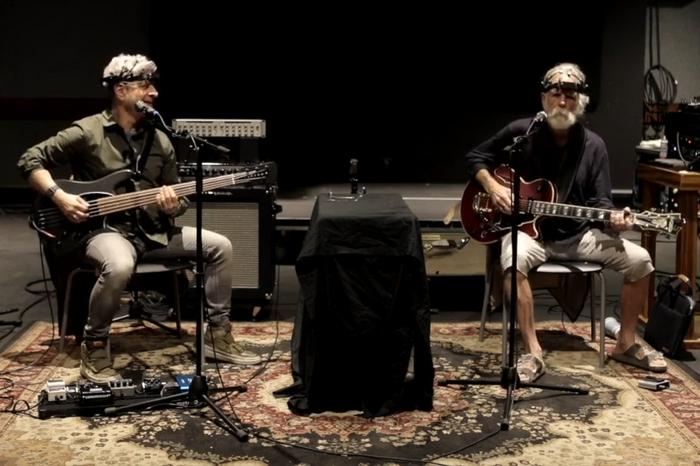
Mike Gordon, left, and Bob Weir participating in a 2023 project that measured and visualized how the musicians became “in sync” with each other during live music making.
We often feel that we are “on the same wavelength” with one another, but can science identify and engineer this phenomenon? Studies by a team of neuroscience researchers suggest that it’s possible—a connectivity that is both beneficial and that can be enhanced for therapeutic and other purposes.
The scientists collaborated with schools, museums, and performance artists—including Bad Bunny and Residente, Marina Abramovic, and Mike Gordon and Bob Weir—to design and conduct projects measuring and visualizing how the brainwaves of thousands of museum visitors, festivalgoers, and high school students became “in sync” with each other during live face-to-face communication.
Collectively, their research, which has encompassed friends, family members, and strangers, has shown that brainwaves match up in certain exchanges, and that when they do, this synchrony can be used to guide and improve social interactions—in other words, a way to engineer social connectedness.
“Our years of experiments show that we can consistently measure the seemingly elusive notion of ‘being on the same wavelength’ with someone else—a synchrony that is linked to healthy social relationships,” says Suzanne Dikker, a research professor at New York University and Ghent University. “Taking the next step, we’ve also been able to design interventions that boost social synchrony.”
The work, which appears in the journal Trends in Cognitive Sciences, also included Yafeng Pan, a professor at Zhejiang University, Xiaojun Cheng, a professor at Shenzhen University, and Guillaume Dumas, a professor at the University of Montreal.
The authors say their work offers the possibility of finding new pathways to utilize synchrony in order to improve social connectedness.
Over the course of a decade, the researchers conducted studies and projects in which thousands of participants’ brain activity was recorded using portable electroencephalogram (EEG) technology—a non-invasive headset. For instance, Dikker collaborated with Bad Bunny and Residente in 2019 to map the artists’ brain activity while they created music and show them in real time how in sync their brainwaves were, so they could test different “syncing strategies.” The EEG data illuminated their brain synchronies during the creation of the single “Bellacoso.”
Overall, these findings pointed to a phenomenon they call “social synchrony”—the alignment of the rhythms of our brains, bodies, and language with people around us during social communication. For instance, the study of high school students found utility in brain synchronization—when students’ brainwaves were synchronized with each other, the more likely they were to report liking the other person as well as the class itself.
“Social synchrony plays an important role in healthy social relationships and in learning,” observes Dikker. “For example, lonely individuals show more idiosyncratic brain activity, and there is growing evidence suggesting that face-to-face activities that involve interpersonal synchrony, such as playing games or engaging in everyday banter, is important to maintaining social cohesion in communities.”
Dikker and her colleagues, Greg Appelbaum and Eric Garland at the University of California, San Diego, will now examine how to leverage brainwave synchronization under a $4-million grant from the Department of Health and Human Services’ Advanced Research Projects Agency for Health (ARPA-H). The researchers will test how to deploy this phenomenon in clinical settings by seeking ways to leverage the synchrony found in earlier experiments to improve therapeutic outcomes.
The synchronization of brainwaves among students during class reflects how much they like the class and each other, research has found. The researchers followed a group of high school students and their teacher for an entire semester and recorded their brain activity during their regular biology classes using portable electroencephalogram (EEG) technology.
Researchers in the Department of Physics & Astronomy at Texas Tech University recently used audio to represent the spectacular explosion of a star in deep space while also delving into the data to better understand how the phenomenon unfolded.
The explosion of NovaV612 Scuti, also known as ASSASSN-17hx, was discovered in 2017 and observed by astronomers around the world. Those observations produced data allowing researchers to study how the eruption changed over time. At Texas Tech the work has been led by undergraduate student Pragati Acharya under the guidance of Assistant Professor Elias Aydi.
By transforming the nova’s changing light into audio, the team has added a new dimension to understanding how the explosion unfolded.
“This sonification allows people not only to see the changing brightness of the explosion, but also to hear its evolution,” Aydi said. “In other words, we can now offer audiences a way to experience what a stellar explosion might ‘sound’ like when astronomical data are translated into audio.”
The findings have been accepted for publication in the journal Monthly Notices of the Royal Astronomical Society (Oxford Press).
A nova occurs when a dense stellar remnant, known as a white dwarf, pulls material from a companion star. As that material builds up on the white dwarf’s surface, it can trigger a sudden thermonuclear explosion, causing the system to brighten dramatically.
Aydi explained that although scientists have long studied these explosions, recent discoveries have changed how researchers understand these event
These discoveries led astronomers to explore how novae could produce such energetic radiation. One explanation centers on shock waves. During a nova eruption, gas can be ejected at different speeds. Later faster-moving material may collide with gas ejected earlier, creating powerful shocks.
The shocks also heat the surrounding gas, causing it to radiate at visible wavelengths. Recent studies have shown that much of the visible light typically observed from novae, long thought to come primarily from nuclear reactions on the surface of the white dwarf, may instead originate, at least in part, from the shock-heated gas.
To investigate the eruption, the researchers used spectroscopy, a technique that separates light into different wavelengths, much like spreading light into the colors of a rainbow. This allows astronomers to measure how strongly the object emits at different wavelengths and to track the motion of gas during the explosion.
Astronomers around the world observed V612 Scuti using spectroscopy and shared their data with the broader scientific community. The Texas Tech team used those observations to examine when the brightness jumps occurred, what caused them and how the gas moved during the eruption.
Aydi said the team found evidence that new ejections occurred with each jump in the light curve. By studying shifts in the spectra, they were also able to calculate the velocity of the material. Over several months of observations, they found that the gas increased significantly in velocity with each major jump.
The team decided to take the analysis a step farther.
“We had high-resolution spectra, which measure intensity versus frequency, and we said, ‘We can actually convert this extensive set of data into an equivalent of sound.’” Aydi said. “So, we converted the intensity of light into sound pitch and the frequency of light into frequency of sound.”
Acharya carried out much of the data analysis, including creating the figures for the paper and producing the sonification. She said she gained valuable experience in coding, spectroscopy and astronomical data analysis.
“I realized how it works bit by bit, code by code, and what the sonification script actually does,” she said. “When I did it all by myself and changed the wavelengths into frequencies and produced a sound, it felt like the best thing I had ever done, and it’s something I will never forget.”
For more information on this story, please click here.
Earth's ionosphere supplied vast majority of ring current ions during May 2024 super geomagnetic storm, study finds
Despite the dense solar wind, solar wind ion contributions to the ring current during the May 2024 superstorm were minimal — the first simultaneous observation of ring current ions and solar wind during a storm this large.
In May 2024, auroras were observed at unusually low latitudes across the globe, lighting up skies that rarely see such displays. Inside Earth’s magnetosphere, the region of space surrounding our planet and dominated by its intrinsic magnetic field, something significant was finally being observed.
It started with a large sunspot firing a rapid series of powerful solar eruptions. Clouds of magnetized plasma merged as they traveled through space and impacted Earth's magnetosphere. No geomagnetic storm this powerful had ever been measured in the Earth’s ring current region, a belt of charged particles in space near our planet.
Two sources of ring current ions are known: solar wind and Earth's ionosphere, the electrically charged upper layer of the atmosphere. For decades, scientists have debated how much each source contributes to the ring current. During most storms, both contribute. However, during a storm driven by a dense solar wind, some scientists expected solar wind ions to continue to play a notable role. Yet the first direct measurements of ring current composition from a super geomagnetic storm revealed that solar wind ion contributions were minimal, and the level of Earth-origin ion dominance had never been observed before.
The findings, published in Science Advances, suggest that understanding how much Earth's ionosphere contributes to the ring current may be essential to accurately predict the severity of super geomagnetic storms. The dominance of ionospheric ions, which are far heavier than solar wind particles, may have intensified the magnetic disturbance and concentrated the ring current peak unusually close to Earth. The researchers also make a case for a proposed Japanese multi-satellite mission to understand exactly how ion supply processes work.
Earth’s ring current
On May 10 and 11, 2024, giant clouds of charged particles from the Sun struck Earth's magnetosphere. The resulting May 2024 super geomagnetic storm, also referred to as the “Gannon storm” or “Mother's Day storm,” reached a minimum SYM-H index of −518 nanotesla, the second-largest value recorded since 1981. The last comparable geomagnetic storm was the November 2004 superstorm.
“Some super or extreme geomagnetic storms are not just impressive light shows—they pose radiation risks to spacecraft, disturb GPS signals and communications, and cause power outages. Understanding how a geomagnetic storm develops is not only a scientific question, but also one with real-world consequences,” said Naritoshi Kitamura, lead author and designated assistant professor from the Institute for Space-Earth Environmental Research (ISEE) at Nagoya University.
The magnetic disturbance of a geomagnetic storm is caused by the ring current. This is a huge belt of energized ions, mostly oxygen and hydrogen, that drift slowly around Earth thousands of kilometers above the equator. The energized ions carry current, and that current generates a magnetic field that partially cancels Earth's own on the ground. This causes the disturbance that is observed by ground-based instruments.
Arase was ready: rare event, first of its kind observation
Japan's Arase satellite was launched in 2016 and has been operated by the Japan Aerospace Exploration Agency (JAXA). The ERG (Arase) science center is jointly operated by Institute of Space and Astronautical Science (ISAS)/JAXA and Institute for Space-Earth Environmental Research/Nagoya University.
Arase orbits the region where the ring current develops. The satellite carries specialized instruments to identify mass and energy of detected ions. It crossed through the ring current just after the storm began, and again near its peak.
“This is the first simultaneous observation of ring current ions and solar wind during a storm this large, and the data was clear—approximately 85% of ions were oxygen from Earth's own ionosphere,” Kitamura explained.
“Near the peak of the storm, Arase detected a 40% decrease in magnetic field intensity at roughly 16,000 kilometers above Earth, and much closer to Earth than similar large decreases previously documented.”
The same region also showed a simultaneous drop in high-energy electrons that normally orbit Earth in that zone. When a magnetic field weakens this severely, electrons drift out from their normal paths. Whether the magnetic field deformation caused the electron loss warrants further investigation.
The findings deepen our understanding of how super geomagnetic storms develop. Space weather forecasting models rely on solar wind conditions to predict storm severity, but this study suggests Earth's atmospheric state, and not just conditions at the Sun, may partly determine how severe a storm becomes.
The study also supports FACTORS, a two-satellite mission concept being prepared for JAXA’s upcoming proposal opportunity, which would directly address this gap. FACTORS aims to improve our understanding of how Earth's atmospheric ions escape into the magnetosphere and contribute to geomagnetic storm development. It may ultimately help scientists more accurately predict how severe these storms will get.
Schematic image of ring current ions on the dusk side during the peak of the May 2024 super geomagnetic storm, viewed from the Sun's perspective.
Credit
ERG Science Team
Japan's Arase satellite lifts off in December 2016. The spacecraft orbited for more than seven years before the May 2024 super geomagnetic storm finally provided the opportunity to measure ring current composition directly.
Extreme dominance of Earth-origin heavy ions in the intense ring current near the Earth during the May 2024 super geomagnetic storm
Article Publication Date
26-Jun-2026
Intestinal cells found to starve Salmonella of essential nutrients, revealing new tactic in infection defense
Discovery sheds light on how the human body controls food-borne infections
University of Vermont
BURLINGTON, VERMONT – Salmonella, an infection that causes diarrhea, fever, and abdominal pain, is the most common form of bacterial food poisoning in the U.S., sickening more than a million people each year. Although most healthy people recover without medical treatment, Salmonella infection can spread throughout the body in young children, the elderly and immuncompromised individuals and become a life-threatening infection. A new discovery sheds light on how the human body controls Salmonella infections and open pathways for potential treatments for Salmonella and other food-borne infections.
Research at the Robert Larner, M.D. College of Medicine at the University of Vermont has revealed details about the fight for essential nutrients between Salmonella bacteria and the host during an infection. New evidence discovered by principal investigator Leigh Knodler, Ph.D., Professor of Microbiology and Molecular Genetics, and colleagues demonstrates that specialized intestinal cells control the ability of Salmonella to grow by restricting their access to essential metals, such as iron and manganese.
Epithelial cells lining the intestine form a physical barrier to protect against gut microbes from entering the bloodstream. But some harmful bacteria, such as Salmonella, can breach this barrier and live inside these intestinal cells. In a study supported by a two-year R21 award from the National Institute of Allergy and Infectious Diseases (NIAID) published this week in The Proceedings of the National Academy of Sciences, a peer-reviewed journal of the National Academy of Sciences (NAS), Knodler and colleagues found that intestinal epithelial cells pump iron and manganese away from intracellular Salmonella to restrict theirgrowth in the intestine. This means that if pathogenic bacteria breach the intestinal barrier, then the host has a back-up means of defense..
Using specialized fluorescent sensors of metal ion availability, Knodler and colleagues traced where metal restriction occurs in the gut during an infection and how the human cells use a specialized system (a metal transporter) to withhold these trace metals. The findings highlight a new dimension of host–pathogen interactions and suggest that manipulating metal transport pathways could strengthen the body’s natural defenses. This new knowledge may lead to more novel treatment or diagnostic options for Salmonella and other diarrheal and food-borne illnesses.
“All forms of life, from bacteria to mammals, need essential trace metals. During an infection, there is a fierce biological tug‑of‑war between the human body and microbes for these nutrients, and the outcome can determine the severity of disease,” said Knodler. “Our research shows that intestinal epithelial cells use a metal transporter to starve Salmonella of iron and manganese, and limit bacterial growth. These transporters are potential drug targets for infectious and other human diseases, and our study lays the groundwork for understanding where and how they act in the body.”
Next steps for the research include examining additional metal transporters in the gut—of which there are dozens—to determine whether they also contribute to pathogen control and how they collectively shape the landscape of nutritional immunity. Collaborators on the study include researchers at the University of Wisconsin at Madison, Vanderbilt University Medical Center and John Salogiannis, Ph.D., at the Larner College of Medicine.
###
Research like this has contributed to the University of Vermont’s designation by the Carnegie Classification of Institutions of Higher Education as an R1 institution, placing it in the top tier of research universities in the U.S.
About the Larner College of Medicine at the University of Vermont
Founded in 1822, the Robert Larner, M.D. College of Medicine at the University of Vermont is the seventh-oldest medical school in the nation. The college is dedicated to developing exceptional physicians and scientists by offering innovative curriculum design, state-of-the-art research facilities, and clinical partnerships with leading health care institutions. The college’s commitment to excellence has earned national recognition, attracting talented students, trainees, physicians, and researchers from across the country and around the world. With a focus on inclusive excellence, the Larner College of Medicine prides itself on cultivating an environment that uplifts and supports its faculty and student populations while advancing medical education, research, and patient care in Vermont and beyond. uvm.edu/larnermed