It’s possible that I shall make an ass of myself. But in that case one can always get out of it with a little dialectic. I have, of course, so worded my proposition as to be right either way (K.Marx, Letter to F.Engels on the Indian Mutiny)
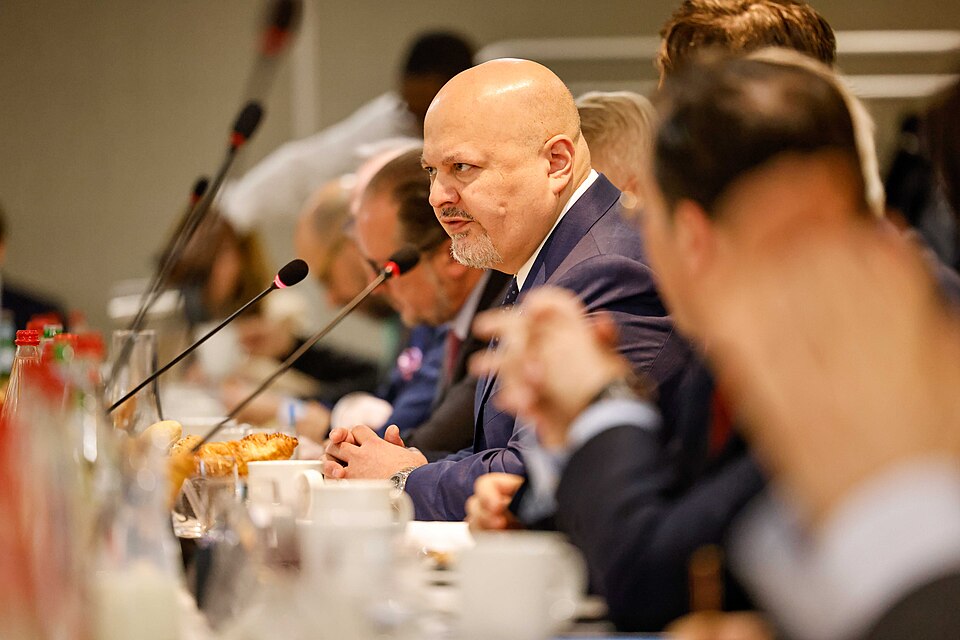
Image by Ministerie van Buitenlandse Zaken/Wikimediacommons, licensed via CC BY 2.0
Could it be put down to a measure of confidence on his part? On this occasion, Israeli Prime Minister Benjamin Netanyahu had, in the Wing of Zion, been less cautious in making a journey to Washington through European airspace. In September 2025, French airspace was avoided during a flight to New York. Most European states, with occasional hiccups of complaint, remain signatories of the Rome Statute, that document founding the International Criminal Court (ICC). The Israeli PM, along with his former defence minister Yoav Gallant, have extant arrest warrants for alleged war crimes in Gaza.
This confidence might have been instilled by the removal of Karim Khan as the Court’s chief prosecutor, who faced allegations of sexual misconduct made by a member of his staff. The result arose from a majority vote of the Court’s member states – 82 in favour of removal, 13 against, with 15 abstentions. The decision was reached on July 24 at an emergency session at the UN headquarters in New York.
Khan has certainly had his problems at an organisation that even optimists can describe as dysfunctional. The Independent Expert Review in 2020 made numerous findings, including “low morale in Chambers.” This included the absence of opportunities for promotion, a perceived “degree of arbitrariness or lack of consistency in management decisions” and “instances of harassment and bullying by some Judges, which have not been sufficiently tackled”. The Office of the Prosecutor was also governed by an “unclear” regulatory framework and a working environment marked by “personality-driven working methods”, with a rampant perception about “a lack of accountability”, notably at the higher levels.
Khan’s own promised efforts to reform his office made little headway. Then came an investigation into claims made by Sarah (as identified by CNN), a lawyer from Malaysia who had worked for the ICC since 2017, and as Khan’s assistant from February 2023 that she had been allegedly harassed and subjected to non-consensual sexual acts by the prosecutor.
In November 2024, the ICC sought an investigation by the UN Office of Internal Oversight Services (OIOS) into “alleged misconduct by the ICC prosecutor” after the complainant refused to cooperate with the ICC’s own investigative body. Curiously enough, the OIOS has no formal mandate for such a function, and certainly none stipulated under the Rome Statute. Khan took a leave of absence pending the OIOS investigation in May 2025. In December 2025, the findings of the OIOS investigation, which covered one allegation of “unwelcome conduct of a sexual nature” and abuse of authority, and three allegations of retaliation against members of the Prosecutor’s office, were received by a panel of expert judges appointed by the Bureau of the Assembly of the States Parties (APS).
In March this year, the Bureau received the findings. Judges Leona Theron of South Africa’s Constitutional Court, Paul Lemmens of Belgium, and Seymour Panton of Jamaica surveyed and digested the materials reviewed by the OIOS before reaching their firm conclusion: “The Panel is unanimously of the opinion that the factual findings by OIOS do not establish misconduct or breach of duty under the relevant legal framework”.
This was clearly not to the satisfaction of the Bureau, whose membership seemed disposed to seeking a scalp. The body made a preliminary determination that further examination was warranted, inviting Khan to submit another round of written observations and evidence, with the alleged victim being given a chance to respond. An assessment, drawing from the OIOS report, the broader evidence, the advice of the expert panel and written submissions was duly made on June 8: Khan would be referred to disciplinary proceedings of the Assembly, his suspension from duty taking place with immediate effect. The finding by the judicial experts had been purely decorative to the final decision. The sense of the political had triumphed.
This entire process reeked of what has been described, rather mildly, as one filled with “procedural anomalies”. The notable advocate Sir James Eadie KC had warned the President of the Bureau in a private legal opinion from November 2025 that the OIOS investigators should not have strayed beyond simple collation and recording of “what may appear from documents and who said what”. The judicial experts would have been left with the determination of the facts. “It would be entirely inappropriate in principle for the investigator (in effect the prosecutor of the misconduct charges) also to be the judge.” He also suggested that, at the barest minimum, some judicial process involving an oral hearing before a panel of judges to test the allegations and determine the facts which could be proved beyond reasonable doubt would be required. “It is entirely inappropriate for the determinative function to be undertaken by executive or political bodies.”
Despite efforts to disentangle Khan’s fate from alleged “misinformation” about the nexus between the prosecutor’s decision to issue the warrants and Israeli and US efforts to seek his ouster, such claims tend to sink in the enfolding quicksand of international relations and expediency. Any international body dedicated to the oft impugned concept of international justice remains vulnerable to lobbies of brute power and firm persuasion. The notion of neutrality in this area remains, at best, specious. And while the individual circumstances of Khan’s alleged misconduct remain specific to himself and his accuser, the sexual remains political. Figures who take the reins in pursuing powerful figures and muddying waters of contentment have found themselves facing charges and accusations (dubious moral character, sexually irregular, flesh fiddler).
The moment the Bureau decided to ignore the judicial assessment on the Khan case, it became political, perceived or otherwise. The Israelis were particularly enthused by the allegations against Khan, seeing another addition to their war chest of claims in discrediting him and inflicting a blow against the court’s functions. Israeli journalist Guy Azriel of the TV channel i24NEWS has been open about the fact that “Israeli Foreign Minister Gideon Sa’ar played an active role in efforts to advance the move [to remove Khan]. According to the [senior] Israeli official, Sa’ar oversaw a dedicated task force and employed intensive diplomatic efforts aimed at securing Khan’s removal from office.” Barak Ravid, global affairs correspondent for Axios, reiterates the same claim from the senior official – presumably the same – that Sa’ar and Israel’s network of embassies “have been working to mobilize as many countries as possible to vote in favor of his dismissal.”
Khan’s now former employer has also received a sustained, libellous assault from various non-signatory powers against its office holders and activities, with the United States taking the lead. On February 6, 2025, President Donald Trump issued Executive Order 14203, a muscular measure sanctioning any person or organisation engaged in efforts to aid the ICC “investigate, arrest, detain, or prosecute a protected person without consent of that person’s country of nationality.” Protected persons covered in the order included armed personnel, current and former, of the US and its allies, and current or former elected or appointed officials of the US government. Khan was the first to be sanctioned. This was followed by members of the ICC judiciary who have, effectively, been subjected to financial ostracization.
This month, US Secretary of State Marco Rubio beat the war drum against the tribunal in a cranky opinion piece in the Wall Street Journal suggesting that more was to come. Among its supporters, he detected the rank smell of fifth column types – leftists, globalists, Third (for Trump, turd, no doubt) World governments – backing an institution that dared investigate, however weakly, the depredations of power. “Independence is our birthright,” he roundly declared. “We don’t intend to trade it for rule by a self-appointed priesthood of ‘international law.’” The Trump administration had therefore taken upon itself the work along with allies to “dismantle the ICC – brick by brick, if necessary.” No less than the entire reserves of the State Department would be deployed against the ICC and its allies, urging member states to exit the regime altogether.
The termination of Khan’s brief is certainly the removal of one of those bricks. It has sent a jitter and chilling shudder through the international legal establishment, leading to some dramatic, even hyperbolic commentary. “The dismissal of Karim Khan as the ICC prosecutor is perhaps the most significant event in the 24-year-old long institutional history of the ICC,” rues Sergey Vasiliev, professor of international law at Open University in the Netherlands. It posed “the greatest setback to the Court’s efforts to pursue justice in situations implicating major powers and their allies not party to the Court, including the US, Israel and Russia.”
Despite the bureaucratic decapitation, the warrants continue to be active, and member states have thus far not indicated a willingness to exit the ICC family. But it remains undeniable that international justice, whatever Khan’s conduct, has been bruised and tarnished by political dictates. Eadie’s sober advice should not be forgotten: “If such officials can be removed or disciplined without a proper adjudication of the allegations against them, against the political context, the integrity of the ICC and its perceived integrity will be fundamentally undermined.” As, indeed, it has been.Email
Social media is not conducive to nuance. In the interest of reach, cut and dried positions are more effective and binary moral judgement expected. This leads to over-simplification of complex issues, and to skipping over facts inconvenient to your chosen narrative.
There are issues affecting two high-profile people where it is worth considering the detail before coming to a firm view – and in doing so perhaps acknowledging that we may not have sufficient information to make that view more than provisional.
I want to look at the furores around Karim Khan and Delcy Rodríguez.
Karim Khan has been dismissed as Chief Prosecutor of the International Criminal Court, by the Bureau of the Court (consisting of the diplomatic representatives of its member states). This follows a lengthy investigation in which three judges found there was no evidence that met the standard of criminal proof, set against member state committee reports that argued in effect that in cases of workplace harassment, the standard of criminal proof is not applicable.
The essential background is that Khan had requested and obtained arrest warrants for Benjamin Netanyahu and two Israeli ministers, pursuant to charges of war crimes against them.
The allegations against Khan did not emerge until after the Netanyahu arrest warrant.
The effort to remove Khan was undoubtedly promoted within the ICC structures by those governments aligned with Israel. The Israeli government itself appears to have been actively pushing for Khan’s removal.
The very well-connected Israeli journalist Guy Azriel, from right-wing Israeli TV channel i24NEWS, has posted that a team of Israeli diplomats was involved in promoting the allegations against Khan. Azriel is a former Israeli diplomat himself and well plugged in.
The ICC has of course suffered from massive pressure from Israel and the United States, with sanctions applied to its judges and personal threats made directly against both judges and staff.
Karim Khan has stated that his family were threatened by Israel. But just as I noted that the allegations against Khan only emerged after the obtained arrest warrants against Netanyahu, we should note that Karim Khan only spoke about this after the sexual allegations.
Yet none of this makes the allegations against Karim Khan automatically untrue. All of that could be true, but the sexual harassment genuine.
That is the viewpoint of Em Colquhoun in this opinion piece in the Canary. Colquhoun also notes correctly that the ICC has a long history of pro-Western narrative bias in its targets for prosecution, and ludicrously targeted Hamas figures for prosecution as “balance” to the Israel warrants.
On December 3 2023 I wrote extremely critically of Karim Khan:
I saw the prosecutor of the International Criminal Court shuttled around Israel and the West Bank in a fleet of armored Toyotas, looking like the most arrogant of VIPs, while refusing to act against Israel and seeking to “bothsides” the genocide unfolding before our eyes.
I realised that Karim Khan KC, brother of an ex Tory MP, himself should by rights be charged with complicity in war crimes.
Karim Khan is not a standout crusader for justice who sought to redress the balance of ICC prosecutions. He only sought the Netanyahu charges when the war crimes of the Israelis in Gaza became so blatant that they could no longer be avoided. The limited number of warrants in circumstances where the entire Israel cabinet and senior IDF command are plainly implicated in Genocide, alongside thousands of soldiers, is glaring. But Khan did appear assiduously to be pursuing the warrants against Netanyahu, Smotrich and Ben Gvir, and Israel was sufficiently worried to actively seek to displace him, with eventual success.
I part with the Canary article where it argues that where the truth of the sexual abuse allegations is not plain, the appearance of impropriety is sufficient to warrant dismissal.
What? This is extraordinary. “It doesn’t matter if you did it, it looks like you could have done it” is an extraordinary measure of guilt. What does it mean in practice?
In my diplomatic career, I frequently travelled in many countries and to many conferences with female staff who often were subordinate to me, and we would quite normally stay in neighbouring hotel rooms. I never had any non-professional relationship with any of the staff concerned and no allegation was ever made against me. But if one had been, I don’t see how I could have avoided Colquhoun’s appearance test.
What would be the consequences in practice? A man could never be alone in a room with a junior colleague, could never travel for work with one? Otherwise there is the appearance of impropriety?
This is nonsense. It is not just nonsense, it is nonsense of a return to Victorian societal standards and actually a threat to the advances in women’s professional status.
The problem with the conveniently timed allegations against Khan is that we have seen the playbook often. The state weaponises sexual allegations, and the agency of apparently left-wing commentators like Colquhoun, to undermine and even destroy those whom the state sees as a threat – as Khan had somewhat unexpectedly become.
Let me give you a personal anecdote.
When I was attempting to stop the acceptance of intelligence from torture by Western intelligence services in the War on Terror, I was suddenly faced with 18 disciplinary charges. They were sprung on me at a meeting in FCO personnel department, where I was told that they would be investigated if I did not accept reassignment to a less controversial Ambassadorship.
I did not accept and an investigation commenced.
One of the charges was that I had extorted sex from visa applicants. I was astonished by this accusation. After months of investigation I was eventually faced with a visa application form as the evidence against me. It had written on it – I do not know by whom, but not by me – “Ambassador says approve”.
The application form was for a young lady named Albina Safarova – a person I had never met in my life. Furthermore it eventually transpired Ms Safarova had not made any complaint against me and had not claimed I had ever met her. The only “evidence” of any kind was “Ambassador says approve”, written by an unknown hand on an application form.
There is more. I started to get messages from many people who had worked for me. It became obvious the FCO was systematically contacting all the women I had worked with in my 22-year career with them, and was encouraging them to make accusations against me.
They could not find one person to accuse me. Many of those contacted still worked for the FCO. It was made plain that their employer would like them to make complaints, yet none did.
In my own case, I know for certain that the state fabricated a sexual abuse accusation against me because I was seen as having become a threat.
This happened to me in 2003. I suspect in today’s peculiar atmosphere the state may have had more success in getting me completely cancelled, despite the complete lack of relevant evidence and the absence of any woman actually accusing me of anything. Doubtless there were situations where Em Colquhoun could have discerned an appearance of impropriety, even though nothing actually happened.
I was eventually cleared of all 18 charges. It is impossible accidentally to make 18 separate accusations against somebody, all of which turn out to be untrue. I was disciplined for having revealed the allegations existed, and eventually forced out.
I subsequently saw sexual allegations weaponised against close personal friends of mine, each of whom was seen as a threat to the State – including Julian Assange and Alex Salmond. I know that I was innocent, and everything I know of their cases makes me believe those two were also. Otherwise, you have to believe that people who have dedicated their lives to anti-imperialist causes are routinely, sexual psychopaths. This is akin to believing Jeremy Corbyn is an anti-Semite.
You would also have to explain why Murray, Assange and Salmond have faced formal investigation when nobody on the Epstein list has – and then further explain why all the resources of the Deep State, fully deployed, were unable to convict the anti-Imperialists.
We do not know how events in the ICC will play out. There is no doubt whatsoever that the UK, EU and allies will seek to obtain the appointment of a Zionist prosecutor who will deprioritise or even drop action against Netanyahu. I expect they will succeed; but we shall see.
I do not know the truth about the Karim Khan allegations. It is important to repeat that. But I am deeply, deeply suspicious of their timing. Any abuse of power imbalance at work, if it existed, is very bad. It has come to be a part of the narrative surrounding the ICC’s actions against Netanyahu. We also have the facts of the Genocide in Gaza and Lebanon, and the scale of the everyday sexual abuse of Palestinian detainees.
So we have potentially two wrongs, the just resolution of which has come into conflict through circumstance and timing.
The first potential wrong is an individual instance of sexual abuse in the workplace by Karim Khan. I do not know if this is true or not. But I do know it has been weaponised by those seeking to stymie the investigation of the second wrong. The second wrong is Genocide and war crime on a mass scale. I do know for certain that this is real.
If pursuing the first alleged wrong does indeed come to prevent justice for the definite crime against humanity, it is difficult to see that as a desirable outcome.
Now, gentle reader, I give you an elegant segue. Let nobody think I do not work at my writing.
Just as Karim Khan was removed as prosecutor of the International Criminal Court, Venezuela announced it was withdrawing from it. Left-wing commentators immediately seized on this as further evidence that Venezuela is under Trump’s direct control. Yet the withdrawal decision was pronounced by new Foreign Minister Felix Plasencia, a man of impeccable left-wing credentials who survived Chávez’s extremely thorough purge of the diplomatic service and earlier served as Foreign Minister under Maduro. The reasons Plasencia gave were impeccably left-wing and entirely valid, relating to the ICC’s Western bias and disproportionate action against leaders from the Global South.
If Venezuela had done this a year ago, it would have seemed a move consistent with the values of the Bolivarian revolution. But happening now, it all seems too convenient that it aligns, in practical effect if not in expressed motivation, with Donald Trump’s campaign against the ICC. It does so at a time when US and Israeli troops have been in the country providing earthquake relief.
The presence of the Israelis had sparked the first demonstration in Caracas by hitherto loyalist Chavista elements against a policy of Delcy Rodríguez’s government.
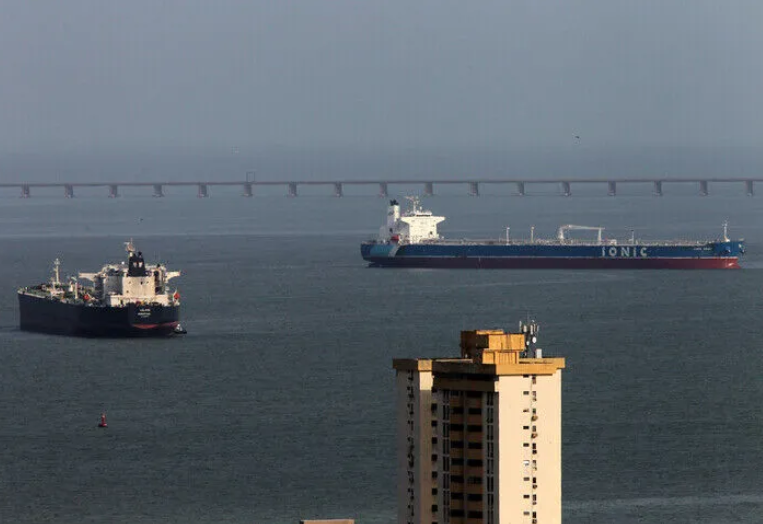
There has been much written recently about the appropriation of Venezuelan oil revenues by the Trump administration. This remains an entirely illegal arrangement, with no founding agreement by the Venezuelan government and based on straight military force. The US still has naval ships off the Venezuelan coast to intercept any tanker not carrying oil to a US Treasury-approved destination.
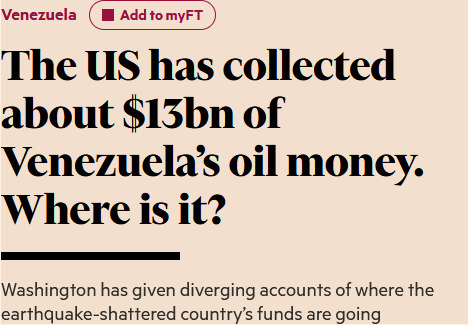
The USA has been illegally selling Venezuela’s oil. It has not physically occupied the oilfields, but Venezuela has been filling tankers with oil for which the US Treasury has collected the payment. Trump has boasted repeatedly of the huge amounts of money his administration has made from Venezuelan oil. The Financial Times this week ran an article on Venezuela’s missing oil money.
The answer to this question is a prime example of the truth taking us away from the simple narrative that gives a comfortingly clear picture. The answer will surprise you. I have direct first-hand knowledge of this from my time in Venezuela and from access to the highest levels of government there.
The US Treasury has been paying Venezuela its oil revenue regularly and promptly. It has been paying 97.5% of it into the Venezuelan treasury within one week of receipt. 2.5% of it has been retained by the US Treasury as a “fee”. The idea of a transaction fee for illegal military seizure of control of the asset is a blatant racket, but that is the extent of the American depredation.
So the total amount the USA has stolen from Venezuela is about $300 million to date, not the billions Trump has claimed. In fact the US naval operation to blockade Venezuelan tankers (and kidnap President Maduro) will have cost much more than the money the US has made from its illegal venture. It is however not in anybody’s interest to say so, of which more in a moment.
There had been an initial period when the money was going to a personal account in Qatar rather than the US Treasury, and no doubt at that time Trump was considering what he could get away with. But that only lasted a couple of weeks, and that money was recovered quickly into the new arrangement.
I can only state for certain that 97.5% was being paid over within a week for the first four months of the period, until I left Venezuela. But it is my understanding that it has continued smoothly.
There is more. The US has been selling the Venezuelan oil at a 5% discount to the world price. How you calculate a benchmark price for Venezuelan crude before applying the discount I am not sure, as the stuff is quite particular. But – and here we get into the realms of inconvenient facts a lot of my audience will not wish to hear – this compares to the 15% discount that China was imposing when it was the main recipient of Venezuelan crude.
On top of which, China was making payment not within a week, but with a delay of months and sometimes years. Plus China was deducting money at source for repayment of Chinese loans to Venezuela. These loans were genuine and for excellent infrastructure projects, but obviously the deduction of repayments from oil revenues hit Venezuelan government fiscal flexibility hard.
So the truth is that Venezuela is (even apart from the price bonanza from the Hormuz closure) getting a great deal more revenue from the United States than it was from China (and Russia) and getting it much quicker. That is an inconvenient fact if ever I heard one.
The Rodríguez government does not trumpet this, as it does not wish to appear complicit or happy with a client relationship that is imposed on it and illegal. The Trump Administration does not trumpet this, because it wishes its base to believe it is making billions out of Venezuela, not engaged in a military-led venture that is actually costing billions.
That is why the whereabouts of Venezuela’s money is a mystery. I know the answer because I was told and shown at the highest levels of government. I actually both phoned and emailed the Financial Times to try to tell them the answer to their front-page question, but they did not reply to me.
However, the basic and rather dull answer is that Venezuela’s money is in Venezuela.
I would add to this a point which Delcy Rodríguez made to me personally. Venezuela had never voluntarily stopped selling oil to the United States. The USA imposed sanctions on Venezuela, not the other way round. In a free world, the United States would be the largest destination for Venezuelan oil and is the country’s most obvious economic partner – a point made by Anya Parampil in her excellent book Corporate Coup: Venezuela and the End of US Empire.
The difficulty is the United States’ unwillingness to engage in fair trade with anyone.
What Venezuela desperately wants is the normal ability to trade fairly with any other country, including the ability to supply Cuba. It has been prevented from doing so because the Western powers are desperate to destroy any state running an alternative economic model – which if capitalism were genuinely an economically superior system, they would have no need to do. China did not impose the sanctions on Venezuela, but exploited its advantage from them.
The USA has imposed a classic Imperialist resource-extraction operation.
The imperial extraction does not lie primarily in the headline price paid for the crude. The oil can only be sold through and to US-approved companies, which capture the larger margins in trading, refining, shipping, financing and marketing. Venezuela receives payment for the raw commodity (minus the small fee), but is locked out of the higher-value stages and denied the freedom to sell to other buyers. That is how classic resource imperialism frequently works: control of commodity access, logistics and the value-added chain rather than simple open seizure of the export revenue.
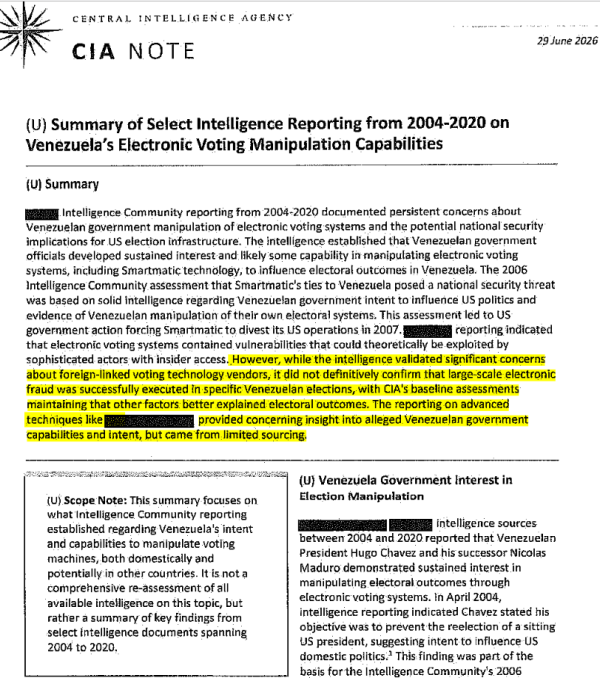
There was a stunning Freedom of Information release last week of a CIA note that indicated that the CIA did not believe that the Venezuelan elections from 2006 to 2020 were significantly affected by election fraud. So the imposition of the vast bulk of Western sanctions which crippled Venezuela over that period – and at one point caused devastating famine and mass emigration – were knowingly based on a lie.
My own investigations in Venezuela led me to believe that opposition claims that they won the 2024 Presidential election – claims promoted by all the Western powers – were equally untrue and the “evidence” incomplete and often forged.
Venezuela has obtained very little by way of sanctions relief from the Trump administration, and appallingly it has received no sanctions relief at all from Western nations to help it cope with the devastating earthquake. This has made it difficult for the relief charities to pay for anything, move goods and equipment to Venezuela or operate there at all. The Western media has delighted in making claims of government inefficiency in earthquake response, while never mentioning the crippling effect of decades of sanctions on government supply chains.
In truth, the resilience of Caracas has been extraordinary. I am in contact with the team I assembled in Caracas and a score or so of other friends and contacts. Mobile phone contact was never cut to the large majority and only for a few hours to those who did lose access. Electricity has been almost constant, and so has potable water supply.
What is more, the massive Russian- and Belarusian-built social housing blocks – which I had greatly feared would have collapsed with huge loss of life – withstood the earthquake comparatively well. It was the modern glass and steel blocks in the wealthier areas which proved most prone to disaster. That may be due to those areas being on flatter alluvial land more prone to shake.
Of all the decisions for which Delcy Rodríguez has been criticised from the left, the one with which I struggle most has been the acceptance of an Israeli earthquake relief team, with accompanying IDF PR personnel. For Israel, which buried tens of thousands of children under rubble, to be parading its assistance in digging people out of rubble, is too much for me.
But consider this. You are Delcy, and your capital has just suffered as much catastrophic damage and loss of life in an hour as Gaza did in many months. You have thousands of people potentially alive and desperate to be dug out. Could you turn down any offer of specialist relief in those circumstances? It was an agonising decision to be forced to make. I received a personal assurance from the Venezuelan government that the Israeli deployment was temporary and had a time limit which, if true, means they have already gone.
I have struggled with this. But ask yourself this question before you condemn, as I asked myself:
If your own children were buried under rubble, and an Israeli rescue team to hand, would you forbid them to dig your children out? When you have considered that question, then you can condemn the Venezuelan government.
I would not, I think, have allowed the Israelis to come and conduct an exercise where I suspect propaganda value to them was in the event greater than any real help: but I am not on the ground to verify what they really did.
It is worth noting here that repeated speculation that Venezuela is about to normalise diplomatic relations with Israel is so far unfounded. I was told in person by the recently departed foreign minister that Venezuela had made plain to the Trump administration that, in its new enforced relationship with the United States, a red line on the Venezuelan side was the anti-imperialist alignment of its foreign policy. That appears to be the case, as reflected in votes at the UN General Assembly, where Venezuela has not switched to the US camp.
Delcy Rodríguez’s point that Venezuela never voluntarily stopped trading with the USA is also relevant to its position with the IMF. Venezuela never left the IMF. Chávez said that he would, but then changed his mind. Maduro also did not leave the IMF.
Contrary to much disinformation, Venezuela has therefore not rejoined the IMF. Nor has Venezuela accepted an IMF loan, a Structural Adjustment Programme, or any IMF budget-monitoring mechanism. What Venezuela has done is to take some 500 million dollars in Special Drawing Rights to which Venezuela was entitled. Access to these had been blocked by financial sanctions, which were voided by the slight easing under Trump.
The money was Venezuela’s share of a general release to assist developing countries through the COVID years. Venezuela was simply blocked from its share. It was, in effect, Venezuela’s own money. To portray taking this as some “betrayal” of socialist values is ludicrous.
I have no reason to adjust the assessment of Delcy Rodríguez that I reached after careful study. In fact I have the strongest reinforcement, in that I now know with absolute certainty that Delcy Rodríguez did not betray Maduro. I have had direct access to documentary, eye-witness, audio and visual evidence that conclusively showed me that:
Maduro was aware of his likely kidnap and stood down armed resistance.
In the preceding weeks Rodríguez had been approached to cooperate with Maduro’s removal and had adamantly refused.
On the night of his kidnap Rodríguez was present, furious, refusing US overtures and seeking every avenue for Maduro’s immediate release.
I believed these things to be true from first-hand accounts before I wrote my last major article on Venezuela: I am now absolutely certain they are true.
Venezuela abjured the path of armed resistance to the poised US forces. Venezuela is a quarter the size of Iran, has far weaker armed forces and is within direct bomber range of the United States. It is a pacific country and has chosen to try to ride out the Trump storm, while maintaining the key benefits of the Bolivarian Revolution – especially free and universal education, free healthcare, widespread pensions and the commune system.
The Chavista system already drew much criticism from the international Left for simply aiming to spread these social benefits from oil revenues, while allowing capitalists to dominate the rest of the economy. Communal ownership of means of production and distribution was growing organically, particularly through the communes, but there has been no fundamental change to the capitalist sector in a mixed economy. It is this factor which makes accommodation with US capitalist firms possible.
This is dependent on the Venezuelan government tolerating US predator capitalism and the US government tolerating Venezuelan wealth distribution. This is the basis on which Rodríguez has been avoiding war and waiting for Trump to pass. It is the basis on which Trump has been exerting no pressure for regime change in Caracas, where he said again this week that Venezuela was “not ready” for early elections.
Where there is room for genuine criticism from the Left is that this approach effectively cooperates with imposed American imperialism in key economic sectors; that the US is seeking to expand its monopoly into other Venezuelan mineral resources; and that imagining this is temporary and the Democrats would now be any better is probably illusory.
But a devastating war is the only currently available alternative, and that definitely would destroy Chávez’s social achievements.
There is no plain right or wrong answer. All of Rodríguez’s options are bloody awful, compounded by the rightward shift of Latin American governments and the new US-backed electoral fraud next door in Colombia. Those who have romantic notions of wearing bandanas and brandishing AK-47s in mountains and jungles have for the most part not seen children die in agony. This is not easy.
I have addressed two apparently disparate topics. What unites them is simple. In both cases the available facts are messy, the moral weights pull in more than one direction, and the political incentives of powerful actors are obvious. Social media, and much of what now passes for political commentary, cannot tolerate that. It demands a clear good guy, a clear villain, and the suppression of any fact that complicates the story.
That demand is not moral clarity. It is intellectual laziness dressed up as principle. It produces the spectacle of people who will not look at the timing of the allegations against Khan, or at the actual flow of Venezuelan oil money, or at the evidence of Rodríguez’s conduct on the night Maduro was taken, because those facts make the preferred narrative less comfortable.
There are truths that conflict. There are sometimes choices in which every available option is bad. Facing that reality, weighing what is known against what is only alleged, and then deciding, is the actual work of political and moral judgement. Declaring the complexity itself illegitimate, and treating those who acknowledge it as morally suspect, is the opposite of seriousness. The age we are in rewards the opposite. That is not a reason to join in. An important concomitant of this viewpoint is that I absolutely have no claim always to be right. If I have guided you through the facts and some key issues around them, and helped stimulate you to form your own opinions, then I am very happy.
This article was originally published by Craig Murray Blog; please consider supporting the original publication, and read the original version at the link above.Email
Craig Murray is an author, broadcaster and human rights activist. He was British Ambassador to Uzbekistan from August 2002 to October 2004 and Rector of the University of Dundee from 2007 to 2010.
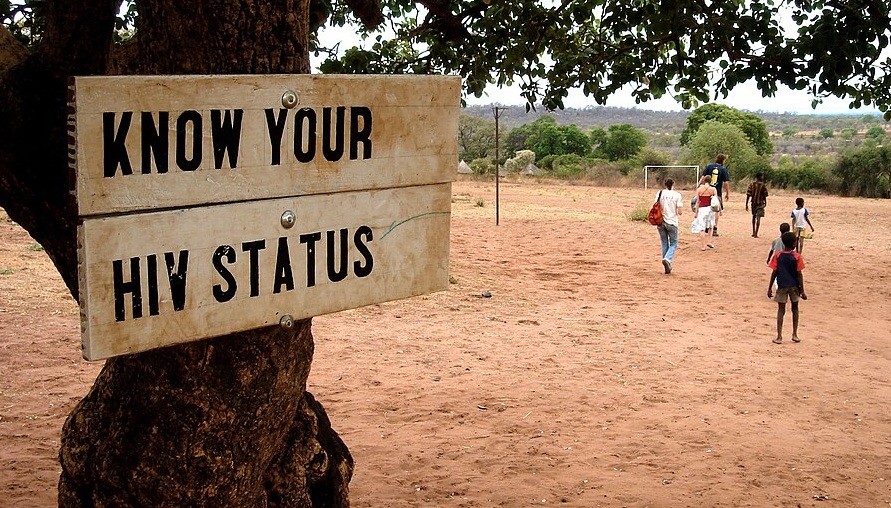
Political Will, Not Just Tools, Will Decide if We End Viral Hepatitis and AIDS by 2030
Image by Jonrawlinson/Wikimediacommons, licensed via CC BY 2.0
As World Hepatitis Day falls on 28 July, the global health community confronts a stark reality: the science to eliminate viral hepatitis, HIV and related epidemics already exists. What remains missing is the political courage, sustained funding and integrated delivery systems to put those tools into the hands of the people who need them most.
South-East Asia: High burden, emerging successes and the logic of convergence
In World Health Organization (WHO)’s South-East Asia region the numbers are daunting. The region carries 14% of the global hepatitis-B and hepatitis-C burden. Hundreds of thousands of pregnant women living with hepatitis-B still risk transmitting the virus to their newborns because birth-dose vaccination coverage sits at only 58% – far below the more than 90% needed.
Surveillance for sexually transmitted infections remains weak; congenital syphilis still claims roughly 8,000 infants a year. The region accounts for nearly 40% of global TB cases and deaths, and half of TB-affected households face catastrophic costs.
Yet Dr Po-Lin Chan pointed to genuine breakthroughs. Dr Chan leads the WHO as Unit Head for Hepatitis, HIV, STIs, EMTCT, and TB for southeast Asian region.
Maldives last year became the first country in the world to achieve triple elimination of mother-to-child transmission of HIV, syphilis and hepatitis B. Thailand and Sri Lanka have eliminated mother-to-child transmission of HIV and syphilis. Case notification and treatment success for TB are strong once people are found. These results prove that elimination is feasible when political commitment, surveillance and integrated programmes align, she said.
Are paths forward converging?
Dr Chan argued that the path forward lies in convergence – breaking disease silos so that the same primary-care platforms, community networks and financing streams deliver multiple interventions. Multiplex diagnostics, self-testing, self-care, oral and long-acting injectable PrEP for HIV prevention, digital tools and AI-assisted X-Ray screening already exist. The challenge is scaling them while addressing the multi-sectoral drivers of disease: undernutrition, diabetes, poverty and catastrophic household expenditure. “It is really about doing differently,” she said. “If we do differently in partnership, converge, break the silos, I believe we can get there.”
Bridging the policy-to-implementation divide
Why proven tools take so long to reach scale? asks Dr Reshu Agarwal, Technical Expert for HIV, Hepatitis, STI and EMTCT, World Health Organization (WHO) India.
Viral-load monitoring was recommended in 2013; by 2023 only 74 countries had routine programmes. PrEP was approved by US FDA in 2012 and its guidelines appeared in 2016; by 2021 only 120 of 180 countries had adopted them, and actual coverage lagged further. HIV self-testing, recommended in 2017, had policies in 109 countries and implementation in 90. Differentiated service delivery and multi-month dispensing accelerated during COVID-19 but quality and scale remain uneven. Long-acting PrEP guidelines issued in 2022 had been adopted by only 21 countries by 2025, said Dr Reshu Agarwal.
The exceptions are instructive. One of the new lifesaving HIV medicines, Dolutegravir, was adopted rapidly almost everywhere and produced sharp improvements in ensuring that those people living with HIV who are receiving the therapy, remain virally suppressed. When policy decisions are made quickly and financing follows, impact follows, she said.
Agarwal listed the usual suspects for delay: slow national adoption of WHO recommendations, restrictive laws, financing shortfalls, weak supply chains and health workforce capacity, and persistent equity gaps driven by gender, geography, stigma and discrimination. The human and economic costs of inaction are measurable in preventable deaths, morbidity and missed Sustainable Development Goal targets.
What works, she said, is strong leadership, community-led responses, data-driven targeting and integrated delivery. The shift required is from pilot projects to national scale, from disease silos to convergent platforms, from short-term project funding to sustainable domestic financing, from top-down programmes to community-led services, and from counting activities to measuring impact and equity.
Four practical Ds to get As in programme outcomes!
WHO India’s Dr Reshu Agarwal offered four practical “Ds” for closing the gap: demonopolise knowledge so communities and frontline providers understand what is available; democratise access by decentralising services to the last mile; differentiate approaches to reach micro-populations and sub-national hotspots with person-centred care; and demystify innovations so that simplification and integration become routine rather than exceptional.
Eastern Europe and Central Asia: The region where AIDS still grows
Eastern Europe and Central Asia remain the only region in the world where the HIV epidemic continues to expand and death rates keep rising. The driver is clear: One large country that accounts for around 70% of new HIV cases in the region has banned opioid agonist treatment by law and frames harm reduction as a ‘dangerous Western influence.’ That same country, also pressures neighbouring governments to restrict or dismantle services, said Ganna Dovbakh of the Eurasian Harm Reduction Association in Lithuania.
The result is a predictable cascade of preventable infections and deaths. People who inject drugs – still the population bearing the heaviest burden – face criminalisation, stigma and the absence of proven interventions. “If political decisions will not be made in Russia then we could not stop AIDS in our region,” Dovbakh stated bluntly.
Yet the picture is not uniformly bleak. Over three decades, civil society, communities of people who use drugs and progressive health professionals across the 28 countries of Eastern Europe and Central Asia have transformed repressive Soviet-era narcological systems – once compared to forced-labour camps – into evidence-based services. Most governments now formally recognise the necessity of harm reduction. Needle and syringe exchange programmes, opioid agonist maintenance therapy, community-based testing, naloxone for overdose prevention and, increasingly, drug checking and fentanyl test strips exist in many places.
Service coverage remains far too low to bend the epidemic curves
Coverage, however, remains far too low to bend the epidemic curves for HIV, viral hepatitis or TB (deadliest infectious disease globally).
Dovbakh identified the primary obstacle: criminalisation of drug use and possession. Punitive laws keep people away from testing, treatment, HIV prevention options like Pre-Exposure Prophylaxis (PrEP) and every other public service. Stigma compounds the exclusion.
She welcomed the 2026 Political Declaration on HIV/AIDS: United to end AIDS, which was adopted at the United Nations General Assembly High Level Meeting (UNHLM) in June 2026. This Political Declaration’s reaffirmation of the 10-10-10 targets on removing societal and legal barriers, and the imminent launch of new UNAIDS-UNODC guidance on decriminalisation co-authored with the community-led International Network of People Who Use Drugs.
“Criminalisation is the first barrier which stops people,” she said. Comprehensive harm reduction must go beyond methadone or buprenorphine to include needle-syringe exchange programmes, information and drug checking for stimulant users, community testing, overdose prevention and integrated services delivered by community-led organisations contracted as equal partners.
Barriers to end AIDS are political, not technical
The threat to that progress is mounting. Criminalising laws (which are not-in-step with public health evidence-based policies), ‘undesirable organisation’ statutes and anti-drug propaganda legislation are shrinking civic space and choking advocacy funding. “Remaining barriers to respond to HIV/AIDS till 2030 are political, not technical,” Dovbakh concluded. Free civic space, supported civil society, decriminalised drug use and comprehensive harm reduction could end AIDS in the region faster than 2030.
Shared agenda for World Hepatitis Day and beyond
Taken together, the three perspectives form a coherent diagnosis. Hepatitis-B and Hepatitis-C, HIV, syphilis, TB and the overlapping epidemics among people who use drugs cannot be defeated in isolation. Criminalisation and stigma remain the biggest barriers ever invented against public health. Siloed programmes waste scarce resources. Delayed adoption of new tools exacts a preventable human cost. Shrinking civic space undermines the very community systems that deliver results.
The good news is equally consistent. Where political leaders have protected harm reduction, contracted community organisations as partners, invested in integrated maternal and child health platforms, and moved rapidly from evidence to national policy, elimination targets have moved within reach. Maldives’ triple elimination is the clearest recent proof. Rapid Dolutegravir scale-up is another. Expanding community-led monitoring and advocacy funding is a third.
On World Hepatitis Day 2026 the message from the experts is unambiguous. The remaining distance to the 2030 goals is not measured in missing technologies. It is measured in political decisions still unmade, laws still unrepealed, budgets still unallocated and silos still unbroken. Close those gaps, and the epidemics of hepatitis, HIV and TB can still be ended – on time or even ahead of schedule. Leave them open, and the cost will continue to be paid in lives.l
Shobha Shukla is the award-winning founding Managing Editor and Executive Director of CNS (Citizen News Service) and is a feminist, health and development justice advocate. She is a former senior Physics faculty of prestigious Loreto Convent College and current Coordinator of Asia Pacific Regional Media Alliance for Health and Development (APCAT Media) and Chairperson of Global AMR Media Alliance (GAMA). She coordinates SHE & Rights Media Initiative (Sexual health with equity and rights). Follow her on Twitter @shobha1shukla or read her writings here www.bit.ly/ShobhaShukla)
People Keep Dying in ICE Custody. 13 Democrats Back a Bill to Abolish the Agency.
At least 53 people have died in ICE custody since President Donald Trump’s return to office.
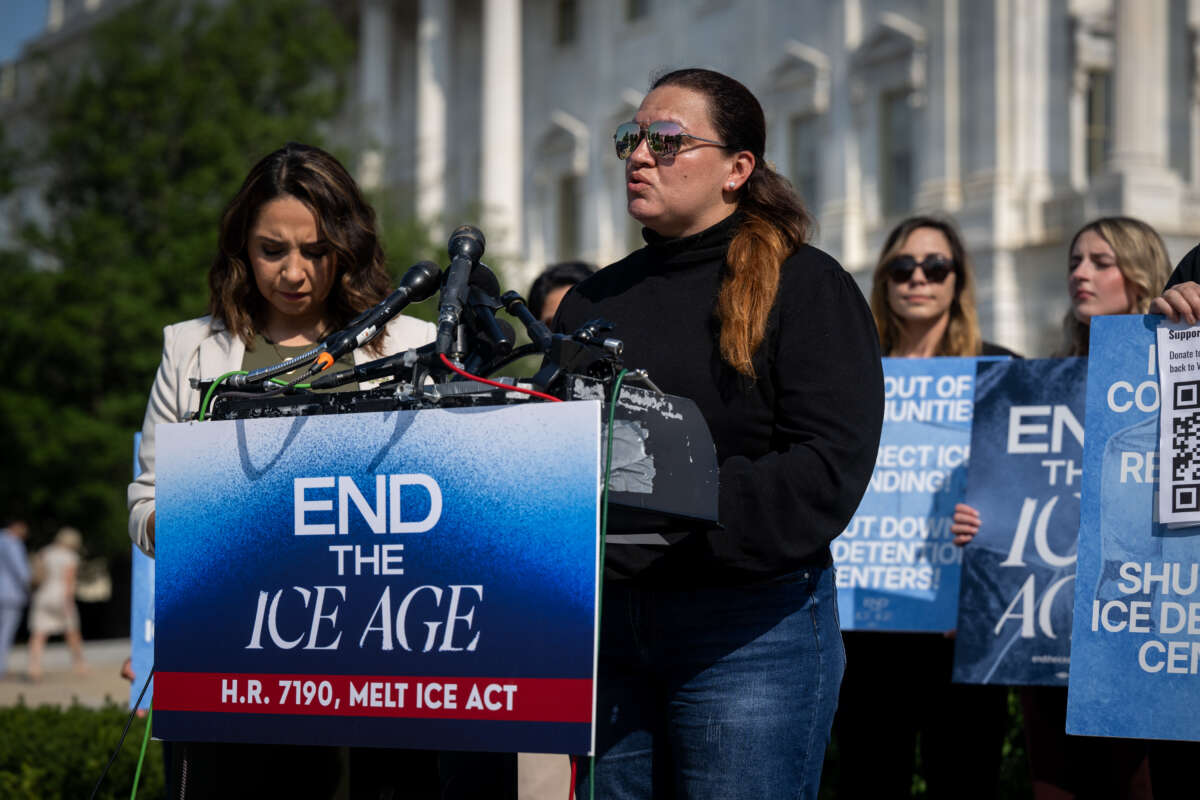
Congresswoman Delia C. Ramirez is joined by Sonimar Maria, the sister of Jesús Manuel Arenas-Silva, a Venezuelan immigrant who was detained on July 13 and died in ICE custody two days after, to demand that members of Congress pass the H.R. 7190, The Melt ICE Act, on July 23, 2026, in Washington, D.C.Office of Rep. Delia Ramirez
Jesús Manuel Arenas-Silva was at home in Georgia with his family on July 9 when Immigration and Customs Enforcement (ICE) agents came to arrest him. Sonimar Maria, Arenas-Silva’s sister, said her family implored the agents not to take the 45-year-old Venezuelan, mentioning his medical needs, but ICE did not listen to their pleas.
Flanked by progressive House Democrats and speaking in Spanish to reporters at a Capitol Hill press conference on July 22, Sonimar said ICE agents also ignored her family’s request to let Arenas-Silva take his medication with him. Arenas-Silva required four different medications for a medical condition, Sonimar said, but ICE allowed him to bring only one to the remote Irwin County Detention Center in rural Georgia.
“Jesús Manuel later told me on a phone call that ICE did not give him the medication he needed,” Sonimar said in a translated statement. “He went without medication during his detention until he tragically died in ICE custody on July 13 … I am 100 percent certain that he did not receive proper care.” Arenas-Silva died while being transferred from Irwin County Detention Center to the Folkston ICE Processing Center, a roughly 100-mile drive. He was found unresponsive five days after he was arrested, according to ICE. At least 53 people have died in ICE custody since President Donald Trump returned to office and launched a mass deportation campaign led by adviser Stephen Miller, making the past fiscal year the deadliest in the agency’s history.
Additionally, at least 30 people have been shot in public or in their homes by federal immigration agents during Trump’s chaotic crackdown, and 11have died, including multiple parents and two United States citizens. Sonimar is calling for an independent investigation into her brother’s death, but the Trump administration has consistently erected barriers to accountability for both the deadly shootings and the deaths in ICE jails.
“He was a loving son, brother, and uncle, a caring and hard-working man who came to this country to seek better opportunities,” Sonimar said of Arenas-Silva, adding that she came to Washington, D.C. to seek justice for her brother so that other families do not have to endure similar trauma.
Some Democrats are pushing for structural changes to put an end to the violence enacted by ICE, which has been emboldened under policies set by Trump and Miller. At a House Judiciary Oversight Subcommittee hearing on conditions in ICE jails on July 22, Democrats slammed the Trump administration and Republicans in Congress for spending billions of dollars to build immigrant jails and recruit poorly trained federal immigration agents while slashing funding for health care and food assistance.
Progressive House Democrats are going a step further than simply questioning ICE’s tactics and bloated budget. They propose abolishing the agency altogether and redirecting its funding to safety-net programs that can help people navigate a spiraling affordability crisis.
“Americans are demanding members of Congress pursue more than training, more than reform, and more than bare-minimum policies,” said Rep. Delia Ramirez (D-Illinois) a July 22 press conference. “They are demanding that no other family suffers the pain of deportation or death at the hands of DHS’s immigration enforcement.”
In January, Ramirez introduced H.R. 7190, or the Melt ICE Act, which would dismantle ICE by ending the Department of Homeland Security’s authority to surveil and jail immigrants. The legislation would also redirect enforcement funding toward federal housing and health care programs to provide services for people impacted by the immigration crackdown, as well as groups that support migrants and households with noncitizen family members.
“The billions of dollars that funded ICE should be given to the communities who suffered under their reign of terror.”
“ICE agents are murdering people in the streets, tearing families apart, abducting our neighbors, and locking them in cages,” said Rep. Rashida Tlaib, a Democrat from Michigan and co-sponsor of the bill. “ICE must be abolished — full stop. The billions of dollars that funded ICE should be given to the communities who suffered under their reign of terror.”
In the past month alone, ICE agents shot and killed two unarmed fathers in their vehicles while they were driving to work: Immigration agents killed Joan Sebastian Guerrero on July 13 in Maine and Lorenzo Salgado Araujo on July 7 in Texas. Both men were reportedly not initial targets for arrest and were pursued by Trump’s immigration officers in vehicle stops that civil rights activists suspect are clear-cut cases of racial profiling. Guerrero, a husband and father of a 3-year-old, was reportedly killed by an ICE agent who was recently recruited despite a well-documented history of violence and abuse.
On July 22, Juan Jairo Coronilla Durán was fatally struck by a semi-truck in Florida while fleeing ICE agents. Coronilla Durán had a tourist visa and was visiting family in the U.S. while on vacation from Mexico. An advocacy group assisting Coronilla Durán’s wife said she thought “he was very afraid, and that’s why he ran away.” Ramirez echoed that, adding Coronilla Durán likely ran away out of fear of being arrested and detained in one of ICE’s notoriousjails and prison camps, where people are dying at a record rate.
“He did what my brother would have done, he did what your sister would do, he did what your mother would do if she was stopped by ICE and looked a certain way — he ran away,” Ramirez said. “He was afraid they would take him to a private detention center where he could die in days and never see his family ever again.”
A recent ramp-up of enforcement is impacting citizens and noncitizens alike as recently deputized and heavily armed federal agents raid homes and target random people on the street to increase Trump’s deportation numbers. A review of 1,200 incidents involving ICE and its partners by the American Civil Liberties Union found the tactics being deployed are causing civil rights violations at a “scale and severity without precedent in our nation’s recent history.”
Ramirez reminded fellow lawmakers that Congress created ICE and the Department of Homeland Security only 25 years ago following the 9/11 attacks and can be dismantled just the same.
“I know that people are saying, ‘You are radical, you want to melt ICE’; people are asking, ‘What is going to happen with detention?’” Ramirez said. “I say to people: Look at our history, and we had a Department of Justice that handled all of our immigration cases until 2003, and I want to remind people that people were not dying the way they are dying right now.”
So far, only 13 Democrats have co-sponsored Ramirez’s Melt ICE Act: Tlaib, along with Representatives Yvette Clarke (New York), Ilhan Omar (Minnesota) Yassamin Ansari (Arizona), Nydia Velázquez (New York), Adelita Grijalva (Arizona), Jesús G. “Chuy” García (Illinois), Valerie Foushee (North Carolina), Ayanna Pressley (Massachusetts), Summer Lee (Pennsylvania), Danny Davis (Illinois), LaMonica McIver (New Jersey), and Sylvia Garcia (Texas). Ramirez suggested that most of the signatories are people of color.
“To all of our white allies in Congress, this is the moment to join the movement to melt ICE,” Ramirez said. “I want to see your last names here, too.”
The Melt ICE Act has virtually zero chance of passing while the GOP holds a majority, but the bill represents an important political Rubicon for Democrats as their base pushes for change in the midterms.
As the elections approach in November, Republicans are deploying a familiar strategy of casting Democrats as radical “communists” who want to defund law enforcement. In reality, the party’s establishment has consistently provided plenty of funding for police, including in the yearsfollowing the nationwide outbreak of protests against racist police violence in 2020 that called for defunding police.
Republicans painted the entirety of the Democratic Party as supporters of the “abolish ICE” and “defund the police” movements anyway, and establishment figures and pundits often mention those movements in their discussion of their electoral losses in 2024. However, Republicans are now on the back foot. Trump is deeply unpopular, with his approval ratings on the economy and immigration plummeting since taking office.
About half of all U.S. adults now support abolishing ICE, including 73 percent of Democrats.
A YouGov poll released on July 21 found that about half of all U.S. adults now support abolishing ICE, including 73 percent of Democrats. Only 40 percent somewhat or strongly oppose eliminating the agency. News of ICE killings appears to be reaching voters, with 60 percent telling pollsters they heard about ICE shooting and killing people in the last week.
In a July 21 letter to House Minority Leader Hakeem Jeffries, more than 100 progressive state lawmakers, city council members, and politicos from his home state of New York demanded that Democrats in Congress come out in support of abolishing ICE. After Joan Sebastian Guerrero was killed by ICE in Maine, the debate over abolishing ICE became central to a much-watched Senate campaign in the state, with Democratic hopeful Troy Jackson recently confirming that he supports dismantling the agency.
Maine Gov. Janet Mills, a moderate Democrat, wrote in a July 15 letter to the state’s congressional delegation that the “violence has to end” before more gunshots shatter a windshield and another family loses a loved one.
“ICE needs to be fundamentally reformed, and if not, then it is time to abolish it,” Mills wrote.
As Ramirez pitched the Melt ICE Act again this week, a coalition of immigrant rights groups launched End the ICE Age, a campaign to dismantle ICE as an agency and pressure Democrats to co-sponsor the Melt ICE Act.
“People are dying in ICE detention at a record-breaking rate, ICE agents are tearing families apart and shooting people on the streets, making people less safe, and causing chaos wherever they go — whether in Minneapolis, Chicago, Los Angeles, Houston, Biddeford, or beyond,” said Setareh Ghandehari, the advocacy director at Detention Watch Network. “Make no mistake, we are witnessing a watershed moment.”