Putin Suffers Humiliating Blow as Russia’s Crisis Spirals
Leigh Kimmins
Tue, July 28, 2026
DAILY BEAST
Alexander Zemlianichenko / via REUTERS
Foreign tourists are balking at visiting Russia, as Vladimir Putin's domestic crisis deepens.
The Kremlin demagogue is facing unprecedented pressure as the war in Ukraine hits home and Donald Trump's war on Iran disrupts energy markets and the global aviation sector.
As the picture gets increasingly bleak, tourists and visitors are taking notice—and staying away, according to figures from Rosstat, the national statistics agency.
Between January and June this year, foreigners made 2.99 million tourist trips to Russia, a year-on-year decline of 19.6 percent, Rosstat reported, despite being a tightly controlled instrument of the Kremlin's political and economic agenda.
Smoke billows from a warehouse after deadly Ukrainian drone attacks in Russia. / Social Media / Social Media via REUTERS
Chinese tourists make up by far the largest share of foreign visitors to Russia, accounting for just over half of arrivals last year under Russian border data. Saudi Arabia is a distant second, followed by Turkmenistan, Turkey, Germany, and the United Arab Emirates. A separate Rosstat methodology, which also counts visits from neighboring countries, similarly ranks China among the top sources of inbound travelers, alongside Kazakhstan and Uzbekistan.
Marina Levchenko is general director of "Tari Tour," a company based in the capital that offers trips to Moscow and Putin's hometown, St. Petersburg. She told Russian business daily Kommersant that Trump's war is to blame for affecting flight programs, as well as negative news about Russia.
Tourists remain wary of reports of a fuel crisis and airport disruptions, Levchenko said, adding that high travel costs are also discouraging visitors. The Association of Tour Operators of Russia likewise identified flight disruptions as the main factor suppressing inbound tourism.
Ukrainian President Volodymyr Zelensky began intensifying drone attacks on Russian oil refineries in mid-June, creating a fuel crisis the likes of which have not been seen since Putin's rise to power more than 25 years ago, NBC News reported. Crucially for Putin and his favorability rating, the crisis is affecting ordinary Russians.
Gas stations in many regions have taken the unprecedented move of introducing rationing schemes and restrictions, and social media has been flooded with videos of long lines and frustrated drivers.
That has generated negative headlines that, coupled with imagery of drones whizzing over Russia's biggest cities, may have prompted potential visitors to think again.
The war in Iran had already forced Russia to introduce a ban on gasoline exports, and now, the Kremlin has begun importing petroleum products, according to NBC.
Those worries come as Putin is already facing anger from small business owners after Ukrainian drones destroyed more than $2 billion worth of inventory at warehouses owned by Wildberries, an online retailer that is Russia's response to Amazon.
Zelensky has intensified attacks on Russia. / Laura Loomer/X
The Russian president has tried to downplay the crisis by saying the shortages are not as critical as local authorities have suggested, and has blamed panic buying for much of the chaos.
The stress is clearly getting to Putin. He scrapped Russia's Navy Day parade over fears of Ukrainian strikes and then raged to a group of sailors about a revenge fantasy and Soviet dictator Josef Stalin.
After canceling the parade—which was set to feature around 200 warships sailing along the Neva River in St. Petersburg—the president opted for a televised meeting with Navy personnel. In an apparent bid to save face, he angrily predicted that Ukraine would ultimately fall apart, claiming that Russia had actually been the only "guarantor" of Ukraine's "territorial integrity." Apart from the eastern regions of Ukraine that Moscow has tried to claim as its own, Putin declared the western regions "a gift from Stalin" and claimed they would "sooner or later" return to Hungary, Romania, and Poland.

Ukrainian Drone Attacks Lead Moscow To Revive Idea Of Buffer Zone In Border Areas – Analysis
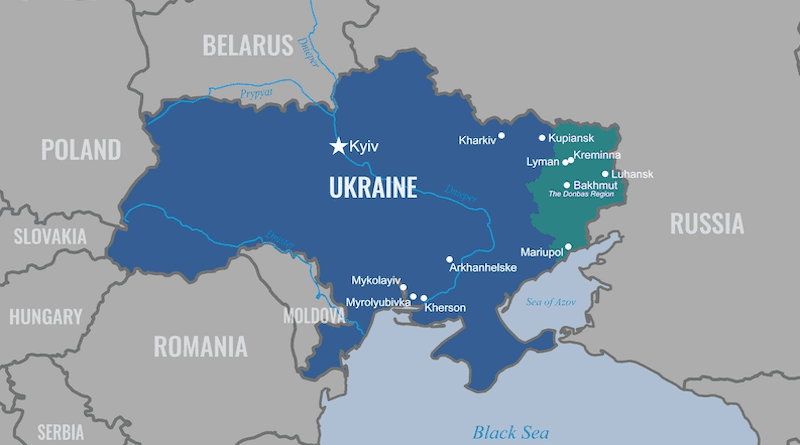
Map of Ukraine. Credit: DOD
July 29, 2026
By Paul Goble
Key Takeaways:
The Russian government has not released details on what such a zone would entail, and there is much disagreement in Moscow over its potential size, the number of additional troops required, and whether its creation would involve the forced removal of people living there.
Creating such a zone has Russian President Vladimir Putin’s public backing, though the increasing range of Ukrainian drones has led some Russians to express doubts, with some calling the idea “stupid” unless the Ukrainian state were destroyed and its entire territory absorbed into the zone.
In response to Ukrainian drone strikes targeting infrastructure ever deeper into the Russian Federation, Russian Press Secretary Dmitry Peskov revived the idea of creating a buffer zone in Russian regions lying along the Ukrainian border and in Russian-occupied regions of Ukraine on the other side (Interfax, July 9). This idea was first enshrined in the Minsk Accords after Moscow seized Ukraine’s Crimea and parts of other Ukrainian regions, and it resurfaced after Ukraine seized Russia’s Kursk oblast (RBC, May 12, 2025).
In the past month, it has returned to Russian discussions with new force following Ukrainian drone strikes on Russian infrastructure deep within the country and a Kyiv proposal for limiting such long-range strikes in both directions, a proposal Russian President Vladimir Putin has rejected out of hand (RIA Novosti, June 28). To date, the Russian government has not released details on what such a zone might look like, how large it would be, how many additional troops would be needed to create it, and whether its creation would require the expulsion of people living there (Nakanune.ru, July 15).
While the idea of such a buffer zone enjoys Putin’s support, a growing number of Russian politicians and commentators are skeptical, with some describing the idea as useless or even “stupid” (RIA Novosti, June 28). Their skepticism centers on three factors—the increasing range of Ukrainian drone strikes, the massive troop numbers the policy would require, including a likely general mobilization, and how forced expulsions, reminiscent of Stalin-era policies, would play with the Russian population (Nakanune.ru, July 15, 22; Vot Tak, July 22; Novaya Gazeta, July 23).
The fighting between Russian and Ukrainian forces has created a broad zone of displacement that extends well beyond the front line itself, and Kyiv and Moscow have responded to it in starkly different ways. Most reporting on the war speaks only of a front line, though the fighting affects people at considerable distances from where troops are positioned. Since Putin seized Ukraine’s Crimea and parts of several other Ukrainian regions in 2014, and especially since the Kremlin leader launched his expanded invasion of Ukraine in 2022, people living in places near the fighting have fled, and the two governments have taken a variety of steps to help them. These efforts have expanded alongside a rising civilian death toll, which reached a record last month. That trend has created enormous challenges for both governments, according to Nikolay Mitrokhin, a Russian sociologist now at the University of Bremen (Vot Tak, July 22).
Tens of thousands of people are involved, though exact numbers remain unavailable given the confusion surrounding these movements. Kyiv has consistently adopted a proactive approach, according to Mitrokhin, warning populations well in advance of Russian attacks and helping them relocate voluntarily. Moscow, in contrast, has been less consistent, neither warning local populations nor providing the assistance it has promised. The Russian government has instead responded to the problem almost exclusively during crises, such as the Ukrainian seizure of Kursk in 2024 and the current wave of Ukrainian drones striking targets deep within the Russian Federation (Vot Tak, July 22).
Moscow’s renewed interest in a buffer zone appears driven more by Ukrainian drone attacks on the Russian interior than by any shift at the front, suggesting the idea functions as a public relations effort to calm the population rather than a plan the Kremlin intends to carry out. Putin and his spokesman admitted as much when they suggested that the deeper Ukrainian drones strike targets in Russia, the larger such a buffer zone would need to be (Interfax, July 9).
Russian commentators have been reluctant to specify how deep such a zone would need to be, though the few who have offered figures suggest roughly 300 kilometers (186 miles) would be required (Nakanune.ru, July 15). Ukraine already strikes targets more than 2,000 kilometers (1,240 miles) inside Russia with drones and has announced plans to develop drones with a range of 10,000 kilometers (6,200 miles). Any buffer zone large enough to stop such strikes would have to encompass all Ukrainian territory, rendering the concept meaningless unless it did exactly that (Vot Tak, July 22).
The lack of specificity surrounding the buffer zone, including its size, the number of troops required, and whether current residents could remain, has pushed the debate from closed Kremlin discussions into the public sphere, where the Kremlin is losing control of the narrative.
The most dramatic example of this shift, one that may kill off the buffer-zone idea altogether, came in a recent broadcast by outspoken Russian television host Vladimir Solovyev, who argued that Moscow must be ready to move 200,000 to 300,000 people from Donetsk, Luhansk, Zaporizhzhia, Kursk, and Bryansk oblasts away from “the line of the front” and resettle them in the Middle Volga, the Urals, and the Russian Far East (RIA Pivden, July 23).
Several Russian military analysts called the idea reasonable for wartime planning, arguing that governments must prepare for worst-case scenarios precisely to avoid them, and suggested that Moscow might relocate people to regions near the North Caucasus rather than east of the Urals, as some feared (Nakanune.ru, July 22).
The prospect of mass deportations reminiscent of Stalin-era policies has provoked public outrage in Russia, undermining political support for the buffer-zone concept. Many Russians reacted with alarm at the prospect that Moscow might again deport large numbers of people, and whole nationalities, into the interior of the country (Novaya Gazeta, July 23). Some Russians may not draw this parallel or might even welcome it. Prominent commentators and even senior Duma figures now argue that a depopulated buffer zone along the Russian–Ukrainian border will not stop the drone attacks in the way the Kremlin suggests, calling the latest Putin proposal simply “stupid” (Vot Tak; Nakanune.ru, July 22).
The most likely outcome is that Moscow will not build a buffer zone anytime soon, and the idea will fade from the Russian media. The discussion itself, however, will carry lasting political consequences. Putin’s talk of a buffer zone appears to be backfiring, with more people questioning his judgment, even if not yet prepared to act against him. This corrosion of authority matters, since it suggests a growing number of Russian elites may conclude that challenging Putin is no longer the fool’s errand many have long assumed.

About Paul Goble
Paul Goble is a longtime specialist on ethnic and religious questions in Eurasia. Most recently, he was director of research and publications at the Azerbaijan Diplomatic Academy. Earlier, he served as vice dean for the social sciences and humanities at Audentes University in Tallinn and a senior research associate at the EuroCollege of the University of Tartu in Estonia. He has served in various capacities in the U.S. State Department, the Central Intelligence Agency and the International Broadcasting Bureau as well as at the Voice of America and Radio Free Europe/Radio Liberty and at the Carnegie Endowment for International Peace. Mr. Goble maintains the Window on Eurasia blog and can be contacted directly at paul.goble@gmail.com .
View all posts by Paul Goble
Map of Ukraine. Credit: DOD
July 29, 2026
By Paul Goble
Key Takeaways:
Ukrainian drone strikes into the Russian Federation have prompted the Kremlin to revive the idea of creating a buffer zone in western Russian regions and in Russian-occupied regions of Ukraine to prevent or at least limit such strikes.
The Russian government has not released details on what such a zone would entail, and there is much disagreement in Moscow over its potential size, the number of additional troops required, and whether its creation would involve the forced removal of people living there.
Creating such a zone has Russian President Vladimir Putin’s public backing, though the increasing range of Ukrainian drones has led some Russians to express doubts, with some calling the idea “stupid” unless the Ukrainian state were destroyed and its entire territory absorbed into the zone.
In response to Ukrainian drone strikes targeting infrastructure ever deeper into the Russian Federation, Russian Press Secretary Dmitry Peskov revived the idea of creating a buffer zone in Russian regions lying along the Ukrainian border and in Russian-occupied regions of Ukraine on the other side (Interfax, July 9). This idea was first enshrined in the Minsk Accords after Moscow seized Ukraine’s Crimea and parts of other Ukrainian regions, and it resurfaced after Ukraine seized Russia’s Kursk oblast (RBC, May 12, 2025).
In the past month, it has returned to Russian discussions with new force following Ukrainian drone strikes on Russian infrastructure deep within the country and a Kyiv proposal for limiting such long-range strikes in both directions, a proposal Russian President Vladimir Putin has rejected out of hand (RIA Novosti, June 28). To date, the Russian government has not released details on what such a zone might look like, how large it would be, how many additional troops would be needed to create it, and whether its creation would require the expulsion of people living there (Nakanune.ru, July 15).
While the idea of such a buffer zone enjoys Putin’s support, a growing number of Russian politicians and commentators are skeptical, with some describing the idea as useless or even “stupid” (RIA Novosti, June 28). Their skepticism centers on three factors—the increasing range of Ukrainian drone strikes, the massive troop numbers the policy would require, including a likely general mobilization, and how forced expulsions, reminiscent of Stalin-era policies, would play with the Russian population (Nakanune.ru, July 15, 22; Vot Tak, July 22; Novaya Gazeta, July 23).
The fighting between Russian and Ukrainian forces has created a broad zone of displacement that extends well beyond the front line itself, and Kyiv and Moscow have responded to it in starkly different ways. Most reporting on the war speaks only of a front line, though the fighting affects people at considerable distances from where troops are positioned. Since Putin seized Ukraine’s Crimea and parts of several other Ukrainian regions in 2014, and especially since the Kremlin leader launched his expanded invasion of Ukraine in 2022, people living in places near the fighting have fled, and the two governments have taken a variety of steps to help them. These efforts have expanded alongside a rising civilian death toll, which reached a record last month. That trend has created enormous challenges for both governments, according to Nikolay Mitrokhin, a Russian sociologist now at the University of Bremen (Vot Tak, July 22).
Tens of thousands of people are involved, though exact numbers remain unavailable given the confusion surrounding these movements. Kyiv has consistently adopted a proactive approach, according to Mitrokhin, warning populations well in advance of Russian attacks and helping them relocate voluntarily. Moscow, in contrast, has been less consistent, neither warning local populations nor providing the assistance it has promised. The Russian government has instead responded to the problem almost exclusively during crises, such as the Ukrainian seizure of Kursk in 2024 and the current wave of Ukrainian drones striking targets deep within the Russian Federation (Vot Tak, July 22).
Moscow’s renewed interest in a buffer zone appears driven more by Ukrainian drone attacks on the Russian interior than by any shift at the front, suggesting the idea functions as a public relations effort to calm the population rather than a plan the Kremlin intends to carry out. Putin and his spokesman admitted as much when they suggested that the deeper Ukrainian drones strike targets in Russia, the larger such a buffer zone would need to be (Interfax, July 9).
Russian commentators have been reluctant to specify how deep such a zone would need to be, though the few who have offered figures suggest roughly 300 kilometers (186 miles) would be required (Nakanune.ru, July 15). Ukraine already strikes targets more than 2,000 kilometers (1,240 miles) inside Russia with drones and has announced plans to develop drones with a range of 10,000 kilometers (6,200 miles). Any buffer zone large enough to stop such strikes would have to encompass all Ukrainian territory, rendering the concept meaningless unless it did exactly that (Vot Tak, July 22).
The lack of specificity surrounding the buffer zone, including its size, the number of troops required, and whether current residents could remain, has pushed the debate from closed Kremlin discussions into the public sphere, where the Kremlin is losing control of the narrative.
The most dramatic example of this shift, one that may kill off the buffer-zone idea altogether, came in a recent broadcast by outspoken Russian television host Vladimir Solovyev, who argued that Moscow must be ready to move 200,000 to 300,000 people from Donetsk, Luhansk, Zaporizhzhia, Kursk, and Bryansk oblasts away from “the line of the front” and resettle them in the Middle Volga, the Urals, and the Russian Far East (RIA Pivden, July 23).
Several Russian military analysts called the idea reasonable for wartime planning, arguing that governments must prepare for worst-case scenarios precisely to avoid them, and suggested that Moscow might relocate people to regions near the North Caucasus rather than east of the Urals, as some feared (Nakanune.ru, July 22).
The prospect of mass deportations reminiscent of Stalin-era policies has provoked public outrage in Russia, undermining political support for the buffer-zone concept. Many Russians reacted with alarm at the prospect that Moscow might again deport large numbers of people, and whole nationalities, into the interior of the country (Novaya Gazeta, July 23). Some Russians may not draw this parallel or might even welcome it. Prominent commentators and even senior Duma figures now argue that a depopulated buffer zone along the Russian–Ukrainian border will not stop the drone attacks in the way the Kremlin suggests, calling the latest Putin proposal simply “stupid” (Vot Tak; Nakanune.ru, July 22).
The most likely outcome is that Moscow will not build a buffer zone anytime soon, and the idea will fade from the Russian media. The discussion itself, however, will carry lasting political consequences. Putin’s talk of a buffer zone appears to be backfiring, with more people questioning his judgment, even if not yet prepared to act against him. This corrosion of authority matters, since it suggests a growing number of Russian elites may conclude that challenging Putin is no longer the fool’s errand many have long assumed.
This article was published by The Jamestown Foundation
About Paul Goble
Paul Goble is a longtime specialist on ethnic and religious questions in Eurasia. Most recently, he was director of research and publications at the Azerbaijan Diplomatic Academy. Earlier, he served as vice dean for the social sciences and humanities at Audentes University in Tallinn and a senior research associate at the EuroCollege of the University of Tartu in Estonia. He has served in various capacities in the U.S. State Department, the Central Intelligence Agency and the International Broadcasting Bureau as well as at the Voice of America and Radio Free Europe/Radio Liberty and at the Carnegie Endowment for International Peace. Mr. Goble maintains the Window on Eurasia blog and can be contacted directly at paul.goble@gmail.com .
View all posts by Paul Goble

No comments:
Post a Comment