Tuesday, July 28, 2026


Source: Originally published by Z. Feel free to share widely.

Right now, in Santa Cruz, California, police officers are going without federally funded bulletproof vests. In Beaverton, Oregon, paramedics are losing the ambulances they were promised. In Fresno, a $2 million grant to test a backlog of 400 rape kits hangs by a thread, over paperwork the city won’t sign.

Cities across America are being handed the same ultimatum: cooperate with federal immigration enforcement, or lose the funding that keeps survivors, officers, and paramedics safe. DOJ grant administrators have told jurisdictions to sign a certification promising cooperation with ICE, or risk losing their money. More than 21 localities that originally received funding to clear rape-kit backlogs are now classified as “sanctuary jurisdictions” — including Fresno, which hasn’t obstructed any criminal investigation. State law — upheld by the 9th Circuit Court of Appeals — prohibits the kind of information-sharing the certification demands, which leaves the city caught between two lawful obligations.

The federal government should stop conditioning public-safety funding on immigration enforcement, full stop. Every time a Global North democracy has tried this before, it has produced the same wreckage — and admitted the damage only after it was too late to undo.

I’ve spent years representing American Muslims at international human rights forums, and I’ve watched this maneuver surface repeatedly, across different countries and in different clothes. It arrives as a funding memo, a certification form, or a line item, rather than a clear attack on vulnerable and minority communities.

A recent Opinium poll commissioned by the transatlantic think tank Concordia Forum puts numbers to that erosion of trust: 85% of British Muslims and 81% of American Muslims believe democracy is the best system of government — yet only about one in five say they are always treated equally under the law. Communities that believe in the system but don’t trust it to protect them are exactly the ones this kind of policy is built to exploit.

The mainstream story frames this as a fight about immigration enforcement, but that’s not what’s at stake. The real question is whether the federal government can use unrelated public-safety money as a lever to force local compliance on a completely separate policy question. Because tying the two together doesn’t make immigration enforcement more effective; it just turns rape survivors, shooting victims, and cardiac patients into unwilling collateral damage.

The U.S. is repeating what Britain knows as the “hostile environment” policy. Launched in 2012, it was built on the same logic: deny access to ordinary services like housing, healthcare, banking, and employment until people prove their immigration status to the government’s satisfaction.

The result was the Windrush scandal, in which thousands of Commonwealth citizens who had lived in Britain legally for decades were denied jobs, evicted from homes, refused NHS treatment, and in dozens of documented cases, wrongly detained or deported, despite having every right to be there. Official estimates put the number of people eligible for redress at roughly 15,000.

Compensation, when it finally came, mocked the harm: years after the scheme launched, only a few hundred people had been paid out of well over a thousand who applied, and some died waiting. The government’s own reviewers eventually called what happened “foreseeable and avoidable.” Parts of the EU have quietly built similar tripwires into housing and healthcare access for migrants.

In each case, the most vulnerable were hurt first. Governments admitted nothing until the human cost became undeniable, and by then it was too late for the people who paid for it.

In Fresno, this is happening in real time. The city is simply trying to honor a state privacy law while a federal grant program threatens to strip the money it needs to clear a rape-kit backlog that has nothing to do with anyone’s immigration status. For a survivor still waiting on a DNA match, that evidence sitting untested on a shelf can be life changing.

Defenders of funding conditions argue that federal dollars come with federal strings, and that a jurisdiction unwilling to cooperate with lawful enforcement priorities shouldn’t expect Washington to underwrite its police department. But that argument quickly falls down, because courts have repeatedly found these conditions were never authorized by Congress in the first place — from City and County of San Francisco v. Trump to City of Chicago v. Sessions to the injunctions Judge William Orrick has issued against the current round of cuts. And even setting the legal question aside, a rape kit is not an immigration enforcement tool. Withholding its funding doesn’t advance the enforcement goal; it just adds a second victim to the first crime.

Left to run its course, this pattern will deliver the U.S. its own Windrush moment: a belated commission, a compensation scheme nobody trusts, and a list of people hurt while the argument was still being had. The fix doesn’t require resolving the immigration debate first.

International human rights bodies already track detention conditions and asylum backlogs as standing categories of concern. They should add “funding-conditioned enforcement” to that list — a formal category flagging, in real time, when a government makes access to unrelated public services contingent on enforcement cooperation.

Catching the warning signs now, while the money is still in dispute, beats writing them up in a report once the damage is done. Santa Cruz’s officers, Beaverton’s paramedics, and Fresno’s rape-kit backlog aren’t asking anyone to settle the immigration debate. They’re asking someone to stop pulling a lever that was never built to touch them.

Salam al-Marayati is president and co-founder of the Muslim Public Affairs Council. An expert on Islam in the West, national security and Middle East politics, he has spoken at the White House and on Capitol Hill, represented the United States at international human rights forums, and written for the New York Times, Wall Street Journal, Washington Post and Los Angeles Times.\\\\\


Source: Originally published by Z. Feel free to share widely.

Last Sunday, Spain lifted the World Cup trophy at MetLife Stadium, closing out six weeks that revealed two very different North Americas.

The first is represented by the United States: a place where human rights took a back seat to the preparations and orchestration of the world’s most important sporting event.

The second is Canada: a country continuing to pride itself as welcoming of diversity, and welcoming of the world.

Yet, even in Canada, nothing can be taken for granted at a time of growing divisions, suspicion and economic uncertainties that are putting stress on human rights.

Let’s start with the U.S. A top-rated FIFA referee was turned back at the American border, travelling on a Somali passport. Iran’s national team was barred from setting foot on U.S. soil, exiled to play its matches out of Tijuana. Dozens of fans from Ghana and Morocco who’d saved for years were simply denied visas, no explanation given. Meanwhile, ICE kept a visible presence near stadiums, in cities that have logged more than 167,000 enforcement arrests since last year.

Meanwhile, in Canadian cities Toronto and Vancouver, stadiums filled with the crowds this tournament was supposed to produce, waving flags from a hundred countries, full of families who’d travelled the world to be there. In fact, Ottawa has made it easier, not harder, for certain travellers to visit.  It felt as though the differences between generosity and suspicion were a line on a map, rather than a political choice.

Even if Canada’s own team was knocked out by Morocco, many Canadians felt proud to have welcomed the world, with around a third saying they hope Canada hosts again. But we cannot mistake FIFA fervour with commitments to remaining a welcoming nation. Growing hate and intolerance sadly do not stop at the border.

Mark Carney’s government has already moved to cap immigration levels which is understandable on one level, given recent stress on housing and employment. However, advocates have raised concerns about how far the federal government has gone.The Strengthening Canada’s Immigration System and Borders Act received royal assent in March, imposing new time limits on asylum claims and letting officials cancel immigration applications en masse. A companion bill still before Parliament would go further, expanding border-agency powers and creating new authority to pass personal data to foreign governments.

Civil liberties advocates have spent months warning that such a channel could let American agencies, ICE among them, quietly trace those who crossed into Canada seeking protection.

The tightening is ongoing: this month Ottawa paused all new family sponsorship applications for parents and grandparents for the rest of 2026, a reminder that these policies land first on families trying to reunite. None of this happened in a vacuum: the Environics Institute recently found a growing share of Canadians feel there is “too much immigration”, and anti-immigrant groups that once organized quietly now stage open displays.

Predictably, hate crime is climbing across the country. Just outside Toronto, Peel Region has recorded a significant spike in hate crime in the past five years, on the basis of race and religion.

South Asians, Jews, and Muslims in Mississauga and Brampton have found themselves targeted. It’s a consistent pattern across Canada.

And among the most disturbing figures is about lives lost: a Senate report studying 2016 to 2021 found that on anti-Muslim killings, Canada ranked worst in the G7, ahead of every one of its peers rather than behind them.

Recent polling from Opinium on behalf of the transatlantic Concordia Forum points to a disturbing future.

American and British Muslims are living in fear: roughly half are worried of being harmed for their faith, over a third have altered where they go and how they move to stay safe, and just one in five believe the law affords them equal standing.

If we continue on this path, worrying aspects of the two versions of North America could quietly converge until one day key differences are gone.

While Canadians have reacted unequivocally to reject encroachments upon our sovereignty, we must also defend the values that make us who are, or aspire to be. That includes holding up multiculturalism, diversity, and human rights as central aspects of our nation, not mere words that can be tossed aside when the going gets tough. 

Six weeks of soccer set the competing values of the two North Americas side by side. While the actual world cup victors may have been decided on the field, it remains to be seen which nation’s values win out.Email

Amira Elghawaby is a human rights advocate who served as Canada’s first Special Representative on Combatting Islamophobia. Her writing has appeared in the Toronto Star and the Globe and Mail.


Source: Barn Raiser

J.D. Scholten, in his recent piece in Barn Raiser [“America Can Grow Its Own Food Again,” July 17], argued that one of the problems with American agriculture is that Iowa and other productive regions are treated as colonies. That is, the value of all of that productivity and effort is siphoned away from the producers and into distant corporate pockets. That much is obvious. The system of industrial agriculture works as it’s supposed to work. As in other colonial relationships, rural communities like those in Iowa do not benefit, even if they and their immigrant neighbors process the pork, produce the corn, or grow the soybeans.

This system is no accident. It has deep historical roots going back to the advent of the railroads in the 19th century.

A common version of the history of Iowa farming is that immigrants from foreign lands or the East Coast increasingly moved to the state as the railroads were established. Those who arrived established small farms that one family could work. Over time, the more efficient, successful ones became larger by buying the land of their less efficient failed neighbors until we were left with very few, very large farms. This is the myth. The reason farms got bigger is that various policies made it so.

First came the massive subsidies for the firms that took on the colossal task of building railroads across the entire North American continent in the mid-1800s. These railroads provided the pipeline to move agricultural products to the East where the markets were, which established the basic colonial relationship.

Interestingly, the latest adaptation of Little House on the Prairie, based on the novels by Laura Ingalls Wilder, now running on Netflix, tackles this issue head-on. In the seventh episode of Season 1, the protagonist, Charles Ingalls, confronts the railway man Eli James, who admits the railroad posted signs advertising “free land” to lure families like the Ingalls to settle in Kansas. The railroad industry wanted to move settlers to land occupied by the Osage Nation to displace the Osage people and lay the groundwork for the railroad and the agricultural industry that would ensue. 

All of that infrastructure ensured the establishment of an agricultural industry, as opposed to Jefferson’s ideal of yeoman farmers that he hoped would be the backbone of a democratic America. That vision was never realized. It is that industry we face today. It includes the Farm Bureau, land-grant schools like Iowa State University, commodity groups, and the U.S. Department of Agriculture, which were all established and shaped by a powerful agricultural industry lobby.

The infrastructure came first as a matter of policy, and agriculture developed within that shell, so that its direction was pre-determined. This was not simply an evolutionary process. All of those interlocking parts are now securely in place and determine legislative policies and the fate of our land and food system.

This is why policymakers do not ask: “How can America feed itself?” Instead, their questions are based much more on the interests of global industry and trade. Therefore, so are the answers.

If the question is how to more efficiently produce more raw materials for the swine, ethanol, and junk food industries, the seed, chemical and implement companies develop answers year to year and farmers do those things. They don’t decide to do anything. They follow industry standards.

One of the people who avidly read all the reports that came out of Ames in the 1920s and 1930s was Joseph Stalin in the newly formed Soviet Union. He was so persuaded on how industrialized farming could remove the individual farmer that he invited some aggies from Iowa State University to the Soviet Union to help him establish his factories in the field. They went and they tried.

It didn’t work out so well for the communists there, but it did pretty well for the capitalists here.

E. Paul Durrenberger is a retired anthropologist and the author of more than 30 books. In The Dawn of Industrial Agriculture in Iowa, (University Press of Colorado, 2021) he documents the processes and policies by which an infrastructure was built within which today’s agriculture would develop.


This article was originally published by Barn Raiser; please consider supporting the original publication, and read the original version at the link above.
Review

The Odyssey Challenges the Right-Wing Myth of a “Golden Past”

The new film pushes back against MAGA attempts to use a fetishization of the ancient world to legitimizing bigotry.

July 25, 2026

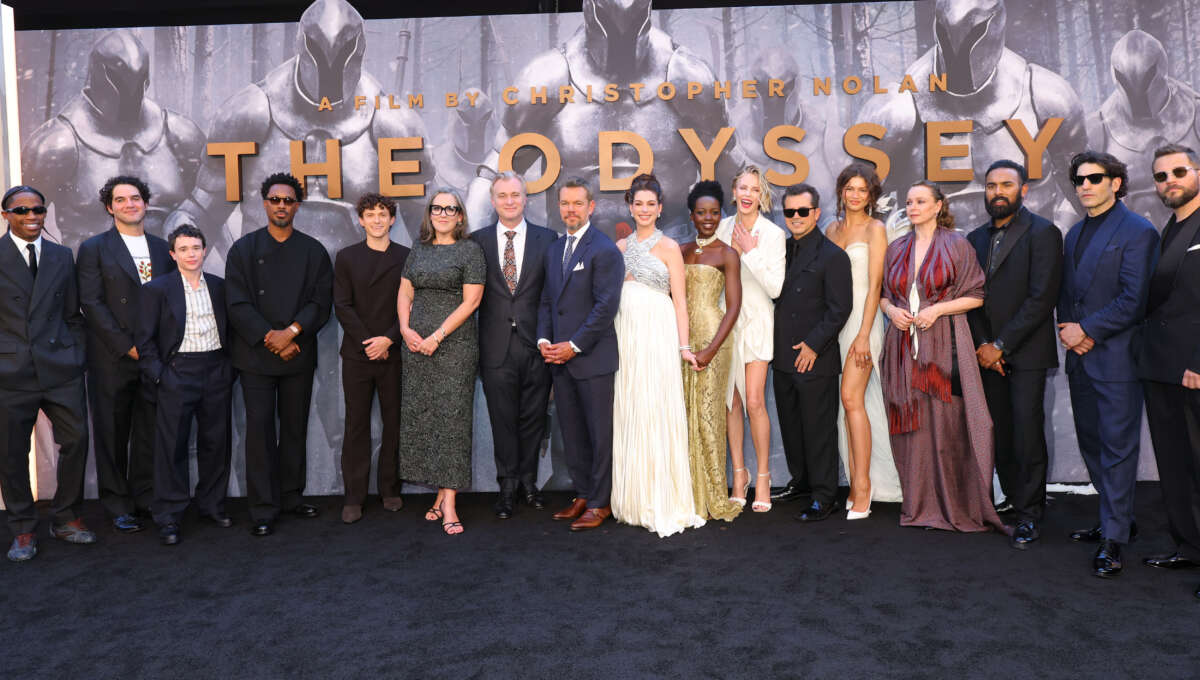
The cast of The Odyssey attends the premiere of the film on July 14, 2026, in New York City.
Mike Coppola/Getty Images for Universal Pictures


Editor’s Note: This article contains spoilers.


Christopher Nolan’s The Odyssey opens with a shot of the bard Demodocus — played by rapper Travis Scott — hitting a staff on a table for a beat. The movie then cuts to Sinon, an Achaean soldier in front of the Trojan Horse, who is played by transgender actor Elliot Page. Later, the hero, Odysseus (a somber Matt Damon) confesses that he is a war criminal. The blood on his hands stopped him from coming home.

The new film, which turns Homer’s epic into a critique of the West, started drawing the ire of right-wing critics before it even hit the screens. This version of The Odyssey calls out racism. It calls out patriarchy. It exposes the human cost of war and denounces the military machismo that Homer and the modern right-wing “manosphere” celebrate. It corrects the failure of empathy in the 8th century BCE epic. We are lucky to have a version of the Odyssey that portrays the real conflict within the story: how a scared and wounded man tries to heal his humanity so he can come home.
Don’t Look a Gift Horse in the Mouth

In the film, Trojan soldiers on horseback gallop across a beach to the Trojan Horse, a giant statue, half-buried in sand. They see the scared soldier Sinon, who says the Trojan Horse is a peace offering. Hardened by war, they kill Sinon but wheel the statue into the city. In its belly, Odysseus and his men wait for nightfall to open Troy’s gates for their army to bring death and destruction.

Nolan’s The Odyssey cuts back and forth across time. In this way, Nolan is loyal to the structure of Homer’s poem, which tells scenes in flashbacks. The center of gravity is Odysseus, long-bearded, trapped on an idyllic island by the nymph Calypso (played by an ethereal Charlize Theron). She drugs him with a lotus flower that causes amnesia. Bit by bit, he remembers his journey after the Trojan War. He recalls his arrogance at guiding his men on a quick sail home. He got them lost and killed. Struck by guilt, he eats more of the memory-erasing lotus.

Memory is key in this movie. Memories of war are how a son, Telemachus (a stoic Tom Holland), learns of his father, Odysseus, and in turn learns how to “become a man.” Memories of war are also how Odysseus accepts the blood on his hands. At the high point in the film, the effects of the lotus fade. He remembers the sacking of Troy. Fire eating stone. Soldiers hacking people like butchers working sides of beef. Odysseus wanders around, stunned at the gore and death. Finally, he snaps out of it, and says to Calypso, “I didn’t want to go home.”


Is There a Future Without Incarceration? Abolitionist Art Shows Us One.
Prison abolitionist art creates a future to briefly live in, and from that place, turn and look at our present. By Nicholas Powers , Truthout May 23, 2026


I read Homer’s Odyssey. I taught Homer’s Odyssey. I can tell you that however soul-stirring and epic it may be, it is written for the elite ruling class.

Nolan’s The Odyssey centers the inner conflict of a war veteran struggling with trauma. When Damon’s Odysseus returns to his castle in Ithaca, disguised as a beggar, he talks with his wife about the horror of war. Nolan’s focus is not original; in 2024’s The Return, actor Ralph Fiennes also played an Odysseus wracked by grief and guilt. Fiennes said in an interview it was “an antiwar film.” In that version, Penelope (played by a steely Juliette Binoche) yelled at him, “How many men did you kill? How many women, raped?”

I read Homer’s Odyssey. I taught Homer’s Odyssey. I can tell you that however soul-stirring and epic it may be, it is written for the elite ruling class. Homer’s Odysseus in no way shows how violence maims men’s souls. But as Damon’s Odysseus walks numb while Troy burns, you can imagine it not as Troy but as Tehran after U.S. and Israeli attacks, or Baghdad during Desert Storm, or Ukraine after Russian missile strikes.
Make Patriarchy Gross Again

In this new recasting of The Odyssey,feminist critiques also abound. The film shows the pressure of patriarchy on women characters such as Penelope (an embattled Anne Hathaway), Circe the witch (a haunting Samantha Morton), and also the unnamed women cut down by soldiers. The tragedy is that the film’s critique can only go so far to the degree that it remains loyal to the source material. Homer’s original, beginning to end, reaffirms male supremacy.

Mother and son fight over the future. Telemachus urges Penelope to marry. He pleads with her that this way, he can maneuver to the throne. She snarls at him, “I have sat on the throne for years! I have experience but none of it matters as much as the bristle on your beard.” She storms off, the point made that she is the most capable leader, but in a patriarchy, her young son has more authority than she does.

The sharpest feminist critique comes at the hands of a witch. During a flashback, Odysseus remembers sailing to island. His men are hungry and spot a farm house. They run to it and the grey-haired Circe, a witch in disguise, feeds them meaty broth that casts a spell. In a deliciously lurid scene, she reshapes each man into a pig, like a sculptor working wet clay. When Odysseus comes, he knows she is a witch. She accuses men of being animals, led by “base instincts” who rob and rape and kill. Only after Odysseus threatens to kill her sister, whom she transformed into a raven, does she reverse the spell, changing the pigs back into his soldiers. Bitterly, she says, “Back into your disguises.” Male self-image is a mask hiding their animal nature.

The Right-Wing Freak Out

Right-wing critics ripped their hair out over this film before it even hit theaters. They hated that Nolan actively diversified the cast. They saw it as evidence that this was a “woke” Odyssey. Once again, their argument goes, liberals stole another piece of culture from them and ruined it.

Exhibit number one: the rumor that Elliot Page would play Achilles. (Not true —again, he played Sinon the soldier.) MAGA critics discovered that Page was cast and got it into their heads that he was Achilles, the most famous warrior in all of literature. Achilles was played like a beefcake calendar model by Brad Pitt in 2004’s Troy. The idea of a transgender actor supposedly “desecrating” Achilles masculinity drove them to create AI videos showing Page as Achilles getting easily killed or stumbling over his shield.

Meanwhile right-wing critics also derided the casting of Black actor Lupita Nyong’o as Helen of Troy as historically inaccurate. Really, they were grasping for an excuse to vent racism. Elon Musk called her casting an “insult.” Right-wing personality Matt Walsh posted on X: “Not one person on the planet actually thinks that Lupita Nyong’o is ‘the most beautiful woman in the world.’” Again, the racist AI videos came, one showing Black actor Samuel L. Jackson as Helen of Troy, implying Nyong’o was ugly.

The fight over who owns history is the fight over legitimacy. Whoever owns the past owns the future.

What spurred this right-wing freak out? A fetish for a “golden past.” Seen through the right’s political lens, the past is a time of law and order, in which natural roles in gender and class were strictly observed, which led to social harmony. In this illusionary past, the best ruled and the inferior obeyed. Professor Curtis Dozier dissects the right’s obsession with antiquity in his 2026 book, The White Pedestal: How White Nationalists Use Ancient Greece and Rome to Justify Hate. He argues that the ancient world is a mirror in which racists can see themselves, legitimized by academic prestige, and that history reflects their values. He summarized the right’s use of history in a New Books Network interview:


Look, this society, ancient Greece and Rome, which you respect and believe is a high point in human civilization, they excluded foreigners from citizenship. They excluded women from political rights. They regarded outsiders as a dangerous threat. They practiced eugenic measures. Plato said if any deformed infants are born, they should be taken away and put into a dark place and never seen again.

The fight over who owns history is the fight over legitimacy. Whoever owns the past owns the future. It is a fight you see in the reactions to Zack Snyder’s 2006 movie 300 compared to Nolan’s 2026 The Odyssey. Snyder’s Spartan warriors, lean and muscled, were idealized men. 300 became the war cry of the MMA-glorifying, manosphere-participating, testosterone-advocating MAGA man. Like Dozier said, it gave their male fantasies a fake Ph.D. in history. It gave them license to attack empathy and women’s rights and diversity.


Home, Sweet Home

The reaction to Nolan’s The Odyssey gives me hope. Yes, it’s flawed. Yes, Nolan’s loyalty to the text forces him to miss more daring interpretations. Yes, the theme of trauma as the obstacle to Odysseus coming home is overwhelmed by the spectacle of violence. In the end scene, it’s obvious the film relishes in Odysseus massacring the suitors. Even so, at the end, the old king exiles himself so his son Telemachus can rule Ithaca with clean hands, saying that Zeus’s Law (basically, the Golden Rule) means Odysseus must leave again, so that peace can come.

In part, Odysseus chooses exile because earlier in the film, he realizes that he was wrong. Everywhere he stopped, he was told about the “people from the sea” who came and stole and killed and ravaged. They broke Zeus’s Law. They brought darkness. Odysseus, in a moment of clarity, says: “We were the sea people. We were.”

In a time of war and poverty and global warming, we need this version of The Odyssey. We need to see a war veteran learning how to heal in order to belong again. The U.S. has committed so much violence in its short 250-year history. We have suffered from it and also sometimes caused it, and we feel lost. But we can get home. We have to recognize our complicity in the chaos we decry. We have to see the blood on our hands, clean it off, and then hopefully, when we reach out for forgiveness, we’ll receive it.


This article is licensed under Creative Commons (CC BY-NC-ND 4.0), and you are free to share and republish under the terms of the license.


Nicholas Powers
Nicholas Powers is the author of Thirst, a political vampire novel; The Ground Below Zero: 9/11 to Burning Man, New Orleans to Darfur, Haiti to Occupy Wall Street; and most recently, Black Psychedelic Revolution. He has been writing for Truthout since 2011. His article, “Killing the Future: The Theft of Black Life” in the Truthout anthology Who Do You Serve, Who Do You Protect? coalesces his years of reporting on police brutality.


Source: The Guardian

The historian Kim Phillips-Fein’s new book is published amid celebrations of the 250th anniversary of the declaration of independence and its truth “self-evident, that all men are created equal”. Country of Lords, however, is a history of Neo-Aristocrats, Social Darwinists, Tech Utopians, and the Long Fight Against Equality in America.

Concise and hard-hitting, the book arrives at a time of glaring social and economic inequality, Phillips-Fein seeing Elon Muskemerging as a trillionaire very much on people’s minds, with a deep level of discomfort, both fear and anger about what this portends”.

“It’s always hard to know what’s going to be happening when you have written a book,” she said. “But I think those questions about economic equality and the impact of extreme levels of economic hierarchy and concentration, and the questions, ‘Can you still have a democracy any longer? What are the ways that you can counter that? What alternate visions are there if you want to live in a world that’s not characterized that way?’, are present.”

Phillips-Fein studies conservatism and “questions about capitalism and democracy”. Her first book, Invisible Hands, was a study of businessmen who fought the New Deal of the 1930s. Her second, Fear City, about the New York economic crisis of the 1970s, was a finalist for the Pulitzer prize. Hers is a major voice. It’s also unique. Not many books start with founder John Adams and end with Peter Thiel of Palantir, Musk’s fellow techno-fascist. Might such company seem unfair on Adams, the Boston lawyer who was part of a great revolution but feared what was unleashed?

“I hope this comes through,” Phillips-Fein said. “Adams is very different from [steel magnate] Andrew Carnegie and [Yale professor] William Graham Sumner and the late 19th-century social Darwinists, and the pro-slavery advocates. He’s also definitely very different from people who are saying extreme levels of economic inequality are good.” Adams, however, was “very ambivalent and skeptical of egalitarian claims … during and after the French Revolution: a deep sense of you can have too much egalitarianism.

Photograph: WW Norton & Company

“In his writing, he does also give a strong kind of conservative temperament and foundational sense of the problems of arguing for greater equality and a deep wariness and sense of pessimism about a politics that claims to do that.”

And so Adams takes his place in Country of Lords. Other subjects include preachers of race-based inequality from George Fitzhugh, a Confederate theorist of slavery as natural good, to Theodore Lothrop Stoddard, a hack journalist who had a huge bestseller in 1920 with The Rising Tide of Color Against White World-Supremacy, “part of a larger intellectual subculture of ‘scientific’ racism … in the aftermath of world war one”. There is also Carnegie, the Scottish-born tycoon who flourished in the Gilded Age of the late 19th century.

“What makes Carnegie so interesting is that he at least allows himself to have some sense of ambivalence,” Phillips-Fein said. “He says that while the concentration of wealth is absolutely necessary and inevitable, and the people at the top … should have the ultimate say over resources, he is deeply aware that this is politically dangerous, that … it creates an unstable society in which the poor and the working class might actually hate the wealthy, and that’s not in the interest of the wealthy in the long run. Also, he has a sense that human brotherhood is lost, or some kind of community that had existed.”

Carnegie’s father was a Chartist, seeking working-class rights. Carnegie’s major outlet for doubts about his wealth came through philanthropy, prominently the construction of libraries for working people.

“He had a very deep sense of paternalism,” Phillips-Fein said. “He was very invested in the idea of business as a romance and kind of a space of adventure and conquest and feudal benevolence. I think Carnegie’s answer was ultimately that the wealthy should have their money but they shouldn’t bequeath much to their descendants, they should invest it in massive philanthropic projects, and this was better than raising wages or other things like that … It is his level of guilt and ambivalence that I think does make him appealing, if also troubling. I think it raises a set of questions that he certainly was never really able to resolve.”

The 1892 Carnegie Steel strike and its violent suppression devastated Homestead, Pennsylvania, and left Carnegie disillusioned. Now, in Washington, Carnegie Science is the Qatari embassy. At Mount Vernon, the Carnegie library hosts an Apple Store.

Country of Lords is also a primer on modern inequality. In the early 1900s, Henry Ford mixed mass auto production with vicious racism. In mid-century, William Shockley was a proto-tech mogul “who went completely off the rails”.

“He was a co-inventor of the transistor and he figures in different histories of Silicon Valley because he ran this company and wanted to maintain a tremendous amount of control, and as a result a bunch of the employees quit and founded their own firm [two eventually founding Intel] … So after Shockley Labs fell apart, Shockley started to become drawn to racist science, pseudoscience and IQ testing in particular. I don’t think anybody really knows exactly what triggered this, but he starts to talk a lot about it publicly in the mid-60s. He was at Stanford at the time. He was supposed to be teaching physics and engineering.”

Shockley, Phillips-Fein says, was really “a uniquely horrible person, and probably quite unhappy as well.” If that sounds familiar, also like Musk, Shockley wasn’t unique. Linked to the meritocratic movement of the mid-century, he was “not isolated. He is actually part of what is a growing, troubling community of people who coalesce in the late 60s, early 70s, and who are really responding, not always directly, to the context of the civil rights movement.

“It was obviously focused on overturning racist legislation that undergirded segregation, but it also made claims about the distribution of resources, saying the reasons for Black poverty are not innate, they reflect centuries of legal and political structures that have upheld white wealth and laid the foundation for exploitation of Black workers and working-class people, and the political disfranchisement has resulted in this distribution of resources. In other words, that’s nothing to do with merit at all.”

In such soil, Phillips-Fein finds the roots of “the tech titans of today”, rejecting liberal ideals.

“They are very skeptical and hostile towards elite institutions, or at least, have a very broad relationship to them,” she said. “So Peter Thiel embraces this set of ideas about competition drawn from the economist Joseph Schumpeter. He writes about how companies in a normal marketplace are competing at the margins … but every so often someone will come along and create a new invention, usually that winds up dominating the marketplace and changing it, and whoever does that first will completely change the marketplace.

“Thiel has the same idea. He kind of writes about how, ‘I was growing up, I wanted to be the best, I wanted to go to these elite institutions. I went to law school, I had the straight and narrow path, but then I realized that all that was wrong, and actually you had to disrupt everything, create your own monopoly, a monopoly of one: nobody else can ever be you,’ and then the people who are kind of blessed with this genius to recognize how to create something completely new in the world, those are the people who will deserve to win in this race and deserve to command the resources of society.”

The Country of Lords endures.

  • Country of Lords, published by WW Norton & Company, is out now

This article was originally published by The Guardian; please consider supporting the original publication, and read the original version at the link above.