LONG READ
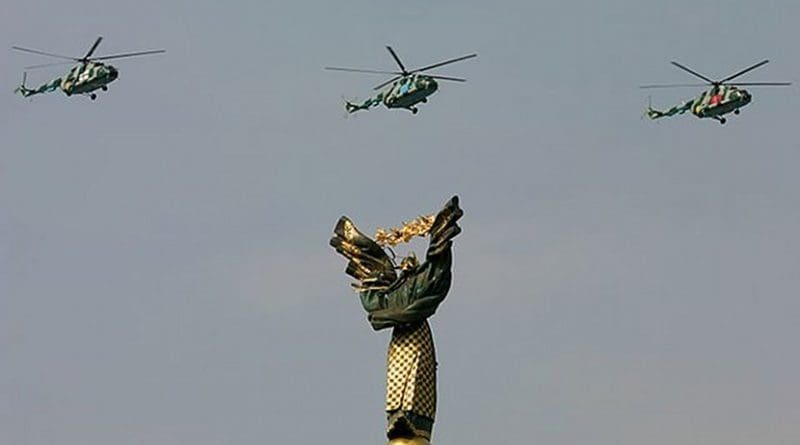
File photo of Ukraine army helicopters flying over Kyiv. Photo Credit: Oleg V. Belyakov, Wikimedia Commons.
July 31, 2026
By Ramesh Jaura
Key Takeaways:
Reconstruction of Ukraine and of the international system is already underway while the war continues. Europe is rearming, diversifying energy and supply chains, pursuing enlargement, and treating economic resilience as a security issue.
The emerging order is more plural, fragmented, and transactional. Influence is dispersing beyond the West, institutions face pressure to adapt, and the central challenge is managing rivalry while preserving sovereignty, law, and cooperation.
The invasion of Ukraine by Russia has now gone well beyond being just a conflict in a particular region; it has changed Europe’s strategic position, brought deterrence back to the heart of its security policy and sped up the development of a more divided international order. Before the last of the guns has been silenced, governments are altering their alliances, reviving their economies and reconsidering the institutions which had previously underpinned the stability that followed the Cold War. The rebuilding of Ukraine is now closely linked to the reconstruction of the international order itself.
The End of Waiting
History seldom announces a new era; it becomes visible only as the certainties of the old one fail. Russia’s invasion of Ukraine on 24 February 2022 was such a moment. More than Europe’s largest war since 1945, it marked the violent end of the post-Cold War order and the start of a period in which many long-held assumptions about international politics no longer held.
For decades, Europe believed history had entered a calmer phase. The Cold War had ended peacefully, and NATO and EU enlargement seemed to show that democracy, interdependence and law were replacing old rivalries. Major war appeared almost unthinkable, pushed to the margins of European politics.
Ukraine shattered that confidence.
Russia’s attack challenged the political and legal foundations of post-Cold War Europe. At stake was not only Ukraine’s independence, but questions many Europeans thought settled: can borders be changed by force, do sovereign states choose their own destiny, and what weight do international agreements carry against military power?
The consequences reach far beyond Eastern Europe. Ukraine has become a central arena for testing the twenty-first-century balance of power, shaping calculations in Europe, the Indo-Pacific and the Middle East. What began as a regional conflict has become a wider struggle over the rules that will guide international politics for decades.
Yet the greatest paradox is that reconstruction has already begun while the war continues.
Defence strategies, energy systems, industrial policies and alliances are being reshaped. Financial institutions are preparing Ukraine’s recovery even as missiles continue to destroy its infrastructure. NATO has restored collective deterrence to the centre of its mission, while the European Union adapts to a strategic reality unlike the one inherited after 1989.
The reversal is striking. Reconstruction is no longer waiting for peace; war itself has become the catalyst for rebuilding Ukraine, reshaping Europe’s security architecture and influencing the international order. Today’s decisions will shape institutions, alliances and cooperation long after the fighting ends.
The effects extend beyond Ukraine. They are redefining Europe’s strategic identity, accelerating a more divided international system and forcing democracies to revisit assumptions that guided policy for a generation. Economic integration has not ended geopolitical rivalry; security, resilience and sovereignty have returned to the centre of international affairs.
Ukraine’s historical importance lies not only in its people’s courage or its cities’ destruction, but in its role as the arena where a new international order is being formed. Whether that order proves more stable or more dangerous remains uncertain. What is already clear is that the world before February 2022 is gone.
Deterrence Returns: Living Under the Nuclear Shadow
For much of the post-Cold War generation, deterrence seemed to belong to another age. Nuclear brinkmanship survived in military planning, but largely vanished from public debate as attention shifted to globalisation, climate change and technology. Few Europeans expected nuclear strategy to shape daily government calculations again.
Ukraine brought that illusion to an abrupt end.
Russia’s invasion showed that military power remains decisive when diplomacy fails. It also revived a twentieth-century reality: conventional wars may be fought with tanks, drones and missiles, but they unfold under the shadow of nuclear weapons. Even unused, those weapons shape every major decision.
This is one of the war’s defining features. Ukraine is not a nuclear conflict, yet nuclear deterrence has shaped the calculations of every principal actor. Military aid, sanctions and strategic signalling have all been weighed against the danger of escalation between nuclear powers.
Moscow has repeatedly invoked its nuclear capabilities, chiefly to shape Western calculations and inject uncertainty into decision-making. Each expansion of support for Ukraine, from advanced air defence to long-range missiles, has therefore required careful escalation assessments.
The Western response has been equally revealing.
The United States and NATO have tried to help Ukraine defend its sovereignty without entering direct war with Russia. Support has grown steadily, but each step has been calibrated to strengthen Ukraine while avoiding confrontation between nuclear powers.
This careful management of risk illustrates how profoundly deterrence has evolved since the Cold War.
Cold War bipolar stability has given way to a more complex rivalry. Nuclear powers now compete through cyber operations, economic coercion, technology, information campaigns and space. The boundaries between peace, crisis and conflict have blurred, making ambiguity itself a strategic tool.
The erosion of arms control has deepened these risks. Agreements that once supported strategic stability have lapsed or been abandoned, while dialogue has narrowed just when it is most needed. With trust diminished, miscalculation has become harder to contain.
The implications reach well beyond Europe.
Governments across Asia, the Middle East and the Indo-Pacific are studying Ukraine’s lessons. The war has reinforced the importance of resilience, alliances and technological superiority, while reopening debates on missile defence, extended deterrence, strategic autonomy and security guarantees.
Yet Ukraine has also demonstrated the limits of deterrence.
Deterrence may reduce the risk of direct major-power confrontation, but it cannot prevent regional wars, hybrid attacks, cyber operations or prolonged rivalry. Military strength can discourage aggression, but lasting stability still requires institutions, diplomacy and political trust.
This is the central paradox. Nuclear weapons remain instruments of unimaginable destruction, yet they have helped prevent direct war between NATO and Russia. Europe again lives under a condition earlier generations knew well: peace preserved not by the absence of fear, but by its management.
The return of deterrence is therefore less a triumph than a warning. It shows that post-Cold War hopes of lasting great-power restraint can no longer be assumed. The task ahead is to maintain credible deterrence while rebuilding the diplomatic habits and safeguards that can one day make it less central.
Beyond Europe: The Fragmentation of the International Order
The war in Ukraine is a European conflict with global consequences, but that understates its reach. Its meaning is now debated worldwide, as governments reassess alliances, strategic priorities and assumptions that shaped politics after the Cold War.
One Western expectation proved misplaced. Russia’s invasion did unite North America, Europe, Japan, Australia and several democratic partners behind Ukraine through military aid, sanctions and political support. Beyond that coalition, however, responses were far more varied.
Many governments in Asia, Africa, Latin America and the Middle East condemned the invasion but avoided comprehensive sanctions. Others maintained ties with both Moscow and Washington, seeking room for diplomatic and strategic manoeuvre rather than permanent alignment.
Interpreting this as support for Russia would be a mistake.
It reflects a wider redistribution of confidence. Many emerging powers no longer see themselves as participants in an order designed elsewhere. They increasingly act as independent centres of influence, pursuing national interests without exclusive alignment.
History goes a long way towards explaining that perspective.
For many countries in the Global South, appeals to defend the “rules-based international order” evoke both agreement and scepticism. They support sovereignty and territorial integrity, but memories of colonialism, selective interventions and uneven legal application shape judgement. The demand is not fewer norms, but equal application.
Ukraine has therefore revealed more than geopolitical divisions. It has exposed differences in historical experience and political memory.
Europe views the war through territorial aggression and collective security. Many developing countries recognise those concerns while facing debt, inflation, food insecurity, climate pressure, energy costs and development needs. For them, Ukraine is important, but not the only defining crisis.
The conflict has nevertheless accelerated changes that were already under way.
The war has accelerated existing shifts. China has deepened its partnership with Russia without direct military involvement. India balances ties with Moscow and the West, while Türkiye, Brazil, Indonesia, Saudi Arabia, South Africa and others pursue pragmatic, multi-directional diplomacy. Global politics is increasingly organised around flexible partnerships rather than rigid blocs.
The same pattern is visible within international institutions.
BRICS expansion, stronger regional organisations and more confident middle powers point to a world where influence is more dispersed. Political authority is spreading across regions whose priorities and historical experiences often differ from the transatlantic community’s.
Economic relations tell a similar story.
Sanctions on Russia showed the continuing weight of Western finance and technology. They also encouraged diversification in trade, payments and reserve exposure. Efficiency still matters, but resilience now shapes supply chains, energy networks, digital infrastructure and access to advanced technologies.
This does not mean post-1945 institutions are disappearing or that a classic Cold War is returning. The emerging system is more plural, fluid and transactional: states may cooperate on climate, compete on technology, deepen trade and strengthen military partnerships elsewhere. Alignment is increasingly selective and issue-specific.
For Europe and its democratic partners, this demands different diplomacy. Influence will depend not only on power, but on credibility, consistency and engagement with countries shaped by different histories. Durable partnerships require respect and more consistent application of international principles.
Ukraine did not create this transformation; it accelerated it. The war has made visible a shift from a world dominated by a small number of powers to one defined by multiple centres of influence, competing priorities and more intricate diplomacy.
The challenge extends beyond restoring peace in Ukraine. It is to build an order that accommodates diversity without abandoning sovereign equality, territorial integrity, international law and peaceful dispute settlement. That balance will shape Europe and the wider international system for decades.
Ukraine and the Reconstruction of the International Order
History rarely lets nations rebuild only after peace. New orders often take shape while conflict continues and outcomes remain uncertain. The Congress of Vienna, the post-1945 settlement and the end of the Cold War all began before their final architecture was clear. Ukraine belongs to that pattern: reconstruction has already begun.
Across Europe and beyond, governments are redesigning defence strategies, strengthening industry, diversifying energy and redefining partnerships. The EU is adapting for enlargement, NATO has restored deterrence to the centre of European security, and financial institutions are preparing Ukraine’s recovery. These are early blocks of a wider political reconstruction.
The transformation reaches deeper than institutions alone. It is changing the way governments think about security, sovereignty and international cooperation.
For three decades, international politics centred on managing globalisation. Today, governments again focus on territorial security, resilience, technological sovereignty and the balance between interdependence and autonomy. The language has changed because the world has changed.
No international order is sustained by military strength alone. Armed power can deter aggression, but it cannot create legitimacy. Economic prosperity can reduce tensions, but not erase rivalry. Lasting peace requires institutions seen as effective and fair.
That challenge has rarely been more pressing.
The system emerging from the war is likely to be more plural. Middle powers will matter more, regional organisations will carry greater responsibility and strategic competition will persist. Influence is becoming more dispersed and complex.
This need not be read as the decline of multilateralism. Properly understood, it may become an opportunity for its renewal.
Post-1945 institutions have proved resilient, but they still reflect an earlier age. To retain authority, they must adapt to broader representation and more consistent application of international law. Reform is not failure; it is the price of relevance.
Ukraine has become the focal point of that wider transformation.
Ukraine’s significance lies not only in its people’s resolve or its cities’ devastation. It lies in how clearly the war exposes unresolved tensions: sovereignty versus spheres of influence, law versus force, interdependence versus rivalry, and universal principles versus uneven application.
Every generation faces moments that redefine the international landscape. Reconstruction after 1945 transformed Europe; the Cold War’s end opened another chapter of democratic and economic confidence. Ukraine has opened a third. Its final shape is uncertain, but its consequences are already global.
The conflict’s legacy will not be measured only by territory, reconstruction or treaties. It will depend on whether the international community restores confidence in sovereignty, peaceful dispute settlement, collective security, accountable institutions and international law.
Rebuilding before peace is one of history’s hardest tasks. It asks governments to look beyond war’s immediate demands and consider the international system they want to leave behind. That responsibility belongs not only to Ukraine or Europe, but to all states willing to defend both principles and the institutions that give them meaning.
History rarely reveals exactly when one era ends and another begins. Future generations may remember Ukraine not only as the battlefield where a nation defended its independence, but as the place where a new international order first came into view. Long before peace returned, the next chapter had begun.
About Ramesh Jaura
Ramesh Jaura is a journalist with 60 years of experience as a freelancer, head of Inter Press Service, and founder-editor of IDN-InDepthNews. His work draws on field reporting and coverage of international conferences and events.
View all posts by Ramesh Jaura →
File photo of Ukraine army helicopters flying over Kyiv. Photo Credit: Oleg V. Belyakov, Wikimedia Commons.
July 31, 2026
By Ramesh Jaura
Key Takeaways:
Russia’s 2022 invasion ended the post-Cold War order of assumed peace and interdependence. It restored deterrence, great-power competition, and military power to the center of European and global politics.
Reconstruction of Ukraine and of the international system is already underway while the war continues. Europe is rearming, diversifying energy and supply chains, pursuing enlargement, and treating economic resilience as a security issue.
The emerging order is more plural, fragmented, and transactional. Influence is dispersing beyond the West, institutions face pressure to adapt, and the central challenge is managing rivalry while preserving sovereignty, law, and cooperation.
The invasion of Ukraine by Russia has now gone well beyond being just a conflict in a particular region; it has changed Europe’s strategic position, brought deterrence back to the heart of its security policy and sped up the development of a more divided international order. Before the last of the guns has been silenced, governments are altering their alliances, reviving their economies and reconsidering the institutions which had previously underpinned the stability that followed the Cold War. The rebuilding of Ukraine is now closely linked to the reconstruction of the international order itself.
The End of Waiting
History seldom announces a new era; it becomes visible only as the certainties of the old one fail. Russia’s invasion of Ukraine on 24 February 2022 was such a moment. More than Europe’s largest war since 1945, it marked the violent end of the post-Cold War order and the start of a period in which many long-held assumptions about international politics no longer held.
For decades, Europe believed history had entered a calmer phase. The Cold War had ended peacefully, and NATO and EU enlargement seemed to show that democracy, interdependence and law were replacing old rivalries. Major war appeared almost unthinkable, pushed to the margins of European politics.
Ukraine shattered that confidence.
Russia’s attack challenged the political and legal foundations of post-Cold War Europe. At stake was not only Ukraine’s independence, but questions many Europeans thought settled: can borders be changed by force, do sovereign states choose their own destiny, and what weight do international agreements carry against military power?
The consequences reach far beyond Eastern Europe. Ukraine has become a central arena for testing the twenty-first-century balance of power, shaping calculations in Europe, the Indo-Pacific and the Middle East. What began as a regional conflict has become a wider struggle over the rules that will guide international politics for decades.
Yet the greatest paradox is that reconstruction has already begun while the war continues.
Defence strategies, energy systems, industrial policies and alliances are being reshaped. Financial institutions are preparing Ukraine’s recovery even as missiles continue to destroy its infrastructure. NATO has restored collective deterrence to the centre of its mission, while the European Union adapts to a strategic reality unlike the one inherited after 1989.
The reversal is striking. Reconstruction is no longer waiting for peace; war itself has become the catalyst for rebuilding Ukraine, reshaping Europe’s security architecture and influencing the international order. Today’s decisions will shape institutions, alliances and cooperation long after the fighting ends.
The effects extend beyond Ukraine. They are redefining Europe’s strategic identity, accelerating a more divided international system and forcing democracies to revisit assumptions that guided policy for a generation. Economic integration has not ended geopolitical rivalry; security, resilience and sovereignty have returned to the centre of international affairs.
Ukraine’s historical importance lies not only in its people’s courage or its cities’ destruction, but in its role as the arena where a new international order is being formed. Whether that order proves more stable or more dangerous remains uncertain. What is already clear is that the world before February 2022 is gone.
The breakdown of the post-Cold War order
International orders rest on power, legitimacy and the willingness of major actors to follow shared rules. When those foundations weaken, institutions may endure, but the order itself begins to erode before its decline is fully visible.
The post-Cold War order emerged from a moment of optimism. The fall of the Berlin Wall in 1989 and the Soviet Union’s collapse two years later seemed to end one of modern history’s most dangerous phases. Many in Europe and North America believed democracy, markets and cooperation would now guide global affairs.
That optimism had substance. The idea of a “Europe whole and free,” rooted in the Helsinki Final Act and reaffirmed in the Charter of Paris, sought to replace confrontation with cooperation. Security would rest less on military balance than on sovereignty, peaceful dispute settlement and the integration of former adversaries. For a generation, the vision seemed to work.
History, however, rarely moves in a straight line.
The institutions that flourished after 1989 proved resilient, but the assumptions behind them were less durable. Interdependence reduced incentives for conflict, but it did not erase history, geography, national ambition or competing ideas of security.
The warning signs accumulated. Russia’s war against Georgia in 2008 showed that force had not disappeared from European politics. Crimea’s annexation and the conflict in eastern Ukraine in 2014 confirmed the point. Yet most governments treated these as grave exceptions, not evidence of a changing strategic reality. Diplomacy and trade continued even as trust declined.
Only in February 2022 did the full significance become impossible to ignore.
Russia’s invasion was more than another breach of international law. It rejected the principles behind Europe’s post-Cold War settlement. By claiming a privileged sphere of influence over a sovereign neighbour, Moscow challenged the post-1945 principle that every nation, large or small, has the right to choose its own future.
The implications reached beyond Europe.
The war revived an old question: can legal norms restrain power when major states put strategic interests first? The post-Cold War order assumed institutions, diplomacy and economic integration had reduced that danger. Ukraine showed that international law still depends on states’ willingness to defend it.
The 1994 Budapest Memorandum illustrates the dilemma. Ukraine gave up the world’s third-largest nuclear stockpile in return for security assurances from Russia, the United States and the United Kingdom. Though not a defence treaty, its failure to protect Ukraine has weakened confidence in political assurances in a more competitive world.
The consequences extend beyond military security.
Economic interdependence, once seen as stabilising, has become a field of strategic competition. Energy, sanctions, advanced technologies, critical minerals and supply chains are now treated as matters of national security. The line between economics and geopolitics has blurred.
The post-Cold War order did not collapse because of one invasion alone. The invasion exposed a longer process in which old assumptions no longer matched geopolitical reality. The institutions of 1989 survived, but they were overtaken by forces they could not contain.
The question is no longer whether the old order can be restored, but what will replace it. The urgent task is to shape a system that can manage renewed great-power competition while preserving cooperation. That challenge begins in Europe, but it cannot end there.
Europe Rediscovers Power
For more than seven decades, European integration was one of history’s most remarkable political achievements. A continent twice devastated by war remade itself around reconciliation, interdependence and law. The European Union became more than a common market: it offered a model in which cooperation replaced confrontation and shared institutions tempered old rivalries.
That success reshaped Europe’s understanding of security.
During the Cold War, Europe relied largely on the United States and NATO for protection. This allowed European leaders to focus on recovery, social progress and integration while ultimate deterrence remained an American responsibility. Military power did not disappear, but it moved away from the centre of political thought.
The end of the Cold War seemed to confirm that approach. Defence budgets fell, armed forces shrank, and military strength seemed less central to statecraft. Europe relied increasingly on trade, integration, institutions and regulatory influence. It became what scholars called a normative power, shaping rules more than projecting force.
That vision was not naïve. European integration remains a great peace project, but it depended on an international environment that proved less stable than many assumed.
Ukraine shattered that assumption.
Russia’s invasion showed that interdependence cannot preserve peace when faced with geopolitical ambition. Markets do not end power politics, and law alone cannot deter aggression. Peace also depends on the credible capacity to defend it.
Germany’s Zeitenwende became the clearest expression of this shift. It marked not only a policy change, but a psychological turning point: a country shaped by military restraint accepted that its old security assumptions no longer matched reality. Strengthening the Bundeswehr reflected a wider European reassessment.
Similar changes followed across Europe. Defence spending rose, military-industrial cooperation accelerated, ammunition production expanded, and procurement was modernised. The EU crossed a historic threshold by financing military assistance to Ukraine while strengthening its own defence-industrial base.
The reassessment went beyond military affairs.
The war showed that economic and national security can no longer be separated—Europe’s dependence on Russian energy exposed wider vulnerabilities. Supply chains, semiconductors, telecommunications, critical minerals and advanced technologies are now treated as strategic assets. Efficiency still matters, but resilience matters too.
This logic also shapes Europe’s approach to China. Instead of full disengagement, governments speak of de-risking: reducing excessive dependence while preserving legitimate trade and investment. The goal is a more durable balance between openness and security.
The transformation is clearest on Europe’s political map.
For years, enlargement fatigue slowed the EU’s expansion. The war changed that calculation. Ukraine’s candidacy, alongside Moldova’s and renewed momentum in the Western Balkans, signals a strategic conviction that Europe’s future should be shaped by sovereign democratic choice, not external coercion or spheres of influence.
The implications go beyond accession. A larger EU will need institutional reform, more flexible decision-making, stronger financing and closer foreign-policy coordination. Reconstruction is therefore not only about Ukraine; Europe itself is renewing its institutions for a changed strategic landscape.
None of this rejects the ideals of European integration. It seeks to preserve them under harsher conditions. Democracy, openness and law remain central, but they now require resilience, cohesion and, when necessary, credible collective defence.
Europe is entering a new chapter. It is not abandoning law and cooperation; it is rediscovering that lasting peace depends on strong institutions and the will to protect them.
International orders rest on power, legitimacy and the willingness of major actors to follow shared rules. When those foundations weaken, institutions may endure, but the order itself begins to erode before its decline is fully visible.
The post-Cold War order emerged from a moment of optimism. The fall of the Berlin Wall in 1989 and the Soviet Union’s collapse two years later seemed to end one of modern history’s most dangerous phases. Many in Europe and North America believed democracy, markets and cooperation would now guide global affairs.
That optimism had substance. The idea of a “Europe whole and free,” rooted in the Helsinki Final Act and reaffirmed in the Charter of Paris, sought to replace confrontation with cooperation. Security would rest less on military balance than on sovereignty, peaceful dispute settlement and the integration of former adversaries. For a generation, the vision seemed to work.
History, however, rarely moves in a straight line.
The institutions that flourished after 1989 proved resilient, but the assumptions behind them were less durable. Interdependence reduced incentives for conflict, but it did not erase history, geography, national ambition or competing ideas of security.
The warning signs accumulated. Russia’s war against Georgia in 2008 showed that force had not disappeared from European politics. Crimea’s annexation and the conflict in eastern Ukraine in 2014 confirmed the point. Yet most governments treated these as grave exceptions, not evidence of a changing strategic reality. Diplomacy and trade continued even as trust declined.
Only in February 2022 did the full significance become impossible to ignore.
Russia’s invasion was more than another breach of international law. It rejected the principles behind Europe’s post-Cold War settlement. By claiming a privileged sphere of influence over a sovereign neighbour, Moscow challenged the post-1945 principle that every nation, large or small, has the right to choose its own future.
The implications reached beyond Europe.
The war revived an old question: can legal norms restrain power when major states put strategic interests first? The post-Cold War order assumed institutions, diplomacy and economic integration had reduced that danger. Ukraine showed that international law still depends on states’ willingness to defend it.
The 1994 Budapest Memorandum illustrates the dilemma. Ukraine gave up the world’s third-largest nuclear stockpile in return for security assurances from Russia, the United States and the United Kingdom. Though not a defence treaty, its failure to protect Ukraine has weakened confidence in political assurances in a more competitive world.
The consequences extend beyond military security.
Economic interdependence, once seen as stabilising, has become a field of strategic competition. Energy, sanctions, advanced technologies, critical minerals and supply chains are now treated as matters of national security. The line between economics and geopolitics has blurred.
The post-Cold War order did not collapse because of one invasion alone. The invasion exposed a longer process in which old assumptions no longer matched geopolitical reality. The institutions of 1989 survived, but they were overtaken by forces they could not contain.
The question is no longer whether the old order can be restored, but what will replace it. The urgent task is to shape a system that can manage renewed great-power competition while preserving cooperation. That challenge begins in Europe, but it cannot end there.
Europe Rediscovers Power
For more than seven decades, European integration was one of history’s most remarkable political achievements. A continent twice devastated by war remade itself around reconciliation, interdependence and law. The European Union became more than a common market: it offered a model in which cooperation replaced confrontation and shared institutions tempered old rivalries.
That success reshaped Europe’s understanding of security.
During the Cold War, Europe relied largely on the United States and NATO for protection. This allowed European leaders to focus on recovery, social progress and integration while ultimate deterrence remained an American responsibility. Military power did not disappear, but it moved away from the centre of political thought.
The end of the Cold War seemed to confirm that approach. Defence budgets fell, armed forces shrank, and military strength seemed less central to statecraft. Europe relied increasingly on trade, integration, institutions and regulatory influence. It became what scholars called a normative power, shaping rules more than projecting force.
That vision was not naïve. European integration remains a great peace project, but it depended on an international environment that proved less stable than many assumed.
Ukraine shattered that assumption.
Russia’s invasion showed that interdependence cannot preserve peace when faced with geopolitical ambition. Markets do not end power politics, and law alone cannot deter aggression. Peace also depends on the credible capacity to defend it.
Germany’s Zeitenwende became the clearest expression of this shift. It marked not only a policy change, but a psychological turning point: a country shaped by military restraint accepted that its old security assumptions no longer matched reality. Strengthening the Bundeswehr reflected a wider European reassessment.
Similar changes followed across Europe. Defence spending rose, military-industrial cooperation accelerated, ammunition production expanded, and procurement was modernised. The EU crossed a historic threshold by financing military assistance to Ukraine while strengthening its own defence-industrial base.
The reassessment went beyond military affairs.
The war showed that economic and national security can no longer be separated—Europe’s dependence on Russian energy exposed wider vulnerabilities. Supply chains, semiconductors, telecommunications, critical minerals and advanced technologies are now treated as strategic assets. Efficiency still matters, but resilience matters too.
This logic also shapes Europe’s approach to China. Instead of full disengagement, governments speak of de-risking: reducing excessive dependence while preserving legitimate trade and investment. The goal is a more durable balance between openness and security.
The transformation is clearest on Europe’s political map.
For years, enlargement fatigue slowed the EU’s expansion. The war changed that calculation. Ukraine’s candidacy, alongside Moldova’s and renewed momentum in the Western Balkans, signals a strategic conviction that Europe’s future should be shaped by sovereign democratic choice, not external coercion or spheres of influence.
The implications go beyond accession. A larger EU will need institutional reform, more flexible decision-making, stronger financing and closer foreign-policy coordination. Reconstruction is therefore not only about Ukraine; Europe itself is renewing its institutions for a changed strategic landscape.
None of this rejects the ideals of European integration. It seeks to preserve them under harsher conditions. Democracy, openness and law remain central, but they now require resilience, cohesion and, when necessary, credible collective defence.
Europe is entering a new chapter. It is not abandoning law and cooperation; it is rediscovering that lasting peace depends on strong institutions and the will to protect them.
Deterrence Returns: Living Under the Nuclear Shadow
For much of the post-Cold War generation, deterrence seemed to belong to another age. Nuclear brinkmanship survived in military planning, but largely vanished from public debate as attention shifted to globalisation, climate change and technology. Few Europeans expected nuclear strategy to shape daily government calculations again.
Ukraine brought that illusion to an abrupt end.
Russia’s invasion showed that military power remains decisive when diplomacy fails. It also revived a twentieth-century reality: conventional wars may be fought with tanks, drones and missiles, but they unfold under the shadow of nuclear weapons. Even unused, those weapons shape every major decision.
This is one of the war’s defining features. Ukraine is not a nuclear conflict, yet nuclear deterrence has shaped the calculations of every principal actor. Military aid, sanctions and strategic signalling have all been weighed against the danger of escalation between nuclear powers.
Moscow has repeatedly invoked its nuclear capabilities, chiefly to shape Western calculations and inject uncertainty into decision-making. Each expansion of support for Ukraine, from advanced air defence to long-range missiles, has therefore required careful escalation assessments.
The Western response has been equally revealing.
The United States and NATO have tried to help Ukraine defend its sovereignty without entering direct war with Russia. Support has grown steadily, but each step has been calibrated to strengthen Ukraine while avoiding confrontation between nuclear powers.
This careful management of risk illustrates how profoundly deterrence has evolved since the Cold War.
Cold War bipolar stability has given way to a more complex rivalry. Nuclear powers now compete through cyber operations, economic coercion, technology, information campaigns and space. The boundaries between peace, crisis and conflict have blurred, making ambiguity itself a strategic tool.
The erosion of arms control has deepened these risks. Agreements that once supported strategic stability have lapsed or been abandoned, while dialogue has narrowed just when it is most needed. With trust diminished, miscalculation has become harder to contain.
The implications reach well beyond Europe.
Governments across Asia, the Middle East and the Indo-Pacific are studying Ukraine’s lessons. The war has reinforced the importance of resilience, alliances and technological superiority, while reopening debates on missile defence, extended deterrence, strategic autonomy and security guarantees.
Yet Ukraine has also demonstrated the limits of deterrence.
Deterrence may reduce the risk of direct major-power confrontation, but it cannot prevent regional wars, hybrid attacks, cyber operations or prolonged rivalry. Military strength can discourage aggression, but lasting stability still requires institutions, diplomacy and political trust.
This is the central paradox. Nuclear weapons remain instruments of unimaginable destruction, yet they have helped prevent direct war between NATO and Russia. Europe again lives under a condition earlier generations knew well: peace preserved not by the absence of fear, but by its management.
The return of deterrence is therefore less a triumph than a warning. It shows that post-Cold War hopes of lasting great-power restraint can no longer be assumed. The task ahead is to maintain credible deterrence while rebuilding the diplomatic habits and safeguards that can one day make it less central.
Beyond Europe: The Fragmentation of the International Order
The war in Ukraine is a European conflict with global consequences, but that understates its reach. Its meaning is now debated worldwide, as governments reassess alliances, strategic priorities and assumptions that shaped politics after the Cold War.
One Western expectation proved misplaced. Russia’s invasion did unite North America, Europe, Japan, Australia and several democratic partners behind Ukraine through military aid, sanctions and political support. Beyond that coalition, however, responses were far more varied.
Many governments in Asia, Africa, Latin America and the Middle East condemned the invasion but avoided comprehensive sanctions. Others maintained ties with both Moscow and Washington, seeking room for diplomatic and strategic manoeuvre rather than permanent alignment.
Interpreting this as support for Russia would be a mistake.
It reflects a wider redistribution of confidence. Many emerging powers no longer see themselves as participants in an order designed elsewhere. They increasingly act as independent centres of influence, pursuing national interests without exclusive alignment.
History goes a long way towards explaining that perspective.
For many countries in the Global South, appeals to defend the “rules-based international order” evoke both agreement and scepticism. They support sovereignty and territorial integrity, but memories of colonialism, selective interventions and uneven legal application shape judgement. The demand is not fewer norms, but equal application.
Ukraine has therefore revealed more than geopolitical divisions. It has exposed differences in historical experience and political memory.
Europe views the war through territorial aggression and collective security. Many developing countries recognise those concerns while facing debt, inflation, food insecurity, climate pressure, energy costs and development needs. For them, Ukraine is important, but not the only defining crisis.
The conflict has nevertheless accelerated changes that were already under way.
The war has accelerated existing shifts. China has deepened its partnership with Russia without direct military involvement. India balances ties with Moscow and the West, while Türkiye, Brazil, Indonesia, Saudi Arabia, South Africa and others pursue pragmatic, multi-directional diplomacy. Global politics is increasingly organised around flexible partnerships rather than rigid blocs.
The same pattern is visible within international institutions.
BRICS expansion, stronger regional organisations and more confident middle powers point to a world where influence is more dispersed. Political authority is spreading across regions whose priorities and historical experiences often differ from the transatlantic community’s.
Economic relations tell a similar story.
Sanctions on Russia showed the continuing weight of Western finance and technology. They also encouraged diversification in trade, payments and reserve exposure. Efficiency still matters, but resilience now shapes supply chains, energy networks, digital infrastructure and access to advanced technologies.
This does not mean post-1945 institutions are disappearing or that a classic Cold War is returning. The emerging system is more plural, fluid and transactional: states may cooperate on climate, compete on technology, deepen trade and strengthen military partnerships elsewhere. Alignment is increasingly selective and issue-specific.
For Europe and its democratic partners, this demands different diplomacy. Influence will depend not only on power, but on credibility, consistency and engagement with countries shaped by different histories. Durable partnerships require respect and more consistent application of international principles.
Ukraine did not create this transformation; it accelerated it. The war has made visible a shift from a world dominated by a small number of powers to one defined by multiple centres of influence, competing priorities and more intricate diplomacy.
The challenge extends beyond restoring peace in Ukraine. It is to build an order that accommodates diversity without abandoning sovereign equality, territorial integrity, international law and peaceful dispute settlement. That balance will shape Europe and the wider international system for decades.
Ukraine and the Reconstruction of the International Order
History rarely lets nations rebuild only after peace. New orders often take shape while conflict continues and outcomes remain uncertain. The Congress of Vienna, the post-1945 settlement and the end of the Cold War all began before their final architecture was clear. Ukraine belongs to that pattern: reconstruction has already begun.
Across Europe and beyond, governments are redesigning defence strategies, strengthening industry, diversifying energy and redefining partnerships. The EU is adapting for enlargement, NATO has restored deterrence to the centre of European security, and financial institutions are preparing Ukraine’s recovery. These are early blocks of a wider political reconstruction.
The transformation reaches deeper than institutions alone. It is changing the way governments think about security, sovereignty and international cooperation.
For three decades, international politics centred on managing globalisation. Today, governments again focus on territorial security, resilience, technological sovereignty and the balance between interdependence and autonomy. The language has changed because the world has changed.
No international order is sustained by military strength alone. Armed power can deter aggression, but it cannot create legitimacy. Economic prosperity can reduce tensions, but not erase rivalry. Lasting peace requires institutions seen as effective and fair.
That challenge has rarely been more pressing.
The system emerging from the war is likely to be more plural. Middle powers will matter more, regional organisations will carry greater responsibility and strategic competition will persist. Influence is becoming more dispersed and complex.
This need not be read as the decline of multilateralism. Properly understood, it may become an opportunity for its renewal.
Post-1945 institutions have proved resilient, but they still reflect an earlier age. To retain authority, they must adapt to broader representation and more consistent application of international law. Reform is not failure; it is the price of relevance.
Ukraine has become the focal point of that wider transformation.
Ukraine’s significance lies not only in its people’s resolve or its cities’ devastation. It lies in how clearly the war exposes unresolved tensions: sovereignty versus spheres of influence, law versus force, interdependence versus rivalry, and universal principles versus uneven application.
Every generation faces moments that redefine the international landscape. Reconstruction after 1945 transformed Europe; the Cold War’s end opened another chapter of democratic and economic confidence. Ukraine has opened a third. Its final shape is uncertain, but its consequences are already global.
The conflict’s legacy will not be measured only by territory, reconstruction or treaties. It will depend on whether the international community restores confidence in sovereignty, peaceful dispute settlement, collective security, accountable institutions and international law.
Rebuilding before peace is one of history’s hardest tasks. It asks governments to look beyond war’s immediate demands and consider the international system they want to leave behind. That responsibility belongs not only to Ukraine or Europe, but to all states willing to defend both principles and the institutions that give them meaning.
History rarely reveals exactly when one era ends and another begins. Future generations may remember Ukraine not only as the battlefield where a nation defended its independence, but as the place where a new international order first came into view. Long before peace returned, the next chapter had begun.
About Ramesh Jaura
Ramesh Jaura is a journalist with 60 years of experience as a freelancer, head of Inter Press Service, and founder-editor of IDN-InDepthNews. His work draws on field reporting and coverage of international conferences and events.
View all posts by Ramesh Jaura →