The Politics Of Opposition: Has Countering Morocco Become Algeria’s Long-Term National Strategy? – Analysis
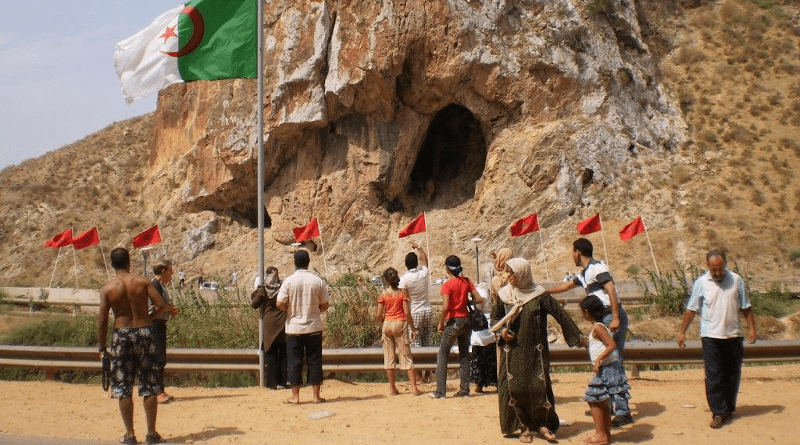
Neighbors greet each other on both sides of the Algeria–Morocco border. Photo Credit: amekinfo, Wikipedia Commons
August 2, 2026
By Dr. Mohamed Chtatou
Key Takeaways:
Opposition to Morocco has become one of the most durable and institutionalized organizing principles of Algerian regional policy, rooted in the colonial border dispute, the 1963 Sand War, and especially the unresolved Western Sahara conflict since 1975.
The rivalry shapes Algerian diplomacy, military posture, energy infrastructure decisions, domestic political discourse, and even competing claims over Amazigh identity, imposing high economic opportunity costs through low regional trade and stalled Maghreb integration.
While Algeria faces many independent national priorities, the pattern of rivalry functions as a persistent filter that distorts broader policy, with limited near-term prospects for cooperation unless functional, sector-specific confidence-building measures are pursued without requiring resolution of the Sahara dispute.
Introduction
Few bilateral relationships in the contemporary world are as durably adversarial, and as consequential for regional order, as the one binding Algeria and Morocco. Since the two states emerged from French and Spanish colonial rule in the middle of the twentieth century, their relationship has oscillated between guarded cooperation and open hostility, punctuated by border war, broken diplomatic ties, closed frontiers, and a Cold-War-style contest for regional primacy that has outlasted every generation of leadership on both sides of the Zouj Bghal crossing. The question this essay poses is deliberately provocative: has countering Morocco become, in effect, Algeria’s long-term national strategy — the organizing logic beneath its foreign policy, its military posture, its regional diplomacy, and even elements of its domestic legitimation? Framed so starkly, the proposition is difficult to sustain in full. Algeria is a state of thirty-two million people with an economy structured around hydrocarbon rents, a young and often frustrated population, chronic governance challenges, and security threats along five different borders that have nothing to do with Rabat. To reduce Algerian statecraft to a single obsession would be to caricature a complex, path-dependent, and multi-causal foreign policy tradition. Yet the opposite claim — that Morocco is incidental to Algerian strategy — is equally untenable.
This essay argues for a middle position, developed across several interlocking dimensions of the relationship: that opposition to Morocco has become one of the most durable, most institutionalized, and most costly organizing principles of Algerian regional policy, even though it does not exhaust Algeria’s strategic horizon. The analysis proceeds inductively rather than by asserting the conclusion at the outset. It traces the historical origins of the rivalry in the colonial border question and the 1963 Sand War; examines the Western Sahara dispute as the structural fact around which the relationship has been organized since 1975; surveys the relevant scholarly literature; considers the underexamined identity dimension bound up with competing claims to Amazigh heritage; documents the rivalry’s expression in diplomacy, domestic politics, economics, military posture, competing developmental models, and public diplomacy; and closes by weighing the evidence for and against the essay’s central proposition before asking whether the two states can move beyond a zero-sum framework that has, by nearly every empirical measure available to regional economists
Historical Origins: From Colonial Border to Sand War
The roots of Algerian-Moroccan antagonism predate Algerian independence itself. French colonial cartography had, over more than a century, redrawn the Saharan and pre-Saharan frontier separating what would become Algeria from the Moroccan sultanate, annexing to French Algeria territories — around Tindouf, Colomb-Béchar, and the Figuig region — that Rabat had historically administered or claimed. Morocco’s independence in 1956 preceded Algeria’s by six years, and Moroccan nationalists, including the future King Hassan II, initially framed Algeria’s liberation struggle as a shared Maghrebi cause, extending sanctuary, arms routes, and diplomatic support to the Front de Libération Nationale (FLN) during the war of 1954–1962. Rabat’s expectation — one that has structured Moroccan grievance narratives ever since — was that an independent, grateful Algeria would negotiate the restitution of the colonially amputated territories. That expectation collided with the doctrine, embraced by Algeria’s post-independence leadership under Ahmed Ben Bella, that the frontiers inherited from colonialism were sacrosanct and non-negotiable, a principle that would later be enshrined continentally in the Organization of African Unity’s 1964 Cairo Resolution on the intangibility of colonial borders.
The result was the brief but formative Sand War (Guerre des Sables) of October 1963, in which Moroccan and Algerian forces clashed over the Tindouf and Figuig sectors. Although mediated to a ceasefire within weeks through the intercession of the Organization of African Unity and Ethiopian arbitration, the war left a residue of strategic distrust on both sides that has never fully dissipated. For Algeria’s new revolutionary elite, the war confirmed a perception of Morocco’s monarchy as an irredentist, expansionist neighbor allied with conservative Western interests; for Morocco’s Palace, it confirmed a reading of Algeria as an ideologically assertive, Soviet-leaning state willing to use force against a country that had sheltered its liberation movement. Both readings, however partisan, have proven remarkably durable, resurfacing in each subsequent crisis (Chtatou, 2018, December 10).
Scholarly Perspectives on the Rivalry
The academic literature on Algerian-Moroccan relations has converged, with some variation in emphasis, on a broadly similar diagnosis. Comparative work on regional security provision in the Maghreb has characterized both states as competing “regional security providers” whose overlapping claims to leadership generate structural friction independent of any single dispute (Boukhars, 2019). Historians of French Algeria have situated the rivalry within a longer colonial and postcolonial genealogy: Stora’s work places the 130-year colonial occupation and the war of independence at the center of Algerian political identity formation in ways that have shaped a distinctively sovereigntist and anti-interventionist foreign policy culture, one considerably more suspicious of external, including Moroccan, entanglement than Morocco’s own postcolonial trajectory (Stora, 2020; Stora, 2021). Scholarship on the 2019 Hirak protests has similarly emphasized that the movement’s core grievances were domestic and institutional — centered on the transparency and accountability of the ruling elite — even as external threat narratives were subsequently mobilized by the state in the movement’s aftermath (Souiah, 2021). Taken together, this literature does not support a monocausal account in which Morocco explains all of Algerian foreign policy; but it consistently identifies the rivalry as a structuring, rather than incidental, feature of the regional order, one whose institutional and psychological roots reach back to the very different colonial and revolutionary experiences that produced the two states.
The Amazigh and Identity Dimension
A less frequently examined but analytically significant layer of the rivalry concerns competing claims to Amazigh (Berber) identity and heritage. Both Algeria and Morocco possess large Amazigh-speaking populations — respectively concentrated in Kabylia, the Aurès, and the Mzab in Algeria, and the Rif, the Middle Atlas, and the Souss in Morocco — and both states have, at different paces and with different degrees of sincerity, moved to grant Tamazight constitutional recognition as an official language, Morocco in 2011 and Algeria in 2016 (Chtatou, 2019, January 29). Yet the political meaning attached to Amazigh identity diverges sharply between the two capitals, and this divergence has periodically been folded into the broader rivalry. In Algeria, the Kabyle Amazigh movement has at times articulated demands for greater autonomy that the central government has treated as a security concern; Algerian officials have on occasion accused Morocco of covertly encouraging Kabyle separatism as an instrument of destabilization, an allegation Rabat has consistently denied. In Morocco, by contrast, the Palace has pursued a strategy of incorporating Amazigh cultural recognition — including the 2001 creation of the Royal Institute of Amazigh Culture and the 2011 constitutional reform — into an inclusive, monarchy-centered national narrative rather than treating it as a separatist threat (Chtatou, 2019, January 29). The contrast illustrates how even a shared civilizational heritage, rooted in the common Amazigh substrate of both societies predating Arab-Islamic conquest, has been refracted through the adversarial lens of the bilateral rivalry rather than serving, as it plausibly could, as a basis for cross-border cultural cooperation.
The Western Sahara Dispute as the Central Organizing Fact
If the Sand War established the rivalry’s psychological architecture, the Western Sahara dispute has supplied its enduring institutional content. Spain’s 1975 withdrawal from its Saharan colony, precipitated by Morocco’s mobilization of some 350,000 unarmed civilians in the Green March, set in motion a conflict that has now structured bilateral relations for half a century. Morocco annexed and has since administered the bulk of the territory, presenting an autonomy plan under Moroccan sovereignty as the only realistic basis for settlement. Algeria, while formally disclaiming territorial ambition in the Sahara, has hosted the Polisario Front’s government-in-exile and refugee camps near Tindouf since 1976, provided it with diplomatic, financial, and — at various junctures — military backing, and championed the Sahrawi Arab Democratic Republic’s claim to self-determination in African Union and United Nations fora.
Each side’s narrative is total and mutually exclusive. Algiers presents its position as a principled application of the UN Charter’s self-determination doctrine and a continuation of its own anti-colonial genealogy; Rabat, and a growing number of external observers, argue that Algeria is a de facto party to the dispute rather than a neutral sponsor of Sahrawi self-determination, pointing to the location, financing, and institutional dependency of the Polisario leadership on Algerian territory (Chtatou, 2021, October 22). The dispute has proven strategically self-reinforcing: because sovereignty over the Sahara is framed by Rabat as a matter of territorial integrity — Morocco’s most sacrosanct national cause — and by Algiers as a matter of decolonization principle, neither government has domestic space to compromise without appearing to betray a foundational commitment. This mutual entrapment has, over five decades, transformed a regional territorial dispute into the fixed coordinate around which nearly every other dimension of the bilateral relationship, and much of Algeria’s broader foreign policy, has come to be organized.
The diplomatic momentum shifted markedly after 2020, when the United States recognized Moroccan sovereignty over the Western Sahara as part of the trilateral agreement normalizing Moroccan-Israeli relations, and accelerated further as a growing number of European and African governments — France among the most consequential, given the long-anticipated Franco-Moroccan strategic treaty — moved toward explicit or implicit endorsement of the autonomy framework. Algeria has read this trend as evidence of encirclement rather than as grounds for recalibration, a perception that has, if anything, hardened its posture (Chtatou, 2026, February 26).
Foreign Policy Through the Prism of Morocco
Algerian diplomacy since the 1970s displays a recurring pattern: initiatives ostensibly pursued for their own sake — African solidarity, energy diplomacy, non-alignment, security cooperation — frequently double as instruments for constraining Moroccan influence. Several arenas illustrate the pattern with particular clarity.
The African Union. Algeria was instrumental in securing the Sahrawi Arab Democratic Republic’s admission to the Organization of African Unity in 1984, a decision that prompted Morocco’s thirty-three-year withdrawal from the pan-African body. When Morocco rejoined the African Union in January 2017 — trading absence for an “empty chair” strategy in favor of direct diplomatic engagement — Algeria intensified its own continental outreach, courting Sahelian and sub-Saharan capitals in what amounted to a redoubled contest for African recognition of the two rival Saharan positions.
Normalization with Israel. Morocco’s decision in December 2020 to normalize relations with Israel, secured in exchange for American recognition of its Saharan sovereignty claim, introduced an entirely new axis of confrontation. Algiers, whose foreign policy identity has long incorporated solidarity with the Palestinian cause as a matter of ideological principle, interpreted the move as a strategic realignment that imported an Israeli security and intelligence presence onto Algeria’s western flank (Chtatou, 2026, June 22). Algerian officials and much of the state-aligned press subsequently promoted the notion of a coordinated “anti-Algerian axis” linking Rabat, Washington, and Tel Aviv — a framing that, while almost certainly overstating the centrality of Algeria to Israeli strategic calculations in the Maghreb, has nonetheless shaped Algerian threat perception and defense planning in tangible ways (Chtatou, 2026, June 22).
Rupture and escalation, 2021. In August 2021, Algeria formally severed diplomatic relations with Morocco, citing what it described as hostile acts, and subsequently closed its airspace to Moroccan civilian and military aircraft, permanently suspended the Maghreb-Europe Gas Pipeline that had for a quarter-century carried Algerian gas across Moroccan territory to Spain, and maintained the closure of the land border that had already been shut since 1994. These measures, still in force at the time of writing, represent the most severe institutionalization of bilateral hostility since the Sand War, and they illustrate how thoroughly a bilateral disagreement has come to condition Algeria’s infrastructure, energy, and airspace policy (Chtatou, 2025, October 14).
The 2026 realignment. Morocco’s founding participation in the U.S.-brokered “Board of Peace” initiative in January 2026 — as a founding member, first financial contributor, and first Arab state to commit militarily to the framework — has further widened the diplomatic distance between Rabat and Algiers, reinforcing Morocco’s positioning as what one analysis termed the Arab pivot of an emergent, American-anchored regional order (Chtatou, 2026, February 26). Algeria, which has cultivated closer defense and energy ties with Russia and, increasingly, China, finds itself on the opposite side of an emerging geopolitical fault line, a divergence that maps closely onto — even if it is not reducible to — the older Rabat-Algiers rivalry.
Algerian diplomacy since the 1970s displays a recurring pattern: initiatives ostensibly pursued for their own sake — African solidarity, energy diplomacy, non-alignment, security cooperation — frequently double as instruments for constraining Moroccan influence. Several arenas illustrate the pattern with particular clarity.
The African Union. Algeria was instrumental in securing the Sahrawi Arab Democratic Republic’s admission to the Organization of African Unity in 1984, a decision that prompted Morocco’s thirty-three-year withdrawal from the pan-African body. When Morocco rejoined the African Union in January 2017 — trading absence for an “empty chair” strategy in favor of direct diplomatic engagement — Algeria intensified its own continental outreach, courting Sahelian and sub-Saharan capitals in what amounted to a redoubled contest for African recognition of the two rival Saharan positions.
Normalization with Israel. Morocco’s decision in December 2020 to normalize relations with Israel, secured in exchange for American recognition of its Saharan sovereignty claim, introduced an entirely new axis of confrontation. Algiers, whose foreign policy identity has long incorporated solidarity with the Palestinian cause as a matter of ideological principle, interpreted the move as a strategic realignment that imported an Israeli security and intelligence presence onto Algeria’s western flank (Chtatou, 2026, June 22). Algerian officials and much of the state-aligned press subsequently promoted the notion of a coordinated “anti-Algerian axis” linking Rabat, Washington, and Tel Aviv — a framing that, while almost certainly overstating the centrality of Algeria to Israeli strategic calculations in the Maghreb, has nonetheless shaped Algerian threat perception and defense planning in tangible ways (Chtatou, 2026, June 22).
Rupture and escalation, 2021. In August 2021, Algeria formally severed diplomatic relations with Morocco, citing what it described as hostile acts, and subsequently closed its airspace to Moroccan civilian and military aircraft, permanently suspended the Maghreb-Europe Gas Pipeline that had for a quarter-century carried Algerian gas across Moroccan territory to Spain, and maintained the closure of the land border that had already been shut since 1994. These measures, still in force at the time of writing, represent the most severe institutionalization of bilateral hostility since the Sand War, and they illustrate how thoroughly a bilateral disagreement has come to condition Algeria’s infrastructure, energy, and airspace policy (Chtatou, 2025, October 14).
The 2026 realignment. Morocco’s founding participation in the U.S.-brokered “Board of Peace” initiative in January 2026 — as a founding member, first financial contributor, and first Arab state to commit militarily to the framework — has further widened the diplomatic distance between Rabat and Algiers, reinforcing Morocco’s positioning as what one analysis termed the Arab pivot of an emergent, American-anchored regional order (Chtatou, 2026, February 26). Algeria, which has cultivated closer defense and energy ties with Russia and, increasingly, China, finds itself on the opposite side of an emerging geopolitical fault line, a divergence that maps closely onto — even if it is not reducible to — the older Rabat-Algiers rivalry.
Domestic Politics and the Uses of External Rivalry
A substantial body of political science scholarship holds that authoritarian and hybrid regimes facing internal legitimacy deficits often derive domestic utility from the cultivation of external threats — a dynamic sometimes labeled diversionary conflict theory. Algeria’s political history supplies recurring illustrations. During the brutal civil conflict of the 1990s, in which the cancellation of the 1991–1992 elections won by the Islamic Salvation Front triggered a decade-long insurgency claiming an estimated 150,000 to 200,000 lives, the military-security establishment consolidated a form of opaque, unaccountable power that critics and opposition voices have long described through the contested but persistent trope of the “pouvoir” or “mafia des généraux” — a governing configuration in which military, intelligence, and economic interests are said to be tightly interwoven and substantially insulated from electoral accountability (Chtatou, 2026, May 11). This configuration has periodically found it expedient to invoke external threats, Morocco chief among them, to reinforce internal cohesion and deflect attention from governance shortcomings.
The Hirak protest movement that erupted in February 2019, following President Abdelaziz Bouteflika’s announcement of a fifth presidential term, marked the most serious internal challenge to this system in a generation. The protests were overwhelmingly peaceful, cross-generational, and focused on domestic demands — an end to the entrenched political-military elite’s grip on power, transparent elections, and accountable governance — rather than on foreign policy grievances (Souiah, 2021). Yet the state’s response to the crisis of legitimacy the Hirak exposed included, alongside genuine institutional adjustments, a discernible intensification of external threat rhetoric, in which allegations of foreign — frequently Moroccan and, after 2020, Israeli — interference featured prominently in official and state-media discourse (Chtatou, 2025, October 14). This pattern recurred amid the 2021 diplomatic rupture, which followed closely on a period of continued social tension and slow-moving political transition under President Abdelmadjid Tebboune.
It would be reductive to claim that Algerian governance is organized *solely* around this diversionary logic. The state continues to invest, often substantially, in housing programs, subsidized food and fuel, higher education expansion, and industrial diversification efforts, reflecting genuine domestic developmental priorities that operate independently of the Moroccan rivalry. But the recurring coincidence between moments of internal political stress and heightened anti-Moroccan mobilization in official discourse is difficult to dismiss as coincidental, and it constitutes one of the clearer mechanisms by which external rivalry has become embedded in domestic statecraft.
The Economic Opportunity Cost of Confrontation
Nowhere is the price of sustained rivalry more measurable than in the economic sphere. The Arab Maghreb Union (Union du Maghreb Arabe), founded with considerable fanfare in 1989 by Algeria, Morocco, Tunisia, Libya, and Mauritania, envisioned a common market, coordinated infrastructure, and eventually a customs union modeled loosely on European integration. It has instead remained essentially moribund for over three decades, its ministerial councils largely dormant and its founding ambitions unrealized. Intra-Maghreb trade remains, by a wide margin, among the lowest levels of regional trade integration anywhere in the world; various estimates place formal trade between Algeria and Morocco at under three percent of each country’s total trade — a figure that stands in sharp contrast to the trade intensity typical of geographically contiguous economies with complementary resource endowments.
The closure of the land border since 1994 — originally imposed by Morocco after a terrorist attack in Marrakesh that Rabat attributed in part to Algerian security lapses, and never reopened despite periodic diplomatic overtures — has entrenched this separation, fostering instead a vast informal and smuggling economy along the frontier that generates neither tax revenue nor regulated employment for either state. The permanent suspension of the Maghreb-Europe Gas Pipeline in 2021 eliminated a functioning, decades-old instance of bilateral economic interdependence, one of the few that had survived previous diplomatic freezes, in favor of parallel and mutually exclusive energy corridors: Algeria has redirected gas exports through the Medgaz pipeline directly to Spain, while Morocco has pursued the ambitious Nigeria-Morocco Atlantic gas pipeline project, intended to link West African gas fields to European markets via a route explicitly bypassing Algerian territory and, implicitly, Algerian leverage over regional energy transit (Chtatou, 2025, October 14).
By way of comparison, regional blocs with far less obvious economic complementarity than Algeria and Morocco — the Association of Southeast Asian Nations, the Southern African Development Community, or even the more modest Gulf Cooperation Council — have achieved substantially higher levels of intra-regional trade and coordinated infrastructure investment over comparable timeframes, underscoring that the Maghreb’s stagnation reflects a political rather than a purely structural or geographic constraint. Economists specializing in regional integration have long argued that a genuinely cooperative Maghreb could generate substantial welfare gains through integrated transport corridors linking Casablanca, Oran, Algiers, and Tunis; expanded intra-regional trade exploiting genuine comparative advantages, including Algerian hydrocarbons and Moroccan manufacturing and agricultural exports; coordinated renewable energy infrastructure exploiting shared Saharan solar potential; deeper and more liquid regional capital markets; a substantially larger tourism market; and materially stronger collective bargaining power in trade negotiations with the European Union and other external partners. Instead, both governments have pursued largely parallel, non-complementary development strategies — duplicated port and logistics infrastructure, competing rather than coordinated Sahelian and African outreach, and defense expenditures oriented substantially toward mutual deterrence — imposing what regional economists have characterized as one of the most significant unrealized integration dividends anywhere in the developing world.
Military Competition and the Security Dilemma
The rivalry’s material expression is nowhere more visible than in defense budgets. Algeria has for over a decade maintained one of the largest military expenditures in Africa, officially justified by reference to instability along its borders with Libya, Mali, and Niger, and to broader Sahelian insecurity following the collapse of state authority in northern Mali after 2012 and the subsequent proliferation of jihadist and separatist armed groups across the region. Algerian officials consistently frame this spending as defensive and regionally oriented rather than Morocco-specific. Morocco, for its part, has pursued a parallel and substantial modernization of its armed forces, diversifying procurement across American, European, and — since the 2020 normalization — Israeli suppliers, acquiring advanced air-defense systems, precision-guided munitions, and unmanned aerial systems, alongside deepening security and intelligence cooperation with Washington through the annual African Lion exercises, now among the largest multinational military exercises conducted on the African continent (Chtatou, 2026, May 6).
Even where each state’s security calculus responds to genuinely distinct and non-Moroccan-specific threats — Algeria’s southern and eastern borders, Morocco’s Atlantic and Sahara-facing posture — the modernization efforts of each side are almost invariably interpreted by the other through the lens of bilateral competition, producing a textbook security dilemma in which defensively intended acquisitions are read as offensively threatening, prompting reciprocal escalation. Algeria’s closure of its airspace to Moroccan aircraft since 2021, and periodic reports of enhanced troop deployments and fortifications along the closed land border, exemplify how deeply militarized the relationship’s day-to-day management has become, even absent open conflict since 1963.
Competing Models of Regional Leadership
Beyond the security and diplomatic dimensions, Morocco and Algeria have in recent years articulated genuinely distinct developmental and geopolitical visions for their own regional leadership, visions that nonetheless remain locked in implicit competition. Morocco has pursued a strategy centered on economic diplomacy, South-South cooperation, and Atlantic-facing infrastructure: expanding Moroccan banking, telecommunications, and construction investment across West and Central Africa; promoting the Nigeria-Morocco gas pipeline as a continental connectivity project; and, most recently, launching the Atlantic African States Initiative to grant Sahelian states — many now governed by juntas estranged from Paris and, in several cases, from the West African regional bloc ECOWAS — access to the Atlantic via Moroccan Saharan ports, positioning the Kingdom as an indispensable logistical bridge between the landlocked Sahel and global markets.
Algeria, drawing on its hydrocarbon wealth, larger military establishment, and long-cultivated legacy of anti-colonial and non-aligned solidarity dating to the FLN’s role in Third World liberation movements, has instead emphasized direct engagement with Sahelian governments, mediation efforts around Mali’s internal conflicts (notwithstanding the 2024 rupture of the Algiers Accord process with Bamako’s military government), and a foreign policy identity rooted in sovereigntist and anti-interventionist principles. These are not, in the abstract, mutually exclusive strategies; a genuinely cooperative Maghreb could plausibly accommodate both a Moroccan Atlantic corridor and an Algerian Sahelian mediation role. In practice, however, each initiative is consistently read by the other capital as an attempt at regional encirclement, and diplomatic energy that might otherwise support complementary regional development is instead expended on mutual containment.
Public Diplomacy and the Media Battlefield
The rivalry is fought not only through formal diplomacy, defense procurement, and infrastructure decisions but through a sustained contest over international public opinion and media narrative. Both governments maintain extensive networks of aligned media outlets, foreign lobbying arrangements, and academic and think-tank outreach designed to shape how the Western Sahara dispute, and the broader bilateral relationship, is understood by external audiences, particularly in Washington, Brussels, and Paris. Moroccan diplomacy has invested heavily in cultivating relationships with American and European policymakers, journalists, and legislators, an effort that bore significant fruit in the 2020 U.S. recognition of Moroccan Saharan sovereignty and in the broader diplomatic momentum toward the autonomy plan that has followed. Algerian diplomacy has responded in kind, mobilizing its own networks — including sympathetic voices within pro-Polisario advocacy circles, segments of the European left, and African liberation-movement solidarity networks inherited from the FLN’s own revolutionary past — to contest Moroccan sovereignty claims and to publicize allegations of human rights concerns in the Moroccan-administered Sahara.
This contest has periodically spilled into direct state-to-state friction unrelated to the Sahara itself. Diplomatic tensions between Algeria and France over historical memory, migration, and, more recently, the 2024 detention of Algerian-French dissident figures have occurred against a backdrop in which Algiers has explicitly linked Parisian policy choices to what it perceives as a tilt toward Rabat in the French political and media establishment, illustrating how the Moroccan rivalry has come to color even relationships, such as that with France, that possess their own independent and long-standing bilateral logic. The result is a regional information environment in which even ostensibly unrelated developments — a European parliamentary resolution, a UN human rights report, a Sahelian coup — are routinely read by both capitals through the interpretive grid of the rivalry, reinforcing the pattern identified throughout this essay: not that Morocco explains everything in Algerian policy, but that remarkably little in Algerian regional policy remains wholly untouched by it.
Is Countering Morocco Algeria’s Only Long-Term Strategy? An Assessment
Having traced the rivalry across several interlocking domains, it is possible to render a more precise verdict on the essay’s opening question. The claim that opposing Morocco constitutes Algeria’s *sole* long-term national program does not withstand scrutiny. Algeria confronts a genuinely broad portfolio of national priorities substantially independent of Rabat: sustaining domestic political stability amid a still-incomplete post-Hirak transition; reducing an economy that remains heavily dependent on hydrocarbon rents despite years of diversification rhetoric; addressing acute demographic and youth-employment pressures in a country where a majority of the population is under thirty-five; safeguarding food and water security amid recurrent drought; modernizing aging infrastructure; and managing an unusually complex and volatile security environment along its Libyan, Malian, Nigerien, Tunisian, and Mauritanian borders, much of which has no bearing whatsoever on the Moroccan file.
Yet the qualified counter-claim is equally well supported: rivalry with Morocco has become one of the most enduring, most consistently invoked, and most consequential organizing principles of Algerian regional strategy, disproportionate to its objective weight among Algeria’s many national interests. Few other single bilateral relationships shape Algerian diplomatic alignment (Israel, the Board of Peace framework, African Union positioning), defense procurement and deployment patterns, energy and infrastructure policy (the abandoned Maghreb-Europe pipeline, redirected export corridors), and domestic political discourse as consistently and as visibly as the Moroccan file does. The rivalry functions less as one interest among many, competing on equal terms for policy attention, than as a persistent filter through which a wide range of otherwise unrelated policy domains come to be interpreted and, frequently, distorted.
The opportunity cost of this pattern is considerable and increasingly well documented. North Africa remains among the least economically integrated regions in the world, despite possessing precisely the kind of complementary economic endowments — Algerian energy and capital, Moroccan manufacturing, logistics, and market access — that elsewhere in the world have driven successful regional integration projects. The persistence of confrontation, rather than the underlying territorial dispute over the Western Sahara itself, appears to be the more proximate obstacle to regional cooperation, since the dispute could in principle coexist with functioning economic relations, as it did for much of the period between 1988 and 1994 and, more partially, up to the reopening of hostility in the 2020s.
Toward Rivalry or Renewal? Prospects for the Maghreb
The trajectory of North African regional order over the coming decade will depend substantially on whether Algiers and Rabat can construct mechanisms for functional cooperation that do not require the prior resolution of the Western Sahara dispute — a resolution that, given the entrenched and mutually incompatible positions each side has adopted, appears unlikely in the near term regardless of shifting international recognition patterns. Confidence-building measures of the kind that have periodically eased other protracted regional disputes elsewhere in the world — technical-level dialogue on shared Sahelian security threats such as terrorism, arms trafficking, and organized crime; gradual, sector-specific economic exchanges insulated from the broader diplomatic freeze; expanded consular and people-to-people contacts for the substantial Algerian and Moroccan diaspora populations with family ties across the closed border — could, in principle, begin to erode the rigidity of the current standoff without requiring either government to abandon its core position on sovereignty.
Whether such measures materialize depends heavily on domestic political conditions in both countries that lie beyond the scope of bilateral diplomacy narrowly conceived: the trajectory of Algeria’s post-Hirak political transition and the internal balance between reformist and status-quo-oriented factions within its security establishment; the pace and durability of Morocco’s continuing diplomatic consolidation around its Saharan sovereignty claim, which reduces Rabat’s own incentive to offer concessions likely to be read domestically as unnecessary; and the broader reconfiguration of external alignments — American, European, Russian, Chinese, and Gulf — that increasingly overlay, and in some respects harden, the underlying bilateral dispute.
The trajectory of North African regional order over the coming decade will depend substantially on whether Algiers and Rabat can construct mechanisms for functional cooperation that do not require the prior resolution of the Western Sahara dispute — a resolution that, given the entrenched and mutually incompatible positions each side has adopted, appears unlikely in the near term regardless of shifting international recognition patterns. Confidence-building measures of the kind that have periodically eased other protracted regional disputes elsewhere in the world — technical-level dialogue on shared Sahelian security threats such as terrorism, arms trafficking, and organized crime; gradual, sector-specific economic exchanges insulated from the broader diplomatic freeze; expanded consular and people-to-people contacts for the substantial Algerian and Moroccan diaspora populations with family ties across the closed border — could, in principle, begin to erode the rigidity of the current standoff without requiring either government to abandon its core position on sovereignty.
Whether such measures materialize depends heavily on domestic political conditions in both countries that lie beyond the scope of bilateral diplomacy narrowly conceived: the trajectory of Algeria’s post-Hirak political transition and the internal balance between reformist and status-quo-oriented factions within its security establishment; the pace and durability of Morocco’s continuing diplomatic consolidation around its Saharan sovereignty claim, which reduces Rabat’s own incentive to offer concessions likely to be read domestically as unnecessary; and the broader reconfiguration of external alignments — American, European, Russian, Chinese, and Gulf — that increasingly overlay, and in some respects harden, the underlying bilateral dispute.
Conclusion
Algeria’s relationship with Morocco constitutes one of the defining and most costly features of contemporary North African geopolitics. It would be inaccurate, and analytically reductive, to conclude that countering Morocco represents Algeria’s *sole* long-term political and economic program: Algerian statecraft addresses a genuinely wide array of domestic and regional priorities that operate independently of Rabat, from Sahelian security to hydrocarbon diversification to demographic management. Yet it would be equally mistaken to treat the rivalry as a marginal or merely episodic feature of Algerian policy. Across diplomacy, domestic politics, economics, and defense planning, opposition to Morocco has become one of the most consistent, most institutionalized, and most expensive threads running through Algerian statecraft since 1962 — a pattern that has hardened rather than softened across the successive crises of 2020–2021 and 2026. Whether this pattern continues to dominate the North African landscape, or gradually gives way to pragmatic, sector-specific cooperation, will shape not only the futures of Algeria and Morocco individually but the stability, prosperity, and integration of the wider Maghreb, a region whose considerable unrealized potential stands as the clearest available evidence that sustained rivalry, however deeply rooted in history and grievance, carries costs that neither society can indefinitely afford.
The analytical task, then, is not to adjudicate which government bears greater responsibility for the impasse — a question that lies beyond the scope of dispassionate scholarship and that each side’s own domestic discourse answers, predictably and uniformly, in the other’s disfavor — but to recognize the structural pattern the evidence discloses: a rivalry that began as a colonial border dispute and hardened, through the Sand War and the still-unresolved Western Sahara question, into a self-sustaining organizing logic capable of absorbing and reshaping nearly every adjacent policy domain it touches, from Amazigh cultural politics to Sahelian diplomacy to hydrocarbon infrastructure. Recognizing that logic, and the considerable agency each government retains to loosen its grip, is the necessary precondition for any future in which the Maghreb’s shared geography becomes an asset rather than, as it has functioned for the past half-century, a perpetually contested frontier.
ReferencesBoukhars, A. (2019). Reassessing the power of regional security providers: The case of Algeria and Morocco. Middle Eastern Studies, 55(2), 242–260. https://doi.org/10.1080/00263206.2018.1538968
Chtatou, M. (2018, December 10). The ongoing cold war between Morocco and Algeria: Analysis. Eurasia Review. https://www.eurasiareview.com/10122018-the-ongoing-cold-war-between-morocco-and-algeria-analysis/
Chtatou, M. (2019, January 29). Amazigh culture in Morocco and Algeria: Analysis. Eurasia Review. https://www.eurasiareview.com/29012019-amazigh-culture-in-morocco-and-algeria-analysis/
Chtatou, M. (2019, March 5). An overview of French colonialism in the Maghreb: Analysis. Eurasia Review. https://www.eurasiareview.com/05032019-an-overview-of-french-colonialism-in-the-maghreb-analysis/
Chtatou, M. (2021, October 22). Morocco and Algeria on the edge of the precipice: Analysis. Eurasia Review. https://www.eurasiareview.com/22102021-morocco-and-algeria-on-the-edge-of-the-precipice-analysis/
Chtatou, M. (2025, October 14). Algeria, a country at odds with itself: Analysis. Eurasia Review. https://www.eurasiareview.com/14102025-algeria-a-country-at-odds-with-itself-analysis/
Chtatou, M. (2026, February 26). Morocco and the “Board of Peace”: A strategic gamble or a deliberate alignment? Analysis. Eurasia Review. https://www.eurasiareview.com/26022026-morocco-and-the-board-of-peace-a-strategic-gamble-or-a-deliberate-alignment-analysis/
Chtatou, M. (2026, May 6). Exercise African Lion 2026 and the strategic centrality of Morocco: Analysis. Eurasia Review.
Chtatou, M. (2026, May 11). L’Algérie et la « mafia des généraux » : Anatomie d’un système de pouvoir opaque et perspectives d’avenir. Amadal Amazigh. https://www.eurasiareview.com/11052026-lalgerie-et-la-mafia-des-generaux-anatomie-dun-systeme-de-pouvoir-opaque-et-perspectives-davenir/amadalamazigh.press
Chtatou, M. (2026, June 22). From coexistence to strategic partnership: Morocco–Israel relations in historical and contemporary perspective: Analysis. Eurasia Review. https://www.eurasiareview.com/22062026-from-coexistence-to-strategic-partnership-morocco-israel-relations-in-historical-and-contemporary-perspective-analysis/
Souiah, S. (2021). Hirak and the crisis of legitimacy in Algeria. The Journal of North African Studies, 26(4), 567–589. https://doi.org/10.1080/13629387.2021.1900743
Stora, B. (2020). Histoire de l’Algérie coloniale (1830–1954). La Découverte.
Stora, B. (2021). France-Algérie, les passions douloureuses. Robert Laffont.

About Dr. Mohamed Chtatou
Dr. Mohamed Chtatou is a Professor of education science at the university in Rabat. He is currently a political analyst with Moroccan, Gulf, French, Italian and British media on politics and culture in the Middle East, Islam and Islamism as well as terrorism. He is, also, a specialist on political Islam in the MENA region with interest in the roots of terrorism and religious extremism.
View all posts by Dr. Mohamed Chtatou →

No comments:
Post a Comment