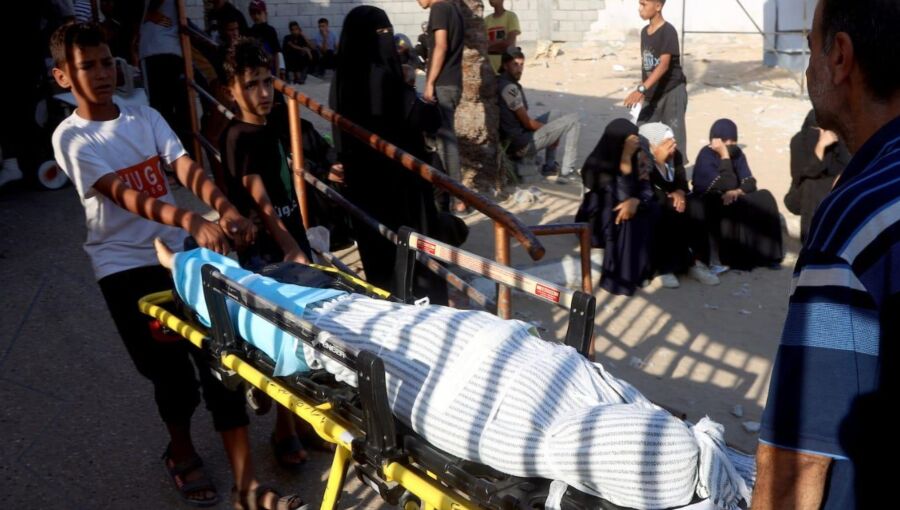
Israeli strikes killed at least two Palestinians in Gaza and destroyed medical supply warehouses next to a hospital on August 1, a day after Hamas said it had agreed to the latest stage of a deal to end the war, AFP reported, citing Gaza's civil defence agency and medical sources.
The strikes cast doubt over the durability of the US-brokered agreement, with an Israeli political source saying there would be no withdrawal of Israeli forces without what it called genuine disarmament of Hamas. Israel has repeatedly carried out strikes during the ceasefire that has technically held since October 10, 2025, and Gaza's health ministry says more than 1,200 Palestinians have been killed since it began.
An Israeli drone strike in the Sheikh Radwan neighbourhood of Gaza City killed two people, according to al-Shifa Hospital, where the casualties were taken. A separate strike in Deir al-Balah in central Gaza killed one more, hospital sources said.
The Israeli military said it was aware of a strike in the Gaza City area on what it called a Hamas terrorist, and that it had struck several areas across Gaza and dismantled five Hamas weapons storage facilities. It said one facility was next to the Al-Aqsa Martyrs Hospital and had been used as a hideout.
An overnight strike destroyed medicine warehouses attached to Al-Aqsa Martyrs Hospital in Deir al-Balah. The Palestinian health ministry said the strike had obliterated two of the four medical supply warehouses and severely damaged the other two.
"Vital quantities of medical consumables and supplies intended for the care of patients and the wounded were lost or destroyed," the ministry said.
Gaza's health ministry said seven people were killed and 76 wounded across the territory over the past 48 hours, putting the toll since the ceasefire began at 1,222. Despite the ceasefire that went into effect in Gaza on October 11, Israeli breaches of the agreement have continued, with the death toll in the Gaza Strip rising to 73,349, since the beginning of the Israeli aggression in October 2023. At least 174,162 others have also been injured.
The strikes followed Hamas's announcement on July 31 that it had agreed to a deal championed by US President Donald Trump, including provisions to hand over its weapons to a Palestinian governing committee and a gradual withdrawal of Israeli forces.
Mark Pfeifle, a former US deputy national security adviser, told Al Jazeera the strikes signalled that Israeli Prime Minister Benjamin Netanyahu was not prepared to accept the agreement in its current form.
Hamas political bureau member Bassem Naim said the ball was in Israel's court and called on mediators to press it to halt violations of the ceasefire. Restrictions on media and limited access in Gaza prevent independent verification of tolls.
How Does Hamas’ Declaration Change The Equation In Gaza? – Analysis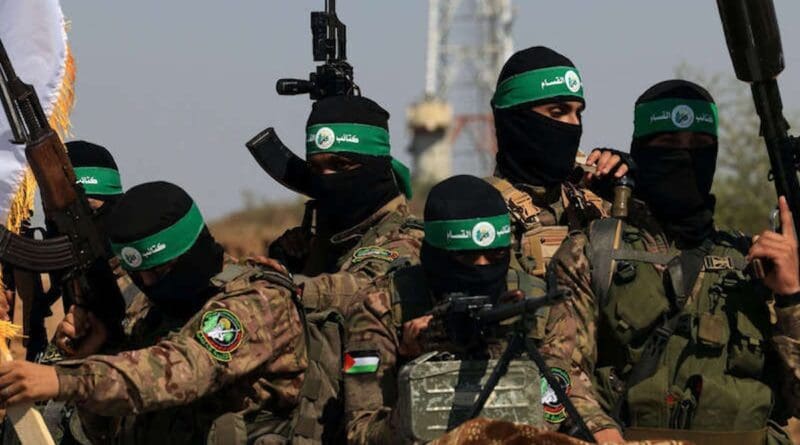
Members of Hamas. Source: Image from Hamas propaganda video
August 2, 2026
Arab News
By Tarek Ali Ahmad
Key Takeaways:
The proposal is highly conditional and linked to a U.S.-backed “Board of Peace” framework that envisions phased Israeli withdrawal, an international force, technocratic Palestinian administration, and Gaza reconstruction.
Analysts remain skeptical, noting Hamas’ history of caveats, deep mutual distrust, Israeli political constraints, and unresolved questions about verification, governance, and long-term feasibility.
For nearly four decades, Hamas has presented itself as an armed resistance movement whose military wing is inseparable from its political identity. Since its founding in 1987, the group has fought successive wars with Israel, weathered repeated military campaigns and resisted international pressure to relinquish its weapons, arguing that armed resistance remains necessary while the Israeli occupation continues.
That is why its recent declaration expressing a willingness to discuss disarmament as part of a broader political settlement has attracted global attention.
Although the proposal is heavily qualified and contingent on Israeli withdrawal, a permanent ceasefire and the establishment of a Palestinian state, it is the first time since the current war began that Hamas has publicly entertained the prospect of giving up the military capability that has defined it for decades.

Whether the statement represents a genuine strategic shift or simply another negotiating position remains fiercely debated. But it has nevertheless injected a new variable into a conflict that, until now, has largely revolved around military operations, hostage negotiations and humanitarian access.
“If the agreement announced by (President Donald Trump’s) Board of Peace is implemented, it will go a long way toward opening space for renewed diplomacy to expand Arab-Israeli integration in tandem with progress toward a Palestinian state,” Daniel Shapiro, a former US ambassador to Israel who later served as a deputy assistant secretary of defense for the Middle East, said.
“But that is a big if. Spoilers abound. Hamas has a long history of seeming to accept deals that in fact come laden with caveats. It would be in keeping with their history to walk back their apparent agreement to disarm.”
The announcement also comes amid renewed diplomatic momentum surrounding the Board of Peace to oversee implementation of a comprehensive settlement.
Under the proposed framework, Hamas’ disarmament would be synchronized with a phased Israeli withdrawal from Gaza, the deployment of an international stabilization force, the establishment of a technocratic Palestinian administration and the launch of a massive reconstruction effort.
The proposal gained fresh attention following Israeli Prime Minister Benjamin Netanyahu’s recent visit to Washington, where Gaza dominated discussions with Trump. While Trump expressed optimism that negotiations were moving in the right direction, Netanyahu has stopped short of publicly embracing the framework, reflecting the political and security divisions that continue to shape Israel’s approach to ending the war.
“The proof of the pudding is in the eating. You need to look at the details, the process and the timelines, and then see where it goes from there,” Yossi Mekelberg, professor of international relations and an associate fellow of the MENA Program at Chatham House, told Arab News.
“You also need to determine whether this is a negotiating position or a message directed not only at Israel, through a video like this, but also at Palestinian society and the people of Gaza, because they are suffering. This puts the onus on Israel and should create a little pressure on Israel.”
For much of its history, Hamas has maintained that disarmament could only occur after Palestinian national aspirations had been fulfilled. The group’s founding charter rejected Israel’s existence, although later political documents softened some of that language without abandoning armed resistance as a central principle.
Unlike the Palestine Liberation Organization, which formally recognized Israel under the Oslo Accords, Hamas continued to argue that negotiations alone could not secure Palestinian rights. Its military wing, the Izz Al-Din Al-Qassam Brigades, grew into one of the region’s most formidable non-state armed forces, developing an extensive tunnel network, manufacturing rockets and drones, and surviving multiple Israeli military campaigns.
Even previous ceasefire negotiations brokered by Egypt, Qatar and the US focused largely on temporary truces, prisoner exchanges and humanitarian arrangements. The future of Hamas’ weapons was generally considered a red line.
That appears to be changing — at least in theory. The latest proposal does not amount to an unconditional surrender. Rather, it envisages a phased process in which Hamas would relinquish its military capabilities alongside reciprocal Israeli steps.
Under the proposed framework, disarmament would proceed in parallel with Israeli military withdrawals, international monitoring, reconstruction efforts and the transfer of Gaza’s administration to a technocratic Palestinian body.
Hamas has made clear that any such process remains contingent upon guarantees of a permanent ceasefire, Israeli withdrawal and a credible political pathway toward Palestinian statehood.
Supporters of the proposal argue that it reflects a recognition that military confrontation alone cannot determine Gaza’s future. Critics counter that the conditions attached are so extensive that the declaration may ultimately prove more symbolic than substantive.
This, according to Mekelberg, “puts Israel in a position where it needs to decide how to react, especially during an election period. Israeli politicians will always say: ‘We will not accept this, and we will not accept that’.”
“But the most important thing, again, is to see whether you can create a process similar to Northern Ireland, in which the danger is reduced by putting weapons beyond use.”
He added: “This would then require Israel to justify why it continues to occupy Gaza and why it is not prepared to withdraw.
“Israel will remain skeptical because skepticism, especially before elections, serves its political purposes. But what should be done, as these initial negotiations begin, is to explore every step: security for Israel, an end to the occupation and disarmament.”
The timing is unlikely to be coincidental.
After nearly two years of devastating conflict, Gaza has suffered widespread destruction. Entire neighborhoods have been reduced to rubble, much of the enclave’s civilian infrastructure has collapsed, and humanitarian agencies continue to warn of worsening conditions for the population.
Hamas has also suffered significant military losses. Much of its senior leadership has been killed, its command structure has been repeatedly targeted, and its ability to operate openly has been severely constrained. While the group remains capable of fighting, analysts broadly agree that the battlefield has changed dramatically since the conflict began.
Regional dynamics have also shifted.
Arab governments that have consistently backed the Palestinian cause have increasingly emphasized reconstruction and governance rather than continued military confrontation. At the same time, international discussions have increasingly focused on who will ultimately govern Gaza once the fighting ends.
Those efforts gathered momentum during Netanyahu’s meetings in Washington, where the Board of Peace and Gaza’s postwar governance reportedly featured prominently. Although both Washington and regional mediators have portrayed the initiative as the most comprehensive framework yet presented, major differences remain over sequencing, security guarantees and political recognition.
These factors may collectively have altered Hamas’ strategic calculations. “Meeting Hamas’ central demands is very difficult for the negotiators. Again, everyone says that this is a tactical negotiating position. At the end of the day, the two sides do not trust each other,” Mekelberg said.
“What they need is to trust the mediators. In other words, every step must demonstrate that there is sensitivity in the process. Hamas will not volunteer to compromise. What you can do is bring the two processes together and establish areas in which each side takes an action in return for an action by the other side.”
Looking ahead, Mekelberg said: “By the time Israel has completely withdrawn, Hamas should be completely disarmed. Each stage should have contingencies. Both sides need to understand the contingencies and the consequences of non-compliance. There cannot be withdrawal without disarmament, or disarmament without withdrawal.
“It has to happen in parallel, with every step verified. Both sides must comply, and then the process can move forward.”
For Israel, however, Hamas’ declaration presents a complicated dilemma.
Successive Israeli governments have argued that the war cannot end while Hamas retains both military capability and governing authority inside Gaza. If Hamas is genuinely prepared to relinquish its weapons, one of Israel’s principle stated war aims could, at least in theory, be achieved through negotiation rather than continued military operations.
Yet skepticism inside Israel remains profound.
Israeli officials have repeatedly questioned whether Hamas would fully dismantle its military infrastructure, surrender hidden stockpiles or permanently abandon armed resistance. Even if an agreement were reached, enormous practical questions remain over verification, enforcement and long-term monitoring.
Political considerations further complicate matters. Netanyahu returned from Washington facing pressure from coalition partners who remain deeply opposed to any arrangement that links Israeli withdrawal to Hamas’ phased disarmament or leaves the group with any future political role inside Gaza. Those domestic constraints could prove as significant as the diplomatic negotiations themselves.
“Gazans may hope that Hamas turning over weapons to a Palestinian governing body will stop the daily killing of Palestinians, not only by Israel but by Hamas and other militias as well,” said Gina-Abercrombie-Winstanley, a distinguished fellow at the Atlantic Council’s Snowcroft Center for Strategy and Security.
“However, Gazans know Netanyahu well. And they know it will take sustained attention and pressure from the US and others to get and keep the Israeli leader in check.
“Netanyahu is a leader who famously defies US presidents and bragged that he was able to block a Palestinian state for decades; one who supports increased Israeli control of the Gaza Strip and who is likely to resist full compliance with this deal to protect his political future. Gazans will wait and see.”
Indeed, the implications extend well beyond Gaza itself.
The future of the territory has become intertwined with wider regional diplomacy. Arab states have argued that reconstruction requires a credible political horizon, while international donors have indicated that billions of dollars in rebuilding assistance will depend upon stable governance and durable security arrangements.
The proposal could also influence broader diplomatic efforts, including discussions surrounding regional normalization, security cooperation and renewed attempts to revive a two-state framework.
At the center of those discussions lies another unresolved question: if Hamas eventually gives up its military role, who governs Gaza?
“It should ultimately be the Palestinian community, with the support of the international community,” Mekelberg said. “At the end of the day, however, the governing structure has to be organic to Gaza.
“It must also view Gaza and the West Bank as one unit and avoid perpetuating the separation between them.
“Any initial governing arrangement should only be temporary. It must eventually be followed by elections in which both sides participate, as a first step towards a two-state solution.
“If anyone sees an interim arrangement as the final outcome, then we will not move from one stage to the next.”
The Board of Peace envisages an interim technocratic Palestinian administration operating under international supervision while reconstruction begins and new Palestinian security institutions are developed.
Longer term, however, difficult political questions remain over whether the Palestinian Authority would ultimately return to govern Gaza, whether elections could be held, and whether Hamas could evolve into a purely political movement divorced from its military wing.
Whether such scenarios are politically feasible remains uncertain.
“In principle, if this works well and Hamas then joins the international community and is allowed to contest elections, that could be possible,” Mekelberg said.
“However, I think there must be a separation from the military wing. This should also be regarded as a confidence-building measure through which the process can move forward and eventually be expanded to the West Bank.
“For this to happen, we need Palestinian elections, and we will need a completely different government in Israel.
“It is a first step — a very important step — but it is only the beginning of a long process.”
For now, the declaration raises more questions than answers.
Even if a political agreement is reached, who would supervise Hamas’ disarmament? How would compliance be verified? Would Israel accept an internationally monitored process rather than insisting on the complete military defeat of Hamas? And could the Board of Peace command sufficient trust among all parties to oversee one of the most complex post-conflict transitions in modern Middle Eastern history?
Perhaps most importantly, after decades of conflict and deep mutual mistrust, is either side politically capable of selling such an agreement to its own public?
Those questions remain unanswered.
Yet the significance of Hamas’ declaration lies less in what has already changed than in what may now be possible to discuss. For the first time since the current conflict erupted, negotiations appear to be extending beyond ceasefires and hostage exchanges toward the much larger question of Gaza’s long-term political and security future.
Whether that ultimately proves to be the beginning of a genuine political transition or another unrealized diplomatic opening will depend not on statements alone, but on the willingness of all parties to convert unprecedented rhetoric into equally unprecedented action.

About Arab News
Arab News is Saudi Arabia's first English-language newspaper. It was founded in 1975 by Hisham and Mohammed Ali Hafiz. Today, it is one of 29 publications produced by Saudi Research & Publishing Company (SRPC), a subsidiary of Saudi Research & Marketing Group (SRMG).
View all posts by Arab News →

No comments:
Post a Comment