SPACE/COSMOS
Astronomers find clear evidence that Betelgeuse star 'is not single'
Astronomers have this week unveiled the first image of an elusive companion star orbiting Betelgeuse, one of the brightest and best-known stars located in the Orion constellation.
Issued on: 02/08/2026 - RFI

The best evidence of the existence of the companion star was published in a study on Tuesday, based on observations by the European Southern Observatory's Very Large Telescope (VLT) in Chile.
"This is the conclusion of a century-long quest," lead study author Miguel Montarges, of the Paris Observatory, said in a statement.
"We have shown that Betelgeuse is not single, it is accompanied by a faint stellar companion."
Betelgeuse is a a red supergiant star, known to many as the hunter's shoulder in the Orion constellation.
Records suggest that thousands of years ago, ancient Egyptians and Indigenous Australians noticed that the star's brightness changed in regular cycles.
The reason for this flickering remained a mystery until astronomers in 2024 posited that it was caused by the crossing of a much-smaller companion star.
Betelgeuse B
Astronomers had feared that the VLT would not be able to spot the companion because it would be blinded by the light from Betelgeuse, which is 1,000 times bigger than the Sun.
The companion star – Betelgeuse B – had been thought to have only 1.5 times the Sun's mass.
"I jumped from my chair when I saw the processed images," Montarges said.
It turned out that the companion was significantly heavier than had been believed, weighing two to three times more than the Sun.

Astronomers have this week unveiled the first image of an elusive companion star orbiting Betelgeuse, one of the brightest and best-known stars located in the Orion constellation.
Issued on: 02/08/2026 - RFI
A colour composite of Betelgeuse made from exposures from the Digitized Sky Survey 2 by the European Southern Observatory.
© ESO/Digitized Sky Survey 2. Acknowledgment: Davide De Martin.
The best evidence of the existence of the companion star was published in a study on Tuesday, based on observations by the European Southern Observatory's Very Large Telescope (VLT) in Chile.
"This is the conclusion of a century-long quest," lead study author Miguel Montarges, of the Paris Observatory, said in a statement.
"We have shown that Betelgeuse is not single, it is accompanied by a faint stellar companion."
Betelgeuse is a a red supergiant star, known to many as the hunter's shoulder in the Orion constellation.
Records suggest that thousands of years ago, ancient Egyptians and Indigenous Australians noticed that the star's brightness changed in regular cycles.
The reason for this flickering remained a mystery until astronomers in 2024 posited that it was caused by the crossing of a much-smaller companion star.
Betelgeuse B
Astronomers had feared that the VLT would not be able to spot the companion because it would be blinded by the light from Betelgeuse, which is 1,000 times bigger than the Sun.
The companion star – Betelgeuse B – had been thought to have only 1.5 times the Sun's mass.
"I jumped from my chair when I saw the processed images," Montarges said.
It turned out that the companion was significantly heavier than had been believed, weighing two to three times more than the Sun.
Using ESO’s Very Large Telescope, astronomers have obtained the clearest image yet of Betelgeuse B, a star orbiting Betelgeuse.
© ESO/M. Montargès et al. Background: N. Rissinger (skysurvey.org)
The observations were taken in December 2024, when the companion star was farthest away from Betelgeuse.
However it took a long time to process and analyse the data, the results of which were published in the journal Astronomy & Astrophysics.
While more observations are needed to definitively prove the companion's existence, "there is very little space left for doubt," Montarges said.
Betelgeuse previously surprised astronomers by dramatically dimming for five months between 2019 and 2020.
Scientists first thought the change meant the star would soon die in an epic supernova explosion.
However, further observations revealed the dimming was caused by a massive amount of material ejected from the surface that created a dust cloud which blocked the star's light.
(with AFP)
The observations were taken in December 2024, when the companion star was farthest away from Betelgeuse.
However it took a long time to process and analyse the data, the results of which were published in the journal Astronomy & Astrophysics.
While more observations are needed to definitively prove the companion's existence, "there is very little space left for doubt," Montarges said.
Betelgeuse previously surprised astronomers by dramatically dimming for five months between 2019 and 2020.
Scientists first thought the change meant the star would soon die in an epic supernova explosion.
However, further observations revealed the dimming was caused by a massive amount of material ejected from the surface that created a dust cloud which blocked the star's light.
(with AFP)
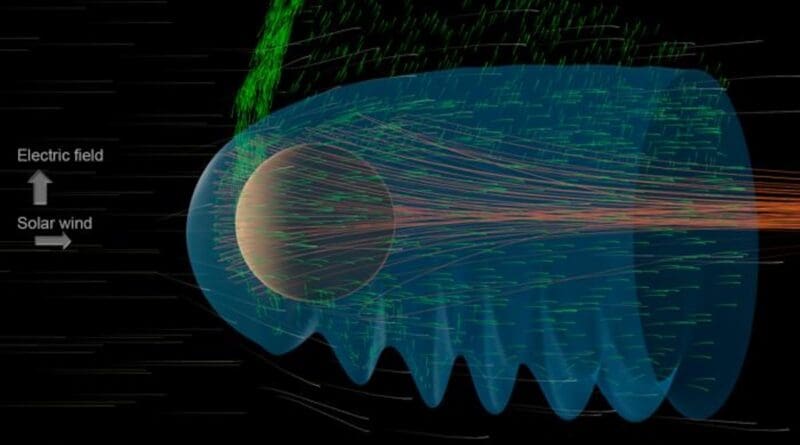
Depiction of Solar wind and electric field interacting. CREDIT: Chi Zhang, Boston University
August 1, 2026
By Eurasia Review
Key Takeaways:
Without a strong global magnetic field, Mars’ upper atmosphere is directly exposed to the solar wind, which can strip atmospheric particles into space in a process resembling wind generating waves on water.
Dual observations from MAVEN and Tianwen-1 reveal that Kelvin–Helmholtz waves stir the edge of Mars’ atmosphere, creating large plasma clouds that drive bulk escape of ions—mainly on one side of the planet depending on the solar wind electric field.
This mechanism helps explain how Mars lost much of its once-thicker atmosphere, with future studies and missions like ESCAPADE aimed at quantifying how strongly these waves contribute to atmospheric loss on Mars and similar unmagnetized planets.
Our Sun constantly releases a stream of high-speed charged particles, known as the solar wind. Unlike Earth, Mars does not have a strong global magnetic field to shield its atmosphere from this flow. As a result, the solar wind can interact directly with the upper atmosphere of Mars and gradually strip atmospheric particles into space.
A new Boston University-led study published in Science Advances found that this removal process can occur in a way that is similar to wind blowing across the surface of water. On Earth, wind can generate rolling waves and vortices on the water surface. At Mars, the solar wind can similarly “stir” the edge of the planet’s upper atmosphere and generate large boundary waves, known as Kelvin–Helmholtz waves.
First author Chi Zhang, a research scientist at BU’s Center for Space Physics, a collaboration between BU’s College of Arts & Sciences and College of Engineering, and a team of researchers used observations from both the MAVEN and Tianwen-1 missions in the study. Tianwen-1 served as a solar wind monitor, while MAVEN observed atmospheric ions escaping near Mars, allowing the researchers to directly relate real-time upstream solar wind conditions to atmospheric ion escape at Mars.
Large clouds of plasma in Mars’ upper atmosphere facilitate “bulk escape” of atmospheric ions. Zhang explained that, although several mechanisms had previously been proposed to account for the formation of these clouds, their origin remained unclear because direct observational evidence was still lacking. A major challenge in connecting the solar wind to atmospheric escape at Mars was that a single spacecraft could not simultaneously measure both the undisturbed solar wind upstream and the escaping atmospheric ions near Mars. In an earlier study published in Nature Communications, Zhang and colleagues demonstrated that simultaneous observations from MAVEN and Tianwen-1 could directly link variations in the upstream solar wind to the Martian space environment. Building on those dual-spacecraft observations, the new Science Advances study identified Kelvin–Helmholtz waves as a key mechanism driving atmospheric ion escape.
Zhang and colleagues provided clear evidence that these plasma clouds are generated by the Kelvin–Helmholtz waves. They further showed that this process does not occur evenly around the planet. “Instead, it is mainly observed on one side of the planet, depending on the direction of the solar wind electric field,” said Zhang. These results establish a direct link between the Kelvin–Helmholtz waves and enhanced atmospheric ion escape from Mars.
“Future research will focus on identifying the conditions that favor the formation and growth of Kelvin–Helmholtz waves and determining how much they contribute to atmospheric escape from Mars,” Zhang noted. Further studies will require more spacecraft observations and advanced numerical simulations. With MAVEN transitioning to the closeout stage of its mission, “its rich scientific legacy will be complemented by NASA’s ESCAPADE mission, which has already launched and will provide an important new opportunity to investigate solar-wind-driven atmospheric loss at Mars,” said Zhang.
“We want to know when these waves are most likely to form, how they evolve, and how strongly they can drive atmospheric escape,” said Chuanfei Dong, a BU Center for Space Physics faculty member and a College of Arts & Sciences assistant professor of astronomy. “This process could also occur on other planets that lack a strong magnetic field, including some exoplanets.”
“Mars is thought to have once been potentially habitable, with a thicker atmosphere and surface liquid water. Understanding how it became the cold, dry planet we see today is important for understanding how planetary environments evolve over time,” said Zhang.
Scientists Use Moonquakes To Locate Lunar Ice
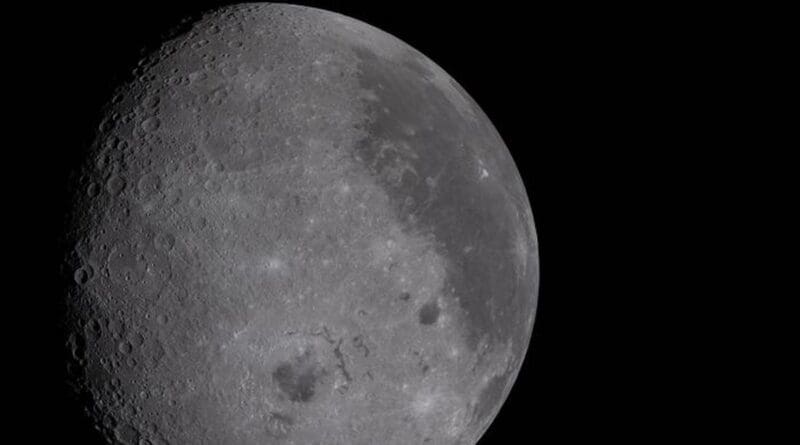
On the first shift during the lunar flyby observation period, the Artemis II crew captured more than two-thirds of the Moon showcasing the intricate features of the nearside. The 600-mile-wide impact crater, Orientale basin, lies along the transition between the near and far sides and is sometimes partly visible from Earth. The round black spot northeast of Orientale is Grimaldi crater, known for its exceptionally dark mare lava floor and heavily degraded rim. CREDIT: NASA
August 1, 2026
By Eurasia Review
Key Takeaways:
By Eurasia Review
Key Takeaways:
Seismic waves can detect and map buried water ice on the Moon because ice stiffens lunar soil, making vibrations travel two to three times faster and causing energy to bounce back.
Laboratory tests, temperature modeling of polar craters, and computer simulations of moonquakes all showed clear seismic signatures of ice, offering a practical way to locate resources for NASA’s Artemis missions and future outposts.
Laboratory tests, temperature modeling of polar craters, and computer simulations of moonquakes all showed clear seismic signatures of ice, offering a practical way to locate resources for NASA’s Artemis missions and future outposts.
Upcoming landers, including China’s Chang’e-7 (late 2026) and NASA instruments planned for 2028, will be able to test these predictions and potentially reveal ice deposits that could supply drinking water, oxygen, and rocket fuel.
Finding water on the moon may only be a matter of detecting the right vibrations.
A new study by geologists at the University of Maryland, Lawrence Berkeley National Laboratory and the University of Hawaii shows that seismic waves—the same kind of vibrations measured during earthquakes—could be used to locate and map ice buried beneath the lunar surface.
The team’s findings, published in the journal Science Advances on July 31, 2026, come at a pivotal moment. NASA’s Artemis program is targeting the moon’s south polar region for crewed landings in 2028, and water ice hidden in the deep, frozen shadows of polar craters is considered one of the most valuable resources an astronaut can find. Melted and purified, the ice can become drinking water. Split apart with electricity, the ice yields oxygen to breathe and hydrogen for rocket fuel, which means that locating a steady supply of lunar ice could dramatically reduce what future missions need to haul from Earth.
“It’s crucial to identify any materials on the moon that an astronaut can make use of while they’re up there,” said Nicholas Schmerr, an associate professor in UMD’s Department of Geological, Environmental, and Planetary Sciences and a co-author of the study. “Since they will be limited by the few resources they brought from Earth, anything they find on the moon will help them basically live off the land, especially for longer-term missions or outposts.”
Right now, no one knows exactly how much ice is on the moon or where it is. Satellites can scan the lunar surface from orbit, but they can only see the top layer of soil. Deposits of water ice may lie much deeper inside—and that’s where this new research comes in.
The idea behind the team’s work was straightforward: frozen soil and dry soil behave very differently when a seismic wave passes through them. Ice stiffens whatever it’s mixed into, making vibrations travel two to three times faster than they would through dry dirt. Ice-rich zones can also cause seismic energy to bounce back rather than pass through, much like how sounds can echo off a wall. Schmerr noted that a well-placed seismometer on the moon would be able to detect these effects.
“We can use seismic waves to not just see whether ice is present but also roughly how much of it there is,” he explained.
To test their theories, the researchers took three approaches. The study’s lead author, Harrison Lisabeth (Ph.D. ’16, geology), a rock physicist at Lawrence Berkeley National Laboratory and UMD alum, froze a volcanic rock from Arizona that when crushed, closely mimics moon dust. He then used X-rays to study how ice settles into tiny gaps between soil grains. Co-author Matthew Siegler from the University of Hawaii modeled detailed temperature maps of the moon’s south polar region, identifying which craters stayed cold enough to preserve ice for billions of years. At UMD, Schmerr ran computer simulations of small moonquakes rippling through and interacting with underground lunar ice. In every case, the ice left clear and measurable marks on the seismic data.
Beyond its practical value to astronauts, lunar ice also has scientific significance. The moon’s shadowed craters can freeze and trap volatiles like water ice, preserving them undisturbed over long timescales—and because the lunar rocks themselves date back some four billion years, studying that ice could reveal how water was delivered to the early solar system.
“The moon witnessed some of the most critical parts of the early solar system, including how water was delivered,” Schmerr said. “Studying the ice deposited there could reveal how water spread and ultimately how Earth’s oceans formed.”
The researchers won’t have to wait long to put their predictions to the test. China’s Chang’e-7 mission, which will carry a seismometer, is expected to land near Shackleton Crater in late 2026, and there are numerous suspected ice deposits in its vicinity. In 2028, NASA’s Artemis astronauts will potentially deploy the Lunar Environmental Monitoring Station, an instrument Schmerr helped develop for seismic exploration.
“Our findings are laying the groundwork for an observation we’ll get in the next couple of years,” Schmerr said. “No one has physically measured the ice on the moon.
Black Hole Feeding Frenzy Ends In Cosmic Indigestion
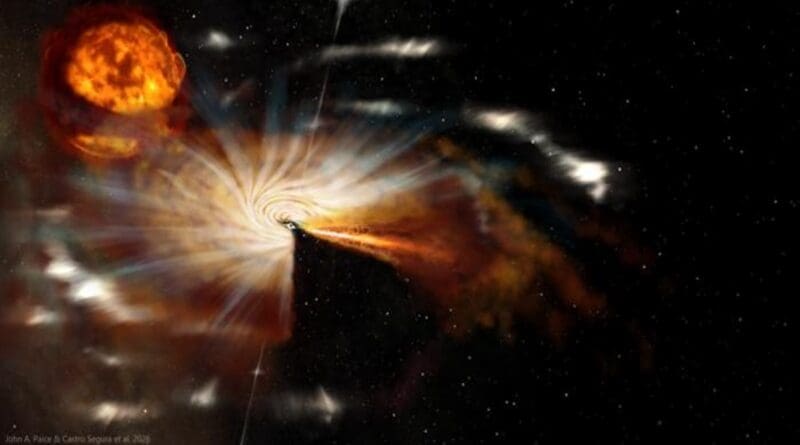
Artist impression of SwiftJ1727 with donor jet clouds. Credit: John A. Paice & Noel Castro Segura et al, ‘SwiftJ1727 - Final - No Overlay – DonorJetClouds’, (2026).
July 30, 2026
By Eurasia Review
Key Takeaways:
Black holes act more like cosmic digestive systems than bottomless pits. Observations of Swift J1727.8−1613 show that while the black hole consumes gas from a companion star, it simultaneously expels large amounts of material as jets and winds.
Powerful outflows continue even when the black hole is very faint. Dense gas was still being blown away after the system faded to just 1% of its peak activity, suggesting black holes remain inefficient eaters long after major outbursts.
The study provides one of the most detailed optical records of a black hole outburst. Using the VLT, researchers tracked the full cycle of feeding and expulsion in real time, revealing a strong link between inflowing disc material and outgoing jets/winds.
University of Warwick-led astronomers discover the cosmic digestive system of a black hole – showing that even when black holes appear faint, they’re not simply bottomless pits.
Black holes are often portrayed as cosmic gluttons that swallow everything that comes too close. But new observations of a dramatic black hole outburst – led by Warwick Postdoctoral Fellow Dr Noel Castro Segura – suggest the reality is much messier.
Using the European Southern Observatory’s Very Large Telescope (VLT), astronomers have followed the newly discovered black hole system, Swift J1727.8−1613, through a spectacular 2023 eruption.
Astronomers found that as the black hole consumed gas from a nearby star, it simultaneously launched some of that material back into space in the form of jets and winds. Critically, the massive outflows of material happen when black holes are very faint, when its activity is very low, much lower than previously thought – meaning black holes may behave less like bottomless pits and more like powerful cosmic digestive systems.
“People often imagine black holes simply swallowing everything around them,” said lead author Dr Noel Castro Segura, a Postdoctoral Fellow at the University of Warwick. “What we’re seeing is a much more complex process. Matter falls in, the system processes it, and a surprising amount is expelled again.”
The study provides one of the most detailed optical records yet of a black hole outburst, allowing researchers to watch how the system changed over time, rather than relying on a few observations. Rather than seeing a blackhole feeding from a star as a single photo, the evidence collected is throughout state changes.
Swift J1727.8−1613 was discovered when it suddenly flared into life in 2023, rapidly becoming one of the brightest X-ray sources in the sky. The system consists of a black hole pulling gas from a nearby star, creating a swirling disc of superheated material around it. During the outburst, astronomers had the opportunity to watch this feeding process unfold in real time as vents have rarely been observed in such quality.
One of the study’s most intriguing findings was that, as the black hole expelled a powerful jet, the disc feeding it also underwent significant changes. This offers a rare glimpse of the connection between matter falling towards a black hole and matter being expelled back into space.
Perhaps the most surprising result came after the black hole’s feeding frenzy had largely subsided. Even when Swift J1727 had faded to around one hundredth of its peak activity, the researchers found evidence that dense gas was still being blown away from the system.
The discovery suggests that black holes may continue driving powerful outflows long after their brightest activity has ended. In fact, the amount of material being expelled could rival the amount ultimately consumed by the black hole itself.
Reflecting on the digestive process of black holes, Dr Noel Castro Segura continued, “if black holes can continue shedding material even after their largest outbursts, it means they may be much less efficient eaters than we previously assumed. A significant fraction of the meal may never reach the black hole at all, changing our understanding of how binary stars in galaxies evolve.”
The observations add to growing evidence that black holes are not simply cosmic eaters. Instead, they appear to be dynamic systems that both consume and redistribute matter — taking material in, processing it and returning a substantial fraction to space through jets and winds.
Commenting on the research, Kyle Solomons, Doctoral Researcher at the University of Cape Town, said: “We usually gravitate towards the dramatic fireworks when a black hole outburst begins, but our observations show that the finale can be just as intense. Even as the system’s X-ray emission dropped to a fraction of its peak, it still had enough power to generate a massive expulsion of gas.”
For Swift J1727.8−1613, astronomers were able to watch that entire cycle unfold during a single outburst, providing one of the clearest views yet of how black holes feed, react, and influence their surroundings.

No comments:
Post a Comment