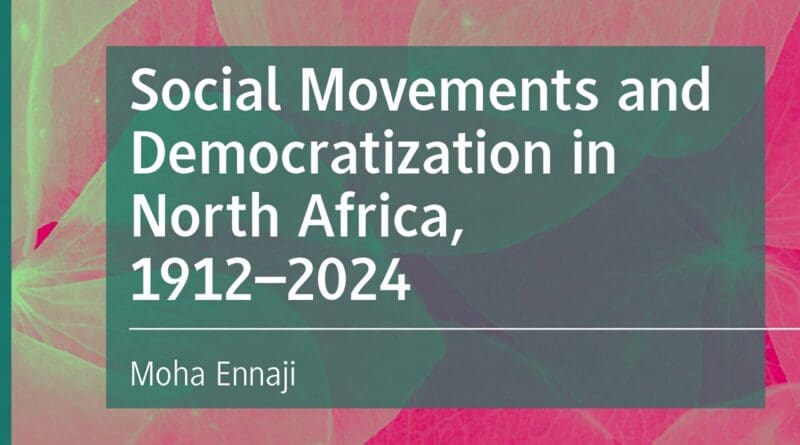
"Social Movements And Democratization In North Africa, 1912–2024," by Moha Ennaji
A Century Of Contention, Provisionally Mapped: Notes Toward A Critical Reading Of Moha Ennaji’s Social Movements And Democratization In North Africa, 1912–2024 – Book Review
July 31, 2026
By Dr. Mohamed Chtatou
Key Takeaways:
Ennaji’s book offers a rare 112-year single-authored treatment of Maghrebi social movements. Covering 1912–2024 across Morocco, Algeria, and Tunisia, it links colonial-era nationalist resistance to post-2011 youth protest in one continuous analytical frame.
The structure organizes contention into six discrete movement types. Nationalist, human-rights/democratic, women’s, Islamist, Amazigh, and youth movements each receive chapters, raising questions about whether overlaps and long-term continuities are fully theorized.
Its distinctive contribution is longue-durée depth within a narrow Maghreb focus. Unlike broader or shorter-span works (Beinin & Vairel, Hill, Mako & Moghadam), the book’s ultimate value hinges on whether it delivers a synthetic theory of change rather than a chronological sequence of separate cases.
1. An Ambitious Act of Periodization
Ennaji’s title stakes a claim before the introduction begins. Framing a study of social movements across a 112-year span—from the eve of the French and Spanish protectorates in Morocco to the aftermath of the 2011 uprisings and their long tail—signals an ambition rarely attempted in single-authored treatments of Maghrebi contentious politics (Ennaji, 2026). Most comparable works either anchor themselves to a single rupture (Beinin & Vairel, 2013, organize their volume around the 2011 uprisings and their immediate antecedents) or to a policy-relevant window such as post-independence state formation (Waltz, 1995). Ennaji’s periodization instead treats 1912 as a hinge in a continuous history of mobilization, implicitly arguing that nationalist resistance to colonial rule and twenty-first-century youth protest belong to a single analytical lineage rather than to separate historical epochs requiring separate theoretical vocabularies.
This is a defensible and productive move, and one consistent with Ennaji’s earlier work, which has repeatedly argued that questions of cultural recognition, minority rights, and democratic governance in North Africa cannot be understood synchronically but must be traced through their colonial and immediate postcolonial origins (Ennaji, 2014). It also raises the central methodological question a full review must answer: does the book sustain a single explanatory framework across this span, or does it function more as a chronological anthology of six movement-types loosely bound by shared geography? The chapter architecture—nationalist, human-rights/democratic, women’s, Islamist, Amazigh, and youth movements, organized in sequence—suggests the latter risk is real. A century-long periodization is only as strong as the connective tissue the author builds between chapters; whether Ennaji’s introduction and conclusion supply a genuine theory of change linking 1912 to 2024, or whether the unity is asserted more than demonstrated, is the single most consequential question for assessing the book’s contribution.
2. The Architecture of Six Movements
The publisher’s description confirms eight chapters organized around six movement categories—nationalist, democratic/human-rights, women’s, Islamist, Amazigh (Berber), and youth—bookended by an introduction and conclusion, with confirmed chapter titles including “The Nationalist Movements” (Ennaji, 2026, Chapter 2), “The Islamist Movements” (Ennaji, 2026, Chapter 4), and “The Youth Movements,” appearing later in the sequence (Ennaji, 2026, Chapter 7). The book states its intention to trace how nationalism, language, religion, gender, and socioeconomic inequality each generate distinct mobilizational logics, while arguing more broadly that uneven development, political exclusion, and identity-based discourse continue to structure contention across the region (Morocco World News, 2026).
Two structural questions follow directly from this design, and both are answerable only once the chapters themselves are in hand. First, category boundaries in social movement scholarship are rarely as clean as a table of contents implies: Amazigh activism in Morocco has been substantially carried by women (Sadiqi, 2014), and youth mobilization after 2011 drew heavily on human-rights and constitutional-reform vocabularies inherited from earlier democracy movements (Beinin & Vairel, 2013). A chapter structure organized by discrete movement-type risks reproducing these movements as more separable than they were on the ground, artificially partitioning what were often overlapping coalitions and shared repertoires of contention. Whether Ennaji’s chapters acknowledge and theorize this overlap—rather than simply noting it in passing—will be decisive for judging the book’s analytical rigor.
Second, the relative textual weight given to each movement-type is itself an argument, even before a single claim is stated. A comparative reviewer will want to know, once pagination is available, whether the space allotted to the Amazigh movement matches its billing in the publisher’s own framing—which lists it alongside women’s, Islamist, human-rights, and youth movements as receiving “particular attention”—or whether, as has occurred in other single-authored regional surveys, the chapter functions as a coda rather than a full analytical unit comparable to the treatment given Islamist or nationalist movements. Given Ennaji’s own substantial prior corpus on Amazigh cultural and political questions, this is a natural point of continuity to verify rather than assume.
3. Positioning Within the Field
Ennaji’s book enters a crowded but unevenly distributed literature. Beinin and Vairel’s edited volume (2013) remains the most influential theoretical intervention on MENA social movements, explicitly challenging classical social-movement-theory concepts—political opportunity structures, framing, mobilizing structures, repertoires of contention—as insufficiently attentive to authoritarian contexts, and doing so through country case studies rather than a single connected narrative. Hill’s Democratisation in the Maghreb (2016) takes the opposite structural approach to Ennaji’s: a state-centered account of regime type and transition trajectories in Algeria, Libya, Morocco, and Tunisia, with social movements treated largely as inputs to elite bargaining rather than as the primary unit of analysis—a book Ennaji has himself reviewed and implicitly positioned his own work against (Ennaji, 2017). Mako and Moghadam’s After the Arab Uprisings (2021) offers the most recent comparative synthesis, organized around four explanatory variables—state and institutions, civil society, gender and women’s mobilization, and international influence—applied across a wider MENA case set including Egypt, Tunisia, Libya, Syria, and Yemen.
Against this backdrop, Ennaji’s contribution is distinctive on two axes rather than one. First, its three-country scope—Morocco, Algeria, and Tunisia, explicitly excluding Libya, Mauritania, and the broader Sahel—narrows the comparative frame relative to Mako and Moghadam or Beinin and Vairel, trading breadth for depth within the Maghreb proper. Second, its 112-year time depth is genuinely without close precedent among these comparators, all of which begin their empirical analysis at or after mid-twentieth-century independence movements at the earliest, and typically in the 1990s or 2000s. The claimed contribution, then, is not that North African social movements are unstudied—Ennaji’s own long publication record on the region’s minorities, women, and multiculturalism attests otherwise (Ennaji, 2014)—but that the region’s contentious politics have not previously been assembled into a single longue-durée narrative spanning colonial nationalism through post-Arab Spring youth mobilization within one authored volume.
Whether this trade-off—depth and duration purchased at the cost of comparative breadth—is vindicated by the analysis depends on execution the reviewer cannot yet assess: does the book’s three-country focus generate genuinely comparative insight into why Tunisian, Algerian, and Moroccan trajectories diverged despite shared colonial and Arab-Islamic inheritances, or does it default to a country-by-country compilation within each chapter, with comparison asserted in the introduction and conclusion but not sustained in the analytical chapters themselves? This is precisely the kind of question that separates a genuinely comparative-historical contribution from a well-organized descriptive survey, and it cannot be settled from the paratext alone.
4. Design Choices That Invite Scrutiny
Several choices visible even from the outside merit flagging as lines of inquiry for the full review, rather than as conclusions.
The exclusion of Libya and Mauritania. A book that takes “North Africa” as its geographic frame while restricting itself to Morocco, Algeria, and Tunisia implicitly defines the Maghreb around its most institutionally continuous states, bracketing the cases—Libya’s state collapse, Mauritania’s distinct Sahelian-Arab hybridity—that might complicate a narrative organized around gradual, uneven democratization. This is a legitimate scoping decision common to much of the literature (Hill, 2016, makes a similar choice extending only marginally further), but it should be justified rather than left as an unstated convention, since the excluded cases are precisely the ones that test whether “North Africa” functions as a coherent unit of analysis or as a geographic label imposed on divergent trajectories.
“Movement” as the unit of analysis. Organizing chapters by movement-type (nationalist, Islamist, women’s, etc.) rather than by country or by mechanism (framing, resource mobilization, repression) commits the book to treating movements as relatively bounded, coherent actors persisting across decades. This is a stronger claim than it may appear: does Morocco’s Amazigh movement of the 1990s share enough organizational and ideological continuity with earlier Berber cultural associations of the 1960s to be narrated as a single movement, or is continuity itself part of what needs to be demonstrated rather than assumed by the chapter structure? Scholars working from a political-process framework, including contributors to Beinin and Vairel (2013), have generally been more cautious about movement coherence over multi-decade spans, treating organizational continuity as an empirical question rather than a structuring premise.
The state/civil-society framing. The publisher’s abstract commits the book to examining the roles of the state and civil society in enhancing civil rights and democracy, a formulation that presumes civil society’s function is fundamentally enhancing rather than, at times, co-opted, instrumentalized, or channeled by the state into managed rather than genuine liberalization—a dynamic well documented for Morocco’s associative sector specifically (Beinin & Vairel, 2013, describe Moroccan civil society as frequently serving as a field for professionalized activists to increase the value of their credentials as much as a vehicle of popular mobilization). Whether Ennaji’s chapters interrogate this ambiguity or adopt a more linear civil-society-builds-democracy logic will materially affect how the book’s normative stakes should be read.
5. What a Complete Review Must Still Establish
Four questions define the agenda for the fuller, chapter-engaged treatment this essay is meant to precede.
First, does the introduction articulate an explicit theoretical framework—whether political process theory, resource mobilization, framing analysis, or a synthetic alternative—robust enough to carry the analysis across six movement-types and eleven decades, or does the book’s theoretical commitment remain largely implicit, asserted through case selection rather than argued through method?
Second, how does each chapter handle the three-country comparison internally? A chapter that proceeds Morocco-then-Algeria-then-Tunisia in sequence, with a closing paragraph noting similarities and differences, performs a different kind of comparative work than one organized thematically across the three cases throughout.
Third, what primary and secondary sourcing underlies the historical chapters, particularly the earliest material (1912–1956), where the historiography on nationalist mobilization is uneven in quality and often shaped by the nationalist movements’ own retrospective self-narration—a methodological hazard familiar from Maghrebi historiography more broadly.
Fourth, and most consequentially: does the concluding chapter return to the century-long arc promised by the title and demonstrate a cumulative argument—a theory of how nationalist mobilization structurally enabled or constrained the women’s, Amazigh, and youth movements that followed—or does it summarize six chapters without fully synthesizing them into a single argument about the relationship between social movements and democratization in North Africa over time?
6. Provisional Assessment
On the evidence available before reading the manuscript, Ennaji’s Social Movements and Democratization in North Africa, 1912–2024 is best understood as a considered attempt to give the Maghreb’s contentious politics the kind of longue-durée, single-authored treatment that Middle Eastern and North African social-movement scholarship has generally reserved for edited, multi-contributor volumes (Beinin & Vairel, 2013) or narrower state-centered comparative studies (Hill, 2016; Mako & Moghadam, 2021). The ambition is genuine and the gap it targets is real: no existing English-language monograph attempts quite this span for quite this set of movements. Whether the book fully delivers a synthetic argument commensurate with that ambition—rather than a well-organized sequence of six strong but discretely bounded chapters—is the question on which its ultimate contribution will turn, and it is a question this reviewer looks forward to answering once the full manuscript is in hand.
References
Beinin, J., & Vairel, F. (Eds.). (2013). Social movements, mobilization, and contestation in the Middle East and North Africa (2nd ed.). Stanford University Press.
Ennaji, M. (2014). Multiculturalism and democracy in North Africa: Aftermath of the Arab Spring. Routledge.
Ennaji, M. (2017). [Review of the book Democratisation in the Maghreb, by J. N. C. Hill]. Review of Middle East Studies.
Ennaji, M. (2026). Social movements and democratization in North Africa, 1912–2024. Palgrave Macmillan.
Hill, J. N. C. (2016). Democratisation in the Maghreb. Edinburgh University Press.
Mako, S., & Moghadam, V. M. (2021). After the Arab uprisings: Progress and stagnation in the Middle East and North Africa. Cambridge University Press.
Sadiqi, F. (2014). Moroccan feminist discourses. Palgrave Macmillan.
Waltz, S. (1995). Human rights and reform: Changing the face of North African politics. University of California Press.
About Dr. Mohamed Chtatou
Dr. Mohamed Chtatou is a Professor of education science at the university in Rabat. He is currently a political analyst with Moroccan, Gulf, French, Italian and British media on politics and culture in the Middle East, Islam and Islamism as well as terrorism. He is, also, a specialist on political Islam in the MENA region with interest in the roots of terrorism and religious extremism.
View all posts by Dr. Mohamed Chtatou →