Monday, August 10, 2026


Iran Has Changed Question. Washington Has no Answer


Vijay Prashad |


For decades, the US and the institutions it dominates, exercised a powerful privilege: they determined the question that countries in the Middle East were required to answer.

For more than three decades, the United States has treated Middle Eastern diplomacy as an exercise in writing the terms for others. Iran’s emerging regional strategy is challenging that privilege. The immediate evidence is emerging in the Strait of Hormuz. Iran and Oman are negotiating an arrangement under which Tehran could oversee vessels entering the Gulf while Muscat manages outbound traffic. The proposal remains unsettled, but it represents something larger than a maritime agreement: Iran is attempting to move the diplomatic agenda away from the narrow question of its nuclear compliance and towards the wider architecture of Gulf security.

Since the end of the Cold War, US diplomacy in the Middle East has often begun with a conclusion: Washington defines the crisis, identifies the acceptable parties, and sets the boundaries of the eventual settlement. Negotiation then becomes less a discussion over the political order than a process through which weaker states are asked to accept it. The agreements produced under this system were not literally surrender documents. Yet they frequently carried the political logic of surrender: one side retained the power to decide what counted as compliance, while the other was required to prove its fitness for economic relief, political recognition or limited self-rule.

Iraq and Palestine

Iraq was the starkest example. After the 1991 Gulf War, comprehensive sanctions devastated an already battered society. The United Nations’ Oil-for-Food Programme, established by Security Council Resolution 986 in 1995, permitted Iraq to sell limited quantities of oil while the proceeds passed through a UN-controlled escrow system to pay for humanitarian goods. It was presented as relief, but its deeper message was unmistakable: Iraq could access its own principal resource only within a structure designed and supervised from outside. Sovereignty had become conditional and punishment – including punctual bombardment by the United States – became commonplace.

The Oslo process operated differently, but it reflected a similar imbalance. The 1993 Declaration of Principles was negotiated directly by Israelis and Palestinians through a Norwegian channel and signed in Washington. It brought mutual recognition and created Palestinian interim institutions, but the arrangement postponed the decisive questions (statehood, borders, Jerusalem, refugees and settlements) while leaving the occupying party in control of territory and facts on the ground. Washington sponsored a ‘peace process’ without correcting the asymmetry that made a just peace so elusive. Israel’s occupation of East Jerusalem, Gaza, and the West Bank became structurally permanent.

In both cases, the United States and the institutions it dominated, exercised a powerful privilege: they determined the question everyone else was required to answer.

Iran

With Iran, that question has for more than two decades been the nuclear weapons file. Concern did not begin in 2005 (the International Atomic Energy Agency’s chronology traces intensive engagement to 2002 and 2003) but the confrontation hardened after 2005, as Iran resumed nuclear energy related uranium-conversion activity and the dispute moved toward the UN Security Council. Iran’s leadership said that it was uninterested in nuclear weapons but was ignored. From then on, almost every discussion of Iran was organised around enrichment levels, centrifuges, inspections, breakout time, and sanctions relief. The framing of Iran’s nuclear energy programme as a nuclear proliferation issue was politically convenient for Washington. It reduced a broad struggle over Israel’s nuclear weapons programme, US military bases, sanctions, and maritime control to a test of Iranian compliance. The United States could maintain an enormous military footprint across the Gulf while presenting Iran’s capabilities as the singular source of instability.

Iran is now attempting to invert that debate. Through diplomacy involving Oman, Pakistan, and other regional states, Tehran’s position is that the nuclear issue cannot be separated from the architecture of regional security. The question is no longer simply what limits Iran will accept, but it is also what limits should apply to the military presence and coercive power of the United States and its allies. This is why the issue of US bases in the Gulf matters. For Washington, those installations are infrastructure that protects allies, energy supplies, and navigation. From Tehran’s perspective, they are the forward positions of a power capable of attacking Iran while remaining insulated from retaliation at home. Iran’s argument is that no durable settlement can demand permanent restraint from Tehran while treating the military posture of the United States in West Asia as beyond negotiation.

The emerging discussion over the Strait of Hormuz makes this reversal concrete. Iran and Oman have reported progress on a new arrangement for maritime traffic through the waterway. According to accounts of the proposal, Iran would oversee inbound traffic to the Gulf and Oman the outbound lane, with some form of payment for security or environmental services still under dispute. The plan is not final, and Washington opposes any arrangement that compromises free passage or gives Tehran control over its own territorial waters. Even so, the political significance of this arrangement that is being discussed is considerable.

For decades, the United States has long cast itself as the ultimate guarantor of Gulf navigation. The Iran-Oman talks suggest an alternative principle: the states that border a strategic waterway can construct its operating order themselves. That possibility also exposes a contradiction in sanctions policy. If commercial vessels must enter the Gulf through a lane administered by Iran, shipowners, insurers, and banks will need to know whether required Iranian services, data systems or fees trigger US restrictions. Merely sailing through Iranian territorial waters would not automatically violate every US sanction. The legal problem would arise not from passage alone, but from payments to Iranian entities, the use of sanctioned service providers, insurance exposure, and the processing of vessel data through an Iranian-administered mechanism. But a functioning Iranian-administered system could force Washington to issue licences, tolerate narrowly defined transactions or risk obstructing the commerce it says it is protecting. Sanctions would no longer be an instrument applied in a political vacuum; they would collide with the practical requirements of maritime passage. What this means for the broader US sanctions policy will become clearer only afterwards for insurers and shipping companies.

The wider regional picture reinforces Iran’s argument. The 2023 reconciliation between Iran and Saudi Arabia, brokered by China after earlier talks hosted by Iraq and Oman, restored diplomatic relations between the Gulf’s two main rivals. It did not settle their competition or erase their conflicts. But it demonstrated that de-escalation could be produced by regional bargaining and non-Western mediation (in this case, substantially, by China) rather than a US bombing campaign.

Pakistan’s mediation and the growing security dialogue among Saudi Arabia, Turkey, and Pakistan point in the same direction, although they should not be mistaken for an Iranian-led bloc. These states have their own interests and, at times, deep suspicions of Tehran. Their significance lies elsewhere: regional governments are experimenting with overlapping arrangements in which Washington is no longer the sole convenor, guarantor, or author. US military action has repeatedly promised deterrence while producing escalation, displacement, and new grievances. Bombardment can destroy facilities and commanders, but it cannot create a legitimate regional order. Nor can a system be stable when one state (Israel) has undeclared nuclear weapons, continues to occupy a people and conduct a genocide against them (the Palestinians), and feels emboldened to attack its neighbours (Lebanon, Iran, Syria) whenever it wishes.

The Real Questions

The real challenge Iran has placed before Washington is therefore conceptual. Who defines the agenda? Who decides which weapons, bases, and alliances are destabilising? Who controls the waterways through which the region’s wealth passes? And must every settlement be guaranteed from outside, or can regional powers (with all their rivalries) build enforceable arrangements among themselves?

The next Middle Eastern settlement will not be durable if it resembles a surrender document. It will have to address nuclear restraint, foreign military deployments, maritime access, sanctions, missiles, and mutual non-aggression as parts of one security problem. Iran’s achievement is not that it has solved that problem. It is that, after decades of being forced to answer Washington’s question, it has compelled the region to consider a different one. The issue is no longer only what Iran must surrender. It is what every power (including the United States) must be prepared to negotiate.

Vijay Prashad is an Indian historian and journalist. He is the executive director of Tricontinental: Institute for Social Research, the chief correspondent for Globetrotter, and the chief editor of LeftWord Books (New Delhi).

This article was produced by Globetrotter.

Courtesy: Breakthrough News


We need a biblical view of American history

(RNS) — A nationalism that ignores the failings of leaders and people is not biblical.
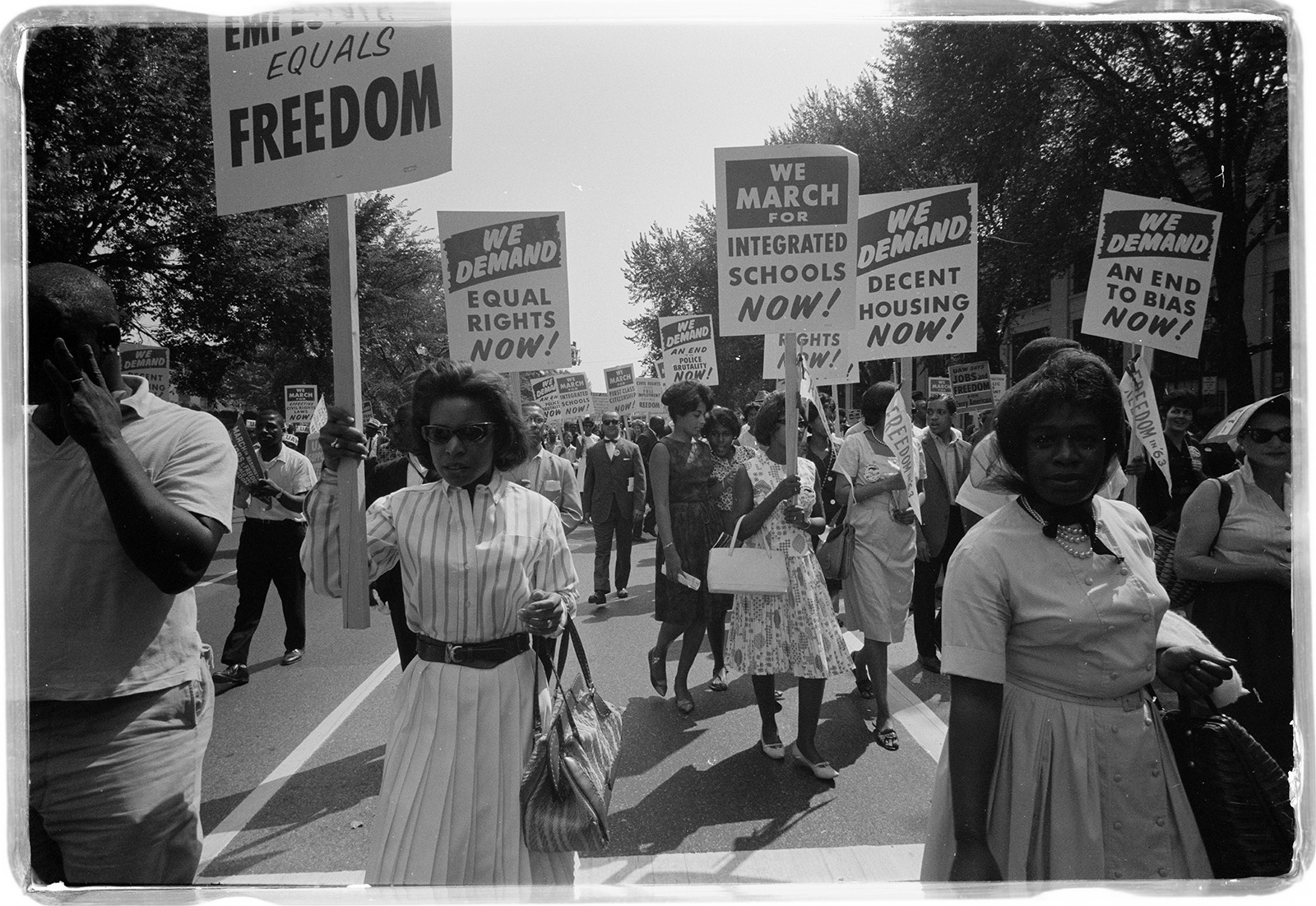
People demonstrate for racial justice on Aug. 28, 1963, in the historic March on Washington for Jobs and Freedom in Washington, D.C. (Photo by Warren K. Leffler/LOC/Creative Commons)


(RNS) — As students prepare to return to school, parents, teachers and politicians are arguing over the teaching of American history.

On one side are those who feel students should learn only the positive things about our nation. Those who push a positive presentation of our history believe that it promotes patriotism and love of country. Students who take pride in their country become good citizens, good workers and good soldiers. Inculcating students with a positive view of history promotes harmony and protects the status quo. Those who sacrifice themselves for the nation are considered heroes. Stress on the negative, in this view, breeds cynicism, disrespect for authority and civil unrest.


Traditionally, emphasizing the positive has been the pattern in national histories all over the world. A unified common story unites people of various economic, social, ethnic and religious backgrounds. Public schools are used not only to spread literacy but also to unite people in a common understanding of who they are.

In this approach to teaching history, every nation sees itself as exceptional, as better and more blessed than any other. Leaders are presented as always doing what is best for the country. In its worse form, such an approach casts others as enemies who threaten the country’s very existence.

This positive framing of history has been undermined in modern times by a scientific approach to history that stressed historical facts over national myths. Even the Catholic Church had to face this reality as historians wrote the truth about popes.

Revolutionaries also criticized the traditional approach to history where it supported a status quo that kept the rich in power and the common people complacent and subservient. And the nationalism promoted by traditional histories was seen as supporting wars that bled the citizenry and fed the military industrial complex.

American flags fill a field. (Photo by Jean Beaufort/Creative Commons)

In America, the traditional approach to history lasted through the Second World War as the country was united to fight fascism. After the war, the country was united against godless Communism.

The national myth was broken by the Vietnam War. America could no longer be portrayed as all powerful. Leaders were not all wise. Soldiers were killed and wounded in a war that we lost. Political and military leaders lied to the public. Subsequent wars in Iraq, Afghanistan and Iran followed the same pattern. On top of that we had Watergate and other scandals.

No historian could with a straight face present American history as the triumph of an intelligent and good people.

Slavery and the Jim Crow era could no longer be ignored. Genocide against Indigenous peoples was exposed. Corruption and graft in politics became part of the story. Sexism and racism were recognized to be interwoven in every chapter.

But if teachers only offer a negative view of American history, the result is cynical students who come out of school with no hope or idealism.

History also needs to include stories of Americans who struggled against racism, sexism and economic exploitation. These new heroes might be flawed but they could be admired for fighting for ideals we could cherish. This approach to history can present America as an unfinished project to which the students are invited to contribute.

The Bible is not a bad guide for thinking about American history.

The Bible does not gloss over the sins and failings of Jewish kings and leaders. They worshipped false gods, exploited the poor and got into stupid wars. Joseph’s brothers sold him into slavery. David had one of his generals killed because he wanted his wife. Even Abraham, out of fear, allowed the pharaoh to have sex with his wife, Sarah. And Moses so disappointed God that he was not allowed to enter the promised land.


The prophetic books of the Bible are filled with social criticism, with attacks on political and religious leaders. And the New Testament does not hide the failings of Peter and the Apostles.

The Bible teaches us not to put our leaders on pedestals, free from criticism. A nationalism that ignores the failings of leaders and people is not biblical. Only God is perfect, holy and just.


‘We garden on our knees’: Kew Theology & Gardening project explores faith, nature and climate

(RNS) — In a corner of west London, an Anglican church is using its proximity to one of the most famous botanical gardens in the world, Kew Gardens, as a reason for a new venture linking theology and nature.
Visitors view flowers in front of the Palm House at Kew Gardens in London. (Photo by Daniel Case/Wikiimedia/Creative Commons)


(RNS) — From the Garden of Eden to the Garden of Gethsemane, where Mary Magdalene mistook the risen Christ for a gardener, cultivated green spaces have long held a special place in Christianity. 

Now, in a corner of west London, an Anglican church is using its proximity to one of the most famous botanical gardens in the world, Kew Gardens, as a reason for a new venture linking theology and nature. St Anne’s Church launched a new charity, Kew Theology & Gardening, to help deepen people’s connection with nature, develop theology of the environment and explore climate change.  

The project started small in 2024 with talks for the local community but has since expanded to holding retreats, partly held in Kew Gardens and partly in St Anne’s. Now the charity is hosting major lectures.  

The most significant so far will be held this September, when Carmody Grey, professor of integral ecology at Radboud University in the Netherlands and a visiting professor at the London School of Economics, will talk on Sept. 30 on “What Are We Here For? Gardening and the Human Vocation” in the garden’s lecture theater. 

A previous lecture was given by the then-director of gardens at Kew, Richard Barley, while another future lecture will be given by environmental biologist Martin J. Hodson, a visiting researcher at Oxford Brookes University.  


Vicar Giles Fraser. (Photo courtesy of St. Anne’s)

“In Britain gardening is just about the most popular activity there is,” said St Anne’s vicar, Giles Fraser. “People spend so much time with their hands in the soil. It’s how they connect with creation — and the story of creation began in a garden.

“We garden on our knees, we pray on our knees. That’s the image I had in my mind when this started,” he added. 

Fraser, who is well-known as a broadcaster in Britain and has just completed a series on church-going for BBC radio, said that his parish was keen to find more ways to connect with its neighbor, Kew Gardens, which is known throughout the world for its research and attracts millions of visitors every year. The connection between St. Anne’s and the gardens, the parish believes, will help people reflect not only on creation but on the environment and threats to it, such as climate change.   

The Kew Theology & Gardening project comes at a time when the Church of England is increasing its work on environmental matters. In July, the church published a major teaching document on care for creation called “Hope for All Creation: A Theological Response to the Environmental Crises.”

The document argues that care for creation is not an option but a core part of Christian belief and mission. It sees environmental action as an expression of hope and roots care for the planet in the biblical story of creation, redemption and renewal, structured around the themes “See, Reflect, Respond.”  

In their forward to the document, the Archbishop of Canterbury, Sarah Mullally, and the Archbishop of York, Stephen Cottrell, say that “we inhabit a world groaning with the growing impact of the climate and environmental crises. Their scale is daunting, and the devastation and suffering they bring — to which more and more people are increasingly vulnerable, especially those in poverty — are growing in scale and intensity. We can feel powerless and overwhelmed in the face of these things and our fears for the future.” But they also write, “To care for creation in partnership with others, to show solidarity with the vulnerable, to be prophetic in speech and action on these issues — locally, nationally and globally — is to live out this faith and hope. It is an essential part of following Jesus and sharing the Gospel today.” 

St. Anne’s Church on Kew Green in London. (Photo courtesy of St. Anne’s)

The Church of England’s General Synod has also just given approval to a new annual Festival of Creation in Christ to be celebrated in Church of England churches on the first Sunday of September — traditionally a time when churches mark the harvest season, reminding people of both their responsibility for stewarding the earth and to express thankfulness for God’s abundance.

According to Grey, who is preparing her Kew lecture, humanity has two vocations that can be expressed in biblical terms, to be fruitful and multiply and to till and keep — both of which can be expressed through gardening.   

“Tilling and keeping and fruitfulness are defining marks of the human life and so are at the core of theological anthropology,” she said. “We have sometimes made too great a difference between beauty and utility, but these two aspects of life show how they are connected. We have children partly for survival but also as an expression of joy. The same is true of gardening — they overlap.” 

Grey also expressed concern that people do not appreciate the importance of plant life enough, citing the example of people being shown a photo of animals in a landscape. When asked to point out life in the photo, they almost always indicate the animals, and when shown a photo of a landscape, they almost always say there is nothing there.  

“The Bible highlights the importance of all life, including plant life, and the imagery of the tree is a key focus of the Bible,” she said.  


People view The Hive art installation at Kew Gardens in London. The Hive is visited by Stations of the Trees pilgrims. (Photo by David Smith/Wikimedia/Creative Commons)

Kew Theology & Gardening has devised a walk called Stations of the Trees, based on the Christian devotion of Stations of the Cross, with each station or stopping point in the gardens focusing on a particular aspect of the environmental crisis.  

Among the stations is the carbon garden, focusing on the importance of carbon and problems associated with excessive carbon; boards highlighting Kew’s role in collecting seeds, with a reflection on the parable of the sower; and the rose garden, where prayers reminding pilgrims of the rosary are offered to Mary. Also included is a visit to olive trees, representing the Garden of Gethsemane, where Christ prayed with foreboding before he was arrested while his disciples slept. Pilgrims are urged to wake up and are given a prayer to say:  

On our watch, we reap what we have sown, on our watch, sea levels rise. On our watch forests destroyed, and so now with tears in our eyes we look to you, with regret, with repentance. Knowing the difficult decades that we face, as temperatures rise, as extinctions increase, as we come to terms with our existential plight. 

Kew Gardens has backed the Kew Theology & Gardening project. A spokeswoman said: “We are always happy that local communities are encouraging people to think about plants and the planet.” 

Kew Gardens and St. Anne’s Church also have historical connections. The Gardens were enriched by George III in the late 18th century, after his mother, Augusta, princess of Wales, expanded the exotic gardens at Kew, and the park was adopted as a national botanic garden in 1840. George III also paid for St. Anne’s Church to be expanded around 1770 and commissioned a private gallery for the royal family to be used when they were in residence at Kew Palace. Several botanist curators of Kew were buried at the church, including Sir Joseph Dalton Hooker, director of the gardens, who, with his Kew colleague George Bentham, created the major modern form of plant classification in the 19th century.  


Why is India Supplying Arms to a Genocidal Regime?


Prabhat Patnaik |


Between October 7, 2023 and November 30, 2025, India made at least 2,596 shipments of small arms, ammunition and military vehicle components to Israel for such aggressive purposes, as per Amnesty’s report.


Amnesty International has just published an investigative report titled, Made in India: The Supply of Weapons and Ammunition to Israel, in which it details India’s arms supplies to Israel at a time when that country was perpetrating a genocide in Gaza. Amnesty International carefully excluded from its purview all shipments carrying items for civilian use; likewise, it even excluded weapons and ammunition that are likely to be used as part of anti-missile defence technology that defends civilians from indiscriminate attacks. In other words, it was careful to focus exclusively on arms shipments from India that would be used for aggressive ends by Israel.

According to this report, between October 7, 2023 and November 30, 2025, India made at least 2,596 shipments of small arms, ammunition and military vehicle components to Israel for such aggressive purposes. Among the articles supplied were 564,970 parts of explosive ordnance (such as 155 mm high explosive artillery shells and drone warheads), 390, 516 military grade small arms parts, and 298 military vehicle components.

There can be no doubt whatsoever that these weapons and ammunition were actually used by Israel in Gaza. In fact, missile fragments labelled “Made in India” were found in a UN-run school in Nuseirat in Gaza sheltering displaced Palestinians, after an Israeli raid on it that killed 33 persons. By supplying arms to Israel which many advanced countries like Spain and Canada have refused to supply, when it is engaged in carrying out genocide, India is becoming complicit in genocide. Spain, in fact, had even denied entry in May 2024 into the Spanish port of Cartagena, to a vessel named Marianne Danica that was carrying 27 tonnes of explosives from Chennai to Israel.

Among the arms suppliers from India are not just private sector firms, including, above all, Adani Defence and Aerospace that has joint ventures with Israeli arms manufacturers like Elbit Systems and Israel Weapon Industries, but also several government-owned firms.

It is significant that the government of India has not responded to the report by Amnesty International. A Ministry of External affairs spokesman was quizzed about it while he was briefing presspersons about something else, and he just breezily asserted, without going into any details, that India’s trade relations with Israel were in total conformity with international law.

Now, this is an absurd assertion for two obvious reasons. First, even if this was correct, it does not absolve India from the moral responsibility of being complicit in the mass slaughter of thousands of Palestinians in the Gaza strip. After all countries, like Spain or Canada, have not ceased supplying arms to Israel only because they fear that doing so would be an illegal act. So, legality cannot be, and has never been, the sole determining factor in a country’s decision-making when the matter concerns the lives of thousands of innocent civilians. This point is specifically pertinent in the case of India which has been always until recent years, a beacon against inhuman acts of oppression against the people of the Third World, and which has always been in the forefront of opposition to such acts.

Second, India is also culpable even in legal terms, for the mass slaughter of Palestinians that Israel has carried out and is still in the process of carrying out, can be legally called genocide; and under the Genocide Convention, complicity with genocide by any state that is a signatory to it is a punishable act.

The Genocide Convention came into being on December 9, 1948, through a decision of the UN General Assembly. India signed the Genocide Convention on November 29, 1949, and formally ratified it on August 27, 1959. Not only is complicity in genocide punishable under it, but signatory countries are enjoined that they “must prevent and punish acts of genocide in both peace and war time”.

Of course, the government of India would hide behind the fig-leaf that Israeli actions in Gaza have not yet been legally declared as genocide; but this excuse simply would not do. South Africa had approached the International Court of Justice in December 29, 2023, with the plea that Israel’s actions in Gaza be declared as a genocide, for which the South African foreign minister and her family had received threats and online intimidation at the time. Subsequently, nearly 20 other countries, including Brazil, Spain and Mexico, intervened in support of South Africa, while only three countries, the United States, Hungary (under the neo-fascist Victor Orban who has since been defeated in elections) and Fiji have publicly opposed South Africa.

The ICJ has not given its final ruling (which in any case takes years) but has ordered legally-binding provisional measures to prevent genocidal acts and to allow humanitarian aid. The fact that Indian arms were used by Israel in the massacre of 33 Palestinians taking refuge in a school at Nuseirat, which constitutes a genocidal act in violation of the ICJ’s provisional directive, would make India legally culpable for complicity in genocide. The Indian government’s stand, therefore, is not just morally reprehensible; it cannot even stand legal scrutiny.

But that is not all. Two UN bodies, the UN Special Committee to Investigate Israeli Practices which submitted its report in November 2024, and the International Commission of Inquiry on the Occupied Palestinian Territories set up by the UN, which submitted its report on September 16, 2025, have come to the conclusion that Israel has committed genocide in Gaza.

The Special Committee accused Israel of using deliberate starvation as a weapon of war against the Palestinian population of Gaza, which, incidentally would violate the ICJ’s provisional directive on allowing humanitarian aid to the besieged population. The International Commission not only listed mass killings which amounted to genocidal acts, but concluded that the top Israeli leadership had been engaged in incitement to commit genocide.

Since these UN bodies had eminent jurists among their members, their verdicts have a juridical status that is of great significance and cannot be brushed aside.

Exactly the same can be said of the resolution of the International Association of Genocide Scholars, which consists of 500 of the world’s top experts specialising in the study of genocide. This Association whose membership includes lawyers, historians, political scientists and human rights activists, passed a resolution which stated that the government of Israel had committed systematic and widespread acts constituting crimes against humanity, war crimes and genocide.

In view of this overwhelming evidence, including weighty legal opinion, supporting the conclusion that Israel has been committing genocide in Gaza, signatory countries to the Genocide Convention like India should be acting to “prevent and punish” Israel; to supply arms to it instead so that it can continue with its genocidal acts against the Palestinians, constitutes a moral and legal affront to humanity.

By acting thus in a manner that constitutes an affront to humanity, the Narendra Modi government has brought shame to the country. Not only is there a moral hollowness at the heart of this government’s domestic policies, there is also a moral hollowness at the heart of its foreign policy.

What is more, supplying arms to Israel when it is engaged in a genocidal offensive against the Palestinian people, is not even logically consistent with this government’s own stand on the Palestinian issue. Prime Minister Modi has time and again reiterated his government’s support for a “two-state” solution to resolve this issue. Israel today rejects this “two-state solution”. In this respect it has gone back on its own position at the time of the Oslo Accords, which had recognised a Palestinian Authority with limited powers. Today, it wants the whole of Gaza under its own control, and the purpose of its aggression is to achieve that end. To aid and abet that aggression, therefore, directly contradicts India’s own vision of what should be happening in Gaza.

Supplying arms to the Israeli genocidal regime, it follows, quite apart from being morally reprehensible and legally culpable, goes against the Modi government’s own explicitly articulated stand on the Palestinian issue; but that is of little concern to this government.

As far as the Modi government is concerned,  cosying up to Donald Trump, and promoting the interests of cronies like the Adanis, who profit hugely from arms sales to Israel, takes precedence over the country’s legal obligations, its moral responsibility, and even its credibility among nations.  


Prabhat Patnaik is Professor Emeritus, Centre for Economic Studies and Planning, Jawaharlal Nehru University, New Delhi. The views are personal.

 Opinion Top Three

As a rabbi, I can't look away from the West Bank. Neither should you.

(RNS) — The Israeli government just indicted a settler for allegedly killing Palestinian activist Awdah Hathaleen. A rabbi who visited the village where Awdah was killed explains why justice has not arrived in Umm al-Khair.
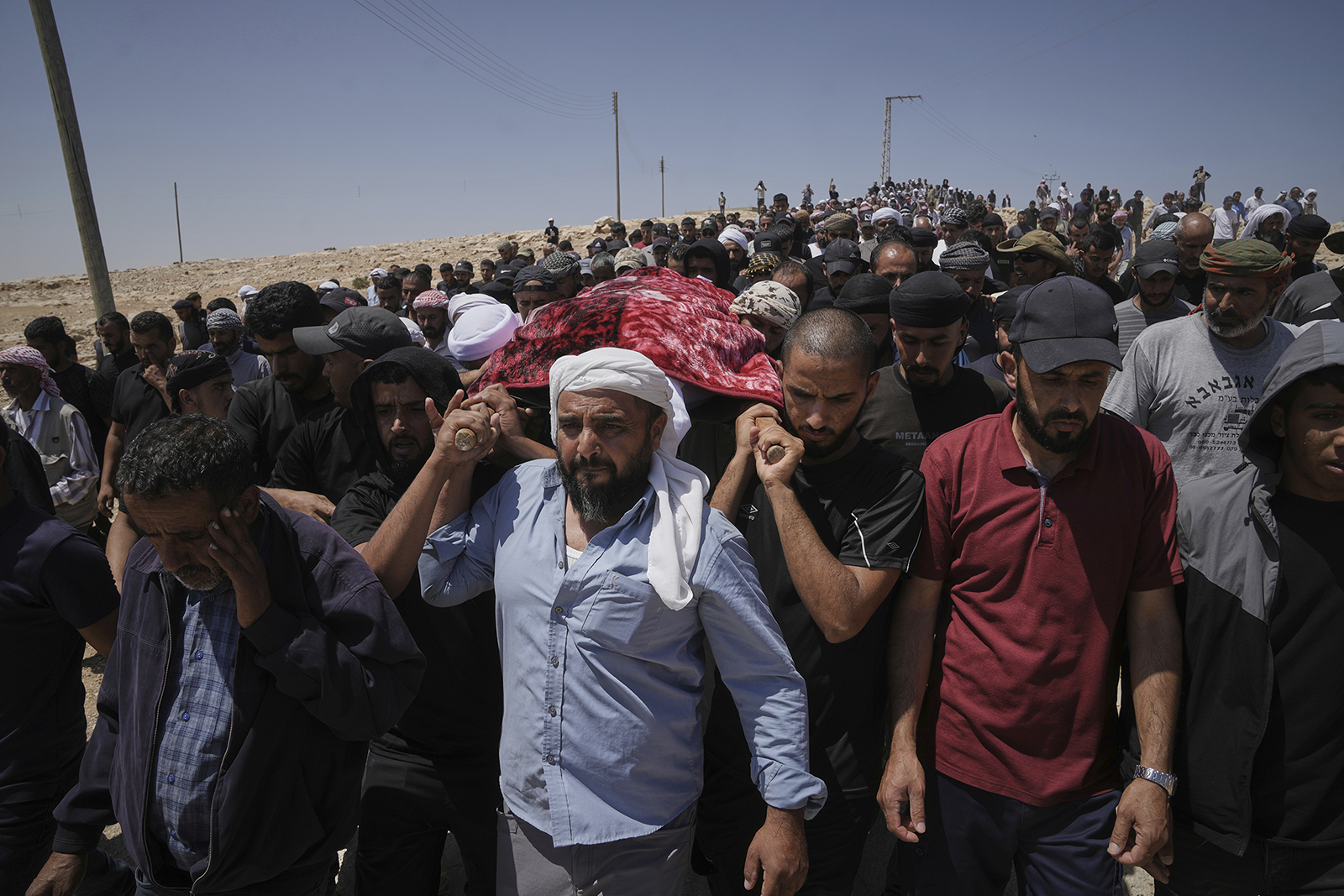
In this file photo, mourners carry the body of Palestinian activist Awdah Hathaleen, who was killed by an Israeli settler, according to Palestinian health officials, during his funeral in the West Bank Bedouin village of Umm al-Khair, Aug. 7, 2025. (AP Photo/Mahmoud Illean)


(RNS) — More than one year after Awdah Hathaleen, a Palestinian teacher and activist, was killed in the occupied West Bank, an Israeli settler was finally indicted for the killing. It should not have taken so long.

According to The Associated Press, 

Levi, a well-known hardline settler, already had been under sanctions imposed by Canada, the United Kingdom and the European Union over allegations of violence. (He had been under sanctions by the US as well, until President Trump revoked them.) Yet for the last year, Levi, who maintains his innocence despite video evidence, has walked free, seen in the village of Umm Al-Khair, and residents said they continued to experience intrusions by settlers.

As Tariq Hathaleen, Awdah’s cousin, put it, “This isn’t justice, a lot is missing, but it’s something, somehow, for Awdah.”

I agree. With Umm al-Khair residents facing abuses from both settlers and Israeli forces, the prosecution of Awdah’s killer is essential, but far from full justice for this community.

Last month, I stood in the very spot in the West Bank village where Awdah was killed. I had gone to Israel to study Torah in a seminar in Jerusalem with 150 other rabbis and to embrace and support many of my dear Israeli friends. But my trip to the region had a second purpose: to visit the West Bank and East Jerusalem and bear witness to the occupation and how the current Israeli government and army are enabling violent settlers.  

American Jewish clergy meet with Eid Hathaleen, center, in the village of Umm al-Khair, in July 2026, in the West Bank. (Photo courtesy of T’ruah)

For more and more American rabbis I know, visiting the West Bank and bearing witness to the occupation or taking part in “protective presence” efforts feels like a moral obligation when traveling to the Holy Land. 

For me, the issue feels personal. Brutal acts of violence, intimidation and dispossession are occurring in my name, as a Jew. Ancient Jewish texts, including those I studied with my colleagues in Jerusalem, urge me not to stand idly by. As a rabbi, I hear the call of my religious tradition to spend time in the West Bank to engage in “protective presence” with Palestinians, to place myself with them physically for protection, to witness their stories and, if need be, to use my privilege as a Jew to stand between them and Israeli settlers or the IDF.   

This was at least my 12th trip to the West Bank, and what I saw broke my heart. 

With a group of rabbis and cantors organized by T’ruah, a U.S.-based rabbinic human rights group, I traveled to Umm al-Khair and heard from Awdah’s cousin Eid Hathaleen. 

Eid showed us where his cousin was standing when he was killed, and he also told how the village is continually the target of violent settlers, who come into the village to kill their chickens and steal their livestock. He shared how settlers enter into the village with impunity day and night, spit on the villagers, fire their weapons and beat up the villagers with sticks, including the women. One night, he said, settlers expelled a Palestinian woman from her outhouse while she was using it.  

Israeli flags planted by Israeli settlers fly in the village of Umm al-Khair, in July 2026, in the West Bank. (Photo by Andy Vogel)

The settlers recently expanded their settlement with temporary trailer homes, which are illegal even under Israeli law, to build a ring around and through the Palestinian village. Under cover of night, they placed Israeli flags all around the village, even on top of the homes of the Palestinian members of the village, Eid Hathaleen told me.

Their message is not subtle: They want the Palestinians gone and are claiming this land as their own. 

The IDF’s repeated response is to punish Palestinians, not the settlers. After a recent attack, the army came and declared that a villager’s home in the middle of the village was a “closed military zone,” along with the animal shed holding many of his goats and sheep. The animals’ owner, Tariq Hathaleen has written, was prohibited from feeding or watering his animals in the heat for days. And, even worse, the army continually issues demolition orders for the Palestinians’ homes.   

I saw more examples of government-supported intimidation of Palestinians that are happening all over the West Bank: in the Silwan neighborhood of East Jerusalem and Khan al-Akhmar in the sensitive E1 area between Ramallah, Jerusalem and Bethlehem. Justice will never be complete while the current Israeli government promotes dispossession, home demolitions and intimidation of Palestinians.  

When I visit the West Bank, I think not only of how the occupation harms Palestinians, but also of how much damage it does to Israelis and Israeli society, degrading both security and morality. 

The majority of Israelis are still sunk in deep pain and fear over the horrors of Oct. 7, 2023. My Israeli friends’ memories of that shocking day and its aftermath still burn in their minds: the brutal murders by Hamas of 1,200 people of all ages; the rape and slaughter of young people at the Nova dance festival that morning; the kidnapping of 250 hostages; the sickening feeling that, for 72 hours, the vaunted Israeli army they had depended on for their safety seemed to simply not exist, as Hamas fighters streamed into Israel.  

My Israeli friends all said they fear a recurrence of those events and don’t trust their leaders to keep them safe.  

But the occupation of the West Bank perpetuates the cycles of violence, anger, revenge and retribution. It only deepens the narratives of victimhood that both Israelis and Palestinians carry. It ensures that conflict will continue.  

The indictment shows that international pressure can make a difference. But the Palestinians living in that village live with the constant fear of settler violence.  The indictment doesn’t change that. It should, though, send a clear message: It is incumbent upon all who care about Palestinians and Israelis to keep showing up and speaking out — sharing these stories, calling our elected representatives to support the West Bank Violence Prevention Act and, when possible, showing up at the West Bank and bearing witness.

Rabbi Andy Vogel is the senior rabbi of Temple Sinai in Brookline, Mass.