Opinion Top Three
As a rabbi, I can't look away from the West Bank. Neither should you.
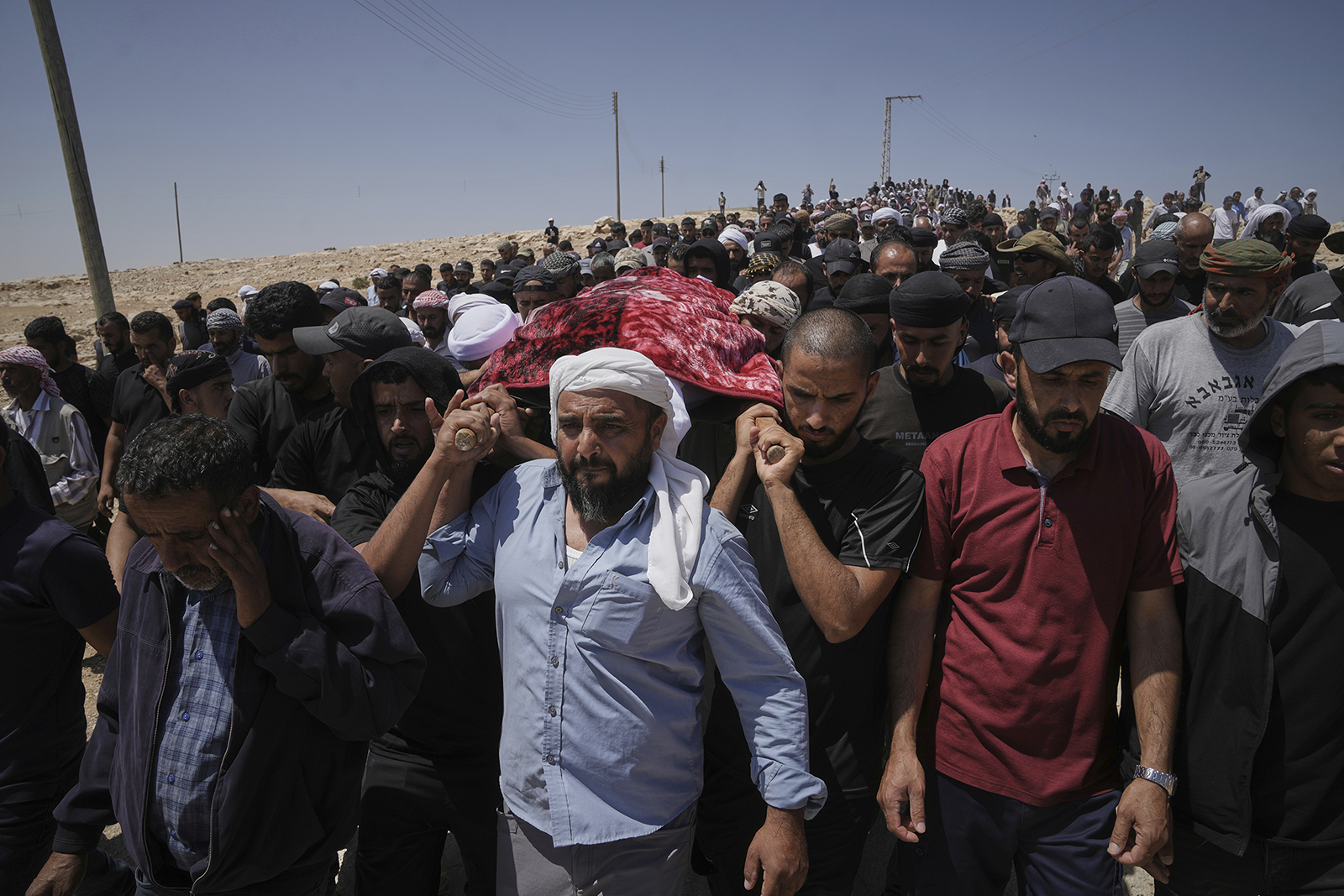
(RNS) — More than one year after Awdah Hathaleen, a Palestinian teacher and activist, was killed in the occupied West Bank, an Israeli settler was finally indicted for the killing. It should not have taken so long.
According to The Associated Press,
Levi, a well-known hardline settler, already had been under sanctions imposed by Canada, the United Kingdom and the European Union over allegations of violence. (He had been under sanctions by the US as well, until President Trump revoked them.) Yet for the last year, Levi, who maintains his innocence despite video evidence, has walked free, seen in the village of Umm Al-Khair, and residents said they continued to experience intrusions by settlers.
As Tariq Hathaleen, Awdah’s cousin, put it, “This isn’t justice, a lot is missing, but it’s something, somehow, for Awdah.”
I agree. With Umm al-Khair residents facing abuses from both settlers and Israeli forces, the prosecution of Awdah’s killer is essential, but far from full justice for this community.
Last month, I stood in the very spot in the West Bank village where Awdah was killed. I had gone to Israel to study Torah in a seminar in Jerusalem with 150 other rabbis and to embrace and support many of my dear Israeli friends. But my trip to the region had a second purpose: to visit the West Bank and East Jerusalem and bear witness to the occupation and how the current Israeli government and army are enabling violent settlers.

American Jewish clergy meet with Eid Hathaleen, center, in the village of Umm al-Khair, in July 2026, in the West Bank. (Photo courtesy of T’ruah)
For more and more American rabbis I know, visiting the West Bank and bearing witness to the occupation or taking part in “protective presence” efforts feels like a moral obligation when traveling to the Holy Land.
For me, the issue feels personal. Brutal acts of violence, intimidation and dispossession are occurring in my name, as a Jew. Ancient Jewish texts, including those I studied with my colleagues in Jerusalem, urge me not to stand idly by. As a rabbi, I hear the call of my religious tradition to spend time in the West Bank to engage in “protective presence” with Palestinians, to place myself with them physically for protection, to witness their stories and, if need be, to use my privilege as a Jew to stand between them and Israeli settlers or the IDF.
This was at least my 12th trip to the West Bank, and what I saw broke my heart.
With a group of rabbis and cantors organized by T’ruah, a U.S.-based rabbinic human rights group, I traveled to Umm al-Khair and heard from Awdah’s cousin Eid Hathaleen.
Eid showed us where his cousin was standing when he was killed, and he also told how the village is continually the target of violent settlers, who come into the village to kill their chickens and steal their livestock. He shared how settlers enter into the village with impunity day and night, spit on the villagers, fire their weapons and beat up the villagers with sticks, including the women. One night, he said, settlers expelled a Palestinian woman from her outhouse while she was using it.

Israeli flags planted by Israeli settlers fly in the village of Umm al-Khair, in July 2026, in the West Bank. (Photo by Andy Vogel)
The settlers recently expanded their settlement with temporary trailer homes, which are illegal even under Israeli law, to build a ring around and through the Palestinian village. Under cover of night, they placed Israeli flags all around the village, even on top of the homes of the Palestinian members of the village, Eid Hathaleen told me.
Their message is not subtle: They want the Palestinians gone and are claiming this land as their own.
The IDF’s repeated response is to punish Palestinians, not the settlers. After a recent attack, the army came and declared that a villager’s home in the middle of the village was a “closed military zone,” along with the animal shed holding many of his goats and sheep. The animals’ owner, Tariq Hathaleen has written, was prohibited from feeding or watering his animals in the heat for days. And, even worse, the army continually issues demolition orders for the Palestinians’ homes.
I saw more examples of government-supported intimidation of Palestinians that are happening all over the West Bank: in the Silwan neighborhood of East Jerusalem and Khan al-Akhmar in the sensitive E1 area between Ramallah, Jerusalem and Bethlehem. Justice will never be complete while the current Israeli government promotes dispossession, home demolitions and intimidation of Palestinians.
When I visit the West Bank, I think not only of how the occupation harms Palestinians, but also of how much damage it does to Israelis and Israeli society, degrading both security and morality.
The majority of Israelis are still sunk in deep pain and fear over the horrors of Oct. 7, 2023. My Israeli friends’ memories of that shocking day and its aftermath still burn in their minds: the brutal murders by Hamas of 1,200 people of all ages; the rape and slaughter of young people at the Nova dance festival that morning; the kidnapping of 250 hostages; the sickening feeling that, for 72 hours, the vaunted Israeli army they had depended on for their safety seemed to simply not exist, as Hamas fighters streamed into Israel.
My Israeli friends all said they fear a recurrence of those events and don’t trust their leaders to keep them safe.
But the occupation of the West Bank perpetuates the cycles of violence, anger, revenge and retribution. It only deepens the narratives of victimhood that both Israelis and Palestinians carry. It ensures that conflict will continue.
The indictment shows that international pressure can make a difference. But the Palestinians living in that village live with the constant fear of settler violence. The indictment doesn’t change that. It should, though, send a clear message: It is incumbent upon all who care about Palestinians and Israelis to keep showing up and speaking out — sharing these stories, calling our elected representatives to support the West Bank Violence Prevention Act and, when possible, showing up at the West Bank and bearing witness.
Rabbi Andy Vogel is the senior rabbi of Temple Sinai in Brookline, Mass.

No comments:
Post a Comment