Saturday, August 15, 2026

Governments Must Act Like Access to Water Is a Human Right, Because It Is

The responsibility to protect access to clean water must guide their decisions on data centers, carbon capture and storage facilities, and other large industrial projects.
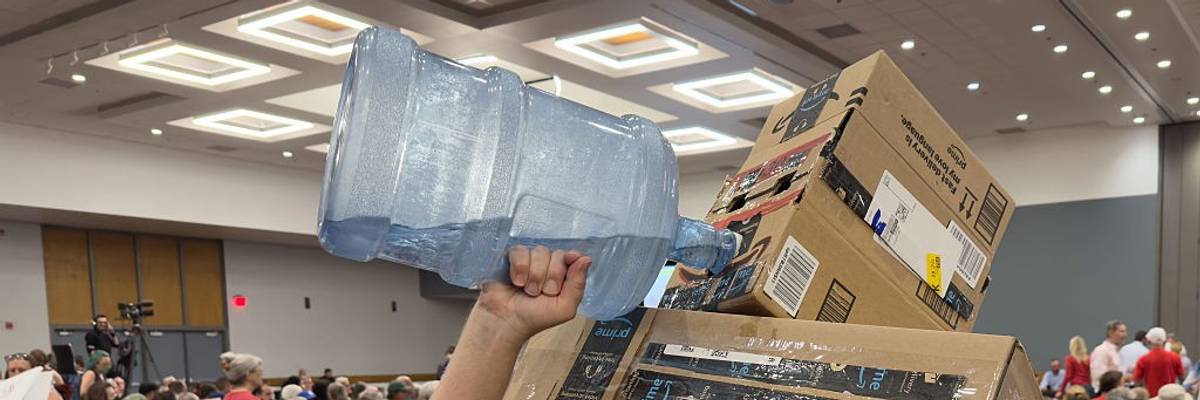


A community meeting is shown at the Tucson Convention Center on August 4, 2025, a public forum to discuss pros and cons of “Project Blue,” a massive data center installation proposed by Amazon Web Services, one of the largest economic development projects ever considered by the city and county.

(Photo by Wild Horizons/Universal Images Group via Getty Images)

Increasingly, communities are facing threats to clean water from large industrial projects such as data centers and carbon capture and storage, or CCS, facilities that are being proposed and constructed in communities across the United States. The question is how should decisions about these facilities be made? Should government officials privilege capital and financial investments? Should they balance investment with other considerations such as noise, water, and energy costs?

Of all the issues raised by these large projects, water is one of the most crucial for the simple reason that we cannot live without water. Given this necessity, access to clean water must be treated as a human right with governments charged with the ethical responsibility to serve as the trustees of water to protect it for present and future generations. This responsibility to protect access to clean water as a human right must guide their decisions on data centers and CCS facilities and other large industrial projects.

Data centers are buildings, sometimes the size of large warehouses, that can contain hundreds of thousands of computer chips that provide processing and storage for online data including data used for energy-intensive artificial intelligence and cryptocurrency, as well as less energy-intensive activities such as storing websites and other data. Carbon capture and storage facilities capture carbon dioxide emitted from industrial facilities and store it underground to prevent the CO2 from escaping into the atmosphere where it would contribute to climate change. Carbon capture facilities can include factory-size machinery that removes carbon dioxide from industrial air emissions, pipelines that transport the CO2, and underground storage repositories. Data centers and carbon capture and storage facilities typically consume large amounts of energy and water. They commonly also have toxic emissions, posing further risks to air, water, and health.

People have a human right to a clean environment—an idea recognized by the United Nations and enshrined in the constitutions of multiple states including Hawaii, Illinois, Massachusetts, Montana, and Pennsylvania. The provisions from Hawaii, Massachusetts, Montana, and Pennsylvania explicitly mention the importance of protecting water supplies. Pennsylvania’s Environmental Rights Amendment says, for example: “The people have a right to clean air, pure water, and to the preservation of the natural, scenic, historic and esthetic values of the environment. Pennsylvania’s public natural resources are the common property of all the people, including generations yet to come. As trustee of these resources, the Commonwealth shall conserve and maintain them for the benefit of all the people.”

Current projects being rushed through city councils or county boards, cloaked in non-disclosure agreements and granted tax credits, deny the public the right to full information about the project and undermine the ability of governments to fulfill its public trust duties.

Most constitutions, like Pennsylvania’s that contain the human right to a clean environment have a parallel provision, that asserts the responsibility of government to serve as the trustee of the commons or natural resources. For purposes of an ordinance on water, government, as the trustee of water, has a duty to make decisions that guarantee water quality and quantity now and into the future for the people within its jurisdiction.

If access to adequate, clean water is a human right—and given the uncertainty about water quantity and quality in light of unstable climate and weather patterns, increasing demands, and aging infrastructure—arguably the most appropriate decision-making tool for governments to use to fulfill its trustee responsibilities is the precautionary principle. The principle stands for the premise that we should take action, even in the face of scientific uncertainty, to prevent harm bySetting goals;
Heeding early warnings;
Exploring alternatives to potentially harmful actions;
Placing the burden of proof on proponents of an activity rather than on those who might be disadvantaged; and
Using democratic processes to carry out and enforce the principle—including the public’s right to free, prior, and informed consent.

This principle is the commonsense idea behind many adages: “Better safe than sorry.” “Look before you leap.” “First do no harm.”

One step in implementing the precautionary principle to protect water requires special focus: the public’s right to give free, prior, and informed consent to projects that will impact water quantity and quality. The consent of the governed is fundamental to democracy as expressed in documents dating back to the Declaration of Independence. Current projects being rushed through city councils or county boards, cloaked in non-disclosure agreements and granted tax credits, deny the public the right to full information about the project and undermine the ability of governments to fulfill its public trust duties.

By protecting local water supplies that may be threatened by these new, energy- and water- intensive uses, communities can help ensure that our most important natural resource remains clean and abundant for generations yet to come.


Our work is licensed under Creative Commons (CC BY-NC-ND 3.0). Feel free to republish and share widely.


Carolyn Raffensperger
Carolyn Raffensperger, MA, JD, is the executive director of the Science and Environmental Health Network.
Full Bio >
WHO Warns Congo’s Ebola Crisis Could Soon Become Deadliest in History

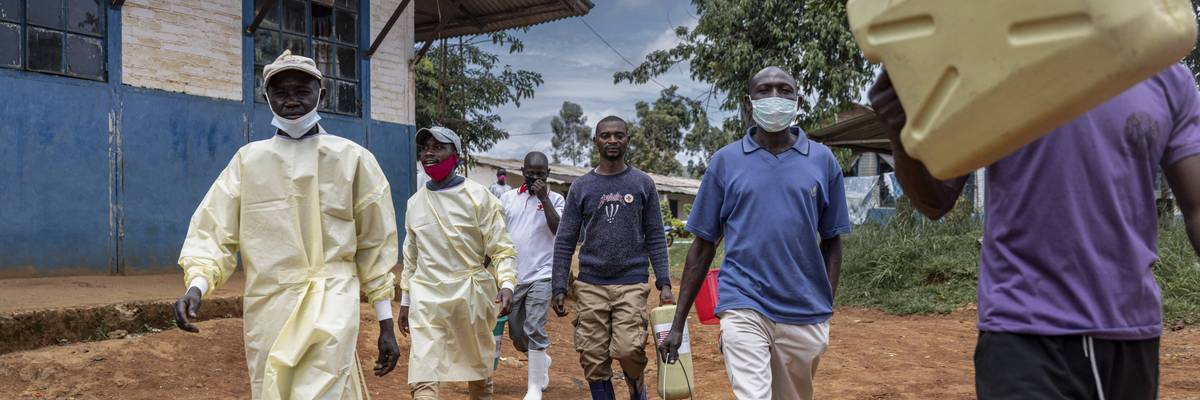
“The outbreak had a big head start, it is still way ahead of us, and we are playing catch-up,” said WHO Director-General Tedros Adhanom Ghebreyesus.


Health workers and local volunteers carry disinfectant containers and sanitation equipment on May 21, 2026 in Mongbwalu, Democratic Republic of Congo.
(Photo by Michel Lunanga/Getty Images)

Brad Reed
Aug 12, 2026
C0MMON DREAMS

The World Health Organization on Wednesday announced that the outbreak of Ebola in the Democratic Republic of Congo is on pace to become the deadliest in history.

In a press conference, WHO Director-General Tedros Adhanom Ghebreyesus said that the current Ebola epidemic is already the second-largest ever recorded, and “is moving faster than any previous Ebola outbreak.”

“At its current pace,” Tedros added, “it is on track to eclipse the West African Ebola outbreak of 2014 to 2016.”

There have been more 4,400 confirmed cases and over 2,000 deaths during the current outbreak, with 80% of deaths occurring in the Ituri province in the northeastern corner of the country.

The WHO chief said he was particularly concerned that many deaths in the region are happening in communities instead of in treatment centers, which suggests there are “chains of transmission we don’t know about” and need to be tracked down to contain the outbreak.

“The outbreak had a big head start,” he said, “it is still way ahead of us, and we are playing catch-up.”

Tedros also shared some encouraging news about the epidemic, highlighting nearly 900 Ebola patients who have recovered “even without specific therapeutics and vaccines,” which he noted were still undergoing clinical trials.

“For the first time, two vaccines specifically designed against Ebola Bundibugyo virus have now entered phase one safety trials in humans,” he said. “In addition, two new animal studies of the vaccine against Zaire ebolavirus—the more common species—have shown promising evidence of cross protection in animals. On that basis, WHO has recommended inclusion of the vaccine in a phase three trial, which we hope to start as soon as possible.”
Venezuela: Don’t Blame the Victim

The solidarity movement must unite in the broadest alliance around the defense of national sovereignty and the right to self-determination, strongly opposing the farcical New York trial of Nicolás Maduro and Cilia Flores, demanding the lifting of all sanctions, and calling for the return of stolen assets.


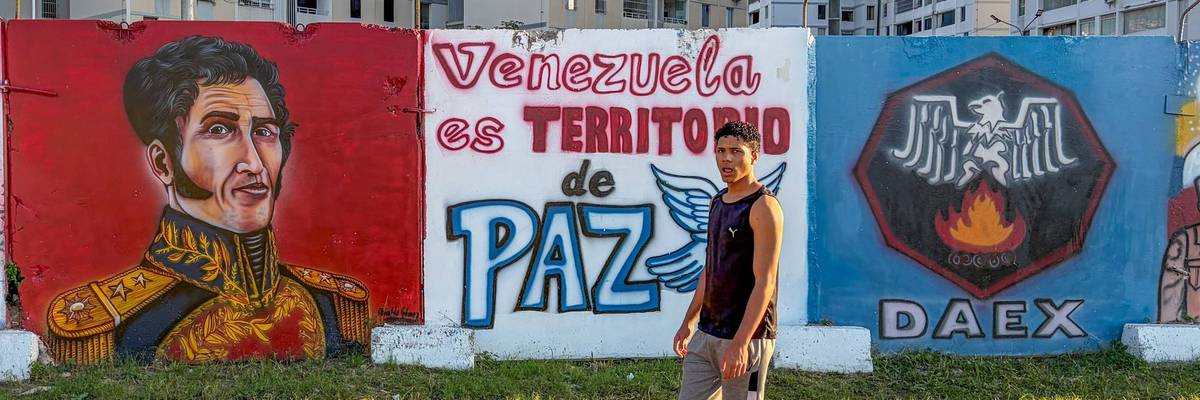
A mural in Ciudad Tiuna in Caracas, Venezuela reads, “Venezuela is a territory of peace” in Spanish.
(Photo by Robert D. Harris)
María Paez Victor
Aug 14, 2026
Common Dreams

“Nothing is easier than to be idealistic on behalf of others.”—Karl Marx, 1858

Under cover of night, the US military kidnapped the lawful Venezuelan President Nicolás Maduro and his wife and National Assembly deputy Cilia Flores on January 3, 2026. Collateral damage included over 100 fatalities of civilians and Cuban and Venezuelan guards.

This unprovoked surprise attack flagrantly violated international law. The hegemon acted in full expectation that it could operate with impunity. Even the neighboring left-leaning governments of Brazil and Colombia offered only mild rebukes. Then Venezuelan Foreign Minister Yván Gil said, “We found ourselves alone.” That is the context in which subsequent developments need to be understood.

The egregious military action culminated a quarter of a century of US and allied (particularly Canada and the UK) machinations against Venezuela: asphyxiating sanctions, stolen assets, diplomatic isolation, cyberattacks, assassination attempts, mercenary invasions, and establishing an ersatz parallel government. For the two months preceding the invasion, the US navy blockaded oil shipments. Still the empire’s goal of regime change was not achieved.
The Revolution’s Resilience Compelled the US to Escalate

Washington and its allies failed to destroy Chavismo, the movement founded by Hugo Chávez and carried forward by his successor Nicolás Maduro. Venezuela did not collapse or degenerate into chaos after the decapitation. Domestic peace prevailed.

The US-backed and funded far-right opposition did not seize power, but found itself ever more marginalized and in disarray.

The Chavista leadership continued in a seamless constitutional succession with Vice President Delcy Rodríguez sworn in as acting president. The unity of the top command held firm, backed by the National Assembly and supreme court. Likewise, the civic-military union and the communes and grassroots Chavista institutions fully supported the government.

Notably, the core Chavista leadership, the military, Socialist Party, and communal formations have remained united under tremendous pressure—pressure designed to fracture that unifying accord.

Relying on its overwhelming military superiority, Washington made a Mafia-style offer you can’t refuse. US Secretary of State Marco Rubio called Rodríguez on that day of infamy and delivered an ultimatum to collaborate with the US or face the country’s military destruction and the murder of her and other leaders. Variations of this scenario are corroborated by both the corporate press and Chavista sources.

President Donald Trump explicitly threatened, “There is more where that came from.” The alternative was the devastation currently being rained down on Iran, a country with far greater military capacity. With US forces deployed throughout the region and off its coast, a military confrontation would have meant annihilation, including the destruction of the oil industry. Rodríguez did what any responsible leader would do given the existing options; she made a tactical retreat in the face of overwhelming force.
Venezuela did not surrender

All the Chavista state institutions and the powerful universe of grassroots organizations that sustain the revolution remain intact. Yet US imperialism, by having a gun pointed to the government’s head, is in a position to exert substantial coercion leading to unpalatable decisions, such as Alex Saab’s deportation.

These accommodations reflect pressures that those of us on the outside can only imagine. How the solidarity movement should respond is a central question.

Former Chávez official Sergio Rodríguez Gelfenstein describes the current negotiations as an exercise in essential national self-preservation. He observes, “What is at stake is the survival of the State and the republic, which if lost, would make the discussion on any other topic banal.” As former Venezuelan Foreign Minister Jorge Arreaza said, “Everything is now negotiated,” with Washington obliged to be in daily give-and-take with Caracas.

Legislative reform had long been on Maduro’s agenda. However, revisions to laws governing the exploitation of hydrocarbons and hard minerals involved offering generous conditions to international capital in order to attract much-needed foreign investment (which Cuba is also doing).

The new amnesty law, another planned initiative, is a key instrument promoting reconciliation and denying extremist elements arguments to incite violence. The law strictly excludes “anyone who has committed war crimes, human rights violations, homicide, drug trafficking, or treason.”

The government is in negotiations with the moderate opposition. Such successive rounds of dialogue were a recurring feature of the Maduro presidency.

Rodríguez has counseled prudence and strategic patience. Notably, the core Chavista leadership, the military, Socialist Party, and communal formations have remained united under tremendous pressure—pressure designed to fracture that unifying accord.
Long-Sought Gains Achieved

The US has reversed itself and in practice recognizes the Venezuelan government as legitimate. The Bolivarian project has not only persisted but forced its greatest adversary to come to some accommodation.

Not since 2019 had the US allowed transactions with Venezuela’s central bank and major state banks. US restrictions had previously cut Venezuela off from the global financial system, preventing access to dollar-denominated transactions and US financial channels. Oil sales to the US have resumed, with some revenues returning to the domestic economy. The US-dominated International Monetary Fund (IMF) is again engaged with Venezuela. Rodríguez has stated that Venezuela is not seeking IMF loans, but access to its own frozen funds.

As a Venezuelan activist friend said, “You gringos tell us how to make our revolution when our problem is you have failed to make yours.”

Although sanctions largely remain in place, special licenses and a temporary easing of economic restrictions for earthquake relief have provided some breathing room for Venezuela’s besieged economy while also facilitating oil flows to the US. The concessions are limited and reversible, leaving the broader structure of US economic warfare intact. Still, the arrangement is preferable to the total oil blockade imposed immediately before the January 3 assault.

Rodríguez has repeatedly demanded that Venezuela be free of sanctions, while formally seeking the release of Venezuelan assets abroad to address the devastation caused by the earthquakes. She has even appealed to King Charles III for the return of 31 tons of Venezuelan gold held by the Bank of England.
Changed Political Landscape

The balance of forces confronting today’s Venezuelan leadership is substantially less favorable than under Chávez, so judging its compromises by an idealized Chávez-era standard is mistaken.

Some internationals invoke Chávez to discredit the current leadership. Overlooked is that during Chávez’s presidency, Venezuela sold oil almost exclusively to the US, when dependency was significant. Ignoring the changed context, infantile leftist claims are made that Chávez never compromised and that “one does not negotiate with the enemy,” forgetting the famous advice from Fidel Castro during the 2002 coup: “Don’t immolate yourself, Hugo.”

Chávez governed during a commodities boom that provided the Bolivarian project with resources for material benefits markedly unavailable today under sanctions. The geopolitical context has shifted significantly since Chávez’s time, especially under the present “Donroe Doctrine.” Not since Maduro’s victory in July 2024 has a left-leaning candidate won in Latin America. The last seven presidential elections have been swept by the right. Until this broader reactionary trajectory is reversed, further retreats are likely.

The purpose and cumulative impact of the illegal unilateral coercive measures have been to erode public support for the government. Years of comprehensive sanctions—despite the 2021-2025 economic recovery following an approximately 75% GDP contraction—have left Venezuela in a vulnerable position. Currently the Venezuelan economy is operating at roughly 30% of its pre-sanctions level.

The Rodríguez government is trying to buy time to recover the economy, although the June 24 earthquakes dealt a terrible blow. According to the United Nations, direct physical damage is estimated at over $37 billion, representing over one-third of Venezuela’s gross domestic product.

Most Venezuelans want domestic peace and a return to prosperity, not a confrontation with the empire.
“Unity Is the Most Important Thing—Without It, Nothing Is Possible; With It, Everything Is Possible.”

Those were the words of Fidel Castro as he was organizing the Cuban Revolution in 1956. Most dangerous for the sister Bolivarian Revolution is the suggestion that the current leadership has betrayed the cause and that a truly leftist “third way” can be fostered to replace them. There have always been competing factions within the Bolivarian movement. But political choices must ultimately be resolved within Venezuela itself, without interference from internationals.

These “third way” analyses, rejecting both Caracas and Washington, typically fail to address what Venezuelans could realistically do at this historical juncture—long on what’s wrong but short on viable alternatives.

Venezuelans will determine their path without foreign interference, either right or left. Solidarity necessitates efforts to accompany and uplift, not dictate.

It was not so long ago that it was the likes of far-right María Corina Machado who highlighted “cracks and fissures within the Chavista ranks” and anticipated “the beginning of a social explosion” against the elected Venezuelan government. Now some solidarity activists are saying the same.

The “tragic essence” of left disunity in Bolivia should be a cautionary lesson of what could happen in Venezuela. The Chavista leadership is painfully aware of this, hence their vigorous effort to establish the broadest united front against US colonization. Rather than being traitors to the cause, the Rodríguezes and Interior Minister Diosdado Cabello represent the most militant Chavistas—fighters from the very inception of the revolution.
What Solidarity Requires

Constructive criticism and solidarity activism need not be counterposed. Dissident opinions are appropriate when contextualized and given as part of a collaborative effort to advance common goals—not as individualistic venting.

Some among the left have appointed themselves as guardians of the faith judging negatively from afar the very difficult and risky tactical retreat undertaken by the Bolivarian leadership, even though it prevented a suicidal military confrontation with US imperialism.

The international left’s angst and disappointment regarding Venezuela’s retreats is understandable. But the Global South is not about to fulfill the revolutionary aspirations of those living in the belly of the beast. That, it should be clear, is the task for people in the imperial core.

As a Venezuelan activist friend said, “You gringos tell us how to make our revolution when our problem is you have failed to make yours.”

Venezuelans will determine their path without foreign interference, either right or left. Solidarity necessitates efforts to accompany and uplift, not dictate. Internationals living in the US, Canada, and the UK need to place the primary focus on our own imperialists. All other contradictions are secondary.

The solidarity movement must unite in the broadest alliance around the defense of national sovereignty and the right to self-determination, strongly opposing the farcical New York trial of Nicolás Maduro and Cilia Flores, demanding the lifting of all sanctions, and calling for the return of stolen assets.

El pueblo unido jamás será vencido.

(A united people will never be defeated.


Our work is licensed under Creative Commons (CC BY-NC-ND 3.0). Feel free to republish and share widely.


Roger D. Harris
Roger D. Harris is with the Task Force on the Americas and the US Peace Council.
Full Bio >

Francisco Dominguez
Francisco Dominguez is the national secretary of the UK-based Venezuela Solidarity Campaign.
Full Bio >

María Paez Victor
María Paez Victor is the founder of Louis Riel Bolivarian Circle in Canada.
Full Bio >
Imploring Latin America to Quit ICC, Hegseth Suggests ‘Fake’ Court Could Target US Over Boat Murders

One critic said he hopes the Hague-based tribunal will investigate the Trump administration’s “illegal, unproven, expensive, destructive, and pointless boat strikes.”


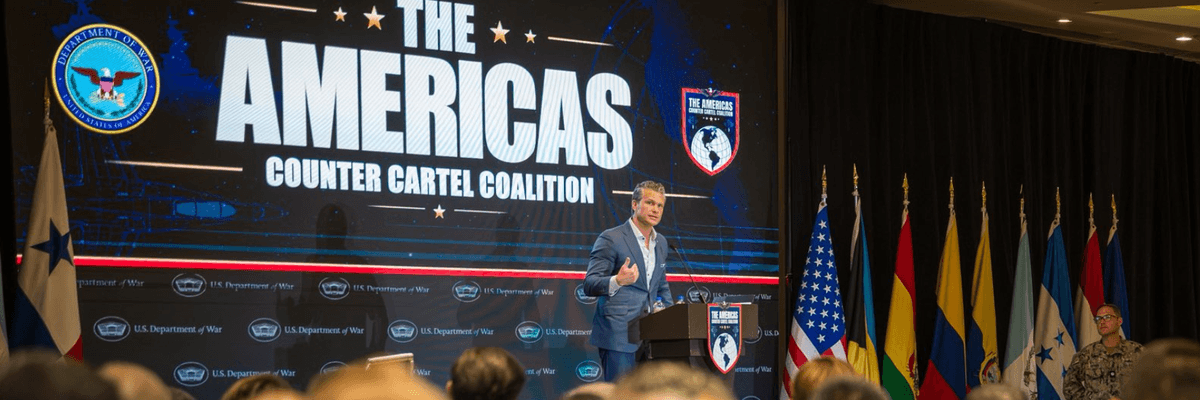
US Defense Secretary Pete Hegseth speaks at the Americas Counter Cartel Coalition conference in Panama on August 12, 2026.
(Photo by Defense Secretary Pete Hegseth/X)

Brett Wilkins
Aug 13, 2026
COMMON DREAMS

US Defense Secretary Pete Hegseth on Wednesday urged Latin American governments to quit the International Criminal Court, accusing the Hague-based tribunal of plotting to prosecute American and allied military personnel while defending the Trump administration’s increasingly aggressive—and, experts say, illegal—campaign against alleged drug traffickers.

“We are working together, we are building together, and we are training together,” Hegseth said during a speech in Panama at a gathering of the Americas Counter Cartel Coalition (ACCC), a group of mostly right-wing regional governments. “We are killing terrorists. And we’re defeating the failed and toxic ideologies of radical socialism and communism.”

“Now, speaking of socialism, make no doubt about it, the international left, along with their enabling left-wing media, is plotting to unlawfully assert International Criminal Court jurisdiction over US and partner military personnel and operations,” Hegseth asserted, offering no evidence or explanation to support his claim.

Legal experts, including former US military Judge Advocate General Corps attorneys, have argued that aspects of the Trump administration’s bombings of boats allegedly smuggling drugs in the Caribbean Sea and Pacific Ocean—particularly Hegseth’s alleged order to “kill everybody” and follow-up attacks targeting survivors—may constitute unlawful extrajudicial killings and war crimes. More than 220 people have been killed in at least 66 such strikes over the past 11 months, with survivors, victims’ relatives, and regional governments claiming at least some of those killed were fishers with no narco-trafficking ties.

Hegseth has also been accused of promoting war crimes in the illegal US-Israeli war of choice on Iran by vowing that US forces would not be bound by “stupid rules of engagement,” threatening to destroy critical Iranian civilian infrastructure like power plants and bridges, and by boasting that US forces were delivering “death and destruction from the sky all day long” as airstrikes killed hundreds of civilians, including 156 students and staff massacred at an elementary school in Minab on February 28.

“To be clear, there is no legitimate basis for the ICC’s lawless power grab that they will entertain anywhere they can in the world,” Hegseth said in Panama. “Our efforts in this effort are 100% lawful under the laws of armed conflict. It’s striking that this so-called court and other globalist bodies undermine our efforts but do nothing to hold real terrorists and real tyrants accountable. And that’s why the ICC poses a threat to your national sovereignty, your constitutional mandates, and the national interests of your people—just as it does ours.”

“That’s why I strongly encourage every ACCC member to leave the ICC, and reject their attempts to rob your governments and your courts of your sovereignty,” he added. “I know as a soldier, I swore an oath to the Constitution, not some fake and illegitimate international court.”


Trump’s assault on the ICC, which began during his first administration, has escalated during his second term. In February 2025, the president issued an executive order declaring a national emergency over the ICC and authorizing sanctions against court personnel involved in investigations concerning the United States and Israel—two of whose leaders are fugitives from the tribunal.

In November 2024, the ICC issued arrest warrants for Israeli Prime Minister Benjamin Netanyahu and former Defense Minister Yoav Gallant for alleged crimes against humanity and war crimes in Gaza, including murder and forced starvation. The court also ordered the arrest of three Hamas leaders for the same categories of crimes allegedly committed during and after the October 7, 2023 attack on Israel, but Israeli forces extrajudicially assassinated all three of the men.

The warrants for the Israeli leaders incensed the Trump administration, which responded with sanctions and threats.

Last month, Secretary of State Marco Rubio announced a “campaign to dismantle” the ICC, promising to “teach” the court “the full meaning of American resolve.” The State Department, meanwhile, said the campaign would seek to “systematically disable” the tribunal’s ability to operate or target US personnel.

The US is not a party to the Rome Statute governing the ICC. However, the treaty states that individuals from nonsignatory nations can be held liable for crimes committed in the territory of a member state, a situation applicable in Palestine, which is an ICC member, while Israel is not.

US disdain and animosity toward the ICC long predates Trump’s presidencies. During the administration of George W. Bush, the US passed the American Service Members’ Protection Act—also known as the Hague Invasion Act—which authorizes the president to use “all means necessary and appropriate,” including military intervention, to secure the release of American or allied personnel held by or on behalf of the ICC.

The Trump administration is seeking to persuade countries to abandon the ICC.

Chad and Venezuela—where Trump ordered a January invasion to abduct President Nicolás Maduro and his wife—have announced plans to withdraw, with Chad saying its decision followed a call from a senior US diplomat. The ICC’s Assembly of States Parties has urged both countries to reverse course, warning that the departures threaten the global fight against impunity. The two nations join Burkina Faso, Mali, and Niger, which also initiated ICC withdrawals in 2026.

Only Burundi and the Philippines have actually completed withdrawals from the Rome Statute. Hungary, meanwhile, reversed its planned departure this year after voters ousted longtime right-wing Prime Minister Viktor Orbán.

Hegseth’s Panama appearance coincided with Colombia becoming the ACCC’s 19th member, as new right-wing President Abelardo de la Espriella requested joint US-Colombian military operations against drug cartels and trafficking.

The alignment marks a sharp turn from the government of former leftist President Gustavo Petro, which repeatedly criticized Trump administration boat strikes and supported the South African-led genocide case against Israel currently before the International Court of Justice, also in The Hague.

Such cooperation has led to US intervention in Ecuador’s war on drugs. US and Ecuadorian forces are carrying out Operation Total Extermination, a joint counternarcotics operation beset by allegations of human rights violations, including arbitrary detention, torture, and destruction of civilian property.

Responding to reporting, University of Virginia researcher and doctoral student Joseph Bouchard wrote on X that the “ICC may investigate the US’s illegal, unproven, expensive, destructive, and pointless boat strikes.”

“They should, and hopefully hold these criminals accountable,” he asserted. “They are killing hundreds of fishermen for no reason beyond cruelty.”
Mysterious Attacks on Ecuadoran Fishing Boats Carried Out by Covert CIA Operation: Report

“It begs the question about why you would need to do this. What would be the purpose of the secrecy?” said a former US government official.


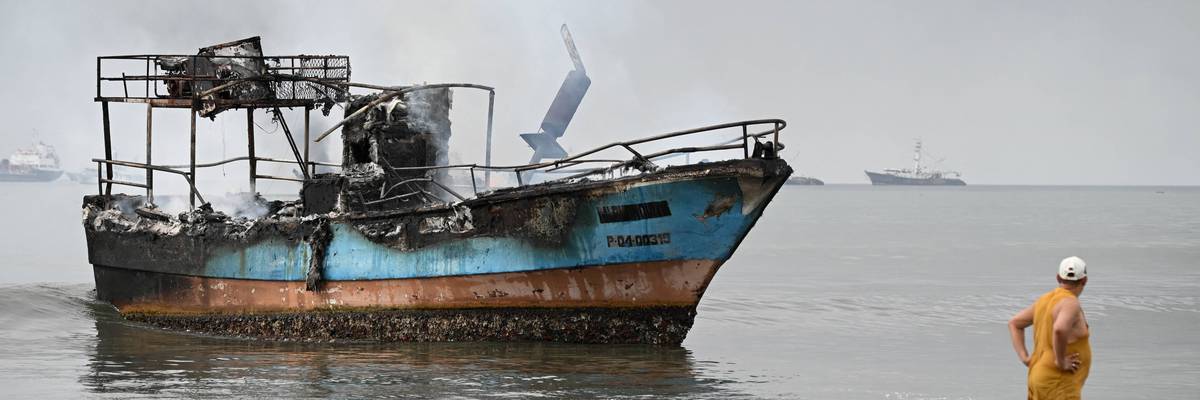
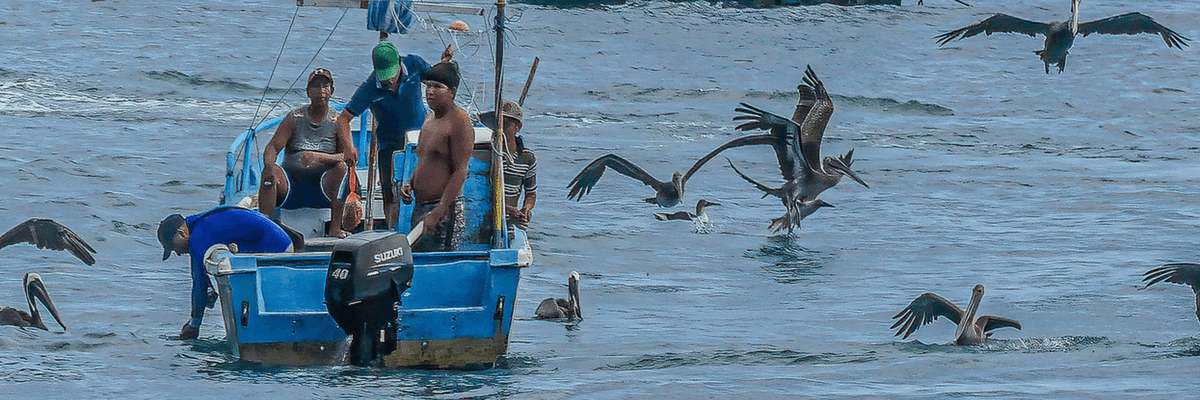
A man stands next to a burned-out fishing boat near the port of Manta, Ecuador on June 6, 2026.
(Photo by Ariel Ochoa/AFP via Getty Images)
Aug 13, 2026
COMMON DREAMS


The Washington Post reported on Thursday that recent mysterious attacks on Ecuadoran fishing boats were carried out as part of a covert CIA operation.

According to the Post, the strikes on the fishing boats, which took place in multiple instances near the Galápagos Islands earlier this year, are separate from the US Department of Defense’s bombing campaign against purported drug-trafficking boats that was launched in September 2025 and has so far killed at least 220 people.

Survivors of a boat attack that occurred in March told the Post they remember coming under fire from small quadcopter drones that either dropped munitions on their vessels or directly crashed into them.

After being shipwrecked, the survivors said they were picked up by a nearby vessel, where they were taken aboard, and “hooded and cuffed by armed men, and transported to El Salvador—only to be returned later without explanation to Ecuador.”

The Post noted that “no evidence has publicly emerged that the crew members were involved in drug trafficking,” adding that “the Galápagos Islands have increasingly become a hub for drug traffickers, where local fishermen are known to pick up jobs delivering gas to smugglers heading to the United States.”

Some former US officials with experience working in Latin America told the Post that they were bewildered about the need for a covert CIA boat strike campaign given that the Trump administration has openly boasted about its other attacks on vessels, which many human rights groups and international law experts have called acts of murder.

“It begs the question about why you would need to do this,” one former official said. “What would be the purpose of the secrecy?”

The covert boat strikes were also reported on Wednesday by The New York Times, which presented evidence that they originated in the US without naming their specific source.

Amnesty International last month raised suspicions of US involvement in the January disappearance of Ecuadoran fishing boat called Fiorella.

Amnesty’s investigation of the Fiorella’s disappearance found that the vessel, in the days before its disappearance, was “allegedly subjected to sustained monitoring by aircraft, patrol boats, and drones bearing United States markings,” as the boat’s captain sent “daily satellite messages to his family expressing his growing concern about the surveillance.”

The ship vanished on January 20.

Two crew members who had departed the ship earlier in the day on a skiff to lay out fishing lines reported seeing “a large column of smoke in the distance in the direction of the Fiorella, but were unable to determine with certainty whether it was from a fire on board,” wrote Amnesty.

The two crew members aboard the skiff are the only confirmed survivors of the incident, as the eight other men aboard the Fiorella are still missing.


Mysterious Attacks on Ecuadorian Fishers Raise Fears of Expanded US Boat Bombings

“It would be one thing if the US didn’t have an overt maritime strike campaign, but they do, and they’re posting snuff films of boats going up in flames regularly,” said one expert.


Ecuadorian fishers are seen 


Brett Wilkins
Aug 12, 2026
COMMON DREAMS

An investigation published Wednesday by The New York Times has raised fresh questions about who attacked three Ecuadorian fishing vessels in the Pacific Ocean earlier this year—but for fishers and their families in the South American nation, the mystery is hardly new.

According to the Times, Ecuadorian fishers aboard the Fiorella, Negra Francisca Duarte II, and Don Maca were separately attacked by what witnesses called unidentified “gringos” using drones. Survivors said they “came under attack by English-speaking assailants wearing matching uniforms with American flag patches, but without any clear insignia to link them to an official government force.”

International rights groups have called for an investigation after the Fiorella and its crew of eight disappeared in January amid Operation Southern Spear, President Donald Trump’s largely ineffective campaign of extrajudicial strikes on boats that the US administration claims, without evidence, were smuggling drugs.

By the Pentagon’s own admission, more than 220 people have been killed in at least 66 such strikes since last September. The US military says no civilians were killed in the strikes, a claim that anonymous government officials called “a fucking joke” and “a total whitewash.”
Government officials in countries including Colombia and Venezuela, as well as victims’ relatives, have contradicted the US claim. The families of two Trinidadian men killed in one strike earlier this year filed wrongful death lawsuits against the United States. Relatives of a Colombian slain in another US strike also filed a complaint at the Inter-American Commission on Human Rights.

Some of the Ecuadorian fishers featured in the new Times piece say they were seized and interrogated by the attackers before being handed over to the Salvadoran navy, which conducts long-range maritime patrols and counternarcotics operations in the Eastern Pacific and occasionally intercepts vessels.

The new Times report says that a maritime patrol aircraft based at a military facility in El Salvador repeatedly flew toward and tracked the Ecuadorian fishing boats in the days before they were attacked or disappeared. An analysis of flight data found that the aircraft’s course appeared to follow the vessels over several days.

Yet the aircraft was not listed among Pentagon operational aircraft. According to the Times, it was registered to a private company whose address was a UPS store mailbox in Virginia, deepening the mystery over who was operating it—and for whom.

“It would be one thing if the US didn’t have an overt maritime strike campaign, but they do, and they’re posting snuff films of boats going up in flames regularly,” Brian Finucane, a former State Department lawyer who specializes in the laws of war, told the Times.

“And that’s what makes this even more squirrelly,” added Finucane, now a senior adviser in the US Program at the International Crisis Group. “Who are these people that are operating, and under what authority? And they are using a UPS store as their company address? Come on.”

The Pentagon has denied involvement, claiming that US Southern Command (SOUTHCOM) did not know about the attacks or have a role in them. But the new findings raise the possibility that the attacks could have involved a private military contractor or another force operating in coordination with Washington’s expanding anti-drug campaign.

“Who are these people that are operating, and under what authority? And they are using a UPS store as their company address?”

In addition to the boat bombing campaign—which the Pentagon has replaced with the newly created Joint Task Force Western Hemisphere—SOUTHCOM has launched Operation Total Extermination, a joint counternarcotics operation with Ecuadorian forces involving the deployment of US ground troops into the Andean nation.

In one operation in the campaign, Ecuadorian soldiers raided and destroyed a dairy farm in San Martín, Sucumbíos, on March 3. Ecuador claimed the site was a traffickers’ camp, but investigations by The New York Times and, later, Human Rights Watch found substantial evidence that it was a working cattle and dairy farm with no credible evidence of a criminal connection. HRW said four workers at the farm were detained and tortured by Ecuadorian forces, and that the broader operation was carried out with US assistance.


The Times investigation published Wednesday followed months of reporting by Ecuadorian and international media and human rights groups, including HRW, on the three fishing vessels and their crews.

In April, Primicias reported growing fear among fishermen in Manabí, Ecuador’s major fishing province, where crews said they had been intercepted and attacked at sea. Fishers from the Don Maca and Negra Francisca Duarte II separately described being surrounded by drones and subsequently detained by what they believed were US personnel.

Don Maca‘s crew told El Universo that drones bombed their boat without warning on March 26. Fishers aboard said they escaped in small boats, approached a foreign vessel for help, and were instead handcuffed and hooded before eventually being transferred to Salvadoran authorities.

El Universo also separately reported a strikingly similar account from the crew of the Negra Francisca Duarte II. Captain Hernán Flores said a drone struck the boat on March 17, setting it ablaze and forcing all 16 fishermen into the water. When they approached a nearby blue vessel seeking assistance, Flores said, armed foreign personnel pointed weapons at them, bound them, and covered their heads.

In the case of the Fiorella, Primicias and El Universo reported that two fishers who had separated from the boat in a smaller vessel saw a drone circling above shortly before they spotted smoke on the horizon. Fiorella and those aboard it have never been found.


With Oral History Project, Journalists Remember ‘Fearless’ Colleagues Killed by Israeli Forces in Gaza

“He never wavered for a single moment from carrying out his mission, reporting the news, delivering the truth, and exposing the atrocities of the Israeli genocide in the Gaza Strip,” said one journalist of Al Jazeera correspondent Anas al-Sharif.


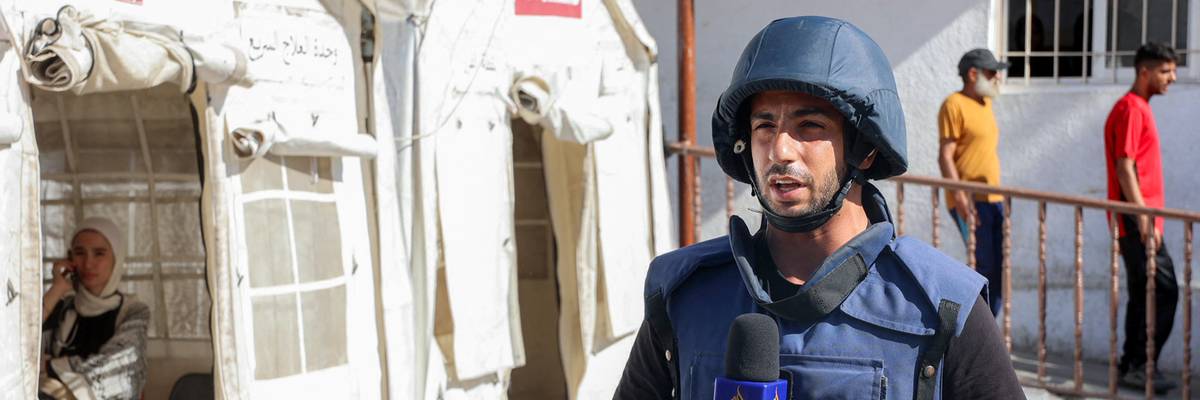
Al Jazeera correspondent Anas 
al-Sharif reports near a hospital in Gaza City, Gaza on October 10, 2024.
(Photo: AFP via Getty Images)


Julia Conley
Aug 13, 2026
COMMON DREAMS


Just over a year after six journalists—Anas al-Sharif, Mohammed Qraiqea, Ibrahim Zaher, Mohammed Noufal, Mohammed al-Khalidi, and Moamen Aliwa—were assassinated in an Israeli strike on their tent outside Al-Shifa Hospital in Gaza City, a collective of media workers on Wednesday set out to ensure that all 270 Palestinian reporters who have been killed while covering Israel’s nearly three-year assault on the exclave are remembered by the world.

The New York War Crimes collective, a project of Writers Against the War on Gaza (WAWOG), said it initially aimed to gather remembrances of al-Sharif, a 28-year-old Al Jazeera correspondent who was born in Jabalia refugee camp and started his career as a volunteer for Al-Shamal Media Network before becoming internationally known for his “ceaseless coverage” of Israel’s US-backed assault on Gaza.

The responses the collective got, said the organizers, “transformed the project. Anas, his colleagues told us, would not have wanted to be remembered as a singular hero, but as a servant of the Palestinian cause.”

“So, over the course of the following year, we gathered spoken testimonies from fellow journalists, photographers, cameramen, journalism professors, students, and workers across the media sector in Gaza,” reads the website for the project, titled A Living Record. “Each contributor was asked to record a personal remembrance of one or more martyrs, to tell a small part of the history that, as [journalist] Samira Nassar says, should be written in gold.”


A number of journalists spoke to WAWOG about al-Sharif, who reported from northern Gaza while the Israel Defense Forces (IDF) were heavily restricting humanitarian aid there as they waged intense attacks there on refugee camps and other civilian infrastructure.

“All the journalists were in awe—really in awe—of him,” said Isra al-Madallal. “Just the fact that he was in the north while all the other journalists were in the south was enough to make everyone keep asking, ‘How are you? Where are you? What are you doing? What is happening? May God keep you steadfast.’ And the starvation—that was something that they lived through together, something intense.”

Another colleague, Doaa Shaheen, said Al-Sharif served as “the voice of Jabalia, the voice of the north as a whole; he never left

“He never wavered for a single moment from carrying out his mission, reporting the news, delivering the truth, and exposing the atrocities of the Israeli genocide in the Gaza Strip,” said Shaheen, adding that when her fellow Jabalia camp native was killed she thought: “So that’s it? He’s been martyred? So where is Anas’ voice?”


Freelance journalist Baraa Lafi remembered Mariam Abu Dagga, a visual journalist who extensively documented how children were being affected by Israel’s attacks, which have been called a genocide by leading human rights groups and Holocaust scholars. She photographed overwhelmed hospitals as medical workers struggled to care for sick and injured Palestinians, as well as documenting the impact of Israel’s blockade on humanitarian aid.

Lafi was wounded in the Israeli double-tap strike on Nasser Hospital that killed Abu Dagga, as well as Moaz Abu Taha, Hussam al-Masri, Ahmad Abu Aziz, and Mohammad Salama, just weeks after Al-Sharif and his colleagues were killed.

“As a journalist, Mariam was brave. Braver than many men,” said Lafi. “Everyone could see that. Mariam in the field was not unassuming and timid—no. She was fearless. She ran toward the fire, she was first on the scene. If she saw an injured child in distress, she would stop and comfort them. If she saw someone upset, she would stop and stay by their side. If Mariam saw a mother searching for her children—whether during famine or bombardment—she would stop filming and stay by her side, going with her from hospital to hospital to help her find them.”


WAWOG collected remembrances from several reporters of “journalists as a collective,” with Bisan Owda, who won the Peabody Award in 2024 for her coverage of the war on social media, saying that despite Israel’s slaughter of more than 73,000 Palestinians and decimation of the exclave’s civilian infrastructure, “there’s still goodness here, in this small place, in the ground underneath us, in those who fight the evil spreading through the rest of the world. To me, those are the people and journalists of Gaza.”

“To me, these individuals were daring enough to dream, to believe that we can make a difference,” said Owda. “We are brave. We are the ones who have the courage to document with our cameras, to change the narrative, change our current conditions, and to draw attention to our people’s oppression. To change what is happening. You are dealing with the bravest people on the face of the Earth. They are the ones spreading the truth to combat every false narrative in the world.”

As The Living Record was published Wednesday, protesters rallied outside The New York Times headquarters in New York City to demand accountability for the killing of journalists in Gaza, while Drop Site News correspondent Mohamed Awad was detained by Israeli forces in Ramallah, the West Bank.

WAWOG said that in the fall, as the third anniversary of Israel’s assault on Gaza approaches, it plans to publish more eulogies of Gaza journalists who have been killed in the exclave.
Solidarity Is Not Enough: Why the World Must Force Accountability for Gaza Now

Israel’s official position leaves the international community with no choice but to take direct, coordinated action across five key fronts.


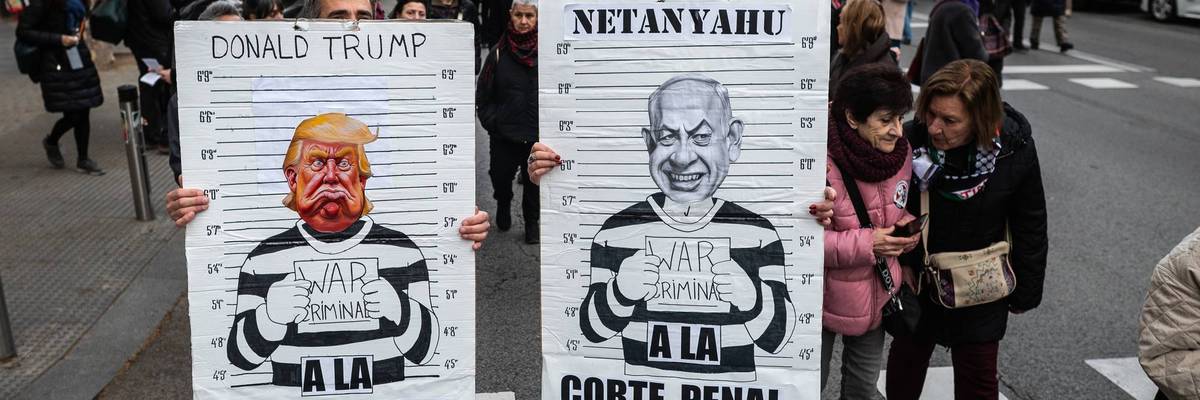
Protesters carry placards with the images of Donald Trump and Benjamin Netanyahu during a protest.
(Photo by Marcos del Mazo/LightRocket via Getty Images)


Ramzy Baroud
Aug 14, 2026
Common Dreams

It is now official: Israeli Prime Minister Benjamin Netanyahu has flatly rejected the core conditions of the Board of Peace framework, explicitly stating that Israel will neither adhere to a ceasefire nor withdraw its forces from Gaza.

During a cabinet meeting on Sunday, Netanyahu stated with unambiguous language, “Israel rejects the 15-point document published by the Board of Peace for Gaza.”

In a previous conversation with lead envoy Nickolay Mladenov, Netanyahu set conditions—such as demanding unilateral operational freedom for the Israeli military to strike inside Gaza at will—that render a genuine peace agreement structurally impossible.

The Israeli army leadership, under Chief of Staff Eyal Zamir, reinforced this posture by outlining three uncompromising “red lines” to the political establishment: complete operational freedom to eliminate perceived threats anywhere in the strip, strict control over all weapons entering or exiting Gaza, and zero military withdrawal unless Hamas is completely disarmed.

We must resolutely reject the premise that the slaughter of the innocent can ever become an accepted routine.

One can fault Netanyahu for many things, including ongoing genocide. But in recent years, he has been remarkably straightforward about his intentions; therefore, no one can claim that Netanyahu has fooled anyone.

Earlier this year, while speaking at a conference in an occupied West Bank settlement, Netanyahu explicitly boasted that he had instructed the Israeli military to expand its physical footprint and permanently occupy at least 70% of the Gaza Strip—a massive expansion far beyond the temporary administrative demarcation lines established in previous truce outlines.

Meanwhile, his far-right ministers have pushed the government’s rejectionist stance even further. Finance Minister Bezalel Smotrich and National Missions Minister Orit Strock issued a joint demand for an emergency cabinet meeting to roll back authorization for the deployment of the International Stabilization Force (ISF).

The ISF, designed under the Board of Peace framework as a transitional peacekeeping body, was meant to oversee humanitarian security, starting with pilot recovery zones in Rafah.

Yet Smotrich and Strock claimed the security cabinet was “misled” into approving the force, arguing that allowing international personnel into Gaza endangers Israeli operational freedom and directly contradicts their explicit war aims.

These latest moves, along with the military’s strict “red lines,” confirm what recent months of relentless bombardment have made clear: The Israeli government has no intention of ending its genocide in Gaza or relinquishing control over the besieged and devastated territory.

But highlighting such positions will make no difference, aside from once more accentuating Israel’s total lack of desire for peace and its intention to perpetuate conflict.

While true, such realization on its own is worthless considering that what is taking place in Gaza and the West Bank is beyond horrific, and that the daily killing of Palestinians makes the term “ceasefire” a cruel joke.

While diplomats debate frameworks, Israeli strikes continue to claim civilian lives daily—bringing the post-truce death toll to over 1,250 and the total killed since October 2023 to more than 73,000.

Therefore, action is needed, and urgently so. Indeed, Israel’s official position leaves the international community with no choice but to take direct, coordinated action across five key fronts.

First, Arab, Muslim, and allied governments must leverage every available international platform, starting with the United Nations General Assembly and Security Council, to formally condemn Israel’s violation of the Gaza peace framework and expose its bad-faith negotiations.

States must move beyond symbolic statements and invoke mechanisms like the “Uniting for Peace” resolution to bypass Western vetoes, push for binding sanctions, and implement a universal arms embargo against Israel.

Second, a renewed global campaign must recenter Gaza and the West Bank, exposing Israel’s broader territorial objectives—specifically the systematic ethnic cleansing of Gaza and the quiet, administrative annexation of the West Bank.

Civil society, trade unions, and grassroots organizations worldwide must pressure their respective national governments to sever diplomatic, economic, and military ties with Israel until it complies with international law.

Third, International legal bodies must accelerate their proceedings. Pressure must be renewed on the International Criminal Court (ICC) to execute arrest warrants for senior Israeli leadership, while the International Court of Justice (ICJ) must enforce provisional measures and issue definitive rulings regarding Israel’s violations of the Genocide Convention.

Legal compliance must be treated as a non-negotiable prerequisite for international relations.

Fourth, a unified international media push is necessary to counter state-sponsored propaganda, keeping public focus fixed on Israel’s long-term strategic plans: the permanent displacement of Gaza’s population and the formal takeover of Palestinian land.

Independent media outlets, journalists, and cultural institutions must challenge official narratives that frame Israeli aggression as self-defense, centering the lived realities and testimonies of Palestinians under siege instead.

Fifth, the international community must bypass Israeli obstruction to ensure massive quantities of food, medical supplies, and shelter materials enter Gaza immediately to prevent widespread starvation and winter exposure.

International aid agencies must establish protected humanitarian corridors by global mandate, refusing to allow Israel to use manufactured famine and humanitarian denial as weapons of war.

With Israel’s intentions fully unmasked, the global community must shift from passive mediation to active enforcement.

Israel wants to normalize genocide, just as it normalized the illegal siege on Gaza before that; the military occupation of the West Bank, East Jerusalem, and Gaza before that; and the ongoing displacement of Palestinians since 1948.

We must resolutely reject the premise that the slaughter of the innocent can ever become an accepted routine.

Knowledge of the atrocity is not enough. Expressing solidarity in words alone is not enough. Concrete, decisive action is required today—and holding the perpetrators accountable remains entirely within our power if the world finds the political courage to act.


Our work is licensed under Creative Commons (CC BY-NC-ND 3.0). Feel free to republish and share widely.


Ramzy Baroud
Ramzy Baroud is a journalist and the Editor of the Palestine Chronicle. He is the author of five books including: "These Chains Will Be Broken: Palestinian Stories of Struggle and Defiance in Israeli Prisons" (2019), "My Father Was a Freedom Fighter: Gaza's Untold Story" (2010) and "The Second Palestinian Intifada: A Chronicle of a People's Struggle" (2006). Dr. Baroud is a Non-resident Senior Research Fellow at the Center for Islam and Global Affairs (CIGA), Istanbul Zaim University (IZU). His website is www.ramzybaroud.net.
Full Bio >
Doctors Without Borders Accuses Israel of ‘Deliberate Effort to Make Existence Itself Impossible’ in Gaza

“What we are witnessing in Gaza is not a series of isolated shortages, it is a policy of attrition by design.”


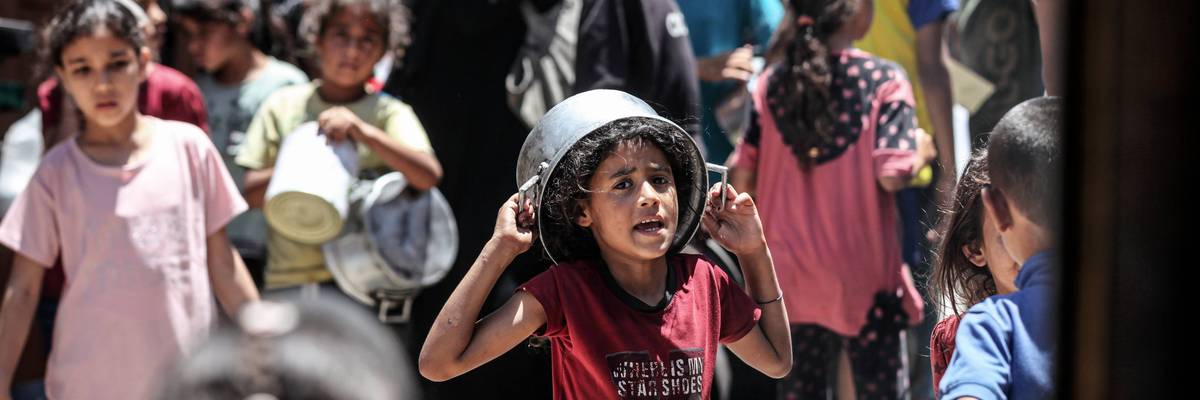
Displaced Palestinians, including many children, wait in long queues to receive hot meals distributed by a charitable organization in Gaza City, Gaza on June 7, 2026.
(Photo by Moiz Salhi/Anadolu via Getty Images)


Jake Johnson
Aug 13, 2026
COMMON  DREAMS


The renowned humanitarian group Doctors Without Borders said Wednesday that the Israeli government is still restricting the entry of engine oil and generator parts to the Gaza Strip, imperiling life-saving hospital functions and other essential services in the decimated territory.

Doctors Without Borders, known internationally as Médecins Sans Frontières (MSF), noted that Gaza’s remaining healthcare system relies “almost entirely” on generators, “with most electricity cut by Israeli authorities and much of the electrical infrastructure destroyed.” The group said that in some Gaza facilities, its teams barely have sufficient engine oil to last a month and have been forced to “buy engine oil at the local market at exorbitant prices.”

Filipe Ribeiro, MSF’s head of mission in Palestine, said that “what we are witnessing in Gaza is not a series of isolated shortages, it is a policy of attrition by design.”

“For more than two years, we have observed Israel’s policies restricting the entry of supplies,” said Ribeiro. “These policies do not merely delay aid; they dismantle the very systems people rely on to survive.”

Israel’s continued restriction of supplies comes as the country’s military, which is armed by the United States, keeps up its deadly bombing of the strip despite a purported ceasefire deal that took effect in October 2025. Israeli attacks have killed more than 1,200 people in Gaza since the start of the ceasefire agreement. The Israeli government, headed by Prime Minister Benjamin Netanyahu, has rejected a US-backed plan for Hamas disarmament in exchange for Israeli withdrawal from Gaza.

Earlier this week, a group of United Nations experts condemned Israel’s recent “strikes on hospitals and shelters, the killing of police officers and UN-contracted staff, attacks on fishers, and abductions and abuses by armed groups reportedly collaborating with the Israeli military, as well as the killing of humanitarian workers, who through their work protecting and promoting fundamental human rights, are human rights defenders.”

“These restrictions have become increasingly far-reaching, also preventing the entry of routine items ranging from ointments for skin diseases to rubber seals needed for medical sterilization equipment.”

According to MSF, Israel’s sustained attacks and obstruction of supplies “extend far beyond hospitals.”

“Without engine oil, all transport services could stop, including much-needed water trucks during the peak of summer heat, ambulances, buses transporting medical staff to work, and trucks delivering humanitarian supplies,” the group said. “Bakeries and flour mills also rely on generators, meaning food production could also be affected.”

MSF characterized Israel’s continued obstruction of engine oil and spare generator parts as “one piece of a larger pattern of structural violence imposed by Israeli authorities to intentionally restrict access to vital services and supplies as part of the ongoing genocide against Palestinians in Gaza.”

“These restrictions have become increasingly far-reaching, also preventing the entry of routine items ranging from ointments for skin diseases to rubber seals needed for medical sterilization equipment,” the group said. “The shortages now impact virtually every aspect of life in Gaza, leaving hospitals and humanitarian organizations without basic supplies.”

Ribeiro said in a statement that “the items change, but the logic remains the same: reducing people to conditions in which life becomes untenable, and dignity is systematically stripped away through the denial of the most ordinary, most essential goods.”

“This is not bureaucracy,” he added. “It is a deliberate effort to make existence itself impossible.”
‘Waiting to Die’: Gaza Cancer Patients Dying at More Than Double the Pre-War Rate as Israel Blocks Treatment

“I am dying. There isn’t a feeling for me to even feel.”


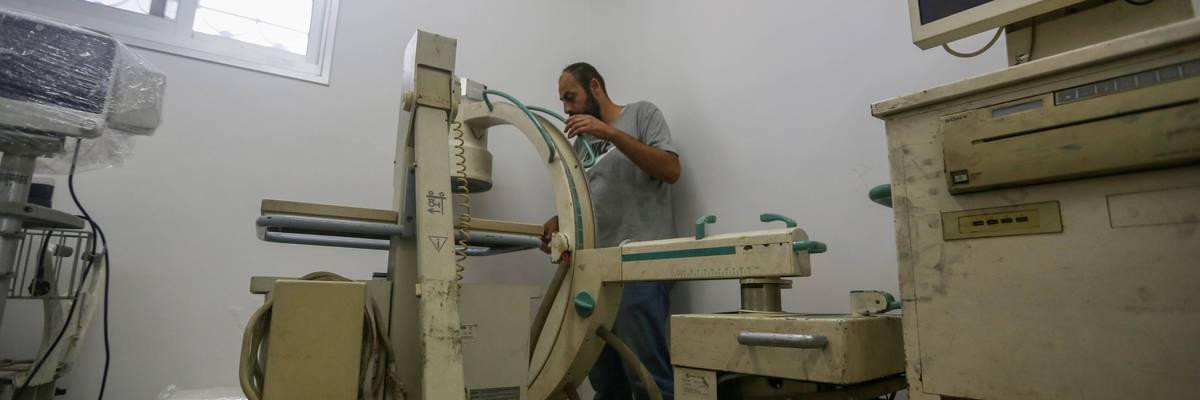
The medical equipment maintenance department at Al-Shifa hospital repairs damaged medical devices using salvaged parts, due to a shortage of new spare parts, on August 13, 2026 in Gaza City, Gaza.
(Photo by Ahmad Hasaballah/Getty Images)

Stephen Prager
Aug 14, 2026
COMMON DREAMS

Israel is causing a wave of preventable cancer deaths in Gaza, leaving an estimated 17,000 people with no avenue for treatment.

As Reuters reported on Thursday, Israel has destroyed the only specialized cancer hospital in the strip and is preventing Palestinians from seeking treatment outside the exclave.

The result: Doctors say that cancer patients in Gaza are dying at between double and triple the rate they were before Israel began its genocidal war there. Israel’s restrictions on aid entering Gaza have made chemotherapy and other forms of treatment inaccessible.

33-year-old Khuloud Abu Sahmoud, a mother of two with ovarian cancer who spoke with Reuters, has been waiting to exit Gaza for nearly a year to receive treatment.

According to Middle East Eye, she is one of at least 4,000 cancer patients in Gaza who have been issued medical referrals to leave the strip but who have been stuck waiting for final permission from Israeli authorities.

In the meantime, her cancer has metastasized to her lungs and bones.

“I am dying. There isn’t a feeling for me to even feel,” Sahmoud told Middle East Eye. “Every day my disease progresses.”

She said that her fingernails have all fallen out and she has been left “just waiting to die.”

“The border crossing for me is the only lifeline. The only vein for me to be saved, to receive treatment abroad,” she said. “I haven’t taken any treatment for three months. I’m living on painkillers.”

She said she made her request to travel in October 2025 after a ceasefire was reached between Israel and Hamas, which was supposed to allow for aid to flow freely into Gaza and for people to leave.

“There has been no response to any appeal so far,” Sahmoud said. “We haven’t received any calls.”


The Coordinator of Government Activities in the Territories (COGAT), the Israeli military authority responsible for administering civilian matters in Gaza, has denied that it is blocking Palestinians from receiving treatment, with a spokesperson stating that permission to travel is “wholly dependent on the receiving country’s request.”

But the agency’s own medical evacuation procedure requires that every patient leaving Gaza undergoes Israeli security screening and “will not be approved if there are security reasons that prevent their passage.”

Israel has also imposed strict numerical restrictions on the number of people allowed to leave through the Rafah crossing, the main exit point from the strip.

Palestinian health officials said only about 11,000 people in total—not just cancer patients—have been allowed to exit since the crossing reopened in February, an average of about 55-60 people per calendar day. This is fewer than half the number who were expected to leave following the ceasefire.

According to Reuters, “a further 20,000 patients, including 5,000 with cancer, are registered for treatment abroad but not yet ⁠permitted to leave.”

All of the 36 hospitals and most primary healthcare facilities in Gaza have sustained damage from Israeli attacks, with only around half even partially functioning, according to the World Health Organization. As of the ceasefire, WHO reported that more than 1,700 Palestinian healthcare workers, including doctors, nurses, and paramedics, have been killed.

“Since the genocidal war on the Gaza Strip, among the most severely affected groups by this extermination are oncology and cancer patients,” said Mohammed Abu Selmia, the director of Al-Shifa Hospital, which has been repeatedly raided, besieged, and damaged, and has just recently restarted oncology services.

Selmia said this is because of the restrictions on the entry of chemotherapy treatments and Israel’s destruction of diagnostic equipment, including MRI facilities.

“This group is suffering immensely,” he said. “Recently, we have been recording a significant number of deaths ranging from three to five daily because patients are not receiving the chemotherapy needed to save their lives.”


The official death toll from Israel’s military campaign in Gaza since October 2023 sits at 73,389, according to the Gaza Ministry of Health. But this only includes violent deaths from the war itself.

Independent analyses have suggested that the true death toll is much higher when factoring in those who have perished due to disease and starvation as a result of Israel’s attacks on medical facilities, civilian infrastructure, and restrictions on aid.

Another cancer patient, Elham al-Skafi, said, “They stopped giving me chemotherapy because it is not available in Gaza.”

“I come in to get nutritional fluids, just so I can stay on my feet, and blood transfusions,” she said. “That is what is currently available. This is what I take.”

She said she’s had a transfer referral for over a year and a half now to leave the country for treatment.

“I am sitting and waiting,” she said. “If the crossings were open, I would have left.”