It’s possible that I shall make an ass of myself. But in that case one can always get out of it with a little dialectic. I have, of course, so worded my proposition as to be right either way (K.Marx, Letter to F.Engels on the Indian Mutiny)
Saturday, August 15, 2026
'Never seen corruption of this magnitude': Horror as Trump family closer to launching bank
FILE PHOTO: U.S. President Donald Trump's sons Eric
The Trump family's pathway to opening a bank through its cryptocurrency investments is sending shockwaves, according to reporting by the Wall Street Journal.
A trust company for World Liberty Financial, the Trump family's flagship crypto venture, has preliminary conditional approval to become a bank, The Journal reported. The Office of the Comptroller of the Currency, a Treasury bureau, gave the early preliminary approval on Friday.
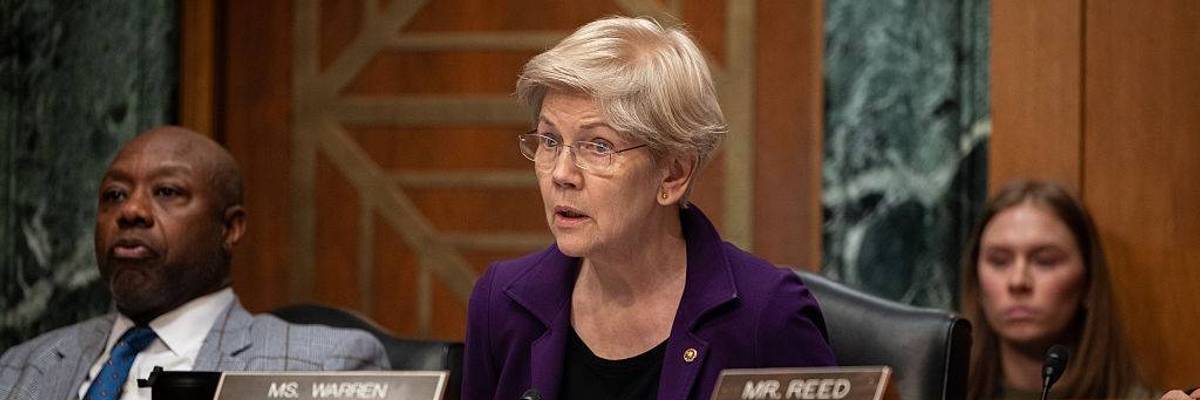
Sen. Elizabeth Warren (D-MA) wrote in a statement that "we have never seen financial conflicts or corruption of this magnitude." President Donald Trump and his two sons launched World Liberty in late 2024 but have not yet made available promised borrowing, lending, and trading services, according to The Journal.
If World Liberty Trust secures final approval, it will be able to operate as a federally chartered national trust bank, which will allow it to issue, redeem, and safeguard a dollar-backed stablecoin it launched last year, The Journal reported. The stablecoin has a market value of about $4 billion, according to The Journal.
Unlike full banks, trust banks generally can't take deposits or make loans, The Journal reported. However, Trump has reported $1.4 billion in earnings from his memecoin and crypto ventures. The Journal noted that those earnings are "the biggest roadblock" for the Clarity Act, a landmark bill seeking a comprehensive regulatory framework for digital assets.
The White House has previously defended Trump's financial ventures as president, saying "neither the President nor his family has ever engaged—or will ever engage—in conflicts of interest," according to The Journal.
Zach Witkoff, the son of the president's friend and Middle East envoy, Steve Witkoff, is the chief executive of World Liberty Financial and chairman of World Liberty Trust Company. The company said it submitted "probably one of the most thoroughly reviewed applications in the history of the OCC" to become a bank, according to The Journal.
"We answered all of the regulator's questions, and we accepted the significant obligations and ongoing scrutiny that come with the national charter," Zach Witkoff said in an interview, per The Journal. "If we were looking for less oversight, we would not have chosen federal supervision."
Warren Leads Demand for Answers on Trump’s ‘Unprecedented’ Volume of Stock Trades “Your stock trading in 2025—reportedly more than 14,000 stock trades worth up to $1.06 billion—was more than all 535 members of Congress last year combined.” Sen. Elizabeth Warren (D-Mass.) questions Treasury Secretary Scott Bessent on February 5, 2026. (Photo by Nathan Posner/Anadolu via Getty Images)
Sen. Elizabeth Warren and Rep. Robert Garcia, the top Democrat on the House Oversight Committee, pressed President Donald Trump on Thursday for information on the “unprecedented” volume of stock trades he or his representatives executed during just the first three months of 2026.
In a letter to the president, Warren (D-Mass.) and Garcia (D-Calif.) noted that Trump reported more than 3,500 stock trades in the first quarter of the year, “made by you or someone on your behalf.” The lawmakers pointed to one finance industry executive who expressed astonishment at the president’s trades, saying, “In the 40-plus years of my time on Wall Street, this is an unusual amount of trading by any standards.”
Trump’s recent stock transactions have been publicly listed in disclosure reports released in May and June by the US Office of Government Ethics. The disclosures show that Trump reported more than 14,000 trades worth over $1 billion during his first year back in the White House.
“The sheer volume of this trading activity, and the timing of a number of transactions, raise questions about whether you are using your knowledge of government activities, your official authority, or the vast megaphone provided by the presidency to make investments or move markets to your personal benefit—and about whether you have been making decisions that boost your portfolio at the expense of taxpayers, the economy, and national security,” Warren and Garcia wrote.
The lawmakers listed dozens of examples of stock trades that Trump executed prior to a “favorable official government announcement” or “favorable presidential statements.”
“On March 2, 2026, you purchased up to $5 million of Apple stock,” the Democrats wrote in their letter. “Just over one week later, on March 11, you purchased up to $500,000 of Apple stock. That same day, you singled out and promoted Apple, calling it a ‘great company’ and highlighting the company’s $650 billion investments in new plants across the country.”
Warren and Garcia demanded that Trump answer a detailed list of questions pertaining to his suspiciously timed stock trades, including whether he personally directed them and the extend of his knowledge of the transactions.
“We all support a ban on members of Congress trading individual stocks in order to avoid conflicts of interest—or even the appearance of conflicts,” the lawmakers wrote to Trump. “Your stock trading in 2025—reportedly more than 14,000 stock trades worth up to $1.06 billion—was more than all 535 members of Congress last year combined. Moreover, the value of virtually every one of the stocks you traded can be directly affected by your official actions and public statements.”
“Markets only work when everyone plays by the same rules. Right now, the most consequential individual market participant in the country is also the person writing (and ignoring) the rules,” the report noted. “President Trump has built a personal trading strategy around having the one advantage ordinary investors can never obtain: knowing what he’ll do next.”
In Gift to Abusive Wall Street Firms, Trump CFPB Moves to Suppress Consumer Complaints “Hiding the consumer narratives and concealing the wrongdoing of corporations and powerful interests—that’s what you do if you’re afraid of the truth,” said one advocate. People walk past a Wells Fargo bank on 14th Street in New York City. (Photo by Michael M. Santiago/Getty Images)
Consumer complaints against financial companies have skyrocketed over the past three years, and the trend drove President Donald Trump’s Consumer Financial Protection Bureau to take action Friday—but not against the firms that have been accused of charging unfair fees, failing to resolve disputed credit card charges, attempting to wrongly collect debts, and other offenses.
Instead, the CFPBannounced that it would no longer be publishing complaint “narratives”—the written description by a complainant of their interaction with the financial company—or data visualizations in the database of complaints, hiding from public view consumers’ remarks on the institutions’ business practices.
“Hiding the consumer narratives and concealing the wrongdoing of corporations and powerful interests—that’s what you do if you’re afraid of the truth,” said Diane Thompson, deputy director and chief advocacy officer at the National Consumer Law Center, in response to the bureau’s announcement. “Nothing could be a clearer sign of the Trump CFPB’s choice to stand against ordinary people and for corporate power and predation.”
The CFPB asserted that “the utility” of the public database of complaint narratives has proven “minimal” since the bureau began publishing the complaints in 2015, four years after it began allowing consumers to submit the complaints, as required by law.
“By their very nature, complaint narratives reflect negative consumer experiences and present only one side of an issue,” said the CFPB.
Christine Hines, senior policy director at the National Association of Consumer Advocates, suggested that presenting “only one side” of an interaction that a consumer has with a financial institution is the point of the database.
“Nearly 6 million consumers who have filed with the CFPB have received some kind of relief, such as getting money back or getting a mistake on a credit report fixed. That’s a real, tangible benefit the public database makes possible.”
“As it shuts down narratives in the complaint database, this CFPB is disregarding its obligation to make the marketplace fair and transparent for everyday consumers, and instead, is helping big banks, lenders, debt collectors, credit bureaus, and others to evade public scrutiny and accountability,” said Hines.
Companies have 15 days to respond to a complaint before the CFPB makes the consumers’ comments public. The bureau has published more than 17 million complaints that have been made since 2011, and in each of the last three years, the complaints have doubled annually.
The bureau received 6.6. million complaints in 2025, up from 3.2 million in 2024 and 1.6 million in 2023.
Erie Meyer, who served as chief technologist at the CFPB and helped build the complaint database, accused the Trump administration of “inventing excuses to hide credit reporting and Wall Street abuses from the public.”
“More than 17 million people have filed complaints with the CFPB about their credit report, mortgage provider, student loan servicer, payment app, or bank account—and the CFPB in turn has worked diligently to resolve these problems, even saving people’s homes from foreclosure and cars from repossession,” said Meyer. “Taking down this data doesn’t protect consumers from confusion, but it does protect companies from public transparency and scrutiny.”
Meyer also pushed back against the administration’s claim that the database is rife with “confusing or misleading information” submitted by complainants.
“The CFPB complaint database and its narratives are the earliest warning system we have for what’s breaking in the economy,” said Meyer. “Before a single story is published, the CFPB confirms the person is a real customer of that company. The company gets two weeks to respond, on the record, in public. That’s not an anonymous internet review—that’s closer to due process than most Americans get anywhere else in their financial lives. Burying this information is an intentional decision to make corporate misconduct harder to see.”
The new rule was announced two months after former CFPB acting Director Russell Vought purged the bureau’s backlog of complaints and made other changes that, the administration said, were aimed at eliminating artificial intelligence-generated and duplicative complaints.
The database, said Public Interest Research Network consumer campaign director Mike Litt, ensures that “companies have an incentive to respond to and fix problems precisely because complaints are made public.”
“Hiding the ‘narratives’ or any other part of the CFPB’s Consumer Complaint Database would truly hurt consumers. Americans deserve user-friendly, searchable access to details about these issues, so they can make educated purchasing decisions,” said Litt. “Nearly 6 million consumers who have filed with the CFPB have received some kind of relief, such as getting money back or getting a mistake on a credit report fixed. That’s a real, tangible benefit the public database makes possible.”
Adam Rust, director of financial services at the Consumer Federation of America, added that law enforcement agencies, Congress, and the press have all been informed by complaint narratives “on what problems are occurring in their communities.”
“These narratives, all published with consumer consent, convey the emotional hurt caused when companies act without regard for the law,” said Rust. “It’s wrong, especially at a time when so many people are struggling to make ends meet, to blunt their voices.”
‘Lawlessness’: Trump Agency Instructs Prediction Market Giant Kalshi to Defy Federal Court Order
One critic said the Commodity Futures Trading Commission’s “cheerleading for prediction markets truly knows no bounds.”
In this photo illustration, the Kalshi logo is seen displayed on a smartphone screen. (Photo: Thomas Fuller/SOPA Images/LightRocket via Getty Images)
Consumer advocacy groups are accusing the Trump administration of engaging in “lawlessness on behalf of well-connected gambling interests” after the Commodity Futures Trading Commission instructed the prediction market giant Kalshi to continue operating in New York, in defiance of a federal court order.
In a Tuesday statement, the CFTC said it “exercised its emergency authority” and “ordered” Kalshi to “continue to operate in accordance with the Commodity Exchange Act’s Core Principles.” The statement came weeks after a federal judge denied Kalshi’s bid to prevent New York from enforcing its gambling laws against the platform, which allows users to “trade on the outcome of real-world events.” The CFTC’s action also came after New York sued Kalshi for allegedly “running an illegal gambling operation.”
Benjamin Schiffrin, director of securities policy for the advocacy group Better Markets, said in a statement that it appears the CFTC “believes that the law does not apply to it.”
“Now that New York has sued Kalshi to prevent it from circumventing state gambling laws, the CFTC has directed Kalshi to continue to operate even if a court enjoins it from doing so,” said Schiffrin. “This is not the first time the CFTC has directed Kalshi to violate a court order. It did so after a Michigan state court ordered Kalshi to void, cancel, and refund some bets. The CFTC is now directing Kalshi to violate the orders of a federal court. Its cheerleading for prediction markets truly knows no bounds.”
New York’s lawsuit, filed late last month, seeks a court order stopping Kalshi from “operating as an unlicensed gambling business and requiring the company to pay fines, forfeit all illegal gains, and pay restitution to users.”
The CFTC, headed by Trump-appointed Chairman Michael Selig, has launched a sweeping effort to prevent states from regulating prediction markets, arguing the federal agency has sole regulatory authority over the platforms. States have pushed back, accusing the CFTC of exceeding its powers.
In a statement on Wednesday, Public Citizen’s Tyson Slocum called the CFTC’s intervention on behalf of Kalshi in New York “a massive overreach.”
“After the federal court rejected gambling platform Kalshi’s request to continue offering gambling products to New Yorkers while the state challenged their legality, the CFTC has swooped in, declaring a phony emergency, and issued an order allowing Kalshi to defy federal courts and a US state,” said Slocum. “The Commodity Exchange Act should not permit such gambling platforms, and until there is reasonable and lawful regulation at the federal level, states should be the ones—not the CFTC—making the decisions on how to regulate gambling.”
Trump Admin Permanently Guts Law ‘Designed to Stop Criminals from Laundering Money’ After Push From Elon Musk
“Trump is making it easier for cartels, criminals, and US adversaries to abuse our financial system,” said Sen. Andy Kim. “Because he’s in the pocket of billionaires like Elon Musk, who’d potentially benefit.”
Billionaire businessman Elon Musk prepares to give $1,000,000 to a Wisconsin voter during a town hall meeting he was hosting at the KI Convention Center on March 30, 2025 in Green Bay, Wisconsin. (Photo by Scott Olson/Getty Images)
Critics are warning that the Trump administration just made financial crimes a lot easier to commit by permanently gutting a law that prevented criminals from using shell companies to obscure their activities. Elon Musk may benefit.
On Tuesday, the Treasury’s Financial Crimes Enforcement Network (FinCEN) issued a final rule permanently exempting US individuals and companies from a section of the Corporate Transparency Act (CTA) requiring them to identify the true owners of opaque companies.
The law, which passed in 2020, was ironically introduced and championed by then-US Senator Marco Rubio (R-Fla.), who is now President Donald Trump’s secretary of state and national security adviser.
At the time, Rubio called the law—which he introduced with Sens. Ron Wyden (D-Ore.) and Sheldon Whitehouse (D-RI)—“the most significant anti-corruption and money laundering law in decades.”
But Republicans have since pushed to repeal the legislation, which Sen. Tommy Tuberville (R-Ala.) referred to as “big government overreach.”
With Republicans in Congress unable to muster the votes to reverse it legislatively, the Trump administration has effectively killed the law by weakening Treasury Department policy. In March 2025, Treasury adopted an interim rule exempting US companies from its requirements.
Plans for a rule change were announced by Treasury less than 24 hours after the SpaceX and Tesla CEO, Musk—who was then leading the so-called Department of Government Efficiency (DOGE)—commented on his social media platform X that he would “look into” the statute in response to a right-wing comedian who’d complained about it.
According to a May report by the nonpartisan Government Accountability Office, more than 99% of entities previously required to report under the law were now exempt. That exemption was made permanent this week.
Treasury Secretary Scott Bessent said it was “a victory for common sense and American small businesses” and called the reporting requirements “burdensome... for millions of law-abiding business owners without compromising our national security.”
Nelson Bunn, executive director of the National District Attorneys Association, said the exact opposite was true.
“By exempting domestic entities and owners from reporting, FinCEN has significantly hindered prosecutors’ ability to identify the bad actors from legitimate businesses when investigating US shell companies used by transnational cartels, human traffickers, and cyberscammers,” Bunn said. “Taking away this indispensable tool for law enforcement endangers American families and communities.”
The change is drawing outrage from Democrats and some Republicans. In a statement on Thursday, Whitehouse and Sen. Chuck Grassley (R-Iowa) said the rule change “undermines the clear intent of the law.”
“The act gave the federal government needed tools to address criminal activity like human trafficking, terrorist financing, drug distribution, sanctions evasion, and more without unduly burdening legitimate commercial entities,” they said. “This decision is an unfortunate one that fails to use all available tools to protect Americans and crack down on illicit financial schemes.”
Sen. Elizabeth Warren (D-Mass.), the ranking member of the Senate Banking, Housing, and Urban Affairs Committee, highlighted that the committee’s previous oversight found the rollback would likely hamper efforts to stop a host of bad actors.
These included Chinese money-laundering networks that have been used to funnel proceeds to drug cartels, fraudsters using opaque ownership to rip off federal grants and benefits, and a Venezuelan national who allegedly used shell companies to hide over $1 billion in cryptocurrency transactions.
Rep. Don Beyer (D-Va.) said the law was “designed to stop criminals from laundering money, and Trump and Secretary Bessent are violating the Constitution to gut it,” and in doing so, “intentionally facilitating corruption and crime.”
In a letter sent to Bessent in March 2026, Warren and other Democratic lawmakers noted that Musk himself would be a direct beneficiary of the rule change, since he “uses a network of dozens of secretive companies—potentially the type of entities that, under the CTA, are required to report ownership information to the Treasury Department.”
The New York Timesfound that in Texas alone, there are over 90 different companies and other legal entities tied to Musk, with others in California, Delaware, and Nevada, which he has used to buy property, structure business deals, hold assets, and pay for political activity—including more than $80 million in super political action committee spending to support Trump in 2024—without putting his own name on the transactions.
“Trump is making it easier for cartels, criminals, and US adversaries to abuse our financial system and harm Americans,” said Sen. Andy Kim (D-NJ). “Why? Because he’s in the pocket of billionaires like Elon Musk, who’d potentially benefit from his shady and corrupt actions.”
Warren said: “Secretary Bessent should reverse this decision. And he needs to testify in front of this Committee to explain why he’s putting American national security at risk.”
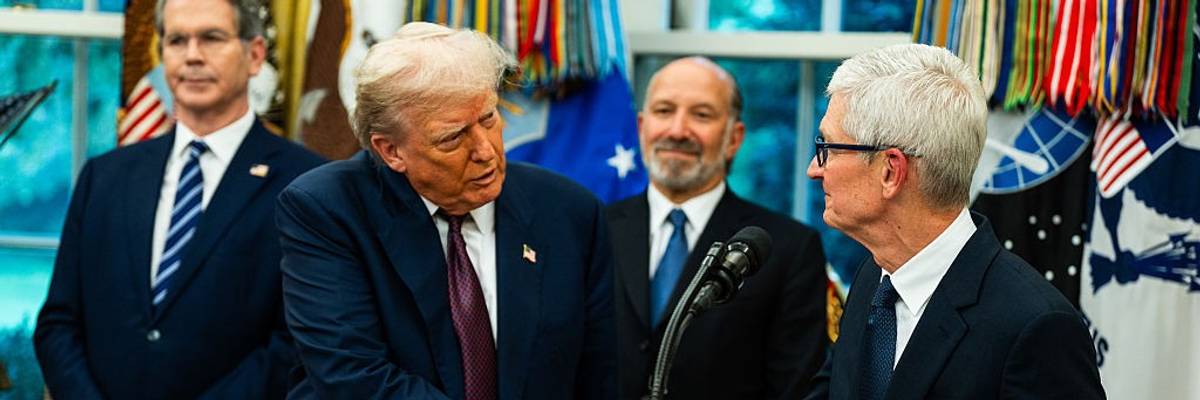
As Families Struggle, Trump Says US Economy ‘Doing Unbelievably From Standpoint of Wall Street’ “Trump’s right. His economy is a win for Wall Street. Meanwhile, while the rich get richer, millions of Americans cannot afford the basic necessities of life.” US President Donald Trump shakes hands with Apple CEO Tim Cook during a meeting in the Oval Office on August 6, 2025. (Photo by Demetrius Freeman/The Washington Post via Getty Images)
President Donald Trump on Friday said that the US economy is “doing unbelievably from the standpoint of Wall Street,” bragging about record equity prices as job and wage growth remain stagnant and millions of Americans struggle to afford groceries.
In remarks to reporters, Trump hailed what he described as “the best market in history” as the S&P 500 index notched its third consecutive week of gains and hovered near its all-time high. The president, a prolific trader who has personally profited from the stock market’s performance, said surging equities are “good for 401(k)s”—retirement accounts that a growing share of Americans are tapping to cover emergency expenses amid a worsening cost-of-living crisis.
“Trump’s right. His economy is a win for Wall Street,” Sen. Bernie Sanders (I-Vt.) said in response to the president. “Meanwhile, while the rich get richer, millions of Americans cannot afford the basic necessities of life—food, housing, healthcare, and a decent retirement.”
The Alliance for Retired Americans, an advocacy group with more than 4 million members across the US, expressed astonishment at Trump’s rosy and narrow assessment of the economy, which the White House posted on its official YouTube page.
“Can’t make it up,” the group wrote on social media. “We don’t live on Wall Street. How is the economy working for you?”
Trump’s comments came the same day that new data showed US consumer sentiment has fallen in August after two consecutive months of improvement, with Americans’ outlook on the nation’s economic conditions worsening across the political spectrum.
Last week, the Labor Department published figures showing that the US economy shed 23,000 jobs in July, wage growth decelerated, and the unemployment rate fell slightly as more people left the workforce.
Despite Trump’s promise to bring them down, prices remain elevated across the economy, driven in part by the president’s illegal war against Iran. Research published last month by the Urban Institute found that American families are increasingly relying on savings and credit—including buy now, pay later programs—to meet their grocery needs.
Americans are also facing what The Century Foundation and Protect Borrowers describe as “a worsening utility debt crisis.”
“Energy bills have increased three times faster than the rate of inflation while Trump has been president,” the groups wrote in an analysis published last month. “The national average monthly utility bill reached $280 in early 2026, a 12% increase since the end of 2024, just before the second Trump administration took office.”
Meanwhile, corporate profits are booming under Trump, with the pharmaceutical industry, Big Oil, and other sectors posting banner earnings.
“Second quarter earnings for S&P 500 companies are on pace to rise 50% year over year, the highest growth rate since the second quarter of 2021,” Yahoo Finance reported.
Pharma Giants Reap Record $300 Billion in Revenue Under Trump as Millions of Americans Ration Medications “Yet again, Trump has betrayed the American people and put billionaires ahead of working families.” US President Donald Trump speaks in the South Court Auditorium of the White House on February 5, 2026. (Photo by Saul Loeb/AFP via Getty Images)
The world’s ten largest pharmaceutical giants reaped around $300 billion in combined global revenue during the first half of 2026 as millions of people in the US—the country with the highest drug prices in the world—stretched, skipped, or rationed doses to afford their medications, despite President Donald Trump’s lofty pledges to slash costs.
An analysis released Thursday by the advocacy group Protect Our Care estimates that Johnson & Johnson, Novartis, AbbVie, Merck, Pfizer, and other pharma behemoths collectively reported $298 billion in revenue in the first half of the year—a $24 billion increase compared to 2025—and distributed $63 billion in benefits to shareholders in the form of share repurchases and dividends.
“The numbers speak for themselves,” said Vaishu Jawahar, director of policy programs at Protect Our Care. “While big drug companies make record-breaking sales, raking in billions more than they did last year, a growing number of Americans are struggling to afford their prescription drugs. Yet again, Trump has betrayed the American people and put billionaires ahead of working families.”
Throughout his second White House term, Trump has made mathematically impossible claims about his efforts to curb drug costs, asserting repeatedly that he has cut prices by upwards of 1,000%. Critics of the Trump administration’s approach have noted that it has relied on voluntary and secretive deals with pharmaceutical companies, which have gone on to raise prices after meeting with the president and showering him with praise.
“Instead of lowering drug prices for seniors, Trump is holding backroom deals with big drug companies and handing them blockbuster giveaways,” said Jawahar. “He has created loopholes for industry giants to evade price negotiations and jack up drug prices for seniors.”
The advocacy group Patients for Affordable Drugs noted in a March report that during the first week of 2026, pharmaceutical companies “increased prices on 64 oncology drugs, with 73% of hikes exceeding inflation.”
Sixty percent of US adults say they are struggling or worried about being able to afford their prescription medications, according to recent polling from the health policy research organization KFF. The group said that number marked the highest level since 2018.
Separate polling released in March by the West Health-Gallup Center on Healthcare in America found that tens of millions of people in the US “said they have made at least one trade-off with daily living expenses to afford healthcare,” including skipping a meal, prolonging a current prescription, and cutting back on utilities.
‘Freezers Are Getting Empty’: US Food Banks Struggle to Meet Demand as SNAP Cuts Rip Through Communities “We are feverishly fundraising and talking to the board about the need to provide grants, but in reality, we are limited,” said the executive director of the Central Illinois Food Bank. People receive food at a distribution station in New York City on November 12, 2025. (Photo by Zhang Fengguo/Xinhua via Getty Images)
Food banks across the US, from New Mexico to Oregon to Illinois, are seeing massive increases in demand as the unprecedented federal nutrition aid cuts that President Donald Trump signed into law last summer take hold, stripping benefits from millions of Americans amid elevated grocery costs—a recipe for disaster.
“Our freezers are getting empty,” Eddie Nelson, the manager of a food bank in Dallas, Oregon, told an Oregon Public Broadcasting reporter earlier this week. The outlet noted that the line for the food bank “stretches out the door and around the corner at the end of the month, when federal food stamp benefits dry up and families struggle to fill their pantries.”
An estimated 4.5 million people, including roughly 1.5 million children, have lost Supplemental Nutrition Assistance Program (SNAP) benefits since the Trump-GOP budget law took effect last year, enshrining around $200 billion in cuts—the largest in the program’s history—as well as new work reporting requirements that are expected to put millions more at risk of losing aid.
The large-scale loss of benefits and expectations of even more hardship in the near future have heavily strained local food banks.
Pam Molitoris, executive director of the Central Illinois Food Bank, said during a panel discussion last month that his organization “cannot absorb” the damage from the federal nutrition cuts, noting that “we are one meal to every nine meals provided by SNAP.”
“We are feverishly fundraising and talking to the board about the need to provide grants, but in reality, we are limited,” said Molitoris.
Roadrunner Food Bank in Albuquerque, New Mexico said it has seen a massive increase in demand this year as the combination of aid cuts and a worsening cost-of-living crisis forces families to seek out charities for assistance. More than 18,000 people lost SNAP benefits in New Mexico between July 2025 and April 2026, according to a tracker maintained by the Center on Budget and Policy Priorities.
“You could look at it like SNAP is the first line of defense against food insecurity in our country; food banks are the last line of defense,” Jason Riggs, Roadrunner’s director of advocacy, said earlier this week. “So the idea is we need both.”
Feeding America, a nonprofit network of hundreds of food banks, says the Trump-GOP cuts to SNAP equate to up to 9 billion meals lost per year—“more than the entire Feeding America network of food banks, meal programs, and church pantries provided last year.”
In the face of growing evidence of the damage their cuts have inflicted on communities across the US, Republican lawmakers have shown no inclination to seriously mitigate the impacts—much less reverse the funding reductions. GOP senators are currently working to advance a farm bill that would only delay for one year the Republican budget law’s potentially catastrophic shift of a significant portion of SNAP costs to states.
Earlier this month, the Republican farm legislation failed to advance out of committee due to Democratic opposition and the absence of Sen. Mitch McConnell (R-Ky.).
“While it is a step in the right direction to give states more time to implement the benefit cost-share, increasing the SNAP cost for states in exchange for a one year delay only increases the unprecedented burden on states. Children will suffer as a result,” said George Kelemen, senior vice president of the No Kid Hungry campaign. “Already, 4.5 million people, including over a million kids, have lost access to SNAP over the past year.”
“Those families are now missing out on the nutritious food SNAP provides,” Kelemen added, “and sadly that number will only grow under this proposal.”
Farage Has ‘Beaten a Man in a Bin,’ But Critics See Tough Road Ahead for Far-Right UK Politician
“Being mocked on stage by a man in a bin does not exactly provide the optics of a heroic struggle against the establishment,” said one critic.
Count Binface arrives for the Clacton by-election at Clacton Leisure Centre in Essex, UK on August 14, 2026. (Photo by Joe Giddens/PA Images via Getty Images)
Nigel Farage, the leader of the UK’s far-right Reform Party, has emerged victorious in a by-election in which his main opponent was Count Binface, a comedian who dresses in an oversized trashcan helmet.
However, some Farage critics predicted his victory would prove fleeting given that he now faces a renewed parliamentary inquiry into an undisclosed £5m gift he received from Christopher Harborne, a Thai-based cryptocurrency billionaire.
Additionally, rival Count Binface received 27% of all votes in the election, a record number for a parody candidate in a race that was boycotted by all major UK political policies.
Writing in The Guardian, columnist Owen Jones described Farage as “a rattled, embattled politician,” noting that the Reform leader did not even attend the official results event, presumably because he found little reason to celebrate having “beaten a man in a bin.”
“Being mocked on stage by a man in a bin,” Jones wrote, “does not exactly provide the optics of a heroic struggle against the establishment.”
Jones said that while it’s too early to write Farage off, he questioned whether the Reform leader is really cut out for the long slog of parliamentary politics.
“Here is a man who appears to enjoy the high life and feel parliamentary politics damages his earning potential,” Jones concluded. “He seems increasingly riled by the sort of scrutiny he has long managed to avoid. Perhaps, after a pointless triumph over a bin, he may simply decide he has had enough.”
In an analysis published Friday by The Washington Post, international correspondent Steve Hendrix wrote that Farage’s own party appears worried that his win over Binface will prove costly, as he “remains in danger of being overcome by the corruption accusations the special election was meant to dispel.”
“Farage had meant for the election to produce a resounding endorsement by his voters, a win to be trumpeted as a rebuke to the establishment,” Hendrix explained. “Instead, he skipped the traditional announcement ceremony Friday and canceled a scheduled speech.”
Binface, meanwhile, declared himself the winner among “the candidates who bothered to turn up for the results” and delivered a “victory speech” in which he crowed about the record number of votes he received against the embattled Reform leader.
“Against Nigel Farage, I’ve got 10,000% more votes than I got against [Labour UK Prime Minister] Andy Burnham,” Binface said. “What does that tell you? Well, it tells you that Nigel, who said he didn’t want to be humiliated, maybe has been... Over one and four people in this constituency would rather have Count Binface as their MP than the leader of Reform UK.”
The Climate Crisis and Its Solutions, by the Numbers
Math illuminates the parameters that humans must live within, and it shines a light on our possibilities. Above all it explains why these are the crucial years: Temperatures and solutions are rising at the exact same moment.
A 2023 billboard campaign by Fossil Free Media shows triple-digit temperatures across much of the United States, "brought to you by Big Oil." (Photo by Fossil Free Media)
Last time I marked the fifth anniversary of this newsletter with a remarkably heavy burst of analysis—a “where do we stand” summary that let me speak at the highest possible level about our past, present, and future. So of course I’m worn out, and perhaps you as well. We’re going to proceed less systematically this time—I’m going to show you some numbers that have arrived in the last few days, and try to make sense of each of them, with only slight regard for how exactly they fit together.
And it’s all a useful reminder that though the climate and energy crises have everything to do with psychology and sociology and economics and political science and theology and love and art and winter, they are rooted in quantifiable physical fact, which cannot be wished away and which must be faced resolutely.
So, to begin:
#76.9°Fahrenheit
That was the average temperature for the lower 48 states in July, according to just-released federal stats, making it the hottest month in American history, 3.3°F hotter than the 20th-century average. As the Wall Street Journal pointed out,Wyoming was the furthest above average for the month. Among other things, this development robs climate deniers of a cherished talking point. July 1936 had been the co-record holder. We understood why—in the words of climatologist Andrew Dessler: During the early 20th century, aggressive plowing and the replacement of native grasses left Great Plains soils exposed. When drought conditions developed, those degraded soils dried out quickly, reducing evaporation and soil moisture and reinforcing the heat.
But try telling that to Fox News. Dessler, by the way, has had a fascinating three-part series on those century-old Midwestern extremes. But now it’s mostly academic; we’re living in a hotter country than any American has ever seen. And indeed a hotter world. As Jeff Masters reports, July 2026 tied for the warmest month in the planet’s history, with July 2024.
#3.6°F
That’s how much temperatures have risen on average in Europe since the 1960s, according to the new State of the Climate 2025 report, which veteran analyst Bob Berwyn broke down this week. Just think about that for a moment, because it helps you to understand the scale of what we’ve done. When you walk outside your home, in Europe or America, it’s 3°F hotter than it would have been a just few decades ago. Think of that amount of extra heat (and remember that ninety percent more is stored away in the oceans, waiting to be released).
Writing from Berlin, Jim Tankersley and Tatiana Firsova offer a vivid account of what that feels like in every day European life: It’s changing the way children see summer.
“Some days it’s too hot, and the heat is just so oppressive. I’m more of a winter person,” said Sophia Nachtsheim, 15, who visited Krumme Lanke on Thursday with her mother and three younger siblings.
#$65 billion
That’s the windfall profit so far for the oil industry thanks to the Iran War, according to a new analysis from the folks at Oil Change International. The five major international oil companies (IOCs) recorded massive jumps in profits in Q2 2026 compared to the same quarter of 2025. Their total adjusted net income amounted to $51 billion for the 3 months—that’s nearly $400,000 per minute. Meanwhile, people around the world are paying around 30% more for gasoline and diesel, with some countries, particularly in Southeast Asia, seeing increases of 80% or more.
It would of course make great sense to tax these windfall profits, earned entirely on the back of dead Iranians and Americans, and everyone who’s paying $4.50 a gallon at the pump. Portugal actually is, at a 33% rate. Exxon’s Darren Woods has responded to wider EU efforts with threats: We canceled investments that we had planned for Europe based on the last time they passed a windfall profits tax. In fact, we’re suing the EU because we don’t think that’s a legal taking for the industry.
#4.8% of Global Energy-Related Carbon Emissions
So far the energy debate around AI has focused on how much electricity it takes to run data centers. But the number above comes from a different heretofore uncounted part of the problem: It’s what a new study says artificial intelligence could add to the atmosphere simply by making it easier for the fossil fuel industry to find and exploit oil and gas wells. Emily Atkin has a top-notch account of the new study, which makes it clear that a data center might as well have an oil derrick sitting on top. She includes these additional numbers: Specifically, they found that Big Oil’s use of AI to produce more oil and gas could create 3.3 to 13.3 times more climate pollution than powering AI’s data centers.
On the low end, these tools could enable additional yearly carbon emissions equal to Mexico’s, according to the research. On the high end, they could enable yearly climate pollution equal to Russia’s—the world’s fourth-largest emitting country.
Meanwhile, I mentioned this parenthetically last week, but it deserves more attention: Climate researcher Zeke Hausfather took the time to calculate how much energy is used when you really use AI “agents” for carrying out tasks. And the answer is: a lot. Asking Claude a question is not so energy-intensive, but as he explained to Robinson Meyer this week: Increasingly AI is being used in an agentic form. And that more means that you give AI a set of instructions or a goal to achieve. And then AI goes off and does many, many, many, things to try to achieve that goal. AI agents are, at least in the corporate world and the software engineering and scientific world, the vast majority of AI use today. And those agents make both much more complicated calls than the prompts would suggest and many, many more calls. And so when you look at the actual energy use of these AI agents, it’s something on the order of 600 times larger per prompt than the traditional, like, type something in a chat box and got to get an immediate response. And so that does end up adding up. I actually looked at two months of my own AI use because I had local logs of all of the numbers there… I found that on average I was using about three kilowatt hours a day for my agentic energy use which is the equivalent of running two refrigerators.
#70%
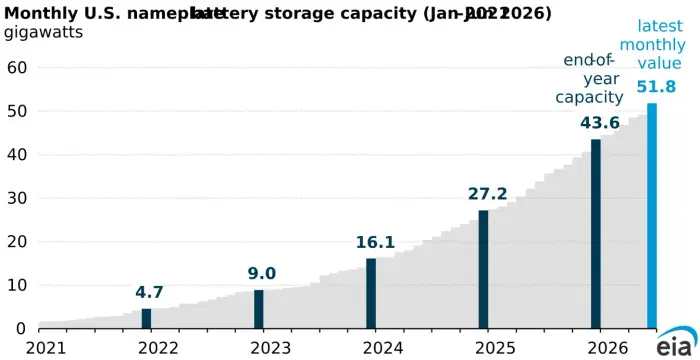
That’s been the average growth in US battery installations over the last three years, according to the US Energy Information Administration, and it’s continuing to accelerate. Here’s the chart:
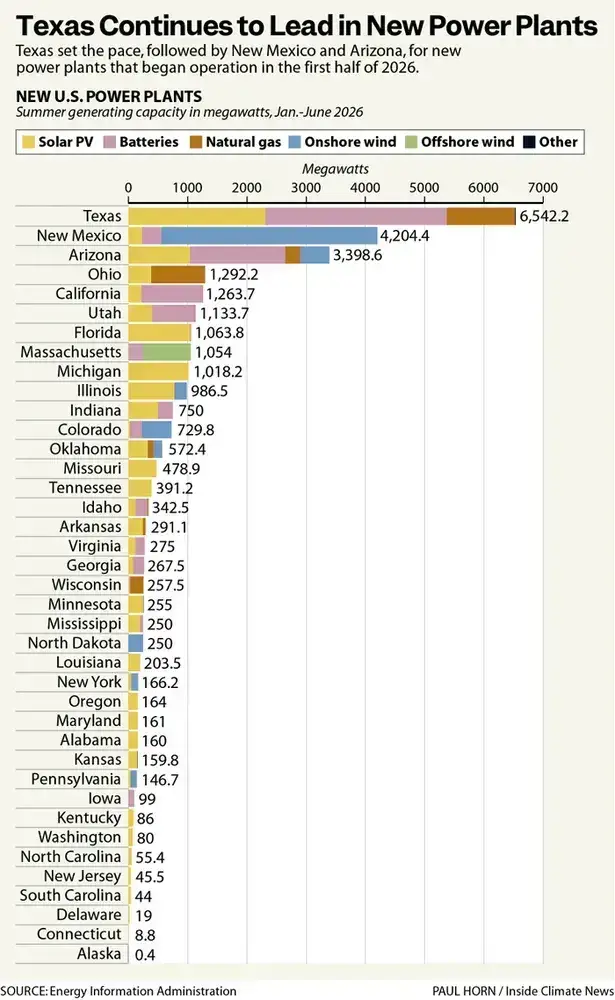
Notice that it’s continuing to rise this year. And as long as we’re doing charts, here it is broken down by state, with batteries in lavender. You’ll note that only four or five states are really participating in the battery revolution so far, which leaves enormous room for rapid growth elsewhere. Batteries are the transformative technology for the second half of this decade, as sun and wind were for the first half. Note also the incredible damage the Trump administration has done to the wind industry.
#44%
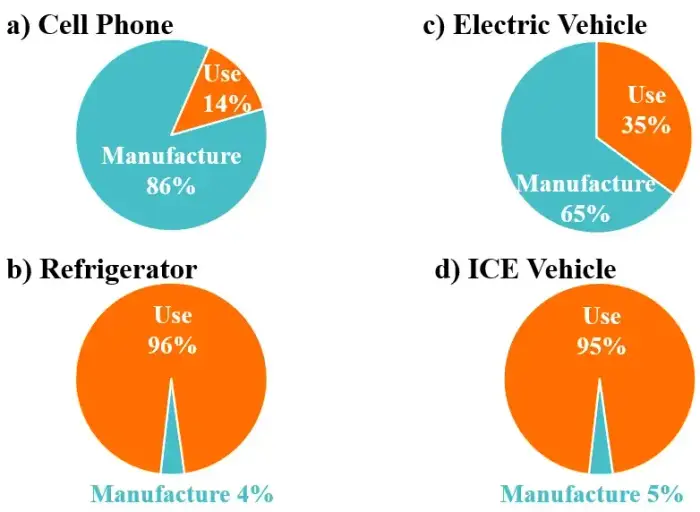
That’s how much you’d save in carbon emissions by retiring your internal combustion engine vehicle (ICEV) and replacing it with an EV—even if it was only two years old, and taking into account the amount of energy used to build both vehicles. A new study in Science from G. Elliott Campbell attempts to answer a question that’s puzzled many good-faith people: Does it really make sense to get rid of my ICEV if I’m worried about the climate. It does, beginning the day you drive it off the lot. It’s somewhat more complicated if you sell your used gas-guzzler to someone else, but as Science editor Jesse Smith notes: The energy impact benefits from swapping an EV for an ICEV begin to accrue as early as the first day of the life of the ICEV, and that replacement early in the life cycle consistently provides reductions in greenhouse gas emissions. Financial considerations will also affect when people choose to make the replacement, of course, but from the perspective of emissions, it is almost never too soon to switch.
As Campbell explained to Tik Root: “We’re trying to show that there’s not an environmental motivation for extending the lifetime of a gas vehicle,” he said. “Electric vehicles are a very clear winner.”
This isn’t true of everything you own, by the way. It basically depends on whether the carbon emissions of the thing mostly come from building it, or from powering it. Hence this chart that Professor Campbell sent me. Hold on to your cell phone another year!
#20 percent
That’s how much of French nuclear capacity is offline due to low river levels with the summer’s heat and fierce drought. (Oh, and a jellyfish invasion at a coastal plant, itself caused by warming seas). As Le Monde reports: According to Agence France-Presse (AFP) calculations based on data published by energy group EDF since 2015, 20.4% of generating capacity was unavailable. Between 9:45 am and 10:00 am, EDF’s nuclear fleet recorded a new peak in outages due to “environmental constraints” or “external environmental causes,” both in terms of the number of reactors shut down or operating at reduced output and in terms of lost generating capacity.
The point is not to say “shut down nuclear power plants.” It’s merely to point out that charge long leveled at sun and wind—that they provide “intermittent power”—is probably truer now of other energy sources (including the natural gas that can get shut down if, say, a war breaks out in the Strait of Hormuz). See the numbers on batteries above—I think it’s pretty clear that once you connect them to a solar or a wind farm you’ve got some of the world’s firmest power. By the way, that’s how BMW has kept its Hungarian plant churning out EVs even as the country’s lone nuke shut down, causing a cascading energy shortage across the country. #22%
That’s how much domestic airline emissions have fallen in Austria over the last three years, since the government banned short haul flights to domestic destinations that were served by trains; something similar happened in France, which passed a more limited version of the same law. As Logan Varsano writes: These initial successes in Austria and France are promising.
They also prompt a number of follow-on questions: What might be the climate benefit if such policies were more broadly adopted across Europe? What if they were implemented beyond Europe’s borders? What if they were applied to short-haul international flights, and not merely domestic routes?
Research published in 2021 found that, in Finland, replacing all short-haul flights with non-high-speed rail could cut emissions by 95%. One year later in 2022, different researchers took a broader look at commercial passenger flights across 31 countries. A 2023 study took a closer look at Spain’s two busiest domestic corridors: Madrid-Barcelona and Madrid-Valencia. In 2024, data from IATA focused a lens back on France. And more recently, a September 2025 study on commercial intra-European aviation concluded that substituting short-haul flights with rail alternatives could reduce a trip’s emissions by up to 97%, depending on the length of the trip.
I’d just add: City center to city center trains are infinitely nicer than dealing with airports, at least for me. Until we get the blimps up and running, more rail please! #5.5°C vs 2°C
This last one is a little complicated, but it underscores the most important point I keep trying to make in this newsletter: We must act fast!
It comes from a new study about the collapse of the Atlantic Meridional Overturning Currents, or AMOC, the most important heat distribution on planet Earth, and one we’re threatening to wreck by raising temperatures. What the study—out Thursday in Nature—calculates is the risk of raising the temperature fast, which is what we’re doing now. On a “slow ramp,” this computer model shows that the currents stay stable until temperatures are raised 5.5°C—which is a lot of breathing room. But if you ramp up the temperature quickly, going past 2°C can shut them down. Rosa van den Dool interviewed one of the study’s authors: The explanation lies in how the ocean is able to adjust to change. “Under slow warming, the entire ocean, from the surface down to its deepest layers, has time to gradually reorganize and adapt to the changing conditions,” says co-author Henk Dijkstra, professor of dynamical oceanography. “Under faster warming, the ocean simply can’t keep up.”
According to the researchers, the critical warming rate lies around 0.3°C per decade, a pace the world is already approaching. Van Westen compares it to driving a car: “If you’re driving toward a wall, it makes sense to steer around it. To do that, you need to brake, otherwise you fly off the road. When it comes to global warming, the world is still pressing extra hard on the accelerator right now.”
Math can’t tell us everything we need to know about the climate crisis. At some level, the crucial calculation is about the size of the human heart, and whether we’re ready to really press for the change that’s required. But math illuminates the parameters that humans must live within, and it shines a light on our possibilities. Above all it explains why these are the crucial years: Temperatures and solutions are rising at the exact same moment. Our job is to see if we can nudge the odds in this race.
And we can, so we must. Thank you for being part of the fight!
Bill Mckibben Bill McKibben is the Schumann Distinguished Scholar at Middlebury College and co-founder of 350.org and ThirdAct.org. His most recent book is "Falter: Has the Human Game Begun to Play Itself Out?." He also authored "The End of Nature," "Eaarth: Making a Life on a Tough New Planet," and "Deep Economy: The Wealth of Communities and the Durable Future." Full Bio >