It’s possible that I shall make an ass of myself. But in that case one can always get out of it with a little dialectic. I have, of course, so worded my proposition as to be right either way (K.Marx, Letter to F.Engels on the Indian Mutiny)
Sunday, August 02, 2026
Indonesian authorities launch rescue operations as ferry fire kills at least five, scores missing
Still from INSRA video / Indonesia’s National Search and Rescue AgencyFacebook
A fire has broken out on a vessel plying one of Indonesia's busiest inter-island transit corridors in Madura, East Java, triggering a multi-vessel search and rescue effort off the coast, Jakarta Globe reports. So far, the latest report reveals that five people have been found dead and at least 41 are still missing.
Reported by the Surabaya Search and Rescue Office (Basarnas), the roll-on/roll-off (Ro-Ro) passenger ferry KMP Mutiara Sentosa 2 caught fire near Madura Island with approximately 271 passengers and crew aboard. The vessel was en route from Tanjung Perak Port in Surabaya to Makassar, South Sulawesi, when the captain reported the onboard fire. Footage played by local Indonesian news outlet iNews records large numbers of people in life jackets on what appears to be a lifeboat.
Nanang Sigit, Head of the Surabaya Search and Rescue Office, confirmed that the emergency alert was received from the Tanjung Perak Harbourmaster's Office at 8:24 am, following initial reports from the vessel's captain between 6:00 am and 7:00 am, before communication was lost. The ferry was located approximately 19 nautical miles off Buruan Sapudi Island when flames engulfed its upper decks. Nearby commercial and tug vessels, including TB Hasnur 26 and the tanker British Mentor, diverted to assist in rescuing passengers who had jumped overboard, while the specialised rescue ship SAR 249 Permadi was deployed to lead evacuation efforts.
In remote maritime corridors, nearby commercial and industrial vessels play an essential role as first responders before specialised Basarnas rescue ships arrive. The rapid spread of flames across passenger decks highlights the need for stricter enforcement of onboard fire suppression systems and emergency power reliability on long-haul Ro-Ro ferries.
Why A Trans-Caspian Pipeline Deserves Renewed Attention – Analysis
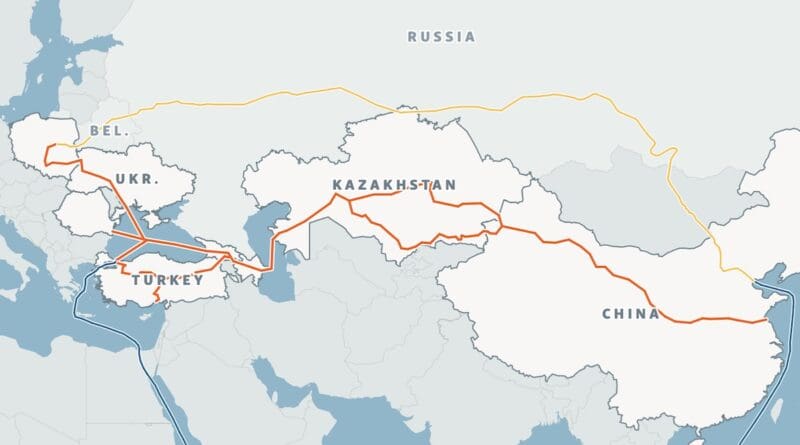
The Middle Corridor -- or the Trans-Caspian International Transport Route -- is a network of roads, railroads, and ports that connect China to Europe. It offers an alternative to a northern route which largely passes through Russia, and to maritime routes. Credit: RFE/RL
US pressure is blocking Iraq’s planned purchase of Turkmen gas because the only delivery route runs through Iranian pipelines, which would generate revenue for Tehran under maximum-pressure sanctions.
A trans-Caspian gas pipeline from Turkmenistan to Azerbaijan has long been blocked by Russian and Iranian geopolitical objections, even though the engineering challenges are manageable and Turkmenistan holds vast underutilized reserves.
Improving Azerbaijan–Turkmenistan relations, US diplomatic support, and the current distractions facing Russia and Iran create a rare window to advance the project, starting with a smaller interconnector as a proof of concept.
This week, the Iraqi government reportedly came under additional US pressure to abandon its planned purchase of natural gas from Turkmenistan. This has nothing to do with Turkmenistan itself, but rather Iran.
Because there is no pipeline directly connecting Iraq with Turkmenistan, both sides would rely on Iranian pipelines to deliver the gas. With the Trump administration reinstituting its campaign of maximum pressure on Tehran, coupled with the ongoing regional conflict, Washington has been reluctant to grant sanctions waivers for Baghdad to purchase Turkmen gas because the arrangement would also generate revenue for Iran.
This episode illustrates how complex the geopolitical situation in the Middle East has become, especially in the context of the conflict involving Iran.
It is also a reminder of the potential of the Middle Corridor — a transportation network linking Central Asia to global markets through the South Caucasus — and highlights why a trans-Caspian pipeline connecting Turkmenistan’s vast natural gas reserves to the South Caucasus, and onward to international markets, deserves renewed attention.
Looking at a map, many would be surprised that no gas pipeline connects the eastern and western shores of the Caspian Sea. The reason for this has much more to do with geopolitics than any engineering or technical challenges.
Russia and Iran have long argued that the Caspian is a shared body of water and that any subsea pipeline should require their approval. As two of the world’s largest natural gas producers, both countries have a strong interest in maintaining their share of global energy markets. Preventing Turkmenistan from exporting its gas across the Caspian has long suited the strategic interests of both Moscow and Tehran.
Natural gas can be transported long distances in liquefied form. However, the liquefaction process is expensive and only economically viable over long distances. In the case of the Caspian, the distance is too short to justify such an investment. A pipeline therefore remains the only economically viable means of transporting Turkmen gas across the sea.
Turkmenistan possesses some of the world’s largest natural gas reserves and has already constructed the East-West Pipeline, which can carry gas from fields in eastern Turkmenistan to the Caspian coast but remains significantly underutilized.
While Azerbaijan has long been enthusiastic about a trans-Caspian pipeline, Turkmenistan has historically been cautious about such a project for fear of antagonizing Russia, Iran and even its largest customer, China. Nevertheless, there are growing signs that the political mood in Ashgabat might be changing. For several reasons, there has rarely been a better opportunity to place the trans-Caspian pipeline back on the regional agenda.
Firstly, regional politics are becoming more favorable. Last month, the Turkmen president, Serdar Berdimuhamedow, visited Baku to meet his Azerbaijani counterpart, Ilham Aliyev. It was the first visit by a Turkmen president in more than three years. Although the two leaders made no explicit reference to constructing a trans-Caspian pipeline, their discussions placed considerable emphasis on the expansion of energy cooperation.
The visit followed the landmark 2021 agreement between Azerbaijan and Turkmenistan to jointly develop the formerly disputed Dostluk offshore field (“dostluk” means “friendship” in both the Azerbaijani and Turkmen languages), ending a decades-long disagreement that had hindered meaningful energy cooperation. Today, relations between Baku and Ashgabat are arguably stronger than at any point since both countries gained independence.
At the same time, the Turkmen foreign minister, Rashid Meredov, recently visited Washington to meet Secretary of State Marco Rubio. In the official readout of the meeting, Rubio stated that he “expressed strong US support for diversifying Turkmenistan’s natural gas exports through trans-Caspian routes.” This is arguably the clearest public endorsement of a trans-Caspian gas corridor by any US administration in more than two decades.
Secondly, the pipeline’s two principal opponents are increasingly distracted. Russia remains consumed by its war against Ukraine, while Iran continues to face sustained economic and military pressure from the US. A project that once would have attracted intense opposition from both capitals is now unlikely to rank as highly among their strategic priorities.
Thirdly, President Donald Trump has placed greater emphasis on strengthening US relations with the countries of Central Asia and the South Caucasus than any previous administration. His administration has elevated engagement with the five Central Asian republics while also supporting efforts to broker peace between Armenia and Azerbaijan, including initiatives to improve regional transportation links connecting Central Asia with global markets. A trans-Caspian pipeline would fit neatly within this broader strategic vision, as Rubio’s comments suggest.
Finally, there is a clear market for Turkmen gas. China remains Turkmenistan’s largest customer but policymakers in Ashgabat must recognize the risks of becoming overly dependent on a single buyer. Europe, Turkiye and Iraq would all benefit from greater access to Turkmen gas, making export diversification both commercially attractive and strategically prudent.
None of this suggests that a Trans-Caspian pipeline could be built overnight. Even if Russia and Iran are temporarily distracted, both countries will continue to discourage Ashgabat from pursuing such a project.
As a practical first step, Azerbaijan and Turkmenistan should consider constructing a shorter, interconnector pipeline linking their existing offshore infrastructure in the Caspian. Such a project would serve as both a confidence-building measure and proof of concept, demonstrating that the two shores of the Caspian can indeed be connected by a pipeline while minimizing unnecessary political friction with Moscow and Tehran.
Over time, as geopolitical conditions become more favorable, that interconnector could evolve into a fully fledged trans-Caspian pipeline. Such a project would strengthen global energy security during a period of continuing uncertainty, provide new economic opportunities for the countries of the South Caucasus and Central Asia, and even help countries farther away, such as Iraq, diversify their energy imports.
The opportunity is there. The question is whether policymakers will be bold enough to seize it.
Luke Coffey is a senior fellow at the Hudson Institute.
UAE Seeks To Ease Tensions With Iran While Deepening Military Ties With US, Israel
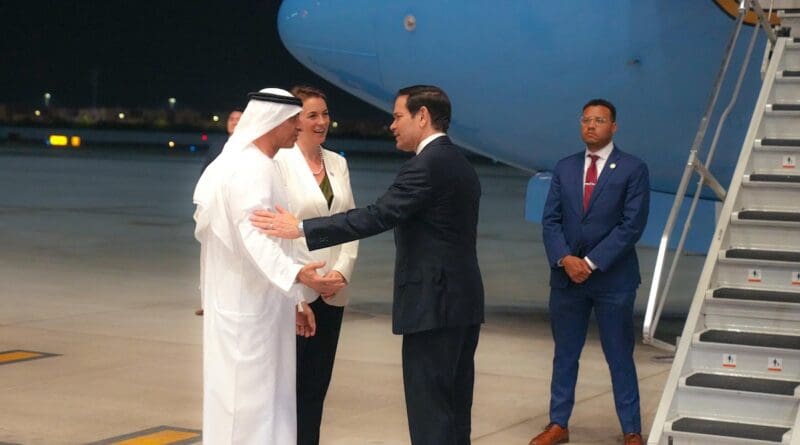
Secretary Marco Rubio is greeted by UAE Ambassador Yousef Al Otaiba and CDA Shannon Dolan as he arrives in Abu Dhabi, United Arab Emirates, June 23, 2026. (Official State Department photo by Freddie Everett)
The UAE is pursuing a dual strategy of easing tensions with Iran through high-level diplomatic contacts while simultaneously strengthening military and security ties with the United States and Israel.
After suffering nearly 3,000 Iranian missile and drone attacks earlier in the conflict, Abu Dhabi has shifted toward de-escalation, including limited restoration of some Iranian residency permits, driven largely by economic interests in Dubai’s trade with Iran.
The approach reflects a calculated balancing act: protecting economic links with Iran while relying on Western and Israeli security partnerships amid ongoing regional instability.
The United Arab Emirates (UAE) is seeking to ease tensions with Iran while strengthening its military and security cooperation with the United States and Israel, a balancing act aimed at protecting its economy and security interests amid heightened regional tensions.
The Financial Times, citing people familiar with the matter, reported that UAE President Sheikh Muhammad bin Zayed Al Nahyan has tasked three of his brothers with managing contacts with Tehran in an effort to reduce tensions: Vice President Sheikh Mansour bin Zayed Al Nahyan, Foreign Minister Sheikh Abdullah bin Zayed Al Nahyan, and National Security Adviser Sheikh Tahnoon bin Zayed Al Nahyan.
Recent phone calls between Mansour bin Zayed and Iranian Parliament Speaker Mohammad Baqer Qalibaf, and between Abdullah bin Zayed and Iranian Foreign Minister Abbas Araqchi, are among the signs of the diplomatic effort, according to the Financial Times.
The UAE began pursuing the policy after a fragile cease-fire between Iran and the United States and stepped up those efforts following a memorandum of understanding between Tehran and Washington on June 12.
The renewed tensions in recent weeks have put the strategy to the test.
In the latest escalation, Iran launched missile and drone attacks against several Gulf states, including Jordan, Kuwait, Bahrain, Qatar, and Saudi Arabia, while the UAE has sought to avoid a direct military confrontation with Tehran.
That marks a notable shift from the earlier phase of the conflict, when the UAE was among the hardest-hit targets of Iranian missile and drone attacks, with the UAE’s Foreign Ministry reporting nearly 3,000 strikes.
Iranian Community Takes A Hit
The UAE has also taken steps affecting its large Iranian community. During the conflict, it suspended the residency permits of about 20,000 Iranian residents who were outside the country.
There have since been reports that some residency permits are being reactivated.
Two Iranians living in the UAE told RFE/RL’s Radio Farda that the residency permits of some of their relatives had been restored, although hundreds of others were still waiting for their permits to be reinstated.
Radio Farda also contacted travel agencies familiar with the matter and found that tourist visas for Iranians were still not being issued.
An Iranian community activist in the UAE said no new residency applications for Iranians were currently being processed, while visas for people whose existing residency permits are expiring were being renewed.
The UAE’s efforts to maintain ties with Iran are also driven by economic considerations, particularly in Dubai, which is home to hundreds of thousands of Iranians. Economic Interests
In its report, The Financial Times quoted a Dubai official as saying Iran’s large population and consumer market make the country important to Dubai as a trade and re-export hub.
The official said Iran’s large population and consumer market offer significant benefits to Dubai as a trading and re-export center, and that maintaining those economic ties was important to restoring normal relations.
An Emirati businessman told the newspaper that doing without trade with Iran was possible but difficult.
The businessman said that while he could replace many items, some inexpensive goods, such as tomatoes, were difficult to replace.
The conflict between Iran, the United States and Israel also contributed to inflation in the UAE, although the government has taken measures to contain price increases.
An Iranian businessman who runs a shop selling Iranian products in Dubai told Radio Farda that Iranian goods were still entering the UAE, but the crisis around the Strait of Hormuz had pushed prices higher.
“For example, caviar comes through Oman, while some goods reach the UAE through the port of Fujairah, which is outside the Strait of Hormuz. And with the resumption of flights between Iran and the UAE, many goods reach us by air, carried by passengers.”
The businessman said he had even developed a relationship with a co-pilot who helped him purchase some products from Iran.
The UAE said it was targeted by about 3,000 Iranian missile and drone attacks during the first phase of the conflict, adding that most were successfully intercepted.
The attacks prompted Abu Dhabi to take a more confrontational stance toward Tehran, and there were reports that the UAE had participated in some attacks on Iran.
The Financial Times described the UAE’s approach as a bold gamble: cautiously reactivating diplomatic and economic channels with Iran while simultaneously deepening its military relationship with Israel and the United States.
For Abu Dhabi, the strategy reflects the challenge of balancing its dependence on Western security partnerships with the economic and strategic importance of maintaining workable relations with its powerful neighbor across the Gulf.
About RFE RL RFE/RL journalists report the news in 21 countries where a free press is banned by the government or not fully established. View all posts by RFE RL →
United Arab Emirates Energy Profile: Ninth-Largest Total Liquid Fuels Producer In The World – Analysis
The United Arab Emirates (UAE) was the ninth-largest total liquid fuels producer in the world in 2025 and was the fourth largest in the Organization of Petroleum Exporting Countries (OPEC). The UAE joined OPEC in 1967 and, with Saudi Arabia, was one of the few members that had notable spare crude oil production capacity to address potential supply shortfalls at the beginning of 2026.1 The UAE departed OPEC beginning on May 1, 2026.2
Since 2018, the UAE has invested heavily in increasing its hydrocarbon production capacity and developing midstream and downstream infrastructure to accommodate future growth in hydrocarbon production.3 At the same time, the UAE has increasingly developed other energy sources such as nuclear and solar to diversify its domestic power generation mix and reserve more of its hydrocarbon production for export.4
In April 2025, OPEC+ began to phase out its production cuts, which led to a substantial increase of crude oil supply in the market, applying downward pressure on global oil prices.5 OPEC+ members, including the UAE, increased crude oil production from 2024 to 2025 after the group raised production targets.
In March 2026, Iran effectively closed the Strait of Hormuz in its war with the United States, which shut in significant levels of production for the Persian Gulf countries inside of the strait, including the UAE. Crude oil and condensate production in the UAE dropped from 4.0 million b/d at the beginning of 2026 to an estimated average of 2.4 million b/d from March through May 2026.6
Petroleum and other liquids
According to the latest estimates by OPEC’s 2026 Annual Statistical Bulletin, the UAE held an estimated 120 billion barrels of proven crude oil reserves in 2025.7
The UAE produces a variety of crude oil grades: its two main export grades are Murban and Upper Zakum, which are light, relatively sour crude oil grades. Some of the UAE’s crude oil grades are included in the collection (or basket) of crude oils that make up the Dubai/Oman benchmark, one of three major international price benchmarks (Table 2).8
Crude oil grade
API gravity number (degrees)
Sulfur content (percentage)
Das
39.1
1.14%
Dubai
30.4
2.13%
Murban
40.0
0.77%
Umm Lulu
38.9
0.70%
Upper Zakum
33.2
2.09%
Data source: Platts S&P Global, Commodity Insights
The UAE produced an average of almost 4.0 million barrels per day (b/d) of liquid fuels from 2016 to 2025. Crude oil and condensate production in the UAE had been increasing steadily and rose to approximately 3.4 million b/d in 2019. In 2020, the UAE began to curb its crude oil production following the slowdown in global economic activity caused by the outbreak of COVID-19 and the April 2020 agreement among OPEC+ member countries to significantly limit their crude oil production. As the voluntary production cuts were gradually unwound, the UAE produced more crude oil. In 2025, the UAE’s crude oil and condensate production reached 3.8 million b/d.9
The UAE government has set a target of increasing crude oil production capacity to 5 million b/d by 2027. To achieve this goal, the government has made efforts to boost upstream exploration and development. UAE’s national oil company, the Abu Dhabi National Oil Company (ADNOC), also plans capital expenditure of $150 billion for the years 2026 to 2030 and unveiled expansion plans for increasing production at oil fields such as the Nasr, Upper Zakum, and Lower Zakum fields.10 According to Energy Intelligence, ADNOC reported that its official production capacity is 4.85 million b/d, which is significantly higher than EIA’s 2025 estimate of 4.15 million b/d and the International Energy Agency’s latest estimate of about 4.3 million b/d.11
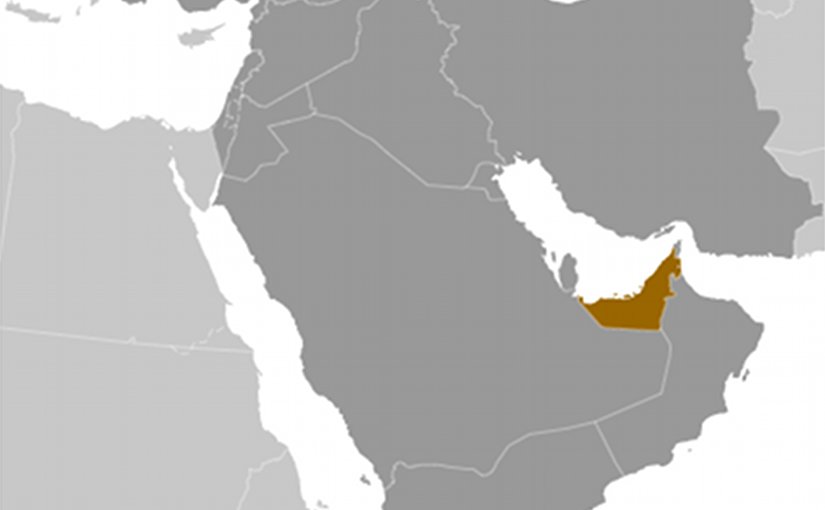
Location of United Arab Emirates. Source: Wikipedia Commons.
The UAE completed the construction of an underground crude oil storage facility in Fujairah in 2023 in what was reported as the world’s largest single storage project at the time of approval in 2019. The crude oil storage facility has a reported capacity of 42 million barrels and can store three different grades of crude oil, which provides the UAE more flexibility to export crude oil through its port and enable the country to boost its total production capacity to its target of 5 million b/d. The UAE also leases strategic crude oil storage sites in South Korea, Japan, and India, although the exact volumes stored in each location are unclear.12
The UAE currently operates the 1.8 million-b/d Abu Dhabi Crude Oil Pipeline that circumvents the Strait of Hormuz by transporting Murban crude oil from inside the strait to the port of Fujairah located just outside of Hormuz. ADNOC is constructing a second pipeline with a capacity of 1.5 million b/d that can allow crude oil to bypass the strait and expects the pipeline to be operational by 2027.13The UAE is one of the few Persian Gulf countries that can bypass the Strait of Hormuz chokepoint and has been able to continue producing and exporting some crude oil, albeit at a lower level than at the beginning of 2026, during the effective closure of the strait.
As of January 2026, there were five refineries operating in the UAE with a total capacity of 1,249 thousand b/d; the country’s sixth refinery, the 74,000 b/d Umm al-Nar refinery, was permanently shuttered in 2021 (Table 3).14 Ecomar Energy Solutions is pursuing an expansion project that could nearly triple capacity at its refinery in Fujairah to 62,000 b/d. The expansion project includes the construction of an additional crude oil distillation unit and new storage capacity.15 The Emirates National Oil Company (ENOC) is also considering a proposal to upgrade the Jebel Ali refinery in Dubai, which could potentially boost capacity at the refinery to 250,000 b/d. As of October 2025, the proposed upgrade plan was still in preliminary stages of development, and no completion date has been reported.16
Refinery name Location Status Owner
Nameplate capacity (thousand barrels per day)
Ruwais Abu Dhabi Operating ADNOC 817 Jebel Ali Dubai Operating Emirates National Oil Company (ENOC) 210 VTTI Fujairah FZC-1 Fujairah Operating VTTI 120 VTTI Fujairah FZC-2 Fujairah Operating VTTI 80 Ecomar Fujairah Operating Ecomar 22 Total 1,249
Data source: Fitch Solutions Country Risk and Industry Research reports
Natural Gas
According to latest estimates in OPEC’s 2026 Annual Statistical Bulletin, the UAE held an estimated 297 trillion cubic feet (Tcf) of proven natural gas reserves in 2025.17
Dry natural gas production averaged about 2.0 Tcf between 2015 and 2024 while dry natural gas consumption averaged about 2.4 Tcf in the same period. Although the UAE exports natural gas in the form of liquefied natural gas (LNG), it is a net importer of natural gas because domestic natural gas consumption exceeds production. The UAE relies on natural gas imports via pipeline or as LNG from other countries, primarily Qatar, to meet its domestic demand for natural gas.18
The UAE is seeking to raise its natural gas production and become a net exporter of natural gas by 2030. To achieve this goal, it plans to develop some of its offshore natural gas fields in the Hail and Ghasha concessions as well as unconventional natural gas resources in the Ruwais Diyab concession. However, the country faces challenges in reaching its goal of becoming a net exporter because of rising domestic demand as well as technical and financial challenges to developing some of its natural gas fields, which produce highly sour natural gas. These fields have a relatively high proportion of acidic gases such as hydrogen sulfide, which is toxic and corrosive to certain metals and so must be separated during natural gas extraction and processing. The additional steps in processing sour natural gas make it more expensive and difficult to exploit these resources.19
According to the most recent data by the World Bank’s Global Gas Flaring Reduction Partnership, the UAE flared about 48 Bcf of natural gas in 2025, making the UAE the 15th-largest natural gas-flaring country in terms of annual natural gas-flaring volume for that year.20
Coal
The UAE does not hold any coal reserves and does not produce any coal. Coal is primarily used in industrial processes in the UAE, with consumption averaging about 2.9 million short tons per year from 2015 to 2024, all of which was imported21
Electricity
While natural gas remains the dominant fuel source for electricity capacity and generation, solar and nuclear have become a significantly larger share of the country’s power generation mix over the past decade. Total electricity capacity in the UAE grew by about 16.8 gigawatts (GW) from 2015 to 2024. About 75% of total capacity in 2024 is derived from fossil fuels, primarily natural gas, while the remainder came from nuclear and solar energy sources. In a similar vein, total electricity generation in the UAE grew by about 41.6 gigawatthours (GWh) from 2015 to 2024. Much of this growth was driven by the increasing development and use of nuclear and solar energy for power generation; in 2024, 28% of total electricity generation was derived from nuclear and solar energy combined, up from less than 1% a decade ago.22
Coal use for power generation was phased out in 2022 when the Hassyan Energy Company, a joint venture between the Dubai Electricity and Water Authority (51%) and a consortium comprised of ACWA Power, Harbin Electric, and the Silk Road Fund (49%), made a decision to convert the power generation units operating at the Hassyan power plant to solely use natural gas as a feedstock, in line with Dubai’s Clean Energy Strategy, which calls for reduced carbon emissions.23
The growth of solar and nuclear energy in UAE’s power generation mix is due to efforts by the government to diversify its power generation mix and meet its growing domestic power generation needs. The UAE’s Net Zero 2050 Strategy is a comprehensive national action plan to achieve carbon neutrality by 2050. The Net Zero 2050 Strategy set emission reduction targets as well as strategic initiatives focusing on key sectors such as power, industry, transport, buildings, waste, and agriculture that aim to improve efficiency and increase deployment of renewable energy sources.24
The Barakah power plant is the UAE’s first commercial nuclear power plant and is located in the Al Dhafra region, which is in the western part of the country. The first unit of the Barakah nuclear power plant went into commercial operation in 2020. The plant has a total capacity of 5.6 GW and became fully operational when it brought online the fourth and final planned unit in September 2024.25
The share of solar power in UAE’s power generation mix has increased significantly over the past decade, as a result of UAE’s clean energy initiatives and strategic investments in solar energy for generation, such as the Mohammed bin Rashid Al Maktoum Solar Park (Maktoum), a multiphase solar park that aims to add over 8 GW of total capacity upon completion in 2030. The Maktoum solar park is in its sixth phase of construction, and its total capacity will increase to about 4.7 GW by the end of 2026. In October 2025, Masdar, a clean energy company based in Abu Dhabi, began the construction of a 5.2 GW integrated solar power and battery storage plant that would enable the facility to provide electricity from a renewable source on a continuous basis, although the power plant will also deploy a 1 GW gas turbine to ensure electricity supply security for the facility. The project, estimated to cost about $6 billion, is being jointly developed by Masdar and state utility company Emirates Water and Electricity Company; Masdar aims for a completion date in 2027.2
The Fujairah F3 power plant began commercial operations in July 2025, providing an additional 2.4 GW of total electricity capacity. The Fujairah F3 power plant is the largest combined cycle gas turbine (CCGT) power plant in the UAE. The Fujairah F3 plant is located in the Fujairah water and electricity complex in Ras Al Qidfa; it is owned and operated by Fujairah Power Company F3, a joint venture comprised of the Abu Dhabi National Energy Company (TAQA), Mubadala Investment Company, Marubeni Corporation, and Hokuriku Electric Power Company.27
Energy Trade
The UAE is a major exporter of crude oil and condensate, averaging about 3.1 million b/d of crude oil and condensate exports between 2022 and 2025, according to estimates by Vortexa. The UAE also imports crude oil and condensate to be used for domestic refining and consumption, and imports were around 280,000 b/d in 2025.28
According to Vortexa, the UAE exported about 3.2 million b/d of crude oil and condensate in 2025, nearly all of it (99%) going to the Asia and Oceania region. Japan and China were the top two importing countries by volume. Japan imported 778,000 b/d of UAE crude oil and condensate, and China imported 700,000 b/d. The remainder of UAE’s exports went to Europe, the United States, and Oman . The UAE’s imports of crude oil and condensate came from a wider range of countries, and Africa and the Middle East were the top two regions by volume. Libya and Qatar were the top two exporters of crude oil and condensate to the UAE by volume for their respective region29
The UAE imports and exports a wide range of petroleum products. According to estimates of trade flows by Vortexa, the UAE exported an average of 1.9 million b/d of petroleum products from 2019 to 2025; around 46% of total exports were either liquefied petroleum gas (LPG) or naphtha. The UAE also imported an average of about 1.0 million b/d of petroleum products during the same period, about 82% of total imports were diesel, gasoline, jet fuel, or fuel oil.30
The UAE exported an average of about 264 Bcf per year of natural gas and imported an average of about 717 Bcf per year from 2015 to 2024. UAE exports all of its natural gas as LNG, but it imports natural gas in the form of LNG through its regasification terminals and piped natural gas from Qatar. The UAE receives piped natural gas imports from Qatar via the Ras Laffen-UAE pipeline (also known as the Dolphin Gas project or the Dolphin Qatar-UAE natural gas pipeline), which began commercial operations in 2006. The pipeline has a capacity of 3.2 Bcf per day (or about 1.2 Tcf per year) and is about 230 miles in length. The pipeline is owned and operated by Dolphin Energy, a joint venture by Mubadala Development Company, TotalEnergies, and Occidental Petroleum, and transports natural gas from Qatar’s North Field to UAE’s onshore receiving facilities in Taweelah.31
The UAE has one operating liquefaction terminal (used for exporting natural gas as LNG) and two operating floating storage regasification units (used for importing LNG), enabling the country to participate in both the export and import of LNG. The liquefaction terminal has been operating since the late 1970s and is owned by ADNOC LNG through a joint venture between the national oil company and private investors. The floating storage regasification units began commercial operations in the 2010s and are owned by Excelerate Energy. The UAE’s national oil company ADNOC is seeking to expand its LNG export capacity by constructing another LNG terminal with a proposed capacity of 461 Bcf per year in Abu Dhabi. The project is currently under construction and is aiming to start commercial operations in 2028 (Table 4).32
Project name
Location
Status
Ownership
Start date
Number of storage tanks
Storage capacity (million cubic feet)
Nameplate capacity (billion cubic feet per year)
Das Island T1 – T3 liquefaction terminal (ADNOC LNG)
Abu Dhabi
Operating
ADNOC LNG (ADNOC 70%; Mitsui 15%; BP 10%; TotalEnergies 5%)
Data source: International Group of Liquefied Natural Gas Importers, GIIGNL 2025 Annual Report Note: FSRU = floating storage and regasification unit, LNG = liquefied natural gas
According to estimates in the Energy Institute’s 2025 Statistical Review of World Energy, the UAE exported all its LNG to countries in the Asia and Oceania region in 2024. India was the top importing country, taking 54% of UAE’s total LNG exports. Japan and China were the second- and third-largest importers of UAE’s LNG taking about 15% and 44 Bcf 14% of UAE’s LNG, respectively.33
The UAE imports most of its natural gas via pipeline, all of which is piped from Qatar. The country, however, also imports small quantities of natural gas in the form of LNG. In 2024, the UAE imported 42 Bcf of LNG, of which about 39 Bcf came from Qatar. The remainder was imported from the United States.34
The UAE imports all the coal it consumes and primarily imports metallurgical coal, bituminous coal, and subbituminous coal. The UAE imports only small quantities of anthracite and lignite coal.35
“United Arab Emirates Oil & Gas Report October 2025,” Fitch Solutions Country Risk Industry Research, October 2025. “Abu Dhabi Plans Drilling Ramp Up,” Middle East Economic Survey, Vol. 65, Issue 7, February 18, 2022. “Adnoc Drilling Eyes Year Of Growth Ahead,” Middle East Economic Survey, Vol. 64, Issue 45, November 12, 2021. John Benny, ed. Luke Johnson, “UAE Gains Momentum in Plans to Expand Output Capacity,” Energy Intelligence, November 6, 2025. John Benny, ed. Deb Kelly, “Adnoc Sets $150B Capex Target, Eyes Higher Ghasha Output,” Energy Intelligence, November 25, 2025. John Benny, ed. Casey Merriman, “Upper Zakum Expansion Plan Headlines Adnoc-US Deals,” Energy Intelligence, May 16, 2025. John Benny, ed. Deb Kelly, “Adnoc Outlines Plan to Hit 5M b/d Target, Boost Gas Output,” Energy Intelligence, November 7, 2025. John Benny, ed. Deb Kelly, “Adnoc to Expand Nasr Capacity as Target Nears,” Energy Intelligence, January 27, 2026.
“United Arab Emirates Oil & Gas Report October 2025,” Fitch Solutions Country Risk Industry Research, October 2025. Oliver Klaus and John Benny, ed. Luke Johnson, “UAE Oil Capacity Growth in Focus Amid Expansions,” Energy Intelligence, July 31, 2025. John Benny, ed. Luke Johnson, “UAE Gains Momentum in Plans to Expand Output Capacity,” Energy Intelligence, November 6, 2025. John Benny, ed. Deb Kelly, “Adnoc Outlines Plan to Hit 5M b/d Target, Boost Gas Output,” Energy Intelligence, November 7, 2025. John Benny, ed. Deb Kelly, “Adnoc Sets $150B Capex Target, Eyes Higher Ghasha Output,” Energy Intelligence, November 25, 2025. International Energy Agency, Oil Market Report, 21 January 2026.
Claudia Carpenter, ed. Aastha Agnihotri, “Ecomar expanding Fujairah refinery, storage capacity as Murban seen adding demand,” S&P Global Commodity Insights, March 22, 2021. “United Arab Emirates Oil & Gas Report August 2025,” Fitch Solutions Country Risk Industry Research, July 2025. “United Arab Emirates Oil & Gas Report October 2025,” Fitch Solutions Country Risk Industry Research, October 2025.
Oliver Klaus, ed. Massoud Derhally, “Enoc Weighs Dubai Refinery Expansion,” Energy Intelligence, May 21, 2024. “United Arab Emirates Oil & Gas Report October 2025,” Fitch Solutions Country Risk Industry Research, October 2025.
U.S. Energy Information Administration, International Energy Statistics database, accessed February 19, 2026.
John Benny, ed. Deb Kelly, “Adnoc Outlines Plan to Hit 54M b/d Target, Boost Gas Output,” Energy Intelligence, November 7, 2025. John Benny, ed. Deb Kelly, “Adnoc Sets $150B Capex Target, Eyes Higher Ghasha Output,” Energy Intelligence, November 25, 2025. John Benny, ed. Deb Kelly, “Adnoc’s Unconventional Gas Strategy Takes Shape,” Energy Intelligence, October 10, 2025. John Benny and Yousra Samaha, ed. Michael Sultan, “Mideast Gulf Giants Advance Gas Projects,” Energy Intelligence, December 11, 2025. John Benny, ed. Deb Kelly, “Adnoc Secures $11B in Financing Against Hail, Ghasha Output,” Energy Intelligence, December 18, 2025. John Benny, ed. Deb Kelly, “Adnoc Green-Lights Sarb Deep Gas Project,” Energy Intelligence, January 8, 2026. “Adnoc’s Growing Gas Ambition Has Europe in Mind,” Energy Intelligence, April 20, 2023. “UAE on track to become a net gas exporter by 2027,” Rystad Energy, August 11, 2022. “New gas discoveries and alternative supply sources will make UAE self-sufficient,” Rystad Energy, October 28, 2020. “UAE to tap sour gas fields to go from importer to exporter by 2030,” Rystad Energy, July 4, 2019. Abdelghani Henni, “Extracting Profits From Abu Dhabi’s Sour Gas,” Journal of Petroleum Technology, February 18. 2013. W.F.J. Burger, et al., “Worldwide development potential for sour gas,” Energy Procedia, Vol. 4, 2011, pg. 2178 – 2184. Prateek Pandey, “Billions of Barrels at Risk in Southeast Asia Due to Sour Gas,” paper presented at Offshore Technology Conference Asia, March 23, 2022, published March 18, 2022.
U.S. Energy Information Administration, International Energy Statistics database, accessed February 19, 2026. International Energy Agency, “United Arab Emirates,” IEA country profile, accessed January 9, 2026.
U.S. Energy Information Administration, International Energy Statistics database, accessed October 17, 2025. “Dubai’s Renewables Capacity Pushes Past 1.5GW,” Middle East Economic Survey, Vol. 65, Issue 03, January 21, 2022.
Vortexa trade flows database, accessed June 11, 2026.
Vortexa trade flows database, accessed June 11, 2026.
Vortexa trade flows database, accessed June 15, 2026.
U.S. Energy Information Administration, International Energy Statistics database, accessed February 19, 2026. “Dolphin Gas Project, Ras Laffen,” Hydrocarbons Technology, accessed December 23, 2025. “Dolphin Qatar–UAE Natural Gas Pipeline,” Global Energy Monitor, accessed December 23, 2025. “Operations,” Dolphin Energy company website, accessed December 23, 2025.
The International Group of Liquefied Natural Gas Importers, GIIGNL 2025 Annual Report, May 20, 2025. “Ruwais LNG,” ADNOC company website, accessed December 23, 2025. “Ruwais LNG terminal,” Global Energy Monitor, accessed December 23, 2025. John Benny, ed. Michael Sultan, “Adnoc Gas CEO: Ruwais LNG ‘Ahead of Schedule,’” Energy Intelligence, January 20, 2026.
U.S. Energy Information Administration, International Energy Statistics database, accessed February 19, 2026.
About EIA
The U.S. Energy Information Administration (EIA) collects, analyzes, and disseminates independent and impartial energy information to promote sound policymaking, efficient markets, and public understanding of energy and its interaction with the economy and the environment. View all posts by EIA →