Monday, August 10, 2026

In Weimar, a festival preserves Yiddish culture while reinventing it
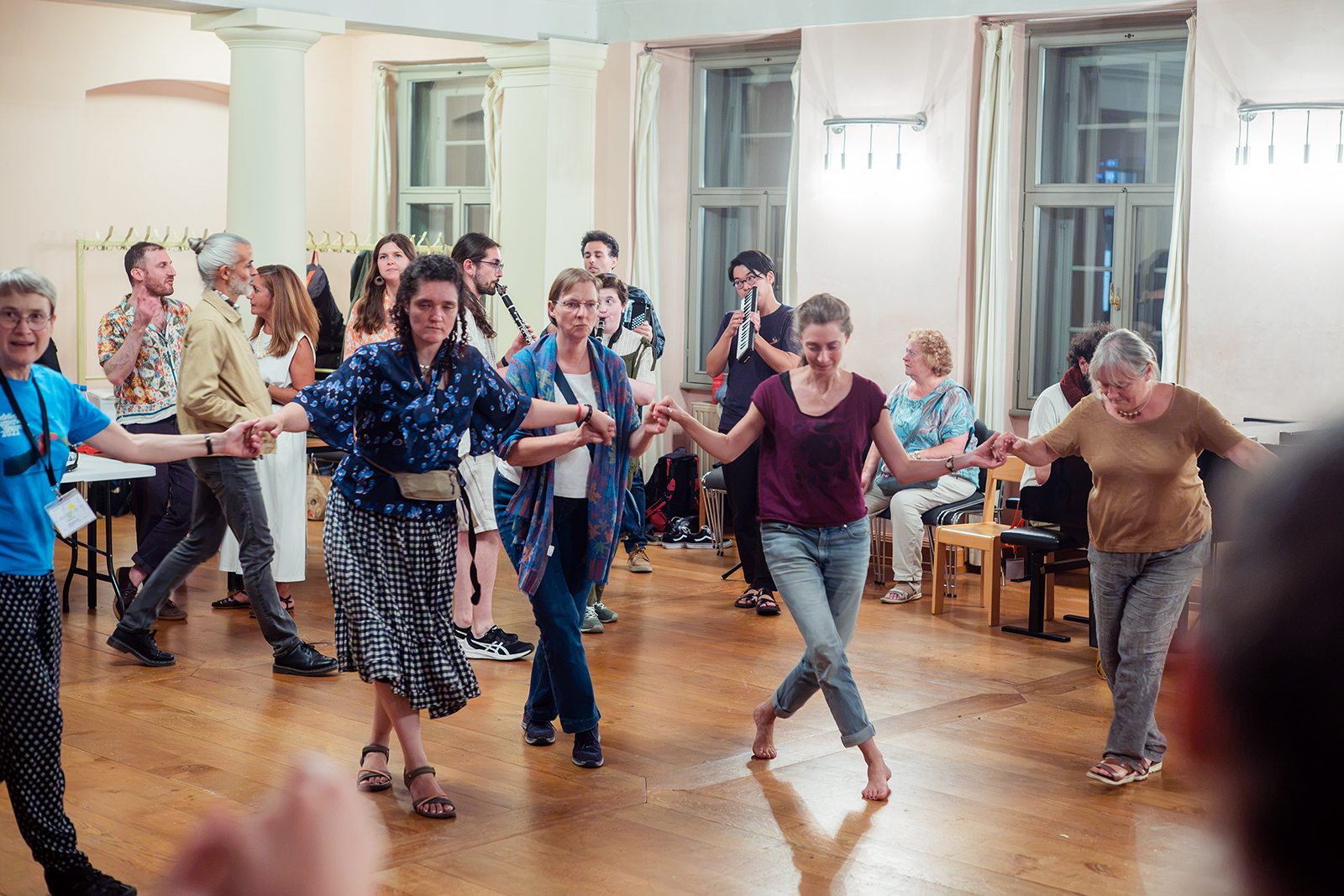
(RNS) — Since its start, the festival has grown from a weekend workshop with a handful of participants to the largest festival of its kind in Europe.
Attendees dance during a Yiddish Summer Weimar event on July 24, 2026, in Weimar, Germany. (Photo by Shendl Copitman)


WEIMAR, Germany (RNS) — In Weimar, Germany, where the streets once echoed with the notes and ideas of Bach, Liszt and Goethe, another European musical tradition has been reverberating for more than a quarter-century: Yiddish.

The annual Yiddish Summer Weimar festival brings hundreds of musicians, students and scholars to the city — most famous for the ill-fated republic that preceded Nazi Germany — for workshops, concerts and performances celebrating the language, music and culture of Ashkenazi Jews — a culture the Nazis sought to destroy but that has continued to reinvent itself. Since 1998, the program has both grown alongside and influenced the growth of interest in Yiddish language and culture from a wide swath of society, Jew and gentile, young and old, religious and secular alike.

“From the beginning, (the idea was) to present Yiddish culture as something which is alive, and not something that was entirely destroyed by the Shoah (Holocaust),” said Alan Bern, the founder and artistic director of Yiddish Summer Weimar.

This year the program ran from July 11-Aug. 15, with Aug. 8-15 being the festival week. 

Before 1939, Yiddish was spoken by well over 11 million people worldwide, including the vast majority of Europe’s Jews. The language is closely related to — but distinct from — German, with a heavy admixture of Hebrew and Aramaic vocabulary, Slavic grammar and other influences.

Stretching back to the 10th century, Yiddish followed Ashkenazi Jewish communities as they migrated from the Rhineland in what is today western Germany to Eastern Europe, into lands such as Poland, Lithuania, Ukraine, Hungary and ultimately on to the new world. Over that millenia, a rich culture of literature, music and thought was created in Yiddish — before its world was largely snuffed out during World War II.
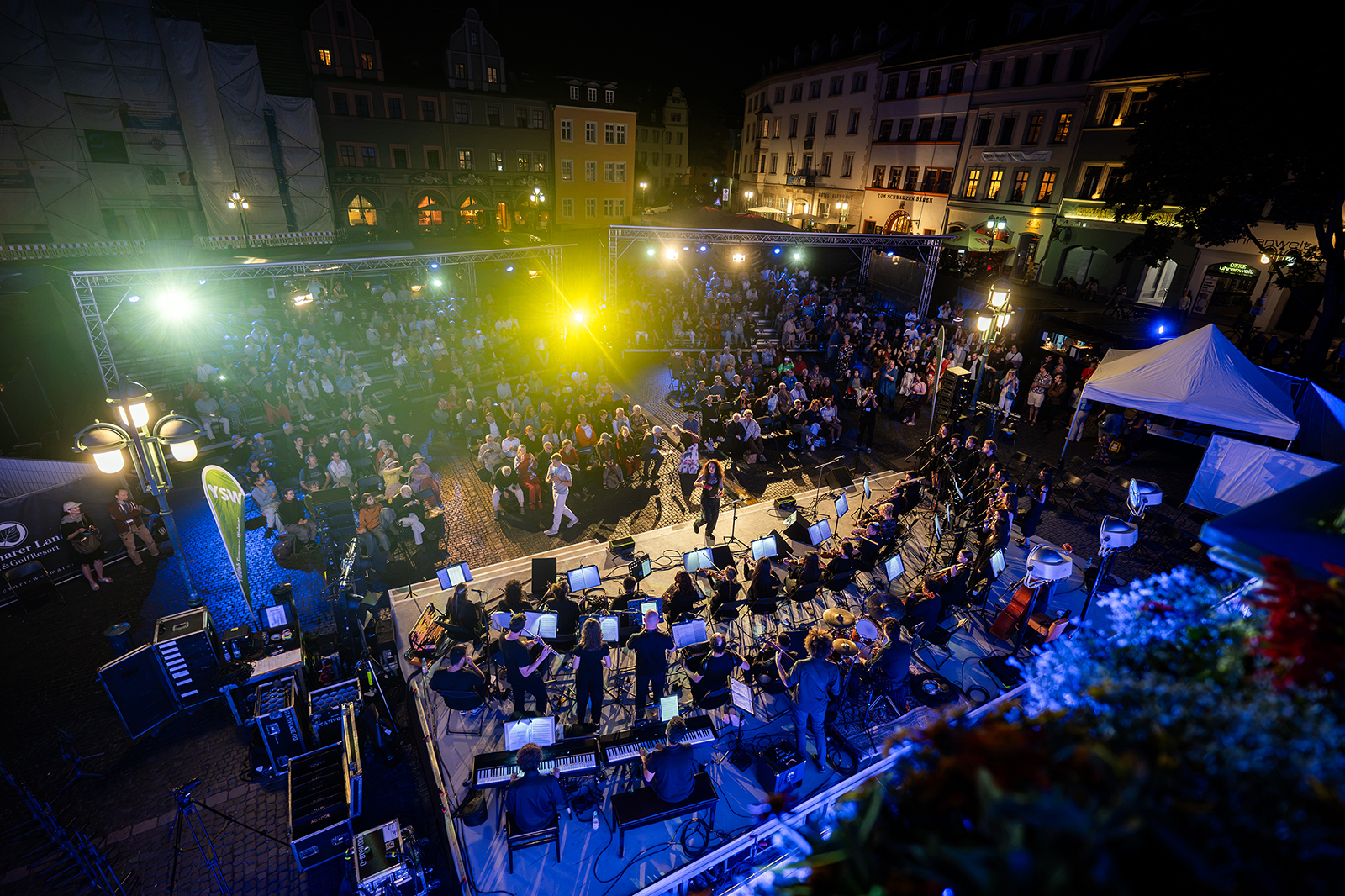
Crowds attend a Caravan Orchestra & Choir performance during Yiddish Summer Weimar on Aug. 8, 2026, in Weimar, Germany. (Photo by Shendl Copitman)


“Jewish culture, Yiddish culture, has a different “yichus” than Western European classical culture,” said Bern, using the Yiddish word for lineage. It came not from the courts of the aristocracy but the masses of the Jewish street, and he believes it’s one of Europe’s great cultural treasures nonetheless. 

Since its start, the festival has grown from a weekend workshop with a handful of participants to the largest festival of its kind in Europe, lasting more than a month, with daily workshops drawing hundreds of participants and near-nightly concerts attended by over 10,000 people total, Bern said.

That’s particularly an achievement in Germany, where Yiddish was once almost exclusively associated with the Holocaust.

“We’re not in a constant posture of mourning the past,” Bern said. “We’re also living and creating, so the fact that we’re talking about a living, creative culture, which is not in denial of the past, but also not stuck in the past, was, I think, surprisingly refreshing to people already in 1998, and it still is today.”

Yiddish is undergoing a sort of renaissance in the 21st century. The language remains the primary tongue of growing ultra-orthodox Jewish communities from New York to Israel, creating a demand for print and other forms of media in the Yiddish language. 

“We have a huge Hasidic pop culture, a contemporary pop culture, which is growing day by day, and where you see often mixing of different elements,” said Eidel Malowicki, who grew up in a Hasidic family in Vienna and is one of the Yiddish teachers at Yiddish Summer Weimar. “Now you even have Hasidic Rap, and it’s a repertoire that is growing every day. … there’s new comics coming out, new magazines.”
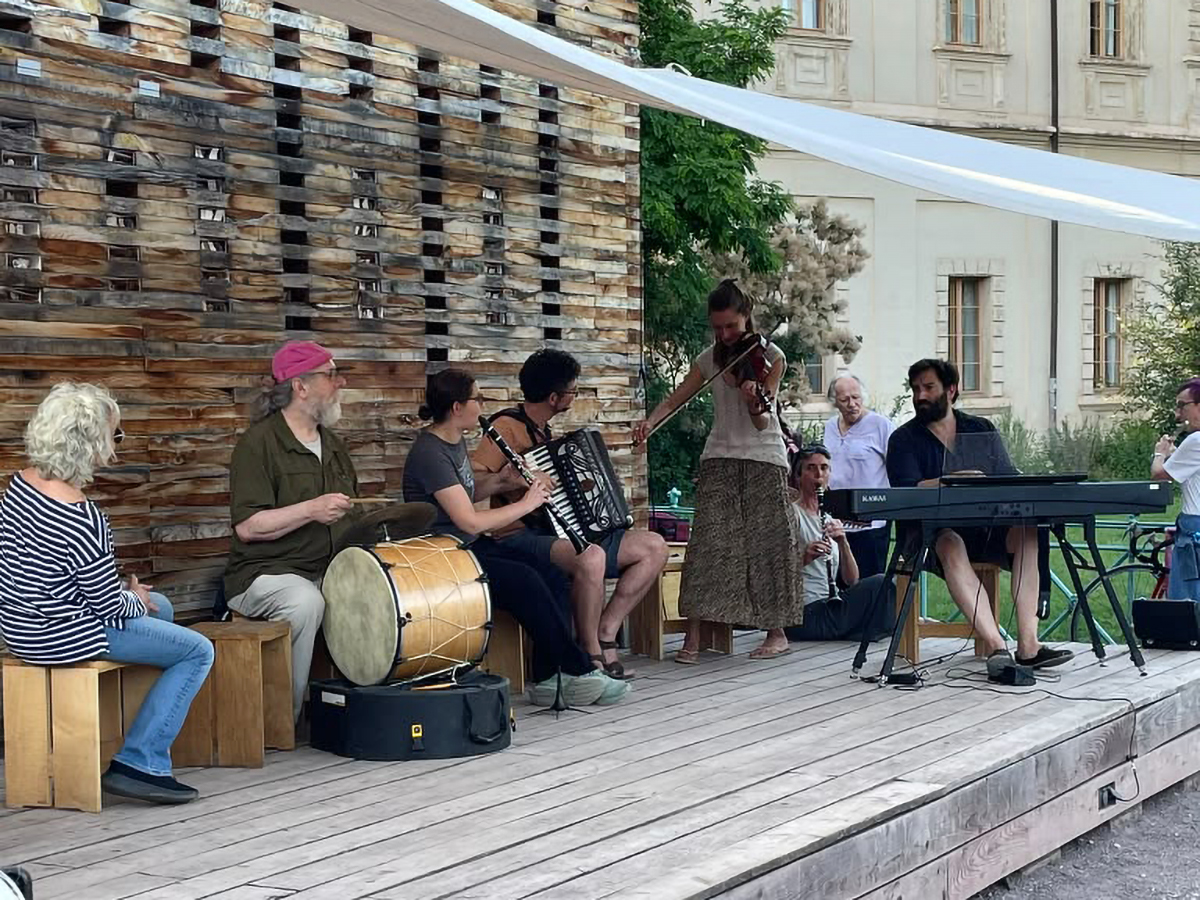
Yiddish Summer Weimar faculty and participants play klezmer in a concert in a Weimar park. (Photo by David Ian Klein)

Meanwhile, Yiddish is drawing interest from other sectors of the Jewish community, too, as well as some outside of it. For many young secular Jews, Yiddish has provided a route for connection with their heritage and Jewish identity unaffiliated with Zionism — and its stark support for the Hebrew language — that they have become increasingly disillusioned with. 

For Dan Kedem, who came from the Tel Aviv area to volunteer at Yiddish Summer Weimar, Yiddish is “a sort of path of redemption from the reality that I grew up in within Israel,” he said. He described feeling like the Jewish story taught to him in Israel was “linear” and “narrow.” 

“So one of the things that I found most fascinating about Yiddish is that exploration of this other Jewish culture, identity and root system of paths and ideas has allowed me to explore my own identity through a much wider lens and open myself to new ideas and new thoughts,” Kedem said. 

Opportunities for Yiddish language study have exploded across the world, and a report by the Yiddish academic journal Ingeveb cited over two dozen programs, camps and festivals in the summer of 2026 alone. The popular language-learning app Duolingo reported nearly 300,000 users for its Yiddish language course this year, the majority of whom are under 25, according to a recent report by RNS and NPR.


Bern estimated that at least half of the participants at Yiddish Summer Weimar are not Jewish. For many of them, connecting with the Yiddish language fills a gap in their national histories and European identity.
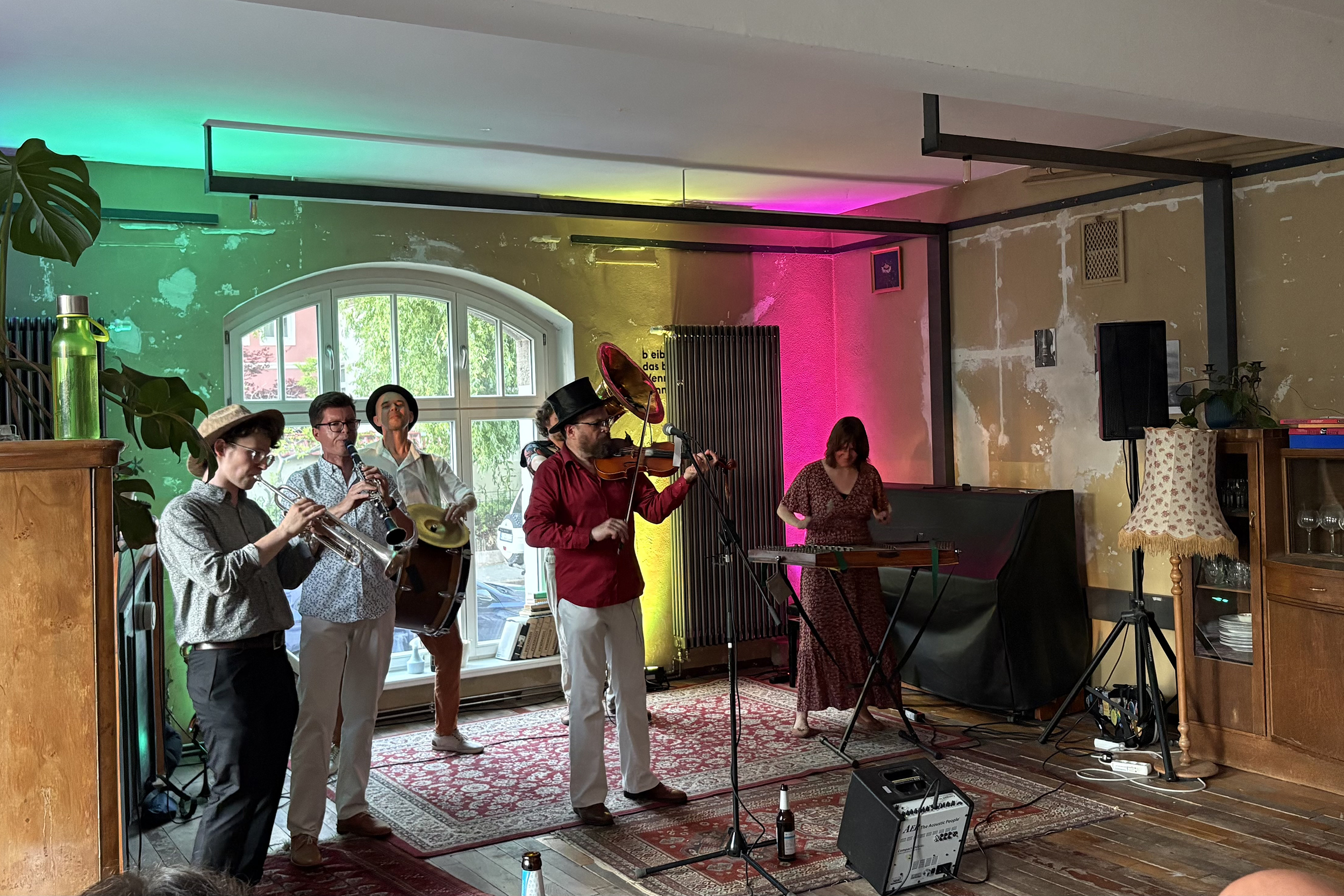
A group performs in a small setting during the Yiddish Summer Weimar in Weimar, Germany. (Photo courtesy of Yiddish Summer Weimar)

“The Jewish world, for me, as a German cis male, has always been something like a secret world, something unknown, something maybe a little bit mysterious,” said Michael Panzner, an intercultural consultant from Frankfurt, Germany. “But I know that it’s very relevant for Germany’s and Europe’s history and development over the centuries.” 

Growing up, he never knew any Jews in Germany, and when he met some as an adult in North America, he didn’t feel comfortable asking his many questions. In Weimar, he said, he found an opportunity to explore this culture he thought was lost from his country in a non-judgmental environment. He hopes to continue going for many more years. 

“I think (Yiddish) is being given way too little attention in today’s cultural life and social life,” he said.

Malowicki agreed, saying many of her students see Yiddish as an “entry ticket into a culture.” 

And while Hasidic dialects are by far the most spoken among modern Yiddish speakers, opportunities to learn the Hasidic dialect from native speakers like Malowicki are relatively rare.

“I see it as a chance to create a bridge between worlds that otherwise wouldn’t have a bridge or a connection,” she said. “I think that there’s a lot that we can learn from one another and our different worlds.”

Such experiences are exactly what Bern hoped participants would find in the program.

“I and my colleagues definitely view Yiddish from a transcultural and transnational point of view,” Bern said. “That’s also unusual for people who tend to think of Yiddish as the culture of some isolated shtetl in the East and separate from all other cultures and doesn’t have any links to other cultures.”
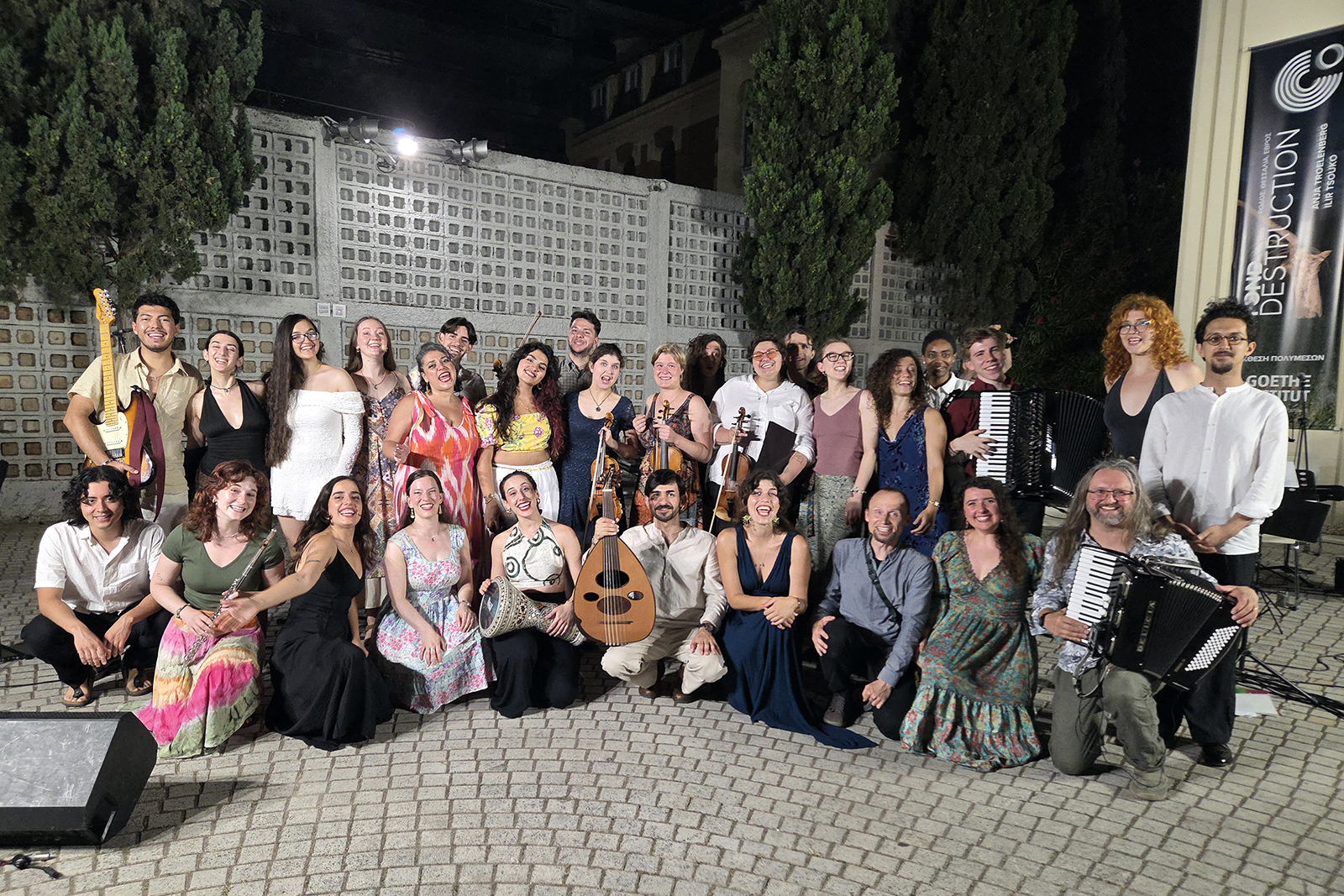
The 2026 Yam Ensemble. (Photo courtesy of Yiddish Summer Weimar)

To that end they have long worked to involve countries and cultures far outside of Ashkenazi Jewry in the program. In the past that has included youth orchestras from Poland and France, and today the Yam Ensemble, which brings together young musicians from Germany, Greece and Turkey to explore the shared influences and heritage of Mediterranean and Klezmer music.  

Of all the places for a festival of Yiddish culture in Europe, Weimar may seem like a strange place. 

Unlike Warsaw, Vilnius, Krakow and other cities where there are Yiddish programs and cultural festivals, Weimar is not a great city of Jewish or Yiddish speaking history. But it couldn’t have found a more fitting or important home, Bern stressed. 

The city is most associated with two things, European high culture and the rise of fascism. It’s where Adolf Hitler reformed the Nazi Party in 1926. And just as Weimar and the Thuringia region became a hot bed of support for the Nazi Party in the 1920s and 30s, it’s also the largest base today for the far-right Alternative für Deutschland Party, often labeled a Neo-Nazi party.

“It’s very ironic to think that here is a place that has a large Yiddish music festival, maybe one of the biggest in the world, and sold out concerts and everything, and it’s this same environment in which there’s a neo-Nazi movement that is just growing all the time,” Bern said. 

As for Weimar’s place in European cultural history, Yiddish isn’t out of place either, Andreas Schmitges, the festival’s curator, said.

“Weimar is a place of what they call German hochkultur (high culture). I mean Goethe, Schiller, Bauhaus, Liszt, everything is hochkultur,” Schmitges told RNS. “To be honest, I think that Yiddish culture is right here in the right place where it belongs because it’s also one of Europe’s hochkulturen (high cultures), so this is a perfect place.

 

Hindu students ask schools to discern the swastika from the Nazi Hakenkreuz

(RNS) — ‘I think it’s very important that young people are told that the swastika has a very positive meaning, but it has been taken and used as a racist symbol,’ said Baijayanti Roy of Goethe University Frankfurt. ‘The swastika does not have any negative connotations, whereas the Hakenkreuz stands for evil.’
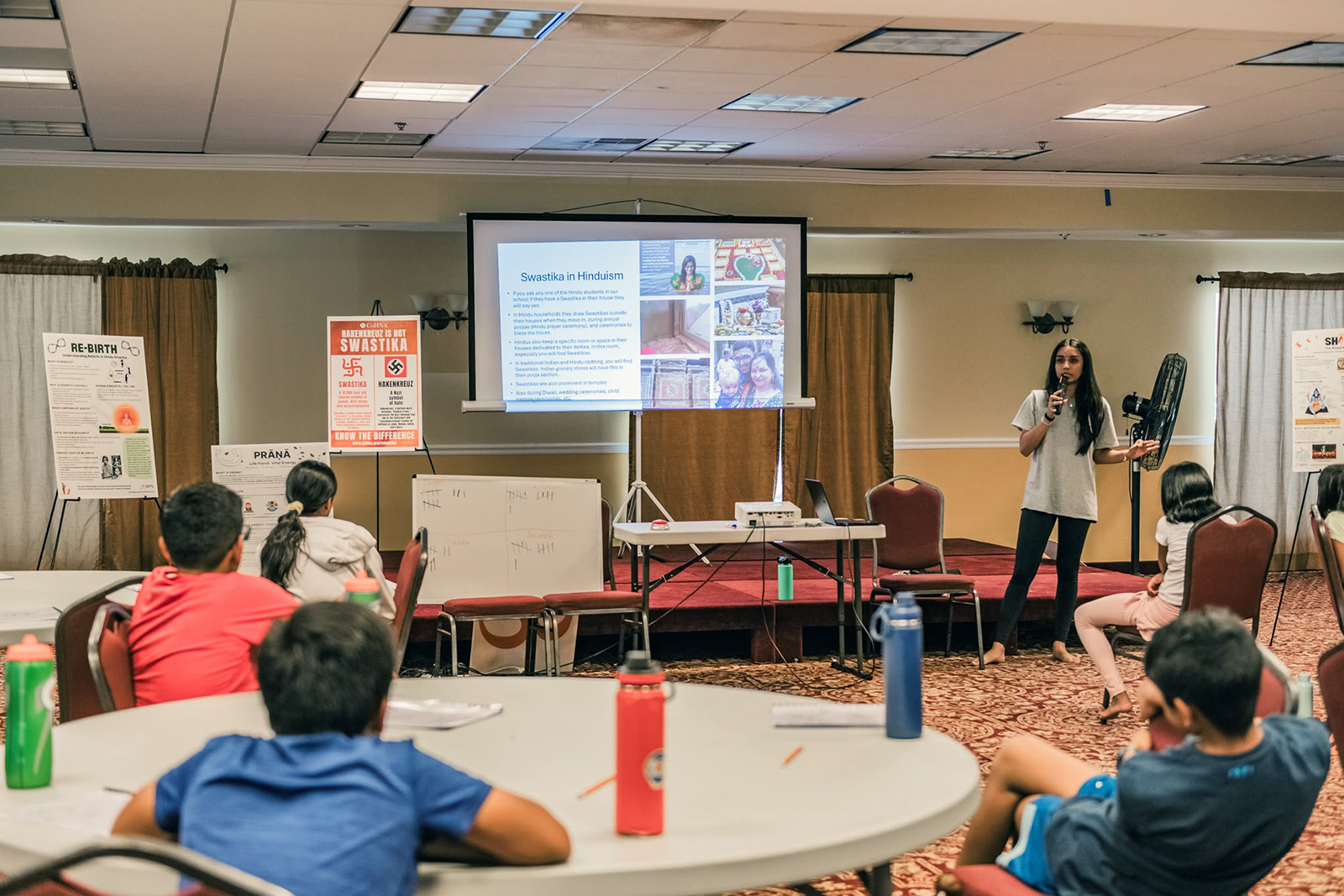
Mira Trivedi, right, presents a lesson about swastika history to kids. Photo courtesy of Mira Trivedi)


(RNS) — Mira Trivedi, 15, grew up surrounded by the swastika. Her family hung it around their home for holidays. A priest drew it on her newborn cousin’s forehead. Her family members wore jewelry with the symbol.

To Trivedi, who is Hindu, the swastika always signaled its auspicious Sanskrit meaning: well-being, good fortune and peace.

So when her eighth grade social studies teacher said the swastika was a hate symbol representing Hitler’s genocidal antisemitism, Trivedi went up after class to explain that the Nazi symbol was not the swastika but the Hakenkreuz, a German word meaning “hooked cross.” The swastika, which is usually slightly different in appearance, is a devotional symbol in South Asian religions, including Hinduism, Buddhism and Jainism, she said. 

Trivedi hoped for a lightbulb moment after her spiel, but the teacher said only higher ups could implement changes about what’s taught about the symbol. “That’s what started my whole journey,” Trivedi said.

She presented her case to the vice principal, principal and board of education at her central New Jersey school in May 2025. “I was sweating through the entire meeting, I was so nervous,” she said. But the effort paid off, and she convinced the school board to educate 35 teachers about the difference between the symbols. 

In recent months, a small but growing contingent of Hindu students across the country like Trivedi have successfully pushed for curriculum changes and education about the difference.

The conflation between the swastika and the Hakenkreuz emerged in the 1930s, but the presence of the swastika in Germany dates back to the late 1800s, said Baijayanti Roy, a lecturer and researcher on interactions between India and Nazi Germany at Goethe University Frankfurt in Germany. During this era, Germany’s Theosophists and Buddhists, who revered Indian philosophy, used the symbol to represent appreciation.

But at the turn of the 20th century, the racist and antisemitic völkisch movement co-opted the swastika to signal Aryan German heritage, Roy said. The proposed design for the fledgling Nazi party’s flag arrived in front of Hitler bearing a mirrored version of the swastika. Hitler approved the design, with one exception: Due to his hatred of Indians, whom he perceived as bastardized Aryans, he replaced the swastika with the “Hakenkreuz” by changing the tilt and removing the four dots and flourishes that typically, but not always, adorn the swastika.


Thus was born a new symbol, stripped of dharmic roots, to represent the Third Reich.

From then on, the Nazis referred to the symbol only as the Hakenkreuz. While some leaders of the Indian independence movement like Subhas Chandra Bose sought tactical military alliances with Hitler, Hitler maintained his animosity toward South Asians as he set into motion the murder of 6 million Jews.

When American media mistakenly described the swastika as a Nazi symbol in the 1930s, the misconception pervaded the American psyche.

“I think it’s very important that young people are told that the swastika has a very positive meaning, but it has been taken and used as a racist symbol,” Roy said. “The swastika does not have any negative connotations, whereas the Hakenkreuz stands for evil.”

 (Photo by Nidhi Srivastava/Flickr/Creative Commons)

But as immigration and globalization increased — and as concerns about antisemitism have ebbed and flowed — the obfuscation has led to fear and confusion about the swastika as a hate symbol.

Members of the nonprofit Coalition of Hindus of North America have sought help from its leaders, as some have panicked after being reported as neo-Nazis by well-intentioned neighbors and coworkers, said Pushpita Prasad, CoHNA’s chief communications officer. 

During the COVID-19 pandemic, for example, workers who glimpsed swastikas in their Hindu colleagues’ homes via Zoom would sometimes report them to human resources. Neighbors, seeing swastikas drawn for Hindu festivals, sometimes called the police. The ensuing investigations were usually dropped once the context became clear. But especially for immigrants with visas, “it was a very shaky, unpleasant experience,” Prasad said.

It’s an example of what scholars have called a context collapse, said Susan Benesch, director of the Dangerous Speech Project, part of the Center for the Study of Organized Hate, a Washington, D.C., group dedicated to preventing and combating hate. “You have people who are existing in two different normative communities and the two sets of norms collide,” she said. 

Many Hindu students across the United States have witnessed and experienced that context collapse. Trivedi said her Hindu neighbors store away devotional objects bearing the swastika whenever guests of non-dharmic faiths visit to avoid painful misunderstandings.

Saisha Vyas, 15, grew up seeing her family draw swastikas on new cars, denoting good fortune. But when her uncle had to take his car back to the dealership, she said the workers called the police on him.

And Priya Bakshi, 17, often longed to wear a sentimental swastika-inscribed necklace to school, but it was banned in her Maryland county. “It’s infringing on our First Amendment rights,” she told RNS. “We cannot express our religion.”  

Vyas and Bakshi, who are both Hindu high schoolers in Maryland’s Howard County Public School System, decided to campaign in their school district for a distinction between the swastika and the Hakenkreuz, emphasizing the intention with which they’re displayed.

After months of preparing educational material, they convinced the school board in February to ban the Nazi Hakenkreuz instead of the swastika, changing the rules for nearly 50,000 students in the district.

Still, they faced challenges. Trivedi became known among her classmates for her campaign. “One kid decided to draw the symbol on my notebook when I stepped away from my desk for a moment, and right underneath that symbol, ‘Nazi’ was written,” she recounted.

But moments of support have vastly outnumbered the antagonism, the three students said. Bakshi said her Jewish friends have been particularly receptive, and she and Vyas met with Jewish groups. “I think they realized that we are trying to help their community as well,” she said, suggesting that the misconception gives the Nazis ongoing power over a symbol and religious practice they despised. “When people come together with genuine empathy, I think it really does help bring everybody in the circle closer together.”

The fundamental question at the heart of the campaign harkens back to the landmark 2003 Supreme Court case Virginia v. Black, which considered whether states could ban cross burning. The case determined that its legality depended on whether the act was done in order to intimidate, Benesch explained. This same distinction can be made about whether a Hakenkreuz is scratched in a school bathroom or a highway overpass, versus a swastika depicted on a Hindu student’s bracelet or in a devotional painting in one’s home.


“None of this stuff is easy,” Benesch said of context clashes. “Even though the collision can often be unpleasant at the time for both parties, in the long run, it can be a very salutary form of public education.”

The students’ successful campaigns over the past two years were built on a smattering of past examples. In 2021, after the Oregon Department of Education heard feedback from Hindu students as well as Native American students who used the whirling log to signify well-being and protection, the statewide policy was edited to refer to the Nazi symbol as the Hakenkreuz.

CoHNA has also campaigned for similar policy updates in Virginia, New York, California, Canada and other regions, Prasad said.

The students hope to formalize the distinction at the state level, and they believe that their recent victories can herald a wider student movement to distinguish the two symbols. Several classmates have signed on to their campaigns. And across the country, their peers have held discussions in Hindu student groups, written essays on the subject and initiated their own dialogues with teachers. 

“I want them to see what we’re doing and feel like they can do the same,” Vyas said. “I can also speak up at my school. I can also speak up in my county. I can make an impact for my own culture.”


Manila taps South Korea to power nuclear revival

Manila taps South Korea to power nuclear revival
/ Viktor Kiryanov - UnsplashFacebook
By IntelliNews - Asia Bureau August 11, 2026

AboitizPower Corporation (AP.PS), one of the Philippines’ leading energy companies, has signed a landmark memorandum of understanding with state-owned South Korea Hydro & Nuclear Power (KHNP) (015760.KS) to explore nuclear energy deployment.

The agreement, signed at KHNP’s headquarters in Gyeongju by KHNP Head of Business Operations Choi Il-kyung and AboitizPower Head Carlos Ramon Aboitiz, lays the ground for exchanging technical information and undertaking joint preliminary feasibility studies for new nuclear installations in the Philippines, according to World Nuclear News.

While the exploratory agreement creates no legally binding obligations, it links the Philippines' private power sector directly with a Korean state giant that boasts an unmatched track record in domestic and international nuclear construction.

“Nuclear energy is complex and highly regulated, and any future role for it must be grounded in rigorous technical assessment and strong regulatory oversight,” said Aboitiz in a corporate statement. “We see significant value in learning from KHNP’s decades of experience and we look forward to working alongside the Department of Energy (DOE) to responsibly assess nuclear energy’s role in the country’s energy future.”

Choi added that the MoU creates a solid foundation for Korean involvement in the Philippines' nuclear market. “Based on the unrivalled experience and technological capabilities accumulated by KHNP through the construction and operation of nuclear power plants both domestically and internationally, we will work closely with AboitizPower to contribute to the Philippines’ energy transition,” he said.

Philippine Energy Secretary Sharon Garin praised the deal as a vital public-private milestone. “The transition toward a secure, clean, and reliable energy future cannot be achieved by government alone,” Garin said. “It requires strong public-private coordination and the exchange of best practices across borders with experienced industry leaders such as KHNP.”

Reassessing Bataan and long-term targets

Manila’s modern nuclear drive is heavily rooted in a desire to fix past mistakes—specifically the $460mn Bataan Nuclear Power Plant (BNPP). Built by Westinghouse in response to the 1973 oil crisis, the 621-MWe pressurised water reactor was completed in 1984 but never loaded with fuel due to political upheaval, financial strain and seismic safety fears following the fall of the Marcos regime.

The mothballed BNPP facility has cost the Philippine taxpayer millions in maintenance since, but modern technology and pressing energy deficits have put its revival back on the agenda. In October 2024, KHNP signed a separate cooperation MoU with the Philippine Department of Energy (DOE) to execute a comprehensive feasibility study on starting up the BNPP, WNN reports.

Reports from the Philippine News Agency indicate that then, but now disgraced South Korean President Yoon Suk Yeol and Philippine President Ferdinand Marcos Jr. personally witnessed the state-level agreement signing in Manila. Under the deal, KHNP agreed to bear the complete financial cost of the two-phase assessment to inspect BNPP's structural condition. Notably, KHNP operates the Kori nuclear power complex in Busan, which utilises design configurations virtually identical to the Bataan facility.

This corporate and state alignment follows Executive Order 164, signed by former President Rodrigo Duterte in March 2022, which formally integrated nuclear power into the national energy mix. Manila’s official policy roadmap sets an ambitious target to deploy 1,200 MW of nuclear capacity by 2032, expanding to 2,400 MW by 2035 and reaching 4,800 MW by 2050. To govern this emerging sector, the Philippine Congress has simultaneously advanced legislation to establish an independent regulatory body known as PhilATOM.

To support the rapid commercial rollout, the Philippine Department of Energy (DOE) released a policy framework establishing rules for the country’s first commercially developed nuclear power plant, designated as the Pioneer NPP. Under a circular signed by Garin, the Pioneer NPP will be classified as a baseload facility and granted priority dispatch in grid scheduling, along with long-term contracting privileges and financial incentives regardless of the nuclear technology chosen.

Broader international partnerships

South Korea is not the only foreign player positioning itself for Manila’s nuclear buildout. The US has also stepped up its diplomatic and technical backing, aiming to export advanced small modular reactor (SMR) designs to Southeast Asia.

In February, the US Trade and Development Agency (USTDA) announced $2.7mn in grant funding for Manila Electric Company (Meralco), the country’s largest private distribution utility, according to World Nuclear News. The technical assistance grant will fund comprehensive assessments of US SMR technologies and help Meralco build an implementation roadmap for the Philippines' first SMR installation. This initiative follows the entry into force of the landmark 123 Agreement between Manila and Washington, establishing the legal basis for nuclear equipment and technology exports.

Meralco is keeping its options open across both sides of the Pacific. In March, KHNP, the Export-Import Bank of Korea and Meralco inked a tripartite MoU to collaborate on developing nuclear power plants in the archipelago.

With nuclear momentum accelerating across policy, corporate and diplomatic tracks, the Philippines is moving aggressively to address its structural power deficits. Partnering with KHNP gives Manila a proven technical ally as it weighs the resurrection of BNPP alongside next-generation SMR deployments to anchor its long-term clean energy transition. Public-private educational partnerships supported by AboitizPower and international institutions are simultaneously establishing specialised nuclear engineering curricula and simulator facilities to build the local workforce required to operate these future reactors safely.


China launches Arctic 'Ice Silk Road' container route to dodge Red Sea chokepoint

China launches Arctic 'Ice Silk Road' container route to dodge Red Sea chokepoint
A weekly Ningbo-to-Felixstowe service will cut sailing time roughly in half, part of a wider shift toward the Northern Sea Route as Houthi attacks keep threatening Bab al-Mandeb shipping. / bne IntelliNewsFacebook
By Ben Aris in Berlin August 10, 2026

A weekly Ningbo-to-Felixstowe service will cut sailing time roughly in half, part of a wider shift toward the Northern Sea Route as Houthi attacks keep threatening Bab al-Mandeb shipping.

Chinese container line Sea Legend will this week launch the first regular container shipping service through the Arctic, branding it the "Ice Silk Road," the Financial Times reported.

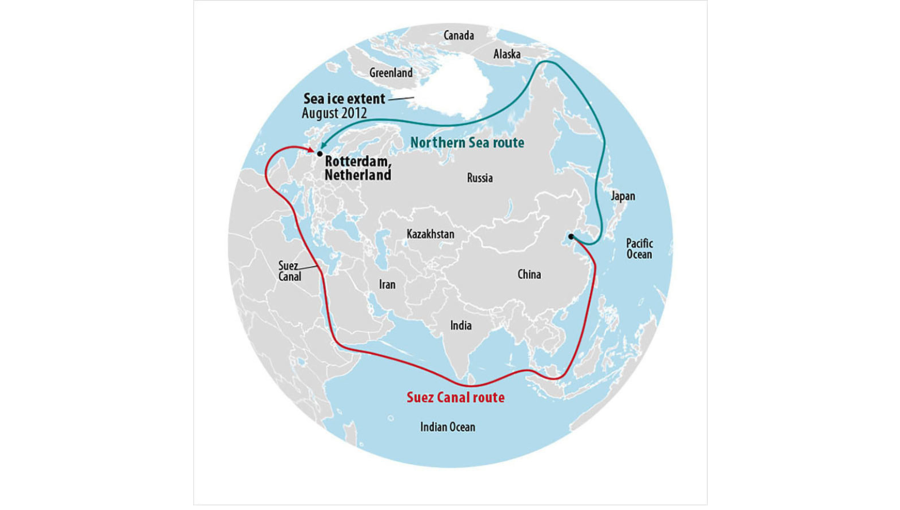
The weekly service will run between Ningbo on China's east coast and Felixstowe in the UK via the Northern Route, skirting the north Russian coast and cutting the usual 40-day sailing time by about half, depending on Arctic Circle conditions. It follows a record 23 transits through the Northern Sea Route last summer, up from 15 in 2024, as melting polar ice widens the seasonal window in which ships can pass without icebreaker support.

Shipping companies are increasingly weighing the Arctic route as a way to avoid maritime chokepoints, particularly the Bab al-Mandeb strait into the Red Sea, where Iranian-backed Houthi militants renewed threats last month. The group said on July 23 it had attacked two Saudi Arabian tankers in the Red Sea, briefly sending oil prices back above $100 a barrel.

"There's been a definite increase in traffic through the Arctic and Northern Sea Route," said Rahul Khanna, global head of marine risk consulting at insurer Allianz. Vessel owners increasingly see the route as a way "to save a lot of time and cost" while also taking "out all the geopolitical chokepoints and conflict zones," he said.

Interest is also showing up in shipbuilding: 167 ice-class vessels were built last year, the highest level in more than a decade, with a further 164 due this year, according to maritime data company Veson Nautical. Many major European lines, including Maersk, have nonetheless pledged not to use the route over concerns for the Arctic ecosystem and relations with Russia, which controls permitting for the Northern Sea Route through its state company Rosatom.

The route still carries real risk: Allianz has recorded more than 500 shipping incidents in the Arctic Circle over the past decade, with machinery damage or failure responsible for almost half. "If we have a casualty in the Arctic, we have limited salvage, assistance, firefighting or rescue," Khanna said.