Showing posts sorted by relevance for query YIDDISH. Sort by date Show all posts

Tuesday, February 11, 2020


The following essay appears as the preface to How Yiddish Changed America and How America Changed Yiddish, edited by the authors and published today by Restless Books.
¤
We have to believe in free will. We have no choice.— Isaac Bashevis Singer
¤
CELEBRATED AND MARGINALIZED, lionized and trivialized, Yiddish is so deeply woven into the fabric of the United States that it can sometimes be difficult to recognize how much it has transformed the world we live in today. It’s a language and culture that’s as American as bagels and Rice Krispies, Hollywood and Broadway, Colin Powell and James Cagney (and connected to all of these, in one way or another). Yet many Americans think of Yiddish, when they think of it at all, as a collection of funny-sounding words. Oy gvald, indeed!
The aim of this book is to present a very different picture of Yiddish, true to its history, as a language and culture that is — like the Americans who spoke, read, and created in it — radical, dangerous, and sexy, if also sweet, generous, and full of life. Its inception is embedded in a radical shift. Some see Yiddish not only as a language but as a metaphor. They note that unlike most other tongues, it doesn’t have an actual address — a homeland, so to speak — or claim, as Isaac Bashevis Singer did when accepting the Nobel Prize in Literature, that it doesn’t have words for weapons. And because of its history, it awakens strong feelings of nostalgia. But others see this as an ongoing problem. In particular, it irritates Yiddishists that the language is fetishized, especially by people who don’t speak it.
Since the Second World War, many valuable anthologies have helped American audiences understand the gamut of Yiddish possibilities. Arguably the most influential has been A Treasury of Yiddish Stories (1954), edited by Irving Howe and Eliezer Greenberg. It concentrated on the Yiddish literary outpouring from figures like the three so-called classic Yiddish writers, Mendele Moykher Sforim, I. L. Peretz, and Sholem Aleichem, and served as a conduit to connect an American Jewish audience to the pre-Holocaust civilization. Its publication was certainly a watershed: the volume was the manifestation of a collective longing. That anthology looked at the shtetlekh, or small towns, in which Ashkenazi Jews lived for centuries through an American lens, as noble, even idyllic, and with a sense of homesickness, but also as a site of contradictions, violence, and unfaithfulness. Readers simultaneously idealized what Israel Joshua Singer called “a world that is no more” and sought to understand themselves as a continuation, as well as a departure, from it.
Other anthologies of Yiddish literature in translation followed suit. Each concentrated on either a region (the USSR, for instance) or a particular literary genre (such as poetry). These volumes include Ashes Out of Hope: Fiction by Soviet-Yiddish Writers (1977), also edited by Howe and Greenberg; The Penguin Book of Modern Yiddish Verse (1987), edited by Howe, Ruth Wisse, and Khone Shmeruk; Benjamin and Barbara Harshav’s American Yiddish Poetry (1986); and Yiddish South of the Border: An Anthology of Latin American Yiddish Writing (2003), edited by Alan Astro. To various degrees, the objectives of these anthologies remained the same.
But in the last few decades, the position of Yiddish in the zeitgeist has dramatically changed. The study of Yiddish thrives in America, among teenagers and senior citizens, the religious and the secular, and everyone in between. Technology has made the language and culture available in wider ways. Young people are studying it. Scholarship related to it is prolific. Its musical rhythms and motifs have been borrowed by other traditions. It is part of movies, television, and radio. And the internet serves up lexicons, memes, recipes, and all sorts of surprising artifacts. Assimilation in the United States has indeed presented Yiddish with challenges, and it has responded impressively, dynamically, demonstrating its flexibility, complexity, and strength.
So what is Yiddish, exactly? First and foremost, it’s a language, a Jewish one. Throughout the thousands of years of their history, Jewish people have spoken many languages, their own and the languages of the majority cultures in which they’ve lived. Hebrew, the language of the Torah (what Christians call the Old Testament) and an official language of the contemporary State of Israel, is one such Jewish language, and many others have arisen in other places and times as means of communications for Jewish communities. For example, Ladino, or Judeo-Spanish, has been spoken by the descendants of the expulsion from Spain in 1492, and Judeo-Arabic has been spoken by Jews throughout the Arabic-speaking world. Yiddish, meanwhile, was the primary Jewish language of Ashkenaz, which is what Jews called northern Europe.
During much of its existence, Yiddish was dismissed as a zhargon, not quite a language at all; this was the common fate of many vernaculars, which were seen as less prestigious than scholarly languages like Latin, and the major European languages like French, English, and German, which had state power behind them. But Yiddish was absolutely a language, one that originated somewhere in central Europe about a thousand years ago, with the oldest extant example of a printed Yiddish sentence dating all the way back to 1272. Written in the Hebrew alphabet, and drawing for its grammar and vocabulary on Germanic, Slavic, Romance, and Semitic languages, Yiddish soon became the vernacular spoken by the majority of the world’s Jews for more than seven centuries, and over those centuries, a language of increasingly popular books and prayers.
In the 19th century, around the same time that languages like Italian and Norwegian evolved into their modern forms, Yiddish hit its stride, flowering into a language not just of commerce and community but of modern theater, journalism, literature, and even national aspiration. At that time, speakers of the dialects of Yiddish — sometimes referred to as Lithuanian, Polish, and Ukrainian Yiddish — constituted large minorities or even majorities in many European cities and in hundreds of European small towns and villages, while many more Yiddish speakers had relocated from Europe to other parts of the globe. The world’s total Yiddish-speaking population just before the Second World War is estimated by scholars to have been about 13 million people.
The language’s fate would be entangled with one of the world’s most brutal tragedies — millions of those Yiddish speakers were murdered by the Nazis and their collaborators in the Holocaust during the Second World War — but it also flowered almost everywhere that Jews settled, before and after the war: Yiddish newspapers and books were published in Montreal and Montevideo, Cairo and Melbourne, Paris and Cape Town (not to mention Warsaw and New York). While mostly the language has had to survive, unlike most major languages, without a government’s backing, Yiddish was briefly an official language of the Soviet Union and today it is one in Sweden. It is currently spoken, at home and in the street, by more than 400,000 people around the world.
We might never know when the very first Yiddish speaker arrived on American shores, but it’s clear that a substantial number of speakers had already arrived by the middle of the 19th century, and that they quickly found their way to almost every corner of the developing nation. In the late 19th and early 20th centuries, an enormous wave of European immigration brought hundreds of thousands and then millions of Yiddish speakers. Free from some of the strictures imposed by European governments, American Yiddish speakers created newspapers and theaters, and before long they had built one of the most vibrant centers for Yiddish culture in the world.
At the height of the language’s American popularity in the 1920s, a handful of different Yiddish newspapers circulated hundreds of thousands of copies every day, and Yiddish theaters on Second Avenue, in Manhattan, seated thousands of spectators every night. Also, as the primary language of a vast immigrant community of poor laborers and their upwardly mobile children, Yiddish became a crucial part of American politics — at a moment when socialism, anarchism, and communism competed for Americans’ votes with more familiar political orientations — and of American business, entertainment, cuisine, and speech.
In short, America, famously a nation of immigrants, was the site of many of Yiddish’s greatest triumphs — a Nobel Prize, best sellers, and theatrical smashes, as well as political movements that changed the way people everywhere work. As specific as its history might be, like any language, Yiddish is, for all intents and purposes, infinitely capacious: you can say anything in Yiddish that you want. And of course, in America, all kinds of people have done so: factory owners and communists, Hasidic Jews and Christian missionaries, anarchists and political fixers, scientists and quacks. To dive into the diversity and complexity of American Yiddish culture, as this book invites you to do, is one wonderful way to appreciate the wild possibilities of life in the United States.
This anthology showcases the rich diversity of Yiddish voices in America, and of the American culture influenced and inspired by Yiddish. It is made of poems, stories, memoirs, essays, plays, letters, conversations, and oral history. Many of the authors represented here were immigrants themselves who remained loyal to Yiddish in the new land. Others are their offspring, the so-called kinder for whom the language was a link to ancestors and a source of inspiration and provocation, or people from a variety of backgrounds, Jewish and not, who learned the language and made it their own.
Much of the material included here comes from the publications or collections of the Yiddish Book Center, a nonprofit organization working to recover, celebrate, and regenerate Yiddish and modern Jewish literature and culture, which was founded in 1980 by Aaron Lansky, then a 24-year-old graduate student of Yiddish literature (and now the Center’s president). In the course of his studies, Lansky realized that untold numbers of irreplaceable Yiddish books — the primary, tangible legacy of a thousand years of Jewish life in Eastern Europe — were being discarded by American-born Jews unable to read the language of their Yiddish-speaking parents and grandparents. So he organized a nationwide network of zamlers (volunteer book collectors) and launched a concerted campaign to save the world’s remaining Yiddish books before it was too late. Since its founding, the Center has recovered more than a million books, and published Pakn Treger (The Book Peddler), the Yiddish Book Center’s English-language magazine that features articles, works in translation, profiles, and portfolios about Yiddish culture. Not exactly “the best of Pakn Treger,” but drawing on its rich archive and the Center’s other collections, this anthology offers landmarks and sidelights of American Yiddish culture to give readers a spirited introduction to what Yiddish America has been and can be.
The book does not attempt to present this material in chronological order or to make a single argument. Like many anthologies, this one wants to be a smorgasbord. We offer the nexus between American and Yiddish culture, in English translation — with full knowledge of how complex, and also generative, translation can be. This anthology’s animating hope is that its readers will make connections between its heterogeneous content, browsing and skipping and finding surprises everywhere.
To that end, the 63 entries have been organized into six distinct parts. The first, “Politics and Possibility,” explores immigrants’ initial encounters with America. It features scenes of ritual and tradition in the Jewish ghetto of the Lower East Side and explores the ways children of immigrants ventured out into Harlem, the Bronx, and well beyond. The selections reflect how, around the turn of the 20th century, Yiddish culture in New York emanated from a community whose first concern was survival, and who had to decide what that struggle for survival implied about politics, ethics, and culture. For example, a watershed moment in the history of Yiddish in the United States took place in 1923 when Sholem Asch’s play God of Vengeance (written in Yiddish in 1906) opened, in English, on Broadway. The play represents a setting that was as shocking to audience members then as it would be today: a brothel operated by a Jewish pimp and offering the services of Jewish prostitutes.
The realities of Jewish participation in sex work in the late 19th and early 20th centuries are complex and tragic, and what Asch’s play captures, with stark symbolism, is the tension between the noble aspirations of Jews of that time to holiness and purity, and the degradations imposed on them by the struggle to earn a living under discriminatory regimes. The play included much that shocked its audiences, including a scene in which a young, supposedly innocent girl is seduced by an older, female prostitute — posing the question of what would happen and what would change when the old authority structures, derived from the rabbis and from Christianity, crumbled away. The second act of God of Vengeance appears in this part. So does a letter written in 1936 about a female athlete who successfully transitioned to male, written to the editor of Forverts, arguably the most important immigrant publication in the United States, in which readers looked for answers to daily questions about becoming American: In what way is this nation also mine? How much tradition am I ready to sacrifice on the road to gaining new rights?
A central question for Yiddish speakers in America, as for most immigrants, was precisely a question about language. Each one had to answer for herself how much she should depend upon and defend the language of her childhood and tradition, and how much she should embrace a new language — English — with its strange possibilities. Such questions had especially large stakes for writers, artists, and politicians. “The Mother Tongue Remixed,” the second part of this anthology, concentrates on the vicissitudes of the Yiddish language as it adapted to the new territory. It features reflections on what happens in the classroom to make Yiddish survive, and the role dictionaries and other authoritative entities play in the continuation of life for the language.
Part two also includes appreciations of figures like Leo Rosten, a humorist who became famous for his efforts to codify “Yinglish” — the blend of Yiddish and English that became common in midcentury America — and some concrete examples of the playfulness with which Yiddish can be deployed, as in the case of Stanley Siegelman’s poem “The Artificial Elephant.” People often get defensive — or prescriptive — about the right ways and wrong ways to speak a language (and of course that kind of attitude has its value), but very often the story of Yiddish in America, even linguistically, has been a story of playfulness and irreverence.
The third part of this volume, “Eat, Enjoy, and Forget,” focuses on one of the avenues through which the culture of Yiddish-speaking Jews has had the broadest impact in America: food. In an immigrant culture, assimilation in the culinary dimension is about experimenting with flavors and ingredients in order to satisfy evolving palates. Those experiments quickly moved from Jewish homes out into restaurants. In the 20th century, delicatessens became staples of every major American city, and bagels triumphed across the country. American companies like Maxwell House and Crisco understood that they could profit by serving a hungry Jewish market. More recently, as nostalgia for Jewish cooking has found its way into haute cuisine, dishes such as latkes have fused with other ethnic favors (say, chocolate-based Mexican mole) to create new tastes that reflect the complex families and histories of Jews in America. Over the decades, classic Ashkenazi dishes have undergone changes in the way they are cooked, in how they are presented, and in what they are accompanied with during a meal. In a 1988, 14-minute short film by Karen Silverstein called Gefilte Fish, three Jewish women of the same family, an immigrant grandmother and her American daughter and granddaughter, explain how each prepares the dish. The first describes the labor-intensive process of cooking it, which she learned from her own mother, starting with the purchase of a living fish — “to make sure it is fresh.” The last just acquires a bottle of the Manischewitz brand before serving it on the table.
The fourth part, “American Commemoration,” focuses on the wide array of Yiddish literary voices in America. It includes translations from the Yiddish of a short story and a lecture by the American Nobel Laureate Isaac Bashevis Singer, still the only Yiddish writer to win the Nobel Prize in Literature — and examples of poetry, fiction, and literary essays by many equally talented but less widely celebrated Yiddish writers, including Chaim Grade, Jacob Glatstein, Anna Margolin, Blume Lempel, Peretz Fishbein, and Celia Dropkin. Almost all American Yiddish writers of that generation were born in Europe, and they naturally drew upon European models as well as Anglo-American ones in developing their verse and prose. It’s not surprising that their narratives frequently take up the experience of dislocation, whether by explicitly telling stories about being an émigré in a land with little patience for the past, or more implicitly by exploring the complications faced by Jews and others in the 20th century.
The fifth part of this anthology, “Oy, the Children!,” considers the descendants of Yiddish speakers, who went on to roles of increasing prominence in American culture. Inheritors of the immigrants’ pathos, their offspring built upon that legacy to make their own marks. In many cases, like Cynthia Ozick’s story “Envy: or, Yiddish in America” (1968) or Joan Micklin Silver’s film Hester Street, they did so by depicting the experiences of Yiddish speakers; artists who did so include novelist Michael Chabon and playwright Paula Vogel, both of them winners of the Pulitzer Prize. In other cases — for example, Hollywood actors Leonard Nimoy and Fyvush Finkel — they distilled the humor or charm of their Yiddish-speaking families and milieus and transformed them in one way or another for wider consumption. Among many other celebrated artists of recent decades, this section also includes graphic artists and storytellers whose drawings depict an older, Yiddish-speaking generation in unexpected and moving ways.
Finally, the sixth and last section of the anthology, “The Other Americas,” explores Yiddish as it flourished not just in the United States but through the American continent, from Canada to Argentina. (The word “America” comes from Amerigo — in Latin, Americus — Vespucci, the Italian cartographer, navigator, financier, and explorer who in 1501–’02 sailed to Brazil and the West Indies.) The language thrived in these regions, too, and continued to link Jews who had come from the same communities in Europe but found themselves in very different situations after immigration. These selections help to suggest some of the ways in which the story of Yiddish in the United States wasn’t unique but rather part of a larger set of phenomena that involved the establishment of Jewish communities throughout the Diaspora.
Each of the entries is introduced with a brief contextual headnote, and a timeline presents some fascinating and representative historical events — but, again, this isn’t a history. It’s most of all meant to be a grab bag, an opportunity for readers to get a little lost and to discover something that they weren’t expecting. It showcases the rich diversity of Yiddish voices in America and of the American culture influenced and inspired by, and created as a result of, Yiddish and its speakers and their descendants. They pushed Yiddish — its sound, its sensibility — to utterly unexpected regions in the continuation of its epic story. By doing so, they have changed America.
¤

Josh Lambert is the academic director of the Yiddish Book Center and visiting assistant professor of English at the University of Massachusetts Amherst. He’s the author of American Jewish Fiction: A JPS Guide (2009) and Unclean Lips: Obscenity, Jews, and American Culture (2014).

Monday, August 10, 2026

In Weimar, a festival preserves Yiddish culture while reinventing it

(RNS) — Since its start, the festival has grown from a weekend workshop with a handful of participants to the largest festival of its kind in Europe.
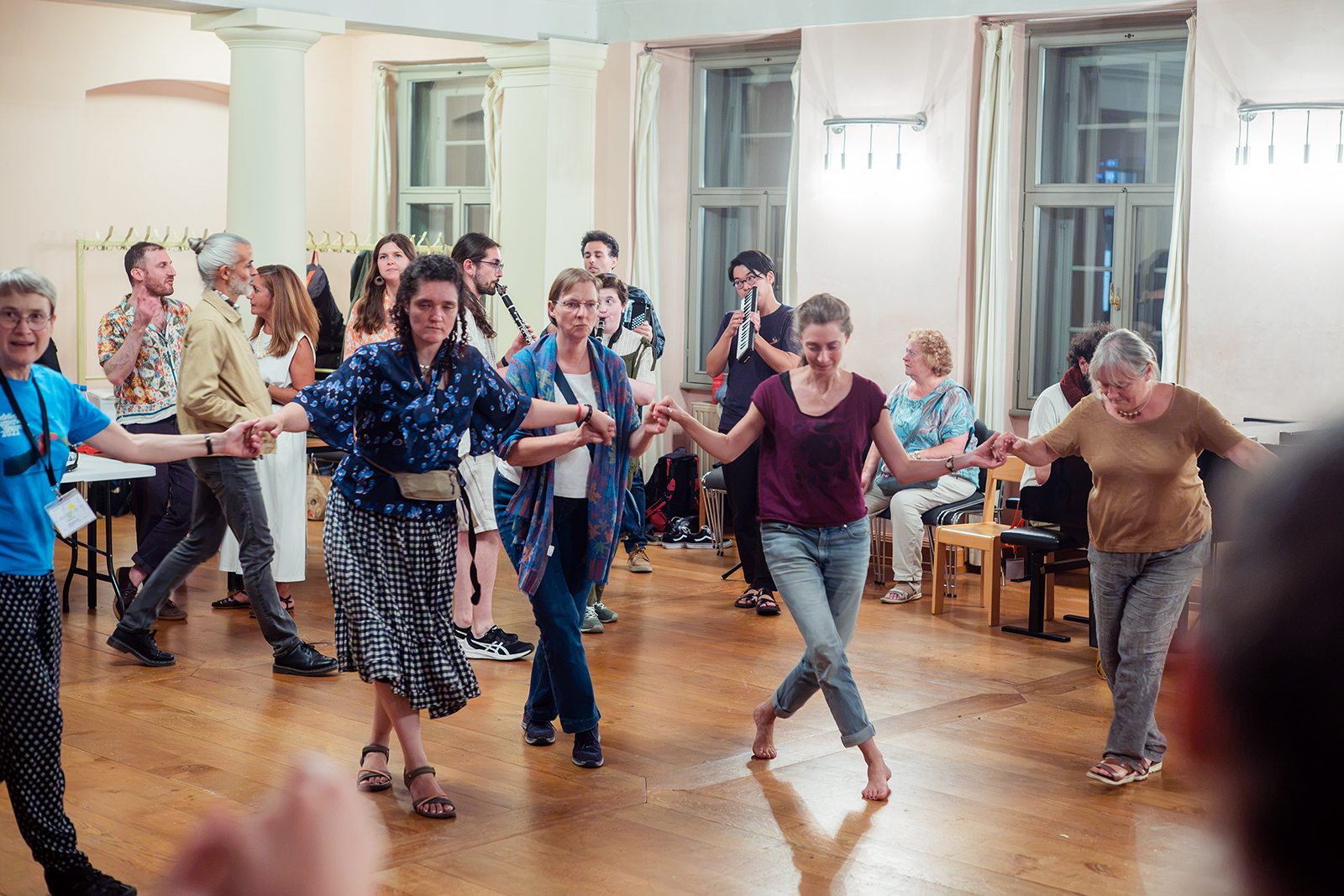
Attendees dance during a Yiddish Summer Weimar event on July 24, 2026, in Weimar, Germany. (Photo by Shendl Copitman)


WEIMAR, Germany (RNS) — In Weimar, Germany, where the streets once echoed with the notes and ideas of Bach, Liszt and Goethe, another European musical tradition has been reverberating for more than a quarter-century: Yiddish.

The annual Yiddish Summer Weimar festival brings hundreds of musicians, students and scholars to the city — most famous for the ill-fated republic that preceded Nazi Germany — for workshops, concerts and performances celebrating the language, music and culture of Ashkenazi Jews — a culture the Nazis sought to destroy but that has continued to reinvent itself. Since 1998, the program has both grown alongside and influenced the growth of interest in Yiddish language and culture from a wide swath of society, Jew and gentile, young and old, religious and secular alike.

“From the beginning, (the idea was) to present Yiddish culture as something which is alive, and not something that was entirely destroyed by the Shoah (Holocaust),” said Alan Bern, the founder and artistic director of Yiddish Summer Weimar.

This year the program ran from July 11-Aug. 15, with Aug. 8-15 being the festival week. 

Before 1939, Yiddish was spoken by well over 11 million people worldwide, including the vast majority of Europe’s Jews. The language is closely related to — but distinct from — German, with a heavy admixture of Hebrew and Aramaic vocabulary, Slavic grammar and other influences.

Stretching back to the 10th century, Yiddish followed Ashkenazi Jewish communities as they migrated from the Rhineland in what is today western Germany to Eastern Europe, into lands such as Poland, Lithuania, Ukraine, Hungary and ultimately on to the new world. Over that millenia, a rich culture of literature, music and thought was created in Yiddish — before its world was largely snuffed out during World War II.

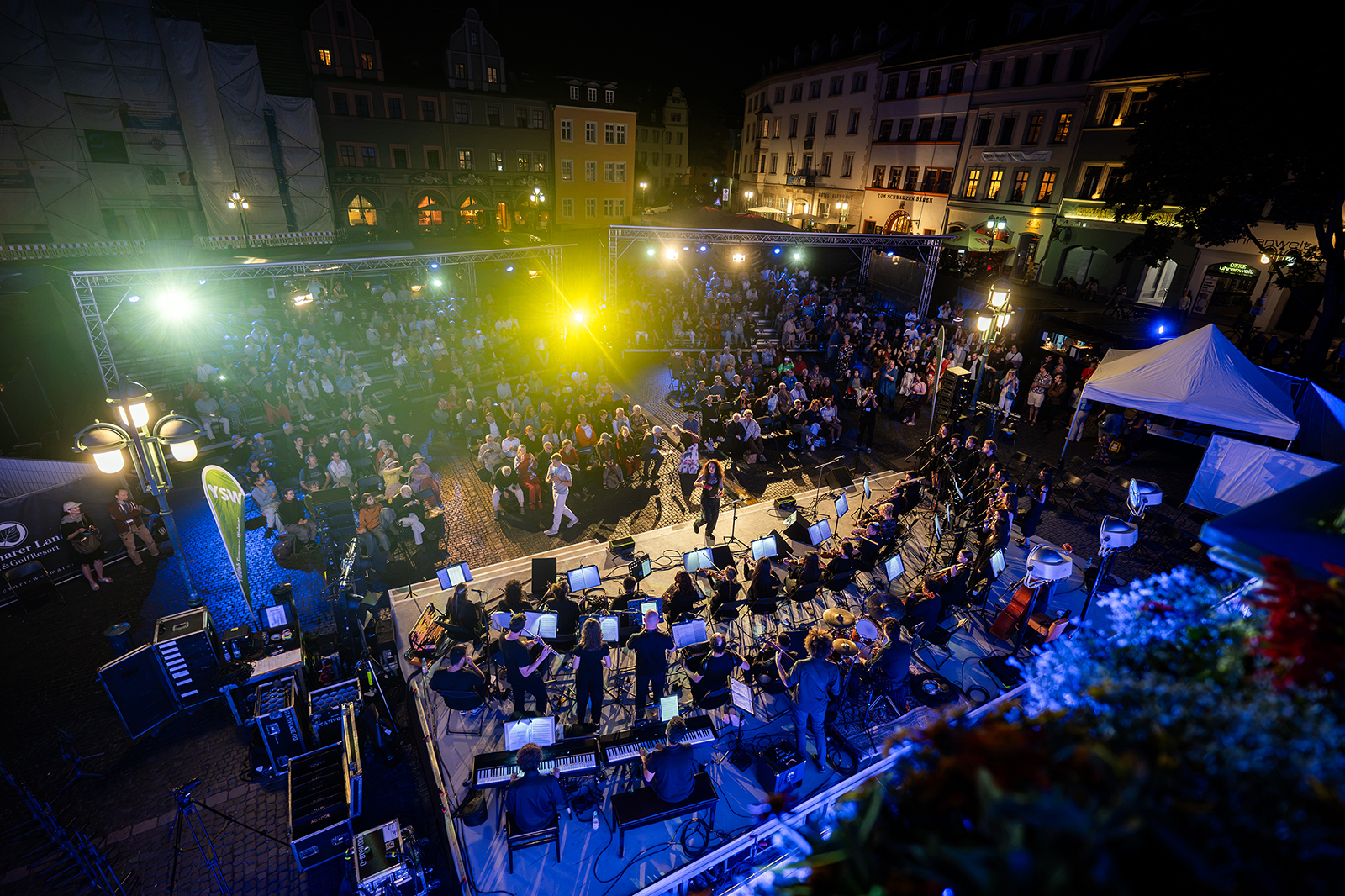
Crowds attend a Caravan Orchestra & Choir performance during Yiddish Summer Weimar on Aug. 8, 2026, in Weimar, Germany. (Photo by Shendl Copitman)


“Jewish culture, Yiddish culture, has a different “yichus” than Western European classical culture,” said Bern, using the Yiddish word for lineage. It came not from the courts of the aristocracy but the masses of the Jewish street, and he believes it’s one of Europe’s great cultural treasures nonetheless. 

Since its start, the festival has grown from a weekend workshop with a handful of participants to the largest festival of its kind in Europe, lasting more than a month, with daily workshops drawing hundreds of participants and near-nightly concerts attended by over 10,000 people total, Bern said.

That’s particularly an achievement in Germany, where Yiddish was once almost exclusively associated with the Holocaust.

“We’re not in a constant posture of mourning the past,” Bern said. “We’re also living and creating, so the fact that we’re talking about a living, creative culture, which is not in denial of the past, but also not stuck in the past, was, I think, surprisingly refreshing to people already in 1998, and it still is today.”

Yiddish is undergoing a sort of renaissance in the 21st century. The language remains the primary tongue of growing ultra-orthodox Jewish communities from New York to Israel, creating a demand for print and other forms of media in the Yiddish language. 

“We have a huge Hasidic pop culture, a contemporary pop culture, which is growing day by day, and where you see often mixing of different elements,” said Eidel Malowicki, who grew up in a Hasidic family in Vienna and is one of the Yiddish teachers at Yiddish Summer Weimar. “Now you even have Hasidic Rap, and it’s a repertoire that is growing every day. … there’s new comics coming out, new magazines.”

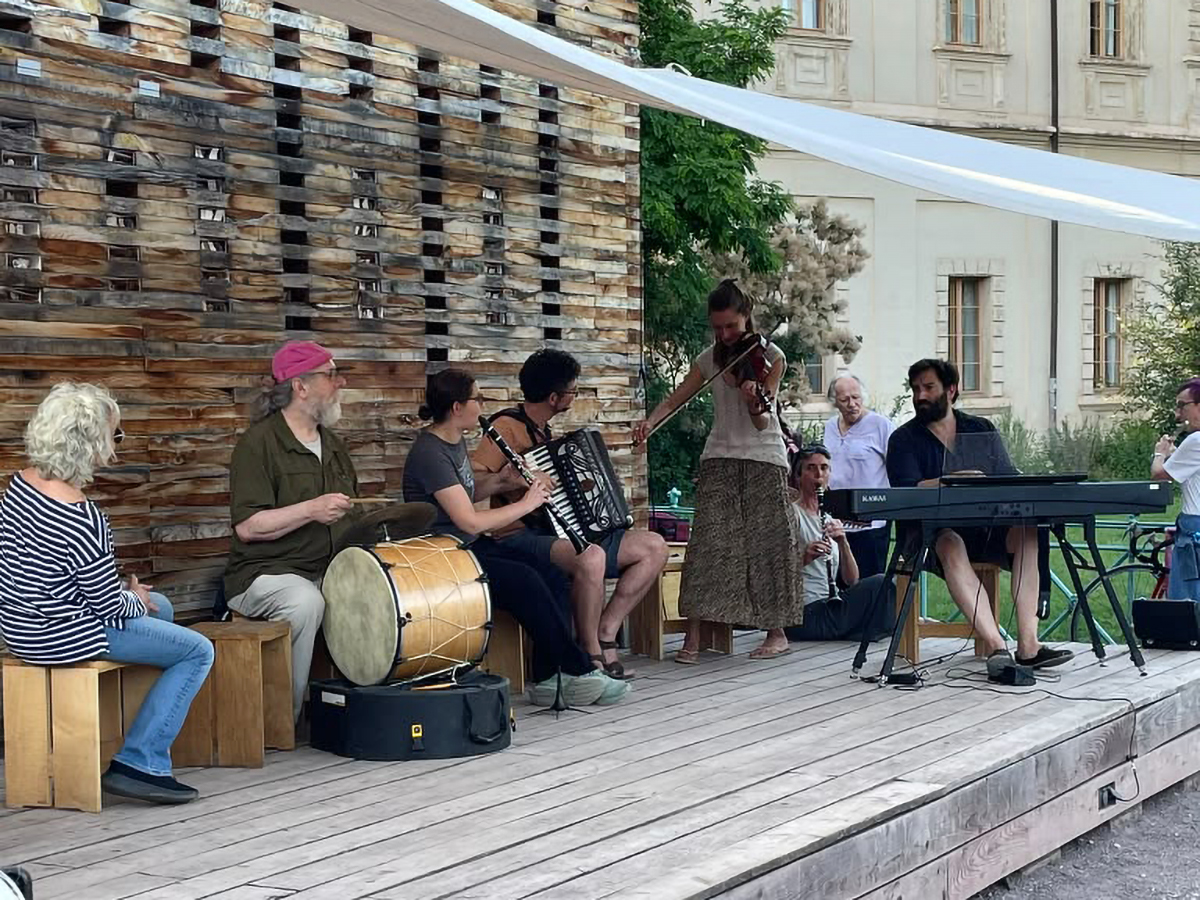
Yiddish Summer Weimar faculty and participants play klezmer in a concert in a Weimar park. (Photo by David Ian Klein)

Meanwhile, Yiddish is drawing interest from other sectors of the Jewish community, too, as well as some outside of it. For many young secular Jews, Yiddish has provided a route for connection with their heritage and Jewish identity unaffiliated with Zionism — and its stark support for the Hebrew language — that they have become increasingly disillusioned with. 

For Dan Kedem, who came from the Tel Aviv area to volunteer at Yiddish Summer Weimar, Yiddish is “a sort of path of redemption from the reality that I grew up in within Israel,” he said. He described feeling like the Jewish story taught to him in Israel was “linear” and “narrow.” 

“So one of the things that I found most fascinating about Yiddish is that exploration of this other Jewish culture, identity and root system of paths and ideas has allowed me to explore my own identity through a much wider lens and open myself to new ideas and new thoughts,” Kedem said. 

Opportunities for Yiddish language study have exploded across the world, and a report by the Yiddish academic journal Ingeveb cited over two dozen programs, camps and festivals in the summer of 2026 alone. The popular language-learning app Duolingo reported nearly 300,000 users for its Yiddish language course this year, the majority of whom are under 25, according to a recent report by RNS and NPR.


Bern estimated that at least half of the participants at Yiddish Summer Weimar are not Jewish. For many of them, connecting with the Yiddish language fills a gap in their national histories and European identity.

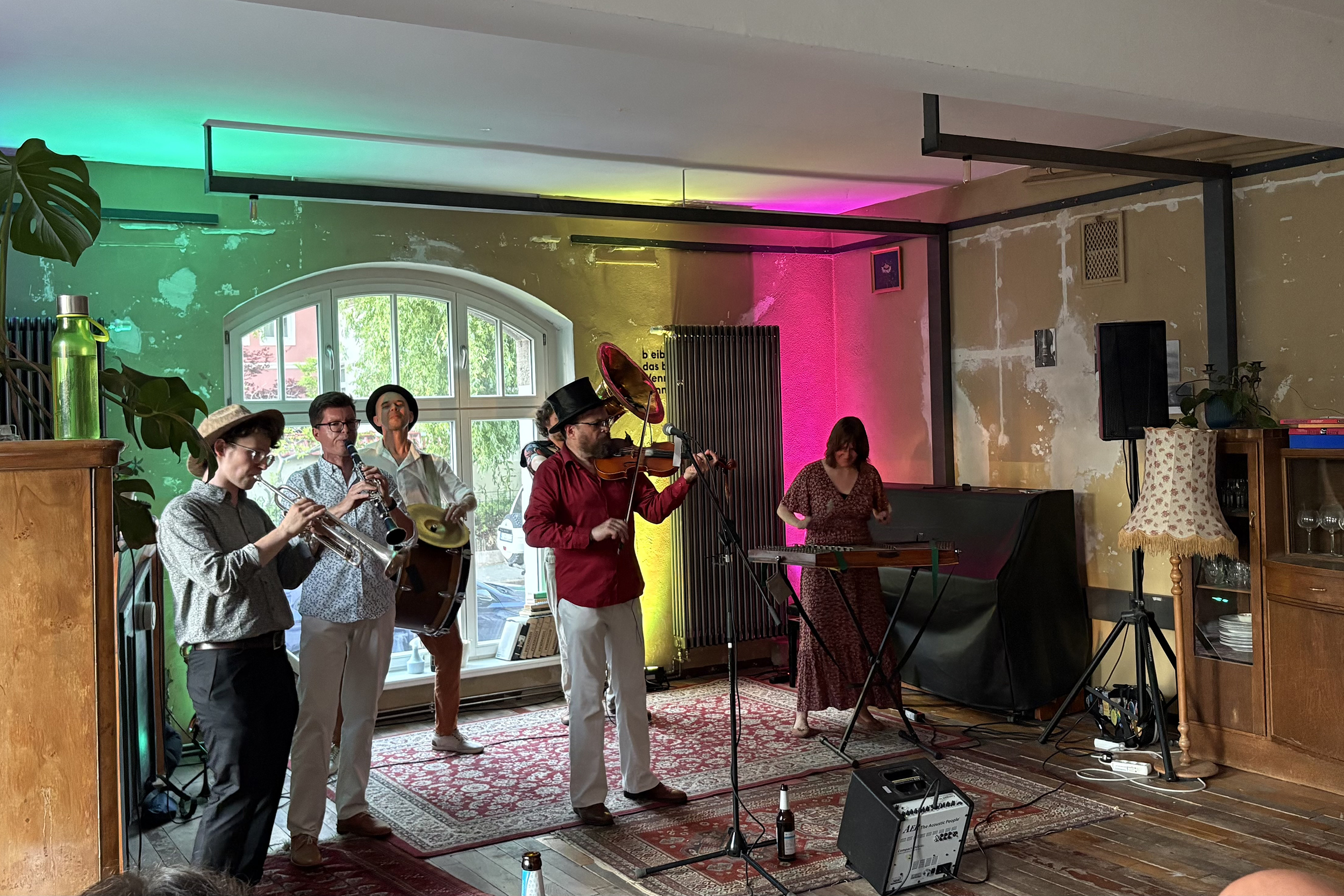
A group performs in a small setting during the Yiddish Summer Weimar in Weimar, Germany. (Photo courtesy of Yiddish Summer Weimar)

“The Jewish world, for me, as a German cis male, has always been something like a secret world, something unknown, something maybe a little bit mysterious,” said Michael Panzner, an intercultural consultant from Frankfurt, Germany. “But I know that it’s very relevant for Germany’s and Europe’s history and development over the centuries.” 

Growing up, he never knew any Jews in Germany, and when he met some as an adult in North America, he didn’t feel comfortable asking his many questions. In Weimar, he said, he found an opportunity to explore this culture he thought was lost from his country in a non-judgmental environment. He hopes to continue going for many more years. 

“I think (Yiddish) is being given way too little attention in today’s cultural life and social life,” he said.

Malowicki agreed, saying many of her students see Yiddish as an “entry ticket into a culture.” 

And while Hasidic dialects are by far the most spoken among modern Yiddish speakers, opportunities to learn the Hasidic dialect from native speakers like Malowicki are relatively rare.

“I see it as a chance to create a bridge between worlds that otherwise wouldn’t have a bridge or a connection,” she said. “I think that there’s a lot that we can learn from one another and our different worlds.”

Such experiences are exactly what Bern hoped participants would find in the program.

“I and my colleagues definitely view Yiddish from a transcultural and transnational point of view,” Bern said. “That’s also unusual for people who tend to think of Yiddish as the culture of some isolated shtetl in the East and separate from all other cultures and doesn’t have any links to other cultures.”

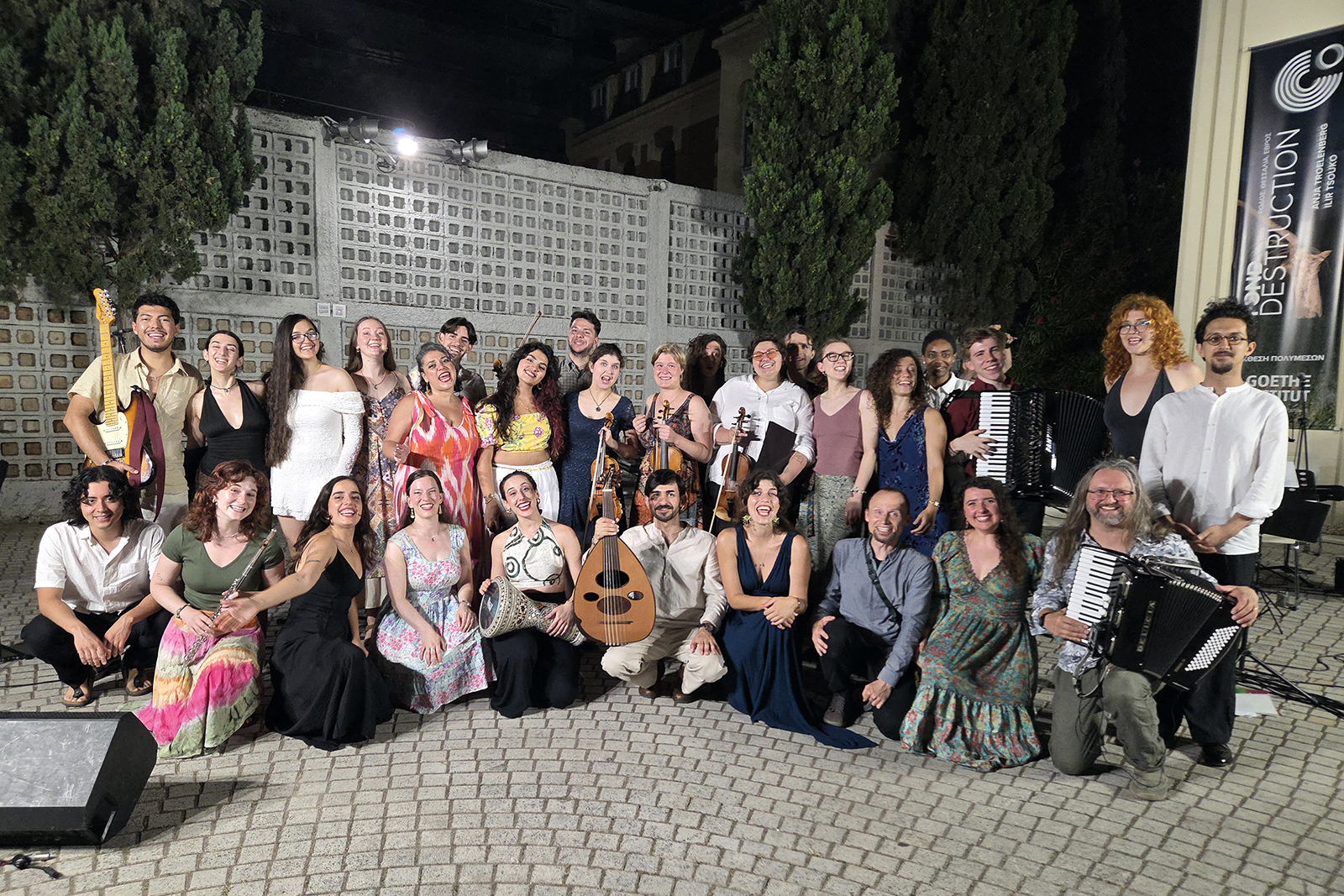
The 2026 Yam Ensemble. (Photo courtesy of Yiddish Summer Weimar)

To that end they have long worked to involve countries and cultures far outside of Ashkenazi Jewry in the program. In the past that has included youth orchestras from Poland and France, and today the Yam Ensemble, which brings together young musicians from Germany, Greece and Turkey to explore the shared influences and heritage of Mediterranean and Klezmer music.  

Of all the places for a festival of Yiddish culture in Europe, Weimar may seem like a strange place. 

Unlike Warsaw, Vilnius, Krakow and other cities where there are Yiddish programs and cultural festivals, Weimar is not a great city of Jewish or Yiddish speaking history. But it couldn’t have found a more fitting or important home, Bern stressed. 

The city is most associated with two things, European high culture and the rise of fascism. It’s where Adolf Hitler reformed the Nazi Party in 1926. And just as Weimar and the Thuringia region became a hot bed of support for the Nazi Party in the 1920s and 30s, it’s also the largest base today for the far-right Alternative für Deutschland Party, often labeled a Neo-Nazi party.

“It’s very ironic to think that here is a place that has a large Yiddish music festival, maybe one of the biggest in the world, and sold out concerts and everything, and it’s this same environment in which there’s a neo-Nazi movement that is just growing all the time,” Bern said. 

As for Weimar’s place in European cultural history, Yiddish isn’t out of place either, Andreas Schmitges, the festival’s curator, said.

“Weimar is a place of what they call German hochkultur (high culture). I mean Goethe, Schiller, Bauhaus, Liszt, everything is hochkultur,” Schmitges told RNS. “To be honest, I think that Yiddish culture is right here in the right place where it belongs because it’s also one of Europe’s hochkulturen (high cultures), so this is a perfect place.

Saturday, July 11, 2026

As Israel divides Jewish communities, Yiddish draws a new generation


(RNS and NPR) — The language app Duolingo reported that roughly 296,000 people around the world are studying Yiddish as of this year. An estimated 60% of them are under 25 years old.


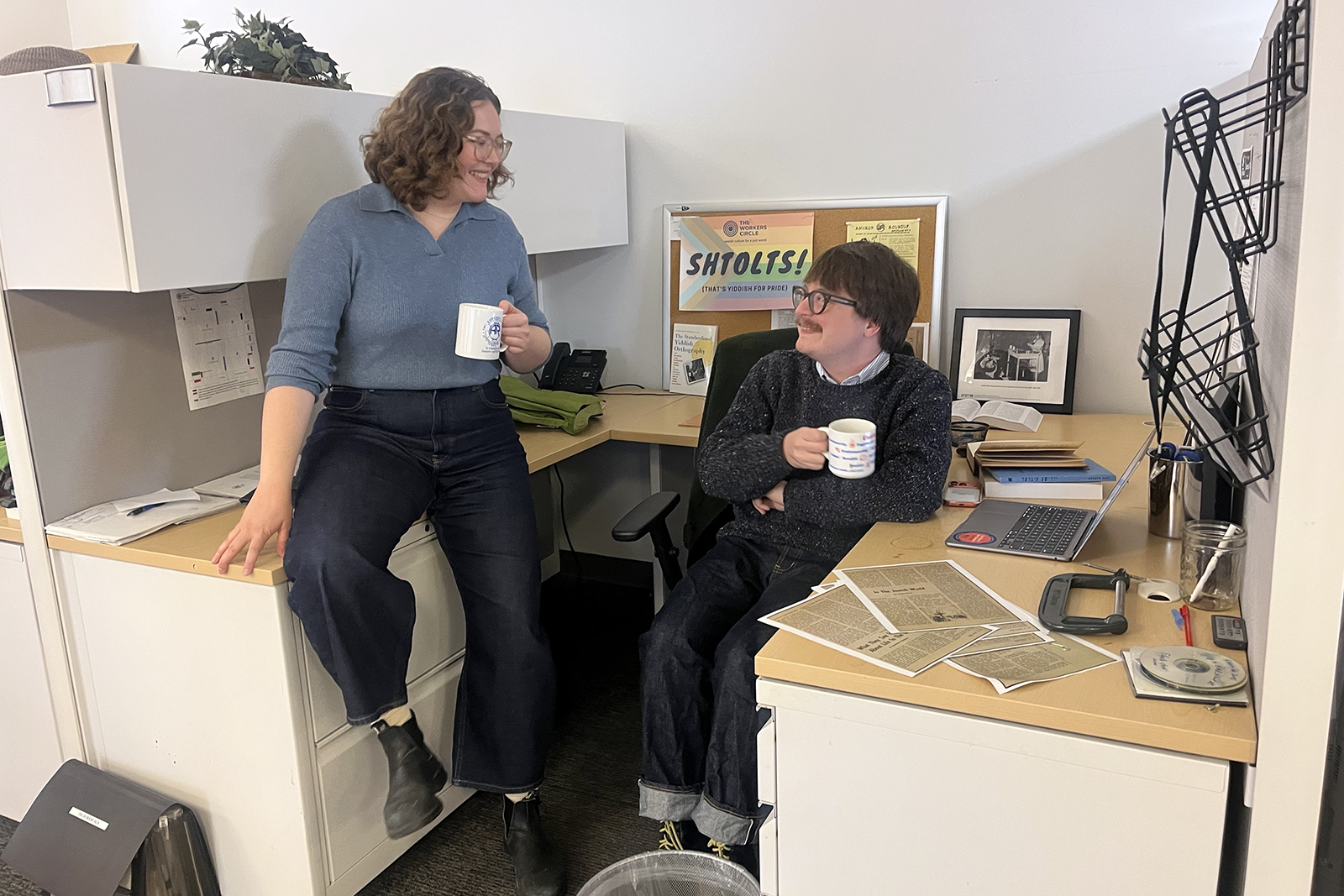
Francesca Rubinson, left, manager of social justice at the Workers Circle, a Jewish nonprofit in Manhattan, and her colleague, Yasha Giner, Yiddish culture and social justice organizer at the Workers Circle, exchange ideas at Giner’s desk about their work on the college ambassador program. (Photo by Nirvani Williams/NEPM)


Nirvani Williams
July 10, 2026 

(RNS and NPR) — Lindsey Bloom, a senior at Mount Holyoke College in South Hadley, Massachusetts, grew up going to Hebrew school and attending a synagogue with an Israeli flag hanging near the front of the sanctuary. However, as she has sought to distance herself from Israel’s government in recent years, she said she didn’t know of other ways to engage with Jewish culture — until she learned about Yiddish.

“I’ve definitely talked to quite a few people that just stopped engaging with their Judaism because they didn’t know where to go,” Bloom told RNS and NPR. “That was the case for me. And then I got into Yiddish, and I was, like, oh, this is actually a lot better. I actually align with this a lot more.”

Bloom isn’t alone. The language app Duolingo reported that as of this year, roughly 296,000 people around the world are studying the language with 10th-century European roots. An estimated 60% of them are under 25 years old.

Mindl Cohen, the academic director of the Yiddish Book Center, an Amherst, Massachusetts-based organization that promotes Yiddish culture and literature, said the young people she teaches are engaging with the culture and language in myriad ways. They are performing new plays, making music that’s inspired by Yiddish music of the early 20th century and translating Yiddish literature, she said.

The Yiddish trend seems to be especially prominent for college students like Bloom who seek to hone a Jewish identity and culture removed from support for the state of Israel — a position that can feel isolating, as the Jewish communities they grew up in have long held support for Israel as a core aspect of Jewish identity.


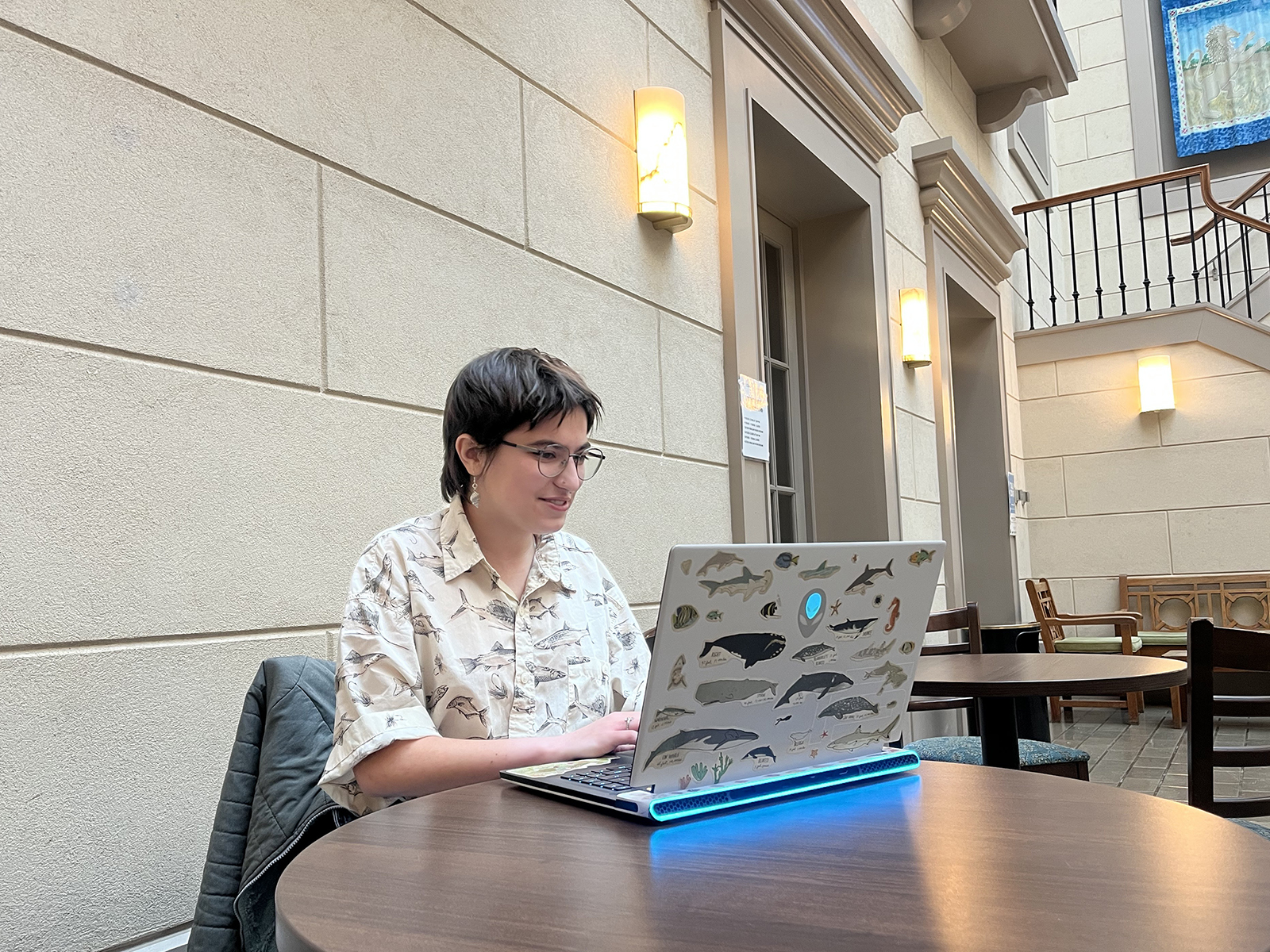
Lindsey Bloom searches various Yiddish texts on her laptop in the Williston Memorial Library on Mount Holyoke College’s campus in South Hadley, Mass. (Photo by Nirvani Williams/NEPM)

Post Oct. 7, 2023, and the ensuing war in Gaza, major divisions have emerged along political, ethnic and generational lines over support for Israel. And data suggests that even prior to the Oct. 7 Hamas attack, Jewish Americans ages 50 and older, especially those who are religious, are much more emotionally attached to Israel than younger Jewish Americans.

For Sally Kaye, a senior at Barnard College in Manhattan, New York, who is also learning Yiddish, her culture and identity are important to her, but she said she has struggled with both recently.

“It’s hard to be, a lot of the times, in synagogue spaces and kind of traditional religious spaces that have been so focused on supporting Israel no matter what,” Kaye said.

Cohen said engaging with Yiddish culture is one way young Jews can gain insight into questions about their identity and connect to the Jewish diaspora.

“The idea of ‘what did it mean for Jews to exist as diasporic people for centuries’ I think can be really inspiring and just provocative for young Jews today, who maybe don’t like aspects of what they see in the politics of the Jewish state of Israel and are trying to think, well, what are ways to change that? What are the different models? What can we learn from history?” Cohen said.


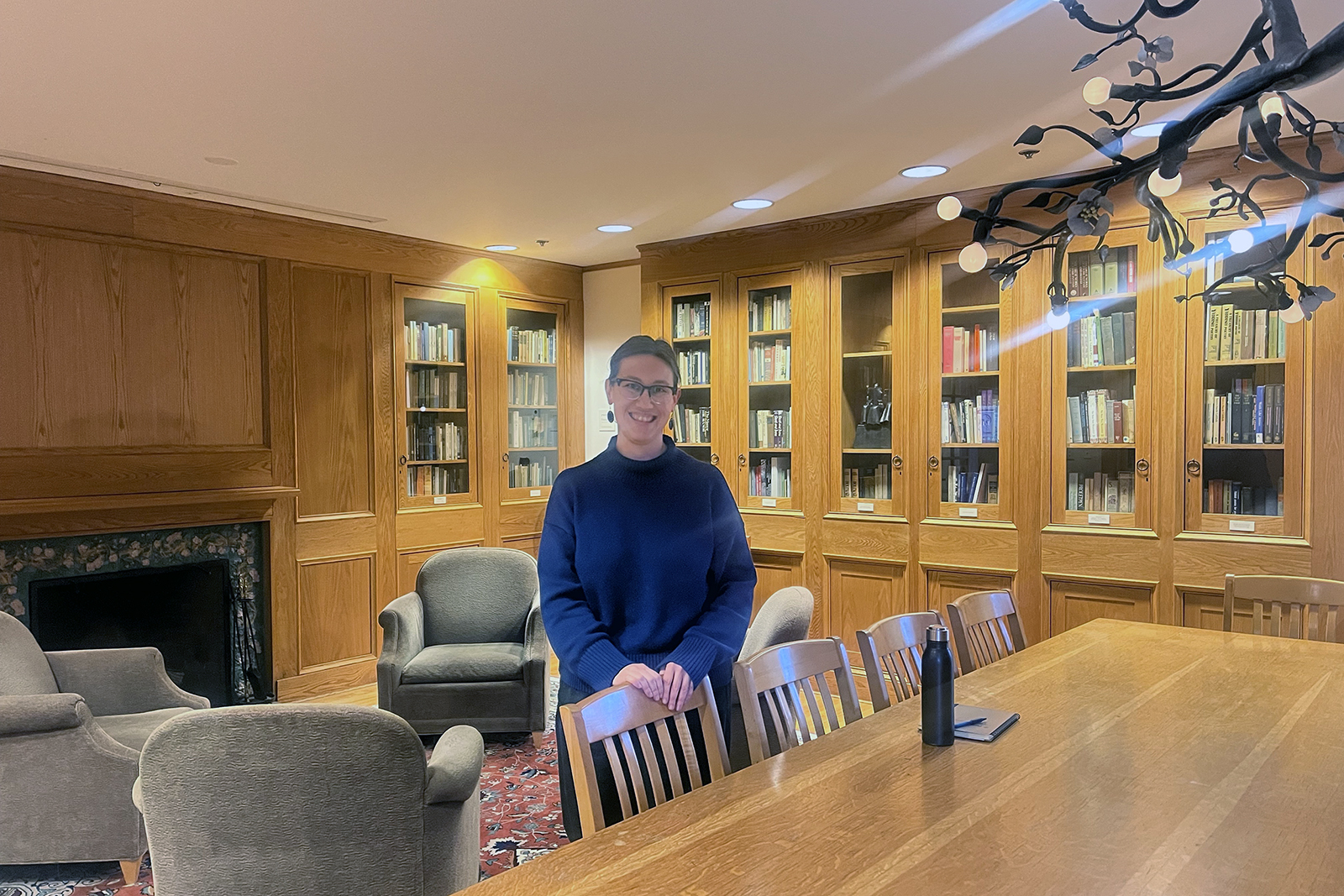
Mindl Cohen in the library of the National Yiddish Book Center in Amherst, Mass., where she had her first Yiddish class. She has since become a scholar in the language and culture. (Photo by Nirvani Williams/NEPM)

She added that her students are interested in learning about how Yiddish speakers expressed their creativity in the past. The students then recreate these art forms in their own way.

“By taking the time to learn about the past and learn about this culture, we can be inspired to continue things and make new things and make versions that feel relevant today,” Cohen said. “That feels very special to see happen.”

The Workers Circle is a Jewish social justice organization headquartered in New York City that claims to be one of the largest providers of Yiddish language classes in the world. Francesca Rubinson, senior social justice organizer, said her organization is trying to create space for those who want a more expansive view of Jewish culture and history.

“It’s been so meaningful for many young people these days, post Oct. 7, to explore what Yiddish language and culture can mean for them, especially because many of them had Yiddish speakers in their own family just a couple generations ago,” Rubinson said. “And due to assimilation, cultural shifts, the prominence of Zionism and of Israel in many Jewish institutions, there has often been less interest or less institutional support for exploring Yiddish language and culture.”

Rubinson works with young Jewish college students and helps them plan Yiddish cultural events on their campus through Workers Circle’s college ambassador program.


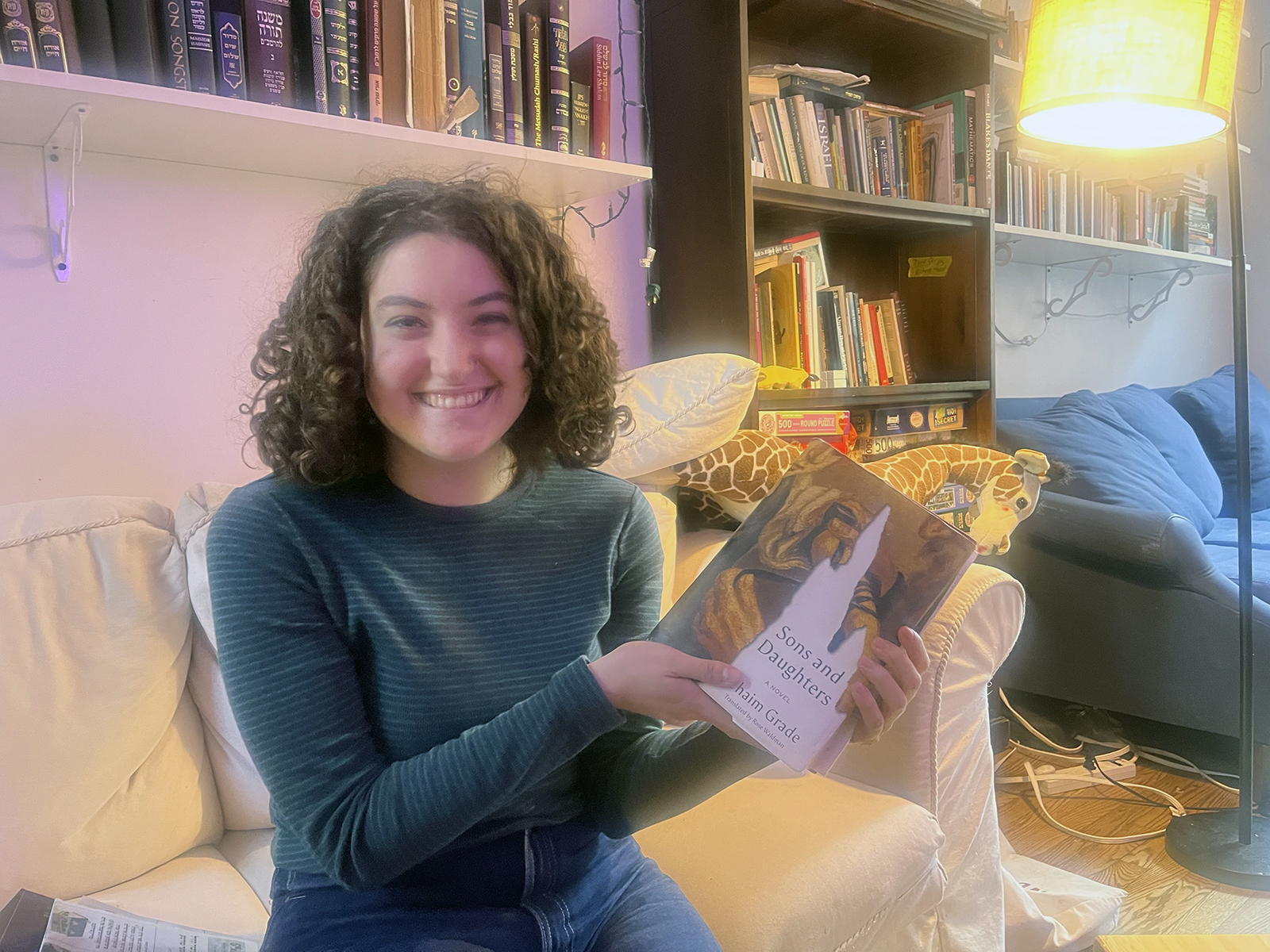
Barnard student Sally Kaye shows her copy of “Sons and Daughters” by Chaim Grade in Yiddish, at the Jewish Food Co-Op in the Upper West Side neighborhood of New York City. (Photo by Nirvani Williams/NEPM)

“The events range from playing Yiddish music and talking about its cultural significance to actions with local immigrant justice organizations as part of their kind of ambassador events that they plan,” she said. “They’ve done letter writing campaigns for local tenants’ rights organizations, and they’ve also continued to bring special speakers and Yiddish teachers to campus.”

Bloom, the Mount Holyoke senior, is a part of the Worker’s Circle college ambassador program. She’s also in a Yiddish singing duo called Khaverte and recently performed Chappell Roan’s “The Subway” in Yiddish. There’s something about the language, Bloom said, that inspires her creatively.

“Playing with the language and playing with the art and making new things, I really, really like it. I like making new Yiddish things,” Bloom said.

She said not only is she able to express herself in her culture and religion, but now, she’s able to find a community that understands her.

This story was produced through a collaboration between NPR and RNS. Listen to the radio version of the story.

Sunday, September 07, 2025

Jewish musicians mourn Gaza's suffering in Yiddish, a language nearly lost to genocide

“Singing in Yiddish about what is happening in Gaza is automatically putting into relation the Holocaust, and whatever is happening there,” 


(NPR and RNS) — A recently released album, ‘Lider Mit Palestine,’ features several artists and 17 original compositions — some modern, some mournful and all shaped by Yiddish and its history.


“Lider Mit Palestine (Songs with Palestine): New Yiddish Songs of Grief, Fury, and Love” album cover. (Courtesy image)

Deena Prichep
September 2, 2025
RNS


(NPR and RNS) — In the first few days after Hamas’ brutal attack on Israel on Oct. 7, 2023, New York artist Joe Dobkin was scrolling through news coverage when he saw a video of an Israeli soldier on a tank rolling into Gaza. The soldier was singing an old Yiddish song.

The song was “Zog Nit Keynmol,” also known as The Partisan Hymn, inspired by the Warsaw Ghetto uprising.

“I saw this, and I got the message that … what this Israeli soldier was doing is for the survival of the Jewish people. This is for me, this is for my family,” said Dobkin. “And this is while all day, every day, I’m watching images come across my social media feeds of people being bombed to death.”

Dobkin is the grandchild of Holocaust survivors — and the descendant of people who didn’t survive — so he wanted to respond in Yiddish, speaking out about what he saw as a genocide, in this language that was almost destroyed by one.

“ I needed something to counter it,” Dobkin explained. “And the thing that I wanted was also in Yiddish.”

Nearly two years later, with the Gaza Health Ministry reporting more than 63,000 Palestinians dead and an unfolding famine in Gaza, Dobkin has released “Lider Mit Palestine (Songs with Palestine): New Yiddish Songs of Grief, Fury, and Love,” a fundraising album that uses the historic language of European Jews to mourn Palestinian suffering.

The idea for the album began first with a song Dobkin wrote in Yiddish:


There is no safety through oppression,
not with occupation or high walls.
The past must not become a prison,
but instead be an instrument of liberation.
How does a prayer sound?
What does family mean?
Who has the right to grow old at home?

After conversations with fellow Yiddish singers Josh Waletzky and Isabel Frey, the group sent out a call for similar songs, writing: “In the midst of the ongoing nightmare in Palestine, inflicted allegedly on our behalf as Jews, we are moved — as inheritors and practitioners of a peoplehood and culture that was threatened with obliteration — to proclaim our commitment to a future of liberation for all people.”

The resulting album was released in July and features 17 original compositions from different musicians — some modern, some mournful, and all shaped by Yiddish and its history, like a poem by Sholem Berger, sung by Esther Gottesman, that when translated reads:


Their death will not revive the dead.
Their hunger is not our bread.
Multiplying their tears will only mean more tears.
Blood is red.

It’s not surprising that so many in the Yiddish community felt called to respond to Israel’s actions in Gaza, said Madeleine Cohen, who directs educational programs at the Yiddish Book Center and teaches Jewish studies at Mount Holyoke College.

“For every generation that comes to Yiddish, there is this feeling of urgency, a feeling of responsibility, because of the violent ruptures of the 20th century,” said Cohen.

Because of genocide, displacement and assimilation, a surprisingly small number of Jews, outside of Orthodox Judaism, grow up speaking Yiddish. Some are drawn to Yiddish because of its history as a language of leftist, socialist causes — versus the embrace of Hebrew as the language of Zionism — and some for its rich cultural tradition. But all who choose Yiddish feel the weight of its story, said Frey, who is an ethnomusicologist as well as a Yiddish musician.

“Singing in Yiddish about what is happening in Gaza is automatically putting into relation the Holocaust, and whatever is happening there,” said Frey.

“It’s something that opens up a space for … acknowledging the pain of the other and seeing it in relation to one’s own trauma and pain. And I think that that’s actually something very powerful.”

Frey, who helped produce the album along with Dobkin and Waletzky, pointed out powerful lyrics in the album’s contributions. She said that one song, by Waletzky, “is based on this Yiddish idiom — the person that digs a grave for the others falls in themselves.”

The lyrics, translated from Yiddish by Frey, say: “You keep digging and digging a deep grave, and you keep thinking it’s for ‘them,’ We’re standing at the crossroads between humanity and the abyss, and it’s tearing out a piece of my heart.”

“I mean, that’s how I’ve been feeling every day,” Frey added.

 To build the world of Yiddish culture is to work in the shadow of loss and destruction — and also music and joy. The Yiddish community — like pretty much every Jewish community — has been torn by what’s happened on and since Oct. 7. But the musicians on “Lider Mit Palestine” are hoping they can use this old language to bring a new perspective.

This story was produced through a collaboration between NPR and RNS. Listen to the radio version of the story.

Sunday, November 24, 2024

For avid readers of Yiddish news, print is still king

(RNS) — Technological advances as well as changing social attitudes have sparked a cultural renaissance among Hasidic Jewish communities, for whom Yiddish is the native tongue.


(Photo by Jen Theodore/Unsplash/Creative Commons)
David I. Klein
November 22, 2024

(RNS) — As many local media outlets around the world are struggling, the Yiddish press is experiencing a rebirth, surprising many who not long ago pronounced the Jewish language as doomed after millions of its core speakers died in the Holocaust.

“Since 2000, over 30 Yiddish print media have been founded, almost exclusively in the Orthodox Jewish milieu of New York and the surrounding area,” said Bjorn Akstinat, a German media researcher who recently compiled a directory of Yiddish media outlets.

Sparked by technological advances as well as changing social attitudes, the boom has led to a parallel cultural renaissance among Haredi and Hasidic Jewish communities (sometimes called ultra-Orthodox), for whom Yiddish is the native tongue

An outgrowth of old High German, heavily influenced by Hebrew, Aramaic and Slavic languages, and traditionally written in the Hebrew alphabet, Yiddish was the primary language of Ashkenazi Jews living in central and Eastern Europe for nearly 1,000 years. At the turn of the 20th century, more than 10 million people spoke Yiddish, encouraged by hundreds of newspapers on at least three continents, with a wide range of religious and political bents.

America’s once largest Yiddish-language newspaper, “Forverts” (The Forward), was founded in 1897 to bring immigrant Eastern European Jews the news of the world — and their new world — in their native tongue. By the eve of World War I, it had been joined by more than 150 other periodicals in New York alone, at least 20 of them dailies, rivaling the output in Warsaw, Krakow, Vilnius, Minsk and other cities with large Jewish populations.

One might write for a religious audience, one from the perspective of the local Communist Party, one for far-left Zionists and yet another for far-right Zionists, and so on.

In Europe, that world was shattered by the Holocaust, and for its survivors, many residents of the U.S., Israel and elsewhere, assimilation meant speaking English or another local tongue. In Israel, Hebraicizion encouraged Jewish immigrants to leave their native languages on the boats they came on and adopt modern Hebrew. For most, Yiddish quickly became a thing of memory.

According to Rukhl Schaechter, Yiddish editor of The Forward, by the 1990s, the last Yiddish outlets were mostly publishing feel-good articles for elderly Eastern European immigrants. As the new millennium dawned, they seemed to be on borrowed time.

Except they weren’t.

Today, in New York’s Boro Park and Williamsburg neighborhoods, or in upstate New York towns such as New Square and Palm Tree, newsstands are filled with Yiddish media of every shape and format.

While Yiddish has indeed declined among the world’s Ashkenazi Jews, the Haredi Jews arrived after the Holocaust as refugees, not as immigrants wanting to become Americans. Fighting assimilation, they have clung to Yiddish as their everyday language. “People came here from Eastern Europe and they resettled together with other people who were like minded, and they kept speaking their language,” said Meyer Labin, a Hasidic journalist.

The birth rate among Haredi couples, at six to seven children, according to a 2023 study, far outpaces the rate of other Jewish groups or just about any other demographic in the United States, boosting a community of a few thousand in the 1950s to hundreds of thousands today.

Clinging to Yiddish certainly preserves a culture but it also insulates a population from outside influences, something that has its costs alongside its benefits. In 2022, a New York Times report argued that Haredi yeshivas in metro New York were failing to educate their students in English, leaving them unprepared for life outside their enclaves.


A variety of past Moment Magazine weekly issues. (Images courtesy Moment Magazine)

Even if Yiddish has bounced back as a vital language, that’s no guarantee of a thriving media scene. (If so, the world’s adoption of English might have stopped the evaporation of newspapers by the thousands since 2000.) Since that year, the circulation of English-language print media has been cut in half, according to a Pew study.

But other facets of Haredi life — including its self-induced cultural isolation — have made print a necessity. “With Orthodox communities, we don’t do digital, up to a certain extent,” said Yoel Krausz, a Satmar Hasid who in 2014 co-founded Moment Magazine, the largest Yiddish weekly magazine in the U.S. “Especially with our youth, our youth don’t have any web and of course no television.”

A little more than a decade ago, Haredi leaders drew as many as 40,000 members of various traditions to New York’s Citi Field to rally against the encroachment of the internet. Opposition has softened since, especially among businessmen, but many Hasidim still don’t use the internet at home and largely forbid it for their children.


“Our youth is growing up only with print publications for their learning and for their education and for entertainment,” said Krausz, and advertisers can only dependably reach the 700,000 or so American Hasidic Jews in print. Even those who do use the internet are invariably offline on Saturday, the Jewish Sabbath, when Orthodox Jews refrain from using electricity.

“S’iz farbunden alle tzuzamen” — it’s all tied together, said Krausz in Yiddish. “It’s a domino effect. Because our readers are only reading in print, they will buy the magazine, they will pay for the magazine, pay for subscription for a print magazine, and then the advertisers will appreciate it as a place to advertise.”

Krausz’s Moment, with a circulation of 25,000, estimates it reaches 150,000 readers weekly, given the size of Haredi households, the overwhelming majority of which are in and around New York. It also finds its way to other Hasidic enclaves around the world, such as in London, Antwerp and parts of Israel. Moment prides itself on its independence, Krausz said, and is not affiliated with any one Hasidic sect.

“Journalism in the Haredi world started, actually, as something somewhat revolutionary in its inception,” said Labin. It sounded like a contradiction, “that the Haredi world would produce newspapers on its own, because newspapers were seen as something foreign, and something that is too worldly,” said Labin.


Past Der Yid newspaper issues. (Image courtesy Der Yid)

Der Yid, founded in 1953, delivered Yiddish speakers the news they might need for business but with little cultural or community coverage. “One of the main aspects of Haredi ideology is that the only culture we have is our religion, Judaism,” Labin explained.

“In Orthodox Judaism, you know, we listen to our rebbes,” Krausz said, referring to the grand rabbis who lead many Hasidic sects. “They have the last (word) on what to do, how to do it and how to go about things.”

Media might distract from direct Torah and Talmudic study, the ideal pursuit for Hasidic men.

“But you know many people need their reading. I can tell you from personal experience it recharges me and allows me to focus on my work,” Krausz said, lamenting that when he was a child there were far fewer options in his own language to satisfy him.

Slowly however, the rebbes’ views began to change. They feared that if they did not provide their own options, their youth would find their media elsewhere. Now, in Hasidic areas, one can find magazines affiliated with different Hasidic sects, editions targeted at children and on special topics such as mental health or parenting.

“We started seeing a proliferation of specialized niche content,” Labin said. “It’s a very vibrant landscape of media.”

Technology has changed things as well; while designing the layout for a magazine was once a laborious process requiring special equipment, nowadays it can be done quickly by anyone with a laptop.

Krausz noted that while much of Moment’s content is journalistic, covering the goings-on of Hasidic communities, it doesn’t report on crime and generally eschews topics that cast a negative light on the community. All of their content is approved by a rabbinic board.

A parallel landscape of grassroots media by and for Haredi women has also seen an explosion in recent years, countering Haredi media that has been blasted for its practice of removing photos of women or doctoring photos to remove the women.

The explosion of Yiddish media interest has also impacted the last remnants of Yiddish publications outside of it. The Forward long since shifted the vast majority of its content to English but still dedicates part of its website to publishing in Yiddish, and even for a time published a special section targeting Haredi readers.

Though the Forward has retired the special section due to changes to the website, said Schaechter, its Yiddish-language editor, “I’m very happy to see how prolific the Haredi and Hasidic world has become.

Similar to the advances in publishing tech, advances in videography and recording technology — as well as a new-found forum to share content in — has resulted in a boom in the Hasidic music scene, with it sometimes seeming like artists are dropping new Yiddish albums or singles weekly.

“You know, Yiddish used to be something that was just a way of communicating. But (in the Hasidic world) it had never become this kind of thing like now, where there is this need to create in Yiddish,” she said.


Yiddish anarchist songs