Tuesday, August 25, 2026


China Defies U.S. Economic D-Day against Iran

China on Tuesday signaled it would not end its ties and trade relations with Iran following the U.S. sanctions unveiled on Monday that target Chinese and Hong Kong entities for helping Iran do business.

On Monday, the U.S. Administration announced a series of new sanctions against individuals and entities linked with Iranian trade and economy, including the shipping and oil industry.

However, “Operation Economic Outcast,” launched by Treasury Secretary Scott Bessent, stopped short of sanctioning any Chinese banks.

The oil trade remains one of the U.S. sanctions campaign’s primary targets. Monday’s designations include brokers, companies, and shadow-fleet vessels operating across the UAE, Hong Kong, China, Singapore, Switzerland, and Europe that transport Iranian oil and channel revenues to Iranian entities. OFAC also sanctioned international companies operating in Iran’s petroleum sector and facilitating the movement and sale of Iranian crude and petroleum products.

In the first official and public reaction to the ‘Economic D-Day’, Lin Jian, spokesperson for the Chinese Foreign Ministry, said at a regular press conference on Tuesday that “China has made clear on many occasions its firm opposition to illicit unilateral sanctions that have no basis in international law or the authorization of the UN Security Council. Economic warfare and maximum pressure provide no solution.”

Such moves by the U.S. “only serve to fuel tensions and lead to risk spillover, which will disrupt the global economic and financial order, and harm the legitimate rights and interests of other countries,” the spokesperson added.

“China will do everything necessary to firmly safeguard its rights and interests,” he said on several occasions, hinting that China could retaliate against the U.S. if sanctions further expand.

Asked if China would be willing to change some of its behaviors and interactions with Iran to comply with U.S. demands, the official said that “China’s cooperation with Iran is conducted within the framework of international law, thus should not be disrupted. China is closely following the developments, and will do everything necessary to firmly safeguard its rights and interests.”

By Charles Kennedy for Oilprice.com


Treasury Expands Iran Sanctions Without Targeting Major Chinese Banks

The Trump administration has revealed the details of its “economic D-Day” campaign against Iran, expanding secondary sanctions that threaten foreign companies with exclusion from the U.S. financial system for continuing to do business with Tehran and targeting nearly 60 individuals, entities and vessels in the first round of new measures.

Treasury Secretary Scott Bessent on Monday formally launched “Operation Economic Outcast,” giving countries a defined, but unspecified, timeline to shut down Iran-related activity identified by Washington. The Treasury said countries that fail to comply will face U.S. action, while entities facilitating Iranian money laundering or sanctions evasion risk being cut off from the U.S. financial system.

OFAC issued new sanctions covering Iran’s digital assets, technology, gold, aviation and shipping sectors, allowing the Treasury to sanction foreign persons operating in or providing services to those sectors. Those authorities add to existing sanctions covering Iran’s financial, petroleum and petrochemical industries. 

The oil trade remains one of the campaign’s primary targets. Treasury said Monday’s designations include brokers, companies and shadow-fleet vessels operating across the UAE, Hong Kong, China, Singapore, Switzerland and Europe that transport Iranian oil and channel revenues to the IRGC-Quds Force and other Iranian entities. OFAC also sanctioned international companies operating in Iran’s petroleum sector and facilitating the movement and sale of Iranian crude and petroleum products. 

China is now being tested. Beijing buys more than 80% of Iran’s seaborne oil, but Washington stopped short Monday of sanctioning the larger Chinese banks that may facilitate those purchases. Iranian crude availability in China is already declining under the U.S. blockade, with Chinese imports estimated at 534,000 barrels per day in August, down from 823,000 bpd in July, according to Reuters.

Iran’s available offshore crude stocks are also shrinking. On Friday, Iranian crude outside the Persian Gulf and Gulf of Oman had fallen to roughly 83 million barrels from more than 100 million barrels before Washington reinstated its blockade in mid-July. About 40 million barrels were sitting in floating storage near Singapore, with market participants estimating that only around 4 million barrels remained unsold.

Oil prices fell more than 2% earlier Monday as traders took profits ahead of Bessent’s announcement, with WTI at $85.18 and Brent at $92.32 in early Asian trading after both benchmarks gained more than 5% last week. Just shortly after the Treasury reveal, at 2:17 p.m. ET on Monday, Brent crude was trading down 2.56% at $91.97, with WTI down 2.58% at $84.81.

By Charles Kennedy for Oilprice.com


The Biggest Victims Of Trump’s Economic D-Day On Iran

  • Trump’s “Economic D-Day” puts Iran’s major trading partners under pressure, with China, Iraq, Turkey, India and the UAE facing varying exposure to secondary U.S. sanctions.

  • China represents Washington’s biggest test, buying more than 80% of Iran’s seaborne crude, while sanctions against major Chinese banks could trigger significant economic and diplomatic fallout.

  • Iraq and Turkey face particularly acute energy risks, while India’s remaining trade is vulnerable and the UAE has already largely cut economic ties with Tehran.

Trump’s “economic D-Day” against Iran is built around one of Washington’s most powerful weapons: access to the U.S. financial system. The problem is that the deeper Washington pushes into Iran’s remaining trade, the bigger the targets become.

China buys more than 80% of Iran’s seaborne crude. Iraq relies on Iranian gas for as much as 40% of its electricity generation. Turkey imported 4.5 bcm of Iranian gas in the first half of this year, while India still maintains a heavily one-sided trade relationship with Tehran. The UAE, once one of Iran’s most important commercial and financial conduits, has already suspended dealings with Tehran.

The U.S. Treasury can sanction tankers, traders and small Chinese refiners without creating much collateral damage outside the Iranian trade. Going after the major banks financing that commerce is different, however. The same is true of forcing Baghdad to choose between complying with Washington and keeping Iranian gas flowing to Iraqi power stations.

The Trump administration took a cautious approach on Monday. Its first round targeted nearly 60 individuals, companies and vessels and expanded sanctions across shipping, aviation, technology, gold and digital assets, but left China’s major banks untouched.

That leaves the most powerful part of Trump’s threat still hanging over Iran’s trading partners. If the first round fails to cut Iranian commerce sufficiently, Washington can move from sanctioning the networks built to evade U.S. restrictions to targeting the banks and companies that still have substantial business to lose in the United States.

Here are five countries facing some of the hardest choices under Trump’s new economic offensive against Iran.

#1. China No country buys more Iranian oil than China, making Beijing the largest remaining source of hard-currency revenue for Tehran. Chinese imports reached 1.58 million barrels per day earlier this year before the war and U.S. blockade began squeezing those flows, with shipments falling to roughly 534,000 bpd so far in August from 823,000 bpd in July, according to Reuters.

But China has spent years building an oil trade with Iran designed to minimize its exposure to U.S. sanctions. Independent teapot refineries buy much of the crude, tankers use ship-to-ship transfers and other methods to disguise its origin, and transactions are settled in Chinese currency through difficult-to-track intermediaries. Washington has repeatedly targeted pieces of that network, including Chinese refiners, trading companies and vessels involved.

Those sanctions have disrupted individual companies without stopping the trade. Iranian oil flows to China reached 1.58 million bpd as recently as February even after Washington intensified sanctions on Chinese buyers. Major Chinese banks are a much more powerful target because they still depend on dollar clearing and access to the wider international financial system.

Bessent stopped short of sanctioning those banks on Monday, saying the Treasury wanted to give countries time to cut their exposure before the new sanctions are enforced. But he also promised a “major announcement” involving a financial institution by the end of the week. The Treasury has already warned two larger Chinese banks that they could face secondary sanctions if Iranian funds are found moving through their systems, according to Reuters.

Going after a major Chinese bank would carry much higher costs for Washington. Trump and Xi are scheduled to meet in Washington in late September, with both sides trying to preserve the trade agreement struck last November on U.S. tariffs and Chinese rare-earth supplies.

China therefore remains the biggest test of how far Trump is prepared to take “economic D-Day.” Beijing has repeatedly rejected unilateral U.S. sanctions, while previous U.S. measures have failed to stop Iranian crude from reaching Chinese refiners

#2. Iraq

Iraq is already struggling from the effects of the U.S.-Iran war. Iraq’s state budget is almost entirely dependent on oil exports, which have been devastated by the naval blockades and maritime crossfire in the Persian Gulf. Following the closure of the Strait of Hormuz, Iraq's southern oil exports plummeted by 75%, with monthly oil revenues dropping to a meager $1.2 billion, leaving the government unable to balance its books.

Iran’s natural gas is absolutely critical for Iraq’s energy sector, with Iran importing $4 billion to $5 billion worth of natural gas annually from its neighbor to fuel its power stations. Indeed, Iranian gas accounts for 30% to 40% of Iraq's electricity generation, and Trump’s warning that any country providing a lifeline to Tehran will face "tremendous economic consequences" directly threatens the temporary U.S. sanctions waivers Baghdad previously enjoyed.

Iraq is facing catastrophic power grid collapses if Washington fully enforces these secondary sanctions, hollowing out basic electricity access for millions of Iraqi citizens during peak season, according to Reuters.

#3. Turkey

Turkey’s pain from the war in Iran is set to only get worse as Washington tightens the noose on Tehran. Turkish manufacturing and textile sectors are reeling from soaring shipping costs and tightening supply chains. Turkey relies on Iran and the wider Gulf region for key manufacturing inputs, including everything from petrochemicals and helium to aluminum and around half of its fertilizer. Turkey is already facing energy supply disruptions coupled with acute inflationary pressures, with fuel prices surging by roughly 50%. These ballooning energy import costs are heavily weighing on Ankara's balance sheet, with the value of Turkey's energy imports projected to outweigh its total exports by up to $40 billion this year.

Meanwhile, Turkey’s 25-year deal to buy up to 9.6 bcm of natural gas annually from Iran via the Tabriz-Ankara pipeline officially expired at the end of July 2026, with the war preventing the two sides from negotiating a new agreement. Turkey’s imports of Iranian gas spiked 34% Y/Y to 4.5 bcm during the first half of 2026, eclipsing Russian supplies, with only Azerbaijan supplying more gas. 

Turkey is far less dependent on Iranian gas than it was when the original supply agreement was signed. Ankara has expanded pipeline imports from Azerbaijan and Russia, built out its LNG import capacity and added floating storage and regasification terminals, giving it several alternatives when Iranian volumes disappear. 

But replacing Iranian gas comes at a price. The Tabriz-Ankara pipeline delivers gas directly into eastern Turkey, where alternative supplies are more difficult and expensive to move, while Iranian pipeline gas has historically been among Turkey’s cheaper sources. Losing those volumes would not leave Turkey without gas, but it would force Ankara to lean harder on LNG and other suppliers just as the war is already pushing up its energy import bill.

#4. India

India has relatively little exposure to Iranian crude compared with China, although purchases have resumed under U.S. exemptions. India imported $707 million worth of Iranian oil during the first half of 2026, according to government data cited by Reuters.

U.S. sanctions have already reduced trade between India and Iran to a fraction of its former size. Bilateral trade fell to $1.63 billion in the 2025/26 fiscal year from $17 billion in 2018/19, with Indian exports now dominated by goods such as basmati rice, tea and pharmaceuticals, according to Reuters. That has left India with a substantial trade surplus with Iran, but the remaining trade is now directly exposed to Trump’s latest sanctions push.

India faces a much larger problem from the war itself. The world’s third-largest oil consumer imports close to 90% of its crude, leaving its economy highly exposed to the surge in energy prices. Higher import costs have put additional pressure on the rupee and inflation while increasing the government’s energy bill.

India’s remaining trade with Iran is heavily weighted toward Indian exports, including rice, tea and pharmaceuticals, with substantial volumes traditionally going through Dubai. The UAE’s decision to halt financial and commercial dealings with Iran has already disrupted that route, forcing Indian exporters to look for alternatives including Turkey. Further U.S. restrictions could squeeze what remains of a trading relationship that has already fallen more than 90% from its 2018/19 peak.

#5. United Arab Emirates

The UAE was one of Iran’s most important economic lifelines before the war, exporting roughly $21 billion worth of goods to Iran in 2024, equivalent to about 30% of Iranian imports. Iran also relied heavily on Dubai as a financial, logistics and re-export hub, making the UAE one of the most important routes connecting Iranian businesses to the wider global economy.

But Abu Dhabi has already moved to cut that exposure. On August 19, the UAE suspended all financial and economic dealings with Iran until further notice after detecting two ballistic missiles launched from Iran toward maritime traffic near Emirati waters. Tehran denied targeting the UAE. The move effectively puts the UAE ahead of Trump’s new sanctions push, sharply reducing the risk that Emirati companies will be caught maintaining the kind of commercial links Washington is now targeting.

That doesn’t mean the economic cost couldn’t still be heavy. The UAE was Iran’s largest source of imports before the war, while Dubai built decades of commercial ties with Iranian traders and businesses. Cutting those links therefore protects the UAE from Washington’s secondary sanctions, but also eliminates billions of dollars in trade.

By Alex Kimani for Oilprice.com

Austrian mountain town finds niche in AI boom


AFP
August 23, 2026
Around 2,200 people from more than 70 countries work at the AT&S site in Leoben – Copyright AFP KERSTIN JOENSSON

Nestled in the wooded hills of Austria’s Styria region, the town of Leoben oozes tradition with its pastel-coloured buildings and quaint central square boasting a 13th-century church.

But on the edge of town, engineers peer through giant magnifying glasses while robotic arms manipulate sheets of copper to develop components used in some of the world’s most advanced AI systems.

AT&S, an electronics company based in Leoben, makes integrated circuit (IC) substrates, the boards that connect chips to computer memory and power supplies — a crucial component in the race to develop AI and high-speed data processing.

The company’s shares have surged more than 450 percent this year, making it one of the most striking beneficiaries in Europe of the AI boom.

For chief executive Michael Mertin, this success shows that Europe can still “occupy important niches” in the AI race, even if it cannot compete with US rivals on chip innovation, or with Asian firms in terms of production scale.

“We will not be the leading nation or the leading region… (but) there are some outstanding technologies where we are world leaders in Europe,” Mertin said.

Founded in 1987, AT&S initially made printed circuit boards before entering the IC substrate business in 2016, when it began serial production at a new plant in Chongqing, China.

The company opened a second factory to produce IC substrates in Malaysia in 2024.

The Leoben site, known as the Hinterberg plant, serves as the global headquarters and houses its research and development operations.

After investing more than 500 million euros ($576 million) in a research and production centre opened last year, it has also become Europe’s only major commercial manufacturer of advanced IC substrates.

– ‘Industrial revolution’ –

Malcolm Penn, chairman of the semiconductor consultancy Future Horizons, said AT&S was one of few European companies directly benefiting from booming demand for AI hardware.

“They’re riding the AI boom… They’re not driving the wave, they’re riding the wave,” he said.

IC substrates are “critical” in the AI ecosystem “because they’re one of the key aspects of reducing power consumption, reducing noise, increasing speed,” he added.

Europe’s strengths in AI-related hardware tend to lie in specialised parts of the semiconductor supply chain, with companies such as Dutch lithography giant ASML and British chip designer Arm occupying leading positions.

AT&S cannot claim to be in the same league as them, but the growth of AI has led to a big increase in demand over the past few months, said Barbara Decker-Schloegl, its senior director of operations.

“You can see it across all areas — customer inquiries keep rising and rising,” she said.

“The issue of artificial intelligence, including the high demand for the corresponding computing modules, will not foreseeably slump,” Mertin added.

“From my point of view, this is an industrial revolution, almost like the introduction of engines or, back then, the steam engine,” he said.

– Local heft, global workforce –

Around 2,200 people from more than 70 countries work at the site in Leoben, a former iron mining centre of 28,000 people in the mountainous southern state of Styria.

Mario Alroy, 36, from India, has been an account manager at AT&S for four years and travels to work daily from Graz, the nearest big city.

“Styria is really a wonderful place to be. You have mountains, you have lakes, if you’re interested in wine you can go wine tasting… The quality of life is very good,” he said.

But around 60 percent of the staff are Austrian, and “AT&S is one of the largest employers in this region”, Decker-Schloegl said.

The Technical University of Leoben, long known for mining, metallurgy and materials science, has supplied AT&S with generations of engineers and technical specialists.

Kerstin Neukamp, a spokeswoman for the mayor’s office, said the growth of AT&S had brought “highly qualified jobs and additional international visibility” for the town and the region.

However, “with additional employees and their families, new demands also arise in terms of housing, education, childcare, and other services offered by the city,” she added.

In Leoben’s central square, Sigrid Halm, a 52-year-old social worker, said AT&S was “very important for the town, because there are a lot of jobs over there”.

“My father used to work there, he was an engineer in Hinterberg and a senior executive. Both of my children have worked there, and I know many people who still work there,” she said.

fec/jza/pdw/js
CANADA

Four provinces set different rules for data centres


Jennifer Friesen
August 21, 2026
DIGITAL JOURNAL

Photo by Geoffrey Moffett on Unsplash

Before anyone pours concrete, a Canadian data centre proposal comes with a bevy of local questions.

Can it get enough power? What will that power cost? Who controls the data? And who gets to say yes?

Ontario added its own on Aug. 13 with a draft Data Centre Playbook.

Alberta, Quebec, and B.C. already have their own rules, and they all look pretty different.

Ontario is proposing to charge new data centres a premium for electricity. Any data centre pulling more than one megawatt (MW) would pay more than the province’s largest factories.

Ontario isn’t offering subsidies, just faster permitting and what it calls white glove service.

Energy and Mines Minister Stephen Lecce said the plan makes data centres pay for “every single cent” of the power they use.

Paying up is only part of it. Projects would be judged on the benefit they bring the economy, the investment they make locally, and their plan to keep Canadians’ data in Canada, according to the government.

Ontario calls the playbook an early part of its coming AI strategy, and pitches that strategy as $122 billion in economic growth by 2035 and 17,000 jobs a year.

That last pillar puts the big U.S. cloud providers on watch, and it’s a harder promise than it sounds.

Data sitting on Canadian soil isn’t automatically beyond American reach.

Under the U.S. CLOUD Act, a U.S.-based provider can be compelled to hand over data it controls wherever that data physically sits. Who controls the provider matters more than where the building is.

All of this is still a proposal. Ontarians have until Sept. 12 to tell the province what they think.
Alberta, Quebec, and B.C. drew three different lines on power

A single large AI data centre can draw as much power as a city, and the requests are arriving faster than any province wants to approve them blindly.

Alberta, Quebec, and B.C. are each sorting them in different ways.

Alberta gives priority to data centres that bring their own power. Those projects move to the front of the line, and the developer pays for whatever grid upgrades their power needs.

Normally a data centre deals with the grid operator, the energy regulator, and the local municipality separately. Alberta’s concierge program, as the province calls it, gives them one provincial point of contact instead.

The largest project to break ground is Meta’s $13 billion campus in Sturgeon County, its first in Canada.

Bigger builds have been announced, including a $70 billion project near Grande Prairie, but many are still in the planning stage.

Meta’s first phase is expected to connect up to 970 MW to Alberta’s grid. Its dedicated gas plant, a 932 MW facility being developed by Pembina Pipeline and its partners, doesn’t open until the second half of 2030.

Alberta Technology and Innovation Minister Nate Glubish said the province used no grants, tax credits or incentives to land Meta.

“We did not want to be first and rush in blindly,” he said at the Calgary announcement in July. “We wanted to be smartest.”
Alberta Minister of Technology and Innovation Nate Glubish, speaks at The Princeton in Calgary on July 8, 2026. — Photo by Jennifer Friesen, Digital Journal

The Pembina Institute warns that Alberta’s reliance on natural gas could raise consumer electricity costs and make them more volatile. But the province points to a different line in the bill, saying Meta is covering its own transmission costs and could lower the transmission portion of other customers’ bills.

Quebec markets some of the lowest power rates in North America to data centres. Now it wants to charge the large ones more, roughly doubling the rate for any new data centre over 5 MW to about 13 cents a kilowatt-hour, so it can save that cheap power for the users it wants most.

Operators are already lining up to fight the increase at the province’s energy regulator this fall, since low-cost hydro has been one of Quebec’s main draws.

B.C. makes data centres compete for a limited slice of power, and it keeps its big resource industries out of the contest.

AI and data centre proposals are competing for a capped pool of about 400 MW over two years.

The province scores those bids partly on data sovereignty and First Nations participation. It says data centres deliver fewer jobs and less revenue than natural-resource projects, so traditional industries like mining, forestry, and LNG sit outside the competition altogether.

Energy Minister Adrian Dix said B.C. built it that way because the province “learned from other jurisdictions that have had an extremely negative economic effect.”

South of the border, some Americans are already paying more because of them.

Right now, everyone else gets stuck with the bill. The fight is over whether data centres ever do.

All four governments want data centres to cover their own power costs. They’re going about it differently, of course, with Alberta using its own-power priority, Quebec its pricing, B.C. its rationing, and Ontario a separate rate. Whether it holds at this scale is untested.

None of this is a sure thing, either.

Companies love to announce capacity they haven’t built yet. The industry even has a word for it, bragawatts, the megawatts that live in a press release and never get built.

In B.C., Conservative MLA David Williams, the party’s critic for BC Hydro and electricity self-sufficiency, calls the process rationing, one that in his words “avoids the root problem” of a province without enough power to go around.
Skipping consultation is what stops these projects

Even where a province says yes, a local council can still say no, and many residents are asking them to.

Oakville became the first Ontario municipality to pass a one-year moratorium on new data centres, two days before the province released its playbook. Hamilton said no to a similar freeze while Mississauga is preparing its own, and residents in Toronto are fighting two projects over water and noise.

Ontario now holds the final say on grid connections, but municipalities still control zoning and development approval. No project has yet tested what happens when the province says yes to the grid and a municipality says no to the site.

Communities fight these projects when they see the risks landing on them (the water, the power bills, the emissions) while the payoff goes somewhere else.

In Manitoba, Premier Wab Kinew said no to a gas-powered AI data centre near Île-des-Chênes, saying it threatened the environment with little economic upside, as a petition against it passed 13,500 signatures.

The energy sector spent 60 years learning this, and its veterans brought the lesson to the AI industry at Upper Bound in Edmonton earlier this year.

“The person who doesn’t get a cheque has the ability to disrupt the whole project,” said energy economist Peter Tertzakian. “It’s a big learning for AI.”

Peter Tertzakian, energy economist and founder of Studio.Energy, speaks at Upper Bound in Edmonton. — Photo by Jennifer Friesen, Digital Journal

The developers who get ahead of it build the community into the deal.

In Alberta, Woodland Cree First Nation holds 51% of a proposed data centre on its traditional territory that is planned to reach 650 MW, with revenue funding housing, education, and elder care. A few hundred kilometres away, Sturgeon Lake Cree Nation is in court challenging a water licence tied to Wonder Valley, arguing Alberta failed to consult it. The Nation also says it was not consulted on the land sale.

Same province, same technology, and a very different answer on who got a say.

The frameworks for doing it already exist. Canada spent a decade building them for pipelines and mines, through Indigenous equity ownership and community benefit agreements, and the First Nations Major Projects Coalition that advises on them now represents 186 First Nations.

The data centre industry can use that playbook or repeat the fights.

Burlington Mayor Marianne Meed Ward, who chairs Ontario’s Big City Mayors, wants consistent federal and provincial rules so individual councils aren’t writing data centre policy from scratch.

Ontario’s comment window closes Sept. 12, and the province says the final playbook will support its AI Industrial Strategy this fall.

Four provinces have staked out their terms. What no one can say yet is which of these projects gets poured, powered, and switched on.

Final shotsThe province a company builds in sets its power cost, its approval odds, and who can legally reach its data.

Data on Canadian soil can still fall un
der U.S. law. Provider ownership and control belong in the vendor contract.

Grid approval can still leave a project facing a municipal vote or a court challenge.


AI Companies Look to the Ocean as a Place to Put Data Centers

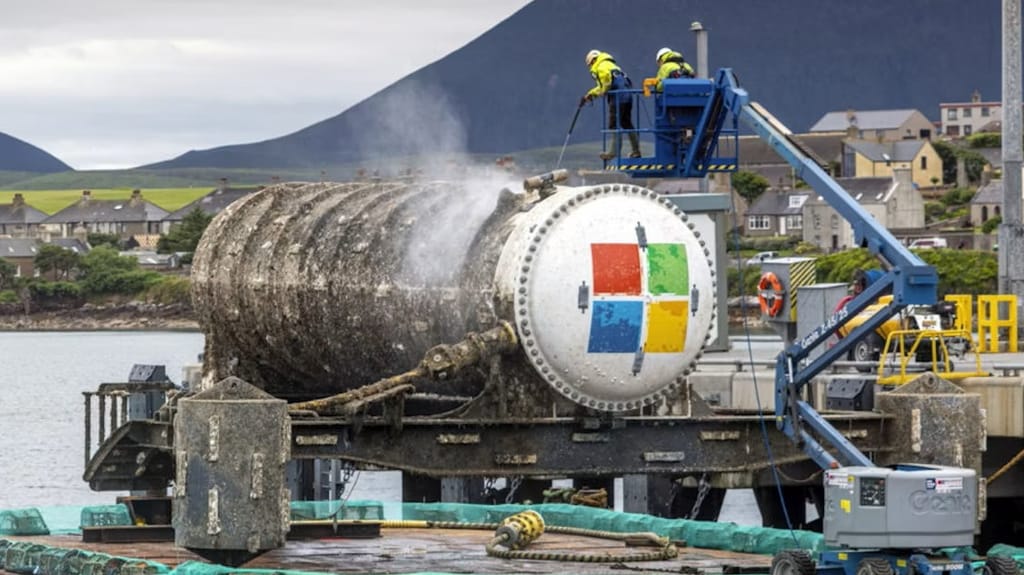
Press handout image courtesy Microsoft

Published Aug 23, 2026 2:34 PM by The Conversation


[By Nir Kshetri]

The artificial intelligence boom is driving unprecedented demand for data centers, raising concerns about their growing energy consumption, water use and carbon footprint. These challenges are making companies look beyond traditional land-based data centers.

Some developers are now exploring the ocean as a new location for AI infrastructure in the hopes that underwater data centers could improve energy use and cooling efficiency while using less fresh water and land area than onshore buildings.

My research focuses on the societal, organizational and environmental implications of emerging technologies, particularly artificial intelligence and the digital infrastructure – including data centers – that supports its development and deployment. I see underwater data centers as a promising new approach for supporting the growth of AI.

But moving servers into the ocean does not make other underlying environmental challenges such as energy consumption and carbon emissions disappear. And it creates new concerns about harm to the marine environment, as well as questions about how these data centers can be regulated – and how companies can maintain and expand them if needed. Whether underwater data centers can become sustainable alternatives to traditional data centers depends on solving these economic, technical and environmental problems.

The rise of ocean-based AI infrastructure

In 2015, Microsoft launched a research project to explore the feasibility, benefits and challenges of underwater data centers. Part of that effort included setting up a waterproof data center on the seafloor near Scotland’s Orkney Islands in 2018. It contained 864 servers and was connected to shore by an underwater cable.

After two years, Microsoft reported that the servers in the underwater data center failed at about one-eighth the rate of servers in comparable land-based data centers. The company is still studying the possible reasons but hypothesizes that in a sealed underwater environment the equipment is less exposed to oxygen, humidity and temperature fluctuations – as well as less jostling from people working to replace broken components.

However, Microsoft ended the project in 2024 and chose not to build more underwater data centers. The company didn’t say why, but others’ analyses suggest the reasons could include regulatory concerns, including the need for environmental permits, as well as a desire for faster upgrades and replacements for the computer equipment inside.

Instead the company has focused on land-based data centers, which can be larger and easier to expand, and also easier to access to repair or replace equipment.

Others have moved ahead, though. China built what may be the world’s first wind-powered underwater data center in Shanghai. The facility launched in June 2025 and began full commercial operations in May 2026.

The US$226 million project uses seawater as a coolant rather than have to refrigerate fresh water, reducing the electricity required to cool the computers. It uses at least 30% less electricity than traditional data centers, and offshore wind turbines reduce reliance on fossil fuels and cut the data center’s carbon emissions.

Japan is testing a different approach: Data centers housed in containers on floating platforms at sea can use seawater for cooling, have unobstructed conditions for solar panels and wind turbines, and reduce demand for land. In 2025, a data center in shipping containers opened on a floating platform near Yokohama. Its power comes from solar panels installed on the same floating platform, with batteries providing energy storage. The test will continue through March 2027.

Singapore is also moving toward commercial-scale floating data centers. In 2026, infrastructure company Keppel began building a four-story floating data center, scheduled to open in 2028. The project will use seawater for cooling, reducing reliance on treated water and improving cooling efficiency. And the fact that it floats means it won’t take up any of Singapore’s limited land availability.

In 2025, Ulsan, South Korea, began planning an underwater data center that could house more than 100,000 servers and use 30% less power than land-based centers by using seawater for cooling.

In Maine, DeepGreen Western Passage has proposed a submersible AI data center in the Bay of Fundy, powered by tidal turbines designed to harness the area’s strong tidal currents.

Land-based data centers could also take advantage of seawater cooling. In Portugal, the SIN01 AI data center in Sines uses seawater from the Atlantic to cool its servers before returning it to the ocean.

The promise of ocean-based data centers

These various approaches offer ways to reduce demand for grid-supplied electricity for powering data centers’ computers and cooling equipment, as well as using less fresh water.

The distance from people’s homes could also be an advantage for data centers in or on the ocean. A Gallup poll in March 2026 found that 70% of Americans oppose building AI data centers in their communities. However, more than half of the world’s population lives within 120 miles of a coast. Underwater could be another way to keep data centers physically close to users for speedy service.

Maintenance, though, is a major challenge. If a computer fails underwater, it cannot be repaired or replaced on site. The entire sealed data center module may need to be brought to the surface, even if just one computer needs work.

Can the ocean sustain AI?

The main environmental concern about ocean-based data centers involves the seawater used for cooling. Discharging warm or hot water can potentially affect oxygen levels, pH and marine life in the surrounding waters.

That heat is already apparent at the few seaborne data centers now operating. HiCloud, the engineering contractor for China’s Hainan underwater data center, has reported a temperature increase of less than 1 degree Celsius (1.8 degrees Fahrenheit) in the seawater near the facility. SIN01 in Sines, Portugal, also returns seawater about 1 C warmer.

Many marine species depend on stable water temperatures for breeding, feeding and migration, raising concerns that heat released by multiple underwater data centers could create localized thermal pollution and alter marine ecosystems. And the ocean is already under pressure. UNESCO, the United Nations agency for international cooperation, including in conservation, estimates that about 60% of marine ecosystems are already degraded or used unsustainably.

The ocean is already warming along with the atmosphere, without additional waste heat from data centers. That additional heat is already threatening coral reef and mangrove ecosystems, seagrasses and other aspects of the marine food web. As that warming continues, ocean waters will be less useful for cooling electronic equipment in some regions.

Underwater data centers could help AI grow while easing some of the pressure on land, energy and water. But the real test is whether the ocean can become AI’s next computing frontier without becoming its next environmental problem.

Nir Kshetri is the Charles A. Hayes Distinguished Professor at the University of North Carolina-Greensboro and a research fellow at Kobe University, Japan.

This article appears courtesy of The Conversation and may be found in its original form here

The Conversation

The opinions expressed herein are the author's and not necessarily those of The Maritime Executive.


ClassNK Launches 'Survey Compass,' AI Assistant for Surveys

ClassNK introduces an AI tool to enhance survey operations for shipowners and management companies.

ClassNK Launches 'Survey Compass,' an AI Assistant Supporting Survey-Related Operations

Published Aug 25, 2026 3:18 PM by The Maritime Executive

[By ClassNK]


ClassNK has launched ‘Survey Compass,’ an AI assistant that supports shipowners and ship management companies in their survey-related operations.

Survey Compass is an AI assistant that responds in natural language to questions on classification survey matters faced by shipowners and ship management companies. Users can quickly confirm the information they need together with its supporting sources, thereby improving the efficiency of survey preparation and response work and reducing their workload. This initial release marks the first step toward ClassNK’s vision of a digital service platform for ships in service. ClassNK will continue to expand and enhance Survey Compass together with our customers, incorporating feedback and requests gathered through its practical use.

Survey Compass is available on ‘ClassNK Customer Hub - Ship in Service -’ (hereinafter ‘CCH SiS’), a web portal service for shipowners and ship management companies.

In the maritime industry, regulations, particularly those related to environmental compliance, are becoming increasingly complex, requiring shipowners and ship management companies to manage a growing number of requirements and an ever-expanding volume of information. Against this backdrop, personnel responsible for survey-related matters are often required to identify the applicable requirements within a limited timeframe. To provide prompt and accurate responses to the classification survey-related inquiries received daily from shipowners and ship management companies, ClassNK has developed Survey Compass, an AI assistant specialized in classification survey support.

Survey Compass accepts questions in natural language, directly searches classification survey-related documents, and presents a concise summary together with links to the underlying information sources. Because information related to classification surveys and ship management is closely tied to the safe operation of vessels, a high level of accuracy and reliability is required.

For this reason, Survey Compass adopts a retrieval-based approach that generates answers based on relevant source documents, reducing the risk of AI-generated inaccuracies. Through this approach, it aims to serve as a trustworthy AI assistant that users can rely on with confidence.

By providing links to the source documents used to generate each answer, Survey Compass enables users to review the original references directly and make informed professional judgments. In the first version, the service will start by covering Part B of the Rules for the Survey and Construction of Steel Ships, the Guidance for Undergoing Surveys, and Technical Information.

Based on feedback and usage during the beta phase, ClassNK will continue to enhance Survey Compass by expanding the range of covered documents, including international conventions and flag State requirements, and by linking with vessel-specific data to provide more context-aware support. Through these enhancements, Survey Compass will evolve to better support users in their day-to-day operations. Going forward, ClassNK will continue to expand services through ClassNK Customer Hub to support the digitalization and operational efficiency of shipowners and ship management companies.

Customers using NK-SHIPS can log in to the web service portal on the ClassNK website with their existing account and access Survey Compass via the link to 'ClassNK web service portal.'

The products and services herein described in this press release are not endorsed by The Maritime Executive.