
“Congress must do the right thing by voting to stop this obvious catastrophe.”
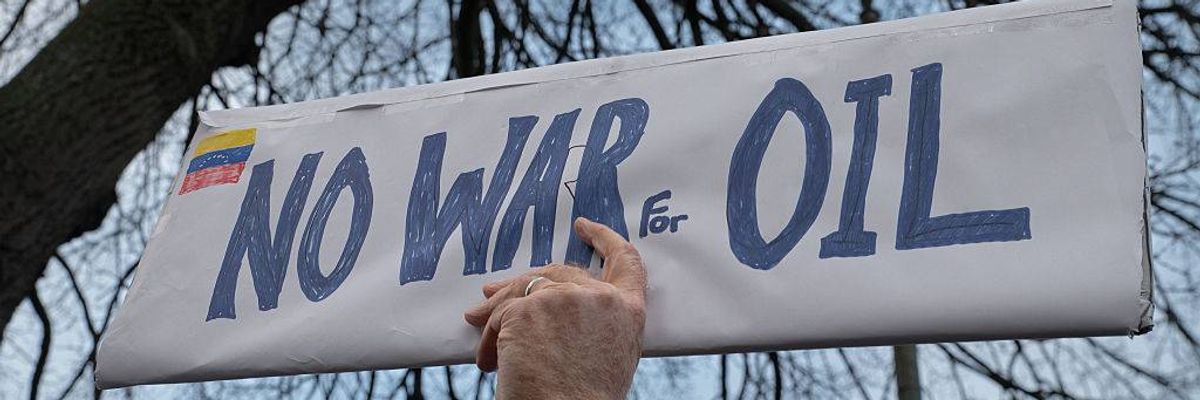
A man’s hand holds a plaque reading “No War for Oil” in front of the U.S. Embassy in Dublin on January 4, 2026 in Dublin, Ireland.
(Photo by Natalia Campos/Getty Images)
Brad Reed
Jan 05, 2026
COMMON DREAMS
President Donald Trump’s invasion of Venezuela is generating fresh calls for his impeachment and removal from office.
Shortly after the US military bombed the Venezuelan capital of Caracas and abducted Venezuelan President Nicolás Maduro and his wife, Cilia Flores, many experts on international law argued that the president’s actions were completely illegal.
In an interview with the New Yorker’s Isaac Chotiner, Yale Law School professor Oona Hathaway said that she didn’t believe there “is a legal basis for what we’re seeing in Venezuela,” while adding that the arguments the Trump administration will likely make simply “don’t hold water.”
For instance, Hathaway noted that while the United Nations charter allows nations to use military force in self-defense against military aggression, the administration’s claims that attacking Maduro was a defensive measure intended to stop the flow of illegal drugs into the US was completely outside the scope of traditional self-defense.
“If drug trafficking is a reasonable justification, then a whole range of possible arguments can be made that basically mean that self-defense is no longer a real exception,” she argued. “It’s the new rule. Why couldn’t you make the same argument about communicable diseases? There’s bird flu coming from a country, and therefore we have a legal justification for the use of military force. Once we start going down that road, the idea that there’s any limit evaporates.”
Hathaway also said that Trump’s militaristic ambitions seem to have grown throughout his second term, and she warned they could lead to a long and bloody US military occupation of Venezuela.
“In his press conference, Trump said that the United States would ‘run the country,’” she said. “And he made it clear that he was not ‘afraid’ to put boots on the ground—for years, if necessary... it’s nothing like anything Trump has done before today. His previous illegal uses of force were all over shortly after they began. The scale of the operation that will be required is massive, and it means putting US soldiers at long-term risk.”
Harvard Law School professor Jack Goldsmith wrote a lengthy analysis after the attack on Venezuela and also concluded that it violated the UN charter. What’s more, Goldsmith argued that Trump’s state plan to seize Venezuela’s oil would likely run afoul of the Fourth Geneva Convention, which limits actions that occupying powers can take on the countries they are overseeing.
“There are a lot of international law rules and restrictions that purport to govern what the United States can do as an occupying power,” he explained. “I don’t have space here to review them, but suffice it to say that these rules will touch on President Trump’s stated aim of ‘tak[ing] back the oil’ and ‘get[ting] reimbursed.’ We will see if the administration takes these rules seriously.”
Many Trump critics also argued that, legality aside, toppling a foreign head of state and vowing to seize their nation’s natural resources was morally wrong and deserving of impeachment.
“This is the behavior of a mob boss—but with nuclear weapons and the world’s strongest military,” argued Zeteo editor-in-chief Medhi Hassan. “None of this is legal. Trump should be impeached by Congress and indicted at The Hague.”
Leah Greenberg, co-founder and co-executive director of Indivisible, denounced Trump’s attack on Venezuela as “wildly illegal, immoral, and irresponsible,” and urged the US Congress to exercise its powers to stop the president from further escalation.
“The power to declare war belongs to Congress and the American people,” Greenberg said. “Trump has once again taken power that’s not his. He is attempting to drag the country into war by decree, all while treating the presidency like a throne. Congress must act immediately to stop these illegal strikes and hold the Trump regime accountable. No Kings, No War.”
Cavan Kharrazian, senior policy adviser for Demand Progress, demanded congressional action to “stop this reckless, unconstitutional act of war.”
“We have seen what happens when the White House invents a pretext to launch a regime change war with an oil-rich nation: disaster and suffering for innocent civilians, our troops and their families, all while costing the American taxpayer a fortune as well,” said Kharrazian. “Congress must do the right thing by voting to stop this obvious catastrophe.”
Kat Abughazaleh, a Democratic candidate for US Congress in Illinois, wrote on Bluesky that the time for Democratic politicians to issue mealy-mouthed statements about Trump’s actions was over.
“Democrats need to grow a fucking spine,” she wrote. “No more strongly worded letters. It’s time to draft articles of impeachment. Impeach. Convict. Remove.”
Rep. Ro Khanna (D-Calif.) also demanded that members of his party take a strong stance against Trump’s illegal Venezuela attack.
“The silence from many media-hyped 2028 contenders today is shocking,” he wrote on X. “If you cannot oppose this regime change war for oil, you don’t have the moral clarity or guts to lead our party or nation.”
IT WASN'T CONGRESS
Alexander Willis
January 5, 2026
President Donald Trump is facing renewed calls for impeachment over his unprecedented attack on Venezuela and failure to notify Congress in advance, but while aboard Air Force One Sunday night he made a startling admission about which group he did inform ahead of the operation.
Trump admitted that he had told oil companies of the operation in advance, and championed them for wanting to “go in” to Venezuela and “do a great job” with securing Venezuela’s oil reserves, the single-largest proven oil reserves on earth.
With Trump having not only not informed Congress of the attack beforehand, including the “Gang of Eight” congressional leaders who are traditionally told of such operations, critics, such as Democratic congressional candidate Fred Wellman, were left floored by the admission.
“I can’t begin to tell you how insane this is,” Wellman, who also hosts the “On Democracy” podcast, wrote Sunday night in a social media post on X to his more than 356,000 followers.
“He did not inform Congress but he’s saying he informed the oil companies. Keep in mind who he means. The billionaire mega donor that just got control of Citgo. Our service members were used directly to move the interests of Trump’s donors.”
Rep. Yassamin Ansari (D-AZ) was also shocked by Trump’s startling admission, calling it an indication that his administration now closely resembles an "authoritarian regime.”
“The oil companies were informed about an act of war before it happened, Congress was not,” Ansari wrote Sunday in a social media post on X. “That, my friends, is what an authoritarian regime run by oligarchs looks like.”
Trump has already made clear that he anticipates the United States benefitting economically from having unchallenged access to Venezuela's vast oil reserves, and the stock values of American oil companies have already surged in the wake of the U.S. attack and subsequent takeover of Venezuela.The Texas-based oil giant Chevron – the lone American oil company to currently have a presence in Venezuela – has already vowed
to work with the Trump administration in its hostile takeover of the South American nation, and cheered what it hoped would be a “peaceful” transfer of power facilitated by the United States.
Alexander Willis
January 5, 2026
RAW STORY
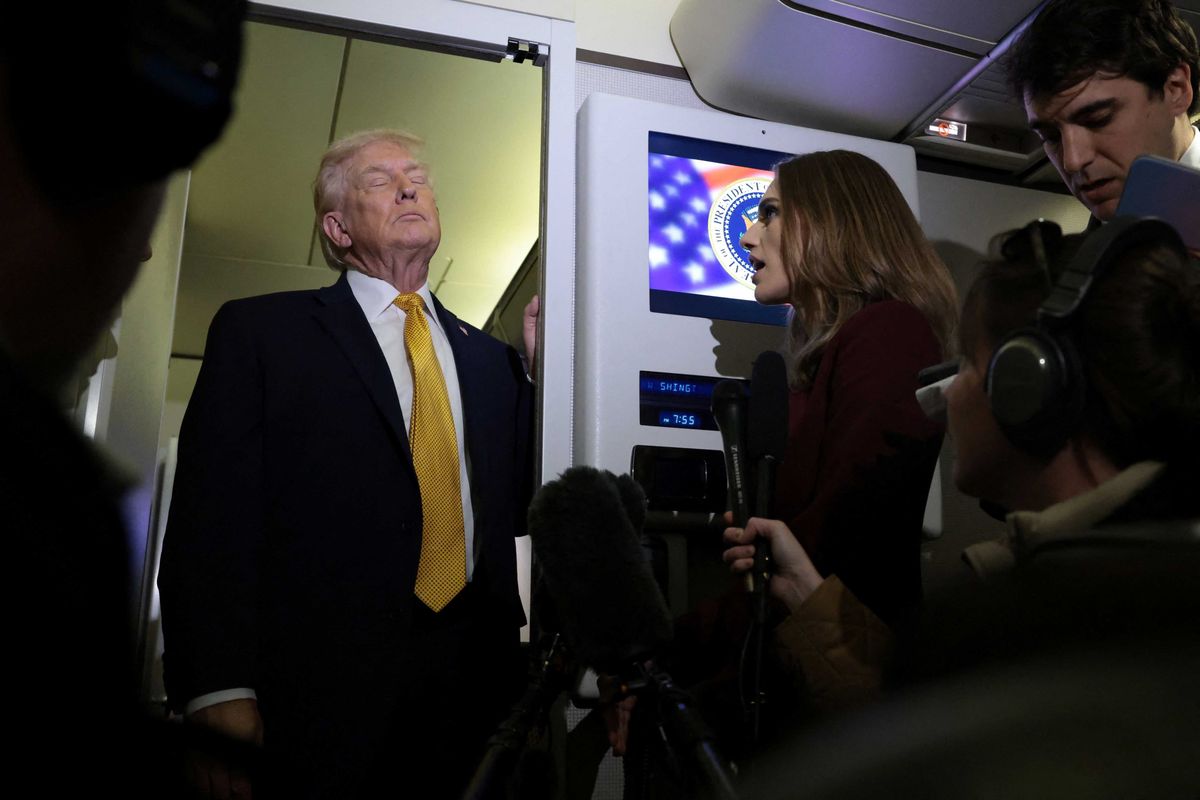
U.S. President Donald Trump pauses before answering a reporter’s question aboard Air Force One en route from Florida to Joint Base Andrews, Maryland, U.S., January 4, 2026. REUTERS/Jonathan Ernst
U.S. President Donald Trump pauses before answering a reporter’s question aboard Air Force One en route from Florida to Joint Base Andrews, Maryland, U.S., January 4, 2026. REUTERS/Jonathan Ernst
President Donald Trump is facing renewed calls for impeachment over his unprecedented attack on Venezuela and failure to notify Congress in advance, but while aboard Air Force One Sunday night he made a startling admission about which group he did inform ahead of the operation.
Trump admitted that he had told oil companies of the operation in advance, and championed them for wanting to “go in” to Venezuela and “do a great job” with securing Venezuela’s oil reserves, the single-largest proven oil reserves on earth.
With Trump having not only not informed Congress of the attack beforehand, including the “Gang of Eight” congressional leaders who are traditionally told of such operations, critics, such as Democratic congressional candidate Fred Wellman, were left floored by the admission.
“I can’t begin to tell you how insane this is,” Wellman, who also hosts the “On Democracy” podcast, wrote Sunday night in a social media post on X to his more than 356,000 followers.
“He did not inform Congress but he’s saying he informed the oil companies. Keep in mind who he means. The billionaire mega donor that just got control of Citgo. Our service members were used directly to move the interests of Trump’s donors.”
Rep. Yassamin Ansari (D-AZ) was also shocked by Trump’s startling admission, calling it an indication that his administration now closely resembles an "authoritarian regime.”
“The oil companies were informed about an act of war before it happened, Congress was not,” Ansari wrote Sunday in a social media post on X. “That, my friends, is what an authoritarian regime run by oligarchs looks like.”
Trump has already made clear that he anticipates the United States benefitting economically from having unchallenged access to Venezuela's vast oil reserves, and the stock values of American oil companies have already surged in the wake of the U.S. attack and subsequent takeover of Venezuela.The Texas-based oil giant Chevron – the lone American oil company to currently have a presence in Venezuela – has already vowed
to work with the Trump administration in its hostile takeover of the South American nation, and cheered what it hoped would be a “peaceful” transfer of power facilitated by the United States.
‘What an Authoritarian Oligarchy Looks Like’: Trump Says Oil Execs Tipped Off About Venezuela Attack
“I can’t begin to tell you how insane this is,” said one critic. “He did not inform Congress but he’s saying he informed the oil companies.”
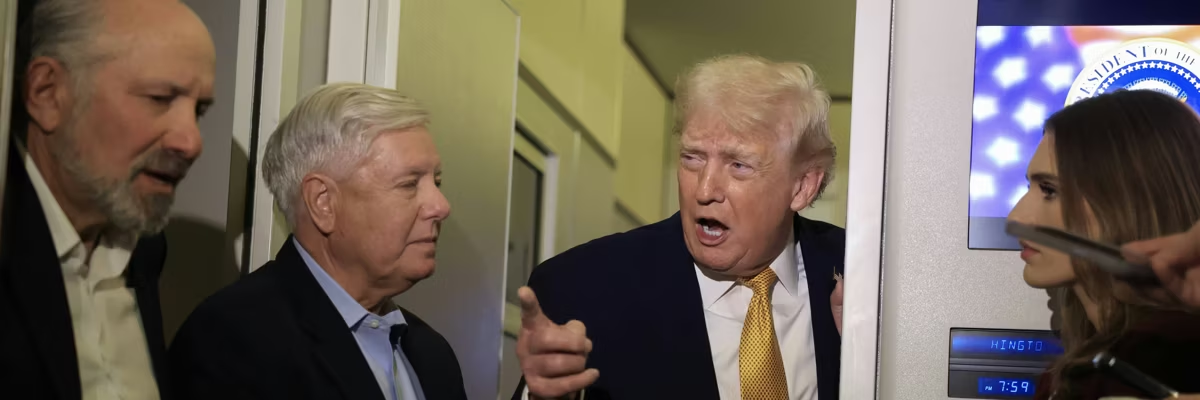
President Donald Trump, Commerce Secretary Howard Lutnick (L) and U.S. Sen. Lindsey Graham (R-SC) (C) speak to the media aboard Air Force One en route to Washington, DC on January 04, 2026.
(Photo by Joe Raedle/Getty Images)
Jon Queally
Jan 05, 2026
COMMON DREAMS
President Donald Trump on Sunday told reporters that the heads of American oil companies were informed of the US military’s attack on Venezuela—described as “brazenly illegal” by scholars and experts—even before it took place.
Trump’s admission, a renowned liar, sparked condemnation because the administration refused to consult with US lawmakers about the operation, citing fears of a leak that would compromise operational security.
“Before and after,” Trump told reporters aboard Air Force One on Sunday when asked if he’d spoken with oil executives or perhaps “tipped them off” about the operation. “They want to go in, and they’re going to do a great job for the people of Venezuela.”
Trump’s remarks were condemned by those critical of the president’s actions in recent days, including his failure to consult with or seek authorization from Congress.
“I can’t begin to tell you how insane this is,” said Fred Wellman, an Army combat veteran now running for Congress as a Democrat in Missouri. “He did not inform Congress, but he’s saying he informed the oil companies.”
“Keep in mind who he means,” Wellman added. “The billionaire mega donor that just got control of Citgo. Our service members were used directly to move the interests of Trump’s donors.”
“The oil companies were notified before Congress,” said Melanie D’Arrigo, executive director of the Campaign for New York Health. “This is what an authoritarian oligarchy looks like.”
Rep. Yassamin Ansari (D-Ariz.) echoed that statement. “The oil companies were informed about an act of war before it happened, Congress was not. That, my friends, is what an authoritarian regime run by oligarchs looks like.”
Asked repeatedly during his exchange with reporters about whether “free and fair” elections were a priority for Venezuela, Trump said the country was a “mess”—calling it a “dead country”—and that priority would be on getting the oil flowing.
“We’re gonna have the big oil companies go in, and they’re gonna fix the infrastructure, and they’re going to invest money. We’re not going to invest anything; we’re gonna just take care of the country,” Trump said. “We’re gonna cherish the country.”
When asked which oil companies he spoke with, Trump said, “All of them, basically,” though he did not mention which ones specifically by name.
“They want to go in so badly,” the president claimed.
Despite Trump’s remarks, oil industry experts have said it’s not nearly so clear-cut that oil majors in the US will want to re-enter the Venezuela oil market—or be tasked with funding a significant rebuild of the nation’s oil infrastructure—given the political uncertainty unleashed by Trump’s unlawful military operation and the kidnapping of Venezuela President Nicolas Maduro.
“The issue is not just that the infrastructure is in bad shape, but it’s mostly about how do you get foreign companies to start pouring money in before they have a clear perspective on the political stability, the contract situation, and the like,” Francisco Monaldi, director of the Latin American energy program at Rice University, told NPR.
The infrastructure investments alone are huge, even under normal political circumstances.
“The estimate is that in order for Venezuela to increase from one million barrels per day—that is what it produces today—to four million barrels, it will take about a decade and about a hundred billion dollars of investment,” Monaldi said.
In an interview with The New Yorker over the weekend, Oona Hathaway, a professor at Yale Law School and the director of its Center for Global Legal Challenges, said there is absolutely no legal justification for Trump’s assault on Venezuela or the kidnapping of Maduro and his wife, Cilia Flores.
“I don’t think there is a legal basis for what we’re seeing in Venezuela,” Hathaway said. “There are certainly legal arguments that the Administration is going to make, but all the arguments that I’ve heard so far don’t hold water. None of them really justify what the President seems to have ordered to take place in Venezuela.”
In a statement on Saturday, Elizabeth Bast, executive director of Oil Change International, said Trump’s assault on Venezuela “defies the US Constitution’s delegation of Congress’s war-making authority and disregards international rules that prevent acts of war without debate or authorization. The US must stop treating Latin America as a resource colony. The Venezuelan people, not US oil executives, must shape their country’s future.”
As Trump and other members of the administration continued to threaten other countries in the region—including Mexico, Colombia, and Cuba—Zeteo editor-in-chief Mehdi Hasan said, “This is the behavior of a mob boss—but with nuclear weapons and the world’s strongest military. None of this is legal. Trump should be impeached by Congress and indicted at The Hague.”
“I can’t begin to tell you how insane this is,” said one critic. “He did not inform Congress but he’s saying he informed the oil companies.”
President Donald Trump, Commerce Secretary Howard Lutnick (L) and U.S. Sen. Lindsey Graham (R-SC) (C) speak to the media aboard Air Force One en route to Washington, DC on January 04, 2026.
(Photo by Joe Raedle/Getty Images)
Jon Queally
Jan 05, 2026
COMMON DREAMS
President Donald Trump on Sunday told reporters that the heads of American oil companies were informed of the US military’s attack on Venezuela—described as “brazenly illegal” by scholars and experts—even before it took place.
Trump’s admission, a renowned liar, sparked condemnation because the administration refused to consult with US lawmakers about the operation, citing fears of a leak that would compromise operational security.
“Before and after,” Trump told reporters aboard Air Force One on Sunday when asked if he’d spoken with oil executives or perhaps “tipped them off” about the operation. “They want to go in, and they’re going to do a great job for the people of Venezuela.”
Trump’s remarks were condemned by those critical of the president’s actions in recent days, including his failure to consult with or seek authorization from Congress.
“I can’t begin to tell you how insane this is,” said Fred Wellman, an Army combat veteran now running for Congress as a Democrat in Missouri. “He did not inform Congress, but he’s saying he informed the oil companies.”
“Keep in mind who he means,” Wellman added. “The billionaire mega donor that just got control of Citgo. Our service members were used directly to move the interests of Trump’s donors.”
“The oil companies were notified before Congress,” said Melanie D’Arrigo, executive director of the Campaign for New York Health. “This is what an authoritarian oligarchy looks like.”
Rep. Yassamin Ansari (D-Ariz.) echoed that statement. “The oil companies were informed about an act of war before it happened, Congress was not. That, my friends, is what an authoritarian regime run by oligarchs looks like.”
Asked repeatedly during his exchange with reporters about whether “free and fair” elections were a priority for Venezuela, Trump said the country was a “mess”—calling it a “dead country”—and that priority would be on getting the oil flowing.
“We’re gonna have the big oil companies go in, and they’re gonna fix the infrastructure, and they’re going to invest money. We’re not going to invest anything; we’re gonna just take care of the country,” Trump said. “We’re gonna cherish the country.”
When asked which oil companies he spoke with, Trump said, “All of them, basically,” though he did not mention which ones specifically by name.
“They want to go in so badly,” the president claimed.
Despite Trump’s remarks, oil industry experts have said it’s not nearly so clear-cut that oil majors in the US will want to re-enter the Venezuela oil market—or be tasked with funding a significant rebuild of the nation’s oil infrastructure—given the political uncertainty unleashed by Trump’s unlawful military operation and the kidnapping of Venezuela President Nicolas Maduro.
“The issue is not just that the infrastructure is in bad shape, but it’s mostly about how do you get foreign companies to start pouring money in before they have a clear perspective on the political stability, the contract situation, and the like,” Francisco Monaldi, director of the Latin American energy program at Rice University, told NPR.
The infrastructure investments alone are huge, even under normal political circumstances.
“The estimate is that in order for Venezuela to increase from one million barrels per day—that is what it produces today—to four million barrels, it will take about a decade and about a hundred billion dollars of investment,” Monaldi said.
In an interview with The New Yorker over the weekend, Oona Hathaway, a professor at Yale Law School and the director of its Center for Global Legal Challenges, said there is absolutely no legal justification for Trump’s assault on Venezuela or the kidnapping of Maduro and his wife, Cilia Flores.
“I don’t think there is a legal basis for what we’re seeing in Venezuela,” Hathaway said. “There are certainly legal arguments that the Administration is going to make, but all the arguments that I’ve heard so far don’t hold water. None of them really justify what the President seems to have ordered to take place in Venezuela.”
In a statement on Saturday, Elizabeth Bast, executive director of Oil Change International, said Trump’s assault on Venezuela “defies the US Constitution’s delegation of Congress’s war-making authority and disregards international rules that prevent acts of war without debate or authorization. The US must stop treating Latin America as a resource colony. The Venezuelan people, not US oil executives, must shape their country’s future.”
As Trump and other members of the administration continued to threaten other countries in the region—including Mexico, Colombia, and Cuba—Zeteo editor-in-chief Mehdi Hasan said, “This is the behavior of a mob boss—but with nuclear weapons and the world’s strongest military. None of this is legal. Trump should be impeached by Congress and indicted at The Hague.”

No comments:
Post a Comment