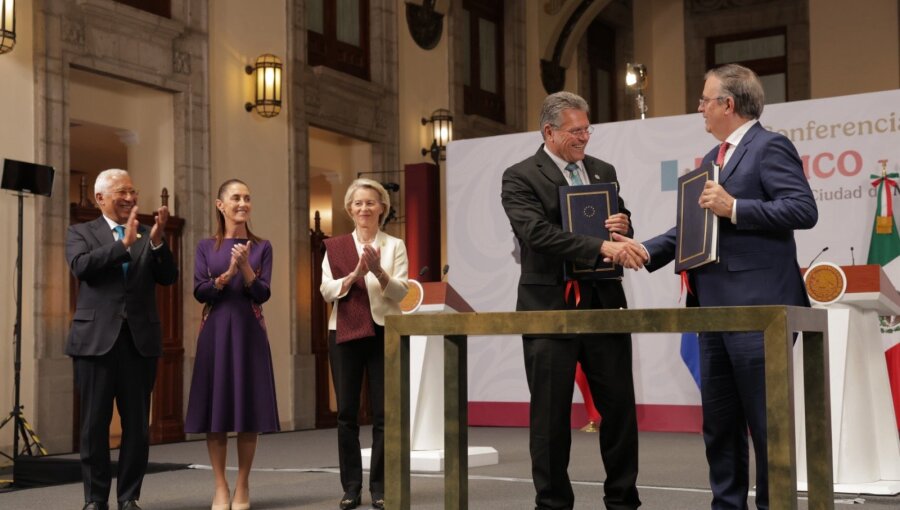
When Claudia Sheinbaum, Ursula von der Leyen and António Costa gathered at the National Palace in Mexico City on May 22 to sign the Modernised Global Agreement, the ceremony marked the end of a decade of negotiations and the beginning of what both sides are calling a new era in transatlantic commerce. But behind the diplomatic pageantry lies a deal that is, at its core, about food.
Industrial goods between Mexico and the EU have traded largely tariff-free since 2007. The unfinished business of the original 2000 agreement was always agriculture, the politically sensitive sector that took another 25 years to unlock. The new Interim Trade Agreement tackles that directly, eliminating nearly all remaining agricultural tariffs and opening Mexican markets to European dairy, meat, poultry and processed foods in a way that would have been unimaginable when the original accord was signed.
"The goal is simple: we want to create more jobs and generate more value on both sides of the Atlantic," von der Leyen said at the signing.
The timing is not accidental
Both Mexico and the EU are navigating a world reshaped by Donald Trump's tariff offensive. The EU was hit with sweeping new US duties in April 2025 and, earlier this week, agreed to a deal capping most European goods at a 15% US levy. Mexico, meanwhile, faces tariffs on automotive, steel and aluminium exports, with around 80% of its goods still flowing to the US, a dependency that Sheinbaum has been working to reduce.
"We are living through complex times on the international stage, but it is precisely at moments like these that we must act with greater cooperation," Sheinbaum said, describing the EU deal as "opening other horizons" while insisting it was "not contradictory" to Mexico's separate USMCA commitments.
Costa called it "a true geopolitical statement" and said the agreement left both sides "better prepared to face the challenges of our time." In a world of hardening blocs and transactional trade politics, a deal spanning 550mn people and more than €100bn in annual commerce carries weight beyond tariff schedules.
What actually changes
The practical benefits will arrive gradually, shaped by quotas and phase-in periods. The EU exported around €2.5bn in agri-food products to Mexico in 2025, making it the second-largest importer of European food in Latin America. Under the new deal, 95% of high Mexican tariffs on EU agri-food products will be removed, with 568 geographical indications protecting products such as Manchego cheese and Serrano ham from imitation in the Mexican market.
The dairy chapter is among the most detailed. Powdered milk gets a 50,000-tonne quota phased in over five years. Aged cheeses get 20,000 tonnes over five years; fresh cheeses 5,000 tonnes over the same period; blue cheeses are fully liberalised immediately. Current tariffs on cheese run as high as 45%, rates that have made European dairy a niche market in Mexico rather than a competitive one.
Meat follows a similar pattern. Pork tariffs, currently at 20%, disappear entirely over seven years, with a separate 10,000-tonne quota for loins. Beef tariffs phase to zero over seven years. Mechanically deboned chicken is liberalised on entry into force; chicken hindquarters get a 20,000-tonne quota. Apple tariffs disappear over 10 years; beans, potatoes, nectarines and tinned peaches over seven. Processed goods including pasta, chocolate, biscuits and lactose get rapid or immediate liberalisation.
Wine gets a simplified trade clause benefiting both sides, easing European access while also helping Mexico's growing wine industry into EU markets. On the Mexican export side, 83% of agri-food products will enter the EU tariff-free, with preferential treatment for orange juice, bananas, honey, tuna preparations and fresh produce.
Mexico's Economy Ministry projects the deal could lift its total EU exports from around $24bn annually to $36bn by 2030. The EU is currently Mexico's third-largest trading partner, far behind the US and China, but this deal adds meaningful diversification at a moment when USMCA renegotiation is proving slower and more fraught than Mexico had hoped.
The bigger picture
The Interim Trade Agreement enters into force through European Parliament ratification alone, without requiring sign-off from all 27 member states, meaning benefits could begin to materialise before the end of 2026. Beyond goods, the deal opens EU companies to government procurement in Mexico, removes barriers to digital trade and introduces legally binding environmental and labour commitments enforceable through independent dispute panels. It also addresses critical raw materials, banning export restrictions, monopolies and dual pricing.
Over 11,000 EU companies are already present in Mexico, collectively supporting 5.5mn jobs. EU investment in Mexico reached €207bn in 2024, representing 28% of total Mexican foreign investment. The new framework is designed to build on that base and to signal, at a moment of significant global trade uncertainty, that both sides are choosing deeper integration.
"Our modernised trade agreement will strengthen trusted supply chains, create new opportunities for businesses and investors and bring our economies even closer together. I particularly welcome our enhanced cooperation on critical minerals, as Mexico is a leading supplier of several essential raw materials," said EU trade commissioner Maroš Šefčovič.

No comments:
Post a Comment