It’s possible that I shall make an ass of myself. But in that case one can always get out of it with a little dialectic. I have, of course, so worded my proposition as to be right either way (K.Marx, Letter to F.Engels on the Indian Mutiny)
Tuesday, June 16, 2026
Biochar helps redesign catalyst chemistry for faster pesticide removal from water
Biochar Editorial Office, Shenyang Agricultural University
Biochar-regulated LDH-derived Co–Mn spinel for non-radical peroxymonosulfate activation: high-efficiency imidacloprid degradation dominated by high-valent metal–oxo species and singlet oxygen
Credit: Xiaolong Dong, Yongzhen Ding, Xiaohu Fan, Fuxiang Zhang, Fengyang Pan, Zulin Zhang, Qiang Fu & Song Cui
A new biochar-regulated catalyst can remove 96.9% of the widely used insecticide imidacloprid from water within 40 minutes, offering a promising route for treating pesticide-contaminated wastewater.
Neonicotinoid insecticides have become an important part of modern agriculture, but their persistence in water has raised growing ecological concerns. Among them, imidacloprid is one of the most widely used and frequently detected compounds. Because it can threaten aquatic invertebrates even at very low concentrations, researchers are looking for faster, more stable, and more selective ways to break it down before it reaches sensitive ecosystems.
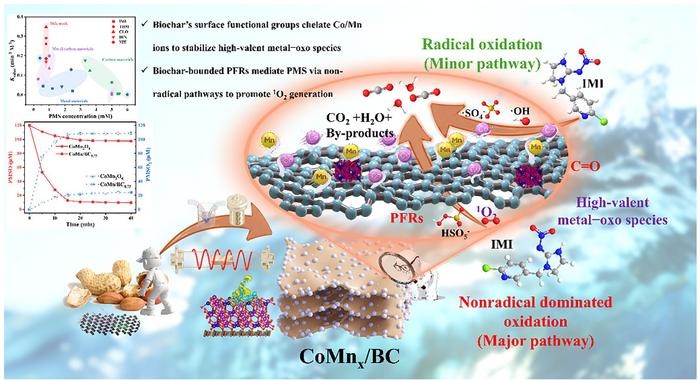
In a new study published in Biochar, researchers developed a cobalt manganese spinel catalyst regulated by biochar and derived from layered double hydroxides. The optimized material, named CoMn0.75/BC, activated peroxymonosulfate, a common oxidant used in advanced water treatment, and achieved 96.9% removal of 5 mg L−1 imidacloprid within 40 minutes. Its degradation rate was substantially higher than systems using biochar or cobalt manganese oxide alone.
“Biochar is not only a support material in this system. It actively changes how the catalyst works, steering the reaction toward more selective non-radical oxidation pathways,” said the study’s corresponding authors. “This provides a useful design strategy for next-generation catalysts used in pesticide wastewater treatment.”
Many advanced oxidation processes rely heavily on radical species, which can be powerful but are often sensitive to pH, background ions, and natural organic matter in real water. In contrast, the new CoMn0.75/BC system shifted the reaction toward non-radical pathways dominated by high-valent metal oxo species and singlet oxygen. These species can offer more selective oxidation and better resistance to interference from complex water components.
The research team found that biochar played several connected roles. Its porous structure helped disperse cobalt manganese spinel nanoparticles and prevent aggregation. Its oxygen-containing functional groups, especially carbonyl groups, helped chelate cobalt and manganese ions and stabilize high-valent metal oxo species. In addition, persistent free radicals naturally bound to the biochar surface promoted singlet oxygen generation during peroxymonosulfate activation.
The catalyst also showed strong practical potential. It maintained more than 85% imidacloprid removal across a wide pH range from 3 to 11, indicating that it could operate under varied wastewater conditions. Common ions such as chloride and sulfate had little influence on performance, consistent with the system’s non-radical-dominated mechanism. The catalyst remained active in tap water and several surface water samples, with strong tolerance to realistic water matrices.
Reusability tests further supported the material’s stability. After five cycles, imidacloprid removal decreased only slightly, from 96.9% to 91.3%. The spinel crystal structure was retained after reaction, and metal leaching remained low. In a continuous-flow column experiment designed to simulate practical treatment, the catalyst-packed system maintained over 80% imidacloprid removal after 420 minutes of operation.
The system also degraded other neonicotinoid insecticides, including thiamethoxam, clothianidin, dinotefuran, and nitenpyram, suggesting broader applicability beyond imidacloprid. The authors note that while the catalyst showed promising durability, longer continuous operation tests and techno-economic analysis will be needed before full-scale application.
“By using biochar to regulate both catalyst structure and reaction pathway, we can move beyond simple pollutant adsorption and toward efficient catalytic detoxification,” the authors said. “This work highlights how biomass-derived carbon materials can be engineered to address emerging water pollution challenges.”
The findings offer a rational blueprint for designing biochar hybrid catalysts capable of treating high-strength industrial wastewater contaminated with neonicotinoid insecticides.
===
Journal Reference: Dong, X., Ding, Y., Fan, X. et al. Biochar-regulated LDH-derived Co–Mn spinel for non-radical peroxymonosulfate activation: high-efficiency imidacloprid degradation dominated by high-valent metal–oxo species and singlet oxygen. Biochar8, 109 (2026).
Biochar (e-ISSN: 2524-7867) is the first journal dedicated exclusively to biochar research, spanning agronomy, environmental science, and materials science. It publishes original studies on biochar production, processing, and applications—such as bioenergy, environmental remediation, soil enhancement, climate mitigation, water treatment, and sustainability analysis. The journal serves as an innovative and professional platform for global researchers to share advances in this rapidly expanding field.
Biochar-regulated LDH-derived Co–Mn spinel for non-radical peroxymonosulfate activation: high-efficiency imidacloprid degradation dominated by high-valent metal–oxo species and singlet oxygen
Article Publication Date
12-Jun-2026
Turning lavender waste into a high-performance sensor for safer ethylene glycol detection
Biochar Editorial Office, Shenyang Agricultural University
A new study has shown that agricultural waste from lavender straw can be transformed into a highly sensitive biochar-based sensor for detecting ethylene glycol, a widely used but potentially toxic chemical found in products such as antifreeze and industrial solvents.
Published in Biochar, the study reports a green and controllable strategy for engineering the tiny pores and surface defects of biochar derived from lavender straw nanocellulose. By carefully adjusting the hydrolysis time during material preparation, the research team created a sensor material that can detect ethylene glycol at room temperature with high sensitivity, a low detection limit, and long-term stability.
“Our work shows that agricultural residues can be more than waste. With precise structural design, they can become advanced functional materials for public safety and environmental monitoring,” said corresponding author Professor Zhaofeng Wu of Xinjiang University. “The key was learning how hydrolysis time controls the internal structure of the biochar.”
Ethylene glycol is commonly used in antifreeze, polyester production, and other industrial processes. However, exposure to ethylene glycol can pose health risks, including effects on the central nervous system and damage to multiple organs. Fast and reliable detection is therefore important for workplace safety, automotive maintenance, industrial inspection, and environmental monitoring.
The team selected lavender straw, an underused agricultural residue from Xinjiang, as the starting material. Lavender straw has a loose fibrous structure and naturally contains calcium, making it suitable for producing biochar with useful sensing properties. The researchers first extracted nanocellulose from the straw using an oxalic acid and acetic acid hydrolysis process, then converted it into biochar through carbonization.
The most important finding was that hydrolysis time acted as a structural “control knob.” When the treatment time was too short, the nanocellulose did not fully separate, limiting pore formation. When the treatment was too long, the structure became damaged and compacted. A moderate hydrolysis time of 3 hours produced the best material, named CLN-3.
CLN-3 formed an open mesoporous network with a specific surface area of 46.36 m² g⁻¹ and abundant oxygen-related surface sites. These features helped ethylene glycol molecules enter the material, interact with the surface, and trigger a strong electrical response.
In testing, the CLN-3 sensor showed an exceptional response of 17,576.67% toward ethylene glycol at room temperature, with a low detection limit of 0.36 ppm. It also maintained stable operation over 40 days and showed repeatable performance over multiple sensing cycles. Compared with many conventional ethylene glycol sensors that require elevated operating temperatures, this room-temperature performance could help reduce energy use and support portable or on-site detection devices.
To better understand why the material performed so well, the researchers combined experimental testing with density functional theory calculations. The calculations showed that naturally present calcium in the lavender-derived biochar enhanced the adsorption of ethylene glycol, increasing adsorption energy from −0.13674 eV to −0.39508 eV when calcium doping and pre-adsorbed oxygen worked together. This stronger interaction promoted charge transfer at the sensor surface, improving the sensing signal.
“The synergy between pores, oxygen vacancies, and natural calcium doping gives the biochar its strong sensing ability,” said corresponding author Hua Zhuo. “This provides a practical design principle for developing low-cost sensors from biomass resources.”
The researchers also demonstrated the sensor’s potential for antifreeze detection in laboratory tests. While further calibration and field validation are still needed for complex real-world environments, the study offers a promising route toward sustainable, low-cost, and sensitive detection technologies.
By converting lavender straw into a functional sensing material, the work highlights a broader opportunity: agricultural byproducts can serve as valuable building blocks for next-generation environmental and safety monitoring devices.
===
Journal Reference: Gong, Y., Liang, C., Sun, Q. et al. Hydrolysis time-controlled pore and defect engineering in nanocellulose-derived biochar for enhanced ethylene glycol sensing. Biochar8, 110 (2026).
Biochar (e-ISSN: 2524-7867) is the first journal dedicated exclusively to biochar research, spanning agronomy, environmental science, and materials science. It publishes original studies on biochar production, processing, and applications—such as bioenergy, environmental remediation, soil enhancement, climate mitigation, water treatment, and sustainability analysis. The journal serves as an innovative and professional platform for global researchers to share advances in this rapidly expanding field.
Credit: Fanchao Xu, Jun Zhu, Kun Liu, Minli Wang, Huiting Liu, Jianjun Lian, Xiaolei Qu & Bingyu Wang
Dissolved black carbon, a water-soluble fraction of black carbon produced from incomplete combustion and biochar, has long been viewed as a mobile form of carbon that can move from soils into rivers, lakes, estuaries, and oceans. A new review published in Biocharshows that its journey through the environment is far more complex than simple transport in water.
The review, titled “Colloidal stability of dissolved black carbon: interfacial mechanisms and environmental implications,” examines how dissolved black carbon, or DBC, behaves as a colloidal material. Its stability determines whether it remains suspended in water, aggregates into larger particles, or deposits into sediments. These processes directly influence not only the fate of DBC itself, but also the movement of pollutants that attach to it.
“Dissolved black carbon is not just a passive carbon residue in aquatic environments,” said the study authors. “Its colloidal behavior can decide whether carbon and associated contaminants travel long distances or become trapped in sediments. Understanding this behavior is essential for predicting environmental risks and carbon cycling.”
DBC is widely distributed in natural waters and is released from black carbon residues through leaching and surface runoff. Because it contains aromatic structures and oxygen-containing functional groups, DBC can bind with heavy metals, organic pollutants, antibiotics, and even nanoplastics. When DBC remains stable in water, it can act as a carrier that helps these substances move through aquatic systems. When it aggregates and settles, it can shift pollutants from the water column into sediments, creating localized contamination hotspots and changing exposure risks for benthic organisms.
The review highlights that DBC stability is governed by its molecular structure and surface chemistry, which depend on feedstock source, pyrolysis conditions, extraction conditions, and environmental aging. Using classical DLVO theory and extended XDLVO theory, the authors explain how electrostatic forces, van der Waals attraction, and Lewis acid-base interactions control DBC aggregation. The review notes that short-range acid-base interactions, especially hydration and hydrophobic forces, can be especially important in determining whether DBC remains dispersed or aggregates.
Environmental conditions can strongly alter this balance. Monovalent ions such as sodium often have limited effects, while divalent cations such as calcium, barium, and some heavy metals can destabilize DBC by binding with oxygen-containing groups and promoting particle bridging. pH also matters. Acidic conditions can reduce surface charge and encourage aggregation, while alkaline conditions often improve colloidal stability. Organic substances, minerals, and photoaging can either stabilize or destabilize DBC depending on their interactions with DBC surfaces.
These findings have important implications for water quality, soil remediation, and climate research. Biochar is widely studied as a soil amendment for carbon sequestration and pollutant immobilization, but DBC released from biochar may carry adsorbed pollutants away from treated soils under certain conditions. At the same time, aggregation and deposition of DBC in estuaries may remove a fraction of land-derived carbon before it reaches the ocean, meaning current estimates of land-to-ocean black carbon flux may need refinement.
“The colloidal stability of dissolved black carbon is a missing link between molecular carbon chemistry and large-scale environmental outcomes,” the authors said. “Future models of pollutant transport and carbon flux should account for how DBC aggregates, deposits, and interacts with coexisting substances in real environmental waters.”
The authors call for integrated characterization methods, stronger mechanistic studies of heteroaggregation in complex waters, and predictive models that combine molecular information with environmental parameters. Such efforts could improve risk assessment, water treatment strategies, and estimates of how black carbon contributes to long-term carbon storage.
===
Journal Reference: Xu, F., Zhu, J., Liu, K. et al. Colloidal stability of dissolved black carbon: interfacial mechanisms and environmental implications. Biochar8, 108 (2026).
Biochar (e-ISSN: 2524-7867) is the first journal dedicated exclusively to biochar research, spanning agronomy, environmental science, and materials science. It publishes original studies on biochar production, processing, and applications—such as bioenergy, environmental remediation, soil enhancement, climate mitigation, water treatment, and sustainability analysis. The journal serves as an innovative and professional platform for global researchers to share advances in this rapidly expanding field.

No comments:
Post a Comment