The US Supreme Court Opens the Door to White Christian Only Government
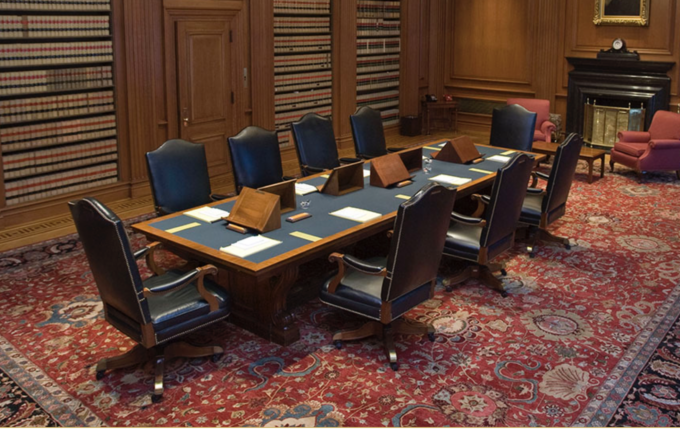
Conference room of the Supreme Court, where cases are decided. Photo: Supreme Court.
The Roberts Supreme Court is determined to earn the contempt with which it is viewed by most of the public. Its ruling this week essentially gave Donald Trump free rein to fire anyone in the government who doesn’t do what he wants. As corrupt as his administration has been to date, the Court’s ruling removed pretty much all remaining restraints.
Coupled with its recent ruling on revoking temporary protective status for immigrants from Trump’s list of “shithole” countries, the Court is effectively allowing Trump to make this a government of white Christian nationalists and for white Christian nationalists. The immigration ruling said that a long list of openly racist comments about people from the countries in question cannot be taken as evidence that Trump is motivated by racial animus in his immigration decision. In the same vein, Trump could fire every non-white or non-Christian person in the government as long as he insists his decisions were not based on race or religion.
But leaving Trump’s racism aside, let’s go back to the corruption that the Supreme Court felt it was important to unleash. As it stands now, agencies like the Food and Drug Administration (FDA) and Federal Aviation Administration (FAA) are supposed to be staffed by professionals who make decisions on approving prescription drugs for public use, or airplanes for flying, based on a careful examination of the evidence on their safety.
The Supreme Court just ruled that Donald Trump can fire the people overseeing these agencies for any reason whatsoever, or no reason at all. In their “unitary executive” theory, the writers of the Constitution felt it was essential that the president have the authority to fire anyone who makes decisions based on evidence or who refuses to lie for them.
This means that if the head of the FDA refuses to approve a drug based on the analysis of the experts who have examined the evidence, Trump can fire them. Similarly, if the FAA doesn’t greenlight a plane because it has failed safety tests, Trump can fire the FAA administrator.
Now, let’s bring Donald Trump’s family into the picture. (I’m always hesitant to mention a new grift on the possibility that the Trumpers would do it, if they had only thought of it.) Suppose Don Jr. has a 10 percent stake in a drug company that is pushing an ineffective, or even harmful, drug as a cure for cancer. The Supreme Court has ruled that Trump can tell the FDA commissioner that they must ignore the judgment of the experts who have examined the evidence and approve Don Jr.’s drug.
The same applies to planes. Eric can take a stake in an airplane manufacturer and demand that the FAA approve its latest plane, or his daddy will fire the commissioner. And if the commissioner happens to be a principled person who refuses to jeopardize public safety to keep their job, the Supreme Court says Trump can fire them and appoint an acting commissioner who will approve Eric’s plane.
If these stories sound far-fetched to you, then you haven’t been paying attention. Trump and his family are openly using the government to steal money in every way imaginable. The Supreme Court just gave them even more ways.
Of course, as the dissenters pointed out, it would not even make sense for Congress to have created these agencies in the first place if the president could put his political hacks in all the positions with any authority. What’s the point of having an FDA if it only approves the drugs of companies that make payoffs to the president’s family?
Trump has said he wanted to downsize government, and the Supreme Court has just come out strongly in favor of that view. Since it has ruled that federal agencies should all be cesspools of corruption, they might as well be shut down. Drug approvals based on payoffs to the Trump family are meaningless. Let’s just save the money and let drug companies push whatever crap they want in whatever way they want. At least no one will be fooled by a federal agency certifying the drugs as safe and effective.
This first appeared on Dean Baker’s Beat the Press blog.
Affirmative Action is Alive and Well . . . If You are Rich and White

Still from The Skulls.
Three years ago, a major Supreme Court ruling struck down affirmative action in higher education admissions. Well, that is what they would like people to believe. In fact, there are still many preference policies in elite college admissions — especially if the student is rich and White. As the Trump administration continues to campaign against universities it claims are using race-related admissions policies that disadvantage White students, it has been silent about the many ways that White students are granted preferential treatment.
It is not hard to find high-profile examples. By his own admission, President George W. Bush was a C-student at Yale; he liked to remind people that even a C-student can become president. Bush also was a C-student in high school, and his SAT score was below the median for his class at Yale. Why might an academically mediocre student gain admission to an Ivy League university?
Bush had many characteristics that gave him advantages. The most important one is that he was a legacy — his father and grandfather both graduated from Yale. This meant that his chance of admission would be higher than other similar students without legacy status. And because of the history of racial discrimination, White students are more likely to have this type of legacy status.
Another admissions advantage is having a parent willing to make a hefty donation. The father of Donald Trump’s son-in-law, Jared Kushner, donated $2.5 million to Harvard in 1998. Kushner was then accepted there, even though reports suggest that he did not have an impressive high school academic record. The economist Raj Chetty and his colleagues found that being from a family in the richest 1 percent increases the odds of a student’s admission to an elite college by 34 percent.
This preference for the very wealthy has clear racial implications. Despite the visibility of a few rich Black celebrities, Black families are significantly underrepresented among the ultra-rich. While about 13 percent of high school students are Black, only 3 percent of the richest 1 percent of families are Black. Meanwhile, about half of high school students are White, but over 80 percent of the richest 1 percent of families are White. The admissions preference for the richest 1 percent functions as a White preference.
There are other policies that serve the same ends. Students at elite colleges aredisproportionately from the Northeast. To diversify their enrollment, elite schools give a preference to applicants from underrepresented states. As one admissions consultant stated, “You have a much better chance of getting in if you’re in a state that might be in a more rural area” rather than a major city. An analysis of data from Brown University found that applicants from the very White states of North Dakota and Montana had an admissions rate more than twice that of applicants from New Jersey, a much more racially diverse state. This kind of preference could have benefited someone like Vice President JD Vance, who may have gained an advantage in admissions to Yale Law School because he is from a small town in Ohio.
Or consider athletic recruiting, which has been called “the biggest form of affirmative action in American higher education.” Elite schools like Harvard recruit for sports such as skiing, sailing, water polo, rowing, squash, fencing, and golf, and the recruited athletes are overwhelmingly wealthy, White students. Elite colleges also rely more heavily on ‘early decision’ admissions programs that require a student applicant to agree to attend the school if accepted. The acceptance rate for such applicants is higher than for regular admissions, and the pool of applications tends to skew White and wealthier. As the journalist Jeffrey Selingo reasons, “Students from upper-middle-class and wealthy families are willing to trade the ability to compare financial aid offers for an increased chance of getting in.”
Using the Supreme Court decision as its guide, Trump’s Justice Department is working to make sure that Black and Hispanic students are extremely underrepresented in elite medical schools. The department claims to be working to prevent the use of “racial proxies”—policies that are race-neutral but that provide a disproportionate benefit to a particular racial group.
Although legacy, donor, geographic, athletic, and early decision admission preferences all tilt in favor of White applicants, the Justice Department does not have an interest in preventing the use of these proxies for White students. It only has an interest in proxies for Black and Hispanic students and in blocking these students’ admission into elite education. In other words, the Trump Justice Department is practicing racial discrimination, not fighting it.
This originally appeared on CEPR.

No comments:
Post a Comment