Historian dismisses Trump Independence Day rhetoric as 'Red Scare idiocy'
Bennito L. Kelty
July 4, 2026
He also suggested, "I think our inclination for this weekend should be to try to transcend Donald Trump's rhetoric and just sort of block it out for 48 hours."
Trump’s assault on nation’s founding promise hands the left perfect opportunity: historianBennito L. Kelty
July 4, 2026
RAW STORY
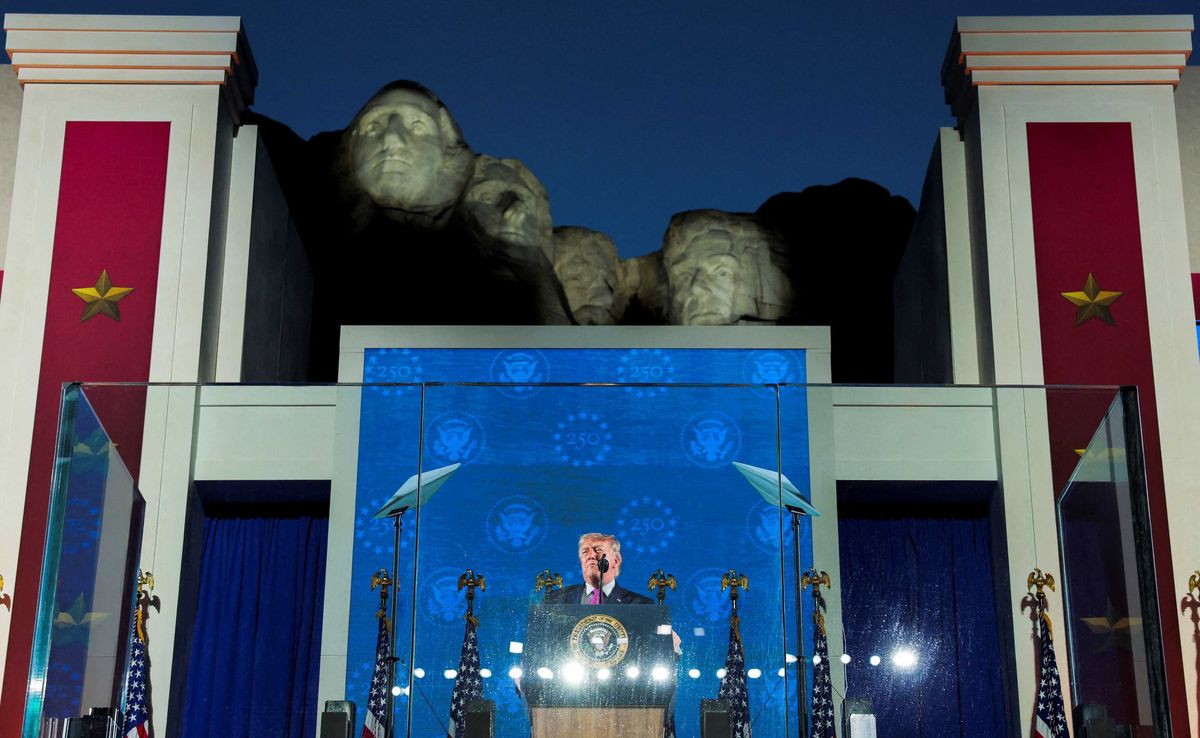
U.S. President Donald Trump delivers a speech during a celebration for the 250th anniversary of U.S. independence, at Mount Rushmore in Keystone, South Dakota, U.S., July 3, 2026. REUTERS/Kylie Cooper REFILE - QUALITY REPEAT TPX IMAGES OF THE DA
A presidential historian slammed Trump's Independence Day speech as nothing more than "Joe McCarthy Red Scare idiocy."
During an appearance on MS NOW on Saturday, Doug Brinkley tore into the speech that Trump gave in front of Mount Rushmore to kick off the Independence Day weekend. In particular, Brinkley found it "deeply offensive" that Trump would spend time warning about communists because of recent primary victories by democratic socialists.
"It was just Joe McCarthy red scare idiocy because he's out there talking about this communist menace as if it's the early Cold War years," Brinkley went off. "It's just what he wants the Republicans to run on in this election cycle."
MS NOW anchor Alex Witt agreed, adding, "When the president says, 'America will never become a communist country,' I was thinking to myself, 'Well, who said it was going to anyway?'"
Brinkley compared Trump's speech to "McCarthy starting to have his list in Wheeling, West Virginia, waving it, that they are infiltrators all over." McCarthy famously tried to root out alleged communists during a period called the Red Scare.
Trump's speech was "utter nonsense," Brinkley continued, while admitting that "politicizing" is "natural in our days."
However, he optimistically viewed most Americans "watching on Main Street" as having the "spirit" of "a red, white and blue blast, and let's have a barbecue, let's see some family, see some friends, and then we'll get on to the bickering of politics during Monday or Tuesday."]
U.S. President Donald Trump delivers a speech during a celebration for the 250th anniversary of U.S. independence, at Mount Rushmore in Keystone, South Dakota, U.S., July 3, 2026. REUTERS/Kylie Cooper REFILE - QUALITY REPEAT TPX IMAGES OF THE DA
A presidential historian slammed Trump's Independence Day speech as nothing more than "Joe McCarthy Red Scare idiocy."
During an appearance on MS NOW on Saturday, Doug Brinkley tore into the speech that Trump gave in front of Mount Rushmore to kick off the Independence Day weekend. In particular, Brinkley found it "deeply offensive" that Trump would spend time warning about communists because of recent primary victories by democratic socialists.
"It was just Joe McCarthy red scare idiocy because he's out there talking about this communist menace as if it's the early Cold War years," Brinkley went off. "It's just what he wants the Republicans to run on in this election cycle."
MS NOW anchor Alex Witt agreed, adding, "When the president says, 'America will never become a communist country,' I was thinking to myself, 'Well, who said it was going to anyway?'"
Brinkley compared Trump's speech to "McCarthy starting to have his list in Wheeling, West Virginia, waving it, that they are infiltrators all over." McCarthy famously tried to root out alleged communists during a period called the Red Scare.
Trump's speech was "utter nonsense," Brinkley continued, while admitting that "politicizing" is "natural in our days."
However, he optimistically viewed most Americans "watching on Main Street" as having the "spirit" of "a red, white and blue blast, and let's have a barbecue, let's see some family, see some friends, and then we'll get on to the bickering of politics during Monday or Tuesday."]
He also suggested, "I think our inclination for this weekend should be to try to transcend Donald Trump's rhetoric and just sort of block it out for 48 hours."
Alexander Willis
July 4, 2026
RAW STORY
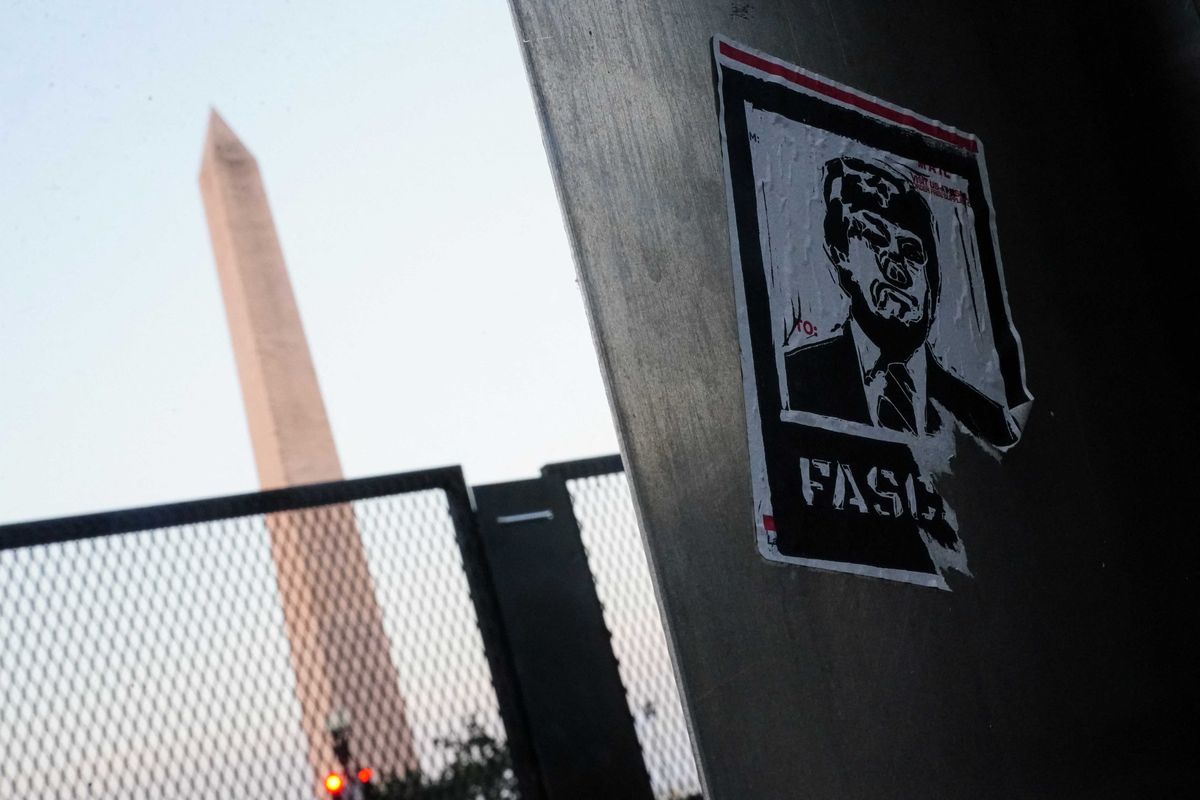
A sticker depicting U.S. President Donald Trump, next to security barricades near the Washington Monument ahead of Fourth of July celebrations, marking the 250th anniversary of U.S. Independence, in Washington, D.C., U.S., July 4, 2026. REUTERS/Nathan Howard
Donald Trump's assault on the nation's founding democratic promise has handed the political left a perfect opportunity to reclaim its legacy, argued historian Harvey Kaye in an analysis published in Zeteo on Saturday.
Kaye, professor emeritus of democracy and justice studies at the University of Wisconsin-Green Bay, wrote that the nation is marking its 250th anniversary even as "Donald Trump and his minions" pursue their "reactionary ambitions" – a timing he called "nothing less than ironic, as if history were playing a cruel joke on us."
“Hardly the grounds for a grand celebration. And yet, the 250th comes at the perfect time for the Left,” Kaye wrote.
“Indeed, rather than dismiss or scorn the occasion as we may be wont to, we progressives, populists, and democratic socialists should step up and embrace it. For are we not also finally seeing the beginnings of a real democratic surge – a surge that might actually lead to taking back the Democratic Party from the neoliberals and billionaires?”
Kaye called on Americans to remember they are "heirs to the promise and project of the American Revolution," invoking Thomas Paine's declaration that "we have it in our power to begin the world over again."
Kaye pointed to past national crises – the Civil War and the Great Depression – as models for how Americans previously responded to authoritarian threats, writing that each generation made the country "radically freer, more equal, and more democratic than ever before."
“Reminding ourselves of all of that, and sensing the democratic possibilities that are emerging, let us toast the 250th with words from the man who first turned us into radicals,” Kaye wrote.
“Angered by misrepresentations of the American Revolution in a history published in 1782 by the famed French writer, Abbe Raynal, Paine replied, ‘It is yet too soon to write the history of the Revolution.’”
In Independence Eve Speech, Trump Warns of Communism Then Promotes One-Party Rule
“If we terminate the filibuster as we should do and immediately vote for the SAVE America Act then we will not lose an election for a hundred years,” the president said.
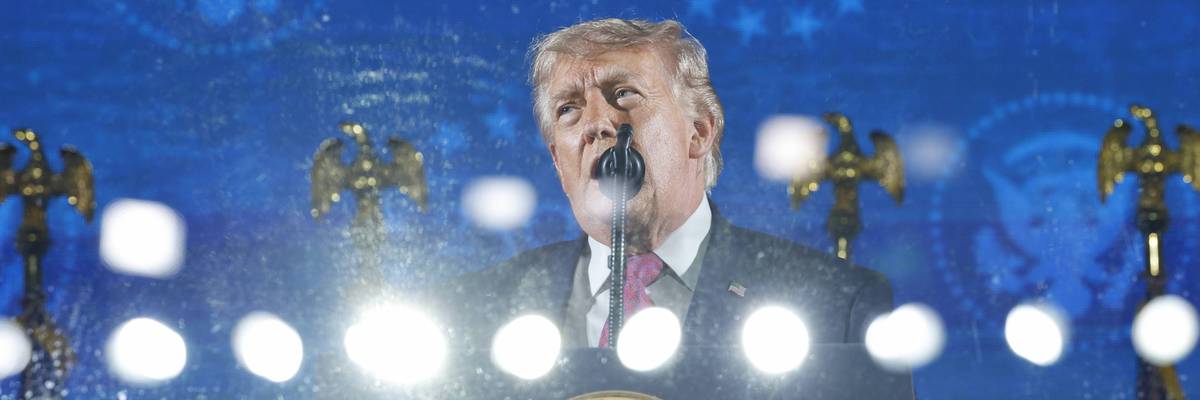
US President Donald Trump speaks during a rally at Mount Rushmore National Memorial on July 3, 2026 in Keystone, South Dakota.
(Photo by Chip Somodevilla/Getty Images)
Olivia Rosane
Jul 04, 2026
COMMON DREAMS
President Donald Trump spent his address to the United States the night before its 250th birthday fearmongering about the “communist menace” and suggesting that his Republican Party should govern the nation for a century.
“America will never be a communist country,” he said from Mount Rushmore, South Dakota Friday night. “We can only lose the midterms if we allow ourselves to lose the midterms, if we are foolish, stupid, and unwise. But if we terminate the filibuster as we should do and immediately vote for the SAVE America Act then we will not lose an election for a hundred years.”
His remarks clearly implied a false link between communism and the Democratic Party and promoted a bill that critics say will make it harder for millions of eligible voters to participate in elections. The SAVE America Act claims to address the documented non-problem of noncitizen voting by requiring voters to show documents such as passports and birth certificates, which can be expensive and difficult to obtain, especially for low-income voters. Such requirements would also impose added burdens on rural voters and married women who have changed their names.
Melanie D’Arrigo, executive director of the Campaign for New York Health, wrote on social media that with his remarks, Trump was “clearly defining the effects of voter suppression bills.”
“What message could be more unifying on the nation’s 250th birthday weekend than touting one-party rule?” writer Michael Freeman posted on social media.
California state Sen. Scott Wiener (D-11) wrote: “The thing about Trump is he tells us what he wants & what he intends to do. He wants to end democracy. Freeze MAGA in power forever. Have zero accountability to the people. Just seize power & keep it. We are so close to true authoritarianism. We must use every ounce of power & leverage we have to stop them.”
Before arguing for 100 years of Republican rule, Trump continued the exaggerated anti-communist rhetoric he has employed in the weeks since progressive and Democratic-Socialist candidates won a series of Democratic primary victories.
“There is now a resurgence of the communist menace in our land, including from newcomers to our country who embrace ideas totally opposed to our way of life and our great success,” Trump said on Friday. “These are not mere political disagreements like differences over taxes or regulations. Communism is a mortal threat to American liberty. It is the greatest threat to our country, including World War I, World War II, Pearl Harbor, or even 9/11.”
In fact, the Democratic Socialists who won primary elections in New York City last month ran on a platform of affordable housing, Medicare for All, stronger unions, and an end to US military support for Israel’s genocide in Gaza, policies backed by large numbers of ordinary Americans.
Trump doubled down on an opposition between communism and US values and also linked his anti-communist to his anti-immigrant stance, threatening to send communists into “exile.”
“You can be a communist or you can be a patriot. You cannot be both,” Trump said in a quote later posted from the White House X account.
“This July 4th, the Trump regime is pushing a new Red Scare. This is an actual White House post. The regime is pretending that communism is a serious threat to America,” Tom Joscelyn, who served as a senior professional staffer on the January 6 Committee, responded on social media.
MeidasNews editor in chief Ron Filipkowski argued that Trump was leaning on anti-communism to divert attention from his own disastrous policies.
“Trump fucks up the economy with his tariffs, raises gas prices for every American with his foolish war, piles on to the national debt with his budget & wasteful spending on vanity projects, covers up Epstein, makes billions for himself, then starts yelling about communism to distract,” he wrote on social media.
Journalist Mark Chadbourn agreed, writing on social media that the speech reflected Trump’s “new strategy.”
“Now he’s failed completely abroad, he’s looking to the Enemy Within to create new Hate Figures to unite his wavering followers,” Chadbourn said. “Can’t stop Iran’s threat so let’s have a 2026 Red Scare to turn neighbour against neighbour. A new HUAC on the way? Very dangerous.”
Trump’s July 3 remarks contrasted with those of New York Democratic Socialist Mayor Zohran Mamdani earlier that day, who uplifted the country’s immigrant heritage, decried greed and racial supremacy, and argued that “time and again, including 250 years ago, those forces of division have been vanquished by the forces of progress.”
“If we terminate the filibuster as we should do and immediately vote for the SAVE America Act then we will not lose an election for a hundred years,” the president said.
US President Donald Trump speaks during a rally at Mount Rushmore National Memorial on July 3, 2026 in Keystone, South Dakota.
(Photo by Chip Somodevilla/Getty Images)
Olivia Rosane
Jul 04, 2026
COMMON DREAMS
President Donald Trump spent his address to the United States the night before its 250th birthday fearmongering about the “communist menace” and suggesting that his Republican Party should govern the nation for a century.
“America will never be a communist country,” he said from Mount Rushmore, South Dakota Friday night. “We can only lose the midterms if we allow ourselves to lose the midterms, if we are foolish, stupid, and unwise. But if we terminate the filibuster as we should do and immediately vote for the SAVE America Act then we will not lose an election for a hundred years.”
His remarks clearly implied a false link between communism and the Democratic Party and promoted a bill that critics say will make it harder for millions of eligible voters to participate in elections. The SAVE America Act claims to address the documented non-problem of noncitizen voting by requiring voters to show documents such as passports and birth certificates, which can be expensive and difficult to obtain, especially for low-income voters. Such requirements would also impose added burdens on rural voters and married women who have changed their names.
Melanie D’Arrigo, executive director of the Campaign for New York Health, wrote on social media that with his remarks, Trump was “clearly defining the effects of voter suppression bills.”
“What message could be more unifying on the nation’s 250th birthday weekend than touting one-party rule?” writer Michael Freeman posted on social media.
California state Sen. Scott Wiener (D-11) wrote: “The thing about Trump is he tells us what he wants & what he intends to do. He wants to end democracy. Freeze MAGA in power forever. Have zero accountability to the people. Just seize power & keep it. We are so close to true authoritarianism. We must use every ounce of power & leverage we have to stop them.”
Before arguing for 100 years of Republican rule, Trump continued the exaggerated anti-communist rhetoric he has employed in the weeks since progressive and Democratic-Socialist candidates won a series of Democratic primary victories.
“There is now a resurgence of the communist menace in our land, including from newcomers to our country who embrace ideas totally opposed to our way of life and our great success,” Trump said on Friday. “These are not mere political disagreements like differences over taxes or regulations. Communism is a mortal threat to American liberty. It is the greatest threat to our country, including World War I, World War II, Pearl Harbor, or even 9/11.”
In fact, the Democratic Socialists who won primary elections in New York City last month ran on a platform of affordable housing, Medicare for All, stronger unions, and an end to US military support for Israel’s genocide in Gaza, policies backed by large numbers of ordinary Americans.
Trump doubled down on an opposition between communism and US values and also linked his anti-communist to his anti-immigrant stance, threatening to send communists into “exile.”
“You can be a communist or you can be a patriot. You cannot be both,” Trump said in a quote later posted from the White House X account.
“This July 4th, the Trump regime is pushing a new Red Scare. This is an actual White House post. The regime is pretending that communism is a serious threat to America,” Tom Joscelyn, who served as a senior professional staffer on the January 6 Committee, responded on social media.
MeidasNews editor in chief Ron Filipkowski argued that Trump was leaning on anti-communism to divert attention from his own disastrous policies.
“Trump fucks up the economy with his tariffs, raises gas prices for every American with his foolish war, piles on to the national debt with his budget & wasteful spending on vanity projects, covers up Epstein, makes billions for himself, then starts yelling about communism to distract,” he wrote on social media.
Journalist Mark Chadbourn agreed, writing on social media that the speech reflected Trump’s “new strategy.”
“Now he’s failed completely abroad, he’s looking to the Enemy Within to create new Hate Figures to unite his wavering followers,” Chadbourn said. “Can’t stop Iran’s threat so let’s have a 2026 Red Scare to turn neighbour against neighbour. A new HUAC on the way? Very dangerous.”
Trump’s July 3 remarks contrasted with those of New York Democratic Socialist Mayor Zohran Mamdani earlier that day, who uplifted the country’s immigrant heritage, decried greed and racial supremacy, and argued that “time and again, including 250 years ago, those forces of division have been vanquished by the forces of progress.”


No comments:
Post a Comment