Friday, April 15, 2022

Russia- Ukraine war: Real reason for Russia's fury over sinking of prized ship
Russian Navy missile cruiser Moskva on patrol in the Mediterranean Sea near the Syrian coast. 
Photo / AP


15 Apr, 2022

Russia has been left furious after its prized flagship Moskva was sunk in the Black Sea, with experts revealing why the destroyed ship is such a blow to President Vladimir Putin.

Moskva sank on Thursday after an explosion and fire that Ukraine claimed was a successful missile strike, as the Kremlin accused Kyiv of targeting its citizens in sorties across the border.

Russia's defence ministry has denied Ukraine's claims, instead saying the blast on vessel was the result of exploding ammunition and added that the resulting damage had caused it to "lose its balance" as it was being towed to port.

"Given the choppy seas, the vessel sank," the Russian state news agency TASS quoted the ministry as saying.

Regardless of which version of events is correct, the destruction of the Moskva presents Putin with a new problem: How to explain the loss to his citizens.

An assessment of the situation from the Institute for the Study of War found that both explanations expose a weakness in the Russian military.

A Flourish data visualization

"The Kremlin's current story of losing the flagship of the Black Sea Fleet due to an accidental fire and ammunition explosion will, at minimum, likely hurt Russian morale and cannot be hidden from the Russian domestic audience," the assessment stated.

"Both explanations for the sinking of the Moskva indicate possible Russian deficiencies — either poor air defences or incredibly lax safety procedures and damage control on the Black Sea Fleet's flagship."

While the loss of the ship is unlikely "deal a decisive blow" to Russia's operations as a whole, it will impact the country's ability to conduct cruise missile strikes on its enemies.

Since Russia began its invasion of Ukraine on February 24, Moscow has gone to great lengths to censor the situation and stop its citizens from being able to see what is really happening.
Russian President Vladimir Putin chairs a Security Council meeting via video conference at the Novo-Ogaryovo residence outside Moscow, Russia. Photo / AP

Factual inconsistencies and censorship have been reported through the country's state-owned media like Russia Today, Channel One and Sputnik, with jarring discrepancies between casualties and the military's progress in Ukraine.

While Russia's media landscape offers a mix of state-controlled and independent publications, Moscow has forbidden media to describe the Ukraine invasion as war, opting for the term "special operation" instead.

Non-government affiliated site The Moscow Times reported last month that "Russia's media watchdog has ordered the country's media to use only official sources" when covering the Ukrainian invasion.

Those who refuse to comply could be blocked within Russia or fined up to five million roubles, or the equivalent of $66,700.

In a report from the BBC, packages from Russia's most-watched channels, Rossiya 1 and Channel One also reveal discrepancies.

In one bulletin, a presenter warns viewers against images of destroyed Russian tanks, calling them "unsophisticated virtual manipulations".

"Footage continues to be circulated on the internet which cannot be described as anything but fake," they say.

Nuclear weapons warning after ship sunk

The US has described the sinking of the Moskva as a "big blow" for the Black Sea fleet, warning it could prompt Putin to escalate the situation.

The fleet has been blockading the besieged southern port city of Mariupol, where Russian officials say they are in full control.

Following its pullout from northern Ukraine earlier this month after failing to take the capital, Russia is refocusing on the east, with Kyiv warning of bloody new clashes to come in the Donbas region.

And with Russian setbacks in the war mounting, the CIA warned that President Vladimir Putin could resort to using a tactical or low-yield nuclear weapon.

"We're obviously very concerned. I know President Biden is deeply concerned about avoiding a third world war, about avoiding a threshold in which, you know, nuclear conflict becomes possible," CIA director William Burns said in a speech in Atlanta.

But the United States is yet to see "a lot of practical evidence" of actual deployments that would cause more worry, he added.

Russian analyst Clint Ehrlich warned Ukraine could expect an "immediate escalation from Moscow" if it really was behind the sinking of the Mosvka.

"There will be a political imperative for the Kremlin to push this setback from the headlines with positive news," he said.

"We may see large-scale strategic bombing, something Russia has held back on to date."

Putin's response to the situation may have already begun, with an air raid alert declared for the entirety of Ukraine in the early hours of Friday morning.

Media outlet Nexta announced on Twitter yesterday that there had been "an air-raid alert on the entire territory of Ukraine".

The Kyiv Independent also announced that an air raid alert had been declared "in all of Ukraine's regions at once".

Ukrainian MP Lesia Vasylenko revealed multiple explosions had occurred in Kyiv, with the ongoing air raid siren already sounding for almost an hour.

"3 explosions in #Kyiv right now. One after the other," she wrote on Twitter.

"The air raid warning has been on for an hour. Most likely #put in gone livid because of the #Moskva sinking. Oh well, we'll just keep standing to #Russia's annoyance".

Climate change activists block London bridges, British oil terminals


LONDON (AP) — Climate-change protesters snarled traffic by blocking four London bridges on Friday, while other activists continued weeks of demonstrations targeting oil terminals across Britain.

Cars and red double-decker buses backed up along roads as hundreds of Extinction Rebellion activists occupied London’s Waterloo, Blackfriars, Lambeth and Westminster bridges, calling for an end to new fossil fuel investments.

READ MORE: We have the tools to save the planet from climate change. Politics is getting in the way, new IPCC report says

The Metropolitan Police force said “pockets of protest” were causing delays and disruption across central London.

The demonstrations are part of a growing climate action movement that has also seen the group Insulate Britain obstruct highways and roads to press demands that the government fund more energy-efficient homes.

In response, the Conservative government has introduced measures to curb disruptive protests, a move that has sparked debate about freedom of speech.

On Friday the government praised oil companies for obtaining court orders to stop demonstrators who have been blocking oil depots.

More than 600 people have been arrested over the past two weeks after environmental activists climbed atop oil tankers, padlocked themselves to structures and blocked roads at oil depots across the U.K. The group Just Stop Oil, which is affiliated with Extinction Rebellion, is demanding the government stop any new oil and gas projects.

Energy Minister Greg Hands said that “while we value the right to peaceful protest, it is crucial that these do not cause disruption to people’s everyday lives.” He said several firms have been granted injunctions that limit protesters’ actions and access to sites.

Protests continued Friday at sites in southeast and central England despite the injunctions, with dozens of arrests.

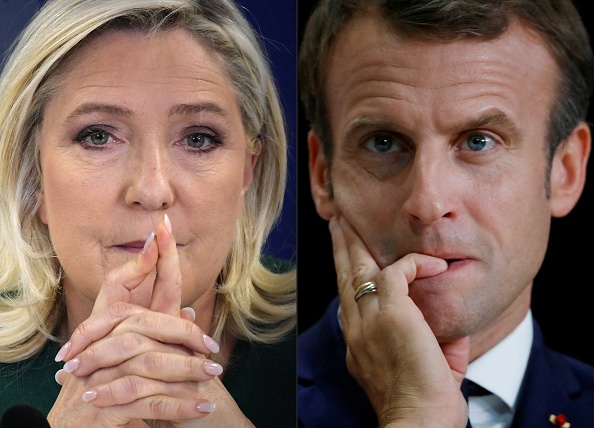
French elections 2022: Macron clashes with Le Pen over hijab ban as second round approaches

Current President Emmanuel Macron told people in the city of Le Havre that "not a single country in the world" has a ban on the headscarf, whereas his rival Marine Le Pen is vowing to place a ban of the hijab in public if elected.


Incumbent President Emmanuel Macron and his far-right rival Marine Le Pen are headed to the second round of the French presidential elections
[Getty]

President Emmanuel Macron has clashed with his rival Marine Le Pen over her plan to ban women from wearing the Islamic headscarf in public, with an eye on the votes of Muslims in the second round of elections.

Le Pen on 24 April will seek to cause the greatest upset in the history of modern French politics by defeating Macron in a run-off in presidential elections.

While polls indicate Macron is ahead they also point to a far tighter race between the centrist and the far-right leader than in their 2017 run-off.

Analysts say one reason for her advance is Le Pen's success in cultivating a more moderate image and portraying herself as the candidate best equipped to deal with problems like rising prices.

But one signature hardline policy the anti-immigration Le Pen has not dropped is her opposition to the Islamic headscarf, saying women who wear the hijab in public in France will be fined if she wins power.

Macron meanwhile has sought to seize on her insistence to argue that Le Pen's policies are no different from those of the hardline National Front (FN) founded by her father Jean-Marie.

'You want to be the first?'


Visiting the eastern city of Strasbourg on Tuesday, Macron during a walkabout to meet voters asked a veiled women if she was wearing the headscarf by choice or obligation.

"It's by choice. Totally by choice!" said the woman, who proudly declared she was a feminist.

Macron replied, in clear reference to Le Pen's plan: "This is the best response to the rubbish that I have been hearing".

He went even further on Thursday during a visit to the northern port city of Le Havre: "There is not a single country in the world that bans the headscarf in public. Do you want to be the first?"

RELATED
In-depth
Florence Massena

Macron is clearly aware of the importance of the votes of France's roughly five million Muslims, who are estimated to make up almost nine percent of the population.

According to a survey by the Ifop pollster, 69 percent of Muslim voters in the first round of the election opted for third-placed candidate Jean-Luc Melenchon.

Wooing the Melenchon vote is seen as crucial for Macron to be assured of victory in round two.

Macron has in the past himself run into controversy from Muslims and leaders of Islamic countries over his tough stance over what the government calls radical Islamism.

After a spate of attacks in late 2020 blamed on radical Islamists, the president railed against what he called "Islamist separatism" in France and forced through a series of measures to limit its spread.

RELATED
Voices
Yasser Louati

'It's not true'


Le Pen has said that wearing the Islamic headscarf in public in France should be an offence punishable by a fine issued by the police, like a traffic infraction.

The debate also goes to the heart of candidates portraying themselves as champions of the French principle of secularism, where religion and state are separate.

"The headscarf has been imposed by Islamists," Le Pen told BFM TV in an interview on Friday describing it as a "uniform".

In an uncomfortable exchange, Le Pen on Friday found herself cornered by a Muslim woman wearing a headscarf during a visit to the town of Pertuis in the south of France.

Le Pen claimed that in "some areas" in France, women who do not wear the headscarf are "isolated and judged".

"It's not true. It's not true," said the woman, laughing incredulously and saying her father had fought for France in the army for 15 years.

After further argument, Le Pen then waved cheerily and breezily ended the exchange.

Even within her own camp, the hardline stance has caused controversy.

"It's an error," said Robert Menard, mayor of the town of Beziers and a supporter of Le Pen in the second round. "It's not possible to put in place".

Montreal students threatened with funding cut for backing BDS

Nora Barrows-Friedman 

ELECTRONIC INFATADA 
15 April 2022

Canadian students pass measures in support of Palestinian rights
 while university administrations attempt to sabotage their efforts. 
Giles CampbellZUMAPRESS

In the last two months, students at universities across Canada have voted to endorse the boycott, divestment and sanctions (BDS) campaign for Palestinian rights amid heavy pressure from pro-Israel lobbyists and backlash from college administrations.

In February, the University of Toronto’s student union passed a measure mandating divestment from companies profiting from Israel’s occupation.

Students at Concordia University in Montreal endorsed an anti-apartheid measure in a mid-March referendum. By a large majority, students voted in favor of pushing the college to pull “vocal and financial support” from states and corporations that are complicit in Israeli apartheid.

The student body at the University of British Columbia voted to urge the university to divest from Israeli settlements in the occupied West Bank on 23 March.

But at McGill University in Montreal, administrators are threatening the undergraduate student union with termination of its funding after students voted in support of a Palestine solidarity policy last month.

The vote was held through a referendum, with more than 70 percent of students favoring the policy.

The policy instructs the university’s student body to boycott corporations and institutions that are complicit in Israel’s crimes and to pressure the university to follow suit.

It also calls on McGill to publicly condemn notorious blacklisting websites and smear campaigns that target Palestine rights advocates on campus.

The policy also mandates a formation of a Palestine solidarity committee within the student union, the Students’ Society of McGill University (SSMU).

“For two decades, Palestinian students at McGill have worked tirelessly to educate their peers about the complicity of this institution in settler-colonial apartheid,” stated students with Solidarity for Palestinian Human Rights McGill.

“Time and time again, their activism has been met with censorship, blacklisting, and repression from an openly hostile McGill administration,” which, the group said, they expected to “do everything in its power to overturn the democratic voice of the students.”

The day after the referendum was completed, the administration sent a “notice of default” to the SSMU president. The notice claimed that the Palestine policy was antithetical to the university’s constitution and could “lead to discrimination” – ostensibly against Jewish students.

It is a trope promoted by Israel lobby groups to claim that supporting Palestinian rights is tantamount to anti-Jewish bigotry. The claim is solely aimed at silencing and disrupting activism.

The McGill administration also said it was looking into allegations of irregularities in the referendum results.

Several days later, the university’s deputy provost, Fabrice Labeau, sent a campus-wide email further condemning the Palestine policy, claiming that it will “bring more division to the community” while he was tasked to “develop an initiative to prevent anti-Semitism and Islamophobia.”

Students organized a rally in front of the administration building in response to the threats.

“But we also wanted to emphasize the fact that we had won this battle already and that the administration was reacting to us winning,” Reem Said of Solidarity for Palestinian Human Rights McGill told The Electronic Intifada.

Said added that the university had quickly come under pressure from Zionist groups that were publishing articles urging the administration to defund the student union, and, likely, from donors.

The administration “clearly felt like they had to show that they were going to crack down,” SPHR member Andreas Iakovos told The Electronic Intifada.
Mobilizing support

Since student-led BDS campaigns began in 2016, Israel-supporting donors have threatened to withhold their financial support if such a measure passed at McGill.

The 2016 BDS motion passed, but was ruled unconstitutional by the student union.

That ruling was eventually nullified by a student judicial board in 2021.

Weeks later, in February 2021, McGill student body representatives passed a “divest for human rights” policy, which demands that the university pull all of its investments from corporations that profit from human rights violations, land theft and environmental destruction in Canada and abroad.

Passing that broad divestment policy “was a really good way for us to gauge the atmosphere on campus, and see how successfully we could mobilize student support for similar campaigns,” Iakovos told The Electronic Intifada.

“We decided that now we really need to be much bolder,” he said.

Said and Iakovos explained that there was strong support on campus for Palestinian rights during and after Israel’s attacks on Gaza last summer.

During that period, Solidarity for Palestinian Human Rights McGill circulated a petition calling on the university to implement divestment.

The petition also explicitly demanded the administration to include Zionism, Israel’s racist state ideology, in its discrimination and racism policy.

More than 1,500 students signed on, as well as a coalition of anti-racist and social justice campus groups.

Top McGill officials rejected the students’ demands.

But campus activists pressed on, eventually drafting the Palestine policy document.
Pushing back

Since the referendum victory last month, students, faculty, campus groups and Palestine solidarity organizations have defended both the policy and the democratic agency of the student body against the administration’s threats.

At least 100 faculty members at McGill have signed an endorsement of the Palestine Solidarity Policy, which they see as “a continuation of a long-standing history of student leadership aimed at bringing meaningful changes to their educational arenas.”

In an opinion piece, Jewish students at McGill said they see “defense of human rights – and effectively the defense of this motion – as an enactment of our Jewish values.”

“Conflating criticism of the settler-colonial state of Israel with anti-Semitism is both incorrect and a dangerous distraction from real instances of anti-Semitism,” they wrote.

The Jewish students also rebuked the Israel lobby groups’ claims that they speak for all Jews on campus.

“For many years, there has been a strong Jewish presence at McGill in solidarity with Palestinian human rights,” they added.

The editorial board of the campus newspaper, The McGill Tribune, excoriated the administration’s attempts to sabotage the policy under the guise of fighting discrimination.

“Palestinian students face constant targeted, structural racism at McGill, but never receive any institutional support. The administration’s latest interference upholds the institutionalized oppression of Palestinians at the expense of student safety,” the editors wrote.

“[Vice Provost] Labeau’s statement uses inflammatory buzzwords and harmful misrepresentations of anti-Zionism in an attempt to intimidate those in support of the Palestine solidarity policy – and in doing so, it imposes the beliefs of administrators, the board of governors, and donors onto students,” the editors added.

The McGill Tribune noted that “by branding the policy as contradictory to values of diversity and inclusion, while touting accusations of anti-Semitism without any real explanation, Labeau’s statement appears to be nothing more than a fear-mongering technique to silence those in opposition to Palestinian liberation and the profit McGill makes from investing in apartheid.”

The student union has until next week to respond to the administration’s notice of default. If the union decides to formally dispute the notice, it could go to legal arbitration.

“Right now, we’re really pushing our student union to take the right stand and protect student democracy,” Reem Said of Solidarity for Palestinian Human Rights McGill said.

“We’re also trying to apply pressure on the administration by making as much public noise as we can, and making it clear to them that we’re not just going to stand by while they bully us and our student union into reversing something that was a democratic referendum.”

Turkey Re-Evaluates Its Position In The Wider Black Sea Region – Analysis

By 

Amid the Russian invasion of Ukraine, Ankara’s foreign policy is set to undergo major changes. Being the most valuable ally the West has in the region, without Turkey’s support any Western strategy will fall short of achieving concrete results in stopping Russia in the long-term.

Turkey’s foreign policy in the wider Black Sea region is in flux. The process did not start with Russia’s aggression against Ukraine this February, nor with Russia’s decision to send peacekeepers into Nagorno-Karabakh as a result of the 2020 war. Rather these events accelerated what started in 2000s when Russia invaded Georgia and then gradually turned its attention to Ukraine, which culminated in the annexation of Crimea.

Ankara has been careful not to overreact or show excessive reliance on Russia. Balancing neatly encompasses Turkish foreign policy thinking. But over time it has become increasingly difficult to maintain this equilibrium. Russia has doubled its military pressure on the wider Black Sea region. Since this geographic area has served as a buffer zone for Turkey against its historic rival, this leaves little chance for Turkey to successfully maintain the balance it has so far pursued. Russian overbearing behavior inevitably invites re-thinking of many tenets in Ankara’s strategy. Turkey will continue to avoid diplomatically confronting Russia, but now Ankara is looking to the increase of military and economic engagement with Ukraine and the South Caucasus countries as the only solution in keeping Moscow at bay.

Thus, an arc of lands along Russia’s southern borders is emerging seen by Turkey as Russia’s soft and vulnerable spots. It is the area where Ankara can make significant inroads in terms of security and economic cooperation. The alternative could be very costly to Turkey. The buffer zone could be lost, and the military balance of power irreversibly tilted in Russia’s favor. It would limit Ankara’s maneuverability and its willingness to play a major geopolitical role in the Black Sea and the South Caucasus. Constrains will far outweigh Turkey’s potential avenues.

Threatened by Russia, Turkey is nevertheless well positioned as it enjoys NATO membership. Moreover, Turkey’s Black Sea-South Caucasus strategy, particularly its investments in shoring up the defenses of Ukraine, Azerbaijan, and Georgia, dovetails with Western strategies toward Russia and the region in general. The opening of the South Caucasus is what the West and Turkey has strived to achieve ever since the end of Soviet Union. Their cooperation in the region is thus highly likely to take a more concrete shape amid the war in Ukraine.

For Turkey the changes in the wider Black Sea region are indicative of gradual emergence of new world order. From Ankara’s perspective the future order will be more chaotic. It will also be hierarchical, with China and America playing a leading role, and others having lesser influence. These changes will play out in the Black Sea region and the South Caucasus where Russia clearly strives to be the major power. But Moscow is also well aware that it is impossible to create an exclusive order as was done during the Russian Empire and the Soviet Union. This requires having adequate resources, which the economically weak Russia does not currently have. At the same time, geopolitical prestige is needed, which Russia is slowly losing, as reflected in the excess of the military element in the Kremlin’s policy in the South Caucasus. Maintaining influence in the region is being achieved through the creation of a larger number of military bases, a clear example of which is the deployment of Russian peacekeepers to Nagorno-Karabakh.

Therefore, Russia will try to establish an order where it would need cooperation with Iran and most importantly Turkey. But Moscow also expects its hegemony will be recognized by Ankara and Tehran. In Russia’s view the new order will not rule out disagreements or sharp diplomatic and economic competition between these three powers, but overall, its position will be unassailable.

However, this is where Turkey’s vision of the South Caucasus and the Black Sea does not align with Russia’s. Ankara will attempt to undermine Russian hegemony by increasing its support for Azerbaijan and Georgia. The trilateral cooperation between these countries could be revisited in favor of greater emphasis on military cooperation.

In another major move, Ankara will try to normalize relations with Yerevan. Over time improved Armenia-Turkey ties means a decrease of Yerevan’s economic and infrastructural dependence on Moscow. It also means opening the region which has been notorious for being geographically closed and highly dependent on Russia.

Turkey will thus double down on its efforts to diversify its penetration into the region and the wider Caspian Sea by establishing various connectivity routes. This multi-pronged strategy is based on the realization that the three South Caucasus states are also eager to have Turkey as a certain counterbalance to Russia.

Thus, the invasion of Georgia, aggression against Ukraine in 2014, the Nagorno-Karabakh gambit and the February attack on the whole of Ukraine – are the developments being factored into Turkey’s new formulation of foreign policy in the wider Black Sea region. Turkey is unlikely to clash with Russia, but it is this longue durée approach which undermines Russia’s primacy in the South Caucasus. In the Black Sea Turkish policy is less successful, but as the war in Ukraine shows that Russia’s plans of destroying its neighbor have largely failed, post-war Ankara-Kyiv ties are likely to grow further.

The arc to the north and north-east of Turkey is a grey area where intense geopolitical competition is unfolding. But while for decades the West-Russia rivalry discourse has dominated the scholarly and analytical community, Turkey was no less a player. In fact, it has been instrumental in limiting Russian power in the South Caucasus as shown by results of the 2020 Nagorno-Karabakh war and the developing rapprochement with Armenia.

This article was published by Caucasus Watch

Emil Avdaliani has worked for various international consulting companies and
currently publishes articles focused on military and political developments
across the former Soviet sphere.
COMPRADOR
Masrour Barzani visits Turkey, to meet Recep Tayyip Erdogan

Posted on April 15, 2022

Masrour Barzani (L) Iraqi Kurdistan prime minister shakes hands with Turkish President Recep Tayyip Erdogan in Ankara, Turkey, November 28, 2019. Photo: Turkish presidency/KRG/Twitter

ISTANBUL,— The prime minister of the Kurdish administration in Iraqi Kurdistan Masrour Barzani arrived in Istanbul, Turkey on Friday and is scheduled to meet with Turkey’s president Recep Tayyip Erdogan.

During the visit, the premier of so-called Kurdistan Regional Government KRG, Masrour Barzani, is expected to discuss strengthening bilateral ties as well as the recent developments in Iraq and the region, according to a statement from Barzani office.

According to analysts the talks will be focused on the plans to export natural gas from Iraqi Kurdistan region to Europe.

On March 13, Iranian forces launched 12 ballistic missiles at the Iraqi Kurdish capital of Erbil, claiming the attack was in response for an Israeli military attack in Syria that killed Iranian military personnel. Most of the missiles were fired at a villa owned by Sheikh Baz Karim Barzanji, the CEO of a major domestic energy company called KAR Group which close to the Barzanis.

According to Iraqi, Turkish, and Western sources, the strike was launched in response to plans to export Kurdistan natural gas to Turkey and Europe.

The Iraqi Kurdistan-ruling Barzani family have close business, economic, and energy ties with the Turkish government, which is an important oil, economic and political partner of Kurdistan Democratic Party KDP. Turkey’s pipelines transport most of the crude oil produced in Iraqi Kurdistan.

Masrour Barzani said on March 29, 2022, that Kurdistan has the capacity to make up for at least some of the energy shortfall in Europe – and that oil and gas development in Kurdistan might not be in the interest of major regional energy producer Iran.

On February 22, Iraq’s Supreme court deemed an oil and gas law regulating the oil industry in Iraqi Kurdistan unconstitutional and demanded that Kurdish authorities hand over their crude supplies. Despite the court verdict, KRG premier Masrour Barzani, who seems to defy the ruling, stated his administration remains committed to its oil and gas contracts.

The Barzani-dominated KRG has no authority in areas which is controlled by Patriotic Union of Kurdistan, where the most gas fields are located. The KDP is not even sharing oil revenues with the PUK, according to critics.

In February 2022, Turkey’s president Recep Tayyip Erdogan met with the president of Iraqi Kurdistan Nechirvan Barzani in Ankara where they discussed a possible natural gas pipeline and gas supply agreement between Turkey and Iraqi Kurdistan.

Masrour Barzani’s last official visit to Turkey was in November 28, 2019.

Iraqi Kurdistan is not a unified region; it is divided politically and geographically into the Yellow and Green zones, which are led by the KDP’s Massoud Barzani and the PUK’s Talabani family. The Barzanis govern Erbil and Duhok, while the Talabanis govern Sulaimani.

AND OCALAN'S PKK FIGHT TURKEY'S DOMINANCE OF KURDISTAN

This is a developing story…

Copyright © 2022 Ekurd.net
 All rights reserved

The U.S. must stand up to Barzani blackmail in Iraq

Posted on April 14, 2022 by Editorial Staff 


Tribal leader and the head of KDP party Massoud Barzani (R) along his son Masrour (L), Duhok, Iraqi Kurdistan, 2018. 
Photo Michael Rubin | The National Interest

For almost twenty years, the U.S. State Department has allowed its fear of Barzani’s intransigence to shape American policy in Iraq.

On May 12, 2018, Iraqis went to the polls to elect a new government. Then, as now, political maneuvering consumed months as Iraqis sought first to select a speaker, then a president, and finally a prime minister. Behind the scenes, individuals and party leaders engaged in political horse-trading and brinkmanship, while diplomats from Washington and Tehran sought to ensure that candidates more sympathetic to their interests, if not worldview, found their way into top positions.

During the struggle to form a new government in 2018, Brett McGurk was the U.S. special envoy to counter the Islamic State. But, by dint of his experience in Iraq and personal relationships with Iraqi politicians across the political spectrum, President Donald Trump and Secretary of State Mike Pompeo relied on him to shape U.S. Iraq policy. While the Americans, Europeans, Arabs, and Iranians all largely agreed that Barham Salih was the most capable and politically moderate candidate, McGurk urged Iraqi politicians to choose Fuad Hussein, chief of staff to Kurdistan Democratic Party leader Massoud Barzani.

Fuad’s achievements were negligible, and Iraqis perceived his capabilities as lackluster. According to Iraqis present in the meetings, McGurk’s reasoning was that picking anyone besides Barzani’s man would lead Barzani to undermine the broader Iraqi system. This was no idle concern; the year before, Barzani, his uncle, Hoshyar Zebari, and his son Masrour had held an independence referendum across both Iraqi Kurdistan and disputed territories claimed by both Baghdad and Erbil.


US Secretary of State Michael Pompeo (R) shakes hands with Massoud Barzani leader of the Kurdistan Democratic Party (KDP) in Erbil, Iraqi Kurdistan, on January 9, 2019. Photo: Public Domain/US Secretary of State

For almost twenty years, the State Department has allowed its fear of Barzani’s intransigence to shape American policy in Iraq. In the era of the Coalition Provisional Authority, some current and former U.S. government officials used their contacts in the State Department or Pentagon to run interference for the Barzanis while simultaneously pursuing their own personal business interests. Many other diplomats and military officers—a notable exception being David Petraeus, the commander of the 101st Airborne at the time—would undermine or soft-pedal efforts to instill democracy or punish corruption for fear of upsetting Barzani.

While other Iraqi political leaders would meet high-profile American leaders in Baghdad, Barzani demanded they visit him at his cliff-top palace complex outside of Erbil. The fact that many did allowed Barzani to depict Americans as supplicants. Ironically, assuaging Barzani in this way only increased his ego and sense of entitlement.

This deference to Barzani did not serve U.S. interests. Russian firms benefited disproportionately from Kurdish oil, and both Massoud and Nechirvan Barzani leaked word of impending operations to Iran’s Islamic Revolutionary Guard Corps. Masrour Barzani—the regional government’s current prime minister—is best known among U.S. intelligence authorities for pestering them on citizenship issues for family members and requests for other inappropriate personal favors.

Nor has this deference brought regional stability. Nearly two decades after Saddam’s fall, Iraq needs talent. Barzani’s nepotism—and U.S. deference to it—undercuts recognition of that talent by signaling that only the Barzanis are capable. This is one of the reasons why, in November 2021, so many Iraqi Kurds traveled to Belarus—many dying en route—in order to try to cross into Poland. Likewise, those who drowned in the English Channel last November were not refugees fleeing war, but rather Iraqi Kurds seeking to escape the Barzanis’ regime of corruption. It is quite telling when supporters of Shia cleric Muqtada al-Sadr, whose followers often engage in corruption, criticize Sadr for the unseemliness of a political alliance with a family as corrupt as the Barzanis.


Brett McGurk, Baghdad, Iraq, June 7, 2017. Photo: Reuters

To look at the problem from the opposite perspective, it is clear that a willingness to stand up to the Barzanis at any point from 2003 to the present would have very likely bolstered Iraq’s stability. There are legitimate reasons to criticize Barham Salih—the people of Sulaimani, his hometown, are not shy about doing so—but the United States is lucky that McGurk’s maneuvering failed in 2018. There is simply no way Fuad Hussein could have navigated Iraq through the crisis of nationwide protests, the aftermath of Qassem Suleimani’s assassination, and the COVID-19 pandemic. Nor would he have been able to advance Iraq on the world stage in the way that Barham did. Moreover, Barzani proxies would have been unable to act and be accepted as an honest broker by Iraq’s various sectarian, ethnic, and political constituencies, let alone Washington, Tehran, Abu Dhabi, and Ankara.

As McGurk, newly-confirmed ambassador to Iraq Alina Rominowski, and others in the White House, State Department, Pentagon, and CIA work to help Iraq secure itself and set itself on a trajectory for economic stability, it is essential that they stop allowing fear of Barzani intransigence undermine U.S. interests and Iraq’s future. It is time to call Barzani’s bluff and allow him to retire into the dustbin of history where he belongs.

Michael Rubin is a former Pentagon official whose major research areas are the Middle East, Turkey, Iran and diplomacy. He is author of “Dancing with the Devil: The Perils of Engaging Rogue Regimes” (Encounter, 2014). He is a resident scholar at the American Enterprise Institute AEI. His major research area is the Middle East, with special focus on Iran, Iraq, Turkey, and Kurdish society. Read more by Michael Rubin.

The article first published at The National Interest.

Copyright © 2022, respective author or news agency, nationalinterest.org


Artificial intelligence: A great help or simply great hype? • FRANCE 24 English

This week's Tech 24 is a special edition from the south of France, where the World AI Cannes Festival is taking place. Almost every sector is abuzz with talk of AI, and investment in the technology is through the roof. But will it change the world completely? Or will it simply keep providing useful tools for specific circumstances?

Peter O'Brien went to the festival to find out.

RNC Will Require GOP Candidates To Abstain From Official Presidential Debates

The Republican National Committee has voted to require its candidates to abstain from presidential debates run by the Commission on Presidential Debates. NBC's Vaughn Hillyard reports on the impact this decision could have.

Crocs: How the Polarizing Footwear Brand Became a Fashion Statement | The Economics Of | WSJ

WSJ breaks down Crocs’s business strategy and explains how -- nearly two decades after the colorful clog first became a global fad -- the company found its footing as the world’s most loved and hated shoe. Illustration: Adele Morgan

Race & Football: How Reforms Fall Short | Meet The Press Reports 

After years of protests and attempted reforms, a new lawsuit on race in football is putting a spotlight on the disparities in coaching and team ownership.


Coaching And Ownership Show NFL's Race Reform Challenges

Blayne Alexander reports on the stark racial disparity between NFL players and the league's coaching and ownership numbers.