Thursday, March 16, 2023

Remembering Chaim Topol — and how ‘Fiddler’ reflected American Judaism

The inside story of ‘Fiddler on the Roof’ reveals some deep truths about American Judaism.
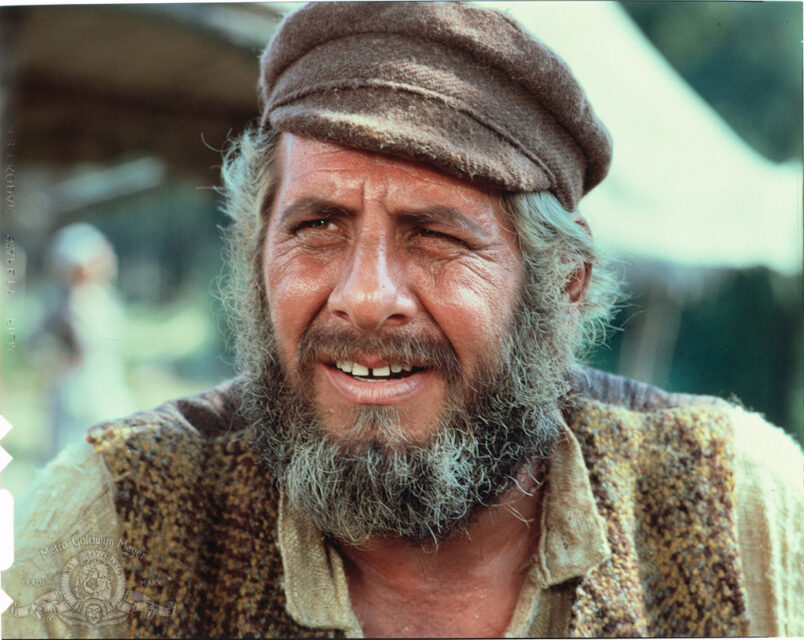
Chaim Topol playing Tevye in the film adaptation of

(RNS) — Ask any rabbi, and they will tell you that inadvertently omitting someone from a list of people who have died is a bad faux pas.

That is what happened at the Academy Awards “in memoriam section.” They neglected to list the Israeli actor Chaim Topol, who died this past week at the age of 87 and who was best known for playing Tevye in the film adaptation of “Fiddler on the Roof,” for which he had received Academy Award nominations.

(Topol was not alone on the list of those who did not make the post-mortem red carpet walk. Paul Sorvino was also omitted, much to the anger of his daughter, actress Mira Sorvino, as was Anne Heche.)

Which got me thinking about “Fiddler on the Roof.” (Check out this important book about “Fiddler,” as well as this documentary movie).

There is no question about it: “Fiddler” is perhaps the most famous piece of American Jewish culture. The show is so popular that since the day the show opened — Sept. 22, 1964 — it has been performed every day, somewhere in the world.

I have been replaying “Fiddler” in my mind. I have also been thinking about something quirky: the changes that were made in the show during production.

Those changes reflect how American Jews struggled with, and adapted, their Judaism.

Walk with me through several musical numbers that were left out of the final show, or changed ever so slightly, and you will see what I mean.

The opening number you never heard: “We’ve Never Missed a Sabbath Yet.” 

The opening song was to have been about the preparation for Shabbat: “Who can relax when there’s so much to be done / Keeping one eye on the soup and the other on the sun?”

But, in 1964, American Jews were not yet comfortable talking about “Shabbat” or “Shabbos”; it was the “Sabbath.” American Judaism was about assimilation. Let’s not highlight our differences.

Instead, let’s just sing about “tradition,” and the challenges and changes to those traditions. 

As lyricist Sheldon Harnick explained:

What is this show about? It’s about this changing of the way of life, of a people, in these Eastern European communities, these little towns, these shtetls, and (director Jerome) Robbins got very excited by that. He said if that’s the case, then you have to write a number about traditions, because we’re going to see those traditions change. Every scene or every other scene will be about whether a tradition changes or whether a tradition remains the same. …

That is what happened. The new opening number became “Tradition.” It is a great song, with Eastern European Jewish scales. It is probably the most universal song in the entire canon of Broadway music, with numerous covers.

But, when it comes to a specific, religious tradition, American Jews — and American Judaism, and perhaps even the world — were robbed.

We could have had a song about observing Shabbat. We got one, of course — the beautiful, haunting “Sabbath Prayer,” which we sang at Jewish summer camp and which is still, in my opinion, the most beautiful song in the show.

But we could have had a song about what really makes Shabbat different and, therefore, holy — a word that many American Jews were reticent to use back then, and are still somewhat tongue-tied about.

They changed the lyrics of “If I Were a Rich Man” (here is Topol‘s iconic version).

Tevye’s soliloquy about his fantasies of wealth originate in the original Sholem Aleichem version, in Yiddish — Ven ikh bin Rothschild.

Tevye imagines he is the quintessential wealthy Jew — Rothschild.

If I were Rothschild, guess what I would do. First of all, I would pass a law that a wife must always have a three-ruble piece on her so that she wouldn’t have to start nagging me when the good Thursday comes and there is nothing in the house for the Sabbath. In the second place I would take my Sabbath gabardine out of pawn — or, better still, my wife’s squirrel-skin coat. Let her stop whining that she’s cold. Then I would buy the whole house outright, from foundation to chimney, all three rooms, with the alcove and the pantry, the cellar and the attic. …

In the Broadway and film version of “If I Were a Rich Man,” the benefits of Tevye’s wealth are clear. He builds a huge mansion — with a third staircase “just for show.” He lavishes his wife, Golde, with luxuries. He imagines a great seat in synagogue. He “wouldn’t have to work hard;” he would have the time to study the holy books. In a sardonic moment, he imagines that when he is wealthy, people would come to him for advice: “When you’re rich, they think you really know.”

In other words, Tevye’s wealth (with certain exceptions, i.e., the piety) turned him into an upper-middle class American Jew.

But, it did not have to be that way. Some years ago, I heard a recording of an older Yiddish version of what would become “If I Were A Rich Man.” In that version, Tevye imagined that when he becomes rich, he would be able to give charity to the poor.

What happened to that version? Why did it wind up on the cutting room floor like Shabbat in the song that could have been the opening number?

The fate of the final song — “When Messiah Comes.”

Another song that most people have never heard — and it is a fascinating story:

Here is the song, as Herschel Bernardi sang it:

When Messiah comes he will say to us,
“I apologize that I took so long.”
“But I had a little trouble finding you, over here a few, over there a few…..
You were hard to re-unite
But, everything is going to be alright.”

Up in heaven there how I wrung my hands
when they exiled you from the Promised Land.
Into Babylon you went like cast aways,
On the first of many, many moving days
What a day …. and what a blow!
How terrible I felt you’ll never know.

Since that day many men said to us, “get thee out,”
Kings they were, gone they are,
We’re still here. …

When Messiah comes and his reign begins
Truth and justice then shall appear on Earth.
But if this reward we would be worthy of
We must keep our covenant with God above.
So be patient and devout, and
Gather up your things and get thee out!

This song was cut from the show before it made its Broadway debut. It was deemed to be too long, too slow and perhaps too ironic. When the people of Anatevka are experiencing tragedy, it dares imagine a world in which the Messiah is coming.

Years ago, I heard the song simply didn’t preview well — among Jews.

Why? It was that whole assimilation thing again. In the 1960s, American Jews were not yet comfortable talking about Shabbat (as in the “lost” opening number); tzedakah (as in the changes in “If I Were a Rich Man”) — and now, the Messiah, and/or about messianic hopes and dreams of redemption. At that time, most Jews would have thought the idea of “Messiah” to be exclusively Christian.

So, rather than a song in a major key about the hope of restoration — a song that echoed God’s call to Abraham, “Get thee out … ” — we got a song in a minor key that reinforced the sad narratives of Jewish history, about being refugees — “Anatevka.”

All these things go through my mind as I remember Topol, and as I think of “Fiddler on the Roof.”

But one last thing that haunts and inspires me — a fact about “Fiddler” that most people do not know.

Jerome Robbins made sure every single character in the show — every villager, every Russian, everyone — had a name.

I have been thinking about that, and about the tortured, complicated legacy of Jerome Robbins — a conflicted Jew, a conflicted gay man, a man who named names during the McCarthy hearings, which earned him the lasting contempt of the first Tevye, Zero Mostel.

Robbins’ insistence that every character would have a name, no matter how small a part and how seemingly irrelevant a role, bears witness to his belief in the dignity of all people.

It was a dignity that was often in short supply in the shtetl, as Jews faced their enemies. 

We need a little bit more of that dignity today.


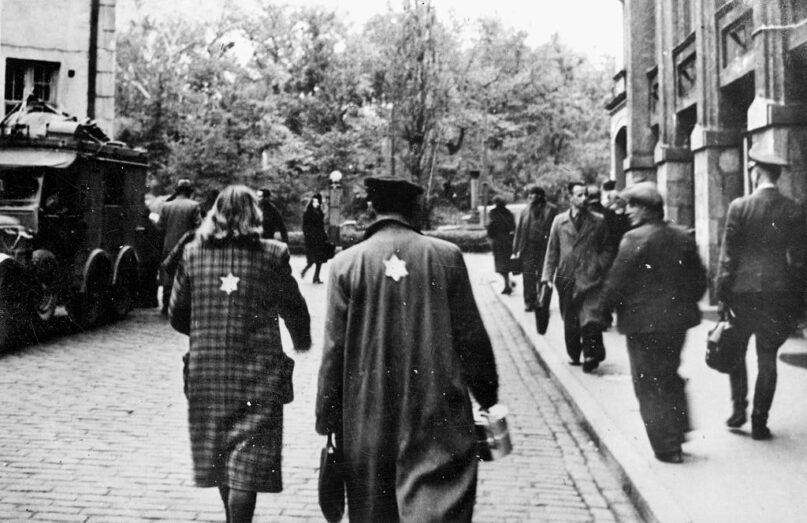
Nazi orders for Jews to wear a star were hateful, but far from unique – a historian traces the long history of antisemitic badges

Badges and other wearable markings had a long history of being used to target Jewish people in Europe.

The Nazis made the yellow badge infamous around the world, but its roots are much older. (Roger Viollet/Getty Images)

(The Conversation) — Growing up in Belgium, I’d hear the story of how my grandparents married during the Nazi occupation. It was not a time for celebrations, particularly for Jewish families like theirs. Naively, though, they thought marriage would protect them from being separated should they be deported. So in June 1942, they went to city hall with their loved ones – “decorated,” as my grandmother would say, with yellow stars.

Hearing that story as a child, I imagined them in dark clothes with shiny stars, each one a human Christmas tree – a celebratory image that only existed in my brain. Her most vivid memory of that day were the looks in people’s eyes: stares of curiosity, pity and contempt. The yellow star had transformed them, in onlookers’ eyes, from joyous newlyweds into miserable Jews.

Decades later, I completed a Ph.D. on the history of forcing Jewish people to wear a badge. My grandmother called to congratulate me – and, I soon understood, to unburden herself of a story she’d never told before.

When the Nazis issued the law forcing Jewish Belgians to wear a yellow star in May 1942, my grandmother’s future father-in-law declared that he would not wear it. The whole family tried to persuade him otherwise, fearing the consequences. But it was in vain, and in the end, my grandmother stitched the star on his coat.

I could hear her voice trembling on the phone as she told me she still could not forgive herself. Their wedding two weeks later would be the last time she saw him: He died in 1945 after being released from a transit camp and a detention home for elderly Jews, spending two years in terrible conditions.

Although the yellow badge has come to symbolize Nazi cruelty, it was not an original idea. For many centuries, communities throughout Europe had forced Jewish residents to mark themselves.

Yellow wheels and pointed hats

In Europe, forced markings for Jews and Muslims were introduced by Pope Innocent III at the Fourth Lateran Council in 1215. The pope explained that it was a means to prevent Christians from having sex with Jews and Muslims, thereby protecting society from “such prohibited intercourse.”

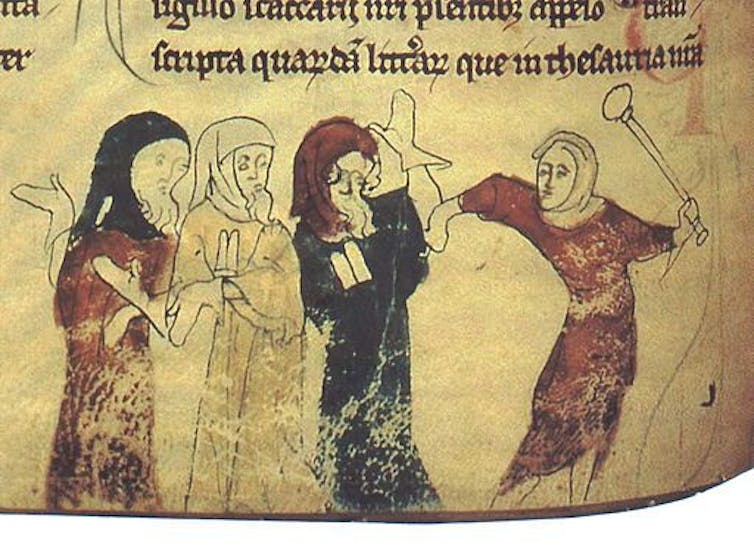
However, the pope did not specify how Jews’ or Muslims’ dress had to be different, resulting in various distinguishing signs. Ways to make Jews visible in the cities and towns of medieval Europe abounded: from yellow wheels in France, blue stripes in Sicily, yellow pointed hats in Germany and red capes in Hungary to white badges shaped like the Ten Commandments tablets in England. Since there were no large Muslim communities in Europe at the time, except for Spain, the regulation only applied to Jews in practice.

A yellowed manuscript shows one figure with a stick threatening three others; all wear robes and head coverings.

A manuscript illustration of England’s expulsion of Jews in 1290 shows figures wearing badges shaped like the Ten Commandments tablets.
British Library/Wikimedia Commons

In northern Italy, Jews had to wear a yellow, round badge in the 15th century and a yellow hat in the 16th century. The reason typically given was that they were unrecognizable from the rest of the population. For Christian authorities, unmarked Jews were like gambling, drinking and prostitution: All represented the moral failings of Renaissance society and needed to be fixed.

Pretext for persecution

However, as I explain in my book, Jews were often arrested for not wearing the yellow badge or hat, sometimes while traveling away from home in places where no one knew them.

Clearly, then, Jews were recognizable from Christians in other ways. The true aim of forcing Jews to wear emblems was not merely to “identify” them, as authorities claimed, but to target them.

My research showed that laws imposing a badge or hat functioned as means to threaten and extort Jewish communities. Jews were willing to pay considerable sums to retract such laws or soften their provisions. For example, Jews requested exemptions for women, children or travelers. When communal negotiations failed, wealthy individual Jews tried to negotiate for themselves and their families.

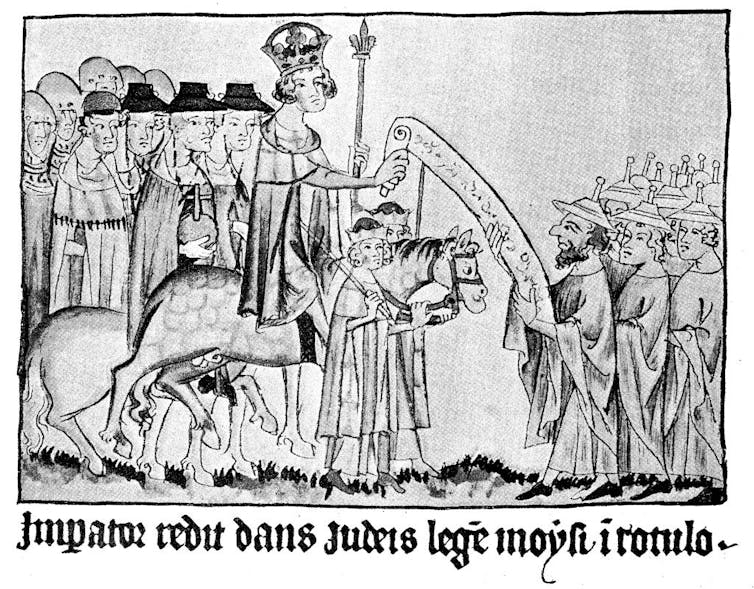
A black and white illustration of a group of people with pointed hats receiving a document from a king on horseback.

Jews in pointed hats receive confirmation of their privileges from Holy Roman Emperor Henry VII, in the Codex Trevirensis from around 1340.
Bildagentur-online/Universal Images Group via Getty Images

Badge laws were frequently reissued, which has led scholars to conclude that their enforcement was inconsistent; after all, a legal directive that is steadily applied does not need to be reimposed. But with the risk of arrest and extortion hanging over the heads of Jewish communities, and their willingness to pay or negotiate to avoid these consequences, badge laws had adverse effects on Jewish life even when not enforced.

In the Duchy of Piedmont in modern-day Italy, for example, Jewish communities banded together to pay additional taxes, sometimes several times in the same year, to receive exemptions from wearing the Jewish badge. Although the Jews’ cohesion was remarkable, it had a high cost, as these communities ended up ruined and leaving the duchy.

When Italian Jews asked authorities to cancel or at least amend badge laws, they were not primarily worried about being recognized as Jews. The problem was being mocked or attacked. Violence had accompanied badge laws since their inception: Just a few years later, Pope Innocent III wrote to French bishops that they needed to take every possible measure to ensure that the badge did not expose the Jews to the “danger of loss of life.”

Yet harassment continued. Sometime in the 1560s, for example, the governor of Milan received a a letter from Lazarino Pugieto and Moyses Fereves, bankers from Genoa, explaining that bandits had robbed them after recognizing them as Jews. In 1572, Raffaele Carmini and Lazaro Levi, representatives of the communities of Pavia and Cremona, wrote that when Jews wore the yellow hat, youngsters attacked and insulted them. And in 1595, David Sacerdote, a successful musician from Monferrato, complained that he could not play with other musicians when wearing a yellow hat.

‘In the past, no one noticed me’

Centuries later, the yellow star had the same effect.

Max Jacob, a French-Jewish artist and poet, wrote of experiencing a vision of Christ, and he converted to Christianity in 1909. During the Nazi occupation of France, he was nonetheless classified as a Jew and forced to wear the yellow star.

A black and white photograph of a bald man in a suit holding a painting.

Max Jacob, French poet and painter.
Sasha/Hulton Archive/Getty Images

In the prose poem “Love of the Neighbor,” he wrote about the deep shame he experienced.

“Who saw the toad cross the street?” he asked. No one had noticed it, despite his clownish, grimy appearance and weak leg. “In the past, no one noticed me in the street either,” Jacob added, “but now kids mock my yellow star. Happy toad! you do not have a yellow star.”

The Nazi context differed significantly from Renaissance Italy’s: There were no negotiations or exceptions, not even for large payments. But the mockery by children, the loss of status, and the shame remained.

(Flora Cassen, Chair and Associate Professor of Jewish, Islamic, and Middle Eastern Studies, Washington University in St Louis. The views expressed in this commentary do not necessarily reflect those of Religion News Service.)

Five charts that explain the desperate turn to MAGA among conservative white Christians

White Christians’ attempt to halt their demographic slide has fostered two narratives of American life.

Photo by Natilyn Hicks/Unsplash/Creative Commons

(RNS) — I prefaced my 2016 book, “The End of White Christian America,” with an “Obituary for White Christian America.” It read, in part:

After a long life spanning nearly two hundred and forty years, White Christian America — a prominent cultural force in the nation’s history — has died. WCA first began to exhibit troubling symptoms in the 1960s when white mainline Protestant denominations began to shrink, but showed signs of rallying with the rise of the Christian Right in the 1980s. Following the 2004 presidential election, however, it became clear that WCA’s powers were failing.

Although examiners have not been able to pinpoint the exact time of death, the best evidence suggests that WCA finally succumbed in the latter part of the first decade of the twenty-first century. The cause of death was determined to be a combination of environmental and internal factors — complications stemming from major demographic changes in the country, along with religious disaffiliation as many of its younger members began to doubt WCA’s continued relevance in a shifting cultural environment.

The End of White Christian America” was published in July 2016, just as Donald Trump was securing the Republican nomination for president and the Make America Great Again worldview was supplanting policy considerations within the GOP (indeed, by the end of Trump’s presidency, the party officially abandoned any attempt to adopt an official policy platform). The data I had available at the time identified a watershed event that was driving this desperate movement: The U.S. had become — for the first time in our history — a country that was, demographically speaking, no longer a majority white Christian country.


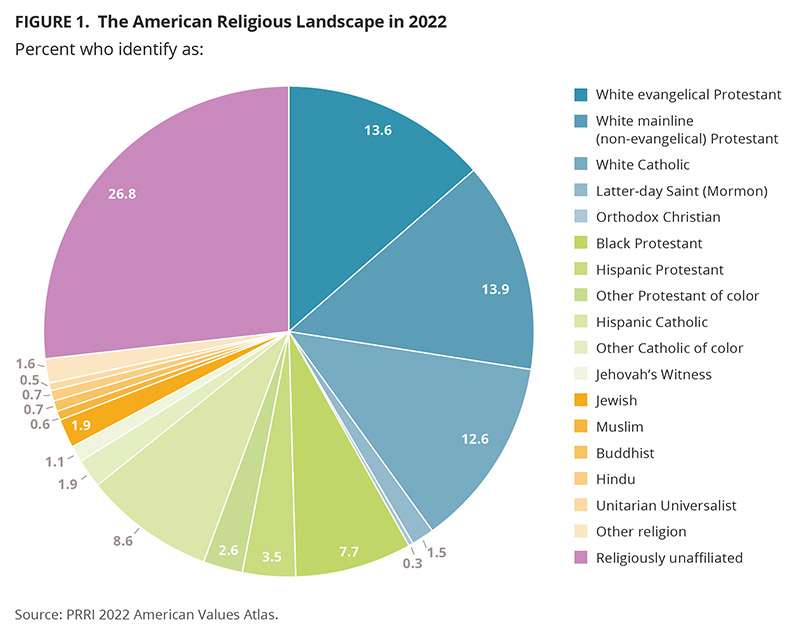
The newly released 2022 supplement to the PRRI Census of American Religion — based on over 40,000 interviews conducted last year — confirms that the decline of white Christians (Americans who identify as white, non-Hispanic and Christian of any kind) as a proportion of the population continues unabated.

As recently as 2008, when our first Black president was elected, the U.S. was a majority (54%) white Christian country. As I documented in “The End of White Christian America,” by 2014, that proportion had dropped to 47%. Today, the 2022 Census of American Religion shows that figure has dropped further to 42%.

"The American Religious Landscape in 2022" Graphic courtesy of PRRI

“The American Religious Landscape in 2022” Graphic courtesy of PRRI

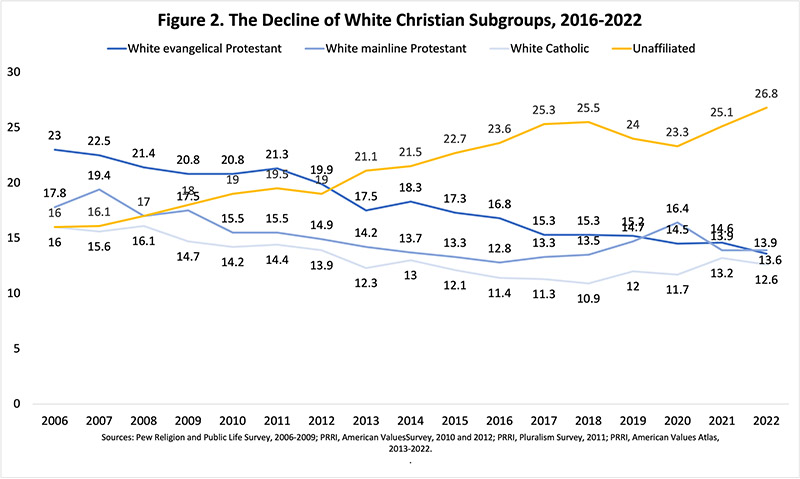
As Figure 2 below demonstrates, all white Christian subgroups — white evangelical Protestant, white non-evangelical/mainline Protestant and white Catholic — have declined across the last two decades. Notably, in the last 10 years, white evangelical Protestants have experienced the steepest decline. As recently as 2006, white evangelical Protestants comprised nearly one-quarter of Americans (23%). By the time of Trump’s rise to power, their numbers had dipped to 16.8%. Today, white evangelical Protestants comprise only 13.6% of Americans.

As a result of this precipitous decline, white evangelical Protestants are now roughly the same size as white non-evangelical/mainline Protestants, a group that experienced its own decline decades early but has now generally stabilized.

"The Decline of White Christian Subgroups, 2016-2022" Graphic courtesy of PRRI

“The Decline of White Christian Subgroups, 2016-2022” Graphic courtesy of PRRI

As the fine print on retirement investment statements reminds us, past trends are no guarantee of future performance. But there is no evidence suggesting any imminent reversal of these trends. The median age of all white Christian subgroups — 54 for both white evangelical and non-evangelical/mainline Protestants, 58 for white Catholics — is considerably higher than the median age of all Americans (48), an indication of the exodus of younger adults from these congregations. By contrast, the median ages of Christians of color, non-Christian religious groups and the religiously unaffiliated are all more consistent with or even below the median age of the country.

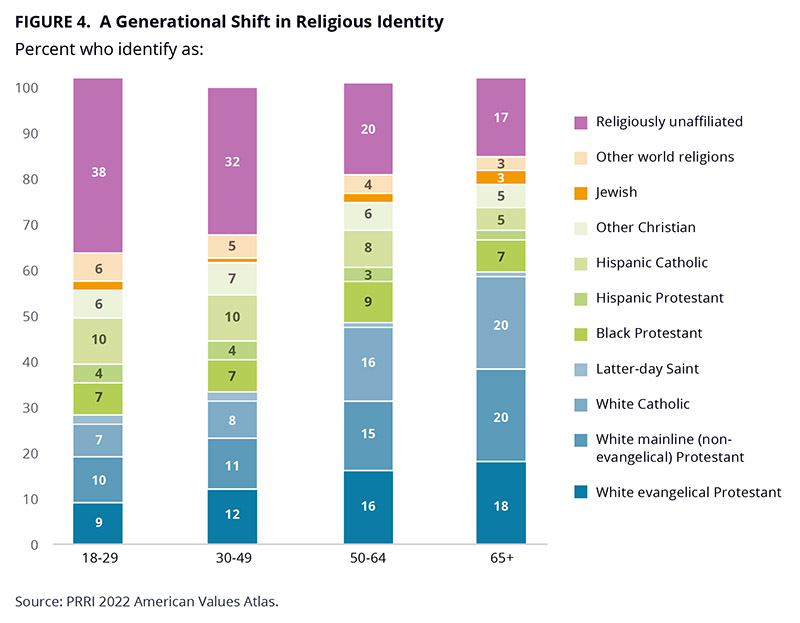
An examination of religious affiliation by age cohorts demonstrates a marked, linear decline of the share of white Christians in each successive younger group. Comparing the oldest (ages 65+) to the youngest (ages 18-29) group of American adults reveals that white Christian subgroups have each lost approximately half their market share just across the generations who are alive today. For example, 18% of seniors, compared with only 9% of young adults, identify as white evangelical Protestant.

"A Generational Shift in Religious Identity" Graphic courtesy of PRRI

“A Generational Shift in Religious Identity” Graphic courtesy of PRRI

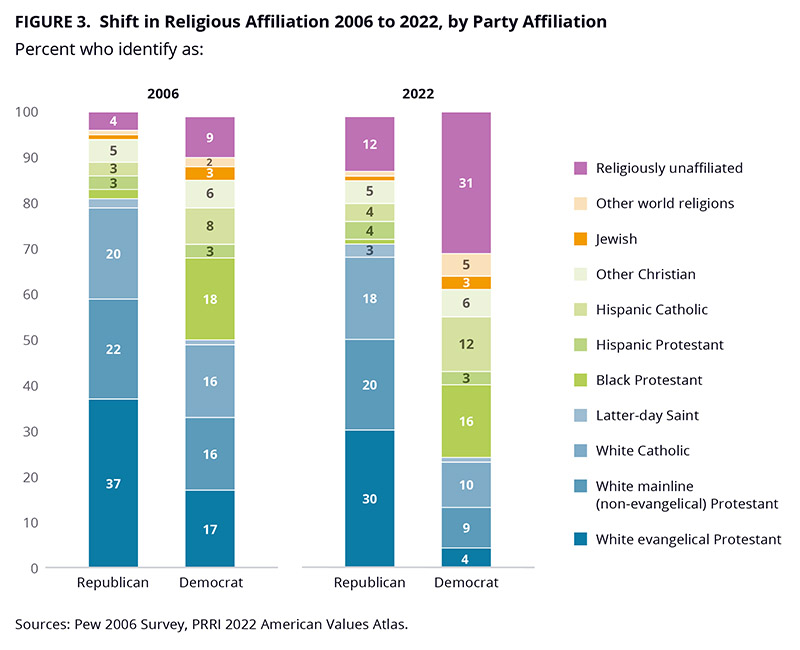
As the numbers of white Christians have dropped, their presence in our two political parties has also shifted. Two decades ago, white Christians comprised approximately 8 in 10 Republicans, compared with about half of Democrats, a gap of about 30 percentage points. As their numbers have declined, this gap has increased to about 45 percentage points, with white Christians continuing to account for about 7 in 10 Republicans but only about one-quarter of Democrats.

"Shift in Religious Affiliation 2006 to 2022, by Party Affiliation" Graphic courtesy of PRRI

“Shift in Religious Affiliation 2006 to 2022, by Party Affiliation” Graphic courtesy of PRRI

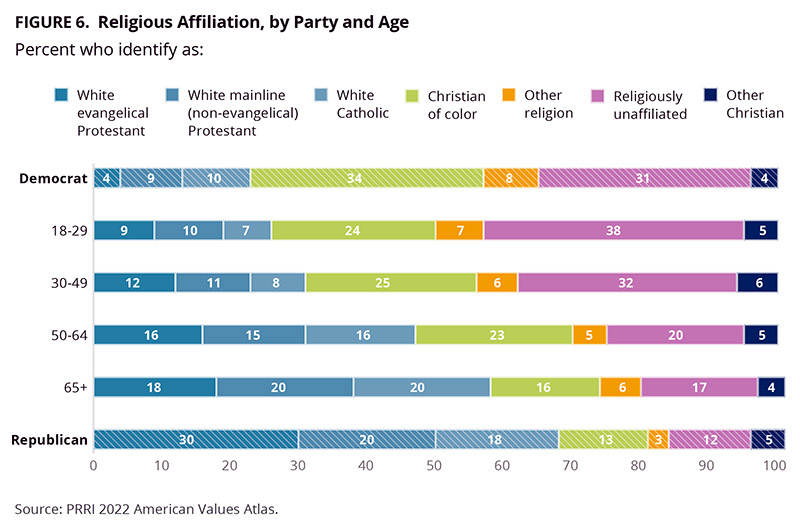
If we overlay the current ethno-religious composition of our two political parties onto the generational cohort chart, we see a stunning result. In terms of its racial and religious composition, the Democratic Party looks like 20-year-old America, while the Republican Party looks like 80-year-old America.

"Religious Affiliation, by Party and Age" Graphic courtesy of PRRI

“Religious Affiliation, by Party and Age” Graphic courtesy of PRRI

In “The End of White Christian America,” I summarized the political polarization this cultural and demographic shock wave had generated: “The two divergent and competing narratives — one looking wistfully back to midcentury heartland America and one looking hopefully forward to a multicultural America — cut to the heart of the massive cultural divide facing the country today.” Trump’s ascendancy, leading ultimately to a violent insurrection at the U.S. Capitol, only heightened this fundamental divide over two incompatible visions of America.

While I held out some possibility in “The End of White Christian America” that white evangelicals and other conservative white Christians might accept their new place alongside others in an increasingly pluralistic America, their steadfast allegiance to Trump’s MAGA vision — actually increasing their support for him between 2016 and 2020 — and their unwillingness to denounce either Trump’s Big Lie that the election was stolen or the violence on Jan. 6 have dashed those thin hopes.


Back in 2016, here’s how I described the likely consequences if white conservative Christians dug in:

[White Christian Americans’] greatest temptation will be to wield what remaining political power they have as a desperate corrective for their waning cultural influence. If this happens, we may be in for another decade of closing skirmishes in the culture wars, but white evangelical Protestants will mortgage their future in a fight to resurrect the past.

But as alluring as turning back the clock may seem to White Christian America’s loyalists, efforts to resurrect the dead are futile at best — and at worst, disrespectful to its memory. Like Mary Shelley’s Frankenstein, resurrection by human power rather than divine spirit always produces a monstrosity.

Robert P. Jones. Photo courtesy of PRRI

Robert P. Jones. Photo courtesy of PRRI

The continued demographic decline makes it clear that the MAGA goal of reestablishing their vision of a white Christian America can’t be realized by democratic means. But as I explained in my most recent posts, I’m deeply concerned that the embrace of Christian nationalism by nearly two-thirds of white evangelicals and a majority of the Republican Party will spawn more theological monstrosities justifying anti-democratic schemes to achieve this end.

(Robert P. Jones is CEO and founder of the Public Religion Research Institute and the author of “White Too Long: The Legacy of White Supremacy in American Christianity.” This article was originally published on Jones’ Substack #WhiteTooLong. Read more at robertpjones.substack.com. The views expressed in this commentary do not necessarily reflect those of Religion News Service.) 


Since the 1880s, Southern Baptists have argued over the role of women

At the SBC’s meeting this summer, delegates may debate a constitutional amendment to limit women leaders. It wouldn’t be the first time.

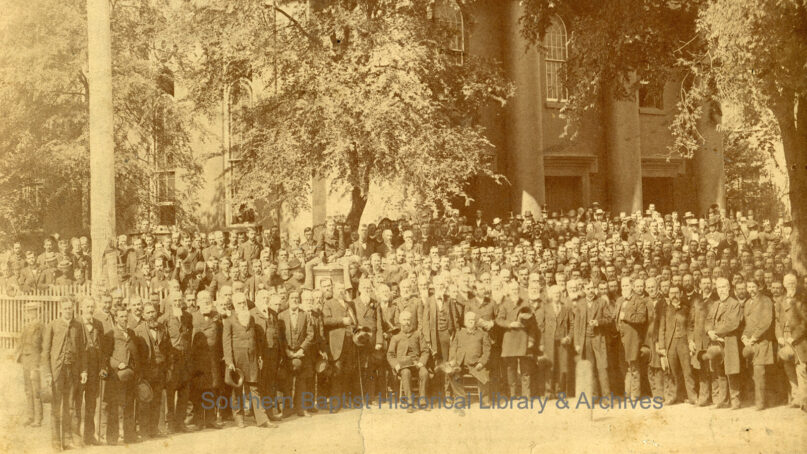
A photo from the 1885 Southern Baptist Convention annual meeting. Photo via the Southern Baptist Historical Library and Archives

(RNS) — In May of 1877, Myra Graves made history.

Widow of the first president of Baylor University, Graves was the first woman seated as a delegate to the Southern Baptist Convention’s annual meeting. She returned again in 1882, according to the Journal of Southern Religion.

No one seemed to notice.

The same could not be said a few years later, when two women from Arkansas showed up as delegates. A pastor from Virginia stood up, saying women had no right to be at the meeting. That led to a hasty gathering of a five-member committee to decide the issue. The committee did not want the women there but ruled that nothing in the denomination’s constitution barred their presence.

The committee’s ruling did not sit well with delegates like a certain Dr. Hawthorne of Georgia.

“I love the ladies, but I dread them worse,” he told delegates, according to the May 16, 1885, edition of the Tennessee Baptist newspaper. “If my wife was here knocking at the door of this Convention I’d never vote against her coming in.”

Delegates to that meeting eventually voted to bar the Arkansas women. Then they changed the SBC’s constitution to make it plain only “brethren” were allowed — a rule that stayed in place for decades.

Nearly 140 years later, the role of women in the SBC is back up for debate. This time, the question is whether churches with women pastors should be expelled from the nation’s largest Protestant denomination.

Since 2000, official Southern Baptist doctrine limits the role of pastor to men. But that doctrine had never been enforced at the national level until recently. This past February, the SBC’s Executive Committee expelled five churches — including Saddleback in California, one of the largest churches in the SBC — for having women pastors.

Several of those churches are expected to appeal at the SBC’s annual meeting in June.


The Rev. Linda Barnes Popham, longtime pastor of Fern Creek Baptist Church in Louisville, Kentucky, one of the churches kicked out alongside Saddleback, told The Tennessean newspaper she was surprised that her role at the church became controversial recently. She said a number of SBC leaders have preached at the church during her three decades as pastor, including the chair of the committee that recommended disfellowshipping Fern Creek.

“If our convention continues to make ‘minor things’ the ‘main thing,’ there will soon not be many churches left in the convention,’” she told that committee in a letter last October, according to The Tennessean.

Saddleback pastor Andy Wood also released a video this week outlining the church’s view on women leaders. 

Author and speaker Beth Moore speaks during a panel on sexual abuse in the Southern Baptist Convention at the Birmingham-Jefferson Convention Complex in Birmingham, Alabama, on June 10, 2019. RNS photo by Adelle M. Banks

Author and speaker Beth Moore speaks during a panel at the Southern Baptist Convention annual meeting in Birmingham, Alabama, on June 10, 2019. RNS photo by Adelle M. Banks

The current SBC debate over women pastors has been fueled, at least in part, by a 2019 tweet from bestselling author and Bible teacher Beth Moore about speaking at a church on Mother’s Day. Her social media post sparked a wave of controversy that eventually contributed to her leaving the denomination.

At the time, the SBC also was dealing with a major crisis over sexual abuse and some felt the alarm bell over women preachers was being used to distract from that crisis. The news of Saddleback’s expulsion has likewise overshadowed decisions around paying for abuse reforms. 

Delegates to the June meeting, known as messengers, may also debate a potential constitutional amendment to officially bar churches that “affirm, appoint, or employ a woman as a pastor of any kind.”

Virginia Baptist pastor Mike Law proposed the constitutional amendment last year, but the SBC Executive Committee has yet to decide whether to let it move forward. Any changes to the SBC’s constitution would have to be passed two years in a row.

Law, pastor of Arlington Baptist Church, said several SBC churches close to his congregation have women pastors. That prompted him to write to the Executive Committee last May, seeking clarification about the SBC’s rules.

His email also had a personal side. Arlington Baptist Church, where Law began serving in 2014, had at least two women pastors in its past. Having women as pastors, he believed, put the church at odds with the SBC’s doctrine.

“Thankfully, the saints at Arlington Baptist have returned to faithfulness on this issue, and unity with Southern Baptists,” Law wrote in his proposed amendment. Law, who was not available for an interview because he was assisting a church member, has also set up a website for the proposed amendment, including a video explaining his rationale.

“Why is it wrong for women to serve as pastors?” Law said in the video, which was sent to members of the Executive Committee. “Because it is contrary to God’s design for his church. It is that simple. Don’t overthink this issue.”

Law also put together a list of 170 women pastors serving at SBC churches. That list includes 51 women who are senior pastors, 20 associate pastors, 47 children’s pastors, 12 elders, 11 worship pastors and 35 “other” pastors.

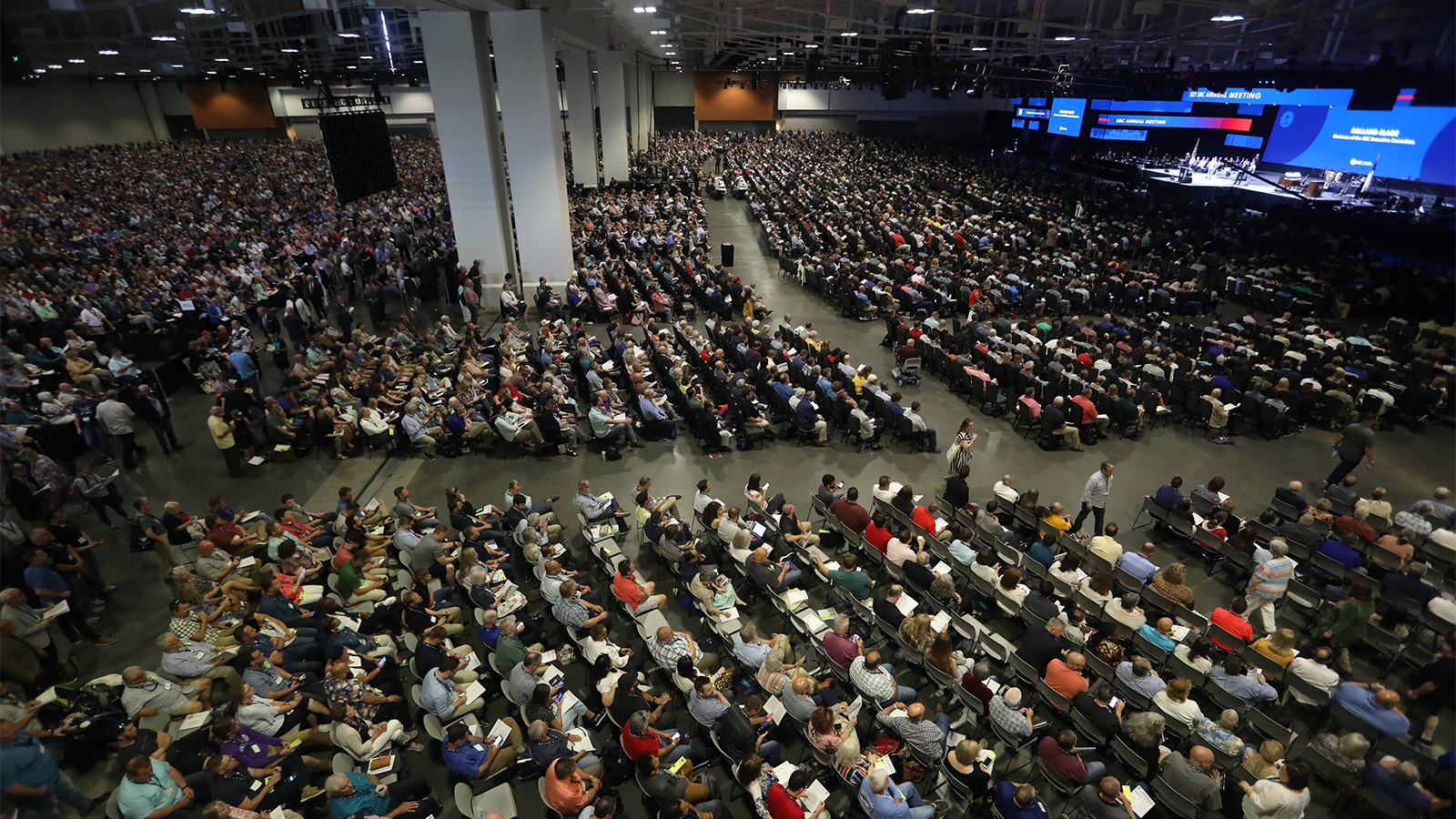
More than 14,000 messengers registered and gathered for the Southern Baptist Convention annual meeting, which opened June 15, 2021, at the Music City Center in Nashville, Tennessee. RNS photo by Kit Doyle

More than 14,000 messengers registered and gathered for the Southern Baptist Convention annual meeting, which opened June 15, 2021, at the Music City Center in Nashville, Tennessee. RNS photo by Kit Doyle

David Booker, lead pastor of Acts Church in Waco, Texas, was not aware until recently that his church was on Law’s list. But he was not surprised.

He and his wife, Kim, the church’s co-lead pastor, founded the church in 2007. The church, which is affiliated with the Baptist General Convention of Texas and the SBC, also has a worship pastor, a children’s pastor and an executive pastor who are all women.

Booker said that men who hold those roles are often called pastors — and so the church just uses the same titles for the women in those roles. The church also has several women elders, a position that some churches limit to men.

“I don’t know if God is that concerned about titles,” he said.

One of the current debates in the SBC is whether the denomination’s doctrinal requirement of male pastors applies only to senior pastors or to any pastoral role. 

David and Kim Booker. Photo courtesy of Acts Church

David and Kim Booker. Photo courtesy of Acts Church

When the church was first founded, Booker said, he and his his wife — who runs a discipleship school for the church but does not preach on Sundays — and other leaders studied biblical passages about the roles of men and women. As Baptists, they wanted to do everything according to the Bible.

“We came to the conclusion that the Bible does not prohibit women in church leadership,” he said. “I can totally get how people feel different.”

According to the current SBC constitution and bylaws, a church must have a “faith and practice which closely identifies with the Convention’s adopted statement of faith.”

Booker said Acts church fits that description. The church is committed to the Bible and to what’s known as the Great Commission, Jesus’ command to make disciples around the world.

David Schrock, pastor of preaching at Occoquan Bible Church in Virginia, which joined the SBC, said that having a shared set of beliefs makes it possible for churches in the convention to work together on missions and starting new churches. Without those shared beliefs, he said, that cooperation falls apart.

Schrock, who said Law is a friend, supports the amendment.

“If we cannot agree on who a pastor can be, when Scripture clearly speaks to the matter, we cannot cooperate in planting churches,” said Schrock. 

Several pastors on Law’s list declined to comment or said their church was no longer affiliated with the SBC. One did say her church stopped giving to the SBC a number of years ago — though some congregation members still give directly to SBC missions.

Law is not the first to propose an amendment to bar churches with women pastors. In 1993, a messenger named Michael Barley from Kentucky proposed an amendment to bar “churches which have ordained women.” The Executive Committee rejected that amendment the following year.

Things have changed since then, said Law. In 2000, the denomination’s official doctrinal statement, known as the Baptist Faith & Message, was revised to state that “the office of pastor is limited to men as qualified by Scripture.”

“With the confessional basis for this amendment now in place, it is time the SBC took this step,” he said.


Majority of coral reefs examined suffer from low oxygen levels, study says

Coral reefs at a study site off Taiping Island, South China Sea. 
Photo by Yi Bei Liang

March 16 (UPI) -- A vast majority of 32 coral reefs examined around the world are suffering from low oxygen levels because of global warming, and the threat to marine ecosystems is expected to get worse in time, according to a study published Thursday.

The new research is documented in the journal Nature Climate Change, and its authors said this is the first time the current state of of low oxygen, or hypoxia, was explored around the world.

The authors, led by researchers from the University of California-San Diego's Scripps Institute of Oceanography, found hypoxia already pervasive on many coral reefs, demonstrating the overall decline in oxygen content across the world's oceans and coastal waterways.

A large team of national and international researchers joined the Scripps scientists in documenting the problem.

"This study is unique because our lab worked with a number of collaborators to compile this global oxygen dataset especially focused on coral reefs -- no one has really done that on a global scale before with this number of datasets," marine scientist Ariel Pezner, a post-doctoral fellow at the Smithsonian Marine Station in Florida, said in a news release.

"We were surprised to find that a lot of coral reefs are already experiencing what we would define as hypoxia today under current conditions."

Researchers used models of four different climate change scenarios to show that projected ocean warming and deoxygenation will substantially increase the duration, intensity and severity of hypoxia on coral reefs by 2100.

Pezner and other participants used autonomous sensor data to explore oxygen variability and hypoxia exposure at the 32 diverse reef sites across 12 locations off the coasts of Japan, Hawaii, Panama, Palmyra and Taiwan, among others.

Hypoxia in the past has been defined by a very specific concentration cutoff of oxygen in the water, often less than 2 milligrams of oxygen per liter. That threshold was determined in the 1950s.

The researchers explored the possibility of four different hypoxia thresholds because of the different environments, including weak, mild, moderate and severe hypoxia.

Based on the new categories, they found that more than 84% of the reefs in this study experienced "weak to moderate" hypoxia and 13% experienced "severe" hypoxia at some point during the research.

The authors found that oxygen was lowest in the early morning at all locations and highest in the mid-afternoon as a result of nighttime respiration and daytime photosynthesis, respectively.

"Imagine that you're a person who is used to sea-level conditions, and then every night you have to go to sleep somewhere in the Rocky Mountains, where the air has less oxygen," biogeochemist and lead author Andreas Andersson said.

"This is similar to what these corals are experiencing at nighttime and in the early morning when they experience hypoxia. In the future, if the duration and intensity of these hypoxic events get worse, then it might be like sleeping on Mount Everest every night."

Pezner worked with Andersson at the Scripps Coastal and Open Ocean Biogeochemistry Research Lab, known as SCOOBY.

Eesearchers discovered that world temperatures continue to rise as marine heat waves became more frequent and severe. They said low oxygen conditions on coral reefs are likely to become more common.

"Baseline oxygen conditions varied widely among our reef habitats, suggesting that a singular definition of 'hypoxia' may not be reasonable for all environments," Pezner said.

"Determining which thresholds are relevant will be important moving forward in making predictions about how reefs might change under warming and oxygen loss."

This study involved a total of 22 authors, representing 14 different research organizations and universities: UC San Diego; University of Puerto Rico at Mayagüez; NOAA Pacific Islands Fisheries Science Center; National Taiwan Ocean University; Georgia Southern University and the University of Montana;.

Also, Smithsonian Tropical Research Institute; National Sun Yat-sen University; Okinawa Institute of Science and Technology; Sea Education Association; Monterey Bay Aquarium Research Institute; National Taiwan University; and the U.S. Geological Survey.

The study is just the latest documenting the challenges facing coral reefs globally. Last October, a study published in the journal PLOS Biology said that half of the world's coral reefs could be facing "unsuitable conditions" by the year 2035 if climate change continues at its current pace.

Researchers at the University of Hawai'i at Mānoa warned those conditions could occur under a worst-case scenario of climate change.
Kellogg Company to split snack and cereal products into separate companies under new names


The Kellogg Company is rebranding its snack and cereal products under separate names. Snacks will now go under the brand name "Kellanova," while cereals will carry the brand name "WK Kellogg Co." File Photo by Keith Homan/Shutterstock

March 15 (UPI) -- The Kellogg Company is rebranding its snack and cereal products under different names, the company announced Wednesday.

The company will split into two separate public companies, "Kellanova" and "WK Kellogg Co."

From now on, the company's snacks will be listed under the brand Kellanova and the company's cereals will be under the brand WK Kellogg Co.

Products under the Kellanova brand name will include Pop-Tarts, Cheeze-It, Pringles, MorningStar Farms, Gardenburger, Eggo, and Nutri-Grain.

Corn Flakes, Fruit Loops, Frosted Flakes, Special K, Mini-Wheats, Koshi, Rice Krispies and Raisin Bran will now be under the WK Kellogg Co. brand.

Products under both brand names will still carry the Kellogg's logo.

The company consulted employees for name suggestions, eventually settling on Kellanova, using the prefix "Kella" to tie the products to Kellogg's and "nova" which means "new" in Latin, according to future Kellanova CEO Steve Cahillane.

The name "WK Kellogg Co." is a simple variation on the name of founder W.K. Kellogg.

The company says 4,000 people submitted suggestions and that a large percentage of respondents wanted to base the new cereal company's name on a variation of founder W.K. Kellogg's name.

When the split was announced in June, the company planned to create three separate companies, one for snacks, one for cereals and one for plant-based products. The company eventually decided to instead incorporate plant-based products under Kellanova.