The Amazing Story About AIDS in Africa that Elon Musk’s Chainsaw Killed
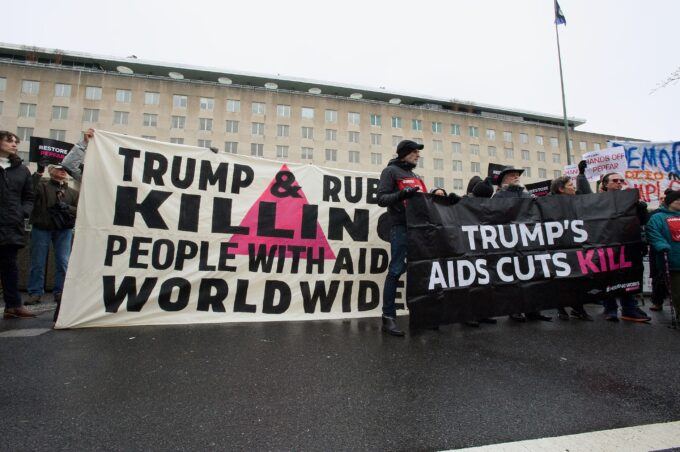
Photograph Source: SWinxy – CC BY 4.0
Almost no one knows the story of how PEPFAR, the President’s Emergency Program for AIDS Relief, came into existence, and what it managed to accomplish before Elon Musk chainsawed it as waste. It is a story that needs to be told, since it shows what a small number of determined activists can accomplish, even without big bucks behind them. (This story is also told in the episode of my podcast, Mostly Economics, with Jamie Love.)
To give some background, in the early and mid-1990s, the AIDS pandemic was spreading rapidly through Sub-Saharan Africa, infecting millions of people. At the time, it was pretty much a death sentence. The drug AZT could alleviate the symptoms for a period of time, but generally lost effectiveness. This meant it could delay the advancement of the disease, but people who contracted AIDS still eventually died from it. And the drug was expensive.
In the mid-1990s, researchers developed a new treatment method involving three drugs, which could keep the virus in check indefinitely. Not only did this therapy keep people from dying, for the most part it let them live relatively normal lives. While this was a fantastic innovation, the therapy was incredibly expensive. It cost $10,000 to $15,000 for a year’s treatment, or $20,000 to $30,000 in today’s dollars.
This was expensive even for people in the United States, but wealthier people could afford it, and most middle-income people could get their insurance to cover it. However, these prices were pretty much out of reach for almost everyone in Sub-Saharan Africa, where the per capita income for most countries was well under $1,000 a year.
This meant that people who contracted AIDS could look forward to gradually deteriorating health and then death. In addition to the immense human tragedy, this was also devastating to these countries’ economies. The people contracting AIDS were younger people and often educated ones. They were teachers, healthcare workers, and others with skills badly needed for economic development. For this reason, making AIDS drugs accessible to Sub-Saharan Africa was a really huge deal.
The key to getting from crazily expensive AIDS medications in the US to affordable drugs for Sub-Saharan Africa was the fact that it did not actually cost $10,000 to $15,000 to manufacture and distribute AIDS drugs. This is what the drug companies were able to charge because they enjoyed patent monopolies and related protections. The actual cost was far less.
These prices could perhaps be justified in the United States, because the drug companies had incurred substantial costs in researching and developing the drugs. But that was in the past; the relevant question was what it cost to manufacture and distribute the drug now. This was especially true given that they were recouping this expense based on their sales in Europe and the United States. The poor countries of Sub-Saharan Africa never fit into their calculations.
This is where Jamie Love comes in. Jamie was working with the Consumer Project on Technology, which is now called Knowledge Ecology International. It had been started as a Ralph Nader organization and Jamie took it over as his own outfit. Jamie was working with Doctors Without Borders, who had substantial operations in Sub-Saharan Africa.
Their original plan was to approach the major pharmaceutical companies to see if they could arrange discount prices for Sub-Saharan Africa. The companies were not anxious to concede much, offering some discounts, say $7,500, but insisting they needed high prices to cover their costs. Needless to say, it would not be feasible for an aid program to treat millions of people at a cost of $7,500 a person.
Jamie went to drug manufacturers around the world to see what it would cost them to produce the mix of drugs in the new AIDS therapy. He found several that were confident that it could be produced at a cost of well under a thousand dollars per year.
Jamie finally struck gold when he managed to arrange a meeting with Yusaf Hamied, the CEO of CIPLA, a huge Indian generic drug manufacturer. Hamied explained several pricing issues. He said that often they had to make payoffs to the regulators in a country, which raised the cost. They also typically made side payments to the doctors who would prescribe the drug.
Jamie asked Hamied about the off the dock price; what it would cost if they just dumped the drugs on a truck with Doctors Without Borders, which would then make the arrangements to transport and deliver the drugs. Hamied said he could do it for between $200-$300 for a year’s treatment. This was a price that an aid program could realistically deal with.
At this price it was also possible for some middle-income people in Africa, or their employer, to pay for the drugs. A company that had trained workers for tasks in construction or other sectors might find it made economic sense to pay for treatment rather than have them get sick and die and have to find and train a replacement.
The next part of this story is almost as amazing. It turned out that Ralph Nader had a friendship with Mitch Daniels, who was at the time the director of the Office of Management and Budget for George W. Bush. (They both had backgrounds from the Middle East.) Nader arranged for a meeting with Jamie where he had the chance to push his case.
Daniels was skeptical and had to be convinced that the benefits of a program for providing AIDS drug was worth the cost. The country had other aid programs, and to Daniels it wasn’t clear than providing the drugs was better than other uses of aid dollars. However, at a cost of $200-$300 per person, Daniels agreed that this would be a good use of taxpayer dollars. That was the beginning of PEPFAR.
In the 22 years of the program’s existence it has saved tens of millions of lives. It also has also allowed for these countries to have some chance at normal economic development.
That’s been the story since 2003, when a conservative Republican president decided that tens of millions of lives in Sub-Saharan Africa was worth a small commitment (less than 0.1 percent of the federal budget) from government. However, Elon Musk decided to make the program one of the first targets of DOGE, cutting off all funding at the very start of Trump’s second term.
It’s not clear if anyone will be able to pick up the pieces. There is no one rushing in to fill the funding gap, which is likely less than what Elon Musk will pocket from Trump’s tax cuts. The people who had worked in the program are no longer drawing paychecks and have mostly gone on to other jobs. And the drugs are not going to the people who need them.
On the plus side, tens of millions of lives have been saved, and the drugs can in principle be provided at an affordable price. (They cost less than $200 a year now.) We just need someone prepared to pick up the tab.
This first appeared on Dean Baker’s Beat the Press blog.


