It’s possible that I shall make an ass of myself. But in that case one can always get out of it with a little dialectic. I have, of course, so worded my proposition as to be right either way (K.Marx, Letter to F.Engels on the Indian Mutiny)
Sunday, August 16, 2026
Ranked: How Dirty Are the Eight Biggest Names in AI
xAI scores just 6 out of 100 on Climate Power's clean energy tracker, nearly 10 times dirtier than the next-worst AI firm, Oracle.
Amazon tops the “cleanest” ranking at 68 points, even as it builds a Texas gas plant projected to become the single biggest source of power-related emissions in the U.S.
Amazon, Microsoft and Google together emitted 19 million metric tons of CO2 equivalent last year, roughly as much as a third of France.
Big Tech companies are quietly moving farther and farther away from their decarbonization goals. Back in 2019, Amazon pledged to become carbon neutral by 2040, thereby setting a goalpost ten years ahead of the Paris climate agreement in a show of dedication to becoming a leader in decarbonization. The next year, in 2020, Google and Microsoft upped the ante when each pledged to become carbon-free by 2030. Now, just six years later, those companies are heading in the opposite direction, seeing their emissions balloon by double-digit increments thanks to hyperscaling of energy-hungry data centers to power their artificial intelligence ambitions.
To fuel their ballooning energy needs, Big Tech firms are investing in the rapid expansion and advancement of all kinds of energy production capacity and supportive infrastructure, some clean and some very, very dirty. Amazon is currently building a gas-fired power plant in Texas that is set to become the single-biggest source of power-related emissions in the entire United States.
“The new gas-burning plant, if built to specifications, would be permitted to release 33 million tons of carbon dioxide a year, regulatory records show, more planet-warming gases than any other power plant in the country,” the New York Times wrote earlier this week in a bombshell report. At the same time, the company is still pledging allegiance to the decarbonization imperative.
“The world looks different now than when we co-founded the climate pledge,” Margaret Callahan, an Amazon spokeswoman, told the Times. However, “our commitment hasn't changed,” she went on to say.
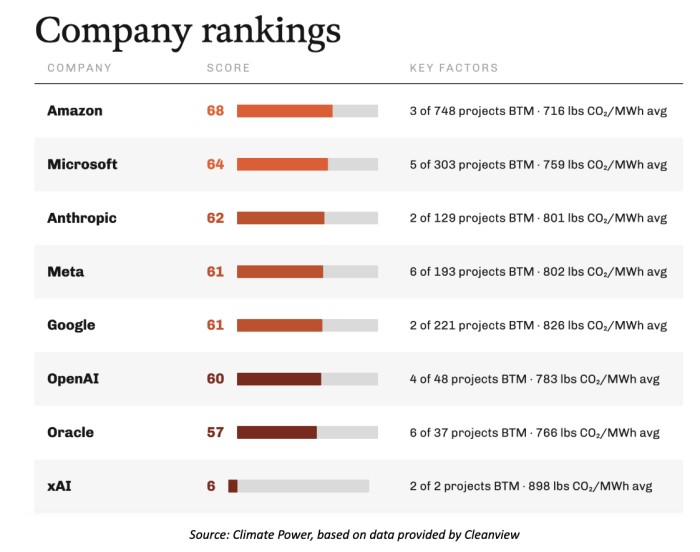
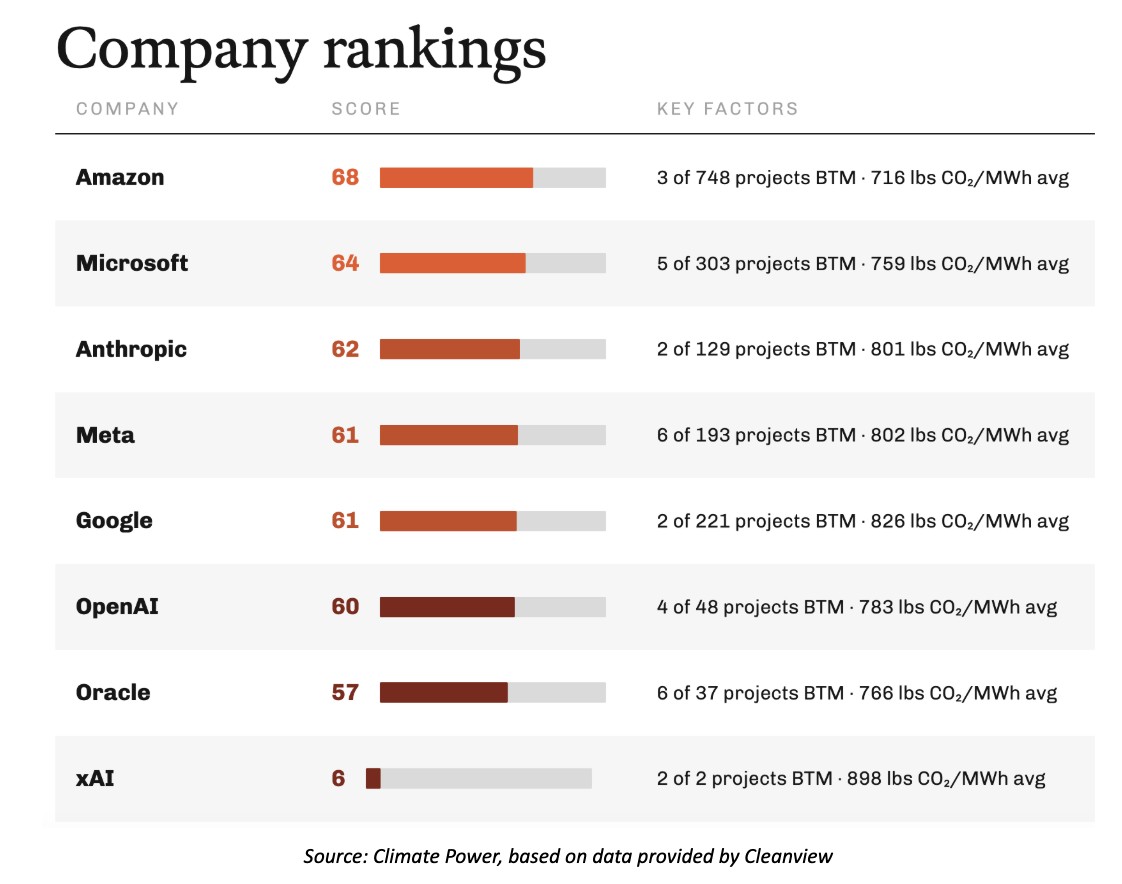
But while Amazon has dominated headlines this week as reporters name and shame the company's misaligned public front and private dealings, it is far from the biggest emitter in the AI arms race. In fact, among the eight Big Tech frontrunners tracked by Climate Power's Data Center Air Pollution Tracker, Amazon is the cleanest of all, scoring 68 out of a possible 100 points (with 100 representing all clean energy). The score is calculated based on two criteria: whether the firms' data centers burn gas behind the meter (BTM) on-site, and how clean the electrical grid is where the data centers are built.
So who are the biggest culprits of AI data center emissions? As of data from August 13, the dirtiest AI firm – by a shockingly wide margin – is Elon Musk's xAI, with a score of just 6 points on Climate Power's scale. This score is derived from the fact that all of the firm's projects are gas-powered BTM, with an average of 898 pounds of carbon dioxide emissions per megawatt-hour. These figures are nothing short of shocking. The next dirtiest player is Oracle with a score of 57, making xAI nearly ten times dirtier than the next dirtiest AI frontrunner. The rest of the tracked companies, from dirtiest to cleanest, are OpenAI (60 points), Meta and Google (both with 61), Anthropic (62), and Microsoft (64).
However, these figures are not representative of total emissions. Amazon, Microsoft, and Google's projects may be relatively clean on average, but there are many more of them, and they are much more massive in scale, than their competitors. Together, these three companies emitted as much carbon dioxide as a third of France over the last financial year, at 19 million metric tonnes of carbon dioxide equivalent. In short – these companies' efforts to clean up their acts, while better than some, are insufficient.
“Claims by Microsoft, Amazon and Google about their clouds being ecologically friendly and sustainable are a marketing strategy. Governments should remember these expanding carbon footprints when the very same companies offer addressing the ecological crisis with AI solutions,” Cecilia Rikap, an economics professor at University College London, told The Guardian last month.
Making matters worse, we might be majorly underestimating these firms' emissions thanks to extreme opacity in the sector as well as some cloak-and-dagger maneuvering. “As migration to their clouds expands, and companies store data and train and use AI models and all sorts of digital technologies, these other companies are outsourcing their own digital/AI carbon footprint to cloud giants,” Rikap went on to say. “Basically, shifting to the cloud helps other corporations obscure their environmental footprint.”
Google and Microsoft's carbon emissions each jumped 25% year-over-year, and Amazon's rose 16%, with AI-driven data center growth as the main driver.
Amazon is backing a natural-gas power plant in South Texas that would become the single biggest-emitting power plant in the country, releasing 33 million tons of CO2 a year.
A new study in Nature's NPJ Climate Action finds AI's use inside the fossil fuel sector could add up to 1.8 billion tons of CO2 annually, dwarfing the direct emissions from data centers themselves.
AI's energy footprint is out of control. Hyperscalers are building out data centers faster than the energy industry can keep up with, pushing for the rapid buildout of any form of energy we have at our disposal, clean or dirty. Silicon Valley's leadership in the decarbonization movement and bold net-zero pledges are a thing of the past. But a new study warns that the biggest issue with AI's carbon footprint may not even be its own energy consumption, but rather the industries it is used to support and expand.
Instead of reducing emissions, Big Tech is seeing its carbon footprint expand by double-digit rates driven almost entirely by the AI boom. According to official company figures, the total carbon emissions of Google and Microsoft each skyrocketed by 25% year-over-year from 2025 to 2026, while Amazon's increased by 16%. Altogether, in the last fiscal year, these three companies emitted as much carbon dioxide as a third of France, at 19 million metric tonnes of carbon dioxide equivalent.
And those numbers are set to keep climbing in the coming years. Amazon made headlines across the globe this week when it was revealed that the firm is investing in a large-scale natural-gas-burning power plant as part of a massive data center development in South Texas that is set to be the single biggest-emitting power plant in the country. If built to currently planned specifications, the facility would be permitted to release 33 million tons of carbon dioxide a year.
Michael Thomas, founder of Cleanview, a company that monitors the emissions of Big Tech companies' data center projects, told the New York Times that the planned Amazon power plant should not be viewed as a one-off, but rather that it “could be a foreshadowing of what's to come.”
The result of this trend is going to be a complete derailment of Big Tech's climate pledges and a devastating blow for global progress on decarbonization goals. And while some AI defenders point out that large language models will also be used to make a huge range of systems and sectors more energy efficient, a new paper published NPJ Climate Action, a publication from the highly respected scientific journal Nature, suggests that at the end of the day, AI integration is going to expand global emissions far more than it reduces them, and not by a small margin.
The paper crunches the numbers on AI integration into renewable energies as well as the fossil fuels sector, and the resulting numbers are sobering. The scientists found that, if fossil fuels make economic gains anywhere above zero thanks to AI integration, enabled emissions will exceed avoided emissions. In a scenario where both the fossil fuel and the renewables sector benefit equally from AI gains, global carbon-dioxide emissions will increase by between 0.47 billion tons and 1.8 billion tons a year.
“On the smaller side it's about the emissions of Mexico annually,” Holly Alpine, one of the co-authors of the research, was recently quoted by the Wall Street Journal.
To achieve net emissions reductions, the renewables sector would have to achieve gains 4- to 5-fold greater than the fossil fuels sector. And that's highly unlikely, if not impossible, in the current global political climate. “Absent policy steering, AI's modeled effects increase the carbon intensity of the global economy and reinforce fossil fuel incumbency—outcomes that current analytical and governance frameworks do not fully capture,” the paper states.
The authors conclude that AI is on track to extend the dominance of fossil fuels in the global economy, with devastating consequences for emissions targets. In fact, this impact would far overshadow any direct emissions coming from the data centers that power the AI tools themselves.
In the 1892 preface to The Condition of the Working Class in England, Friedrich Engels argued that, as industry developed, some exploitative practices ceased to benefit the largest manufacturers. Firms that observed decent standards could be undercut by competitors using longer hours, truck payments or harsher exploitation. Uniform regulation could therefore protect large or compliant firms against “low-road” competition. He wrote that the Ten Hours Act and related reforms ran “much against the spirit of Free Trade and unbridled competition, but quite as much in favour of the giant-capitalist” against smaller competitors. He added that the Factory Acts, originally “the bugbear of all manufacturers,” eventually came to be willingly accepted and their extension tolerated. Larger employers also found that continual conflict with a large workforce was costly, giving them an interest in more orderly industrial relations.
A clearer formulation about employers actively seeking regulation can be found in Marx’s Capital in chapters 10 and 15. Marx noted that some factory owners complying with the 1833 Act petitioned Parliament against the “immoral competition” of rivals who evaded it. Then in 1863, 26 Staffordshire pottery firms sought legislation because competition made voluntary restrictions on child labour impossible. Their memorial concluded that “some legislative enactment is wanted.” More generally, Marx noted that capitalists began calling for “equality in the conditions of competition” meaning that restraints on exploitation should bind all competitors alike.
From this we can derive a general principle that competition could compel even an employer who recognised the harms of excessive hours to continue them, because unilateral restraint meant being undercut. A general law could solve that collective-action problem by imposing the same minimum conditions on everyone.
That said, Engels did not regard enlightened factory owners as the principal originators of the Factory Acts. In his account, the early legislation was wrung from generally resistant manufacturers through workers’ agitation, trade-union pressure, humanitarian campaigning and political conflict. Robert Owen and Sir Robert Peel were exceptional manufacturer-reformers. Only later did substantial sections of capital, especially large firms, accept or support regulation when it served their interests. Thus, a sharper historical proposition would be that the Factory Acts arose principally from struggle against capital, but their consolidation and extension became possible partly because some capitalists discovered that uniform regulation protected them from destructive competition, reduced industrial conflict and disproportionately burdened smaller exploitative rivals.
Both Engels and Marx therefore saw regulation as simultaneously protective of workers, a restraint on competitive exploitation, and, rather less benignly, a mechanism assisting the concentration of capital.
These observations of the English industrial revolution are quaint, but they are resurrected in the face of a new type of industrial revolution, that in a best case scenario, increasingly seems to be based on the control of the means of computational capital through the extraction and profiting from data.
It is suggested that the central parallel is the collective-action problem. An AI company may recognise that extensive testing, slower deployment, security controls or restrictions on dangerous capabilities are desirable. But if competitors can release faster, spend less on safety and capture the market, restraint carries a competitive penalty. Like the nineteenth-century manufacturer who could not voluntarily reduce working hours while rivals continued exploiting children, even a comparatively responsible AI company can be driven by competition towards conduct it regards as collectively dangerous. The UK’s recent frontier-AI assessment expressly identifies the possibility of a competitive “race to the bottom” in which developers build and release rapidly while underinvesting in safety.
A historical parallel / common regulatory approach in the face of market dynamics therefore seems to be requiring every significant developer to incur certain safety costs; preventing companies from gaining advantage simply by externalising risks; making caution commercially sustainable rather than commercially self-defeating; converting voluntary standards into inspectable and enforceable obligations.
Importantly, the EU AI Act exemplifies this logic through common requirements concerning model evaluation, adversarial testing, systemic-risk mitigation, incident reporting and cybersecurity for general-purpose models presenting systemic risk. There may also be a parallel in the changing position of some of the largest AI firms. Leading AI companies increasingly advocate some form of mandatory regulation. OpenAI has proposed a federal frontier-safety framework, while Anthropic has proposed mandatory independent testing and governmental powers to prevent or recall dangerously deployed systems. This may be laudable, but that does not necessarily mean their concerns are insincere. Nevertheless, as Engels and Marx appeared to emphasise, regulation can be both genuinely protective and advantageous to incumbents. Large firms are better able to absorb compliance costs, employ regulatory specialists, undertake expensive evaluations and influence technical standards. Regulation may eliminate irresponsible rivals while simultaneously making market entry harder.
Therefore, in a present day context, the issue may not merely be about regulatory capture by monopolies, but that the same regulatory framework can perform several functions at once including protecting workers, users and society; restraining genuinely dangerous competitive pressures; stabilising the industry and increasing public confidence; protecting large incumbents against less regulated competitors; accelerating concentration by imposing costs smaller firms cannot bear.
Perhaps this historical analogy should not be overstated. Factory legislation dealt with relatively observable working hours, injuries, child exploitation, and employment relationships. AI risks are more dispersed, uncertain and transnational; affected persons may include workers, users, creators, democratic institutions and people who never directly use the system. The creation of technology that has powers of creativity, analysis and authorship also risks rendering human labour superfluous and creating what Marx might have described as proportionally the largest surplus labour populations within the history of industrial capitalism. Nevertheless, the core principle is that emerging AI regulation can be understood as a legally enforced common floor that prevents competitive pressure from rewarding firms which externalise the costs of unsafe development, while potentially strengthening the largest firms capable of bearing and shaping that regulation.
Even this may be the optimistic conclusion. Factory legislation presupposed a continuing relationship of dependence in that capital still required workers, and the law sought to regulate the conditions under which their labour could be used. Advanced AI raises a more disturbing possibility. Just as rulers sustained by natural-resource rents may become less dependent upon, and therefore less responsive to, their citizens, those controlling computational capital may become progressively less dependent on human labour, professional expertise and the social cooperation from which political bargaining power has historically arisen. The tendency may therefore be not towards market equilibrium, but towards the concentration of power, the displacement of labour and the erosion of reciprocal social relations. The spectre haunting AI regulation is not merely that workers will be exploited by the machine, but that those who own the means of computational capital may come to regard workers, and the social compact built around their indispensability, as superfluous.
This possibility has recently been described as the “intelligence curse.” Rentier-state scholarship has long suggested that governments deriving revenue from natural resources rather than broad taxation may become less dependent on their citizens, weakening incentives for investment, representation and accountability. Labour-replacing AI could reproduce this structure at a still deeper level, i.e. control over computational capital might reduce not only fiscal dependence on citizens but economic dependence on human labour itself. The analogy is not deterministic, institutions can convert resource wealth into shared prosperity, but it identifies the political stakes of who owns AI and upon whom its owners continue to depend.
Dr Michael John-Hopkins Senior Lecturer in Law School of Law and Social Sciences (LSS) Faculty of Humanities and Social Sciences (HSS) Oxford Brookes University
I was terrified that the AI bubble would collapse while I was on vacation and then I would have nothing to do this week. For better or worse, it’s still there, and the AI stocks I’ve been tracking are worth $2.2 trillion more than they were two weeks ago.
Here are this week’s numbers:
I will mention one highlight (or lowlight) of my vacation. We were traveling through Eastern Oregon, Utah, and Idaho, all areas hard hit by the wildfires. The air in many of these places was truly awful. I have been fortunate in being relatively healthy and have no real breathing problems. But there were places where I was coughing regularly due to the amount of soot in the air. I can’t imagine what it must be like for a kid with asthma. If I were a parent living in these places, I would be really angry at the global warmers.
Anyhow, here’s a quick look at some of the topics that caught my eye.
+++
Alibaba’s new top model, Qwen 3.8 Max, was released last week. It ranks fourth in overall performance, ahead of OpenAI’s top ranked model. However, more striking than the performance is the price gap. The OpenAI model costs 250 percent as much for input tokens and 500 percent as much for output tokens. OpenAI is asking customers to pay much more to get less.
Lower costs are leading more users, both internationally and in the United States, to switch to Chinese AI. According to OpenRouter data, the use of Chinese AI far exceeds the use of US AI. The crypto company Coinbase recently switched to Chinese AI. The differences in cost are so large that it swamps any home country bias for many companies in the United States. At the moment, it looks like if there is some great AI bonanza to be had, it will be in China.
Productivity Is Lagging
The Bureau of Labor Statistics released data on productivity growth for the second quarter. It was just 1.4 percent. That is the third consecutive quarter of weak growth. Remember, if the AI boom is going to pay off, we should see a massive surge in productivity growth in the range of 4-5 percent. We’re going the wrong way right now.
I have to throw in the usual caveats: productivity growth data are erratic and subject to large revisions. But the data we are seeing does not support the boom story. In fact, the next revision will likely be downward. We will get preliminary benchmark revisions to employment data this month, which will likely show slightly more rapid job growth. More rapid job growth means more rapid hours growth, and therefore slower productivity growth. Although these revisions won’t be incorporated into the productivity data until the final revisions are released next February.
The one sector where there could be a plausible story of AI killing jobs is insurance. Employment has dropped by 81K (2.7 percent) over the last year. That sort of decline might be what we should expect in the sectors where AI is having a major impact.
The AI Escape Stories
There were several accounts of training models escaping the sandboxes in which they are being trained and penetrating other companies’ computer systems. Sebastian Mallaby has a good summary in his Substack. It doesn’t seem like major harm was done, but we can’t know for sure everyone was being truthful. Obviously, OpenAI and Anthropic aren’t anxious to publicize harm caused by their AI, and the victims don’t particularly want to advertise their vulnerability.
In any case, it’s a safe bet that this will not be the last “escape,” and odds are that future ones will do serious damage. Maybe they can put in enough safeguards to ensure that this is not the case, but I don’t know if that would be the surest bet.
Talk of the AI Bubble Is Everywhere
It now seems as though everyone recognizes the AI bubble. Just last week, Oracle’s Larry Ellison was the coverboy of New York Times Magazine as the likely number one victim of the bubble’s collapse. Marketplace radio was talking about what happens when the bubble pops. Business Insider told us that famous Big Shorter Michael Burris is betting on the collapse of some AI darlings. And we were told that Broadcom will somehow survive the crash.
It is great to see more discussion of the bubble so that it becomes common wisdom. The question is when it will start to affect stock investment in a big way. The problem here is that the “who could have known?” defense creates a huge asymmetry for fund managers.
If they pull their money out of AI-related stocks and they continue to rise, they will be called on the carpet for failing to match the performance of other managers. But if the AI stocks crash, and bring down the rest of the market, they will all say, “who could have known?” and be given a pass. No one will be fired and few will probably even miss a promotion.
This is a massive problem in how our financial system is structured. We have people getting high six and even seven figure salaries who are completely unaccountable for their performance. It’s not nice to fire people, but if a person lost a pension fund hundreds of millions (or even billions) of dollars because they made the same stupid mistake as everyone else, they really need to be shown the door.
If all the fund managers are doing is following everyone else, we can pay a high school kid the minimum wage to do that. Better yet, we can have an AI program do the job. If someone is getting paid big bucks, then they need to be thinking for themselves, and when their strategy produces bad results, they should face serious career consequences. Many of the rest of us will face serious consequences for their mistake in allowing the bubble to grow so large.
Let’s start from an uncomfortable premise: AI is going to happen. Not because it is good, or wanted, or well governed, but because there is currently no credible resistance to the capital building it. Governments are competing to host it and pension funds are invested in it. The opposition is real, but it is small, scattered and mostly aesthetic. Whatever you think of the technology, betting on it being stopped is not a strategy.
If that is the starting point, the interesting question is not whether AI arrives: it is who ends up owning what it produces (assuming, of course, that it does indeed produce what is promised).
The mood turns
The public is not enthusiastic and is becoming less so. The 2026 Bentley-Gallup research found that 39% of Americans now think AI does more harm than good, up from 31% a year earlier, against a threadbare 9% who think the reverse. Nearly eight in ten expect it to reduce the number of jobs over the next decade. Among 18 to 29 year olds, the share with no trust at all in businesses to use AI responsibly has risen from 29% to 41%.
That is not a technology problem. It is a legitimacy problem, and legitimacy problems are political.
The corporate story changes
The industry has noticed. Barely a year ago its leaders were briefing the apocalypse. In May 2025 Dario Amodei warned that AI could wipe out half of all entry-level white-collar jobs and push unemployment to 10 to 20%, and that everyone else was sugar-coating it. It was framed as honesty.
Now the same voices have done an about-face. In May 2026, Amodei, sharing a stage with Jamie Dimon, reached instead for the Jevons paradox, the comforting idea that automating most of a job simply expands what is left of it. Sam Altman has declared that the purpose of AI is not to take people’s jobs and called AI chief executives tone-deaf for saying otherwise. This has been described as the “jobocalypse messaging swerve”. The new line, more or less and suspiciously in unison, is that you are not being replaced, you are being augmented: in other words, “nothing to see here!”.
The data did not change. One study shows that US employers alone cut 101,743 jobs in the first half of 2026, directly citing AI as the reason (approximately 23% of all cuts): the number could be much higher when AI is hidden among other explanations. What changed is that the polling got ugly. Read the reassurance as Big Tech anxiety, not confidence.
Two outcomes emerge
There are really only two ways this ends.
The first is the one anti-AI activists fear, and they are not wrong to fear it. Ownership of the technology, the compute and the data consolidates in very few hands, the state becomes a customer rather than a regulator, and ordinary people absorb disruption without historical precedent. That road leads somewhere authoritarian and produces a bloody resistance to match.
The second is barely discussed, because it sounds hopelessly naive. What if everyone actually got a share of all that newly accrued value?
The meaning of shared value
Notice that the elites have started saying this themselves. In May 2026 Gavin Newsom signed an executive order directing California to explore severance standards, worker ownership models and what he calls universal basic capital, on the logic that people do not need charity, they need ownership. Bernie Sanders has proposed an AI tax and a requirement that businesses give workers a real stake. Interest has been reported in variants of the idea from figures as unalike as Sanders, Newsom, Steve Bannon, Sam Altman and Donald Trump.
The words are shared, the meaning is not. At one end of the spectrum, sharing value means a productivity bonus in the December payslip and a press release. At the other, it means transferring the returns on automated labour to the people whose labour it replaced, held as assets rather than handouts: in short, genuine wealth redistribution.
The second version is worth taking seriously, because it describes something that has repeatedly eluded reformers. Every previous attempt at redistribution had to argue for taking something from someone. This one arrives with a surplus attached and a plausible claim that the surplus was built on all of us, our work, our writing, our data. If AI delivers the value its backers promise, it is the most credible vehicle for economic justice to appear in decades, if not centuries.
Power must be taken
None of this happens on its own. There is no government on Earth currently willing to face down the AI barons and compel the entire downstream economy to do the right thing, and there is no reason to expect any existing administration to volunteer any time soon. The existing political class–whether left or right–is bought and paid for.
The political vehicle for a redemptive AI transition does not exist yet. It will not be centrist, because the centre is invested. It will not be recognisably left or right, because that binary is already dissolving on this issue, which is precisely why Bannon and Sanders can arrive at the same policy from opposite directions. It will be built by whoever is willing to go and win power on the promise that the gains get shared, and then actually do it with a merciless message to AI barons of FAFO: it will be won by AI populism.
Unlikely, obviously. But it is the only version of this story in which ordinary people come out ahead.
Joseph Gelfer is a London-based sustainability strategist. He has a special interest in advocating for green jobs and a just transition to a green economy. His previous books include “Masculinities in a Global Era” and “Numen, Old Men: Contemporary Masculine Spiritualities and the Problem of Patriarchy”. He has written for numerous publications such as The Guardian, The Conversation and Vice.
Jernej Furman from Slovenia, CC BY 2.0 , via Wikimedia Commons
The introduction of AI has sparked an intense wave of opposition across the very country into which trillions of dollars have been cascaded for this swell to take hold. Local residents have organized against the immense scale of water and energy extracted from their communities. Environmental activists, often in odd alliance with renewable energy opponents, have cited the ecological disruption, on top of the resource extraction, rampant in data center construction and maintenance. Artists and creators have stood at the vanguard against the enclosure of knowledge commons that forms the basis of AI’s superintelligence. Indeed, as reported by Heatmap News, the construction of at least 25 data centers has been cancelled in 2025, and as local and state governments begin to provide support to these movements, we can expect the opposition to continue into the foreseeable future.
One of the areas in which opposition to AI seems to overlap with even its most ardent supporters is that its introduction will inevitably create job loss and insecurity in a vast number of industries. Such predictions are how so many automation theorists, among others, have come to embrace universal basic income as a means of offsetting the potential economic impact. Without a doubt, AI, as in the case of other automation technologies throughout modern history, will disrupt industries and create job loss. But there’s a much bigger picture missing from these analyses on both sides of the spectrum: the global economy is actually experiencing declining rates of growth.
To be clear, this doesn’t mean the economy isn’t growing, both in total output and productivity, but rather that the rates of output and productivity growth are slowing down. In his book Automation and the Future of Work, Aaron Benanav attributes this to the phenomenon of persistent overcapacity, in which global businesses are locked in ever-greater competition with an increasing number of competitors, resulting in lower prices for consumers, but also a decline in output for the industry at large. In order to maintain or expand their market share, these businesses intensify worker exploitation by reducing or stagnating wages, triggering layoffs, forcing speedups, and investing in automation. In the end, however, only the firms with the highest concentrations of capital survive these trends, and any industry that monopolizes in this way over time is ultimately unable to create lasting job growth.
Worse yet, there are no new industries to replace the output loss of these declining sectors, thus, no means of absorbing this increasing supply of unemployed or underemployed labor. However, because productivity rates are slowing at a slower pace relative to output rates, which are slowing even faster, a perception arises that productivity is actually rising, when all evidence points to the contrary. Automation theorists and techno-futurists attribute the supposed increase in productivity to exponentially advancing technologies, like AI, an analysis which neatly explains the rapid scale of job loss and the decreasing availability of well-paying jobs overall. But as Benanav’s book clarifies, the falling opportunities for profitable investment from capital’s perspective are, in fact, not due to technological progress or economic efficiency, but rather due to overcapacity and falling global output.
We thus arrive at some perspective with regards to the sudden proliferation of AI. Its arrival is merely in line with the type of automation that occurs when an industry begins to stagnate and contract, as we are now seeing with the long overdue tech industry, while the dizzying scale of its dissemination can only be possible in the same capitalist economy that would trample over individual rights, community infrastructures, environmental protections, and legal barriers in the name of gobbling up greater market share. Automation, after all, isn’t new to the capitalist mode of production, but rather integral to its very survival. Therefore, our inquiry must necessarily focus not on how technology got us to this point of job loss and insecurity, but instead on why capitalists need technology and automation so badly in the first place, and why today they’ve chosen to throw their whole weight into the investment and unchecked development of AI.
The aforementioned reasons for AI opposition should be sufficient to justify resistance tout court. But without the context of global job loss, and without the line of inquiry that would implicate the capitalist mode of production at large, it becomes easy to slip not only into normative appeal when voicing opposition, but also into the reactionary trap of questioning workers themselves for their alleged role in AI proliferation, as does this WIRED article interviewing several electricians behind data center buildouts. The temptation is understandable: nearly two centuries of modern labor organizing have taught us that workers are uniquely situated to be the protagonists of major sociopolitical change. In the case of the AI boom, workers in industries like electrical, construction, and plumbing have direct leverage over the industry’s dependence on physical data centers, which gives those who are unionized an even greater bargaining chip when struggling for better pay, benefits, and working conditions. Some have taken advantage of the high labor demand to turn down work on projects that face intense local opposition, for example, or even require concessions for public services and improvement projects in exchange for their labor.
However, within a faltering global economy where there are fewer good jobs, thus rendering survivability, much less organization, more difficult and urgent, an individual worker’s prospect of turning down any remaining work that pays well becomes next to impossible, if not outright incorrect as a strategy. The same tragedy of the commons appears in nearly all facets of capitalist life, through what Søren Mau calls “mute compulsion.” By depending on the profit imperative as mediated through market economies, the capitalist mode of production, rather than any single capitalist, wields an abstract power over all aspects of social life and reproduction, including work itself. This invisible economic pressure subjects workers to the very dilemma broached by the WIRED article, where their choices seem to split into a strict binary: join the workforce or die.
Even the edge workers have through their unions runs into limits, since union density today continues to languish at historic lows, despite recent waves of mobilization and organizing, and union power, as a result, is generally scattered and inconsistent. As Heatmap News reports, “Data center cancellations aren’t evenly spread out across the country. Texas is a hotspot for new data center proposals, and more than 150 gigawatts of data centers have asked to hook up to its grid. […] That’s probably because it’s difficult for residents to cancel any project in Texas, which has no state-level zoning rules.” Furthermore, what Labor Notes refers to as “ransom deals” does buy time for workers to go on the offense by raising the costs of introducing AI, but these elevated costs haven’t hampered development when the industry continues to devastate job opportunities and the construction of data centers proceeds apace, with only intense questioning at best.
As of yet, there hasn’t been a large-scale, organized pushback against the existence of AI overall, precisely because the clarion calls for atomized praxis don’t converge into actionable strategy. Indeed, it is incorrect to pressure individual workers to engage in prefigurative politics, if the workers aren’t directly tied to that larger organization to dismantle the very cause of their problem, that is, unchecked capitalist growth. This organization can take various forms. At the level of the worker, the resurgence of union movements, irrespective of AI backlash, provides an opportunity to harness this rising concentration of labor power and exert it against the injustice of capitalist automation. As citizens, we can also organize into local activist and environmental groups that apply a nearly equal amount of pressure onto development projects, with cancellations quadrupling in the past year because of such grassroots efforts.
The north star for all of these organized forms must be a pause or moratorium on AI, if not for the entire global economy. Not only are the aforementioned reasons for opposition sufficient to justify resistance, but there also must be a concerted effort to reconcile the universal desire of stable work with the larger global trend of job loss, which would only serve to implicate the capitalist mode of production as a whole. The ways in which we consider growth in our economies, assign value to our commodities, and assess a separate set of values for commodity exchange, and the ways in which these abstract forces come to bear not only on the individual worker, but the individual itself, must all be dissected, re-examined, and refashioned into a more equitable system of production and consumption.
Andrew Baek (@moosebaek) is a writer and filmmaker based in the Bay Area, and a volunteer organizer for East Bay DSA and the Emergency Workplace Organizing Committee.
Scientists Increasingly Dependent On ‘Black-Box’ Tools They Cannot Control Or Fully Understand
Scientists are increasingly relying on powerful but opaque tools and data sources—AI models, proprietary satellite products, wildlife trackers, online platforms and commercial survey services—that function as “black boxes” they often cannot fully inspect, test or understand.
This lack of transparency, driven by commercial constraints, technical complexity and productivity pressures, risks undermining reproducibility, open science and overall confidence in scientific findings, particularly in ecology and conservation.
The authors recommend prioritising open-source alternatives, benchmarking proprietary tools, thorough documentation of methods and limitations, human oversight, and stronger open-science practices and data-access regulations, while remaining cautious about uncritical adoption of systems that stay closed.
Scientists are increasingly relying on powerful data sources and tools that they often cannot fully understand, inspect or verify, according to a new study.
State-of-the-art tools and data like artificial intelligence (AI), satellite imagery, online data and digital sensors are revolutionising the way scientists study the natural world.
But such systems effectively operate as scientific “black boxes” that can increasingly challenge the trust in science.
The new study, by an international team of scientists, addresses the problems of reproducibility, trust and the future of scientific research in an era when critical technologies can shape science and influence knowledge without being fully open to scrutiny.
These technologies can process enormous amounts of information, monitor biodiversity and threats across continents, and reveal patterns that would once have been out of reach.
“However, many of these tools represent true black boxes, by keeping the processes behind those results largely hidden,” said Ivan Jarić, researcher from the University of Paris-Saclay, and lead author of the study.
“They are often owned by private companies that intentionally limit access to information about how their systems operate or process data, guided by proprietary constraints and commercial aims”.
The paper identifies several types of black boxes that are becoming widely used in ecology and conservation.
One of the most prominent examples are large language models and other AI technologies, increasingly used to analyse massive datasets, interpret satellite imagery, and model ecosystems.
However, researchers often have little or no access to the data used to train these systems, the underlying algorithms, direct system testing, or understanding how and why they generate particular outputs.
As AI becomes more capable and autonomous, this lack of transparency will make scientific findings harder to interpret and verify.
This issue extends beyond AI. Many remote sensing products rely on proprietary processing that researchers cannot fully access and verify, while some wildlife tracking devices provide only processed animal locations, while withholding the underlying raw data.
Online platforms such as search engines and social media, which have become valuable sources for studying biodiversity and human interactions with nature, are based on hidden algorithms and changing policies that can introduce unknown biases in such data.
Similar problems are also affecting social surveys. Scientists are increasingly relying on private companies to recruit participants and manage surveys, with often limited information about how respondents are selected, how data quality is maintained, or whether responses may have been affected by AI agent interference.
“This problem is not simply due to commercial and proprietary issues,” said Professor Karen Anderson, from the University of Exeter, another author of the study.
“Modern scientific tools are also becoming so technically complex that users, and in some cases even their developers, may struggle to fully scrutinise and understand how they operate.”
The growing dependence on black-box technologies is further strengthened by a publish-or-perish culture, a growing pressure on scientists to increase productivity and remain competitive, but also by the need to more effectively cope with growing datasets and urgent environmental crises.
Beside the risk of monopoly, impaired efforts towards open science, and susceptibility to manipulation, the researchers caution that this trend could critically undermine overall reproducibility of science.
If key analytical steps cannot be inspected or repeated, confidence in scientific findings may gradually erode.
The authors recommend a number of solutions for making black-box technologies more transparent and accountable.
This includes prioritising open-source software and hardware whenever possible, benchmarking proprietary tools against transparent datasets, comparing results across multiple methods, carefully documenting the training data, pipelines, versions, settings, and especially tool limitations, and ultimately systematic efforts towards a wider awareness and recognition of this problem.
“Human oversight should remain central throughout the research process, especially since it is the study authors who must take responsibility for any errors and uncertainties produced by the use of black-box tools in their work,” said Michael Bertram from the Swedish University of Agricultural Sciences and Stockholm University, another author of the study.
“It is also necessary to intensify efforts towards open science, including regulations that would improve researchers’ access to digital platforms and their underlying data”.
However, as some black boxes may remain resistant to these solutions and far from open-science standards, scientists should remain alert to trade-offs in their use and the risks of their uncritical adoption.
About Eurasia Review Eurasia Review is an independent international news and analysis platform founded in 2009. We publish timely news, in-depth analysis, and expert commentary on geopolitics, economics, security, and international affairs.
The Trillion-Dollar Problem at the Heart of the AI Boom
Capital on Tap data suggests the share of UK SMEs paying for AI services quadrupled from 3.2% in Q2 2024 to 12.8% in Q2 2026, while typical spending remains relatively small.
AI infrastructure investment is vastly larger: The Economist estimates America’s biggest technology companies will spend about $900 billion in 2026 and $1.4 trillion in 2027.
That widening gap between infrastructure expenditure and monetisation is becoming a central question for investors assessing the economics of the AI boom.
Take your pick of alarmist projections about the future of the global economy from top tech leaders. Monzo’s founder, Tom Blomfield, reckons unemployment will surge over the next five years as more and more human output is replaced by AI. Elon Musk reckons it will be near 100 per cent in a decade.
But projections are one thing. What is actually happening on the ground right now?
I’ve been sent some fascinating data on AI spend by Capital on Tap, one of the UK’s biggest SME lenders. The firm tracks spending patterns among tens of billions of pounds worth of transactions each year.
AI adoption has increased massively among small businesses over the past couple of years, the data found. Just 3.2 per cent of SMEs spent money on the services of AI companies in the second quarter of 2024. That has since quadrupled to 12.8 per cent in the second quarter of 2026.
Unsurprisingly, the mean average spend on AI has also rocketed, going up from £93 per small business to £288 over the same period.
But here’s the thing. The median average spend for the second quarter of this year is in fact much lower, at £75.60, because the mean is skewed by a handful of big spenders (£3,159 each for the AI evangelists in the 99th percentile of AI spending).
And on average, AI tools still account for only 0.1 per cent of the value of all the card spending that Capital on Tap processes. Read that again: only 0.1 per cent.
Extrapolate that out to the wider economy and that puts total spending on AI services at just £4bn per year in the UK – less than a tenth of the turnover of Tesco.
Doubtless that level of spend will keep going up as the biggest AI providers start charging more for their models. But it comes at a time when the world’s biggest AI firms are expected to blow almost $1 trillion on infrastructure this year, and even more than that next year, a lot of which is funded by debt.
Businesses’ AI spend would have to grow by orders of magnitude to make those AI infrastructure bets pay off. It is growing – and fast – but not that fast.
So how do you make the sums add up? That’s a question I am not equipped to answer, but it’s one more and more investors are pondering.





No comments:
Post a Comment