Sunday, July 19, 2026

Robin Hood in Reverse: How the Pentagon

Makes Us Poorer



July 17, 2026

Photograph by Nathaniel St. Clair

In an era of high prices for fuel, food, and housing, an extra $4,000 could make a life-saving difference for many families. But instead, that’s what the average household had to shell out for the Pentagon last year.

That’s right: The average U.S. taxpayer in 2025 had over $4,000 taken out of their paychecks to fund the Pentagon, according to the National Priorities Project at the Institute for Policy Studies. In the coming years, that amount is set to rise as Congress considers a $1.5 trillion war budget for 2027.

For the growing number of working poor in the United States, that money can mean the difference between making rent or falling behind, or between being able to afford an emergency trip to the doctor or going without care.

Money directed to the Pentagon represents nothing but betrayal for many Americans. A large majority oppose our wars, especially the latest conflict in Iran. And roughly half of the Pentagon’s budget flows to for-profit contractors, fueling the billionaire (and now even trillionaire) class.

Take SpaceX, one of many companies built on government contracts funded by taxpayer dollars. Elon Musk’s company would not exist without U.S. taxpayers. As early Tesla investor Ross Gerber put it, “There would not be (Tesla and SpaceX) if it weren’t for the government.”

Early investments and contracts from the U.S. government helped propel SpaceX to success, while continued awards from the Pentagon provided the stable revenue that made the government one of Musk’s largest customers. The company is now valued at more than $1 trillion. Private investors alone did not make Musk a trillionaire — taxpayers across the United States did.

But Musk isn’t the only person who made himself rich off the backs of American workers.

Lockheed Martin receives over 70 percent of its revenue from U.S. government contracts. The numbers for Raytheon and General Dynamics are similar. These military contractors simply would not exist without the taxpayers — and a new $1.5 trillion budget would send hundreds of billions of dollars more to people who already have more than most Americans could even conceptualize.

At the same time, while taxpayers are subsidizing the military-industrial complex, the jobs those industries are allegedly providing are in decline, with the war industry creating over 2 million fewer jobs than it did forty years ago.

Worse still, under the so-called “Big Beautiful Bill” Republicans passed a year ago, the money for these ever-rising Pentagon budgets comes directly from SNAP, Medicaid, and other programs that help Americans make ends meet.

Under those cuts, millions of Americans — including children — have lost SNAP benefits already. And that’s impacting not just families but the farmers who helped feed them.

SNAP benefits were “guaranteed money in the pockets of farmers,” said Reese Amxy, a policy organizer at the Illinois Stewardship Alliance. But 150,000 people in the state have already lost eligibility.

It’s not just Illinois. Arizona has seen the steepest decline, with 50 percent of recipients — nearly half a million — already losing benefits. Louisiana (21 percent), Florida (20 percent), Oklahoma (16 percent), Virginia (16 percent), Texas (14 percent), Wyoming (13 percent), and Arkansas (12 percent) round out the rest of the hardest hit states so far.

Yet the person who lost SNAP and the farmer who lost their income alike will be asked to foot the bill for the $1.5 trillion war budget. This is Robin Hood in reverse. Worse still, the weapons those taxes buy are often to use to kill children like ours in Gaza and Iran.

The weapons and tech CEOs that would benefit from the massive war budget, and the politicians bought off by them, seek to keep this cycle going next year at an even grander scale. Americans need to demand their lawmakers say no more Pentagon spending — and invest in the things that actually keep our communities safe instead.

 SECULAR, HUMANIST, INTERNATIONALIST

Bipartisan Bill Would Place Thomas Paine Memorial Among America's Most Honored Founders in Washington, D.C.

Thomas Paine Memorial Association


By Margaret Downey

More than two centuries after Thomas Paine helped ignite the movement for American independence, Congress has taken an important step toward giving him the national recognition many historians believe he has long deserved.

The Thomas Paine Memorial Association (TPMA) welcomes the introduction of the Common Sense 250 Act of 2026 (H.R. 9600), bipartisan legislation sponsored by Congressman Jamie Raskin (D-MD-08) and Congresswoman Victoria Spartz (R-IN-05). Once enacted, the bill would authorize a memorial honoring Thomas Paine in Area I of Washington, D.C.’s monumental core—an honor reserved for individuals whose contributions to the United States are of “preeminent and lasting historical significance.”

The legislation arrives at a particularly meaningful moment as the nation commemorates the 250th anniversary of its founding. It also marks the 250th anniversary of the publication of Common Sense, the extraordinary pamphlet that transformed colonial debate into a movement for independence.

Although Thomas Paine’s words helped inspire the birth of the United States, he remains one of the few major Founding figures without a memorial in the nation’s capital.

Born in England, Paine arrived in America in 1774 with little more than a letter of introduction from Benjamin Franklin. Within months, he had become one of the Revolution’s most influential voices.

Published in January 1776, Common Sense became the bestselling political work of the eighteenth century. Written in language ordinary citizens could understand, it persuaded thousands of colonists that complete independence—not reconciliation with Great Britain—was both necessary and achievable. He sold half a million copies of Common Sense when the nation was still only an idea. Paine never sought to profit from his revolutionary writing. He declined royalties from Common Sense, surrendered his copyright so it could be freely reprinted, and donated his earnings to support the Continental Army.

Thomas Paine gave this country its argument for independence, then took up a musket in the Continental Army to help win it. His service extended beyond the printed page. During the Revolutionary War, Paine served alongside General George Washington’s army and wrote the thirteen essays collectively known as The American Crisis. His words inspired soldiers during some of the war’s darkest days.

Paine’s legacy extends well beyond American independence. He condemned slavery decades before abolition became a national movement. He advocated universal education for boys and girls, defended religious liberty, promoted democratic government, argued for social welfare programs, and envisioned international cooperation among free nations. He also popularized the phrase “United States of America,” helping define the identity of the new nation.

His writings later influenced leaders including Abraham Lincoln and Frederick Douglass, demonstrating that his ideas continued to shape American democracy long after the Revolution.

For many supporters, the absence of a memorial to Paine on the National Mall has become one of the nation’s most significant historical omissions.

Congressman Jamie Raskin emphasized the historic significance of the legislation, saying, “On the 250th anniversary of the publication of Common Sense, our legislation finally brings the great Tom Paine from the attics and libraries of history to a place of shining prominence on our National Mall, establishing the dazzling national memorial he deserves.”

Congresswoman Victoria Spartz connected the proposal to the nation’s anniversary celebration, stating, “As we celebrate America’s 250th anniversary, we remember Thomas Paine’s timeless words, ‘These are the times that try men’s souls,’ important words that helped rally General Washington’s army. Their sacrifices should remind us of the price so many Americans paid to secure our freedom—a precious gift we have a solemn duty to preserve for future generations.”

Leaders of the Thomas Paine Memorial Association described the bill as the culmination of decades of effort by supporters throughout the United States and abroad.

TPMA Vice President Robyn Blumner noted that Paine’s influence continues to resonate around the world. “Thomas Paine’s writings transformed scattered resistance into a movement for independence,” she said. “His ideas helped create the United States, and his influence continues to shape democratic societies around the world. A memorial worthy of his legacy belongs in our nation’s most distinguished commemorative landscape.”

Secretary of TPMA Annie Laurie Gaylor underscored the memorial’s symbolic importance during the nation’s semiquincentennial. “Without Thomas Paine, the United States would not be celebrating its 250th anniversary,” she said. “No tribute to this milestone would be more fitting than ensuring that Paine’s long-overdue memorial stands prominently near the Capitol and National Mall, where his life, words, and vision can inspire millions of visitors.”

TPMA Treasurer Diane Straka reflected on the many years of dedication that have brought the project to this point. “For decades, supporters across the United States and around the world have shared a vision of honoring Thomas Paine in the place where his ideas helped shape the nation he inspired,” Straka said. “This legislation brings that vision significantly closer to reality. We remain steadfast in our commitment to honoring Thomas Paine and to ensuring that every contribution entrusted to us advances our mission with transparency, accountability, and responsible stewardship.”

If Congress approves the legislation, supporters will have up to seven years to complete fundraising, finalize the memorial’s design, secure approvals from federal commissions, and construct the monument on an approved Area I site.

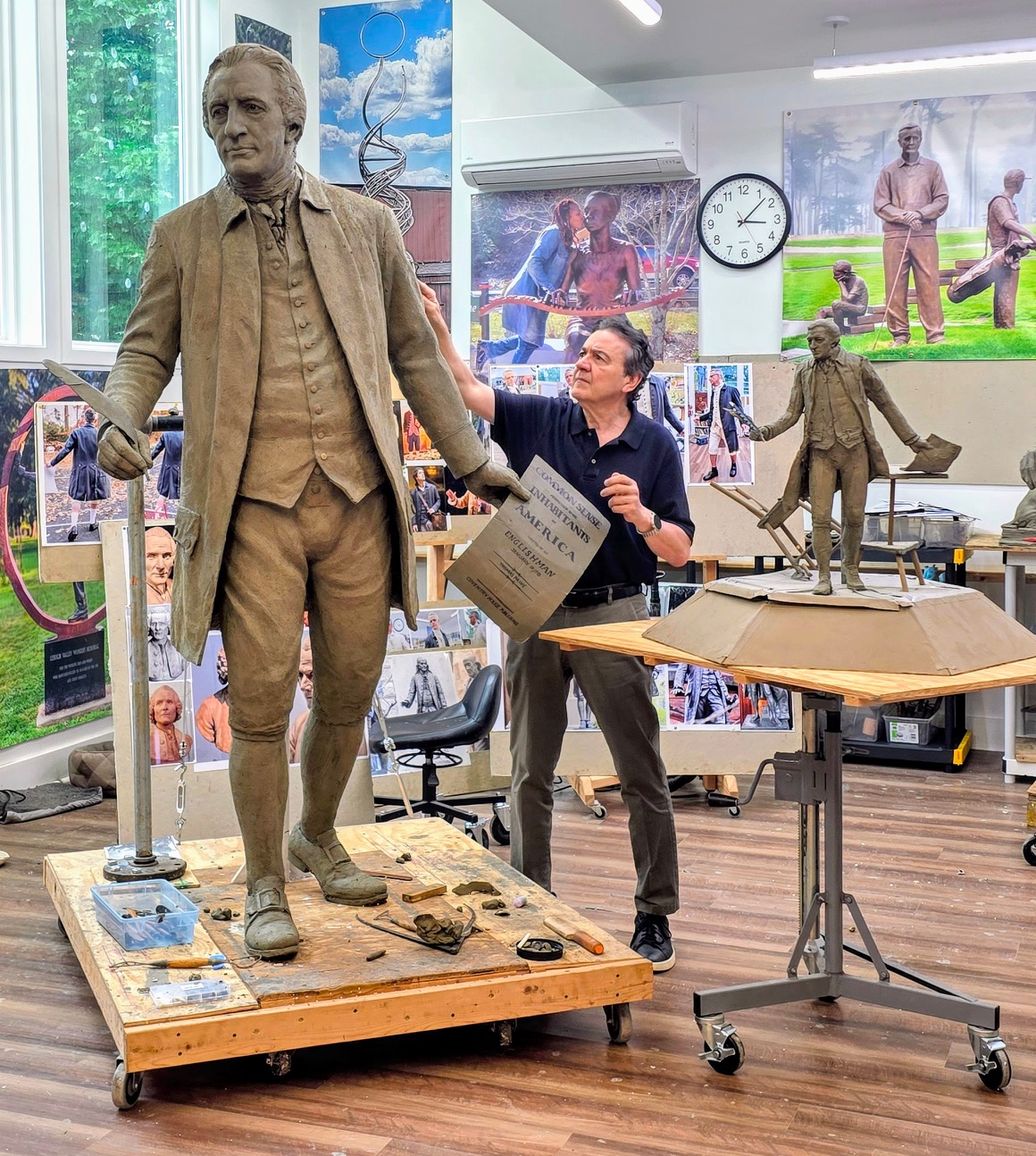
The Thomas Paine Memorial Association has already enlisted internationally acclaimed sculptor Zenos Frudakis, whose clay statue of Thomas Paine is currently housed at his studio in Glenside, Pennsylvania.

Upon learning that the legislation had been introduced, Frudakis reflected on the significance of the project. “As a sculptor, there are few honors greater than being entrusted with preserving the memory of someone who helped change the course of history. My goal is to create a Thomas Paine who speaks not only to his own time, but to every generation that believes in freedom, reason, and the power of ideas.”

For supporters of the memorial, the legislation represents more than authorization for another monument. It is an opportunity to restore one of America’s most influential founders to his rightful place among the nation’s honored architects of liberty. For 250 years, the capital he helped bring into being has had no memorial to him. TPMA seeks to correct that, and Area I is the prestigious location where he belongs.

As the United States reflects on its first 250 years, many believe there could be no more appropriate time to recognize the writer whose words helped make American independence possible.

Thomas Paine Memorial Association

Email: Margaret@ThomasPaineMemorial.org

Website: https://ThomasPaineMemorial.org

Facebook: https://www.facebook.com/ThomasPaineMA/

Meetup: https://www.meetup.com/thomas-paine-memorial-association-meetup-group/

###

Disclaimer: The views and opinions expressed in this article are those of the authors and do not necessarily reflect the official policy or position of RNS or Religion News Foundation.


National Baptists launch social justice center near US Capitol

WASHINGTON (RNS) — ‘Voting rights are being eroded,’ said President Boise Kimber of the National Baptist Convention U.S.A. Inc. ‘Black political leaders are being decimated by redistricting.’
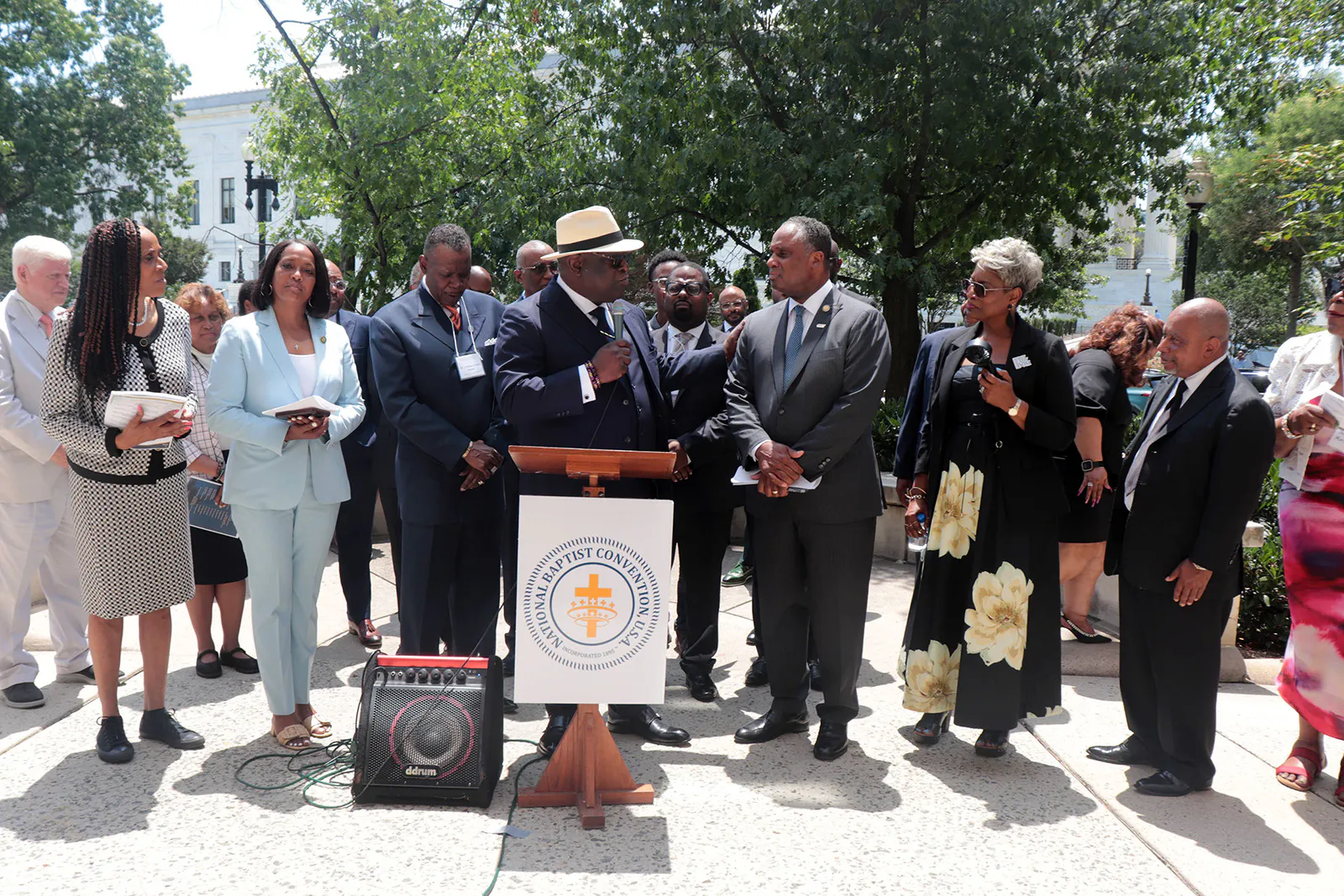
National Baptist Convention U.S.A. Inc. President Boise Kimber, center, speaks during an introduction ceremony for the Center for Social Justice outside the United Methodist Building, Tuesday, July 14, 2026, in Washington, D.C. (RNS photo/Adelle M. Banks)


WASHINGTON (RNS) — Months ahead of the midterm elections, leaders of the National Baptist Convention U.S.A. Inc., a historically Black denomination, have launched a Center for Social Justice steps away from the U.S. Capitol and across the street from the Supreme Court.

At an introduction ceremony on Tuesday (July 14), NBCUSA President Boise Kimber cited numerous challenges facing African Americans that he said need to be addressed: “Voting rights are being eroded. Black political leaders are being decimated by redistricting. Black history is being whitewashed and erased. Economic equality is also moving farther out of reach.”

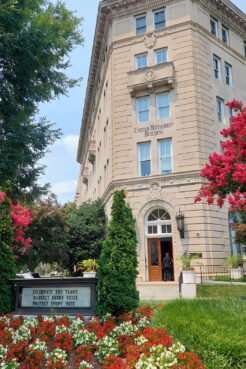
The announcement of the center was made in the chapel of the United Methodist Building where leaders said the NBCUSA will be sharing space with the National Religious Partnership for the Environment.

Cassandra Carmichael, the partnership’s executive director, told RNS in a statement that her organization offered some of its space to the denomination.

“We are currently working through the final details but definitely looking forward to working alongside them as they advocate for social and environmental justice issues,” she said.

The United Methodist Building, Tuesday, July 14, 2026, in Washington, D.C. (RNS photo/Adelle M. Banks)

In his remarks, Kimber emphasized the need to mobilize voters — including in states like Tennessee, Alabama and Louisiana — where redistricting has occurred in the wake of the recent Supreme Court decision that gutted a section of the Voting Rights Act.


RELATED: Black clergy strategize, preach and urge election turnout after Voting Rights Act gutting


“For many years, we believed we were moving close to a more perfect union,” he said. “We even elected a Black president. And yet the past two years have shown how quickly hard-won progress can be undone. We became too comfortable, underestimating how quickly those gains could be taken away.”

Members of Congress and of other faith organizations appeared at the launch event, which included several speakers who stood outside the building in the shadow of the Supreme Court after the chapel ceremony concluded.

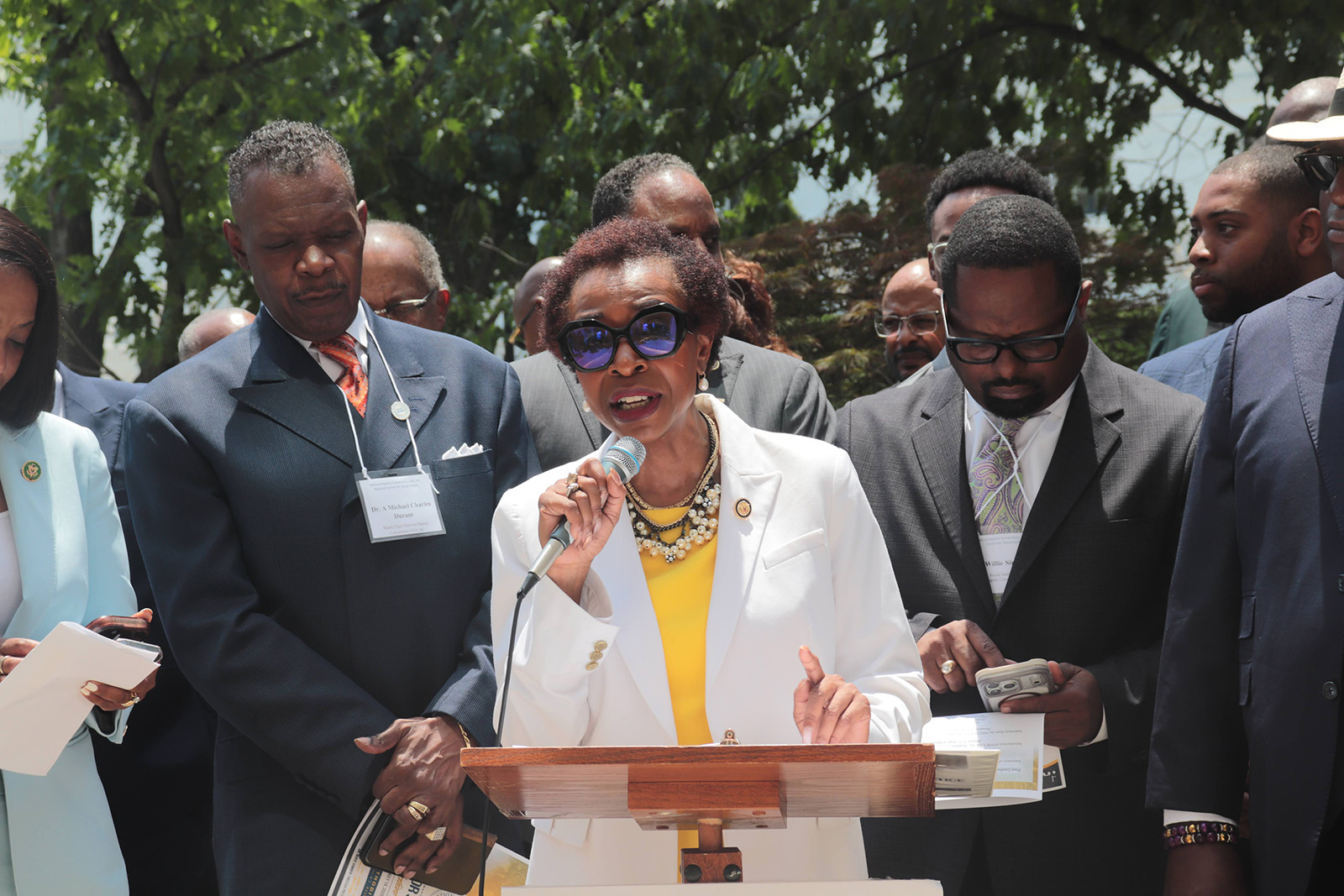
Congressional Black Caucus Chair Yvette Clarke said the launch of the center was timely and a reflection of the history of the Black church’s work on equality and justice.

“From the Civil Rights Movement to the present day, faith leaders have challenged our nation to live up to its highest ideals and to fulfill the promises of our Constitution for every American,” said Clarke, D-N.Y. “As a national hub for policy engagement, research, education and advocacy, this center will carry that legacy forward.”

Dozens of faith and political leaders attended the launch event, including other members of Congress and officials of other denominations, ecumenical groups and the National Newspaper Publishers Association, a Black consortium that is working with the NBCUSA on voter registration efforts.

Congressional Black Caucus Chair Yvette Clarke speaks outside the United Methodist Building, Tuesday, July 14, 2026, in Washington, D.C. (RNS photo/Adelle M. Banks)

On Wednesday, the Black Opposition Coalition, a national research initiative about Black voters that includes the NAACP and nine other organizations, said new data shows that about two-thirds of Black voters “say that recent attacks on voting rights and gerrymandering in the South make them more likely to vote in the upcoming midterm election.”

The center is to be housed in the century-old building that leases offices to religious and interfaith groups, including the National Council of Churches, the Islamic Society of North America and Interfaith Alliance, as well as programs of higher education institutions. It has been the backdrop of major protests and the home of apartment dwellers that included members of Congress.

“The National Baptist Convention coming to Washington, D.C. to engage in ministries of justice is good news,” said Bishop Julius C. Trimble, general secretary of the United Methodist Church’s General Board of Church and Society, which is the owner of the building.

“The National Baptist Convention currently does not have leased space at the United Methodist Building, but we are glad to welcome them to D.C. for the holy work of justice as demonstrated by love of God and neighbor,” he added.

 Opinion

If the church doesn’t rise up for the disabled, who will? 

(RNS) — Moving forward does not require first answering every question. The gospel calls us to simply take the next right step.
(Photo by Chona Kasinger/Disabled and Here/CC BY 4.0)


(RNS) — We are watching systems designed to care for our nation’s most vulnerable begin to shrink.

On June 18, 2026, the U.S. Department of Justice’s (DOJ) Office of Legal Counsel issued a memorandum threatening the Olmstead v. L.C. decision, the 1999 ruling protecting the right of people with disabilities to live in their communities. The slip opinion is “inconsistent with long-standing interpretations of federal disability rights law embraced by courts and administrations of both parties.” The U.S. Department of Education also announced recently that the U.S. Department of Health and Human Services will oversee special education and rehabilitative services, while DOJ will handle civil rights activities. Federal officials insist these changes reduce bureaucracy and ensure stronger service coordination.

Perspectives on these recent federal actions vary widely within the disability community. Some disability advocates interpret the memorandum as federal officials seeking to strengthen access to care for adults with serious mental illness, while others believe the DOJ’s slip opinion signals a move toward broader institutionalization across the disability community as a whole. On the issue of education, consensus exists among advocates: shifting administrative responsibilities to DOJ and HHS will cause confusion, delay claims and weaken enforcement of education and civil rights laws. 

These changes follow April 2025 comments by a senior HHS official who said nonverbal individuals with autism “will never pay taxes, they’ll never hold a job,” and “autism destroys families.” Such deficit-focused language against any segment of the disability community — and the latest announcements — pave the way for significant, troubling changes to the nation’s social safety net.


As we face these reminders of the inhumanity of government systems, an important question arises: Who will care for those no longer held by the safety net? I believe Scripture calls the church to step up.

The biblical mandate: Gut-wrenching justice and mercy

In Micah 6:8, the prophet distills God’s expectations regarding the marginalized: “To act justly and to love mercy and to walk humbly with your God.”

The original Hebrew word for justice, “mishpat,” means more than simply punishing wrongdoers. It refers to dismantling oppressive systems and proactively ensuring people — particularly society’s most vulnerable — receive their rights. Paired with this is “hesed,” translated as mercy or steadfast love, which describes a stubborn, unbreakable commitment to another person’s well-being.

Jesus perfectly embodied “mishpat” and “hesed.” The Greek word “splanchnizomai” describes his reaction to those suffering or excluded from society. This visceral, gut-level empathy demanded immediate action. Jesus didn’t simply feel compassion, mercy and grace toward people. He took action. He healed. He touched. And he restored people to the center of the community.

Throughout history, believers like William Wilberforce, the Rev. Martin Luther King Jr. and the Rev. Billy Graham understood that this biblical mandate often required a countercultural response to the defining injustices of their day, such as the slave trade or segregation. The modern church has sometimes struggled to mirror this same gut-level, systemic justice.

The data tells a concerning story

Frankly, the church would benefit from a comprehensive examination of the disability community’s experiences within the American church. Although only sparse, somewhat dated data exists, a heartbreaking story emerges:

  • 32.3% of special-needs families have left a church.
  • 46.6% of special-needs parents avoid religious activities because their child was unwelcome or excluded.
  • 45% of adults with disabilities attend church monthly, compared with 57% of adults without disabilities.

My late friend and colleague, Bobby Silverstein — disability rights champion and behind-the-scenes architect of the Americans with Disabilities Act — often said, “What gets measured gets done.” I couldn’t agree more. Changing church culture in this area begins with allocating resources to measure it.

This data gap provides a unique opportunity to closely examine our past and current systemic shortcomings. It is understandable that some may be reluctant to engage in such an undertaking, concerned about the potential findings. But better understanding the experiences of individuals, families and caregivers within our congregations can inform future efforts. Given that faith-based organizations with 15 or more employees must follow the ADA’s employment requirements, it’s imperative to understand these numbers as well.

Until we measure these realities, we cannot effectively address the cracks.


The next right step

Moving forward does not require first answering every question. The gospel calls us to simply take the next right step.

Formal training or a title isn’t necessary to pursue what I refer to as covenantal health. Covenantal health moves beyond piecemeal, individual accommodations to establish systematic accessibility. It pushes us to view disability as an ordinary aspect of church life rather than a hurdle to overcome or a project to manage. It recognizes that leveraging the gifts and anticipating the needs of the entire body of believers — including those impacted by disability — is essential for the church’s health, survival and growth.

If you’re a church leader, remind your community why this matters and ground it in the gospel. Share stories. Church members also have a responsibility to help leadership see the positive, life-changing impact of full, meaningful inclusion. Embrace progress over perfection. Don’t let the fear of doing it imperfectly stop you from doing it at all. Start with one family. Begin with one conversation.

We are called to a long obedience combined with holy impatience. The path forward undoubtedly requires flexibility. But we serve a God who draws the forgotten into the center of the fold.

It is time for the church to rise and look like the kingdom.

(Nadia Ibrahim Mossburg, born with cerebral palsy, uses her experience as a senior adviser in disability policy to improve policy at the national, state and local levels. The views expressed in this commentary do not necessarily reflect those of Religion News Service.)