China’s Belt And Road Initiative: Key Economic Issues – Analysis
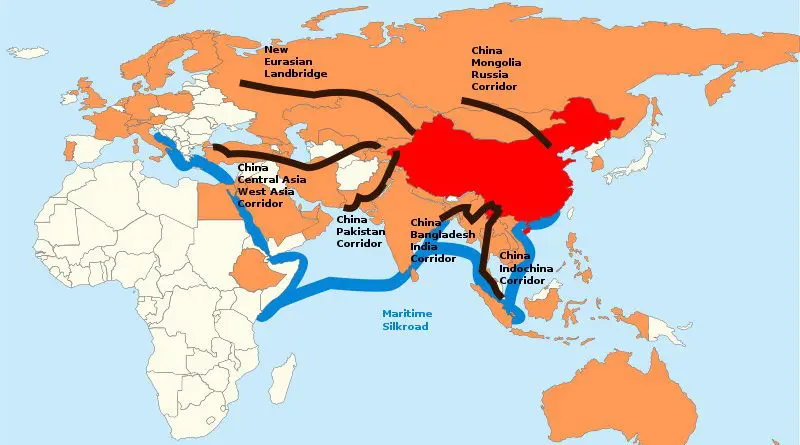
China's Belt and Road Initiative (BRI). China in Red, the members of the Asian Infrastructure Investment Bank in orange. Credit: Lommes, Wikipedia Commons
August 14, 2026
The Congressional Research Service (CRS)
By Karen M. Sutter and Michael D. Sutherland
The Congressional Research Service (CRS)
By Karen M. Sutter and Michael D. Sutherland
Key Takeaways
China’s Belt and Road Initiative (originally One Belt, One Road), launched in 2013 and later elevated in Party documents, seeks to build PRC-centered global infrastructure, trade, technology and production networks through land, maritime, digital, green and polar corridors.
Financing and project delivery are dominated by state banks, funds and national-champion firms using often opaque, collateralized loans and integrated packages that expand Chinese standards, secure resources and create long-term economic and strategic dependencies, raising concerns about debt sustainability, lack of reciprocity and potential dual-use applications.
The United States and partners have responded with alternative financing tools (such as the DFC and EXIM programs), quality-infrastructure initiatives and greater scrutiny of Chinese deals, while Congress continues to debate further measures to monitor and counter BRI’s economic and geopolitical effects.
The People’s Republic of China (PRC or China) in 2013 launched an ambitious and multifaceted foreign economic policy initiative—One Belt, One Road—to expand China’s global economic reach and influence. In 2015, China’s leaders changed the English name to the Belt and Road Initiative (BRI) (while keeping the Chinese name),possibly to deflect attention from the initiative’s focus on developing China-controlled and -centered global ties in a hub-and-spoke format. The Communist Party of China (CPC) incorporated the initiative into its Charter in 2017. It reaffirmed the efforts’ significance at its 20th Party Congress in 2022 and in China’s 15th Five-Year Plan for National Economic Development (2026-2030). Some in Congress assess that One Belt, One Road projects advance PRC economic and geopolitical goals while undercutting U.S. global influence and interests. In response, some Members have sought to develop alternative U.S. and multilateral financing programs.
Scope and Objectives
One Belt, One Road has evolved into a global effort that aims to develop PRC-centered and -controlled global production, trade, infrastructure, and transportation networks. It includes a land-based “Silk Road Economic Belt” and a “21st Century Maritime Silk Road.” Sub-initiatives include a “Polar Silk Road” focused on Arctic shipping routes and a “Digital Silk Road” to promote PRC information and communications technology (ICT) exports and satellite networks. A “Green Silk Road” promotes PRC renewable energy products and services. Other efforts seek to promote health and science and technology (S&T) ties and the use of PRC technical standards among partner countries. The effort emphasizes policy coordination, trade and investment, dispute settlement, tourism, and student/personnel exchanges.
One Belt, One Road projects in energy, ICT, manufacturing, and transportation infrastructure look to vertically integrate PRC production supply chains, technology infrastructure, and transportation networks. The effort involves technology and financial integration that expands the use of China’s digital platforms and currency. It seeks to expand PRC firms’ presence overseas, create markets for China’s goods and services, and secure access to foreign sources of agriculture, energy, and strategic commodities, such as critical minerals. Projects also aim to develop China’s interior regions, employ PRC workers, and offload PRC excess industrial capacity.
At the One Belt, One Road forum in 2023, PRC leader Xi Jinping prioritized “high quality development”; intermodal and green infrastructure; digital trade zones; S&T cooperation; a “compliance evaluation system” to address corruption; and cooperation in energy, tax, finance, think tanks, media, and culture. In 2021, Xi presented at the United Nations (UN) a Global Development Initiative to complement One Belt, One Road with projects for poverty alleviation and food security and in areas to advance PRC firms globally in infrastructure, manufacturing, and digital technologies. See CRS In Focus IF13099, China Primer: China’s Global Development Initiative.
China’s Investment and Financing
China’s use of onshore financing and special-purpose vehicles for foreign investment complicates analysts’ ability to track PRC global economic activity. One Belt, One Road is an umbrella initiative, and projects may be specifically or loosely tied to the effort. As a result, many groups track PRC cross-border financing, investment, and overseas projects generally. China’s stock of global outward foreign direct investment (ODI)—investment made into a business or real asset in another country—stood at $3.6 trillion (7.8% of world total) in 2025, up from $34.7 billion (0.5% of world total) in 2001. In comparison, the United States accounted for $6.6 trillion, or 14.4%, of global ODI stock in 2025 (down from 32% in 2001), according to official country data compiled by the UN. PRC ODI flows have picked up since 2021 and were $174 billion in 2025, accounting for about 9% of global ODI flows. (U.S. ODI flows were $263 billion, or about 14% of global ODI flows in 2025.) Additionally, PRC cross-border contracts—a corporate structure used for overseas construction and infrastructure projects—have been stable and reached an all-time high of $289 billion in 2025. The PRC also operates cross-border projects in agriculture, energy, minerals, finance, technology, and shipping (Figure 1).
AidData, a research lab at the College of William & Mary, estimates that, as of 2023, China’s overseas lending portfolio was $2.1 trillion. (In comparison, the World Bank’s portfolio in 2025 was about $400 billion.) It assessed that even as One Belt, One Road focused on developing countries, since 2000, PRC lending has been shifting toward high-income countries (e.g., the United States) and financing for technology deals and the purchase of foreign firms in strategic sectors. AidData reports that, as of 2023, 24% of PRC lending was for low- and lower-middle-income countries, and that infrastructure accounted for about 20% of China’s overseas lending portfolio.
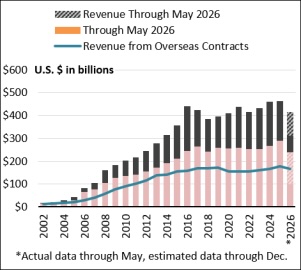
Figure 1. China’s ODI Flows and Overseas Contracts. Source: CRS, with data from China’s Ministry of Commerce.
PRC state banks (e.g., CHEXIM and CDB), firms, and funds (e.g., Silk Road Fund) undertake a large share of PRC overseas lending and investment. The PRC government often pays firms in China for projects they implement, while host governments pay the PRC government for the projects. Projects are neither assistance—PRC loans are typically not interest-free and issued at market terms—nor truly commercial, because repayments are often backed by collateral commitments (e.g., lease rights, minerals, or commodities) made to the PRC government, which in turn absorbs much of the commercial risk for PRC firms. Recipients of collateral may include state firms not party to the original transaction that are designated by the PRC government.
Role of China’s State Firms
PRC strategic investments are typically state-sponsored and aim to advance national economic and foreign policy goals. A handful of state firms operate most projects. These firms are funded by and report directly to the central government, and include China Harbor, CRRC, State Grid, China Three Gorges, and COSCO. China’s projects strategically position national champions—such as Huawei, ZTE, and Alibaba—by creating technology infrastructure and systems built to PRC standards. Alibaba’s internet project in Malaysia, for example, provides a foundation for PRC data/cloud, e-commerce, and financial services. Projects may offer the PRC visibility and touchpoints into sensitive infrastructure and services via interconnection and interoperability in communications, energy, and transportation. Projects in critical minerals support PRC industrial policies.
U.S. Concerns
Some observers note the economic benefits of China’s investments in developing countries while others argue that China is introducing unsustainable debt obligations and opportunities to gain economic concessions and influence. China tends to extend the duration of its loans, rather than forgive debt repayment, which can create long-term financial dependencies. For example, in 2017, when the Sri Lankan government was unable to repay PRC loans, China Merchants Port Holdings Company Ltd. acquired a majority stake in the firm that operates Sri Lanka’s Hambantota port and the right to operate the port for 99 years. Credit and loan terms are generally opaque and China tends to settle agreements bilaterally. China’s opacity in lending came to a head in 2019 when U.S. officials questioned whether International Monetary Fund relief for Pakistan might also be used to repay Pakistan’s debts to China.
The PRC government insists that most PRC state banks and state firms are not subject to sovereign lending terms adopted by the United States and other major creditors in the Paris Club. PRC loans often forbid multilateral debt restructuring (e.g., under Paris Club auspices). China joined two G20 debt relief initiatives that accept Paris Club disciplines, but these apply only to CHEXIM and the China International Development Cooperation Agency. The PRC claims it has provided more deferments under G20 schemes than Paris Club members, but many countries indebted to China do not appear to qualify or have not applied—likely due to PRC pressure—for G20 debt relief. Some experts say One Belt, One Road undermines the role and principles of multilateral financial institutions, which work with China on projects, and argue China should not have a leadership role in these institutions. Such collaboration may set better terms for host countries while also advancing PRC goals.
PRC entities are expanding overseas in sectors that the PRC restricts to foreign investors in China (e.g., construction, transportation, finance, and communications). The PRC does not offer reciprocal market access for the rights it secures in other countries, challenging a core trade tenet and advantaging PRC firms over their competitors. It has opened foreign markets with “deal-ready” financing and integrated project delivery.
PRC investments in strategic sectors and infrastructure have prompted some governments to increase scrutiny of these deals. Some analysts assess that certain PRC projects have military uses. Under its military-civil fusion program and China Standards 2035 initiative, China is developing standards that promote civilian-military interoperability, including in various technologies and infrastructure (e.g., ports). Commercial land deals may facilitate a military presence. China Merchants Bank, for example, signed the lease for property in Djibouti on which China developed a military base. Sam Enterprise Group, a firm reportedly tied to China’s military, bought land in Vanuatu and the Solomon Islands. PRC projects offer alternatives to U.S.-led networks and standards. PRC-built BeiDou satellite and rail networks offer substitutes to U.S.-controlled GPS navigation technology and sea lanes where the U.S. military operates. PRC digital platforms support use of the PRC’s digital currency.
PRC state banks (e.g., CHEXIM and CDB), firms, and funds (e.g., Silk Road Fund) undertake a large share of PRC overseas lending and investment. The PRC government often pays firms in China for projects they implement, while host governments pay the PRC government for the projects. Projects are neither assistance—PRC loans are typically not interest-free and issued at market terms—nor truly commercial, because repayments are often backed by collateral commitments (e.g., lease rights, minerals, or commodities) made to the PRC government, which in turn absorbs much of the commercial risk for PRC firms. Recipients of collateral may include state firms not party to the original transaction that are designated by the PRC government.
Role of China’s State Firms
PRC strategic investments are typically state-sponsored and aim to advance national economic and foreign policy goals. A handful of state firms operate most projects. These firms are funded by and report directly to the central government, and include China Harbor, CRRC, State Grid, China Three Gorges, and COSCO. China’s projects strategically position national champions—such as Huawei, ZTE, and Alibaba—by creating technology infrastructure and systems built to PRC standards. Alibaba’s internet project in Malaysia, for example, provides a foundation for PRC data/cloud, e-commerce, and financial services. Projects may offer the PRC visibility and touchpoints into sensitive infrastructure and services via interconnection and interoperability in communications, energy, and transportation. Projects in critical minerals support PRC industrial policies.
U.S. Concerns
Some observers note the economic benefits of China’s investments in developing countries while others argue that China is introducing unsustainable debt obligations and opportunities to gain economic concessions and influence. China tends to extend the duration of its loans, rather than forgive debt repayment, which can create long-term financial dependencies. For example, in 2017, when the Sri Lankan government was unable to repay PRC loans, China Merchants Port Holdings Company Ltd. acquired a majority stake in the firm that operates Sri Lanka’s Hambantota port and the right to operate the port for 99 years. Credit and loan terms are generally opaque and China tends to settle agreements bilaterally. China’s opacity in lending came to a head in 2019 when U.S. officials questioned whether International Monetary Fund relief for Pakistan might also be used to repay Pakistan’s debts to China.
The PRC government insists that most PRC state banks and state firms are not subject to sovereign lending terms adopted by the United States and other major creditors in the Paris Club. PRC loans often forbid multilateral debt restructuring (e.g., under Paris Club auspices). China joined two G20 debt relief initiatives that accept Paris Club disciplines, but these apply only to CHEXIM and the China International Development Cooperation Agency. The PRC claims it has provided more deferments under G20 schemes than Paris Club members, but many countries indebted to China do not appear to qualify or have not applied—likely due to PRC pressure—for G20 debt relief. Some experts say One Belt, One Road undermines the role and principles of multilateral financial institutions, which work with China on projects, and argue China should not have a leadership role in these institutions. Such collaboration may set better terms for host countries while also advancing PRC goals.
PRC entities are expanding overseas in sectors that the PRC restricts to foreign investors in China (e.g., construction, transportation, finance, and communications). The PRC does not offer reciprocal market access for the rights it secures in other countries, challenging a core trade tenet and advantaging PRC firms over their competitors. It has opened foreign markets with “deal-ready” financing and integrated project delivery.
PRC investments in strategic sectors and infrastructure have prompted some governments to increase scrutiny of these deals. Some analysts assess that certain PRC projects have military uses. Under its military-civil fusion program and China Standards 2035 initiative, China is developing standards that promote civilian-military interoperability, including in various technologies and infrastructure (e.g., ports). Commercial land deals may facilitate a military presence. China Merchants Bank, for example, signed the lease for property in Djibouti on which China developed a military base. Sam Enterprise Group, a firm reportedly tied to China’s military, bought land in Vanuatu and the Solomon Islands. PRC projects offer alternatives to U.S.-led networks and standards. PRC-built BeiDou satellite and rail networks offer substitutes to U.S.-controlled GPS navigation technology and sea lanes where the U.S. military operates. PRC digital platforms support use of the PRC’s digital currency.
U.S. Government Response
PRC overseas financing practices are prompting the United States with its allies and partners to adjust approaches to global financing to compete with China. Congress enacted the Better Utilization of Investments Leading to Development Act of 2018 (BUILD Act; P.L. 115-254) to create the U.S. International Development Finance Corporation (DFC) and increase support for quality market-oriented and financially sustainable projects with environmental and social safeguards. The DFC has sought to compete with PRC consortia on projects and in markets in which the PRC has a major presence. In 2019, Congress created a China and Transformational Exports Program at the Export-Import Bank of the United States with new financing tools and flexibilities to counter PRC financing. The G-7 Partnership for Global Infrastructure and Investment and Blue Dot Network seek to promote quality infrastructure financing. In 2020, the U.S. government sanctioned PRC state firms that built One Belt, One Road military infrastructure in the South China Sea.
The 119th Congress is debating the effects of dismantling the U.S. Agency for International Development on competition with the PRC. S. 1011 would require the State Department to monitor and counter PRC projects. H.R. 9093 would require a report on the PRC’s use of One Belt, One Road to undermine the U.S.-led global order, and a strategy to counter it. Congress may examinethe PRC government’s role in directing and financing investments in the United States and acquisition of U.S. firms in strategic sectors, and U.S. policy on such investments;
PRC entities’ presence in U.S. production, energy, transportation, and communications networks and investments in the Western Hemisphere; and
whether to allow U.S. development or export financing for global projects that use PRC components or services.
About the authors:
Karen M. Sutter, Specialist in Asian Trade and Finance
Michael D. Sutherland, Analyst in International Trade and Finance
Source: This article was published by the Congressional Research Service (CRS).

About CRS
The Congressional Research Service (CRS) works exclusively for the United States Congress, providing policy and legal analysis to committees and Members of both the House and Senate, regardless of party affiliation. As a legislative branch agency within the Library of Congress, CRS has been a valued and respected resource on Capitol Hill for nearly a century.
View all posts by CRS →
Michael D. Sutherland, Analyst in International Trade and Finance
Source: This article was published by the Congressional Research Service (CRS).
About CRS
The Congressional Research Service (CRS) works exclusively for the United States Congress, providing policy and legal analysis to committees and Members of both the House and Senate, regardless of party affiliation. As a legislative branch agency within the Library of Congress, CRS has been a valued and respected resource on Capitol Hill for nearly a century.
View all posts by CRS →

No comments:
Post a Comment