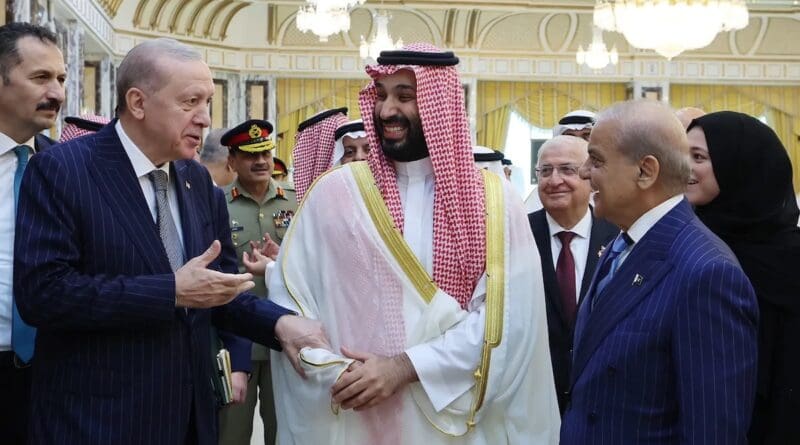
Turkey's President Recep Tayyip Erdogan, Saudi Arabia's Crown Prince Mohammed bin Salman, and Pakistan's Prime Minister Shehbaz Sharif meet during the signing of the trilateral defense agreement in Mecca, Saudi Arabia, on Aug. 7. MURAT CETINMUHURDAR/TURKEY'S PRESIDENTIAL PRESS SERVICE
August 14, 2026
Observer Research Foundation
By Shivam Shekhawat
Key Takeaways
On August 7, 2026, Pakistan, Saudi Arabia and Türkiye signed the Mecca Joint Defense Agreement, establishing that an attack on any one signatory would be treated as an attack on all and committing the three countries to deeper defence cooperation, interoperability and collective responses decided by consensus.
For Pakistan the pact extends its earlier bilateral mutual-defence arrangement with Saudi Arabia, reinforces long-standing military ties with both Riyadh and Ankara, and elevates Islamabad’s role as a security partner and mediator amid doubts about the reliability of the U.S. security umbrella in West Asia.
The agreement is presented as defensive and open to potential new members, yet it reflects a broader regional search for alternative security frameworks; India is watching closely given its strained relations with Türkiye and concerns over Pakistan’s growing integration into West Asian security architectures.
On August 7, 2026, Pakistan, Saudi Arabia and Türkiye signed the ‘Mecca Joint Defense Agreement’, also referred to as the Mecca Defence Accord, at the Makkah Al-Mukarrama summit in Saudi Arabia. The pact aims to build collective deterrence and enhance regional stability, while further consolidating defence cooperation among the three countries. Coming against the backdrop of the war between the United States and Iran and its regional fallout, the timing of the signing is widely read as a response by these states to the faltering US security umbrella in West Asia — even as all three signatories have stressed that talks on the pact had been under way for some time.
Pakistan’s Prime Minister, Shehbaz Sharif, described the agreement as an ‘extension’ of the ‘Strategic Mutual Defence Agreement’ signed with Saudi Arabia on 17 September 2025, which also included a collective security clause. The agreement’s significance for Pakistan is thus twofold: it positions the country as a beneficiary of the shifting regional order, embedding Islamabad further within the West Asian security architecture, while also giving it room to elevate its external standing.
The Contours of the Agreement
The agreement lays out two specific objectives. First, in what is seen as an echo of NATO’s Article 5 clause, the trilateral agreement calls for an attack on any one of the three signatories to be treated as an attack on all of them, inviting a collective response in line with the principles of collective deterrence set out in Article 51 of the UN Charter. The important aspect here is not the clause for collective security — which was also a key element of the 2025 pact between Saudi Arabia and Pakistan — but the subsequent response, based on discussion and consensus among all the signatories. The type of support offered would thus vary depending on the needs of the aggrieved partner, as the pact provides for general commitments rather than fixed obligations. This support could take the form of a military response, logistical support, intelligence sharing, or the provision of arms and ammunition.
Second is the pursuit of increased defence cooperation among the three countries, building on the long-standing defence partnership among them. The defence pact with Saudi Arabia has already solidified Islamabad’s partnership with the kingdom. Pakistan’s deployment of troops to Saudi Arabia, and its training of Saudi troops and personnel, has continued since the 1980s. In April, it deployed close to 8,000 troops, fighter jets and air defence systems to the Abdulaziz Air Base in Saudi Arabia. Riyadh has also been a major source of aid and assistance to Pakistan: in April 2026, it rolled over a US$3 billion deposit to the country, and in July 2026, it extended a separate US$5 billion facility for another three years.
Pakistan also enjoys a strong defence partnership with Ankara, which was Islamabad’s third-largest arms supplier between 2020 and 2024, providing Bayraktar TB-2 drones and aircraft electro-optical sensors, while also looking to expand the relationship through joint production of Turkey’s fifth-generation KAAN fighter jet programme. Pakistan also used Turkish drones during hostilities with India last year.
The agreement is also seen as creating new opportunities to improve integration between the armed forces of the three countries, with a focus on military interoperability, joint training, threat assessment, and the synergising of weapons and communications systems.
Following the signing, all three countries issued additional statements clarifying the pact’s terms and scope, with the emphasis falling on its defensive nature and the assurance that no country was being targeted. Saudi Arabia further clarified that the pact had no nuclear dimension, nor was it aimed at starting an arms race in the region. This addressed lingering echoes of the controversy that had followed the earlier defence pact with Riyadh, when a statement by Pakistan’s Defence Minister, Khawaja Asif, on Pakistan’s nuclear arsenal being made available to the kingdom, prompted Saudi officials to clarify that the agreement was purely a comprehensive military one. Pakistan’s status as a nuclear-armed state, however, continues to invite such assumptions. While Pakistan describes the new pact as an extension of the Saudi agreement, all three countries have stressed that it does not override any pre-existing bilateral or multilateral arrangements they hold with each other or with others.
Membership, too, was framed as flexible: Türkiye signalled the possible inclusion of Egypt, while Pakistan’s Foreign Minister, Ishaq Dar, clarified that any country aligning with the pact’s ‘fundamental principles’ could join. Though this leaves the actual criteria for admitting new members vague, it serves a clear purpose — to counter concerns that the pact might replace the US security umbrella with an alternative, or that the grouping is a closed one with no room for others.
While the modalities of how the pact would take shape have remained out of public view, Turkish Foreign Minister Hakan Fidan highlighted that its institutionalisation will be through the establishment of a political and military committee, which would include representation from the foreign and defence ministries of all signatories as well as their chiefs of staff.
On August 7, 2026, Pakistan, Saudi Arabia and Türkiye signed the ‘Mecca Joint Defense Agreement’, also referred to as the Mecca Defence Accord, at the Makkah Al-Mukarrama summit in Saudi Arabia. The pact aims to build collective deterrence and enhance regional stability, while further consolidating defence cooperation among the three countries. Coming against the backdrop of the war between the United States and Iran and its regional fallout, the timing of the signing is widely read as a response by these states to the faltering US security umbrella in West Asia — even as all three signatories have stressed that talks on the pact had been under way for some time.
Pakistan’s Prime Minister, Shehbaz Sharif, described the agreement as an ‘extension’ of the ‘Strategic Mutual Defence Agreement’ signed with Saudi Arabia on 17 September 2025, which also included a collective security clause. The agreement’s significance for Pakistan is thus twofold: it positions the country as a beneficiary of the shifting regional order, embedding Islamabad further within the West Asian security architecture, while also giving it room to elevate its external standing.
The Contours of the Agreement
The agreement lays out two specific objectives. First, in what is seen as an echo of NATO’s Article 5 clause, the trilateral agreement calls for an attack on any one of the three signatories to be treated as an attack on all of them, inviting a collective response in line with the principles of collective deterrence set out in Article 51 of the UN Charter. The important aspect here is not the clause for collective security — which was also a key element of the 2025 pact between Saudi Arabia and Pakistan — but the subsequent response, based on discussion and consensus among all the signatories. The type of support offered would thus vary depending on the needs of the aggrieved partner, as the pact provides for general commitments rather than fixed obligations. This support could take the form of a military response, logistical support, intelligence sharing, or the provision of arms and ammunition.
Second is the pursuit of increased defence cooperation among the three countries, building on the long-standing defence partnership among them. The defence pact with Saudi Arabia has already solidified Islamabad’s partnership with the kingdom. Pakistan’s deployment of troops to Saudi Arabia, and its training of Saudi troops and personnel, has continued since the 1980s. In April, it deployed close to 8,000 troops, fighter jets and air defence systems to the Abdulaziz Air Base in Saudi Arabia. Riyadh has also been a major source of aid and assistance to Pakistan: in April 2026, it rolled over a US$3 billion deposit to the country, and in July 2026, it extended a separate US$5 billion facility for another three years.
Pakistan also enjoys a strong defence partnership with Ankara, which was Islamabad’s third-largest arms supplier between 2020 and 2024, providing Bayraktar TB-2 drones and aircraft electro-optical sensors, while also looking to expand the relationship through joint production of Turkey’s fifth-generation KAAN fighter jet programme. Pakistan also used Turkish drones during hostilities with India last year.
The agreement is also seen as creating new opportunities to improve integration between the armed forces of the three countries, with a focus on military interoperability, joint training, threat assessment, and the synergising of weapons and communications systems.
Following the signing, all three countries issued additional statements clarifying the pact’s terms and scope, with the emphasis falling on its defensive nature and the assurance that no country was being targeted. Saudi Arabia further clarified that the pact had no nuclear dimension, nor was it aimed at starting an arms race in the region. This addressed lingering echoes of the controversy that had followed the earlier defence pact with Riyadh, when a statement by Pakistan’s Defence Minister, Khawaja Asif, on Pakistan’s nuclear arsenal being made available to the kingdom, prompted Saudi officials to clarify that the agreement was purely a comprehensive military one. Pakistan’s status as a nuclear-armed state, however, continues to invite such assumptions. While Pakistan describes the new pact as an extension of the Saudi agreement, all three countries have stressed that it does not override any pre-existing bilateral or multilateral arrangements they hold with each other or with others.
Membership, too, was framed as flexible: Türkiye signalled the possible inclusion of Egypt, while Pakistan’s Foreign Minister, Ishaq Dar, clarified that any country aligning with the pact’s ‘fundamental principles’ could join. Though this leaves the actual criteria for admitting new members vague, it serves a clear purpose — to counter concerns that the pact might replace the US security umbrella with an alternative, or that the grouping is a closed one with no room for others.
While the modalities of how the pact would take shape have remained out of public view, Turkish Foreign Minister Hakan Fidan highlighted that its institutionalisation will be through the establishment of a political and military committee, which would include representation from the foreign and defence ministries of all signatories as well as their chiefs of staff.
Pakistan’s Balancing Act
Consistent with the fanfare that typically accompanies Pakistan’s signing of international agreements, both the symbolism of this pact and the context in which it took shape are seen to have given fresh momentum to Pakistan’s external standing. During the visit, Prime Minister Sharif was accompanied by Chief of Defence Forces Field Marshal Asim Munir, Foreign Minister Ishaq Dar, and Defence Minister Khawaja Asif. In its statement celebrating the agreement, the civilian government credited the CDF’s role in bringing it to fruition, alongside the coordinated decision-making that led to its signing. Islamabad’s inclusion was also seen as a testament to its defence capabilities, with FM Dar reiterating that it aligns with the country’s foreign policy.
This foreign policy has played out in myriad ways over the past year. Following the crisis with India, and the military’s consolidation of control over the civilian government, Pakistan has leaned on the post-crisis victory narrative — raising its expectations of how it wants to be perceived in the world. Even as the country continues to grapple internally with acute security and economic challenges, with political stability also under scrutiny, both the warm reception given by US President Donald Trump to Munir and the subsequent thaw in bilateral ties appear aimed at seeking legitimacy.
Since 28 February, when the war between Iran and the United States broke out, Pakistan has assumed the role of mediator, positioning itself as a stabiliser and security provider. Its inclusion in the Trump administration’s Board of Peace (BoP) for Gaza in January 2026, and its subsequent hosting of talks in April between Tehran and Washington, are both seen as examples of its growing mediatory role. It is also one of thirteen countries that are part of the Saudi-proposed multinational maritime defence coalition to protect shipping and energy routes in the Red Sea. While the US-Pakistan relationship has seen its regular ups and downs since Pakistan’s founding, it was the signing of the defence pact with Saudi Arabia that reignited conversations about Pakistan’s strategic importance to the region.
The Gulf countries’ growing exasperation with Washington’s inability to protect their interests in the region, coupled with the closely coordinated US-Israeli military campaign against Iran, has dented their confidence in American security guarantees. While this is also the gradual culmination of grievances accumulated over the last few decades, the most recent crises to have upended the region have made the search for alternative safety valves far more urgent. It is in this context that Pakistan’s importance to the region’s countries comes into sharper focus.
If the Saudi-Pakistan pact offers any insight into how this new agreement will pan out, it has more to do with institutionalising what already existed and signalling intent, rather than creating something entirely new. The coming together of these countries reflects a reshaping of the region’s security architecture, with countries exploring ways to supplement US security support with alternative frameworks that give them greater agency over outcomes. While officials downplayed the pact as a response to the US-Iran war, the fallout of the war — particularly its toll on the interests and assets of Washington’s Gulf partners — nonetheless accelerated its signing.
New Delhi is closely watching these developments, mindful of its national interests. While ties between New Delhi and Riyadh remain strong, its bilateral relationship with Ankara has deteriorated. The latest round of hostilities between India and Pakistan in May 2025, coupled with the Pakistani military’s increasing hold over the country’s security and foreign policy, shows that India will need to stay attentive to developments in its western neighbourhood. In that context, Pakistan’s growing inclusion in West Asia’s regional architectures will be a cause for concern for India.
About the author: Shivam Shekhawat is a Junior Fellow with the Strategic Studies Programme at the Observer Research Foundation.
Source: This article was published by the Observer Research Foundation.
About Observer Research Foundation
ORF was established on 5 September 1990 as a private, not for profit, ’think tank’ to influence public policy formulation. The Foundation brought together, for the first time, leading Indian economists and policymakers to present An Agenda for Economic Reforms in India. The idea was to help develop a consensus in favour of economic reforms.
View all posts by Observer Research Foundation →

No comments:
Post a Comment