WHO defends immunisation schedules after Trump orders fewer childhood shots
By Olivia Le Poidevin
Tue, August 11, 2026
By Olivia Le Poidevin
Tue, August 11, 2026
REUTERS

A sign reading "Gold Standard Childhood Vaccine Recommendations" is displayed next to a bust of Benjamin Franklin, during an event with U.S. President Donald Trump to sign an executive order regarding vaccine flexibility, in the Oval Office at the White House in Washington, D.C., U.S., August 10, 2026. REUTERS/Kylie Cooper
GENEVA, Aug 11 (Reuters) - The World Health Organization on Tuesday defended the science-based process used to determine childhood immunisation schedules after U.S. President Donald Trump signed an executive order aimed at reducing the number of recommended childhood vaccinations in the United States.
On Monday, Trump signed an executive order calling for a reduced childhood vaccination schedule of 11 immunisations. Trump said the move would provide U.S. children with "gold-standard" protection and align the United States more closely with other developed countries that recommend fewer shots.
Vaccine experts say that other developed countries that may recommend fewer shots face different disease risks and have different healthcare systems.
The order advances a long-standing objective of U.S. Health Secretary Robert F. Kennedy Jr., who has questioned vaccine safety and promoted claims linking vaccines to autism even though scientific studies and public health authorities have found no evidence of a link.
WHO spokesperson Tarik Jašarević told a press briefing in Geneva that vaccination recommendations were based on more than 60 years of research by WHO, national authorities and independent expert groups.
The timing of individual vaccines was determined through extensive scientific review of when people were most vulnerable to particular diseases and the development of the immune system, Jašarević told reporters in Geneva.
Jašarević said countries typically relied on national immunisation technical advisory groups made up of multidisciplinary experts who provided independent, evidence-based recommendations to governments and vaccination programme managers. Those groups, he said, draw on guidance from WHO's Strategic Advisory Group of Experts on Immunization (SAGE) when establishing national schedules.
"What comes out from WHO is science-based," Jašarević said.
"We hope that all countries will use this best scientific evidence that we have."
SEPARATE SHOTS FOR MEASLES, MUMPS AND RUBELLA
Trump's executive order has drawn criticism from medical associations, public health experts and vaccine manufacturers, who say there is no new scientific evidence to justify the changes and that the existing U.S. schedule reflects decades of evidence and the specific health needs of Americans, rejecting the comparison to other countries.
Physicians have warned that reducing the number of recommended vaccinations could leave more children vulnerable to preventable diseases and create confusion among parents about when children should be immunised.
The Trump order also recommends separating the combined measles, mumps and rubella (MMR) vaccine into three individual injections. Vaccine maker Merck has said there is no published scientific evidence showing a benefit from splitting the shot and warned that requiring separate visits could increase the risk of delayed or missed vaccinations.
(Reporting by Olivia Le Poidevin; Editing by Kate Mayberry)
A sign reading "Gold Standard Childhood Vaccine Recommendations" is displayed next to a bust of Benjamin Franklin, during an event with U.S. President Donald Trump to sign an executive order regarding vaccine flexibility, in the Oval Office at the White House in Washington, D.C., U.S., August 10, 2026. REUTERS/Kylie Cooper
GENEVA, Aug 11 (Reuters) - The World Health Organization on Tuesday defended the science-based process used to determine childhood immunisation schedules after U.S. President Donald Trump signed an executive order aimed at reducing the number of recommended childhood vaccinations in the United States.
On Monday, Trump signed an executive order calling for a reduced childhood vaccination schedule of 11 immunisations. Trump said the move would provide U.S. children with "gold-standard" protection and align the United States more closely with other developed countries that recommend fewer shots.
Vaccine experts say that other developed countries that may recommend fewer shots face different disease risks and have different healthcare systems.
The order advances a long-standing objective of U.S. Health Secretary Robert F. Kennedy Jr., who has questioned vaccine safety and promoted claims linking vaccines to autism even though scientific studies and public health authorities have found no evidence of a link.
WHO spokesperson Tarik Jašarević told a press briefing in Geneva that vaccination recommendations were based on more than 60 years of research by WHO, national authorities and independent expert groups.
The timing of individual vaccines was determined through extensive scientific review of when people were most vulnerable to particular diseases and the development of the immune system, Jašarević told reporters in Geneva.
Jašarević said countries typically relied on national immunisation technical advisory groups made up of multidisciplinary experts who provided independent, evidence-based recommendations to governments and vaccination programme managers. Those groups, he said, draw on guidance from WHO's Strategic Advisory Group of Experts on Immunization (SAGE) when establishing national schedules.
"What comes out from WHO is science-based," Jašarević said.
"We hope that all countries will use this best scientific evidence that we have."
SEPARATE SHOTS FOR MEASLES, MUMPS AND RUBELLA
Trump's executive order has drawn criticism from medical associations, public health experts and vaccine manufacturers, who say there is no new scientific evidence to justify the changes and that the existing U.S. schedule reflects decades of evidence and the specific health needs of Americans, rejecting the comparison to other countries.
Physicians have warned that reducing the number of recommended vaccinations could leave more children vulnerable to preventable diseases and create confusion among parents about when children should be immunised.
The Trump order also recommends separating the combined measles, mumps and rubella (MMR) vaccine into three individual injections. Vaccine maker Merck has said there is no published scientific evidence showing a benefit from splitting the shot and warned that requiring separate visits could increase the risk of delayed or missed vaccinations.
(Reporting by Olivia Le Poidevin; Editing by Kate Mayberry)
Trump's 'rapid-fire' lies accompany major announcement debunked by fact-checker
Travis Gettys
August 11, 2026
RAW STORY
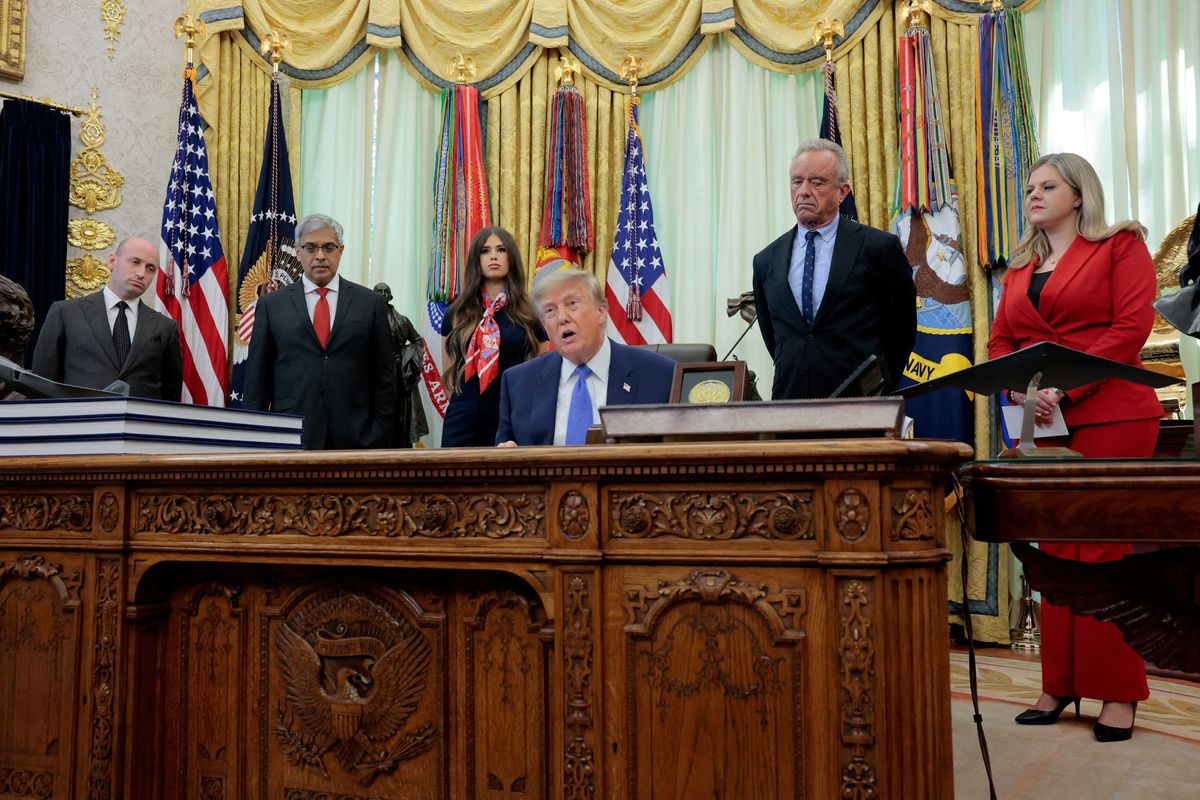
U.S. President Donald Trump attends an event to sign an executive order regarding vaccine flexibility, with Heidi Overton, White House Deputy Chief of Staff Stephen Miller, Dr. Jay Bhattacharya, Director of the National Institutes of Health, and Secretary of Health and Human Services (HHS) Robert F. Kennedy Jr., in the Oval Office at the White House in Washington, D.C., U.S., August 10, 2026. REUTERS/Kylie Coope
CNN's Daniel Dale debunked what he called "rapid-fire vaccine misinformation" provided by President Donald Trump to justify his executive order changing U.S. vaccine policy.
The 80-year-old made a series of false and misleading claims about vaccines and autism on Monday while signing an executive order recommending that children receive fewer vaccinations spread out over a longer period than called for by current guidelines, Dale reported for CNN.
Trump again suggested a link between vaccines and autism, saying rising autism rates coincided with "progressively more and more vaccines," but that connection has been debunked by more than 40 studies across seven countries involving over 5.6 million people.
"There's no new science," said Dr. Aaron Milstone of Johns Hopkins, a member of the American Academy of Pediatrics' infectious diseases committee. "Study after study have continued to show no associations between vaccines and autism." The vaccine-autism theory originated from a fraudulent, later-retracted 1990s study; experts attribute the real rise in diagnosed autism cases largely to improved detection and awareness, not vaccines.
Trump also renewed his call to split the combination measles-mumps-rubella (MMR) vaccine into three separate shots, claiming that together the vaccines "could be quite lethal." When a reporter pressed him for evidence, Trump admitted he had none, saying only that "some people" say so.
The CDC's own website states there is "no published scientific evidence" that separating the shots offers any benefit, and the combination vaccine has a decades-long safety record. Dr. Paul Offit of Children's Hospital of Philadelphia noted that splitting the doses would likely reduce the odds that children complete the full vaccination series and would mean more injections overall. Separate MMR shots aren't even manufactured in the U.S. currently, according to American Academy of Pediatrics president Dr. Andrew Racine.
Trump repeated his frequent claim that vaccine doses are "the size of a bottle of soda" injected into children. In reality, a typical dose like the MMR vaccine is about 0.5 milliliters — roughly a tenth of a teaspoon — compared with 500-600 milliliters in a standard soda bottle.
He also claimed autism prevalence was "1 in 10,000" 20 years ago, dramatically understating the actual rate. CDC data show the prevalence in 2006 was one in 110, and even in 2000 it was one in 150 — figures far higher than Trump's claim, which appears to reference estimates from studies conducted decades earlier, in the 1960s and 1970s.
Finally, Trump claimed children are required to get "72 jabs," a figure experts say is inflated. Racine said he didn't know where the number originated. It appears to count every individual vaccine dose through age 18 — including optional annual flu and COVID-19 shots that no state actually mandates for school attendance — as a separate "jab," even though some doses are combined into single shots or given orally.
Travis Gettys
August 11, 2026
RAW STORY
U.S. President Donald Trump attends an event to sign an executive order regarding vaccine flexibility, with Heidi Overton, White House Deputy Chief of Staff Stephen Miller, Dr. Jay Bhattacharya, Director of the National Institutes of Health, and Secretary of Health and Human Services (HHS) Robert F. Kennedy Jr., in the Oval Office at the White House in Washington, D.C., U.S., August 10, 2026. REUTERS/Kylie Coope
CNN's Daniel Dale debunked what he called "rapid-fire vaccine misinformation" provided by President Donald Trump to justify his executive order changing U.S. vaccine policy.
The 80-year-old made a series of false and misleading claims about vaccines and autism on Monday while signing an executive order recommending that children receive fewer vaccinations spread out over a longer period than called for by current guidelines, Dale reported for CNN.
Trump again suggested a link between vaccines and autism, saying rising autism rates coincided with "progressively more and more vaccines," but that connection has been debunked by more than 40 studies across seven countries involving over 5.6 million people.
"There's no new science," said Dr. Aaron Milstone of Johns Hopkins, a member of the American Academy of Pediatrics' infectious diseases committee. "Study after study have continued to show no associations between vaccines and autism." The vaccine-autism theory originated from a fraudulent, later-retracted 1990s study; experts attribute the real rise in diagnosed autism cases largely to improved detection and awareness, not vaccines.
Trump also renewed his call to split the combination measles-mumps-rubella (MMR) vaccine into three separate shots, claiming that together the vaccines "could be quite lethal." When a reporter pressed him for evidence, Trump admitted he had none, saying only that "some people" say so.
The CDC's own website states there is "no published scientific evidence" that separating the shots offers any benefit, and the combination vaccine has a decades-long safety record. Dr. Paul Offit of Children's Hospital of Philadelphia noted that splitting the doses would likely reduce the odds that children complete the full vaccination series and would mean more injections overall. Separate MMR shots aren't even manufactured in the U.S. currently, according to American Academy of Pediatrics president Dr. Andrew Racine.
Trump repeated his frequent claim that vaccine doses are "the size of a bottle of soda" injected into children. In reality, a typical dose like the MMR vaccine is about 0.5 milliliters — roughly a tenth of a teaspoon — compared with 500-600 milliliters in a standard soda bottle.
He also claimed autism prevalence was "1 in 10,000" 20 years ago, dramatically understating the actual rate. CDC data show the prevalence in 2006 was one in 110, and even in 2000 it was one in 150 — figures far higher than Trump's claim, which appears to reference estimates from studies conducted decades earlier, in the 1960s and 1970s.
Finally, Trump claimed children are required to get "72 jabs," a figure experts say is inflated. Racine said he didn't know where the number originated. It appears to count every individual vaccine dose through age 18 — including optional annual flu and COVID-19 shots that no state actually mandates for school attendance — as a separate "jab," even though some doses are combined into single shots or given orally.
Fact check: Trump makes numerous false and misleading claims about vaccines and autism
Daniel Dale, CNN
Tue, August 11, 2026
Vaccine doses are nowhere near 'the size of a bottle of soda'
Trump has repeatedly inflated the size of the vaccine doses American children receive as he has criticized US vaccination practices. He did it again Monday. This time, he said, "I saw this early on, and I've seen proof of it — where they have a vaccination that looks like the size of a bottle of soda poured into a little child's body."
In reality, no vaccine injected in a little child is even close to the size of a soda bottle; doses are far smaller than a teaspoon. The MMR vaccine, to cite a typical example, has a dosage of 0.5 milliliters, roughly a tenth of a teaspoon. Many soda bottles contain between 500 and 600 milliliters.
Autism was far more common 20 years ago than Trump claimed
Trump has repeatedly used wildly inaccurate figures when discussing the known prevalence of autism 20 years ago — shrinking that 2006 prevalence to make it sound as if there has been a far faster increase than there actually has been. On Monday, he said, as he has before, that it was "1 in 10,000 20 years ago."
That's not even close to true. The known prevalence of childhood autism was 1 in 110 in 2006, according to data published on the CDC website; even in 2000, it was 1 in 150. While some of the earliest studies on the subject, from the 1960s and 1970s, estimated autism prevalence to be in the range of 2 to 4 per 10,000 children, that was much further back than the "20 years ago" Trump used Monday and on prior occasions.
There are far fewer required shots than Trump said
While calling for children to receive fewer injections, Trump claimed, "In many cases, we were requiring 72 jabs for our beautiful, healthy, lovely, delicate little children."
That's a significant overstatement of the number of injections Americans are required to receive even by age 18, let alone during their littlest years. Racine said in the Monday briefing that he didn't know where Trump got the "72" figure.
Trump did not explain his math, but he appeared to be separately counting every single dose of every vaccine an American might receive by age 18 as a "jab" — even though some of those doses are commonly given orally or in a combination shot rather than in a separate injection. And Trump did not explain that it appears around half of the shots included in a "72" count would be optional annual flu and Covid-19 vaccinations; no state is "requiring" these shots for children to attend school.
Isa Mudannayake, Meg Tirrell, Brenda Goodman and Asuka Koda contributed to this article.
For more CNN news and newsletters create an account at CNN.com
Daniel Dale, CNN
Tue, August 11, 2026
President Donald Trump made numerous false or misleading claims about vaccines and autism on Monday.
Trump has long pushed vaccine misinformation. He delivered his latest inaccurate remarks at a White House event during which he signed an executive order that recommends that US children receive fewer vaccinations over a longer period of time than they do today.
Trump again floated the idea that vaccines cause autism, though that notion has been thoroughly debunked by extensive research in multiple countries. He again baselessly impugned the safety of the combination vaccine for measles, mumps and rubella, which has for decades proven highly safe and highly effective.
He again wildly overstated the size of the vaccine doses children receive, which are nowhere near "the size of a bottle of soda." He again wildly understated the prevalence of autism 20 years ago. And he again exaggerated the number of injections children have been required to receive.
Here is a fuller fact check of some of Trump's comments.
Studies have debunked the idea of a link between vaccines and autism
Trump did not explicitly assert that there is a connection between vaccines and autism. But he did once more hint at the idea that there might be a link, saying, "I came in and I said, 'I want to find what's going on with autism.' It's many, many times what it used to be years ago, and it gets progressively worse, and we had progressively more and more vaccines. "
Studies have shown there is no connection between vaccines and autism – as the US Centers for Disease Control and Prevention flatly stated on its website until the Trump administration baselessly changed the site's language to include unscientific talking points last fall.
"There's no new science," Dr. Aaron Milstone, professor of pediatrics at the Johns Hopkins University School of Medicine and member of the American Academy of Pediatrics' Committee on Infectious Diseases, said in a briefing Monday. "All the data say that there's no association between vaccines and autism. Study after study have continued to show no associations between vaccines and autism. So I think that's clear, and there are no new data."
Independent researchers across seven countries have conducted more than 40 studies involving over 5.6 million people to conclude that there is no link between vaccines and autism, Dr. Sean O'Leary, a professor of pediatrics and infectious diseases at the University of Colorado Denver Anschutz Medical Campus and Children's Hospital Colorado, said last fall. The idea of a link between vaccines and autism has "been debunked many times," said O'Leary, adding, "It is considered settled science."
Dr. Alycia Halladay, the chief science officer for the Autism Science Foundation, noted last fall that experiments in countries including Denmark, Sweden, Finland, Israel and Japan collected data from large groups of people and tracked their vaccination patterns and whether they had an autism diagnosis.
"All of those studies have shown no link between vaccines and autism," Halladay said. "It remains the No. 1 studied environmental factor in autism, and there is no link whatsoever."
The notion of a connection between the measles, mumps and rubella (MMR) vaccine and autism was popularized by a fraudulent, debunked study in the 1990s. There's no doubt that the known prevalence of autism has spiked in the 21st century, but experts have attributed the increase in large part to improvements in diagnostic practices and greater awareness of the symptoms.
The MMR vaccine is highly safe and highly effective
As Trump called Monday to split up the measles, mumps and rubella vaccine into separate shots, he baselessly suggested, as he has before, that the combination vaccine is unsafe.
"Together there could be a possibility they're quite lethal, and separately it looks like they are not at all lethal but just very effective," he said.
It's not true that the combination MMR vaccine could be "quite lethal." As the CDC website continued to say at the time Trump spoke Monday, the combination vaccine has proven "very safe" and has been highly effective since it was approved in the US in the early 1970s; it is used today in dozens of countries. Some children experience side effects, but those are usually mild and temporary.
"There have been no deaths shown to be related to the MMR vaccine in healthy people," the Infectious Diseases Society of America says on its website. "There have been rare cases of deaths from vaccine side effects among children who are immune compromised, which is why it is recommended that they don't get the vaccine."
At the time of Trump's remarks Monday, the CDC website still said: "No published scientific evidence shows any benefit in separating the combination MMR vaccine into three individual shots." And when a reporter asked Trump whether there is any evidence of lethality, he acknowledged he had none, instead saying, "What I've heard is that there are some people that say it is that way."
Whoever those "some people" are, they are not medical authorities.
"Numerous studies and many decades of experience have showed us that they are safe and that they work well when given together," Dr. Adam Ratner, a pediatric infectious diseases physician in New York City, said last fall.
"I'm not aware of any evidence that it's dangerous to give MMR together," Dr. Ofer Levy, a professor of pediatrics at Harvard Medical School and director of the Precision Vaccines Program at Boston Children's Hospital, said last fall after Trump made similar claims.
Separating the MMR vaccine into separate shots "doesn't make the vaccine safer," Dr. Paul Offit, a vaccine scientist at Children's Hospital of Philadelphia and former member of the CDC's independent vaccine advisory group, said Monday. "In fact, what it means is that you're probably less likely to finish all those six shots, and it's more painful for the child."
Separate vaccines for measles, mumps and rubella are not currently available in the US, and "it's impossible to separate out the MMR vaccine into its constituent components," Dr. Andrew Racine, president of the American Academy of Pediatrics, noted in the Monday briefing. Since the hypothetical separate vaccines would have to be manufactured and tested before they were deployed, "it would take a long, long time for that to be the case," he said.
Trump has long pushed vaccine misinformation. He delivered his latest inaccurate remarks at a White House event during which he signed an executive order that recommends that US children receive fewer vaccinations over a longer period of time than they do today.
Trump again floated the idea that vaccines cause autism, though that notion has been thoroughly debunked by extensive research in multiple countries. He again baselessly impugned the safety of the combination vaccine for measles, mumps and rubella, which has for decades proven highly safe and highly effective.
He again wildly overstated the size of the vaccine doses children receive, which are nowhere near "the size of a bottle of soda." He again wildly understated the prevalence of autism 20 years ago. And he again exaggerated the number of injections children have been required to receive.
Here is a fuller fact check of some of Trump's comments.
Studies have debunked the idea of a link between vaccines and autism
Trump did not explicitly assert that there is a connection between vaccines and autism. But he did once more hint at the idea that there might be a link, saying, "I came in and I said, 'I want to find what's going on with autism.' It's many, many times what it used to be years ago, and it gets progressively worse, and we had progressively more and more vaccines. "
Studies have shown there is no connection between vaccines and autism – as the US Centers for Disease Control and Prevention flatly stated on its website until the Trump administration baselessly changed the site's language to include unscientific talking points last fall.
"There's no new science," Dr. Aaron Milstone, professor of pediatrics at the Johns Hopkins University School of Medicine and member of the American Academy of Pediatrics' Committee on Infectious Diseases, said in a briefing Monday. "All the data say that there's no association between vaccines and autism. Study after study have continued to show no associations between vaccines and autism. So I think that's clear, and there are no new data."
Independent researchers across seven countries have conducted more than 40 studies involving over 5.6 million people to conclude that there is no link between vaccines and autism, Dr. Sean O'Leary, a professor of pediatrics and infectious diseases at the University of Colorado Denver Anschutz Medical Campus and Children's Hospital Colorado, said last fall. The idea of a link between vaccines and autism has "been debunked many times," said O'Leary, adding, "It is considered settled science."
Dr. Alycia Halladay, the chief science officer for the Autism Science Foundation, noted last fall that experiments in countries including Denmark, Sweden, Finland, Israel and Japan collected data from large groups of people and tracked their vaccination patterns and whether they had an autism diagnosis.
"All of those studies have shown no link between vaccines and autism," Halladay said. "It remains the No. 1 studied environmental factor in autism, and there is no link whatsoever."
The notion of a connection between the measles, mumps and rubella (MMR) vaccine and autism was popularized by a fraudulent, debunked study in the 1990s. There's no doubt that the known prevalence of autism has spiked in the 21st century, but experts have attributed the increase in large part to improvements in diagnostic practices and greater awareness of the symptoms.
The MMR vaccine is highly safe and highly effective
As Trump called Monday to split up the measles, mumps and rubella vaccine into separate shots, he baselessly suggested, as he has before, that the combination vaccine is unsafe.
"Together there could be a possibility they're quite lethal, and separately it looks like they are not at all lethal but just very effective," he said.
It's not true that the combination MMR vaccine could be "quite lethal." As the CDC website continued to say at the time Trump spoke Monday, the combination vaccine has proven "very safe" and has been highly effective since it was approved in the US in the early 1970s; it is used today in dozens of countries. Some children experience side effects, but those are usually mild and temporary.
"There have been no deaths shown to be related to the MMR vaccine in healthy people," the Infectious Diseases Society of America says on its website. "There have been rare cases of deaths from vaccine side effects among children who are immune compromised, which is why it is recommended that they don't get the vaccine."
At the time of Trump's remarks Monday, the CDC website still said: "No published scientific evidence shows any benefit in separating the combination MMR vaccine into three individual shots." And when a reporter asked Trump whether there is any evidence of lethality, he acknowledged he had none, instead saying, "What I've heard is that there are some people that say it is that way."
Whoever those "some people" are, they are not medical authorities.
"Numerous studies and many decades of experience have showed us that they are safe and that they work well when given together," Dr. Adam Ratner, a pediatric infectious diseases physician in New York City, said last fall.
"I'm not aware of any evidence that it's dangerous to give MMR together," Dr. Ofer Levy, a professor of pediatrics at Harvard Medical School and director of the Precision Vaccines Program at Boston Children's Hospital, said last fall after Trump made similar claims.
Separating the MMR vaccine into separate shots "doesn't make the vaccine safer," Dr. Paul Offit, a vaccine scientist at Children's Hospital of Philadelphia and former member of the CDC's independent vaccine advisory group, said Monday. "In fact, what it means is that you're probably less likely to finish all those six shots, and it's more painful for the child."
Separate vaccines for measles, mumps and rubella are not currently available in the US, and "it's impossible to separate out the MMR vaccine into its constituent components," Dr. Andrew Racine, president of the American Academy of Pediatrics, noted in the Monday briefing. Since the hypothetical separate vaccines would have to be manufactured and tested before they were deployed, "it would take a long, long time for that to be the case," he said.
Vaccine doses are nowhere near 'the size of a bottle of soda'
Trump has repeatedly inflated the size of the vaccine doses American children receive as he has criticized US vaccination practices. He did it again Monday. This time, he said, "I saw this early on, and I've seen proof of it — where they have a vaccination that looks like the size of a bottle of soda poured into a little child's body."
In reality, no vaccine injected in a little child is even close to the size of a soda bottle; doses are far smaller than a teaspoon. The MMR vaccine, to cite a typical example, has a dosage of 0.5 milliliters, roughly a tenth of a teaspoon. Many soda bottles contain between 500 and 600 milliliters.
Autism was far more common 20 years ago than Trump claimed
Trump has repeatedly used wildly inaccurate figures when discussing the known prevalence of autism 20 years ago — shrinking that 2006 prevalence to make it sound as if there has been a far faster increase than there actually has been. On Monday, he said, as he has before, that it was "1 in 10,000 20 years ago."
That's not even close to true. The known prevalence of childhood autism was 1 in 110 in 2006, according to data published on the CDC website; even in 2000, it was 1 in 150. While some of the earliest studies on the subject, from the 1960s and 1970s, estimated autism prevalence to be in the range of 2 to 4 per 10,000 children, that was much further back than the "20 years ago" Trump used Monday and on prior occasions.
There are far fewer required shots than Trump said
While calling for children to receive fewer injections, Trump claimed, "In many cases, we were requiring 72 jabs for our beautiful, healthy, lovely, delicate little children."
That's a significant overstatement of the number of injections Americans are required to receive even by age 18, let alone during their littlest years. Racine said in the Monday briefing that he didn't know where Trump got the "72" figure.
Trump did not explain his math, but he appeared to be separately counting every single dose of every vaccine an American might receive by age 18 as a "jab" — even though some of those doses are commonly given orally or in a combination shot rather than in a separate injection. And Trump did not explain that it appears around half of the shots included in a "72" count would be optional annual flu and Covid-19 vaccinations; no state is "requiring" these shots for children to attend school.
Isa Mudannayake, Meg Tirrell, Brenda Goodman and Asuka Koda contributed to this article.
For more CNN news and newsletters create an account at CNN.com
MS NOW host blows a fuse as Trump admin makes move that 'everybody feared would happen'
Tom Boggioni
August 11, 2026
.JPG)

Tom Boggioni
August 11, 2026
RAW STORY
.JPG)

An announcement by President Donald Trump and HHS Secretary Robert F. Kennedy Jr. on childhood vaccine scheduling for a personal response on MS NOW Tuesday morning.
On Monday, the two announced changes that are contrary to advice from medical experts, based on Trump and Kennedy’s mistaken insistence that there is a causal relationship between vaccines and autism.
With Trump calling the advisory a “major victory for parents' rights, religious and constitutional rights, and for the gold standard science,” MS NOW host Joe Scarborough claimed the president and RFK Jr. are way out of their lane and putting families in danger.
After sharing a clip of the president saying putting vaccines together can be “explosive,” the “Morning Joe” host bluntly stated, “That is just not true.”
“Physicians and scientists have said the MMR shot is safe and effective, and breaking it up could leave children vulnerable to dangerous diseases for longer,” co-host Mike Brzezinski contributed. “President Trump yesterday also repeatedly suggested the number or timing of vaccines could play a role in rising rates of autism, despite scientific consensus and decades of studies that have firmly concluded there is no link.”
Scarborough then went off.
“By the way, I just want to say, and we're going to go through all of this, I just want to say I have a child that's on the spectrum, and this is something I have studied intensively, even talking to Bobby 25 years ago — seen study after study after study,” he recalled.
“I've been looking at study after study after study, just like I've looked at study after study after study on diabetes,” he added. “There is not a single relevant study, there's not a single legitimate study that suggests vaccines play any role in the rise of autism. If there were, I would have been telling you about it over the past 20 years.”
“There's not one legitimate study,” he continued. “You know, there was a bogus study done for trial lawyers, which Bobby Kennedy is one of the trial lawyers, that was published in The Lancet [at the end of the 90s. It was like 12 people and they all separated themselves from it because it was false. It was a scam!”
Scarborough fumed that seeing the claims repeated in the Oval Office represented what "everybody feared would happen" putting Kennedy in charge of HHS.
"This is so stupid. And it's so dangerous. And it's spread so much disinformation," he railed.
On Monday, the two announced changes that are contrary to advice from medical experts, based on Trump and Kennedy’s mistaken insistence that there is a causal relationship between vaccines and autism.
With Trump calling the advisory a “major victory for parents' rights, religious and constitutional rights, and for the gold standard science,” MS NOW host Joe Scarborough claimed the president and RFK Jr. are way out of their lane and putting families in danger.
After sharing a clip of the president saying putting vaccines together can be “explosive,” the “Morning Joe” host bluntly stated, “That is just not true.”
“Physicians and scientists have said the MMR shot is safe and effective, and breaking it up could leave children vulnerable to dangerous diseases for longer,” co-host Mike Brzezinski contributed. “President Trump yesterday also repeatedly suggested the number or timing of vaccines could play a role in rising rates of autism, despite scientific consensus and decades of studies that have firmly concluded there is no link.”
Scarborough then went off.
“By the way, I just want to say, and we're going to go through all of this, I just want to say I have a child that's on the spectrum, and this is something I have studied intensively, even talking to Bobby 25 years ago — seen study after study after study,” he recalled.
“I've been looking at study after study after study, just like I've looked at study after study after study on diabetes,” he added. “There is not a single relevant study, there's not a single legitimate study that suggests vaccines play any role in the rise of autism. If there were, I would have been telling you about it over the past 20 years.”
“There's not one legitimate study,” he continued. “You know, there was a bogus study done for trial lawyers, which Bobby Kennedy is one of the trial lawyers, that was published in The Lancet [at the end of the 90s. It was like 12 people and they all separated themselves from it because it was false. It was a scam!”
Scarborough fumed that seeing the claims repeated in the Oval Office represented what "everybody feared would happen" putting Kennedy in charge of HHS.
"This is so stupid. And it's so dangerous. And it's spread so much disinformation," he railed.
Trump signs order calling for spacing out childhood vaccines, against medical groups' guidance
ALI SWENSON and COLLIN BINKLEY
Updated Mon, August 10, 2026
ALI SWENSON and COLLIN BINKLEY
Updated Mon, August 10, 2026
AP

President Donald Trump holds up an image taken from his Truth Social account as Health and Human Services Secretary Robert F. Kennedy Jr. watches during a meeting to sign an executive order about vaccines, Monday, Aug. 10, 2026, in the Oval Office of the White House in Washington. (AP Photo/Jacquelyn Martin) (AP Photo/Jacquelyn Martin)

Health and Human Services Secretary Robert F. Kennedy Jr. speaks as President Donald Trump listens during a meeting to sign an executive order about vaccines, Monday, Aug. 10, 2026, in the Oval Office of the White House in Washington. (AP Photo/Jacquelyn Martin) (AP Photo/Jacquelyn Martin)

National Institutes of Health Director Dr. Jay Bhattacharya speaks during a meeting to sign an executive order about vaccines, Monday, Aug. 10, 2026, in the Oval Office of the White House in Washington. (AP Photo/Jacquelyn Martin) (AP Photo/Jacquelyn Martin)
WASHINGTON (AP) — President Donald Trump on Monday signed an executive order calling for revamped childhood vaccine recommendations that promote his long-held but discredited theory that childhood shots should be spaced out into separate medical visits.
The order advocates separating the measles, mumps and rubella (MMR) vaccine into three different single-disease shots and administering all childhood immunizations at separate appointments whenever possible. It also directs the nation's health department to improve research on vaccines, which are already extensively studied, and present a plan to offer separate measles, mumps, and rubella vaccines for children, since that is not currently an option in the United States.
The renewed focus on vaccines marks a departure from the Trump administration's recent efforts to emphasize less controversial health policies related to healthy eating, drug price negotiations and medical fraud crackdowns ahead of November's midterm elections.
Public health experts have raised concerns that spacing out shots as Trump suggests can lead to an increased risk that children become infected with a vaccine-preventable disease before returning for another visit. Childhood vaccines — and how and when to give them in combination — go through rigorous studies, and safety tracking continues for years as the shots are used.
Trump called the announcement a "major victory for parents rights, religious and constitutional rights, and for the gold standard science."
Speaking about the order at the Oval Office on Monday, Trump repeatedly suggested the number or timing of vaccines could play a role in rising rates of autism spectrum disorder, even as scientific consensus and decades of studies have firmly concluded there is no link. The order also includes several changes to the childhood vaccine schedule that his health department has already attempted, but that have been blocked by a federal judge. A White House official who insisted on anonymity to brief reporters said Trump was within his right to provide his own recommendation through the executive order and said the lawsuit blocking the health department's schedule was a separate issue.
Dr. Andrew Racine, president of the American Academy of Pediatrics, said the announcement spreads uncertainty, fear and confusion where "there doesn't need to be any of that." He disputed Trump's recommendations and said previous ones should stand.
"Science about vaccines and their efficacy has not changed," he said. "The distribution of viruses and other pathogens in our environment has not changed. Children in this country have not changed in the last 48 hours."
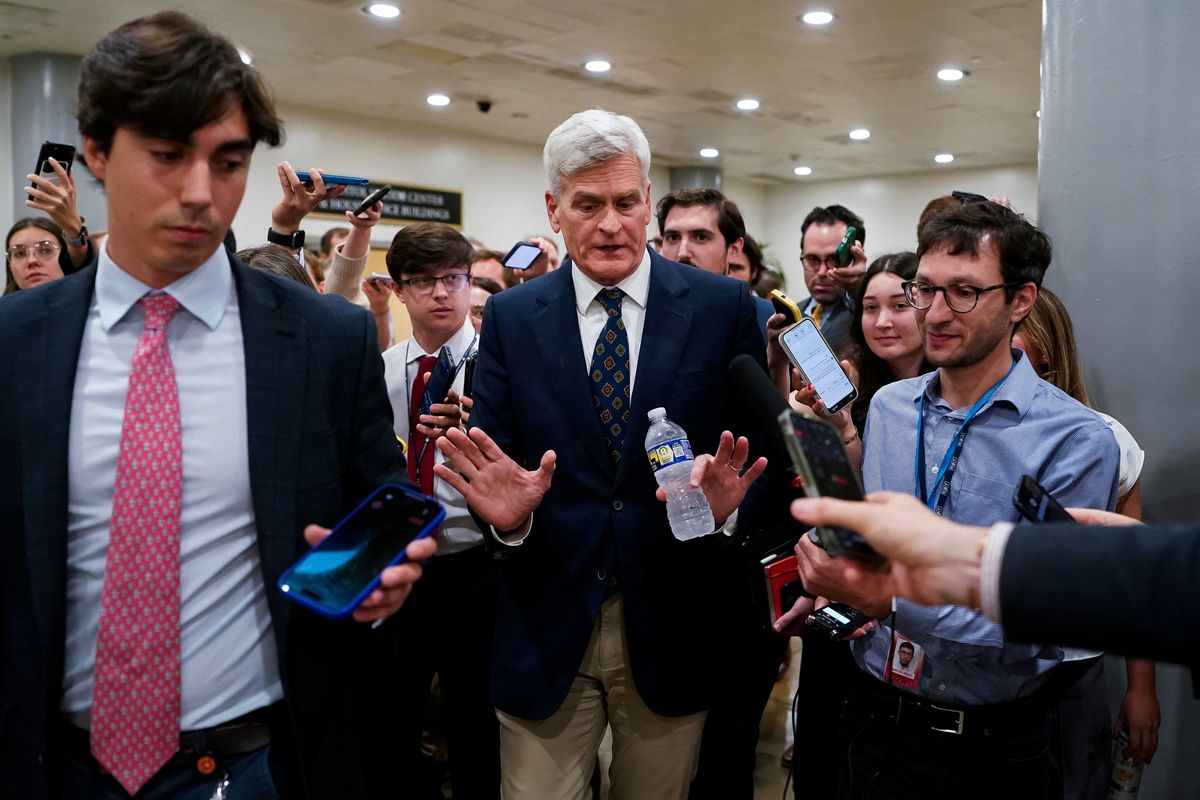
Sen. Bill Cassidy, the Republican chair of the Senate health committee, slammed the executive order in a social media post, saying vaccines are safe and do not cause autism.
"I'm a doctor. This executive order is wrong," the Louisiana senator wrote. "The President does not have the expertise to make these changes."
Who is in charge of vaccine policy?
Even as the order calls for revised vaccine recommendations, states, not the federal government, have the authority to require vaccinations for schoolchildren. The order advises states with school vaccine mandates to consider updating their laws to reflect the administration's preferred schedule, according to a White House fact sheet.
Last December, Trump ordered the Department of Health and Human Services to review how peer nations approach vaccine recommendations and consider revising U.S. guidance accordingly. The department responded by cutting the number of vaccines it recommends for every child, a move that has since been blocked in court.
Changes to federal childhood vaccine recommendations customarily require approval from the director of the Centers for Disease Control and Prevention. The newly Senate-confirmed CDC director, Dr. Erica Schwartz, oversaw policies promoting vaccination of service members while in a leadership position at the U.S. Coast Guard.
However, public health law expert Lawrence Gostin at Georgetown University said the Supreme Court's interpretation of Trump's power may allow him to supersede Schwartz if she does not agree to new recommendations.
"This is clearly the first test for Dr. Erica Schwartz," Gostin said in an email. "The President is placing her in an untenable position."
Asked on a call with reporters why the president was advocating splitting MMR into three single-disease vaccines, the White House official did not provide any studies supporting the decision. They said that was Trump's long-held view and that some countries provide individual measles vaccines in certain circumstances.
Kush Desai, a Trump spokesperson, told The Associated Press that the president is "one of countless parents who have voiced questions and concerns about the combined MMR vaccine" and said the plan to develop single-disease vaccines would "give parents more options on timing and frequency for their children," ultimately increasing vaccine uptake.
Studies of babies and toddlers in the U.S. have shown that the use of combination shots for childhood vaccines, rather than single ones, increased the likelihood of completing all recommended vaccinations by the age of 2.
Announcement follows other Trump administration vaccine actions
Health Secretary Robert F. Kennedy Jr., an anti-vaccine activist before he entered politics, set out to overhaul immunization guidance at DHS in the first year of Trump's term. He fired an entire 17-member vaccine advisory committee, installing replacements who made far more restrictive recommendations that have since been halted by a federal judge. He also personally directed the CDC to abandon its position that vaccines do not cause autism, without supplying any new evidence to support the change.
Throughout his second term, Trump has been fixated on connecting autism to vaccines. He has recently ramped up pressure on Kennedy to identify the cause of autism, something Kennedy had pledged to do with new research unveiled last year. Trump publicly prodded the health secretary for an update on autism research in a Cabinet meeting last month.
"How are you doing on the autism research?" Trump asked.
"We will have an answer for you," Kennedy said.
Scientific consensus and decades of studies have firmly concluded there is no link between childhood vaccines and autism. Racine reiterated that point on Monday, noting that the potential link had been studied in "over 40 methodologically well-designed studies in over seven countries involving over 5 million children."
"I'm not sure that there is anything that has been as thoroughly looked at as this question," he said. "And the answer is unequivocally no."
In the Oval Office, Kennedy repeated his assertion that he believes an unknown environmental factor is to blame for rising autism diagnoses and said that his department will deliver research findings "as soon as they are ready."
Monday's order comes as students are returning to classrooms around the country and the nation contends with a measles outbreak that experts say could result in the U.S. losing its measles elimination status.
Doctors have raised concerns that Trump's falsehoods on vaccines could stoke vaccine hesitancy. Federal data shows U.S. kindergarten vaccination rates have been dropping, with the share of children with exemptions rising to an all-time high in the 2024-25 school year.
___
Associated Press writers Laura Ungar and Mike Stobbe contributed to this report. Swenson reported from New York.
President Donald Trump holds up an image taken from his Truth Social account as Health and Human Services Secretary Robert F. Kennedy Jr. watches during a meeting to sign an executive order about vaccines, Monday, Aug. 10, 2026, in the Oval Office of the White House in Washington. (AP Photo/Jacquelyn Martin) (AP Photo/Jacquelyn Martin)
Health and Human Services Secretary Robert F. Kennedy Jr. speaks as President Donald Trump listens during a meeting to sign an executive order about vaccines, Monday, Aug. 10, 2026, in the Oval Office of the White House in Washington. (AP Photo/Jacquelyn Martin) (AP Photo/Jacquelyn Martin)
National Institutes of Health Director Dr. Jay Bhattacharya speaks during a meeting to sign an executive order about vaccines, Monday, Aug. 10, 2026, in the Oval Office of the White House in Washington. (AP Photo/Jacquelyn Martin) (AP Photo/Jacquelyn Martin)
WASHINGTON (AP) — President Donald Trump on Monday signed an executive order calling for revamped childhood vaccine recommendations that promote his long-held but discredited theory that childhood shots should be spaced out into separate medical visits.
The order advocates separating the measles, mumps and rubella (MMR) vaccine into three different single-disease shots and administering all childhood immunizations at separate appointments whenever possible. It also directs the nation's health department to improve research on vaccines, which are already extensively studied, and present a plan to offer separate measles, mumps, and rubella vaccines for children, since that is not currently an option in the United States.
The renewed focus on vaccines marks a departure from the Trump administration's recent efforts to emphasize less controversial health policies related to healthy eating, drug price negotiations and medical fraud crackdowns ahead of November's midterm elections.
Public health experts have raised concerns that spacing out shots as Trump suggests can lead to an increased risk that children become infected with a vaccine-preventable disease before returning for another visit. Childhood vaccines — and how and when to give them in combination — go through rigorous studies, and safety tracking continues for years as the shots are used.
Trump called the announcement a "major victory for parents rights, religious and constitutional rights, and for the gold standard science."
Speaking about the order at the Oval Office on Monday, Trump repeatedly suggested the number or timing of vaccines could play a role in rising rates of autism spectrum disorder, even as scientific consensus and decades of studies have firmly concluded there is no link. The order also includes several changes to the childhood vaccine schedule that his health department has already attempted, but that have been blocked by a federal judge. A White House official who insisted on anonymity to brief reporters said Trump was within his right to provide his own recommendation through the executive order and said the lawsuit blocking the health department's schedule was a separate issue.
Dr. Andrew Racine, president of the American Academy of Pediatrics, said the announcement spreads uncertainty, fear and confusion where "there doesn't need to be any of that." He disputed Trump's recommendations and said previous ones should stand.
"Science about vaccines and their efficacy has not changed," he said. "The distribution of viruses and other pathogens in our environment has not changed. Children in this country have not changed in the last 48 hours."
Sen. Bill Cassidy, the Republican chair of the Senate health committee, slammed the executive order in a social media post, saying vaccines are safe and do not cause autism.
"I'm a doctor. This executive order is wrong," the Louisiana senator wrote. "The President does not have the expertise to make these changes."
Who is in charge of vaccine policy?
Even as the order calls for revised vaccine recommendations, states, not the federal government, have the authority to require vaccinations for schoolchildren. The order advises states with school vaccine mandates to consider updating their laws to reflect the administration's preferred schedule, according to a White House fact sheet.
Last December, Trump ordered the Department of Health and Human Services to review how peer nations approach vaccine recommendations and consider revising U.S. guidance accordingly. The department responded by cutting the number of vaccines it recommends for every child, a move that has since been blocked in court.
Changes to federal childhood vaccine recommendations customarily require approval from the director of the Centers for Disease Control and Prevention. The newly Senate-confirmed CDC director, Dr. Erica Schwartz, oversaw policies promoting vaccination of service members while in a leadership position at the U.S. Coast Guard.
However, public health law expert Lawrence Gostin at Georgetown University said the Supreme Court's interpretation of Trump's power may allow him to supersede Schwartz if she does not agree to new recommendations.
"This is clearly the first test for Dr. Erica Schwartz," Gostin said in an email. "The President is placing her in an untenable position."
Asked on a call with reporters why the president was advocating splitting MMR into three single-disease vaccines, the White House official did not provide any studies supporting the decision. They said that was Trump's long-held view and that some countries provide individual measles vaccines in certain circumstances.
Kush Desai, a Trump spokesperson, told The Associated Press that the president is "one of countless parents who have voiced questions and concerns about the combined MMR vaccine" and said the plan to develop single-disease vaccines would "give parents more options on timing and frequency for their children," ultimately increasing vaccine uptake.
Studies of babies and toddlers in the U.S. have shown that the use of combination shots for childhood vaccines, rather than single ones, increased the likelihood of completing all recommended vaccinations by the age of 2.
Announcement follows other Trump administration vaccine actions
Health Secretary Robert F. Kennedy Jr., an anti-vaccine activist before he entered politics, set out to overhaul immunization guidance at DHS in the first year of Trump's term. He fired an entire 17-member vaccine advisory committee, installing replacements who made far more restrictive recommendations that have since been halted by a federal judge. He also personally directed the CDC to abandon its position that vaccines do not cause autism, without supplying any new evidence to support the change.
Throughout his second term, Trump has been fixated on connecting autism to vaccines. He has recently ramped up pressure on Kennedy to identify the cause of autism, something Kennedy had pledged to do with new research unveiled last year. Trump publicly prodded the health secretary for an update on autism research in a Cabinet meeting last month.
"How are you doing on the autism research?" Trump asked.
"We will have an answer for you," Kennedy said.
Scientific consensus and decades of studies have firmly concluded there is no link between childhood vaccines and autism. Racine reiterated that point on Monday, noting that the potential link had been studied in "over 40 methodologically well-designed studies in over seven countries involving over 5 million children."
"I'm not sure that there is anything that has been as thoroughly looked at as this question," he said. "And the answer is unequivocally no."
In the Oval Office, Kennedy repeated his assertion that he believes an unknown environmental factor is to blame for rising autism diagnoses and said that his department will deliver research findings "as soon as they are ready."
Monday's order comes as students are returning to classrooms around the country and the nation contends with a measles outbreak that experts say could result in the U.S. losing its measles elimination status.
Doctors have raised concerns that Trump's falsehoods on vaccines could stoke vaccine hesitancy. Federal data shows U.S. kindergarten vaccination rates have been dropping, with the share of children with exemptions rising to an all-time high in the 2024-25 school year.
___
Associated Press writers Laura Ungar and Mike Stobbe contributed to this report. Swenson reported from New York.
Michael Loria,
USA TODAY
Updated Mon, August 10, 2026

President Donald Trump is hailing his new order on vaccines as a win for freedom of choice in children's future medical care but critics are slamming the move, saying it could lead to greater risk of diseases rarely seen for generations.
Trump signed an executive order Monday, Aug. 10, aimed at giving Americans more choice in terms of what vaccines their children take, according to the White House. The order aims to decrease the number of vaccines children take and split vaccines that have been administered in a single shot into several split across separate doctor's visits.
"Nothing bad can happen from what we're doing," Trump said. "It's possible it doesn't work. I don't think that's much of a possibility, frankly. We're going to learn a lot."
But critics, including elected Republican Party officials, say the new White House policy will make children less safe and will add healthcare costs for parents.
U.S. Senator Bill Cassidy, a Louisiana Republican and physician, said the White House directive trade on a claim unsupported by science that vaccines are harmful and cause autism.
"Parents should listen to their child's pediatrician about vaccines rather than listening to an inaccurate executive order," Cassidy said in a statement on his official X page. "This is so wrong."
Health experts also criticized the plan.
"This upends decades of public health practice and consensus and it's been done unilaterally without reason and without evidence," Lawrence Gostin, a global health law professor at Georgetown University, told USA TODAY.
He added: "Childhood vaccines have been the greatest public health achievements in our lifetimes and they have the best track record of any medical intervention for safety and effectiveness and by reducing the number of vaccines and also requiring many additional doctor's visits, it's going to open up even wider gaps in immunization coverage among children."
Gostin predicted that major outbreaks of measles, mumps, rubella and other childhood diseases are inevitable and that some children will die.
Trump's new "Delivering Gold Standard Childhood Vaccine Recommendations for Americans" is the White House's latest effort to change the landscape in vaccines across the country. Previous administration efforts have been blocked in court.
The president told reporters in the Oval Office on Aug. 10 that the order comes in response to claims that some vaccines are "quite lethal" and "explosive" when taken together, though he said he does not have evidence to support such claims.
Trump said the order does not force parents to limit vaccinations.
"Parents can still choose to give their children all of the vaccinations if they wish," Trump said on Aug. 10 before signing the order. "They will be covered by insurance."

Robert F. Kennedy, Jr., Secretary of Health and Human Services, testifies about the health care agenda for the Trump administration in front of the Senate Committee on Finance in Washington, D.C., on September 4, 2025. (Jack Gruber, USA TODAY)
Updated Mon, August 10, 2026
President Donald Trump is hailing his new order on vaccines as a win for freedom of choice in children's future medical care but critics are slamming the move, saying it could lead to greater risk of diseases rarely seen for generations.
Trump signed an executive order Monday, Aug. 10, aimed at giving Americans more choice in terms of what vaccines their children take, according to the White House. The order aims to decrease the number of vaccines children take and split vaccines that have been administered in a single shot into several split across separate doctor's visits.
"Nothing bad can happen from what we're doing," Trump said. "It's possible it doesn't work. I don't think that's much of a possibility, frankly. We're going to learn a lot."
But critics, including elected Republican Party officials, say the new White House policy will make children less safe and will add healthcare costs for parents.
U.S. Senator Bill Cassidy, a Louisiana Republican and physician, said the White House directive trade on a claim unsupported by science that vaccines are harmful and cause autism.
"Parents should listen to their child's pediatrician about vaccines rather than listening to an inaccurate executive order," Cassidy said in a statement on his official X page. "This is so wrong."
Health experts also criticized the plan.
"This upends decades of public health practice and consensus and it's been done unilaterally without reason and without evidence," Lawrence Gostin, a global health law professor at Georgetown University, told USA TODAY.
He added: "Childhood vaccines have been the greatest public health achievements in our lifetimes and they have the best track record of any medical intervention for safety and effectiveness and by reducing the number of vaccines and also requiring many additional doctor's visits, it's going to open up even wider gaps in immunization coverage among children."
Gostin predicted that major outbreaks of measles, mumps, rubella and other childhood diseases are inevitable and that some children will die.
Trump's new "Delivering Gold Standard Childhood Vaccine Recommendations for Americans" is the White House's latest effort to change the landscape in vaccines across the country. Previous administration efforts have been blocked in court.
The president told reporters in the Oval Office on Aug. 10 that the order comes in response to claims that some vaccines are "quite lethal" and "explosive" when taken together, though he said he does not have evidence to support such claims.
Trump said the order does not force parents to limit vaccinations.
"Parents can still choose to give their children all of the vaccinations if they wish," Trump said on Aug. 10 before signing the order. "They will be covered by insurance."
Robert F. Kennedy, Jr., Secretary of Health and Human Services, testifies about the health care agenda for the Trump administration in front of the Senate Committee on Finance in Washington, D.C., on September 4, 2025. (Jack Gruber, USA TODAY)
Sen. Ron Wyden (D-OR) questions Robert F. Kennedy, Jr., Secretary of Health and Human Services, as he testifies about the health care agenda for the Trump administration in front of the Senate Committee on Finance in Washington, D.C., on September 4, 2025. (Jack Gruber, USA TODAY)
The White House's new executive order urges U.S. states and territories to follow a new blueprint for administering vaccines that would upend decades of public health practice.
Trump's order generally aims to lower the number of vaccines children take by recommending shots be administered in separate visits, by narrowing the number of people to hom the White House recommends for some vaccines and by offering support to parents who don't want their children to be vaccinated.
Among the recommendations, Trump's order calls for separating the combined measles, mumps and rubella vaccine into separate shots that would be administered across several doctor's visits. The combination shot is widely known as the MMR vaccine.
White House officials did not have an immediate answer on how federal officials would address rising medical bills resulting from additional doctor's visits. Trump earlier promised that vaccines would remain covered by insurance.
Health experts prefer combination formulations, including the MMR vaccine, because they target more than one pathogen, require fewer shots, and research shows patients are more likely to complete recommended vaccine series when fewer shots are involved.
It's unclear how soon the MMR separation recommendation could be implemented. The combination shot has been administered since 1971 and most vaccine makers manufacture the shot as a combination, not as individual vaccines.
According to the new order, the Department of Justice will also support parents aiming to challenge in court existing public standards. White House officials said the order aims to "maximize parental choice."
What does the order do?
The White House's order has no binding effect as law and should not be taken as a change in federal vaccine policy.
According to experts, changing federal vaccine recommendations is a rigorous process based upon reviews of evidence.
The Trump administration's order better serves as a blueprint for states and territories to adopt. But given the president's sway in Republican-led states, the order is expected to have a potentially broad impact, especially as the number of unvaccinated children traveling around the country rises.
"None of it [is] based in science," Peter J. Hotez, a vaccine pediatrician and scientist at Texas Medical Center, said of the White House order in a statement. "Measles has already returned, and we should expect congenital rubella syndrome to follow, pertussis also at risk, and even polio wouldn't surprise me."
What impact could the order have on the spread of disease?
Dorit Reiss, a law professor at the University of California College of the Law, San Francisco, noted the White House's recommendations come out amid ongoing measles and pertussis outbreaks. Pertussis is more commonly known as whooping cough.
"Did @SecKennedy not tell the president about the ongoing Trump/Kennedy measles and pertussis outbreaks, the deaths from them, and the fact that we will likely lose our measles elimination status on his watch?" said Reiss in a statement on X. "Someone should tell the President about that."
Measles was rare until 2025 when some 2,280 cases were seen across the country, according to Johns Hopkins. There have been nearly 2,500 cases so far in 2026. Almost all cases are reported among people who are unvaccinated or unknown to be vaccinated.
According to Johns Hopkins, 2025 saw the greatest number of whooping cough cases since 2012 with 29,000. The rising number of cases comes amid falling vaccination rates. Newborns and infants are particularly vulnerable to the disease.
Trump mocked over apparent zone-out during Oval Office vaccine announcement
Brendan Rascius
Mon, August 10, 2026
Mon, August 10, 2026
THE INDEPENDENT

President Donald Trump appeared to zone out during an Oval Office announcement on vaccines, prompting mockery online.
President Donald Trump appeared to zone out during an Oval Office announcement on vaccines, prompting a fresh round of mockery online.
On Monday, Trump signed an executive order that calls for reducing the number of vaccines recommended for children and splitting the MMR shot — which protects against measles, mumps and rubella — into three individual vaccines.
The order is the latest step in the administration's campaign to remake the childhood vaccination schedule, led by Health and Human Services Secretary Robert F. Kennedy Jr., who has long questioned vaccine safety.
During the ceremony, the 80-year-old president appeared to repeatedly close his eyes while seated behind the Resolute Desk — including as Kennedy and National Institutes of Health Director Jay Bhattacharya spoke beside him.
Videos of the moments quickly circulated on social media.
President Donald Trump appeared to zone out during an Oval Office announcement on vaccines, prompting a fresh round of mockery online.
On Monday, Trump signed an executive order that calls for reducing the number of vaccines recommended for children and splitting the MMR shot — which protects against measles, mumps and rubella — into three individual vaccines.
The order is the latest step in the administration's campaign to remake the childhood vaccination schedule, led by Health and Human Services Secretary Robert F. Kennedy Jr., who has long questioned vaccine safety.
During the ceremony, the 80-year-old president appeared to repeatedly close his eyes while seated behind the Resolute Desk — including as Kennedy and National Institutes of Health Director Jay Bhattacharya spoke beside him.
Videos of the moments quickly circulated on social media.
President Donald Trump appeared to zone out during a vaccine announcement in the Oval Office on Monday with HHS Secretary Robert F. Kennedy Jr (AFP via Getty Images)
"I love how he pops out of it for a few seconds then closes his eyes again and he's right back in dream land. This is getting ridiculous," wrote one X user. Another chimed in: "Why doesn't the assembled media speak out about this...they all see it."
"What a loser," a third user wrote. "After years of listening to those 'sleepy joe' comments…" The remark referred to Trump's longtime nickname for former President Joe Biden, whom he repeatedly accused of being mentally and physically unfit for office.
Some commenters, however, were more supportive of the president. "In Trump's defense, good Lord, the speaker is boring," one wrote.
The White House defended Trump, saying: "President Trump's sharpness, unmatched energy, and historic accessibility stand in stark contrast to what we saw during the last administration when Democrats and the legacy media intentionally covered up Joe Biden's serious mental and physical decline from the American people. President Trump is the sharpest and most accessible President in American history who is working nonstop to solve problems and deliver on his promises."
Trump, the oldest person ever inaugurated as president, has faced persistent scrutiny over his health since returning to the White House, including over moments during official events in which he has appeared to close his eyes for extended periods. One such moment came during Lindsey Graham's funeral last month.
"The president has severe daytime somnolence," CNN medical analyst Dr. Jonathan Reiner said in May. "He falls asleep very often. He's fallen asleep in the Oval Office on multiple occasions with people talking to him, in the cabinet room," he said. "And chronic insomnia is a severe illness. It can result in an increase in risk of dementia, a decrease in cognitive effects in older people."
Director of the National Institutes of Health Jay Bhattacharya (L) speaks before President Donald Trump signs an executive order calling for more research and flexibility on vaccines (AFP via Getty Images)More
Trump, for his part, has repeatedly insisted that he is in excellent health. After a physical at Walter Reed in May, the president wrote on Truth Social that "everything" had "checked out PERFECTLY."
In a YouGov survey conducted last year, 78 percent of respondents said they believed Trump had not been transparent about his physical health.
The Independent has contacted the White House for comment.