Thursday, August 13, 2026


World ties its hottest month on record as July heat sweeps three continents

World ties its hottest month on record as July heat sweeps three continents
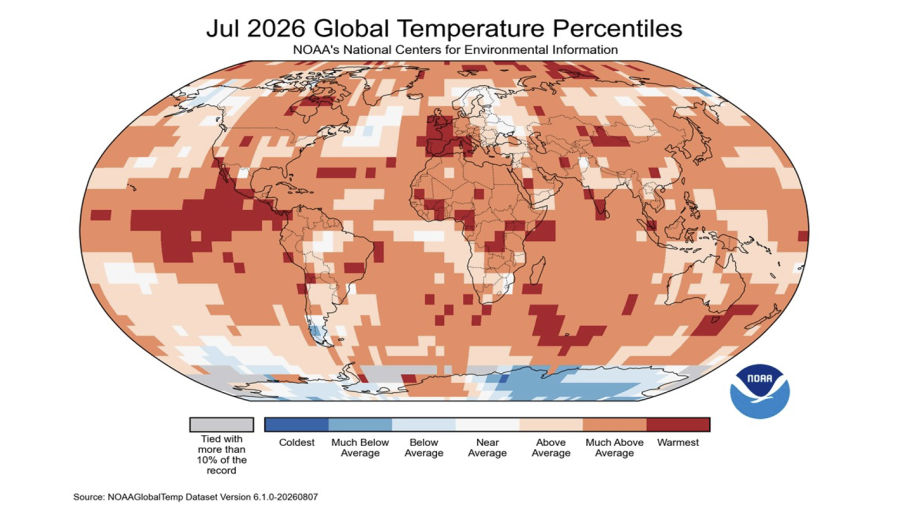
Record-high July temperatures spanned western Europe, the Americas, Africa, Asia and the Arctic, with only a sliver of Antarctica running cold. / bne IntelliNewsFacebook
By Ben Aris in Berlin August 13, 2026

The planet has just endured its joint-hottest month in 176 years of record-keeping, as searing July heat handed North America, Africa and Asia their warmest month ever.

July 2026 tied with July 2024 as the hottest July since global records began in 1850, the US National Oceanic and Atmospheric Administration (NOAA) reported on August 11, with global surface temperatures running 1.18C above the twentieth-century average.

The rankings split by dataset: NASA rated July 2026 the hottest July outright, while Copernicus and the World Meteorological Organization placed it second, 1.47C above the pre-industrial average. Either way, the four warmest Julys on the books are now the past four.

July is climatologically the warmest month of the year, which makes the two tied Julys, on NOAA's reckoning, “more likely than not the hottest months on record for the globe since 1850”.

Figure 1. Departure of July 2026 temperatures from the 1991-2020 average. Record warmth (dark red) stretched across western Europe, the Americas, Africa, Asia and the Arctic; only a small part of Antarctica ran cold. Image credit: NOAA/NCEI

The oceans did the heavy lifting. Global sea-surface temperatures set a July record, running 1.02C above average – the first July past that mark – as the daily reading for the 60°S-60°N band closed the month at 21.05C, a hair behind the all-time high set in March 2024.

Behind the heat sits a strengthening El Niño. NOAA puts near-certain odds on the event lasting into February 2027, with temperatures in the benchmark Niño 3.4 region already 1.8C above average and edging towards the 2C mark that defines a “super” El Niño. A record-strong event layered on the warming trend could yet tip 2026 or 2027 into all-time-hottest-year territory.

Europe managed only its seventh-warmest July as a whole, yet western Europe lived through its hottest June-July on record. Late-June heat had already handed Hungary its hottest day on record and pushed Poland past 40C for the first time. Seventeen countries or territories beat or tied an all-time heat record over the period; the Northern Hemisphere's top reading was 52.7C at Omidieh, Iran, on July 14.

The United States, meanwhile, logged its hottest month in recorded history, eclipsing the Dust Bowl peak of 1936. Insurance broker Gallagher Re counted 29 billion-dollar weather disasters worldwide in 1H26, at a cost of $104bn – which it called a “manageable start”, still short of the $139bn decade average.

The bill is mounting all the same: extreme heat could cost Europe's economy €800bn by 2030, insurer Allianz has warned. At the poles, Arctic sea-ice cover shrank to its sixth-lowest July extent in the 48-year satellite record and Antarctic ice to its fifth-lowest. Across the month at least 250 weather stations with data back to 1980 set – not merely tied – an all-time heat record, on a tally by records tracker Maximiliano Herrera published in Yale Climate Connections.


Anthropic joins race to acquire Israel's Decart AI for $6bn

Anthropic joins race to acquire Israel's Decart AI for $6bn
“Claude AI by Anthropic” by Anthropic, CC BY 2.0 “Claude AI by Anthropic” by Anthropic, CC BY 2.0 / CC: AnthropicFacebook
By IntelliNews Tel Aviv bureau August 13, 2026

Anthropic is in acquisition talks for Israeli artificial intelligence startup Decart AI at a valuation of approximately $6bn, local Israeli media reported.

As the AI race continues to intensify, so too has the battle to acquire the Israeli AI company, which specialises in generating simulated 3D environments and instantly transforming live video feeds.

The Claude AI developer joins a crowded field, with Nvidia, Amazon, and SpaceX all listed as interested parties in Decart’s acquisition in recent weeks. Nvidia had been in exclusive talks to acquire Decart and participated in its most recent funding round, but negotiations collapsed after a larger bidder entered, Hebrew language Calcalist reported.

Decart, founded in 2023 by Dean Leitersdorf and Moshe Shalev, both veterans of IDF intelligence unit 8200, has raised $450mn across four rounds in under three years.

Its seed round of $21mn was led by Sequoia Capital, followed within a month by a $25mn round at a $500mn valuation led by Benchmark. A third round valued the company at $3.1bn, and in early 2026 it closed a further $300mn at a $4bn valuation, with Israel's Aleph Fund joining the cap table.

Decart's core technology generates video in real time at significantly lower computational cost than competing models, positioning it as infrastructure-layer software for AI hardware manufacturers.

The company gained wide attention with OASIS, a real-time generative game that reached 1mn users in three days. Decart is also developing world models capable of modifying live video feeds in real time, a capability viewed as evidence of the depth of its infrastructure engineering.

For Anthropic, which has been spending heavily on computing capacity to develop and support its Claude model family, Decart's chip-efficiency software could reduce the cost of running AI workloads at scale.

If a deal closes, Decart's engineering team is expected to join Anthropic's inference and performance organisation, Ascendants reported, suggesting the transaction is as much a talent acquisition as a technology one.


Cholera outbreaks hit six African countries as DRC battles record Ebola

Cholera outbreaks hit six African countries as DRC battles record Ebola
Cholera is spreading through six countries along west and central Africa's rivers while the Democratic Republic of Congo fights its largest Ebola outbreak on record, with a warming climate helping both on their way. / bne IntelliNewsFacebook
By Ben Aris in Berlin August 13, 2026

Cholera is racing along west and central Africa's rivers and trade routes, with active outbreaks in six countries and millions of children at risk, UNICEF has warned.

The waterborne disease is spreading faster than at any point in recent years, moving along two great river systems just as the Democratic Republic of Congo (DRC) – the country with the heaviest cholera death toll – fights the largest Ebola epidemic in its history. Behind both stands an accelerant that scientists increasingly name: a warmer, wetter, more disordered climate.

“This outbreak is no longer confined by borders,” said Gilles Fagninou, UNICEF's regional director for west and central Africa. “It is moving along shared rivers, trade routes and population movements, putting millions of children at risk.”

Two corridors, six countries

The outbreaks are strung along two routes. In the Lake Chad basin, a single Vibrio cholerae O1 Ogawa strain is moving between Chad, Cameroon and Nigeria. In the Congo river basin, the disease is linking the DRC, the Republic of Congo and the Central African Republic.

Nigeria has the region's biggest outbreak, with more than 50,000 cases and 338 deaths since January 1, driven by a surge in Borno state. The DRC has recorded the heaviest toll: more than 30,400 cases and nearly 700 deaths.

Flooding along both corridors is contaminating water, wrecking sanitation and cutting relief workers off from the communities that need them most. Children are carrying much of the burden. In the Central African Republic, under-10s account for 44% of reported cases; in Chad, nearly two-thirds of infections are in children under 15; in Cameroon the median patient is just 10 years old.

UNICEF is asking for a further $15mn to widen its response over the next six months, expanding access to clean water, strengthening surveillance and supporting oral cholera vaccination campaigns alongside the World Health Organization (WHO) and the Africa Centres for Disease Control and Prevention (Africa CDC).

A record Ebola outbreak

As cholera crosses those borders, the DRC is also fighting the worst Ebola epidemic in its history. The WHO recorded more than 3,600 confirmed cases and nearly 1,590 deaths as of July 30, a case-fatality rate of 44%, surpassing the 2018-2020 epidemic to become the country's largest on record and the fastest-spreading Ebola outbreak ever documented.

Declared on May 15, the outbreak is caused by the Bundibugyo strain, which has no licensed vaccine or approved treatment, and has spread across five provinces. By mid-July more than 80% of new infections were being picked up outside known contact lists, a sign that health teams were losing track of transmission chains.

“Ebola in eastern DRC is not a standalone event,” said Dr Tyler Evans, an infectious-disease specialist who worked the 2014-16 West African epidemic – the largest in history – and the 2018-20 DRC response. “It is sitting on top of armed conflict, mass displacement, malnutrition, measles, mpox, a fragile health system, and now a withdrawal of external support. The virus is the spark. The structural conditions are the accelerant.”

Evans warns that an outbreak of this size going undetected for months in the most Ebola-experienced country on earth says less about the pathogen than about the response systems dismantled before it arrived. Genomic work cited by his team points to a fresh animal-to-human spillover rather than a virus quietly circulating from an earlier outbreak, though the origin has not been formally confirmed.

The economic bill is climbing with the case count. The UN Development Programme (UNDP) has warned the outbreak could cost African economies up to $3.6bn and push almost one million people into poverty if it spreads. The Africa CDC and WHO are seeking $518mn for a six-month continental response.

The climate connection

A question hangs over both diseases: is a hotter planet making them worse? A growing body of research suggests it is, at least as an amplifier.

The WHO has already tied the global cholera surge to a changing climate. “Most of these larger outbreaks … is a direct impact of the increase in adverse climate,” the agency's cholera lead, Philippe Barboza, has said, pointing to floods, unprecedented monsoons and back-to-back cyclones. Vibrio cholerae thrives in warm water, and the heavy rain and flooding that UNICEF blames for the current spread wash sewage into drinking supplies.

A systematic review of 43 studies, published in Environmental Science and Pollution Research in 2020, found cholera incidence “highly attributed to climatic variables”, chief among them rainfall, air temperature and sea surface temperature.

The link runs wider than cholera. The IPCC's sixth assessment warned that ill health and premature deaths from climate impacts will rise sharply, with extreme weather already driving food and water insecurity across Africa. Warming is pushing vector-borne disease into places that once escaped it: yellow fever has climbed into Colombia's highlands, malaria killed more than 300 people in Zimbabwe in the first half of 2025, and mosquito-borne viruses are turning up far from their usual range.

Climate is not the whole story. Conflict, mass displacement, broken sanitation and, in Ebola's case, the syndemic Evans describes all feed these outbreaks. But the direction of travel is one way, and the warning from the epidemiologists is the same for both diseases: build the standing, locally led capacity now, before the next spark, rather than scrambling for money once the bodies are counted.


Belgium's diamonds win exemptions in Washington and Brussels

Belgium's diamonds win exemptions in Washington and Brussels
A gold ring encrusted with 321 diamonds for Donald Trump, and a Russian gem trade Antwerp cannot quit. / bne IntelliNewsFacebook
By Ben Aris in Berlin August 13, 2026

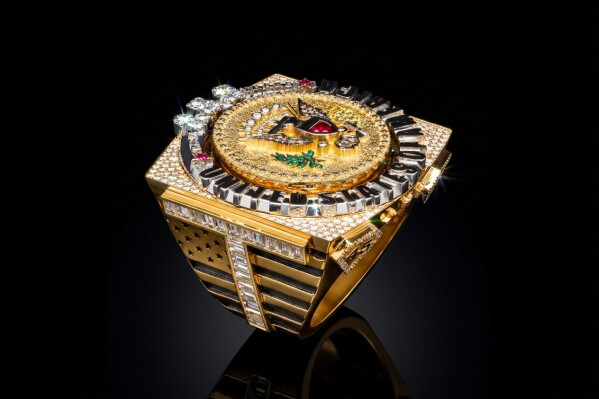
A gold ring set with 321 diamonds, handed to Donald Trump by Antwerp's diamond traders, has drawn accusations of a “cartoonish bribe” weeks after their gems slipped free of his tariffs.

Senators Elizabeth Warren and Richard Blumenthal have written to the Antwerp World Diamond Centre (AWDC), whose president presented the ring to the president during America's 250th-anniversary celebrations in Brussels on June 28. The 18-karat piece, engraved “Crafted in Antwerp for Donald John Trump”, also carries 56 sapphires, 13 emeralds and six rubies, and has been valued by independent jewellers at up to $35,000. Washington restored a zero tariff on European natural diamonds, a trade worth $2.1bn a year to Belgium, on July 24.

“June 28: Belgium's diamond industry gifted Trump an 18-karat gold ring. July 24: European diamonds got their exemption from Trump's tariffs. I'm investigating what looks like cartoonish corruption,” Warren wrote.

The ring lands amid wider questions over the president's financial dealings. Trump and administration officials placed hundreds of stock trades around market-moving policy calls, most conspicuously a wave of buying before he paused his sweeping tariffs on April 9 2025, hours after he told followers “this is a great time to buy”, a sequence Democratic lawmakers have branded possible insider trading.

The 18-karat gold ring set with 321 diamonds and dozens of other gems that Antwerp's diamond centre gifted to US President Donald Trump. Credit: Antwerp World Diamond Centre

Antwerp's Russian habit

Belgium's grip on the rough-diamond trade explains the reflex to protect it. Antwerp handles the bulk of the world's rough stones and earns billions of euros a year, and for two decades it leaned heavily on Russian supply. That dependence kept Russian gems out of the first 11 rounds of EU sanctions after the 2022 invasion, even as banks, oil and coal were hit; in 2021 Belgium alone bought roughly $1.4bn of Russia's diamonds.

Russia is the world's largest producer of rough diamonds, and state-controlled Alrosa digs more than 90% of it. Even after a deliberate squeeze on output, Russia mined 31.5mn carats in 2025 and shipped gems worth $2.5bn, close to a third of world production by volume.

The ban held off until the 12th package, agreed in December 2023 and in force from January 1 2024, the first EU embargo on Russian diamonds, widened in stages to stones cut in third countries such as India in step with the G7.

It proved as leaky as the oil measures beside it. Within months dealers were quitting Antwerp for Dubai, protesting that it was “impossible” to prove a stone's origin, while Russian exports found new homes: shipments to Hong Kong jumped 18-fold in early 2024. Washington, which banned Russian stones earlier, has quietly kept a licence open for select diamonds until September 2026.

None of the newer rounds revisits the gems. The embargo already amounts to a full import ban, and the 20th package in April 2026 went after circumvention routes rather than stones. Brussels has floated no fresh total ban; the harder task is enforcing the one it has.

Exemptions all round

The same logic runs through oil. The bloc's 21st sanctions package, drawn up in July 2026, was watered down after Greece, Cyprus and Malta pushed back on tightening the Russian oil price cap, keen to shield the shipping industries that dominate global tanker markets. Left untouched, the floating cap would have loosened automatically from about $44 to $58 a barrel.

Greek owners have reason to fight. Their tankers have earned at least $3.8bn hauling Russian crude since mid-2023, a fifth of the shadow fleet, according to the Financial Times. Russia took in some $160bn from oil exports last year, largely unbothered by the cap.

From Antwerp's gem dealers to Athens's shipowners, the pattern keeps surfacing: the pressure on Russia holds until a member state's own business is threatened, and an exemption appears. The ring on Trump's finger is only the most glittering version of it.


Kazakh billionaire Turlov bids for presidency of World Chess Federation

Kazakh billionaire Turlov bids for presidency of World Chess Federation
Kazakh billionaire Timur Turlov has been running the local chess federation but after the current president Arkady Dvorkovich was included in the 21st sanction package and suddenly quit, Turlov finds himself as the frontrunner to take over as head of the global chess federation. / bne IntelliNewsFacebook
By Leon Aris in Berlin August 13, 2026

Kazakh billionaire Timur Turlov did not set out to run world chess. In late June the founder of Freedom Holding Corp, the Nasdaq-listed financial services group, agreed to stand as deputy to Arkady Dvorkovich, the International Chess Federation (FIDE) president seeking a third term.

Then on July 23 the EU added Dvorkovich, a former first deputy prime minister in the Russian government, to its 21st sanctions package. Dvorkovich suspended his powers within hours. Within a day the FIDE presidential ticket had reconstituted itself with the top two names exchanged: Turlov for president, and Viswanathan Anand, the five-time world champion who had become interim president, as his deputy.

That is how a 38-year-old billionaire who has been the head of the Kazakh chess association for barely three years became the frontrunner in an election to be decided on September 26, when delegates from nearly 200 national federations gather in Samarkand alongside the Chess Olympiad.

Speaking with IntelliNews by video link from Almaty, Turlov seems less interested in the timetable than in the business case. Chess, he argues, is an undervalued sponsorship market.

"Chess is also a very great club of people," he said. "A lot of chess fans are intellectual people. It's bankers, politicians, business leaders, and different artists.”

Businesses, he added, are "missing a great opportunity for sponsorship. Because with relatively small budgets, you can get a global influence.”

Turlov, who has had a rags-to-riches ride to become Kazakhstan’s wealthiest man, has bought into that thesis heavily. Freedom Holding, of which he owns roughly two-thirds, has spent more than $75mn on the game and puts in about $15mn a year. It funded the 2024 world rapid and blitz championships on Wall Street, backed successive Candidates tournaments, and in April acquired ChessBase, the Hamburg company whose databases have been the sport's professional infrastructure for four decades.

The digital pitch

What he proposes to bring to FIDE is narrower than the sponsorship argument suggests. Professional chess, he says, is governed competently; what neither FIDE nor its members capture is the value that could be created by migrating the game online. He wants to digitise chess completely.

"I think I can help with digitalization, with building a strong digital platform... to be able to regulate this digital growth," he said. Otherwise, "funding for federations never will be secured and never will be sustainable if we will not significantly present online.”

The game has already been popularised by the enormously successful “Queen’s Gambit” Netflix series and made accessible by the very popular chess.com site that is both a place to learn and a platform to compete, but Turlov wants to go further.

Pressed for specifics, he lists CRM systems for each federation, a chess ID so federations can count their players, voluntary accreditation of clubs, calendar tools, and arbiter registries. Then something harder. He wants "a very strong link between online gaming platforms and national federations", he said, "starting from building biometric identification of chess players to maintain integrity of ratings".

Neither that commitment nor the platform architecture appears in the five published pillars of his campaign, launched on August 1 under the motto "Moving Chess Forward. Together.”

·       Global Institution: Build a united, independent, transparent, and respected worldwide chess organization.

·       Digital Infrastructure: Create modern tools to help Member Federations manage tasks and share resources.

·       Financial Strength: Strengthen funds to invest more heavily in global programs, education, and events.

·       Equal Empowerment: Ensure every Member Federation has an equal voice, regardless of size or location.

·       Event Standards: Raise the quality of FIDE tournaments, increase prize funds, and expand player opportunities.

Nor does the goal he nominates when asked what would define a first term.

"We need to become an Olympic sport and I think we have a very good chance to become an Olympic sport," he said. "It's not fast, but at least I want to come as close as possible to this moment in the next four years.”

The route runs through continental competition: "We need recognition from international competition like Asian Games, European Games, Africa Games.”

The obstacle, he believes, is not participation but legibility. "Hundreds of millions of people play chess in the world and it's enough for the Olympics for sure," he said. Missing is a broadcast product non-players can follow — a problem he thinks artificial intelligence can solve. "Sometimes to really understand all beauty you need to be at least a master to understand the beauty of grandmasters," he told IntelliNews. "With the help of AI... we can build broadcasts more attractive for the general public.”

His reference point throughout is the Freedom super-app, his company’s flagship product, which bundles banking, insurance, travel and groceries for more than 11mn customers, and which he describes in the same terms he uses for governing a sport.

"Each big organization is kind of similar sometimes even to a small country," he said. In chess, that means embedding the game in other people's platforms. Asked, half in jest, whether customers might one day solve chess puzzles to pay for things, he did not hesitate. "Yes, why not? You can give some gigabytes for solving puzzles, some extra internet, some extra engagement.”

He would supply federations with a software development kit for such deals and warns those that ignore digital: "They will lose authority over this game.”

Continuity, and its price

Turlov's rivals for FIDE’s top job — the German entrepreneurs Jan Henric Buettner, running with Malcolm Pein, and Wadim Rosenstein, running with Gordon Tang — are campaigning against precisely what he represents. His is substantially the Dvorkovich machine with the names reordered, and he does not disown it: his letter to member federations offered "continuity with a new level of practical effectiveness".

Asked to assess his predecessor, he was warm. "I still truly believe that Arkady did a great job... He spent most of his life in the airplane," he said. "It will be, in my opinion, very unfair to not appreciate what was done.”

The criticism is oblique — "I think there were some limits in collaboration also, especially last four years" — and the gap he identifies is technical: "the biggest sphere for advancement, in my opinion, is, of course, this digital development.”

And then there is the money. Turlov is worth an estimated $7bn and he intends to personally fund some of his prospective projects.

"My key is to provide some financial backstop to FIDE, to make sure that we will be able to plan a longer calendar, for example, for the next two years," he said. "That happens not just because of a lack of professionals. That happens because of a lack of predictability.”

He names two relationships he would try to repair: "We'll still have a great potential to restart some relationship with the Ukraine Federation, for example, with the American Federation.”

The Russia question

Moscow-born, Turlov renounced his Russian citizenship in 2022 and became a Kazakh citizen; Freedom sold its Russian subsidiaries the following year. The Russian Chess Federation, itself suspended, endorsed not him but Kirsan Ilyumzhinov, a Russian oligarch and chess fanatic. His first act after being elected President of the Republic of Kalmykia was to make chess a compulsory part of the school curriculum in the region, which he claims increased pupil’s academic performance by 40%. He is also a former president of FIDE, but eventually failed to file his candidature for the job.

Turlov describes himself as a Kazakh but nonetheless expects the association with Russia to stick.

"I regret very much about this situation with Russia," he said. "But it's still extremely difficult to fully distinguish sport from politics.” However, he is specific on one key condition: "I think one of them is very important to stop this war.” Asked directly whether he worries about being characterised as Kremlin-influenced, he did not address the charge.

The race for the presidency has meanwhile turned acrimonious. On August 7 Buettner sent the FIDE Council a cease-and-desist notice alleging federation staff and funds were being used to support Turlov, citing activity in Cape Town, Bucharest and Addis Ababa, and demanding written confirmation of neutrality within seven days. Neither side had responded publicly at the time of writing.

Turlov carries other baggage: Ukraine sanctioned him personally in October 2022, a listing Freedom calls an error, and in March the US Securities and Exchange Commission issued a Wells Notice to the company and to him as chief executive. But no court has ruled against him, he denies any wrongdoing and he has not been sanctioned by either the EU or America.

Bank first, federation second

Turlov’s day job continues, building one of the fastest growing fintech businesses in Central Asia, which is rapidly emerging as an innovative  tech hub. Freedom Holding is already moving out of its traditional stamping ground and has filed a banking application with France's ACPR as well as clearing the purchase of a small Turkish bank "I truly believe that now I will be much more useful for any society and for any country as a businessman," he said. "And frankly, I will be much freer in my decisions.”

His pitch to delegates rests on delivery. "If we're promising something, we are from business, we are not from politics. We know how important it is to deliver what was promised," he said. Being unfamiliar to the chess world he casts as an asset: "I hope that I still will be able to surprise many delegates... Sometimes it's better to talk than not to talk.”

Asked what chess has taught him that he expects to use in Samarkand, he offered something closer to a warning to himself. "In management, especially for organizations like FIDE, your mistakes are usually in relationships with different people," he said. "A lot of chess players actually don't care so much about relationships... But in federation, you need to be focused on relationships. That's all we do.”

"Mistakes could not be just factual," he added. "Mistakes also could be in your relationships. And also if you're tired and sick, so don't clash with your people, with your friends, with your colleagues, with your community.”
 

India courts Myanmar’s rare earths as China tightens grip

India courts Myanmar’s rare earths as China tightens grip
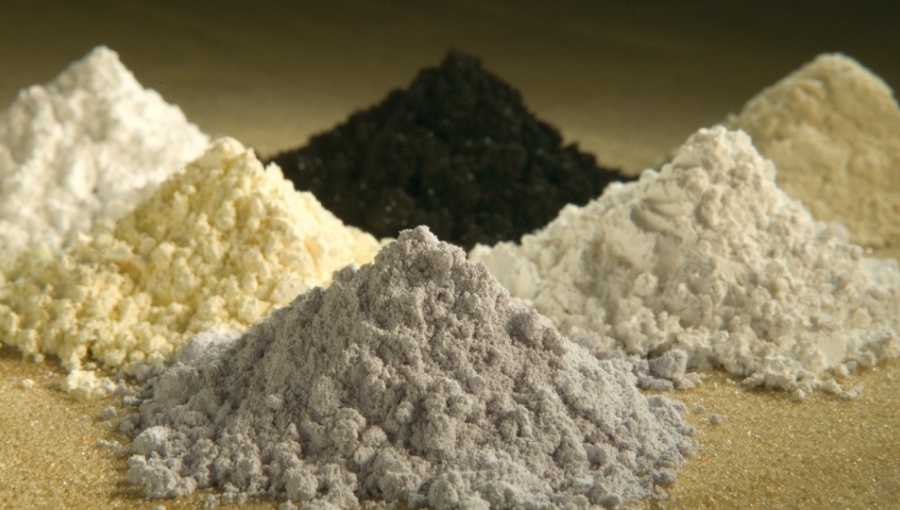
/ Peggy Greb, US Department of Agriculture - PDFacebook
By IntelliNews - New Taipei Bureau August 13, 2026

Myanmar's rare earth reserves could, in time, become an important long-term strategic hedge for India as New Delhi seeks to diversify supplies of critical minerals away from China.

In the short term though experts point to infrastructure constraints and political risks in the war-torn country as meaning that any new supply chains are unlikely to be put in place any time soon.

According to S&P Global, India and Myanmar have already agreed to increase existing cooperation on sectors including mining, trade and the all-important investment of rare earths. This came about following talks between Myanmar’s junta chief President Min Aung Hlaing and Indian Prime Minister Narendra Modi in New Delhi on June 1.

And while no actual supply agreement was signed at the time, India's Foreign Secretary Vikram Misri said the two sides also discussed cooperation in the rare earths sector.

Like many other countries, India is seeking to strengthen its domestic critical minerals supply chain as part of efforts to reduce reliance on China and Beijing’s overbearing dominance of the global rare earth industry.

But with Myanmar one of the world's leading producers of heavy rare earth elements, the need to contend with weak domestic and international infrastructure as well as China's entrenched influence in Naypyidaw is evident. The military control exercised by armed groups over key mining regions as a long-standing civil war rages adds another layer of danger to the issue.

Despite those obstacles, there are analysts who believe engagement with Myanmar could eventually broaden India's supply options if handled carefully – even if some say the world’s largest democracy should not be negotiating with a military junta who deposed a democratically elected neighbour. At the same time practicality points to doing so as strengthening long-term supply chain resilience.

Myanmar is already recognised as amongst the world's largest producers of dysprosium and terbium according to S&P Global, and given that these metals improve the performance of permanent magnets used in electric vehicle motors, wind turbines and advanced defence systems they are crucial to a range of New Delhi business sectors on many levels.

Added to this, International Energy Agency (IEA) data shows that Myanmar and China together account for about 83% of global mined supply of heavy magnet rare earth elements – a point which only shines a spotlight on the importance attached to these elements.

Another issue stems from most of Myanmar's production coming from Kachin state in the country's far north, which borders China; a region partly controlled by the Kachin Independence Army (KIA), the chief executive of the US-based critical materials company K66 has claimed.

After the KIA seized control of the state's main mining towns in late 2024 in the third year of the war, China's imports of heavy rare earths from Myanmar declined, with data from S&P Global Market Intelligence's Global Trade Analytics highlighting the reality on the ground that Myanmar accounted for a full 52.8% of China's total rare earth imports the year after - down from almost 60% the year before. China was reported as then entering negotiations with the KIA to facilitate access to supplies from Kachin.

China has also demonstrated its influence over the wider rare earth sector through export restrictions as is widely reported. IEA data shows China accounted for 91% of global rare earth refining capacity in 2024 in addition to 94% of magnet manufacturing capacity – numbers the US, EU and others are desperate to see reduced.

As a result, these restrictions prompted India, the US, Japan and other countries to seek alternative sources and put in place supply chains less dependent on China.

This in turn culminated in Myanmar's rare earth resources representing a worthwhile strategic hedge for India, even as war rages in the country and democratically elected leaders languish in jail or under house arrest.

But even if a deal is negotiated with Naypyidaw, at present, India lacks the processing capacity required to make immediate use of materials coming in from across the 1000 mile border with Myanmar. To this end, any deal with Myanmar offers greater value as a reserve option in the long-tern, than as a near-term source of supply.

And while India shares a border with Kachin state, although no transport links currently connect the two areas and the terrain is mountainous and largely impassable, it is unlikely New Delhi will follow in China’s footsteps and reach out to deal with the KIA direct. Not openly at least.

Even so, closer cooperation with Myanmar on any level would support India's ambitions to develop its own rare earth industry. Under the National Critical Mineral Mission launched in 2025, India has stated it plans to complete four mineral processing parks by 2030-31.

Steady cooperation with both Myanmar's ruling junta and the KIA would therefore be necessary in the coming years if India hopes to secure greater access to rare earth supplies.

Adding another layer to the issue, India's participation in the Quad Critical Minerals Initiative Framework alongside Australia, Japan and the US could further accelerate its ambitions even if the Quad is deemed geopolitically inert on some levels; the four countries having agreed to mobilise $20bn in funding for eligible critical minerals projects.

Complicating this, however, are US sanctions on Myanmar – the most influential Quad member but also the party showing the least interest in the group since President Donald Trump has come to power.

Even if, as experts have suggested, potential Quad support could help India establish processing facilities in its north-eastern states closest to the Kachin border, new or additional US sanctions on Myanmar imposed on a whim by President Donald Trump could end a project before it has even begun.

As such, while India for its part though has maintained a level of diplomatic engagement with Myanmar despite widespread international criticism of Min Aung Hlaing – an issue many in the country find hard to swallow given its frequent chestbeating as the world’s biggest democracy – New Delhi must tread carefully.

By hosting Min Aung Hlaing earlier in the year, India also attracted international criticism after the junta leader had been shunned by the international community – even China – until his June visit to meet Modi.

The question the government of Prime Minister Modi must now ask itself is whether or not it would be willing to sacrifice a much-lauded claim of respect of democracy and the rule of law, to access raw earths from a junta-led neighbour.