Friday, August 14, 2026


‘The real challenge starts after sundown’: Europe’s heatwave boosted solar by up to 17% on hot days

Ground-mounted solar panels beneath a blue sky.
Copyright American Public Power Association via Unsplash.

By Liam Gilliver
Published on

A surge in solar power has helped meet heightened power demand from Europe’s blistering heatwaves, according to a new analysis.

Solar has been doing the “heavy lifting” to help Europe meet its energy needs amid a string of blistering heatwaves.

A new analysis from energy think-tank Ember found that solar output in European countries rose by up to 17 per cent on heatwave days in June and July.

Researchers say that this helped power the grid as electricity demand increased by as much as a quarter on hot days. Heatwaves often trigger a spike in electricity consumption due to the sudden need for cooling, mainly from energy-intensive air conditioning (A/C) units.

The International Energy Agency (IEA) estimates that space cooling, which is mostly A/C units and fans, consumed around seven per cent of the world’s electricity in 2022. Even in countries where A/C ownership is low, countries experience energy demand spikes when scorching temperatures hit.

During the early summer heatwaves of 2025, France, for example, recorded an evening electricity peak that was 25 per cent above the off-season average due to air conditioning.

Solar performing ‘better than usual’ amid heatwave

Ember’s analysis found that during the late-June heatwave this summer, daily electricity demand rose byup to 28 per cent in Italy, 23 per cent in Hungary, 14 per cent in France and 13 per cent in Spain compared with pre-heatwave days.

It says as heatwave-driven demand increased, solar was the only major power source to perform “better than usual”. Compared with other days in June and July, average daily solar generation during the heatwaves was 17 per cent higher in France and Hungary, five per cent higher in Spain and the same in Italy.

“Solar is already doing heavy lifting during heatwaves, but the real challenge starts after sundown,” says senior energy analyst Chris Rosslowe.

“In the evening, when cooling demand is still high, the grid is most exposed to expensive gas-fired power.”

How Europe’s blistering summer impacts energy

Europe’s back-to-back heatwaves, which scientists say would have been “virtually impossible” if it weren’t for climate change, have triggered mass droughts across the continent.

Low water levels along the Danube River forced nuclear output to be curtailed in Hungary, while experts warn that hydropower neared an “all-time low” in the Alpine region.

Fossil-fuelled energy has suffered from the drought too, with Poland forced to reduce output at a coal-fired power plant due to critically low water levels in the Vistula River.

The late-June and early-July heatwaves also saw average daily electricity prices surge 119 per cent higher in Hungary, 44 per cent in France, 13 per cent in Italy and seven per cent in Spain than on comparable days in the preceding weeks.

Experts say the price surge reiterates the need for battery storage systems, which can prevent excess solar energy from being wasted.

“While solar saves the day, battery storage can save the evening,” Rosslowe says.

“Together, they are one of the clearest ways to make Europe’s power system more resilient in the hotter summers. As solar output rises during heatwaves and other power sources struggle, storage can carry that cheap electricity into the evening.”

Battery-only electric cars on the rise in Europe: Which countries lead?

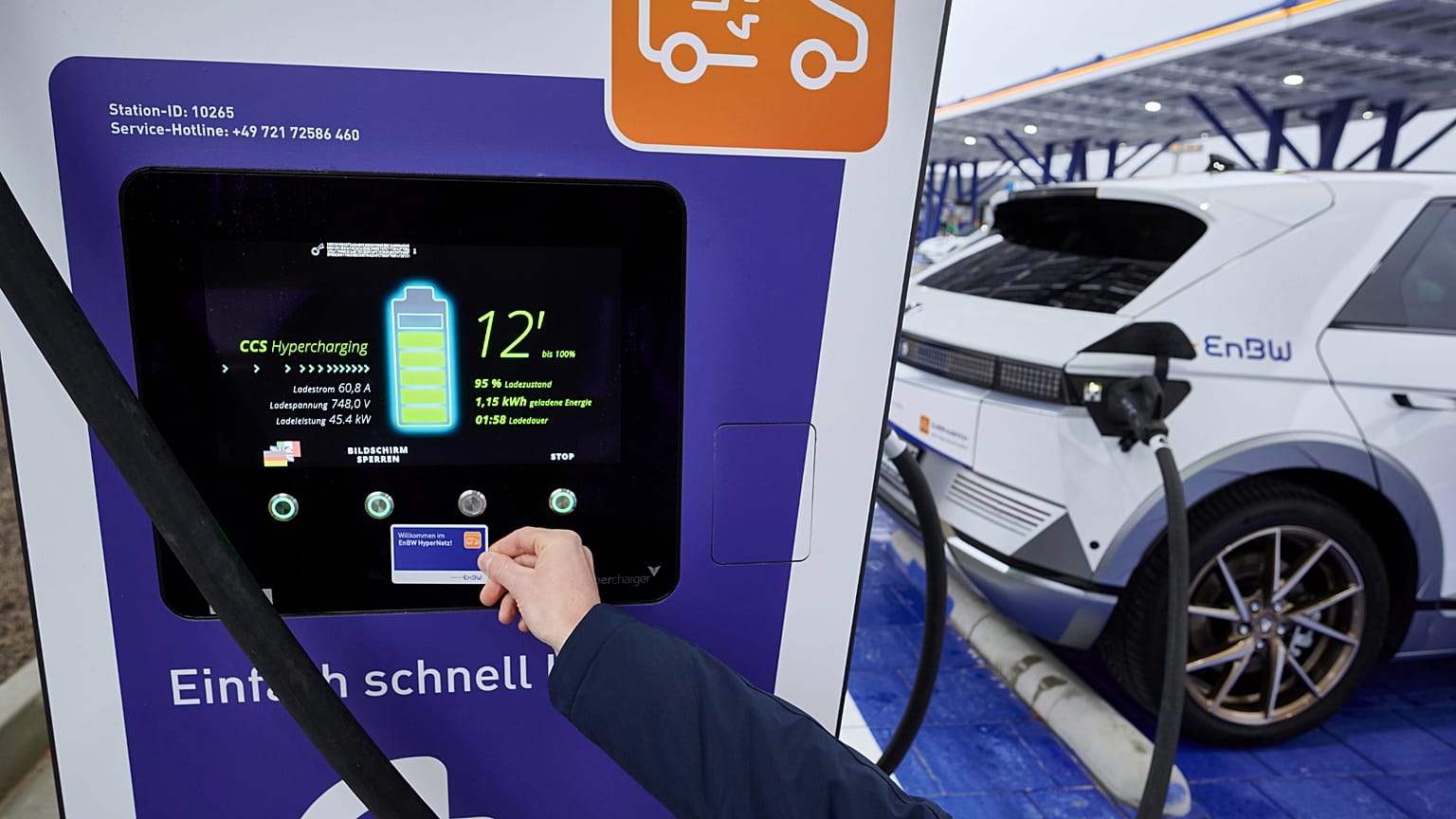
An electric car is charged at a charging point at the Kamener Kreuz before the opening of the largest fast-charging park for e-cars to date operated by the energy company EnB
Copyright (c) Copyright 2021, dpa (www.dpa.de). Alle Rechte vorbehalten

By Servet Yanatma
Published on

The share of newly registered battery-only electric passenger cars is rising significantly in many European countries, but their share of the total car fleet remains very low in many countries.

The number of newly registered battery-only electric passenger cars has risen rapidly across Europe in recent years. In the EU alone, around 1.9 million new battery-electric cars were registered in 2025.

As a result, battery-only electric vehicles are taking an increasingly large share of new car registrations. In 2025, they accounted for 17.3% of all new passenger cars registered in the EU. In several European countries, the share is higher than one in three according to Eurostat.

But the transition is far from even across the continent. Some countries are moving towards electric cars much faster than others.

So, how is the number of battery-only electric passenger cars evolving across Europe? Which countries have the highest shares? And how many battery-electric cars are now on the road in each European country?

Ten years ago, in 2015, only around 47,000 battery-only electric passenger cars were newly registered in the EU. The number passed half a million in 2020 and climbed to almost 1.9 million in 2025 according to Eurostat.

Their share of newly registered passenger cars has risen sharply as well. Battery-only electric cars accounted for just 0.4% of new registrations in 2015 and 1.9% in 2019. By 2025, the share had reached 17.3%.

Among 38 European countries, including EU members, EU candidate countries, EFTA members and the UK, Germany recorded the highest number of newly registered battery-only electric passenger cars in 2025, at around 545,000.

The UK followed closely with about 473,000, according to data from the European Automobile Manufacturers’ Association (ACEA).

France ranked third with around 331,000, followed by Turkey with 187,000.

Norway recorded around 173,000 new battery-only electric passenger cars, while the Netherlands had 156,000 and Belgium 144,000.

Denmark, with 126,000, and Spain, with 105,000, also surpassed the 100,000 mark.

By contrast, Italy, which is one of Europe’s five largest economies, registered only around 95,000 battery-only electric passenger cars in 2025.

Electric cars exceed one in three in several countries

Of course, the share of battery-only electric passenger cars among all newly registered cars provides a more meaningful picture of how quickly each country is making the transition.

Norway is a clear outlier: more than 95% of newly registered passenger cars in 2025 were battery-only electric. Two other Nordic countries followed, with Denmark at 67.8% and Iceland at 41.2%.

Battery-only electric cars also accounted for more than one in three new registrations in Malta (37.6%), Finland (37.2%), Sweden (36.4%) and Belgium (34.1%).

Among Europe’s five largest economies, the UK had the highest share of battery-only electric passenger cars in new registrations in 2025 at 23.4%.

France followed at 19.6%, just ahead of Germany at 19.1%.

Spain and Italy, however, remained significantly below the EU average of 17.3%. Battery-only electric cars accounted for just 8.7% of new passenger car registrations in Spain and 6.1% in Italy.

The share of electric cars remains particularly low in several Eastern European and Balkan countries, as well as in many EU candidate countries. Turkey is a notable exception, with battery-only electric cars accounting for 16.7% of new registrations.

The share is below 2% in Croatia, Montenegro, Serbia, and Bosnia and Herzegovina.

Electric cars remain a small share of Europe’s car fleet

When it comes to the share of battery-only electric cars in the total passenger car fleet, the picture changes considerably. No country exceeds one in three.

Norway remains the clear leader, with battery-only electric cars making up 32% of all passenger cars in 2025. Denmark follows at 17.9%.

Luxembourg (8.7%), Sweden (8.6%) and the Netherlands (7.2%) complete the top five.

Across the EU as a whole, however, battery-only electric cars account for just 2.9% of the total passenger car fleet.

Among the EU’s ‘Big Four’ economies, Germany has the highest share at 4.1%, closely followed by France at 3.9%.

The share falls to 1.1% in Spain and just 0.9% in Italy.

Overall, battery-only electric cars account for less than 1% of the passenger car fleet in 16 of the 37 European countries.


Uber and China’s Pony AI to launch over 2,000 robotaxis across Europe

The logo for Uber is displayed above a trading post on the floor of the New York Stock Exchange, Monday, Oct. 20, 2025.
Copyright AP Photo/Richard Drew

By Indrabati Lahiri
Published on

The expanded partnership with blend a mobility platform, fleet management capacity and autonomous driving technology.

Uber has revealed that it would be expanding its partnership with China’’s Pony AI (Pony.ai) to introduce more than 2,000 robotaxis in Europe.

The comes as more companies focus on large-scale commercialisation of autonomous driving services.

The expanded partnership will add to existing plans to launch a commercial robotaxi service in Zagreb in Croatia. Users will be able to book these rides through Uber’s platform, with plans to grow the service to four more European cities down the line.

The partnership model will blend three key elements needed to provide robotaxi services at scale: a mobility platform, fleet management capacity and autonomous driving technology.

Both companies also intend to explore opportunities in the Middle East, however, exact details for these have not been shared yet.

This expanded agreement marks an important new phase in the partnership between Pony.ai and Uber. It reflects our shared commitment to bringing safe, reliable Robotaxi services to more European cities,” Dr. James Peng, founder and CEO of Pony.ai, said in a press release.

"By combining Pony.ai’s proven autonomous driving technology and operational know-how with Uber’s global mobility platform and extensive market reach, we aim to build sustained commercial operations at scale across Europe and beyond," he continued.

Pony AI, a global autonomous vehicle company building robotaxis, self-driving systems and self-driving trucks, already operates paid, fully driverless robotaxi services in key Chinese hubs like Beijing, Guangzhou, Shanghai and Shenzhen.

The company will be bringing its Level 4 autonomous driving technology to the table, along with valuable operational experience from large-scale robotaxi projects.

On the other hand, Uber will provide its global mobility platform, which includes payment, booking and customer service functions.

Local support from fleet operators will also be used for day-to-day operations in individual markets.

“The next chapter for autonomous mobility is about moving from individual launches to repeatable commercial scale,” Sarfraz Maredia, global head of Autonomous Mobility & Delivery at Uber, said.

“Together with Pony.ai, we’re combining advanced autonomous technology with Uber’s hybrid platform, on-the-ground experience, and operational excellence, to build a model that can quickly and reliably expand across cities," he continued.

The rise of autonomous vehicles

Several companies around the world, including European ones like Mercedes-Benz, BMW and Volkswagen have been exploring autonomous driving technologies and solutions in the last few years.

This is due to massive projected market growth, as well as the potential to solve key bottlenecks like driver deficits.

Autonomous vehicles also complement electric vehicle architectures very well, so they are often seen as the next natural step. They could help in boosting urban efficiency in many areas as well.

However, safety concerns, and a lack of adequate technology has been holding several companies back, especially in Europe.

On the other hand, China has emerged as a clear leader in autonomous driving technology, due to massive state support and it being treated like a national and strategic priority.


China’s Belt And Road Initiative: Key Economic Issues – Analysis


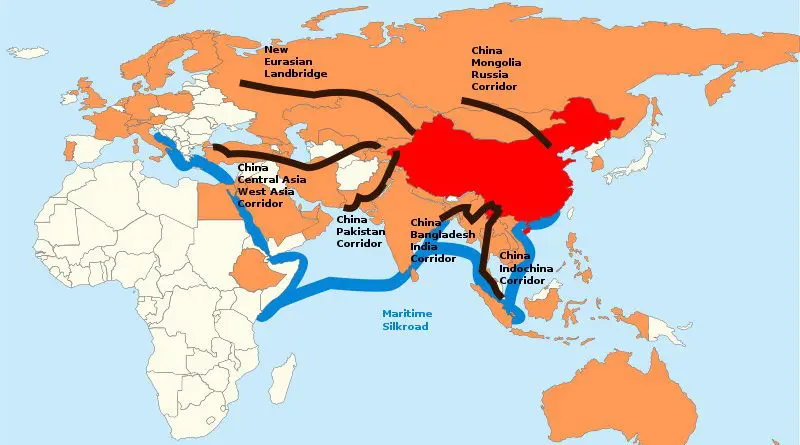
China's Belt and Road Initiative (BRI). China in Red, the members of the Asian Infrastructure Investment Bank in orange. Credit: Lommes, Wikipedia Commons

August 14, 2026
The Congressional Research Service (CRS) 
By Karen M. Sutter and Michael D. Sutherland


Key Takeaways

China’s Belt and Road Initiative (originally One Belt, One Road), launched in 2013 and later elevated in Party documents, seeks to build PRC-centered global infrastructure, trade, technology and production networks through land, maritime, digital, green and polar corridors.

Financing and project delivery are dominated by state banks, funds and national-champion firms using often opaque, collateralized loans and integrated packages that expand Chinese standards, secure resources and create long-term economic and strategic dependencies, raising concerns about debt sustainability, lack of reciprocity and potential dual-use applications.

The United States and partners have responded with alternative financing tools (such as the DFC and EXIM programs), quality-infrastructure initiatives and greater scrutiny of Chinese deals, while Congress continues to debate further measures to monitor and counter BRI’s economic and geopolitical effects.


The People’s Republic of China (PRC or China) in 2013 launched an ambitious and multifaceted foreign economic policy initiative—One Belt, One Road—to expand China’s global economic reach and influence. In 2015, China’s leaders changed the English name to the Belt and Road Initiative (BRI) (while keeping the Chinese name),possibly to deflect attention from the initiative’s focus on developing China-controlled and -centered global ties in a hub-and-spoke format. The Communist Party of China (CPC) incorporated the initiative into its Charter in 2017. It reaffirmed the efforts’ significance at its 20th Party Congress in 2022 and in China’s 15th Five-Year Plan for National Economic Development (2026-2030). Some in Congress assess that One Belt, One Road projects advance PRC economic and geopolitical goals while undercutting U.S. global influence and interests. In response, some Members have sought to develop alternative U.S. and multilateral financing programs.

Scope and Objectives

One Belt, One Road has evolved into a global effort that aims to develop PRC-centered and -controlled global production, trade, infrastructure, and transportation networks. It includes a land-based “Silk Road Economic Belt” and a “21st Century Maritime Silk Road.” Sub-initiatives include a “Polar Silk Road” focused on Arctic shipping routes and a “Digital Silk Road” to promote PRC information and communications technology (ICT) exports and satellite networks. A “Green Silk Road” promotes PRC renewable energy products and services. Other efforts seek to promote health and science and technology (S&T) ties and the use of PRC technical standards among partner countries. The effort emphasizes policy coordination, trade and investment, dispute settlement, tourism, and student/personnel exchanges.


One Belt, One Road projects in energy, ICT, manufacturing, and transportation infrastructure look to vertically integrate PRC production supply chains, technology infrastructure, and transportation networks. The effort involves technology and financial integration that expands the use of China’s digital platforms and currency. It seeks to expand PRC firms’ presence overseas, create markets for China’s goods and services, and secure access to foreign sources of agriculture, energy, and strategic commodities, such as critical minerals. Projects also aim to develop China’s interior regions, employ PRC workers, and offload PRC excess industrial capacity.

At the One Belt, One Road forum in 2023, PRC leader Xi Jinping prioritized “high quality development”; intermodal and green infrastructure; digital trade zones; S&T cooperation; a “compliance evaluation system” to address corruption; and cooperation in energy, tax, finance, think tanks, media, and culture. In 2021, Xi presented at the United Nations (UN) a Global Development Initiative to complement One Belt, One Road with projects for poverty alleviation and food security and in areas to advance PRC firms globally in infrastructure, manufacturing, and digital technologies. See CRS In Focus IF13099, China Primer: China’s Global Development Initiative.

China’s Investment and Financing

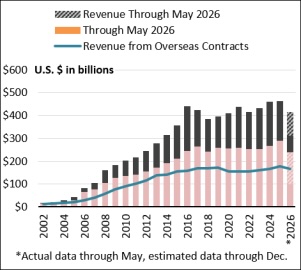
China’s use of onshore financing and special-purpose vehicles for foreign investment complicates analysts’ ability to track PRC global economic activity. One Belt, One Road is an umbrella initiative, and projects may be specifically or loosely tied to the effort. As a result, many groups track PRC cross-border financing, investment, and overseas projects generally. China’s stock of global outward foreign direct investment (ODI)—investment made into a business or real asset in another country—stood at $3.6 trillion (7.8% of world total) in 2025, up from $34.7 billion (0.5% of world total) in 2001. In comparison, the United States accounted for $6.6 trillion, or 14.4%, of global ODI stock in 2025 (down from 32% in 2001), according to official country data compiled by the UN. PRC ODI flows have picked up since 2021 and were $174 billion in 2025, accounting for about 9% of global ODI flows. (U.S. ODI flows were $263 billion, or about 14% of global ODI flows in 2025.) Additionally, PRC cross-border contracts—a corporate structure used for overseas construction and infrastructure projects—have been stable and reached an all-time high of $289 billion in 2025. The PRC also operates cross-border projects in agriculture, energy, minerals, finance, technology, and shipping (Figure 1).

AidData, a research lab at the College of William & Mary, estimates that, as of 2023, China’s overseas lending portfolio was $2.1 trillion. (In comparison, the World Bank’s portfolio in 2025 was about $400 billion.) It assessed that even as One Belt, One Road focused on developing countries, since 2000, PRC lending has been shifting toward high-income countries (e.g., the United States) and financing for technology deals and the purchase of foreign firms in strategic sectors. AidData reports that, as of 2023, 24% of PRC lending was for low- and lower-middle-income countries, and that infrastructure accounted for about 20% of China’s overseas lending portfolio.

Figure 1. China’s ODI Flows and Overseas Contracts. Source: CRS, with data from China’s Ministry of Commerce.

PRC state banks (e.g., CHEXIM and CDB), firms, and funds (e.g., Silk Road Fund) undertake a large share of PRC overseas lending and investment. The PRC government often pays firms in China for projects they implement, while host governments pay the PRC government for the projects. Projects are neither assistance—PRC loans are typically not interest-free and issued at market terms—nor truly commercial, because repayments are often backed by collateral commitments (e.g., lease rights, minerals, or commodities) made to the PRC government, which in turn absorbs much of the commercial risk for PRC firms. Recipients of collateral may include state firms not party to the original transaction that are designated by the PRC government.

Role of China’s State Firms


PRC strategic investments are typically state-sponsored and aim to advance national economic and foreign policy goals. A handful of state firms operate most projects. These firms are funded by and report directly to the central government, and include China Harbor, CRRC, State Grid, China Three Gorges, and COSCO. China’s projects strategically position national champions—such as Huawei, ZTE, and Alibaba—by creating technology infrastructure and systems built to PRC standards. Alibaba’s internet project in Malaysia, for example, provides a foundation for PRC data/cloud, e-commerce, and financial services. Projects may offer the PRC visibility and touchpoints into sensitive infrastructure and services via interconnection and interoperability in communications, energy, and transportation. Projects in critical minerals support PRC industrial policies.
U.S. Concerns

Some observers note the economic benefits of China’s investments in developing countries while others argue that China is introducing unsustainable debt obligations and opportunities to gain economic concessions and influence. China tends to extend the duration of its loans, rather than forgive debt repayment, which can create long-term financial dependencies. For example, in 2017, when the Sri Lankan government was unable to repay PRC loans, China Merchants Port Holdings Company Ltd. acquired a majority stake in the firm that operates Sri Lanka’s Hambantota port and the right to operate the port for 99 years. Credit and loan terms are generally opaque and China tends to settle agreements bilaterally. China’s opacity in lending came to a head in 2019 when U.S. officials questioned whether International Monetary Fund relief for Pakistan might also be used to repay Pakistan’s debts to China.


The PRC government insists that most PRC state banks and state firms are not subject to sovereign lending terms adopted by the United States and other major creditors in the Paris Club. PRC loans often forbid multilateral debt restructuring (e.g., under Paris Club auspices). China joined two G20 debt relief initiatives that accept Paris Club disciplines, but these apply only to CHEXIM and the China International Development Cooperation Agency. The PRC claims it has provided more deferments under G20 schemes than Paris Club members, but many countries indebted to China do not appear to qualify or have not applied—likely due to PRC pressure—for G20 debt relief. Some experts say One Belt, One Road undermines the role and principles of multilateral financial institutions, which work with China on projects, and argue China should not have a leadership role in these institutions. Such collaboration may set better terms for host countries while also advancing PRC goals.

PRC entities are expanding overseas in sectors that the PRC restricts to foreign investors in China (e.g., construction, transportation, finance, and communications). The PRC does not offer reciprocal market access for the rights it secures in other countries, challenging a core trade tenet and advantaging PRC firms over their competitors. It has opened foreign markets with “deal-ready” financing and integrated project delivery.

PRC investments in strategic sectors and infrastructure have prompted some governments to increase scrutiny of these deals. Some analysts assess that certain PRC projects have military uses. Under its military-civil fusion program and China Standards 2035 initiative, China is developing standards that promote civilian-military interoperability, including in various technologies and infrastructure (e.g., ports). Commercial land deals may facilitate a military presence. China Merchants Bank, for example, signed the lease for property in Djibouti on which China developed a military base. Sam Enterprise Group, a firm reportedly tied to China’s military, bought land in Vanuatu and the Solomon Islands. PRC projects offer alternatives to U.S.-led networks and standards. PRC-built BeiDou satellite and rail networks offer substitutes to U.S.-controlled GPS navigation technology and sea lanes where the U.S. military operates. PRC digital platforms support use of the PRC’s digital currency.

U.S. Government Response

PRC overseas financing practices are prompting the United States with its allies and partners to adjust approaches to global financing to compete with China. Congress enacted the Better Utilization of Investments Leading to Development Act of 2018 (BUILD Act; P.L. 115-254) to create the U.S. International Development Finance Corporation (DFC) and increase support for quality market-oriented and financially sustainable projects with environmental and social safeguards. The DFC has sought to compete with PRC consortia on projects and in markets in which the PRC has a major presence. In 2019, Congress created a China and Transformational Exports Program at the Export-Import Bank of the United States with new financing tools and flexibilities to counter PRC financing. The G-7 Partnership for Global Infrastructure and Investment and Blue Dot Network seek to promote quality infrastructure financing. In 2020, the U.S. government sanctioned PRC state firms that built One Belt, One Road military infrastructure in the South China Sea.


The 119th Congress is debating the effects of dismantling the U.S. Agency for International Development on competition with the PRC. S. 1011 would require the State Department to monitor and counter PRC projects. H.R. 9093 would require a report on the PRC’s use of One Belt, One Road to undermine the U.S.-led global order, and a strategy to counter it. Congress may examinethe PRC government’s role in directing and financing investments in the United States and acquisition of U.S. firms in strategic sectors, and U.S. policy on such investments;

PRC entities’ presence in U.S. production, energy, transportation, and communications networks and investments in the Western Hemisphere; and
whether to allow U.S. development or export financing for global projects that use PRC components or services.

About the authors:
Karen M. Sutter, Specialist in Asian Trade and Finance
Michael D. Sutherland, Analyst in International Trade and Finance

Source: This article was published by the Congressional Research Service (CRS).


About CRS
The Congressional Research Service (CRS) works exclusively for the United States Congress, providing policy and legal analysis to committees and Members of both the House and Senate, regardless of party affiliation. As a legislative branch agency within the Library of Congress, CRS has been a valued and respected resource on Capitol Hill for nearly a century.
View all posts by CRS →
A New Axis In Middle East: Reading The New Saudi-Turkish-Pakistani Defence Pact – Analysis


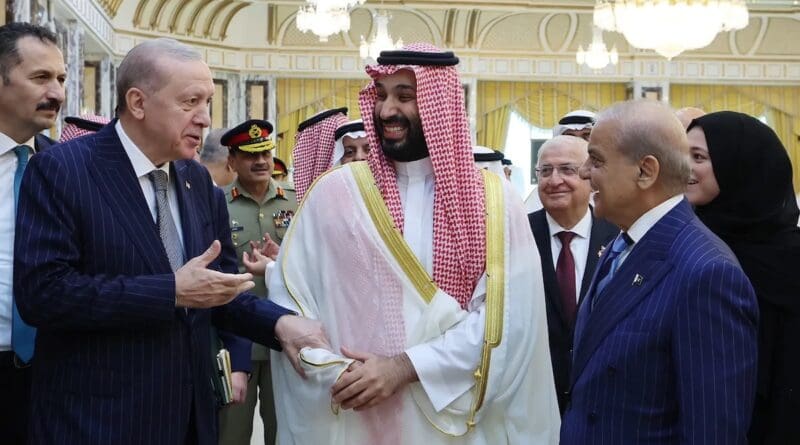
Turkey's President Recep Tayyip Erdogan, Saudi Arabia's Crown Prince Mohammed bin Salman, and Pakistan's Prime Minister Shehbaz Sharif meet during the signing of the trilateral defense agreement in Mecca, Saudi Arabia, on Aug. 7. MURAT CETINMUHURDAR/TURKEY'S PRESIDENTIAL PRESS SERVICE


Key Takeaways

On August 7, 2026, Pakistan, Saudi Arabia and Türkiye signed the Mecca Joint Defense Agreement, establishing that an attack on any one signatory would be treated as an attack on all and committing the three countries to deeper defence cooperation, interoperability and collective responses decided by consensus.

For Pakistan the pact extends its earlier bilateral mutual-defence arrangement with Saudi Arabia, reinforces long-standing military ties with both Riyadh and Ankara, and elevates Islamabad’s role as a security partner and
 mediator amid doubts about the reliability of the U.S. security umbrella in West Asia.

The agreement is presented as defensive and open to potential new members, yet it reflects a broader regional search for alternative security frameworks; India is watching closely given its strained relations with Türkiye and concerns over Pakistan’s growing integration into West Asian security architectures.

On August 7, 2026, Pakistan, Saudi Arabia and Türkiye signed the ‘Mecca Joint Defense Agreement’, also referred to as the Mecca Defence Accord, at the Makkah Al-Mukarrama summit in Saudi Arabia. The pact aims to build collective deterrence and enhance regional stability, while further consolidating defence cooperation among the three countries. Coming against the backdrop of the war between the United States and Iran and its regional fallout, the timing of the signing is widely read as a response by these states to the faltering US security umbrella in West Asia — even as all three signatories have stressed that talks on the pact had been under way for some time.

Pakistan’s Prime Minister, Shehbaz Sharif, described the agreement as an ‘extension’ of the ‘Strategic Mutual Defence Agreement’ signed with Saudi Arabia on 17 September 2025, which also included a collective security clause. The agreement’s significance for Pakistan is thus twofold: it positions the country as a beneficiary of the shifting regional order, embedding Islamabad further within the West Asian security architecture, while also giving it room to elevate its external standing.

The Contours of the Agreement

The agreement lays out two specific objectives. First, in what is seen as an echo of NATO’s Article 5 clause, the trilateral agreement calls for an attack on any one of the three signatories to be treated as an attack on all of them, inviting a collective response in line with the principles of collective deterrence set out in Article 51 of the UN Charter. The important aspect here is not the clause for collective security — which was also a key element of the 2025 pact between Saudi Arabia and Pakistan — but the subsequent response, based on discussion and consensus among all the signatories. The type of support offered would thus vary depending on the needs of the aggrieved partner, as the pact provides for general commitments rather than fixed obligations. This support could take the form of a military response, logistical support, intelligence sharing, or the provision of arms and ammunition.

Second is the pursuit of increased defence cooperation among the three countries, building on the long-standing defence partnership among them. The defence pact with Saudi Arabia has already solidified Islamabad’s partnership with the kingdom. Pakistan’s deployment of troops to Saudi Arabia, and its training of Saudi troops and personnel, has continued since the 1980s. In April, it deployed close to 8,000 troops, fighter jets and air defence systems to the Abdulaziz Air Base in Saudi Arabia. Riyadh has also been a major source of aid and assistance to Pakistan: in April 2026, it rolled over a US$3 billion deposit to the country, and in July 2026, it extended a separate US$5 billion facility for another three years.


Pakistan also enjoys a strong defence partnership with Ankara, which was Islamabad’s third-largest arms supplier between 2020 and 2024, providing Bayraktar TB-2 drones and aircraft electro-optical sensors, while also looking to expand the relationship through joint production of Turkey’s fifth-generation KAAN fighter jet programme. Pakistan also used Turkish drones during hostilities with India last year.

The agreement is also seen as creating new opportunities to improve integration between the armed forces of the three countries, with a focus on military interoperability, joint training, threat assessment, and the synergising of weapons and communications systems.

Following the signing, all three countries issued additional statements clarifying the pact’s terms and scope, with the emphasis falling on its defensive nature and the assurance that no country was being targeted. Saudi Arabia further clarified that the pact had no nuclear dimension, nor was it aimed at starting an arms race in the region. This addressed lingering echoes of the controversy that had followed the earlier defence pact with Riyadh, when a statement by Pakistan’s Defence Minister, Khawaja Asif, on Pakistan’s nuclear arsenal being made available to the kingdom, prompted Saudi officials to clarify that the agreement was purely a comprehensive military one. Pakistan’s status as a nuclear-armed state, however, continues to invite such assumptions. While Pakistan describes the new pact as an extension of the Saudi agreement, all three countries have stressed that it does not override any pre-existing bilateral or multilateral arrangements they hold with each other or with others.

Membership, too, was framed as flexible: Türkiye signalled the possible inclusion of Egypt, while Pakistan’s Foreign Minister, Ishaq Dar, clarified that any country aligning with the pact’s ‘fundamental principles’ could join. Though this leaves the actual criteria for admitting new members vague, it serves a clear purpose — to counter concerns that the pact might replace the US security umbrella with an alternative, or that the grouping is a closed one with no room for others.

While the modalities of how the pact would take shape have remained out of public view, Turkish Foreign Minister Hakan Fidan highlighted that its institutionalisation will be through the establishment of a political and military committee, which would include representation from the foreign and defence ministries of all signatories as well as their chiefs of staff.


Pakistan’s Balancing Act

Consistent with the fanfare that typically accompanies Pakistan’s signing of international agreements, both the symbolism of this pact and the context in which it took shape are seen to have given fresh momentum to Pakistan’s external standing. During the visit, Prime Minister Sharif was accompanied by Chief of Defence Forces Field Marshal Asim Munir, Foreign Minister Ishaq Dar, and Defence Minister Khawaja Asif. In its statement celebrating the agreement, the civilian government credited the CDF’s role in bringing it to fruition, alongside the coordinated decision-making that led to its signing. Islamabad’s inclusion was also seen as a testament to its defence capabilities, with FM Dar reiterating that it aligns with the country’s foreign policy.

This foreign policy has played out in myriad ways over the past year. Following the crisis with India, and the military’s consolidation of control over the civilian government, Pakistan has leaned on the post-crisis victory narrative — raising its expectations of how it wants to be perceived in the world. Even as the country continues to grapple internally with acute security and economic challenges, with political stability also under scrutiny, both the warm reception given by US President Donald Trump to Munir and the subsequent thaw in bilateral ties appear aimed at seeking legitimacy.

Since 28 February, when the war between Iran and the United States broke out, Pakistan has assumed the role of mediator, positioning itself as a stabiliser and security provider. Its inclusion in the Trump administration’s Board of Peace (BoP) for Gaza in January 2026, and its subsequent hosting of talks in April between Tehran and Washington, are both seen as examples of its growing mediatory role. It is also one of thirteen countries that are part of the Saudi-proposed multinational maritime defence coalition to protect shipping and energy routes in the Red Sea. While the US-Pakistan relationship has seen its regular ups and downs since Pakistan’s founding, it was the signing of the defence pact with Saudi Arabia that reignited conversations about Pakistan’s strategic importance to the region.

The Gulf countries’ growing exasperation with Washington’s inability to protect their interests in the region, coupled with the closely coordinated US-Israeli military campaign against Iran, has dented their confidence in American security guarantees. While this is also the gradual culmination of grievances accumulated over the last few decades, the most recent crises to have upended the region have made the search for alternative safety valves far more urgent. It is in this context that Pakistan’s importance to the region’s countries comes into sharper focus.

If the Saudi-Pakistan pact offers any insight into how this new agreement will pan out, it has more to do with institutionalising what already existed and signalling intent, rather than creating something entirely new. The coming together of these countries reflects a reshaping of the region’s security architecture, with countries exploring ways to supplement US security support with alternative frameworks that give them greater agency over outcomes. While officials downplayed the pact as a response to the US-Iran war, the fallout of the war — particularly its toll on the interests and assets of Washington’s Gulf partners — nonetheless accelerated its signing.

New Delhi is closely watching these developments, mindful of its national interests. While ties between New Delhi and Riyadh remain strong, its bilateral relationship with Ankara has deteriorated. The latest round of hostilities between India and Pakistan in May 2025, coupled with the Pakistani military’s increasing hold over the country’s security and foreign policy, shows that India will need to stay attentive to developments in its western neighbourhood. In that context, Pakistan’s growing inclusion in West Asia’s regional architectures will be a cause for concern for India.

About the author: Shivam Shekhawat is a Junior Fellow with the Strategic Studies Programme at the Observer Research Foundation.

Source: This article was published by the Observer Research Foundation.


About Observer Research Foundation
ORF was established on 5 September 1990 as a private, not for profit, ’think tank’ to influence public policy formulation. The Foundation brought together, for the first time, leading Indian economists and policymakers to present An Agenda for Economic Reforms in India. The idea was to help develop a consensus in favour of economic reforms.
View all posts by Observer Research Foundation →
Israeli settlers seize Palestinian water source in occupied West Bank to create recreational pool


Israeli settlers have taken control of a freshwater spring that Palestinian farmers in the occupied West Bank have relied on for generations, diverting its water to create a pool at an archaeological site advertised as a tourist attraction and leaving crops to wither. It is estimated that Israeli settlers have now seized control of 95 percent of the northern Jordan Valley's springs, pushing Palestinian communities off their land.


Issued on: 14/08/2026
By: FRANCE 24


A drone view shows Israelis visiting an ancient water reservoir in the Jordan Valley in the Israeli-occupied West Bank. © Ilan Rosenberg, Reuters


On a searing summer day, Israeli settlers splashed in a West Bank pool created ​by siphoning off water that had irrigated Palestinian crops, one of many seizures of water resources across the occupied territory.

The spring served as a lifeline for the nearby village of Fasayil in the fertile Jordan Valley, where Palestinians have relied on it for generations for food, employment and to supplement irregular Israeli supplies to their domestic taps.

“Our water supply remains cut off to this day, depriving us of the water we depend on for our homes, our livelihoods, ​and our agricultural land,” said Saad ‌Nemer, who farms the land.

Saad Nemer, a Palestinian landowner who says that Israeli settlers diverted water from his land making it impossible to plant crops, visits his arid farm in Fasayil, a village in the Israeli-occupied West Bank. © Mohamad Torokman, Reuters

Israeli settlers seized his irrigation pipeline in June, channeling the water to an ancient pool in an archaeological site. Soon after, settlers advertised it as ⁠an Israeli tourist attraction and Israel’s far-right finance minister pledged financial support.

“They are now in the process of developing a recreational park around the pool,” Nemer said.
Settlers stop Palestinian villagers approaching

The seizure of the spring at Fasayil is part of a pattern that Palestinians say is designed to make their lives in the West Bank ‌untenable. Israeli settlers have attacked at least 160 water and sanitation sites across the Palestinian territory this year, United Nations data shows.

Nemer’s greenhouses and fields would normally be full ⁠of eggplant, zucchini and watermelons, but without water he has not been able to plant in the scorched land.

“The settlers cutting off our water has caused us losses and has meant that many families will lose their work and their livelihoods,” he said.

Nemer said that an employee had been beaten up by settlers and he himself had faced threats for attempting to approach the spring as far ​back as two years ago.

Yishai Shreiber, 21, an Israeli settler who had come to swim in the pool near Fasayil on an August afternoon, said Palestinians would not now ‌dare approach.

“Now that they see this entire mass of people, all these large groups of Jews coming here to bathe, they are afraid to come here,” said Shreiber.

Israelis visit an ancient water reservoir in the Jordan Valley in the Israeli-occupied West Bank. © Ronen Zvulun, Reuters

Shreiber said the West Bank belonged to the Jewish people, and that if Palestinians don’t want to accept Jewish authority, they should leave.

Nemer showed Reuters a 2025 land ownership document from COGAT, the Israeli military agency which enforces civilian policy in the occupied territories. He also presented a map drawn for the pre-occupation 1957 registration of his ‌title deeds showing that his land included both the spring and the pool.

COGAT and Finance Minister Bezalel Smotrich did not respond to requests for comment.
'Water war' is part of Israeli West Bank takeover, Palestinians say

Israel’s far-right coalition government has overseen massive settlement construction that Smotrich says is aimed at burying the idea of a Palestinian ​state, which has been recognised by more than 150 of 193 UN member states as encompassing the Gaza Strip and West Bank, including East Jerusalem.

The United Nations and most governments consider the settlements to be illegal under international law related to military occupation. Israel seized the West Bank in the 1967 war, but argues the territory is disputed rather than occupied.

Water flows from a hose in the Palestinian village Fasayil, where residents say that Israeli settlers diverted water from its natural spring causing crops to die. © Mohamad Torokman, Reuters

Palestinians have experienced a sharp rise in settler violence, and Palestinian field researcher ​Fares Foqahaa estimated that settlers had now seized control of 95 percent of the springs in the northern Jordan Valley, displacing communities

In another West Bank village, Qusra, settlers still besieging three homes on Thursday had also cut off their water and ​electricity.

Adel Yassin, an official with the Palestinian Authority’s water authority, said that settlers target water resources as part of a systematic campaign to force Palestinians off ​their land.

“I see this as a water war. It is the silent bullet that kills Palestinians without a sound,” he said, referring to the process of making their livelihoods unsustainable.

Israeli archaeologist says settlers are damaging the site

In early June, Eliav Libi, a settler leader targeted with sanctions by Canada and other countries, posted a video ​showing the pool beginning to fill with water.

He and other settlers say the pool belonged to the biblical-era Jewish king Herod. Alon Arad, an archaeologist with the Israeli rights group Emek Shaveh, said the pool’s provenance is unclear.

“We see in many cases the use of archaeology ... to create this feeling that the West Bank is exclusively Jewish,” Arad said, adding that the settlers were damaging an archaeological site by filling it with water.

A drone view of Israelis visiting an ancient water reservoir in the Jordan Valley, in the Israeli-occupied West Bank. © Ilan Rosenberg, Reuters

Outside the pool, a billboard advertised a 3 million shekel ($1 million) investment from Smotrich, an architect of settler expansion, who said in a Telegram post the money was for the restoration and development of “Herod’s Pools”.

The pool and the nearby spring were packed with Israeli families swimming and wading in ⁠the water. No Palestinians were present.

One of the few natural springs still available to Palestinians is near the city of Nablus at Wadi al-Badhan. In July, families sat at plastic tables placed in shallow streams picnicking with their feet in the running water.

The springs are located close ⁠to Nablus’s urban centre and had until this ​year rarely faced incursions from settlers.

Palestinian children play in a natural spring in Wadi al-Badhan, near Nablus, in the Israeli-occupied West Bank. © Ammar Awad, Reuters

Hundreds of settlers descended into the springs earlier this summer, sitting at the plastic tables and walking through the pools, five Palestinians said.

Nizam Fares, the owner of a natural spring park in al-Badhan, said people could no longer enjoy visiting the area.

“People have become scared and jumpy. They come and ask if the settlers are coming or not,” he said.

(FRANCE 24 with Reuters)


Israeli troops fail to oust settlers blockading Palestinian homes in the West Bank


The Israeli military failed to evict settlers blockading Palestinian homes in the occupied West Bank on Wednesday in a ⁠rare confrontation between settlers and the military. The settlers have been blocking essential supplies from entering the Palestinian village of Qusra since the weekend.


Issued on 13/08/2026 
By: FRANCE 24

Israeli settler violence against Palestinians in the West Bank is soaring. © Zain Jaafar, AFP


The Israeli military failed in an attempt on Wednesday to remove occupied West Bank settlers who for days have blockaded Palestinian homes, an eyewitness and an AFP photographer reported.

The siege began on Sunday, when a group of settlers set up a makeshift tent near houses in the Palestinian village of Qusra, just south of Nablus, blocking essential supplies from entering.


"We have received no food and no medicine," Qusai Abu Rida, a Palestinian trapped inside one of the houses, told AFP by telephone, adding that he had only managed to secure electricity thanks to solar panels.

The Israeli military condemned the settlers' actions and declared the area a "closed military zone", before on Wednesday morning removing the tent where the settlers had been staying.

Security forces "are working to evacuate the civilians who were staying there", the military said in a statement.

By mid-afternoon, an AFP photographer at the scene said the military had left and the tent had been removed, but that the settlers were still at the site.

Abu Rida confirmed the situation remained unchanged, with the settlers still in possession of chairs and blankets.

West Bank: Settler violence hits 'all-time high'
Cover image: © France 24
01:26


"The army has withdrawn, and so far we are still besieged, with the settlers at our doorstep," he told AFP.

Violence by Israeli settlers towards Palestinians in the West Bank has persisted for years, often with little or no legal consequence, but recent months have seen a surge in attacks.

Israel has occupied the West Bank since 1967.

More than 500,000 Israelis live in settlements in the Palestinian territory, which are illegal under international law, among some 3 million Palestinians.

The Israeli military said Tuesday it had received several reports of settlers entering and taking control of Palestinian homes and land in the area.

"This is illegal, reprehensible and unacceptable activity that harms the residents of the areas and disrupts their daily lives," it said.

It also said that disciplinary action would be taken against security personnel who had been filmed at the site days earlier.

According to an AFP tally based on data from the Palestinian health ministry, Israeli soldiers or settlers have killed at least 1,097 Palestinians, including both militants and civilians, since the start of the Gaza war in October 2023.

Israeli figures show at least 48 Israelis, including civilians and security personnel, have been killed in Palestinian attacks or during Israeli military operations during the same period.

(FRANCE 24 with AFP)


US ambassador to Israel slams settler siege of West Bank Palestinians as ‘terror’


US Ambassador to Israel Mike Huckabee on Thursday denounced a siege by Israeli settlers against Palestinians in the West Bank village of Qusra as a "horrific act of terror". Huckabee, an evangelical Christian pastor who in the past has embraced Israeli settlements in the occupied West Bank, said the Israeli army intervened on Wednesday after a US request, but the soldiers failed to remove the settlers.


Issued on: 13/08/2026 
By:  FRANCE 24
Video by:  Noga TARNOPOLSKY

Cover image: Israeli settlers gather in front of Palestinian houses in the village of Qusra, south of Nablus, in the West Bank, August 12, 2026. © Zain Jaafar, AFP
05:05


The US ambassador to Israel, a staunch supporter of West Bank settlements, on Thursday denounced as "terror" a siege by settlers against Palestinians that drew an unsuccessful intervention by the army.

Settlers near Nablus since Sunday have blockaded Palestinian homes, including one owned by a US citizen, with residents saying they have been cut off from food and other supplies.

"Actions by those who carried out this horrific act of terror meant to intimidate and harass this family are disgusting," Mike Huckabee, the US ambassador in Jerusalem, wrote on X in response to criticism of the US response.

"No excuse for such thuggish behaviour," he wrote.

Huckabee said Israel had intervened at the request of the United States, its crucial ally.


The remarks are especially striking from Huckabee, an evangelical Christian pastor who in the past has embraced Jewish settlement in the West Bank, which Israel has occupied since 1967, and rejected the idea of a Palestinian state.

The Israeli military on Wednesday sent in forces who took away a tent, but witnesses said settlers defiantly remained at the site with blankets.

READ MOREIsraeli troops fail to remove settlers besieging Palestinian homes in West Bank village

The army announced later Wednesday that it would send a new battalion to try to impose order.

Violence against Palestinians by Israeli settlers in the West Bank has increased dramatically since the October 7, 2023 attack on Israel by Hamas from the Gaza Strip.


Cover image: © France 24
02:30


More than 500,000 Israelis live in settlements in the West Bank, which are illegal under international law, among some three million Palestinians in the territory.

(FRANCE 24 with AFP)