Thursday, August 13, 2026


Europe’s petrochemical collapse: plants close as investment heads for China

Europe’s petrochemical collapse: plants close as investment heads for China
/ Julia Taubitz - Unsplash CroppedFacebook
By Mark Buckton in New Taipei August 14, 2026

Europe’s petrochemical industry has moved from a profitability crisis to a broader industrial retreat, with plant closures, asset sales and cancelled investments accelerating over the past year.

The situation was already severe in July 2025, when Reuters reported that high production costs, ageing plants and a surge in global capacity led by China were forcing European producers to shut facilities or reconsider their presence on the continent.

And the deterioration has continued.

European chemical production capacity announced for closure reached 17.2mn tonnes a year in 2025, more than double the previous year and almost six times the level recorded in 2022, according to the European Chemical Industry Council, or Cefic. Cumulatively, 37mn tonnes of capacity has been announced for closure since 2022, equivalent to about 9% of European chemical production capacity. Around 20,000 direct jobs have been affected.

Investment outflow

Investment has moved in the opposite direction. Confirmed investment in new European chemical capacity fell by more than 80% in 2025, according to Cefic data. The decline reflects high energy and carbon costs, weak demand, heavy regulation and competition from newer plants in China, the US and the Middle East.

The pressure is particularly acute for basic chemicals such as ethylene and propylene. These are key building blocks for plastics, pharmaceuticals and industrial goods. Europe has increasingly relied on imports as domestic production becomes less competitive.

The European Commission sought to respond in July 2025 with a chemicals industry action plan. It proposed a Critical Chemical Alliance, stronger trade defence measures, lower energy costs and additional state aid for energy-intensive industries. The Commission also said it would update state-aid rules to cover additional chemical sectors. But the measures have yet to halt the retreat.

Eni’s Versalis has continued to dismantle loss-making commodity chemicals operations in Italy. Its Brindisi and Priolo crackers were shut in 2025 as part of a wider restructuring. The company is shifting towards bio-based chemicals, biorefineries, circularity and higher-value products.

Other major groups have also reduced European exposure. Dow approved the closure of its ethylene cracker in Böhlen, Germany, with the shutdown expected in the fourth quarter of 2027. It also plans to close other European chemical assets.

ExxonMobil announced in November 2025 that it would shut its Fife Ethylene Plant in Scotland in February 2026. The company cited high supply costs, weak market conditions and the UK economic and policy environment.

TotalEnergies plans to close its oldest Antwerp steam cracker by the end of 2027. The company has pointed to an expected European ethylene surplus and weaker demand. It will retain a newer cracker at the site.

SABIC has taken a different route. In January 2026 it agreed to sell its European petrochemicals business to Germany’s AEQUITA for $500mn. The business covers major sites in the UK, Germany, Belgium and the Netherlands. The transaction is part of a wider consolidation of Europe’s olefins and polyolefins industry.

The economics remain difficult. European producers rely heavily on naphtha, while US producers have access to cheaper ethane from shale gas. Middle Eastern producers also benefit from lower-cost feedstocks and newer plants.

Age is another disadvantage. Many European crackers were built decades ago, leaving operators with higher maintenance and energy costs than competitors running newer facilities in Asia and the Middle East.

The China factor

China’s expansion has compounded the problem. Large volumes of new capacity have weakened global margins just as European demand has remained subdued. Chinese producers are increasingly competitive in polymers and other downstream products, putting further pressure on European manufacturers.

There are still major investments in Europe. INEOS’s Project ONE ethane cracker in Antwerp is the clearest example. The company has continued construction of the plant, which is designed to use US ethane and produce about 1.5mn tonnes of ethylene a year. In April 2026, the project reached a new milestone when its main electrical substation was commissioned, allowing the site to enter the commissioning phase.

The project is intended to be among Europe’s most competitive ethylene facilities. Its externally sourced electricity is contracted from North Sea wind farms. Final construction activity was still under way in August 2026 after logistics disruptions delayed the arrival of major modules from the Middle East.

But new investment is increasingly selective. In January 2026, Vioneo abandoned plans for a €1.5bn fossil-free plastics plant in Antwerp and chose China for its first commercial-scale facility, citing access to green methanol, supply-chain efficiency and a faster route to market.

The same pressures are affecting other advanced economies. South Korea has been preparing a restructuring of its petrochemical industry, while Japanese producers have also been cutting capacity as the region confronts prolonged oversupply.

Europe’s challenge is therefore no longer simply how to preserve existing crackers. It is whether the continent can retain enough basic chemical production to support downstream industries while shifting towards lower-carbon technologies.

For now, the evidence points towards a smaller and more concentrated industry. The most competitive sites, particularly those with integrated operations, newer equipment or access to cheaper feedstocks, are more likely to survive.

The result could be a European petrochemical industry that remains strategically important but produces less of the basic chemicals on which the continent’s manufacturing base depends. The July 2025 warning has therefore become harder to dismiss: Europe is not simply restructuring its petrochemical industry. It is deciding how much of it can afford to keep.

China’s Africa investment surge shifts the contest from capital to value

China’s Africa investment surge shifts the contest from capital to value
/ bne IntelliNewsFacebook
By bne IntelliNews August 12, 2026

Chinese Belt and Road Initiative investment announcements in Africa surged 254% year on year to a record $33.5bn in H1 2026, driven overwhelmingly by megaprojects in Ethiopia and Egypt as Chinese companies increasingly favour direct investment in energy, manufacturing and processing over the sovereign lending model that defined an earlier phase of Beijing’s economic engagement with the continent.

Africa accounted for about 67% of all Chinese BRI investment announcements globally during the period, according to the Green Finance & Development Center (GFDC). But the importance of the figure lies less in the scale of a single six-month period than in what it suggests about the changing structure of China’s relationship with Africa.

During the first decade of the BRI, Chinese engagement was associated above all with policy-bank loans to African governments, which then hired Chinese state-owned groups to build railways, roads, ports, dams and power plants. The emerging model gives a greater role to companies investing directly in productive assets and assuming more of the commercial risk themselves.

That points to a gradual shift in China’s role from creditor and contractor towards investor and industrial owner. For African governments, the question is increasingly not simply how much Chinese capital arrives, but how much of the resulting value, technology and industrial capability remains on the continent.

A record built on announcements

The $33.5bn figure requires careful interpretation. GFDC’s tracker includes credible investment announcements and signed implementation agreements, generally involving projects worth about $20mn or more. It therefore measures an investment pipeline rather than capital already transferred into African economies.

China’s Ministry of Commerce, by contrast, recorded $17.52bn of non-financial direct investment across all BRI partner countries worldwide in H1, down 7.4% year on year in dollar terms. The figures are not directly comparable: GFDC records announced project values, while the ministry measures outward investment flows. 

But the contrast is instructive. Africa’s pipeline is expanding rapidly at a time when officially measured Chinese investment across the wider BRI is declining.

The African total is also highly concentrated. GFDC recorded $14.8bn of investment announcements in Ethiopia and $12.2bn in Egypt, meaning the two countries accounted for about 80.6% of the continental total.

At project level, the concentration is sharper still. Ming Yang Smart Energy Group’s (SSE: 601615) proposed programme in Ethiopia is valued at about $14.17bn, while XinFeng Steel’s planned expansion in Egypt is worth roughly $10bn. Excluding those two projects would reduce Africa’s H1 total to about $9.3bn.

The record is therefore not evidence of a uniform investment boom across Africa. It is better understood as two exceptional megaprojects sitting on top of a broader, but considerably smaller, pipeline.

Ethiopia and Egypt anchor the new model
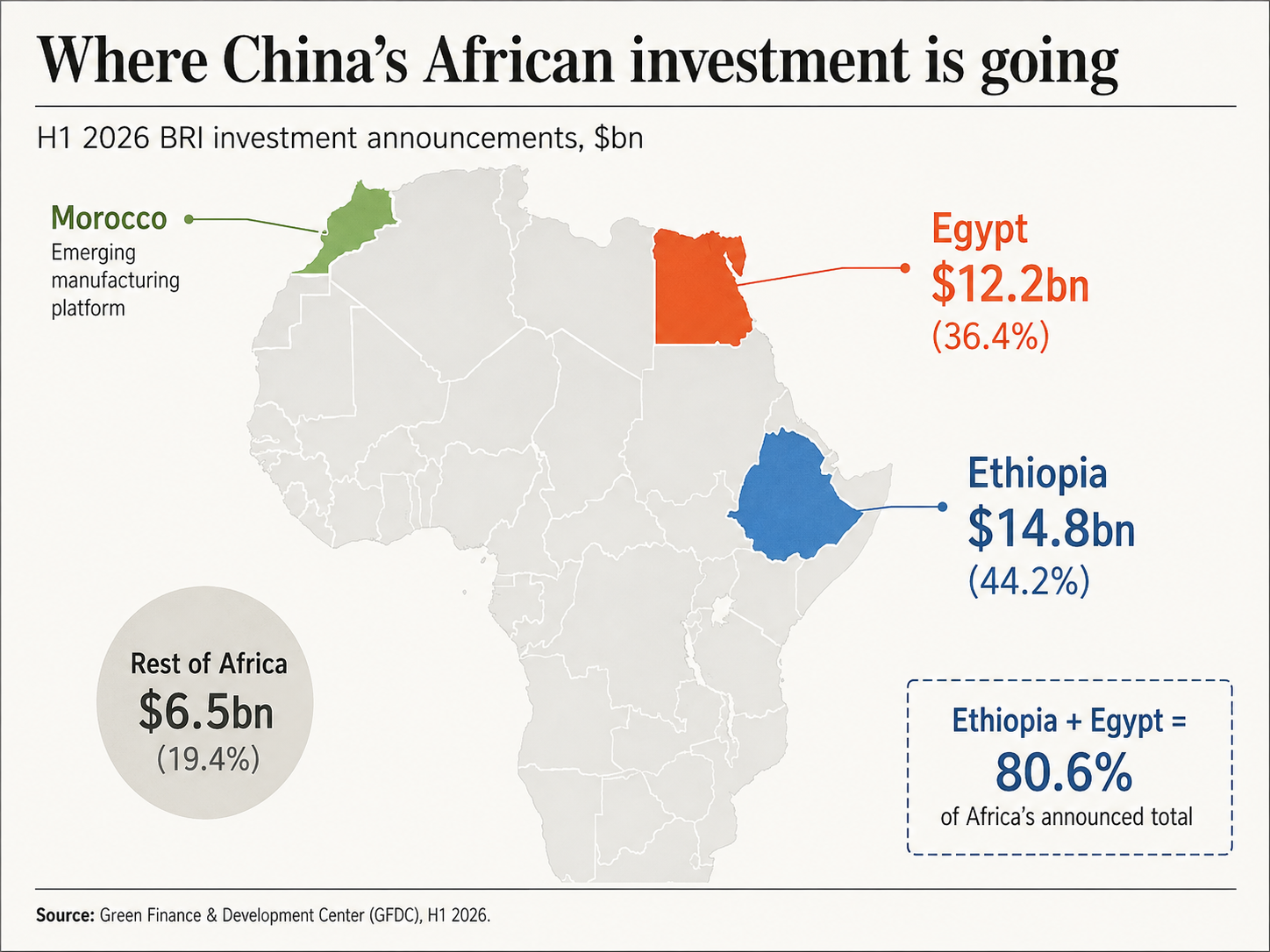
Ethiopia provides perhaps the clearest illustration of how the emerging model differs from the infrastructure lending of the past.

Ming Yang’s renewable-energy programme was initially presented at the Invest in Ethiopia forum in March as an investment exceeding $10bn. GFDC subsequently recorded its scope as having expanded to about $14.17bn after an investment licence was granted in May.

The proposed programme includes wind and solar generation, green-ammonia production and renewable-energy equipment manufacturing, with a reported generation capacity of about 8.4GW.

More important is the investment structure. Ming Yang is not simply proposing to supply equipment or build a power station under contract. The plan envisages a Chinese company owning and operating productive assets while locating parts of the manufacturing and energy value chain inside Ethiopia.

That is particularly notable in a country that has spent years dealing with sovereign debt stress. Rather than a government borrowing billions of dollars to hire a Chinese contractor, a Chinese corporate investor would take direct exposure to the project’s commercial performance.

There nevertheless remains a large gap between an investment licence and $14bn of funded assets. Questions over financing, electricity offtake and customers for green-ammonia production will determine whether the project develops at anything close to its announced scale.

Egypt’s $12.2bn tally is similarly dominated by one industrial proposal. XinFeng began construction in April 2025 on an integrated metals complex at Sokhna in the Suez Canal Economic Zone valued at $1.65bn. By 2026, the project had expanded into a proposal for about $10bn of investment in an integrated steel complex targeting roughly 10mn tonnes of annual automotive and higher-value steel capacity.

For Cairo, the project fits its industrial strategy: attract foreign manufacturers, reduce reliance on imported industrial goods and use the Suez Canal Economic Zone as an export-oriented base connecting Europe, the Middle East and Africa.

For Chinese manufacturers, such locations are becoming more attractive as weaker domestic demand, excess capacity in some sectors and higher trade barriers in the US and EU increase the appeal of overseas production.

From sovereign lending to corporate risk
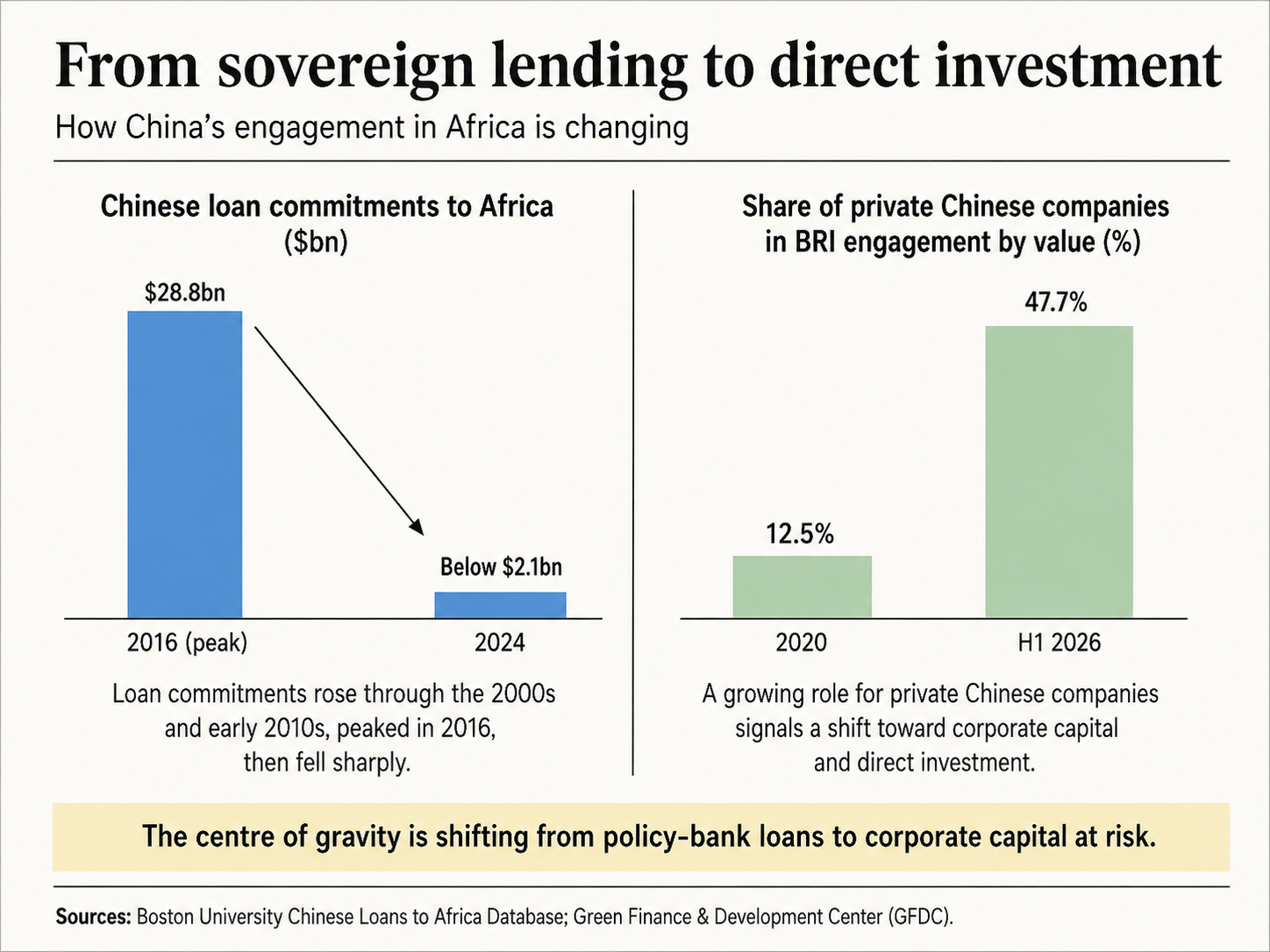
The strongest evidence of a broader shift comes from the decline of the financing model that preceded it.

Boston University’s Chinese Loans to Africa Database identifies about $180.87bn of Chinese loan commitments to African governments and regional institutions between 2000 and 2024. Annual commitments reached about $28bn in 2016, but had fallen to just under $2.1bn by 2024.

At the same time, private Chinese companies have become much more prominent within the BRI. GFDC estimates that privately owned companies accounted for 47.7% of global engagement by value in H1 2026, up from 12.5% in 2020.

This does not amount to a withdrawal of the Chinese state from Africa. Policy banks, state-owned enterprises and diplomatic ties remain important. But the commercial mechanism is becoming more diversified.

Under the earlier model, a Chinese bank might lend to an African government, which would then employ a Chinese contractor. Under the newer model, a Chinese company invests directly in a power plant, steel mill or processing facility and earns returns from ownership and operation.

For African governments facing tighter fiscal space, this can reduce the need to place new debt directly on the sovereign balance sheet. But it also gives Chinese companies a more durable presence in national economies. A contractor may leave once a railway or dam is completed; an investor owning a strategic industrial asset can remain for decades.

The contest over value

The more important question for African economies is increasingly not whether Chinese investment brings factories and infrastructure, but how much local value those assets create.

GFDC’s sectoral figures suggest the composition of Chinese engagement is changing. Chinese metals and mining engagement reached a record $21.8bn globally in H1, with roughly 80% involving processing facilities rather than extraction. Manufacturing engagement was entirely investment-led.

For African governments, this offers a potential route away from the longstanding pattern of exporting raw materials and importing higher-value manufactured goods. Steel mills, mineral-processing plants and renewable-energy equipment factories can create jobs and place more stages of production inside African economies.

But physical location does not necessarily determine who captures the value. A factory in Ethiopia, Egypt or Morocco can remain Chinese-owned, dependent on Chinese machinery and intermediate inputs, while the most sophisticated parts of the supply chain remain elsewhere.

Technology transfer therefore becomes a central test. Senegalese economist Mamadou Ndione, cited by The Africa Report, has argued that Chinese investment can allow African engineers to build expertise alongside Chinese companies. Whether that happens depends on workforce training, local procurement, management structures and the ability of domestic suppliers to move into more sophisticated parts of the value chain.

Renewable energy illustrates the tension. Chinese companies can help African economies add generation capacity and establish local manufacturing rapidly. Yet much African solar production still depends heavily on Chinese cells and upstream components. Local assembly can increase industrial activity while leaving control over key technologies elsewhere.

Trade and industrial policy converge
China’s investment strategy is also increasingly intertwined with trade policy, with bilateral trade at CNY1.41 trillion ($209bn) in H1 2026, according to Beijing.

On May 1, China also extended zero-tariff treatment to all 53 African countries with which it has diplomatic relations, widening preferential access beyond the continent’s least-developed economies.

For African governments, that access could become more valuable if Chinese investment helps create the productive capacity needed to export processed and manufactured goods rather than predominantly commodities. It also fits with the ambitions of the African Continental Free Trade Area, which could make individual countries more attractive as production bases serving a wider continental market.

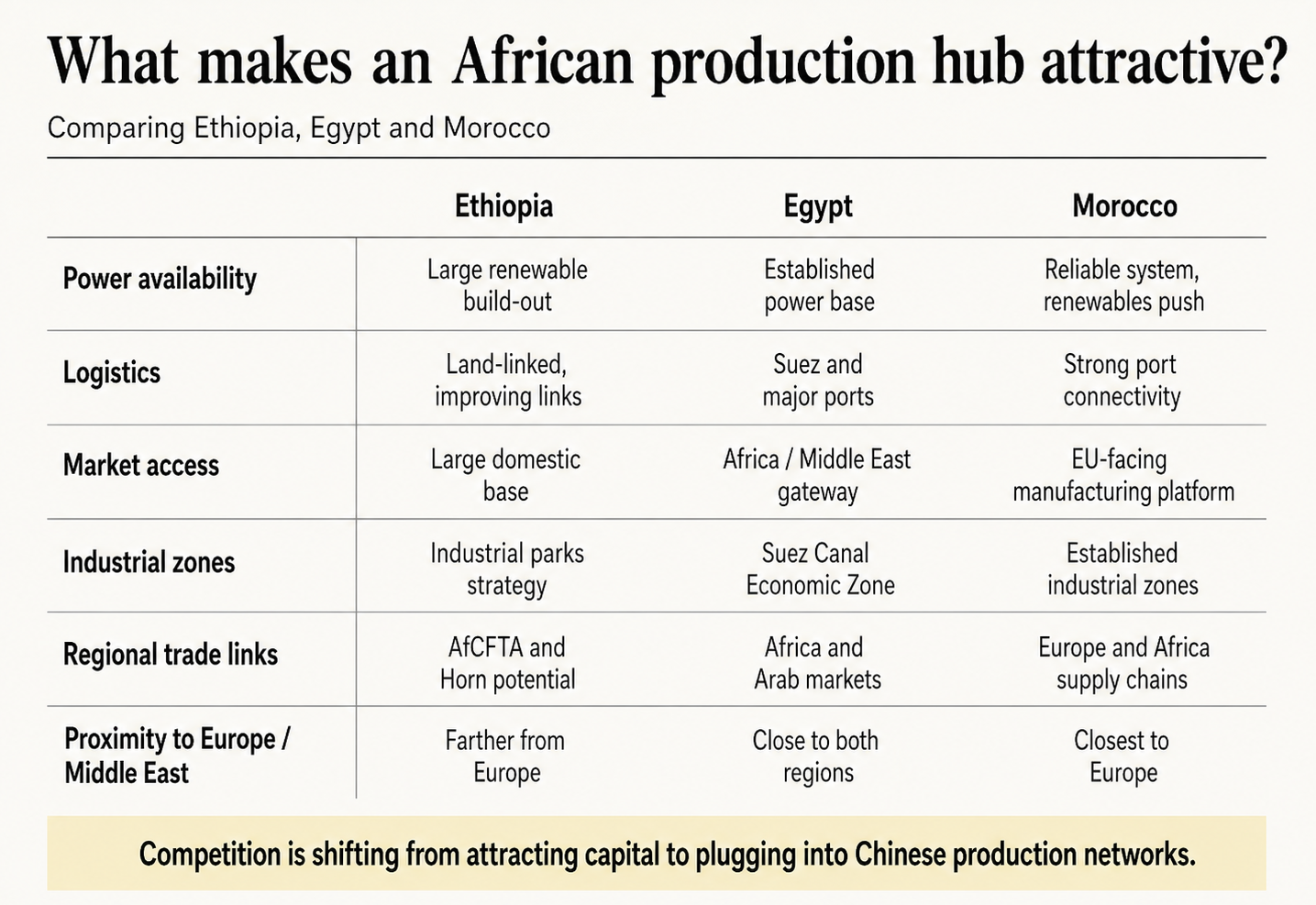
But this creates a sharper divide between countries able to offer reliable power, transport, predictable regulation and access to regional markets and those that cannot.

Morocco has increasingly presented itself to Chinese investors not simply as a domestic market but as a manufacturing platform linked to European and African supply chains. Egypt’s Suez Canal Economic Zone reflects a similar strategy.

The competition among African economies is therefore becoming less about attracting Chinese capital at any cost and more about securing a position within Chinese companies’ international production networks.

A different form of dependence

The move from sovereign lending towards direct investment changes the nature of economic dependence rather than necessarily reducing it.

Under a sovereign loan, the main risk is the government’s repayment obligation if a project underperforms. Under direct investment, more commercial risk sits with the company and its financiers. But governments can still assume indirect liabilities through land concessions, tax holidays, guarantees, power-purchase agreements and supporting infrastructure.

Nor does local manufacturing automatically reduce reliance on China. An economy can become less dependent on imports of finished goods while becoming more dependent on Chinese capital, machinery, technology and intermediate inputs.

That makes the quality of investment at least as important as its quantity. The longer-term effect will depend on whether domestic suppliers participate, local workers acquire transferable skills and increasingly sophisticated stages of production move into the host economy.

Execution will determine whether 2026 marks a turning point

The evidence that China’s economic model in Africa is changing is increasingly persuasive. Sovereign lending has fallen sharply from its 2010s peak, private companies account for a much larger share of BRI engagement, and investment is increasingly directed towards manufacturing, processing and energy assets.

But the $33.5bn H1 record remains exceptionally dependent on a handful of announcements. Ethiopia and Egypt account for more than four-fifths of the total, while the Ming Yang and XinFeng projects alone represent about $24bn of planned investment.

If those projects materialise at anything close to their stated scale, 2026 could mark an important stage in the evolution of China-Africa economic relations: a period in which Beijing’s presence shifted more clearly from financing governments and constructing infrastructure towards owning factories, energy projects and processing facilities.

If they are delayed, downsized or struggle to secure financing, the same numbers will instead demonstrate how quickly BRI announcements can run ahead of realised capital flows.
Survey shows Americans want to start brain health habits earlier


A new national survey commissioned by The Ohio State University Wexner Medical Center finds most U.S. adults believe brain health habits should begin before age 40.


Ohio State University Wexner Medical Center

Brain Health Habits News Package 

video: 

A new national survey from The Ohio State University Wexner Medical Center finds most U.S. adults believe brain health protective habits should begin before age 40. Douglas Scharre, MD, the medical director of the Center for Cognitive and Memory Disorders, says simple, age-specific habits in your 20s, 30s and 40s, including regular exercise, quality sleep, a Mediterranean diet, socializing, puzzles and playing an instrument, can help delay memory decline for years.

view more 

Credit: The Ohio State University Wexner Medical Center


Key takeaways 

  • A survey commissioned by The Ohio State University Wexner Medical Center found 60% of Americans want to prioritize brain health earlier in life but don’t know how. 

  • Ohio State neurologist Douglas Scharre, MD, says regular exercise, quality sleep, healthy eating and strong social connections can help support long-term brain health.

  • The SAGE test can help detect early memory and thinking changes when treatment may be most effective.

COLUMBUS, Ohio – A new national survey commissioned by The Ohio State University Wexner Medical Center finds most U.S. adults believe brain health habits should begin before age 40. 

The survey of 1,000 adults found that 60% want to prioritize brain health earlier in life but don’t know how. 

Even people with no family history or signs of memory or thinking problems, dementia or Alzheimer’s disease are starting to take steps to protect their brain health, said neurologist Douglas Scharre, MD, medical director of Ohio State’s Center for Cognitive and Memory Disorders.

“Middle-aged or younger will be a perfect time to start brain healthy habits,” said Scharre, who also is a professor of neurology at Ohio State College of Medicine. “Once you start working on your brain health, it could provide a more robust brain reserve which could delay the time to when you may develop memory issues, such as forgetting your keys.”

Scharre suggests these brain boosting habits at any age to help fight cognitive decline:

  • Exercising consistently.

  • Getting enough good sleep. 

  • Eating a Mediterranean-style diet that includes fruits, vegetables, lean proteins and healthy oils such as olive oil.

  • Socializing with family and friends. 

  • Keeping your mind active through puzzles, games, music or learning a new language.

“Use it or lose it,” Scharre said. “The mental activity of socializing is wonderful for the brain. You are conversing with someone. You're reading their facial expressions. Are they bored with you? Did they like what you said? You are listening to and comprehending a story they are telling. You remember a better story that you tell them. You engage in a nice discourse. You're going to use your brain to pull out your memories. You're going to make judgments. Your brain is working.” 

By age 65, Scharre recommends that people without a family history of memory problems begin routine brain health screenings such as the Self-Administered Gerocognitive Examination (SAGE test) that he developed. 

The test is designed to identify early signs of memory or thinking problems. It measures thinking skills and helps doctors understand how well a person’s brain is functioning.

Finding memory and thinking problems early is important, especially as new treatments for dementia and Alzheimer’s disease become available. An estimated 7.4 million Americans are living with this disease according to a report by the national Alzheimer’s Association. 

“Then if there's any abnormality in your test scores, you can talk to your provider and check for causes of your cognitive issues and find a diagnosis,” Scharre said. 

The test cannot confirm Alzheimer’s disease, but it gives doctors a starting point for tracking memory and thinking skills over time. Taking the test again later helps doctors track changes in memory and thinking skills.

Those with a family history of cognitive problems at an early age could start taking cognitive tests themselves sooner than age 65, Scharre said. 

If screening tests suggest a problem, doctors may order other tests, including MRI scans or blood tests, to look for potential causes such as stroke or thyroid issues.

“What usually happens is people just deny, delay and three or four years later, they're getting worse and have not received treatments,” Scharre said. “Some newer Alzheimer’s treatments may help slow the disease, but they work best when started early. If you wait too long, they're not going to help.”

People can take the SAGE test whenever they notice memory or thinking concerns. The test comes in four versions so people can take a different form 6-12 months later for their recheck and will not become familiar with the answers. The 11-question test measures several thinking skills, including memory, language, problem-solving and other abilities related to daily life.

Scharre worked with BrainTest Inc. SEZC who developed an exact digital version of the SAGE test that has been validated as equivalent to the SAGE test.

No matter your age, Scharre, in addition, urges people to protect their brains from traumatic injuries by wearing helmets and seatbelts and avoiding high-impact sports. 

“You only get one brain,” Scharre said. 

Test your cognitive abilities
Access SAGE or BrainTest at wexnermedical.osu.edu/SAGE
Access BrainTest at BrainTest.com 

Disclosure
Scharre is a member of the Scientific Advisory Board and is Head of Medical Affairs for BrainTest.

Survey Methodology 

This study was conducted by SSRS on its Opinion Panel Omnibus platform. The SSRS Opinion Panel Omnibus is a national, twice-per-month, probability-based survey. Data collection was conducted from May 14 – May 18, 2026, among a sample of 1,004 respondents. The survey was conducted via web (n=974) and telephone (n=30) and administered in English. The margin of error for total respondents is +/-3.5 percentage points at the 95% confidence level. All SSRS Opinion Panel Omnibus data are weighted to represent the target population of U.S. adults ages 18 or older.

This report provides information about the sampling procedures and the methods used to collect, process, and weight data for this study.

###


History, not age, determines the genomic importance of ancient trees


Chinese Academy of Sciences Headquarters
ancient Chinese swamp cypress trees showing poor growth in Shangrao, Jiangxi, China 

image: 

ancient Chinese swamp cypress trees showing poor growth in Shangrao, Jiangxi, China

view more 

Credit: ZHANG Weiping


Ancient trees—those that are remarkably old for their species—are declining worldwide, raising concerns about the loss of the ecological and evolutionary history they represent. Their exceptional longevity has long encouraged the idea that they act as genetic reservoirs, preserving variation that may have been lost from younger populations. But does great age itself make an ancient tree genetically unique?

A new genomic study of the critically endangered Chinese swamp cypress (Glyptostrobus pensilis) suggests that an ancient tree's genetic significance depends less on its age than on its history.

In a study published in Nature Plants on August 11, researchers from the South China Botanical Garden (SCBG) of the Chinese Academy of Sciences (CAS) and Uppsala University found that ancient trees are far from genetically uniform. Some preserve rare genetic variation that is poorly represented elsewhere, while others largely harbor genetic variation already found in surviving wild or cultivated populations.

Chinese swamp cypress is the only living species of the genus Glyptostrobus, a relict wetland conifer once widespread across the Northern Hemisphere. Today, the species survives mainly in southern China, with scattered occurrences in Vietnam and Laos. Roughly 100 geographically scattered ancient trees remain, alongside about 10 extremely small wild populations and cultivated stands established largely within the past five decades. The study defined ancient trees as those more than 100 years old.

This unusual mix of ancient, wild, and cultivated trees provides a rare opportunity to disentangle the effects of tree age from those of population history.

In this study, the researchers surveyed 59 locations across southern China and Vietnam and conducted whole-genome sequencing of 147 trees, including 64 ancient, 33 wild, and 50 cultivated individuals. Genomic analyses showed that the ancient trees did not share a common origin. Thirty-eight were closely related to nearby wild populations, suggesting historical local introductions, sometimes from limited sources, while the remaining 26 were more consistent with natural relics left behind as former populations declined.

"These ancient trees may look similarly old, but their genomes tell very different historical stories," said ZHANG Weiping from SCBG, first author of the study. "Some are likely remnants of former natural populations, while others reflect a long history of human introduction and cultivation."

Population genomic analyses further identified three genetic groups: two highly differentiated genetic lineages, the Zhujiang and Minjiang lineages, and a small group with mixed ancestry that retained relatively high levels of ancestral genetic variation. The researchers found that genetic diversity, inbreeding, and the burden of deleterious mutations varied much more according to genetic lineage than according to whether the trees were ancient, wild, or cultivated. Furthermore, ancient trees as a whole did not consistently show greater genetic diversity or more favorable genomic characteristics than younger trees.

The strongest contrast emerged in rare genetic variation. Natural relic ancient trees retained substantially more genetic variation that was poorly represented in present-day wild and cultivated populations than did historically introduced ancient trees. Simulations further showed that losing natural relic trees, or ancient trees from certain genetic lineages, could reduce the species' overall nucleotide diversity by as much as 15.1%.

"Longevity alone does not make an ancient tree genetically irreplaceable," said KANG Ming from SCBG, corresponding author of the study. "What matters is the evolutionary history carried by that individual and whether the same genetic legacy still survives elsewhere."

The issue is particularly urgent for Chinese swamp cypress. Of the 64 ancient trees surveyed, 39 (60.9%) were classified as being in poor condition or dying. As these trees decline, genetic legacies preserved in only a few individuals could disappear with them.

"Ancient trees deserve protection for many reasons beyond genetics," KANG said. "But genomics can add another layer of information, helping conservationists preserve not only old trees themselves, but also the evolutionary history they carry."

For rare and endangered species, such genomic information can complement existing protection measures based on age, ecological importance, cultural value, and historical significance. It can also help identify individuals that represent distinctive evolutionary lineages or preserve genetic variation that is poorly represented elsewhere, according to KANG.


Singapore researchers develop spinning device that could help navigation without GPS


Millimeter-scale rotor spins freely for over 10 hours and achieves commercial-grade gyroscope sensitivity, paving the way for precision navigation in GPS-denied environments


Agency for Science, Technology and Research (A*STAR), Singapore

A graphite rotor levitates and spins above permanent magnets in a high-vacuum chamber, while lasers and electrodes monitor and control its motion for gyroscopic sensing. 

image: 

A graphite rotor levitates and spins above permanent magnets in a high-vacuum chamber, while lasers and electrodes monitor and control its motion for gyroscopic sensing.

view more 

Credit: A*STAR


SINGAPORE – Researchers at the A*STAR Quantum Innovation Centre (A*STAR Q.InC), part of the Research, Innovation and Enterprise (RIE) Flagship in Semiconductors, have developed a levitated, millimetre-scale rotor that continued spinning for more than 10 hours after its drive was switched off, achieving the lowest energy loss reported for a mechanical rotor of its size.

The team used the platform to demonstrate commercial-grade gyroscope[1] sensitivity, providing a foundation for precision sensing technologies that could support navigation where GPS is unavailable, including underground or underwater.

The study, published in Nature Communications, proposes a solution to a longstanding challenge in diamagnetic levitation and establishes a new platform for ultra-sensitive sensing technologies.


Rotational symmetry enables record-low energy loss

Mechanical systems that lose very little energy can detect extremely weak forces and movements, making them useful for precision sensing. While levitation removes friction from physical contact, diamagnetic levitation has historically been limited by eddy-current damping, a mechanism that dissipates energy and slows motion.

The team at A*STAR Q.InC overcame this challenge by exploiting rotational symmetry. As the rotor turns around its central axis, it experiences almost the same magnetic field throughout each rotation, greatly suppressing the eddy currents that would otherwise slow it down. As a result, the rotor’s rotational motion lost energy around 100,000 times more slowly than its sideways and vertical movements.

This allowed the team to achieve a dissipation rate of 3.85 microhertz, the lowest reported for a mechanical rotor at the millimetre scale.

“Achieving extremely low energy loss in larger rotors has long been a challenge, despite their ability to interact more strongly with weak signals,” said Dr Xianfeng Chen, Scientist at A*STAR Q.InC and lead principal investigator of the study. “Our work overcomes this trade-off, establishing a platform for advancing precision sensing and exploring quantum behaviour in larger mechanical systems.”


Prolonged rotation delivers commercial-grade gyroscope sensitivity

Gyroscopes are a core component of inertial navigation systems, enabling vehicles to track changes in orientation even when GPS signals are unavailable. However, their performance depends heavily on the stability of the spinning element at their core.  A more stable gyroscope could therefore help vehicles navigate accurately for longer without external signals.

Using real-time control and precisely applied electrostatic forces, the team accelerated the rotor to 930 revolutions per minute. In high vacuum, it continued spinning for more than 10 hours after the drive was switched off.  The resulting stability enabled the platform to detect rotations as slow as 0.0065 degrees per second, placing its sensitivity within the commercial-grade range. Modelling further indicates that it could reach the more demanding navigation-grade range with further development, with potential applications such as autonomous underwater vehicles and other GPS-denied operating environments.


Building a future sensing capability in Singapore

Led and developed by A*STAR Q.InC, the platform combines four capabilities rarely achieved in a single system: millimetre-scale passive levitation, room-temperature operation, high spinning speed, and record-low rotational energy loss at this scale.

“This work demonstrates how advances in fundamental science can establish strategically important capabilities for Singapore,” said Professor Lam Ping Koy, A*STAR Chief Quantum Scientist, who leads A*STAR Q.InC. “By drawing on expertise in advanced control, levitation physics, precision engineering and sensing from across A*STAR and Singapore’s wider quantum research ecosystem, we are laying the foundations for future technologies that could address real-world needs in navigation and beyond.”

The team will next increase the rotor’s spinning speed, improve its stability and make the supporting systems more compact. Its longer-term goal is to develop an affordable, commercially viable sensor platform for real-world navigation.


– END –


Enclosed:
ANNEX A – Notes to Editor on Research Findings

______________________________________________________________________


About the Agency for Science, Technology and Research (A*STAR)
The Agency for Science, Technology and Research (A*STAR) is Singapore's lead public sector R&D agency. Through open innovation, we collaborate with our partners in both the public and private sectors to benefit the economy and society. As a Science and Technology Organisation, A*STAR bridges the gap between academia and industry. Our research creates economic growth and jobs for Singapore, and enhances lives by improving societal outcomes in healthcare, urban living, and sustainability. A*STAR plays a key role in nurturing scientific talent and leaders for the wider research community and industry. A*STAR’s R&D activities span biomedical sciences to physical sciences and engineering, with research entities primarily located in Biopolis and Fusionopolis. For ongoing news, visit www.a-star.edu.sg.

Follow us on
Facebook | LinkedIn | Instagram | YouTube | TikTok


[1] A gyroscope is a device containing a rapidly spinning wheel or circulating beam of light that is used to detect the deviation of an object from its desired orientation. Gyroscopes are used in compasses and automatic pilots on ships and aircraft, in the steering mechanisms of torpedoes, and in the inertial guidance systems installed in space launch vehicles, ballistic missiles, and orbiting satellites.