It’s possible that I shall make an ass of myself. But in that case one can always get out of it with a little dialectic. I have, of course, so worded my proposition as to be right either way (K.Marx, Letter to F.Engels on the Indian Mutiny)
Beauty and the Beast: Brutalist architecture in the former Yugoslavia
Eyesore or iconic architecture? Brutalism blossomed under Yugoslavia's communist leader, Marshal Tito. The epic concrete housing towers and civic buildings are still in use today and have become Instagram stars.
Aviation Museum, Belgrade
Josip Broz Tito became leader of the Socialist Federal Republic of Yugoslav in 1945 in the aftermath of World War Two. Faced with the task of rebuilding the cities devastated during the war, Tito often opted to create a concrete utopia of the future via massive Brutalist structures that would symbolize a virile new communist state. The above Aviation Museum was built in Belgrade in 1969.
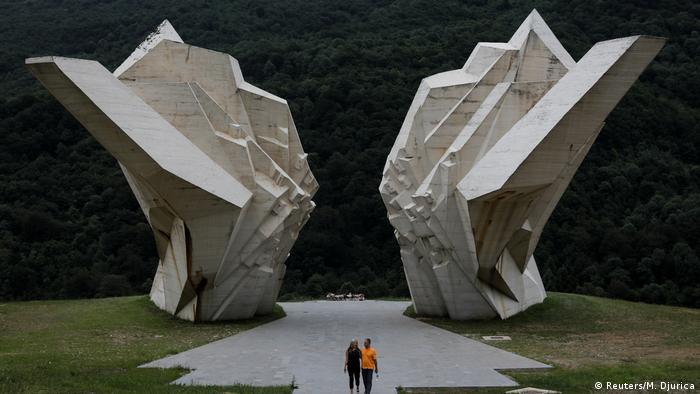
Bizarre memorial
This memorial built on the highest peak of the Petrova Gora mountain range in central Croatia is in danger of falling into disrepair. The monument to the uprising of the people of Kordun and Banija celebrates the resistance of the civilian population against the Nazi regime.
Industrial aesthetics
The New York Museum of Modern Art dedicated an exhibition to photographs to Brutalist architecture in 2018, in effect rehabilitating a style of building that many would rather see disappear. The Clinical Hospital Dubrava building in the Croatian capital Zagreb has decidedly industrial overtones. The clinic has a trauma center and functions as a teaching hospital.
War memorial
The concrete monument on the Sutjeska River in Bosnia and Herzegovina commemorates one of the bloodiest battles of the Second World War. Known as the Tjentiste memorial, it commemorates the killing of 7,000 members of the Yugoslav army by Nazis bombers in 1943. Like other Brutalist relics in the region, the memorial was in a state of disrepair until it was renovated in 2018.
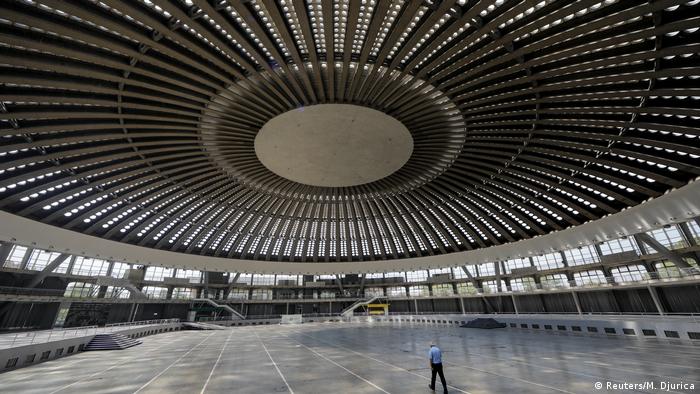
Huge cupola
Hall 1 of the Belgrade Fair grounds was opened to the public in 1957 — at the time, its dome was the largest in the world. It remains a testimony to the architectural adventurism of the postwar modernists, another massive Brutalist structure that has piqued the interest of Instagram users globally, with #brutalism offering fresh perspectives on these 20th century concrete monoliths.
Hundreds of Twitter employees on H-1B visas fear being deported if Elon Musk fires them
Ryan Hogg, BI Sun, November 6, 2022 Hundreds of Twitter employees on special visas could be deported after Elon Musk's job cuts.
He cut thousands of jobs with the mass layoffs equating to as much as half of the company workforce.
A Forbes report suggests nearly 700 Twitter employees were on H-1B employment-tied visas.
Elon Musk's cost-cutting plans may have left hundreds of Twitter employees on high-skill work visas on a countdown to deportation.
At least 250 Twitter workers appear to be employed on H-1B visas, according to official records, and now face an uncertain future.
And according to analysis of US Citizenship and Immigration Services data by the National Foundation for American Policy, that number could be as high as 670, or 8% of the company pre-cuts, Forbes reported.
Musk began culling the social-media giant's workforce on Thursday night, Insider reported, with access to work applications like Slack suddenly cut off for many now-former employees.
About half of Twitter's workforce, or about 3,700 people, are expected to have lost their jobs, per Insider. But for some of these workers, the consequences could be even more severe.
Companies give H-1B visas to people from other countries with "highly specialized knowledge" and a relevant bachelor's degree, per USCIS. They are intended to last for three years, but can go up to six.
If sponsored employment is lost, a migrant has 60 days to find a new job before facing deportation. The US allows 65,000 successful applications a year. Workers on H-1B visas are able to stay in the US if they can find new employment, according to "portability" rules.
Records suggest Immigration Services granted "continuing approval" for 242 visas earlier this year, suggesting hundreds of employment-conditional migrants were working at Twitter before Musk's layoffs.
Musk asked vice presidents to compile lists of employees deemed least worthy of staying as he endeavors to radically alter the way Twitter works. It is unclear what departments visa-tied Twitter employees work for, or how susceptible their positions are to layoffs.
According to immigration law, Musk must pay the "reasonable costs" of transportation of migrant workers whose employment has been terminated before the end of their authorized stays.
According to multiplereports, Musk himself was able to stay in the United States after finishing his college degree thanks to the H-1B visa. He previously reprimanded Donald Trump in 2017 for Trump's decision to suspend the special work visas.
Musk also faces a lawsuit from former employees for not giving adequate notice over mass layoffs, which may provide some from of respite for vulnerable workers. The billionaire has since tweeted that the company offered everyone who got laid off three months' worth of severance, though some staff have disputed his claim.
Twitter user @maybettl, who said they were laid off from the company this week, tweeted that some staff were offering to be laid off to save their colleagues on work visas. Insider wasn't able to verify this information.
Twitter didn't respond to Insider's request for comment on the number of employees on special work visas, or the number of those employees it had laid off.
Elon Musk is a ‘brutalist decision-maker’: Twitter employees are flooding Blind with bad reviews Jyoti Mann Sun, November 6, 2022 Twitter laid off nearly half of its workforce on Friday.Getty Images
Twitter employees are posting bad reviews about the company and Elon Musk on anonymous forum Blind.
One person called Musk a "brutalist decision-maker." Another said he has "no idea" what he's doing.
Posting on the day the layoffs were announced, one user said management was causing "stress."
Twitter employees are flooding the employee forum Blind with bad — and some good — reviews about the company and its new CEO, Elon Musk.
Insider trawled through the community app, where employees can anonymously write reviews and post about their workplaces, to see what Twitter staff are saying about the company.
Twitter laid off thousands of employees on Friday when Elon Musk completed his $44 billion takeover of the platform. After axing nearly half of the Twitter workforce, Musk tweeted on Friday that there was "no choice" as the company was losing more than $4 million a day.
Blind requires that users give their work email address, the company they work for, and their job title when they sign up. The site does not verify employment, but requests that people use their work email to "gauge the professional status" of users, Blind's website states.
Users have posted a total of 953 Twitter reviews to the site since 2020 and the company has an overall star rating of 3.8 out of 5 stars. Each poster adds a star rating to their review. Some of the reviews were posted the day some staff members learned of the mass layoffs the next morning, but the majority are from earlier.
One poster who described themself as an engineering manager said on Wednesday: "Brutalist decision-maker at the helm. Emergency driven work is exciting for those who like thrills. Pay is no longer tied to the stock market fluctuations."
The anonymous poster, who gave Twitter a two-star rating, added: "The absolute and swift destruction of a compassionate, human-first corporate culture is leaving Tweeps feeling like we've lost our family."
Another user, who posted the day the company sent staff a memo announcing layoffs, said it "was good until Elon take over."
The self-described senior software developer listed getting to "work for Elon" as a "pro" of working at the company, then put being treated as a "labor robot" on an accompanying list of "cons."
"Sense of achievement on delivering mission critical projects with 24/7 working and sleeping at office," the post said.
A software engineer said on November 2 that before the company was made private, it was an "incredible" place to work.
They added: "Elon mother flipping Musk and his ego the size of mars. Twitter is already chaos, but come layoffs Friday, it will a massive dumpster fire. The man has no idea what he's doing and I'd bet $8 Twitter won't be around or relevant in a couple years."
It is not possible to tell which of these posters, if any, had been laid off.
Another Blind user wrote on Thursday that the management changes are creating "stress" as a result of people being fired or quitting.
Twitter did not respond to Insider's request for comment.
Not just job cuts: Elon Musk eliminated Twitter's ‘Days of rest’ and work-from-home policies last week — pushing a '24/7' work culture hard.
Jing Pan Mon, November 7, 2022 Not just job cuts: Elon Musk eliminated Twitter's ‘Days of rest’ and work-from-home policies last week — pushing a '24/7' work culture hard. Here are 3 other investments the billionaire likes
If you are a Twitter employee who has a satisfying work-life balance, you may not want to hear what the new boss has to say.
Elon Musk has completed his acquisition of Twitter, despite saying that he overpaid for the company. And now, he’s finding ways to reduce expenditures at the social media giant.
The billionaire entrepreneur cut close to 3,700 jobs at Twitter, or half of the workforce, via email last week.
Musk has also removed Twitter’s “Days of rest” — monthly days off for employees to rest and recharge — in his push to implement a “24/7” work culture.
Additionally, Bloomberg reported that Musk plans to end the company’s remote work policy and ask remaining employees to return to the office full-time.
Who would want to join Twitter now? It's still hiring for more than 90 roles despite cutting thousands of jobs Jyoti Mann
Sun, November 6, 2022 Elon Musk now owns Twitter.Justin Sullivan/Getty Images
Twitter is still hiring to fill more than 90 roles despite laying off half of its workforce.
Twitter's careers page advertised 92 jobs a day after the mass layoffs.
Twitter posted seven roles on LinkedIn's jobs section a few days before Elon Musk took over.
Twitter is still hiring for more than 90 roles despite the company laying off half of its workforce on Friday.
Twitter's careers page listed at least 92 open roles on Saturday. More than a third of the positions are based at its headquarters in San Francisco.
Twitter first advertised seven roles, all of which are based in London, on LinkedIn two weeks ago. Six jobs are for software engineers, despite one London-based senior engineer being fired while he slept.
Elon Musk sent a memo to Twitter employees on Thursday telling staff they would find out if they were being laid off via email on Friday. Some employees learned their fate on Thursday night after being cut off from accessing their work emails and laptops.
The Tesla founder took control of Twitter last week after his $44 billion deal to buy the platform was complete. He immediately fired top executives including CEO Parag Agrawal, and Ned Segal, the chief financial officer.
Musk later floated new ideas for the company, including charging users $8 to gain a "verified" status along with seeing fewer ads.
A growing chorus of companies including Pfizer, General Motors, and Volkswagen have since paused ads on Twitter amid concerns over the platform's approach to content moderation.
Musk told some of the leading advertisers on the platform in a call that Twitter will have varying tiers of how it would moderate content, likening it to age ratings for films, The Financial Times reported.
Musk then tweeted Friday that Twitter's "strong commitment" to moderating content remained "absolutely unchanged." He also said in another tweet that he had "no choice" but to make mass layoffs because the company was losing $4 million a day.
He said: "Everyone exited was offered 3 months of severance, which is 50% more than legally required." Some Twitter staff have disputed that claim.
Twitter didn't respond to Insider's request for comment.
Elon Musk wants to nickel-and-dime Twitter users for features that were once free just 7 months after saying he 'didn't care about the economics'
Samantha Delouya
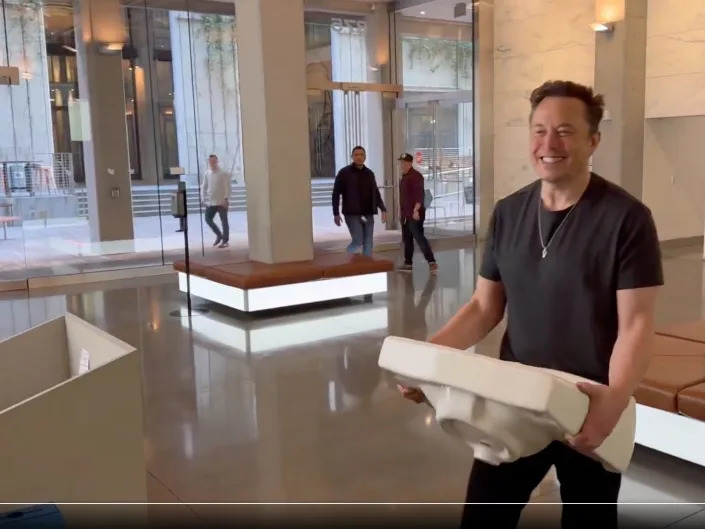
Elon Musk carrying a sink into Twitter's headquarters in San FranciscoElon Musk/Twitter
Elon Musk is haphazardly suggesting ways to "pay the bills" at Twitter as debt interest payments soon come due.
His approach is starkly different than when he said he "didn't care about the economics" of buying it in April.
Musk has reportedly suggested paid direct messages and "paywalled" videos to advisors as ways to make Twitter more money.
Not long after Elon Musk offered to buy Twitter for $44 billion in April, he said he "didn't care about the economics at all" of the purchase.
"This is just my strong, intuitive sense that having a public platform that is maximally trusted and broadly inclusive is extremely important to the future of civilization," Musk said at the TED2022 conference.
Seven months later, the world's richest man seems to have changed his tune, haphazardly suggesting ideas to his advisors, and even his Twitter followers, in an attempt to make the platform profitable.
Earlier this week, Musk announced that Twitter would begin charging $8 per month for its "blue check" verification program, which was previously free to those who qualified.
"We need to pay the bills somehow!" Musk wrote in a tweet responding to complaints about the fee.
But that's not the only idea Musk has in mind to squeeze cash out of his new company. The New York Times reports that Musk and his advisers have weighed adding a service that would allow users to send direct messages to high-profile users for a fee and "paywalled" videos.
Musk has also considered charging for user analytics and reviving the short-form video platform, Vine, according to his interactions with followers on Twitter.
The rushed attempts to drum up new revenue streams at Twitter are at odds with how Musk spoke about the purchase of the social media platform last spring when he extolled the platform's virtue as a "de facto town square" and compared the Twitter deal to Jeff Bezos' purchase of The Washington Post.
Now, Musk has Twitter employees working 24/7, trying to find a way to make to eke out money from the platform as Twitter will eventually be expected to pay massive interest payments. Musk borrowed $13 billion from banks to partially fund the deal, and the company will have to pay $1 billion in annual interest as a result. Twitter's entire cash flow last year totaled less than $1 billion, according to the Times.
Charging for previously free services isn't the only way Musk has tried to save the company money. On Thursday night and Friday morning, large swaths of Twitter's staff learned they had been laid off, either via email or by simply losing access to their Slack and email accounts.
Tuesday, February 25, 2025
Q&A: How AI is changing the film industry
‘AI is Soulless’: Hollywood Film Workers Strike and Emerging Perceptions of Generative Cinema
In 2023, a good portion of Hollywood went on strike — in part over concerns about artificial intelligence in filmmaking. Now the use of AI has roiled this year’s Academy Awards: Several of the best picture nominees used AI in production. “The Brutalist” showed AI generated architecture blueprints in a scene and its editor used a program called Respeecher to hone actors’ Hungarian pronunciations. “Emelia Peréz” used Respeecher to adjust an actor’s singing voice.
Brett Halperin, a University of Washington doctoral student in human centered design and engineering, interviewed picketing film workers about AI during the 2023 strikes. Their concerns ranged from AI’s effects on wages and jobs to the inauthenticity of the resulting art.
Halperin published the findings Feb. 6 in ACM Transactions on Computer-Human Interaction.
UW News spoke with Halperin about how film workers are thinking about AI and the history of technology in filmmaking.
The striking film workers you spoke with raised various concerns about the use of AI in filmmaking. Were you surprised to see some consternation around the Oscars this year?
Brett Halperin: We have seen backlash to AI from workers and the general public manifest in multiple ways over the past few years — from striking to protesting screenings. Many filmmakers have valid concerns about how studio use of AI can undermine their craft and labor. Meanwhile, many writers and artists object to how their materials are scraped and co-opted as training data for machine learning models without their consent or compensation. This makes AI particularly thorny and controversial. But it’s also important to situate this backlash in the broader historical context.
Throughout history, the “death of cinema” trope has resurfaced with each major technological shift. For example, the use of synchronized sound systems starting in 1926 rendered many silent-era acting techniques, production methods and even professions obsolete. While this caused massive disruption, it ultimately created new professions, such as sound specialists, and transformed rather than eradicated cinema. The rise of color, television, digital media and so on follow similar trajectories. AI presents another iteration of this trope that continues to reflect the shifting cultural and industrial anxieties about technological agency. Part of what makes cinema unique relative to other art forms is that it has always depended on complex, evolving technologies. This change is unsettling, but also an opportunity for all of us, including the Academy, to reevaluate what makes film meaningful.
The Academy is reportedly considering making AI disclosure mandatory for the 2026 Oscars. Do you see value in this?
BH: Generally, I think as much transparency as possible is a good thing. But as AI further integrates into production processes and workflows, excessive mandates could become unreasonably cumbersome and difficult to track.SoI would first start by asking: What do we mean by AI? Computer-generated imagery and its associated algorithms have been in the Hollywood studio system since the 1970s. At what point did CGI and other algorithmic tools become rebranded as AI?
In my view, regulation should focus on where AI use has the potential to undermine workers and manipulate viewers. For example, AI actors and de-aging techniques might further intensify body image issues among the public, as well as take work away from actual actors. Disclosure would help the Academy and spectators understand what they are seeing to not only assess the ethics, but also better judge and criticize films in general.
The uses of AI in “The Brutalist” and “Emelia Peréz” are relatively minor. What were workers’ feelings about AI tools as instruments to assist their work, rather than replace it?
BH: The workers did not oppose AI altogether. They seemed to recognize that technological change is an ongoing part of cinema and expressed degrees of openness to the creative possibilities. They acknowledged that there are potentially useful applications insofar as the decision-making power and control over AI lies with them rather than studio executives forcing its integration.
That said, the workers seemed to find current AI-assisted capabilities to be rather unimaginative and unequipped to augment (or replace) their work. For example, a writer who tried to use it to assist him described the written outputs as “hacky” and “generic.” Many of the workers made compelling cases for why AI cannot take over the tasks that truly define filmmaking, such as fostering authentic human connection on and off screen and telling stories that matter to people.
What were your major takeaways from talking with the film workers? Have those changed at all as the technology has evolved in the last year and a half?
BH: Despite being around for decades now in various forms, so-called AI today is exhibiting a “novelty effect,” which is currently exploitable, but bound to fade. As AI further integrates and becomes more deeply embedded into cinema like prior technologies, I suspect that the anxiety around it will simmer down.
Rather than fuel the hype cycle, we should remain patient and vigilant in working toward ethical implementations and protections, because AI can incur harms today that require protections for workers and viewers. While Hollywood unions have won protections through collective bargaining agreements, they will need to be continuously updated as the technology develops, as well as extended to non-unionized workers and workers in other media industries through state and federal policies. I would especially like to see policies that establish informed consent and compensation for artists whose materials are used as AI training data.
What should the public know and consider about AI in filmmaking?
BH: It’s ultimately up to those of us watching movies to decide what we like and don’t like about AI in cinema. We have the power of our attention and wallets to decide what films we want to support. At the end of the day, the Hollywood studio system will invest in what is profitable and divest from what is not. We should listen to the workers for guidance and watch films that align with our values. Despite the current anxiety around AI and the lure of its spectacle today, the public should remember what makes a film truly valuable: the human hearts and souls behind it.
Daniela K. Rosner, a UW professor of human centered design and engineering, is the co-author on the journal article. This research was funded by the Labor Research and Action Network and the National Science Foundation.
For more information, contact Halperin at bhalp@uw.edu.
‘AI is Soulless’: Hollywood Film Workers Strike and Emerging Perceptions of Generative Cinema
Monday, June 14, 2021
Gottfried Boehm, architect of concrete churches, dies at 101 BERLIN (AP) — German architect Gottfried Boehm, who was famous for his concrete brutalist-style church buildings, has died at 101.
Boehm's Cologne architecture office on Thursday confirmed his death on Wednesday night but didn't give a cause.
Boehm, who was born in Offenbach in central Germany in 1920, built more than 50 churches, many of them in his signature concrete style. He was one of the most famous postwar architects in the country and in 1986 became the first German to receive the renowned Pritzker Architecture Prize.
One of his most best-known sacral buildings is the Catholic pilgrimage church Mary, Queen of Peace, in Neviges near the western city of Duesseldorf. Built in the brutalist style and consecrated in 1968, the church became famous for its irregular roof and forum-like interior.
Boehm also created other buildings such as the city hall of Bensberg near Cologne, a glass-and-steel fronted theater in Potsdam, and a pyramid-shaped public library in Ulm.
The governor of North Rhine-Westphalia state, Armin Laschet, praised Boehm for his work.
“His unique architecture style made him world-famous,” Laschet said adding that Boehm leaves behind a “visible and impressive lifework.”
The Associated Press
Thursday, March 16, 2023
THE FIRST MASONS Like it or not, building in Italy means mastering concrete
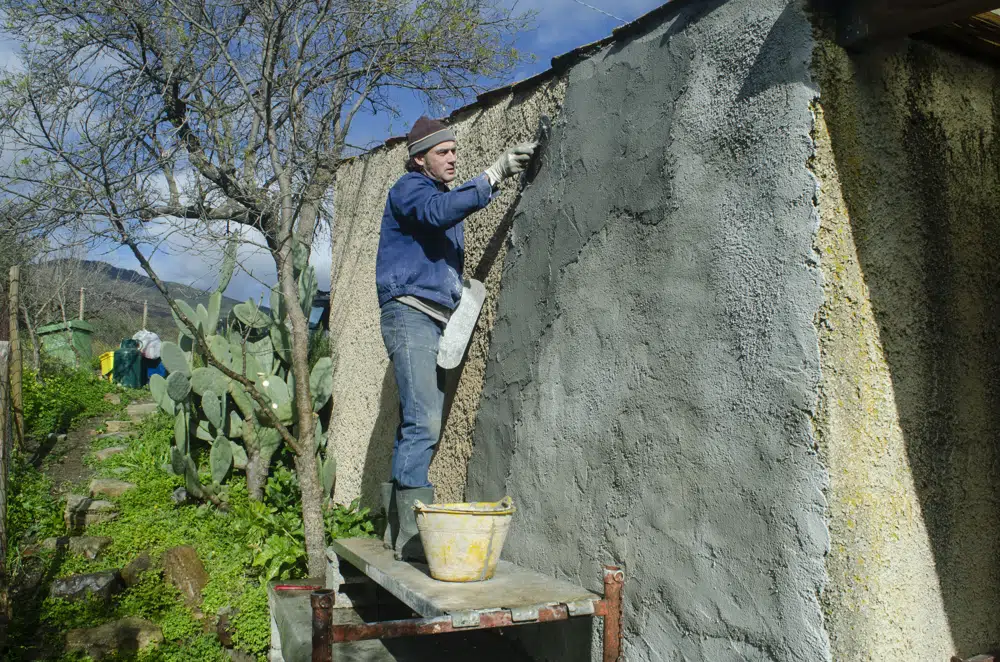
By CAIN BURDEAU This image provided by Audrey Rodeman shows Cain Burdeau covering a wall of a small concrete house where he lives with his family outside Castelbuono, Sicily, Italy, in a coat of concrete plaster. Burdeau had to become familiar with masonry to build in Italy, a land where laborers have long excelled with trowels, chisels, mortar mixes, stones and bricks. (Audrey Rodeman via AP)
CONTRADA PETRARO, Sicily (AP) — Everywhere you look in Italy, it’s there: It can be hulking and gray but also colorful and fun. Ominous but also beautiful.
Masonry using concrete and its old ingredient, cement, are inescapable here. It’s a crucial difference between construction in North America and in Europe: the carpenter versus the stone worker.
That was the difficult reality I faced when I moved from the U.S. with my family into a long-abandoned farm property 3 kilometers (a couple of miles) outside a town called Castelbuono in the Madonie Mountains in north-central Sicily.
I had a whole bunch of ugly and crumbling concrete to deal with. Or that’s how I saw it at first.
Coming from a background in American carpentry, the art of masonry was entirely new to me. But here, in a land where laborers have long excelled with trowels, chisels, mortar mixes, stones and bricks, I realized I’d have to become familiar with them too.
Masonry is especially legendary in Italy, home to many of the world’s most spectacular examples of stone and mortar work. The country also boasts the largest un-reinforced concrete dome still in existence: the Pantheon of ancient Rome.
As I began experimenting with concrete work and got a little better at it, I also came to appreciate more all those concrete buildings around me in Sicily — from the ancient beauties to the clunkier, Brutalist-style versions that went up in a post-World War II building boom.
The farm’s main part consists of two barns: an old stone structure, and a newer, tower-like one made of concrete blocks. Nearly five years went by before I finally attempted to turn the barns into a house.
During those years, my family had been living comfortably in a tiny modern home, also built in concrete blocks, a few yards from the barns where the farmer who built this place kept animals and tools, and made wine and olive oil. The 430-square-foot home – with a flushing toilet, lights, shower, windows, veranda and tiled floors – was the reason we’d bought the property.
The hulking barns, though, remained always at the back of my mind, holding the potential to be transformed into a bigger, more beautiful house.
Finally, one day I picked up a borrowed, hand-held jackhammer and started busting into the work.
My first objective was to remove a concrete-and-stone bench sitting against a sagging wall of the old barn. After a few weeks of work, I’d burnt through my friend’s jackhammer and a cheap new one.
It was hard going. Hand chisels were more apt to bounce off than accomplish any demolition. Normal drills were absolutely useless. The hours accumulated, along with a pile of busted concrete bits, stones of many sizes, lots of sand and cement, steel rods, broken bricks, pebbles.
My back was sore. I was exasperated. I looked up and sighed at the thought of what still awaited:
One side of the two-story barn was bereft of even a coat of plaster, and bats flew in and out of its gaping cracks. A big concrete trough was pulling away from the wall of the main barn. Inside the barns, the walls had no electrical outlets. Water lines and windows were scarce. The floors needed to be layered in new concrete.
And maybe worst of all, concrete beams throughout the structure were showing cracks.
Overwhelmed, I went back to jackhammering, chiseling, cutting steel re-bar, piling up rubble, cutting electrical lines into the concrete walls and, eventually, even beginning to plaster.
“Rome wasn’t built in a day, I suppose,” I bolstered myself.
In town, a friend and marble worker tried to teach me the mysteries of Italian construction, running his hand over a massive stone and mortar edifice.
“Look at this ancient place’s walls; look at how thick these walls are,” said Antonio Capuana, admiration in his voice. “These are load-bearing walls that keep up the entire house. This wall was part of a barn for an old monastery.”
Back then, he said, cement didn’t exist. The builders used stone and cocciopesto — a clay mixed with lime — to make huge structures.
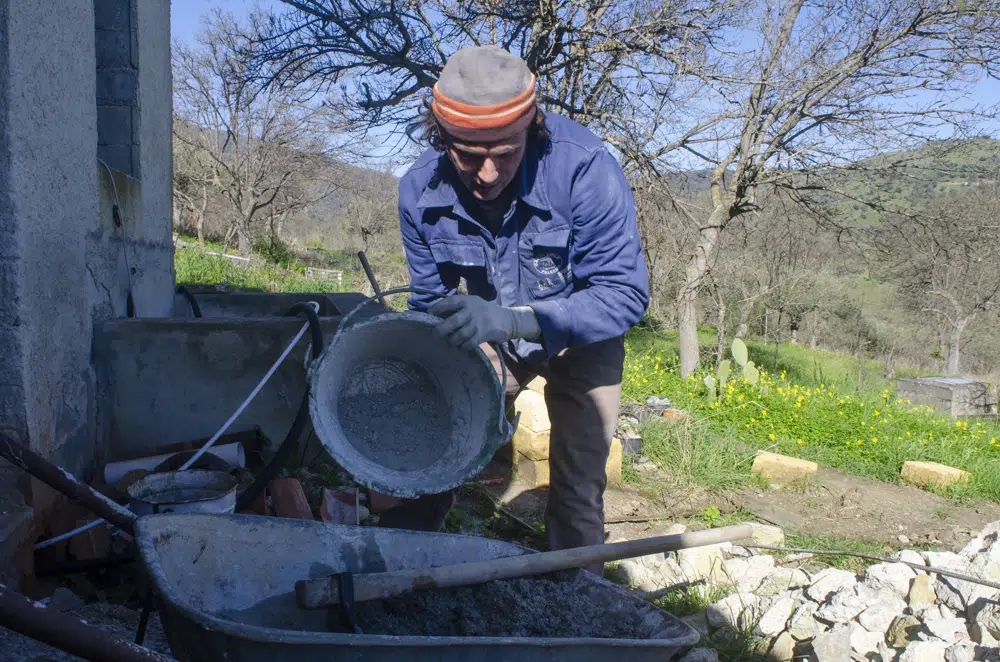
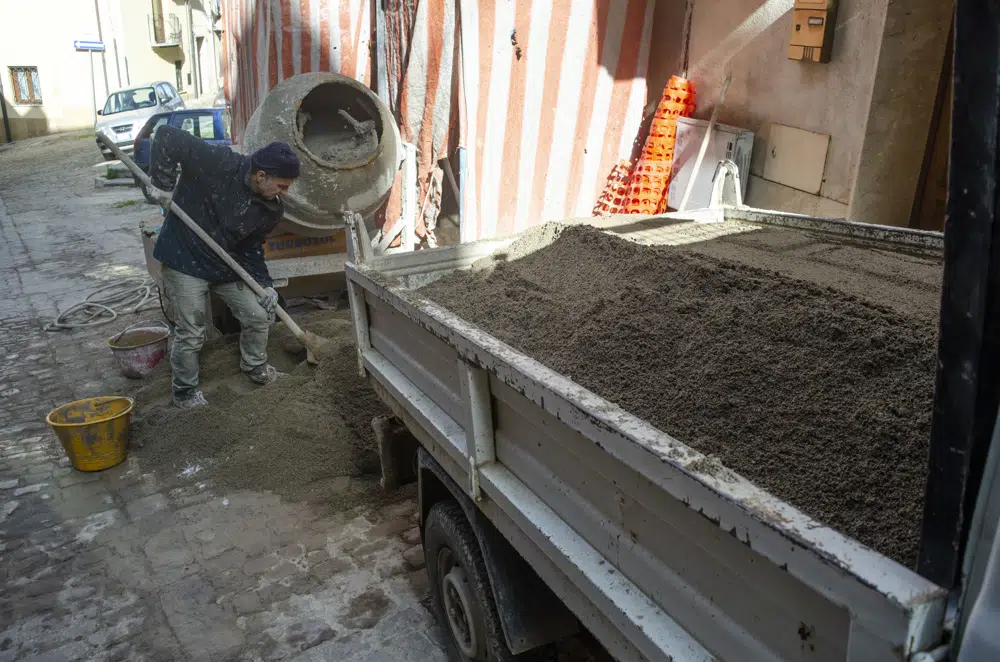
This image provided by Cain Burdeau shows a construction worker mixing concrete on a street in Castelbuono, Sicily, Italy. In Italy, masonry using concrete is an inescapable aspect of construction and a crucial difference between home building in North America and in Europe. (Cain Burdeau via AP)
Widespread use of modern concrete and cement arrived in Sicily in the early 1900s and boomed after World War II, as it did in much of the world.
“Cement changed the world,” Nicolo Pierlucio Raimondo, an architect in Castelbuono, told me.
The art of mortar-making goes back to the ancient Romans and Arabs, he said. They experimented with the binding qualities of pozzolans, naturally occurring cements such as volcanic ash and gypsum. The invention of Portland cement in the 1820s, and its mass adoption in the early 1900s, was another game changer.
“Think about how much bigger cities have gotten in these last 100 years. Cement had a big part in this,” the architect said. “It helped speed up construction.”
But he added a cautionary note: “How long will these concrete structures last? No one knows.”
Capuana, the marble worker, pointed across the street to a row of concrete homes built in the 1960s and ’70s.
“Look at the overhangs on all those buildings,” he said. “They were made with steel and concrete. Over time, we’ve had to rebuild them all.”
By contrast, experts are still trying to understand the secret to the longevity of the ancient Romans’ concrete.
Modern concrete’s biggest weakness is water seeping through its tiny pores, a major factor in hairline cracks. Once water penetrates and rusts the steel used to reinforce concrete, a cracking process known as spalling worsens.
Gioacchino Allegra, a master builder overseeing the remodeling of a concrete home on the outskirts of Castelbuono, said today’s concrete is more compact than that of the building boom of the 1960s, which reduces spalling.
I also reached out to the International Masonry Institute for guidance.
Amy Lamb Woods, a concrete expert and preservationist there, said the post-World War II boom in concrete construction — the Brutalist stuff — was made possible by the advent of better kilns in the early 1900s.
On the down side, concrete became associated with urban decay. On the plus side, its use helped create so much modern infrastructure, from highways to hospitals.
“There’s this onslaught of: ‘Oh, it’s concrete, it’s ugly,’ and they want to tear them down,” Woods said. “All of us preservation people are advocating for their preservation because we believe these buildings are iconic, breathtaking, especially when they’re maintained well.”
In the U.S., that debate has intensified because concrete structures older than 50 years are now eligible for landmark status.
Also, because concrete is now recognized as causing some 8 percent of all carbon dioxide emissions, most of that from cooking that cement in those kilns.
Yet as Woods noted, “The most green building you can build is the one that you restore and preserve. You’re in essence keeping the building. And so, you’re not putting it into a landfill, and you’re continuing its use.”
Listening to her made me feel so much better about the potential in my towering and downright ugly concrete barn, and about all the concrete work waiting to be done.
——
The ancient lowly; a history of the ancient working people from the earliest known period to the adoption of Christianity by Constantine
Ukraine’s Trade Unions Face Russian Invasion and Homegrown Attacks on Labor Rights
In Ukraine, organized labor has rallied behind the resistance against Russia’s invasion. But rather than reward its contribution, the government is using the war to push through anti-labor measures, posing a long-term threat to workers’ right to organize.
Train driver Oleksandr Skyba heads a local chapter of the Independent Railroad Workers’ Union. (Photo: Volodya Vagner)
When airport worker Andrey Chuba signed up for service in the Ukrainian military, it was partly to get away from another conflict. The year was 2020, when the war with Russian proxy forces was low-intensity and confined to the country’s eastern Donbas region. But at Boryspil International Airport, outside of Kyiv, conflict was brewing between management and workers. Chuba, a security guard, had been part of a wildcat organizing effort against unpopular changes to shift schedules, and was facing reprisals from his employer. Left hanging by local union leaders, who Chuba says were in the bosses’ pocket, he felt that a three-year army contract was a decent way out. Legislation guaranteed that, in addition to his military wage, he would continue receiving his civilian pay. But that was a lifetime ago.
When we met near Kyiv’s Independence Square this past December, the city was covered in gray slush, and the threat of Russian aerial attacks had become a part of daily life. Many Kyivites have developed an ear to distinguish the booms of Ukrainian air defense from enemy hits. When kept awake at night by the howling of Vladimir Putin’s Iranian-made drones, colloquially called “mopeds,” they know their colleagues will be just as sleepy the next day.
The airport where Chuba used to work has been mothballed, pending a peace that feels more remote with each month that passes. While his military contract has been extended until further notice, legislative amendments passed since the full-scale invasion have stripped him of the civilian part of his wage. “I’m not the only one,” he tells me. “Lots of people in service are in the same situation.”
Chuba is currently fighting the wage cut in court, arguing that legal amendments cannot be applied retroactively, like in his case. Although he admits the airport is currently strapped for cash, he doesn’t see it is a valid argument to deny him his pay. It recently emerged, he points out, that its CEO earned the equivalent of about $50,000 in the first half of 2023. Chuba’s story is one of many, illustrating a concerning trend.
While Ukrainian soldiers are defending their country at the front, Ukrainian workers have seen an attack from the rear, targeting their livelihoods, rights, and representatives. Since spring 2022, Ukraine’s parliament, which is dominated by president Volodymyr Zelenskyy’s Servant of the People party, has passed a series of amendments and reforms which have cut social benefits, deregulated labor relations, and restricted the power of trade unions.
Among other things, firing employees has been made easier, zero-hour contracts have been legalized, and private companies with fewer than 250 employees have been permitted to sign individual contracts with workers, rather than adhere to collective agreements or the country’s labor code. MP Halyna Tretyakova, head of the parliament’s social policy committee, has been spearheading Ukraine’s neoliberal reform course. According to her, the country’s labor law, originating in the 1970s, is an outmoded Soviet holdover.
Parliament has also decided to merge the country’s social insurance fund (managed jointly by the state, employers, and unions) with the state pension fund. Critics say the merger reduces union oversight, jeopardizes benefits like parental and sickness pay, and primarily benefits the insurance industry. Indeed, Tretyakova, herself a former insurance executive, has dismissed concerns over benefit reductions, suggesting the private sector can fill any gaps.
Confederation of Free Trade Unions of Ukraine (KVPU) activists Petro Tulei and Olesia Bryazgunova. (Volodya Vagner)
Russia’s invasion has undoubtedly plunged the Ukrainian economy into a deep crisis. Yet, reformers’ claims that their agenda is necessitated by the stresses of war seem dubious, given that similar proposals had already been launched in 2019, before Putin’s all-out war. At the time, unions put up stiff resistance, and the bill was withdrawn. With martial law in effect, however, protests and strikes are now banned. This time, unions only succeeded in lobbying for some of the latest reforms to be limited to wartime. But with the war dragging on, even these temporary laws risk becoming the new normal. Moreover, it appears that the governing party wants to go further yet and break the labor movement permanently.
Diplomatic Endeavors
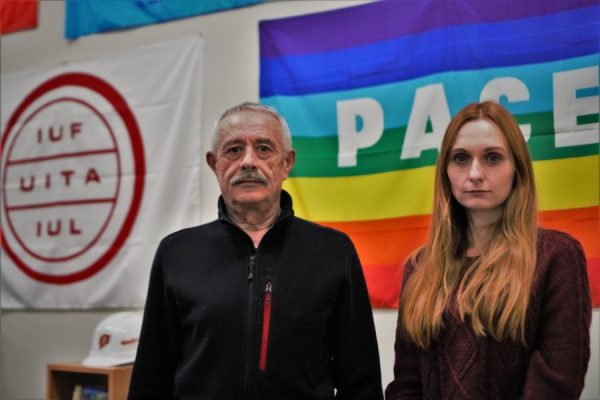
The world of Ukrainian trade unions is complex and contradictory, and the answer to how grave the situation is depends on which representatives you ask. When Jacobin visited the Confederation of Free Trade Unions of Ukraine (KVPU), one of the country’s two main union centers, its vice chairperson, Petro Tulei, and international secretary, Olesia Bryazgunova, struck a diplomatic tone. To them, the essential thing is the long-term perspective. “What’s important now, is to achieve peace and security, by defeating the Russian aggressor. After that, the democratic process will resume its normal course,” says Tulei. He emphasizes that, through behind-the-scenes dialog, unions did have some positive influence on the recent legal changes.
The KVPU emerged out of the great Donbas miners’ strikes during late-Soviet Perestroika, and is associated with the Ukrainian independence movement. Its chair, Mykhailo Volynets, is an MP for Yulia Tymoshenko’s oppositional Fatherland party, and has been one of the most vocal parliamentary critics of the recent reforms. The walls at KVPU headquarters are adorned with pictures of him shaking hands with Western leaders like Joe Biden.
According to KVPU deputy head Tulei, the neoliberal technocrats who legitimize their agenda by citing Ukraine’s ambitions of joining the European Union have a poor understanding of the European social model. He is proud that his organization actively participated in the 2014 revolution, which put Ukraine on its European path, and views EU integration as a promise of a more social Ukraine to come. “The European Commission has already reminded our lawmakers that Ukrainian labor law must be in line with EU standards,” he says.
Bryazgunova’s assessment is similarly colored by geopolitical considerations: “I get pissed off when our domestic shortcomings, like these reforms, are used abroad as arguments against financial and military aid to Ukraine,” the KVPU international secretary says bluntly. “This is a dangerous line of reasoning. Why should we have to die, just because we have some liberal madmen here?” Rather than criticize Ukraine, she asks fellow labor activists abroad to stand up for Ukrainian refugees and to lobby for socially just reconstruction programs for the war-ravaged country.
But not all Ukrainian labor activists are content to keep quiet until the war is over. “For bosses and top officials, the war has become a source of enrichment and a way to encroach on socioeconomic rights,” complains Oleksandr Skyba, a train driver with the state railway company. At the Kyiv freight depot, where he is based, he heads the local chapter of the Independent Railroad Workers’ Union, which is part of KVPU. According to him, Ukrainian companies do not suffer from their workers enjoying excessively good conditions. “On the contrary, a socially secure worker is a productive and patriotic worker,” he says. The policies being implemented, Skyba believes, instead risk undermining the population’s morale.
He rejects the reformers’ rhetoric about needing to cleanse the country’s social sector of its Soviet legacy. “Our legislation has been updated many times since then. And regardless — what about our tanks and artillery at the front, didn’t we inherit them from the Soviet era? And the buildings where our parliament and president work? If we’re just going to raze everything Soviet, let them sit in tents instead!”
According to him, the anti-worker sentiment now being promoted under the cover of war primarily benefits dishonest actors. He cites his own workplace as an example. Since the railways are considered critical infrastructure, a certain quota of its workers may be exempted from the military draft. But when management compiles the lists of who is to be deferred, sometimes they “forget” inconvenient employees — like Skyba himself. “I got a six-month exemption in August, but in September I was suddenly told I was no longer on the list. And there are similar stories from colleagues in Dnipro and Zaporizhzhia,” he says.
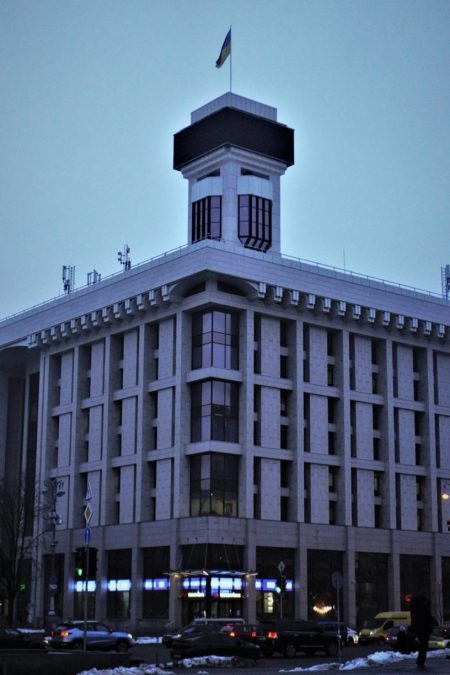
Skyba is not the only labor leader with reason for personal concern. “I wouldn’t be surprised if my office was bugged,” says Natalia Zemlianska. She heads the Ukrainian Union of Manufacturers, Small Business Owners, and Migrant Workers, which unites around five thousand members. Sitting behind her desk on the sixth floor of the House of Unions, her window faces onto Kyiv’s Independence Square, ground zero for Ukraine’s 2014 revolution. The imposing brutalist edifice belongs to the country’s largest labor union center, the Federation of Trade Unions of Ukraine (FPU), of which Zemlianska’s organization is a member.
The Federation of Trade Unions of Ukraine owns Kyiv’s brutalist House of Unions. (Volodya Vagner)
The FPU is heir to the Soviet-era trade union federation. As confrontational labor organizing did not fit into the ruling Communist Party’s image of its workers’ paradise, the FPU’s predecessor was politically toothless. Its main task was providing sanatoriums and holiday resorts for members, rather than aiding them in workplace struggles, and critical labor activists say much of today’s FPU is still stuck in those habits. To this day, the FPU owns significant real estate, and it has been criticized for prioritizing its own commercial interests over representing workers. Whatever its deficiencies, the FPU is also home to many dedicated organizers, defending the interests of its members. And since the authorities have taken aim at the labor movement in general, and the FPU in particular, they are feeling increasingly threatened.
“We are under enormous pressure right now,” says Zemlianska. “FPU deputy head Volodymyr Sayenko was arrested in December 2022, and even though the investigation against him has been concluded, he is still being held.” Sayenko’s bail has been set at a whopping 124 million hryvnia, roughly $3 million. Several other FPU representatives, including Zemlianska, have had their homes raided by police. The investigation revolves around suspicions of embezzlement of FPU real estate.
Claims of Wrongdoing
Allegations of corruption and state attempts to seize FPU property have been a recurring theme stretching back through several previous governments. Given that the fight against corruption, an endemic issue in Ukraine, is broadly considered an apolitical, commonsense imperative, such allegations also serve to legitimize whatever political vendetta anyone might pursue. As part of the current investigation, stewardship of several FPU properties, including the House of Unions, was recently transferred to Ukraine’s Asset Recovery and Management Agency, ARMA.
Zemlianska won’t comment on the details of the case currently being made against Sayenko, but stresses that the authorities’ behavior contradicts the principles of rule of law and fails to honor international conventions protecting labor leaders from harassment. To her, the authorities’ anti-corruption rhetoric rings hollow.
One official who, in her view, personifies the authorities’ hypocrisy on the matter is Olena Duma, head of ARMA. Transparency International Ukraine has called her appointment a “significant danger” to the functioning of the agency, citing her political ties and lack of relevant experience. Since last summer, Duma also presides over an entity called the Trade Union Confederation of Ukraine. It is no accident that its title is confusingly similar to that of Ukraine’s two existing labor union centers, the KVPU and the FPU.
Zemlianska and several other labor leaders Jacobin has spoken to describe Duma’s organization as a pseudo-union, set up to undermine the country’s genuine labor movement. “ARMA already has the power to evict us from our offices at any time. This fiction of a union is but another instrument in this raiding. By transferring our real estate to it, the whole thing can be presented to the public as some kind of reshuffling within the union movement,” Zemlianska explains.
Internal documents recently obtained by OpenDemocracy suggest Duma’s astroturf union is part of a larger scheme, launched behind the scenes by MPs of the ruling party, including social policy chief Tretyakova, to set up an entire new union structure that would be friendly to the government and its reform program. To FPU representative Zemlianska, what’s tragic about this approach to dealing with labor is that it is reminiscent of the political culture Ukraine is struggling to leave behind.
“On the one hand we are forced to fight Russia’s aggression, to avoid living like in Russia, where unionists are put behind bars, but at the same time, we see the same tendencies here. Come on! Ten years ago, people gave their lives out there,” she exclaims, gesticulating to the square outside her window. “But now it feels like everything has been forgotten, and we’re starting over again! How is that possible?”
As Ukraine’s governing party seems set on combating the country’s labor movement, workers like airport guard Andrey Chuba are facing a murky future. Has he lost faith in his country? “We must believe in victory,” he says defiantly. “There is no damn alternative.”